11.1 Sequences & Summation Notation
                         Day Two


John 14:15 "If you love me, you will keep my commandments."
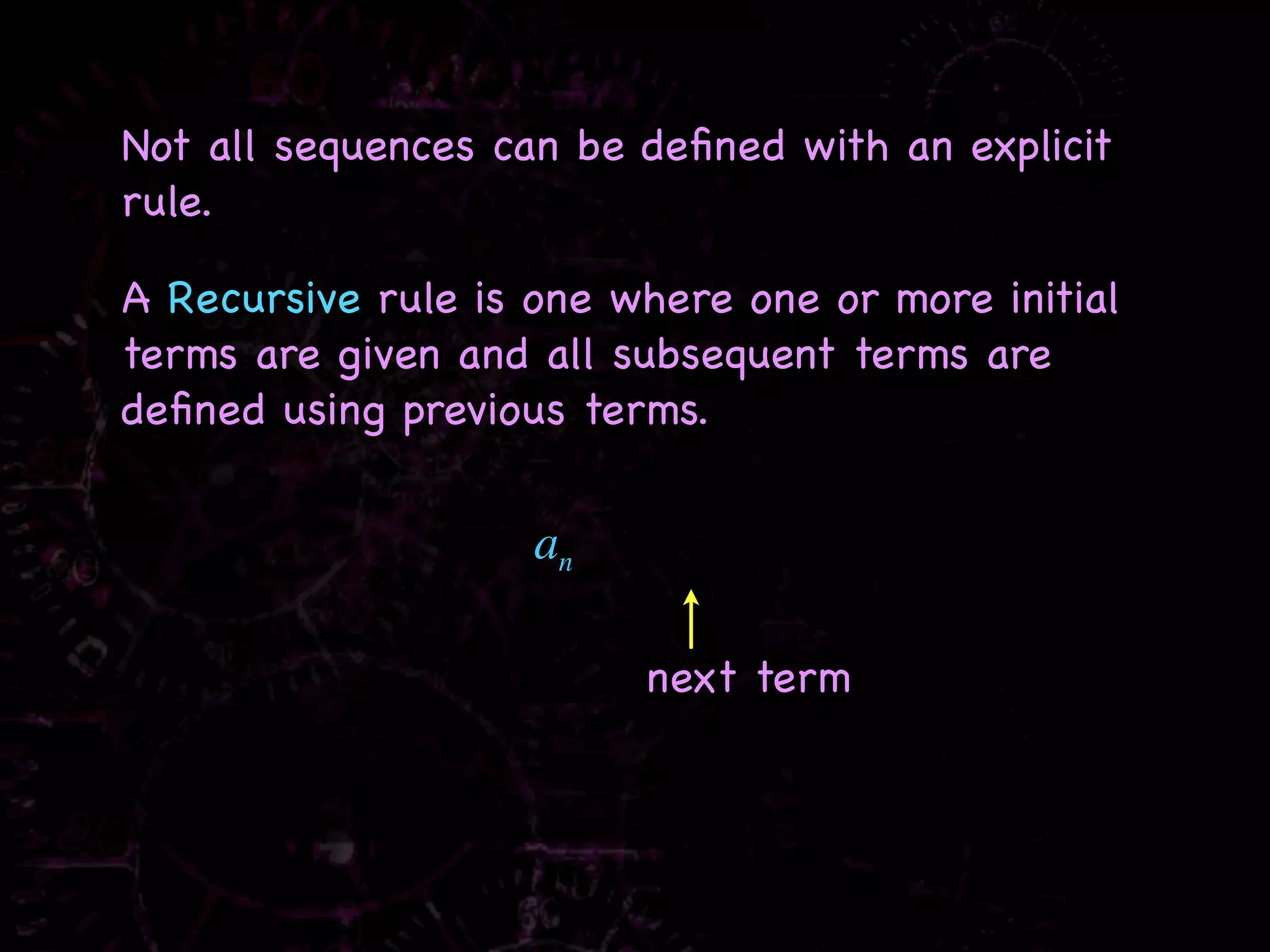
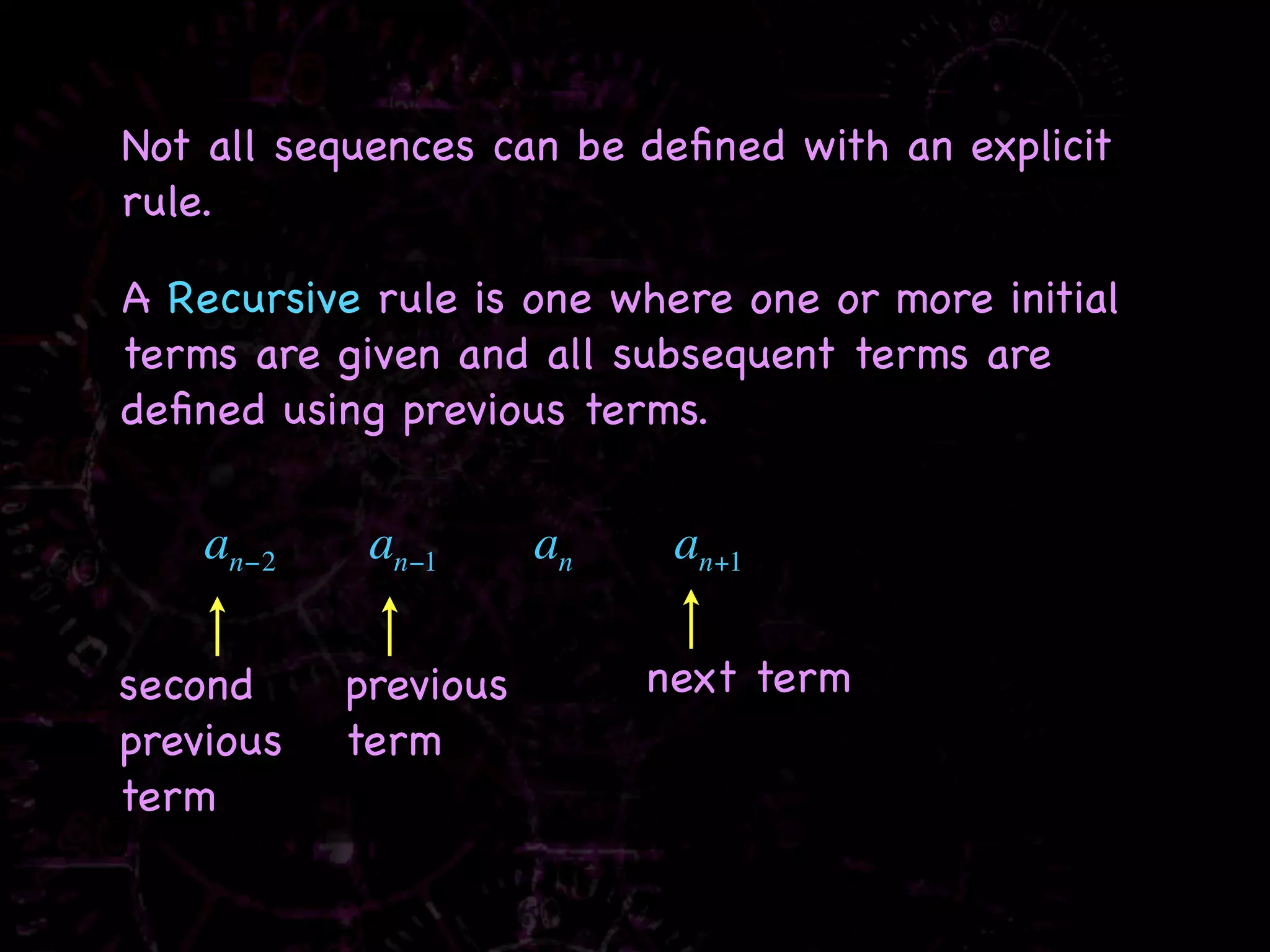
Not all sequences can be defined with an explicit
rule.
Not all sequences can be defined with an explicit
rule.

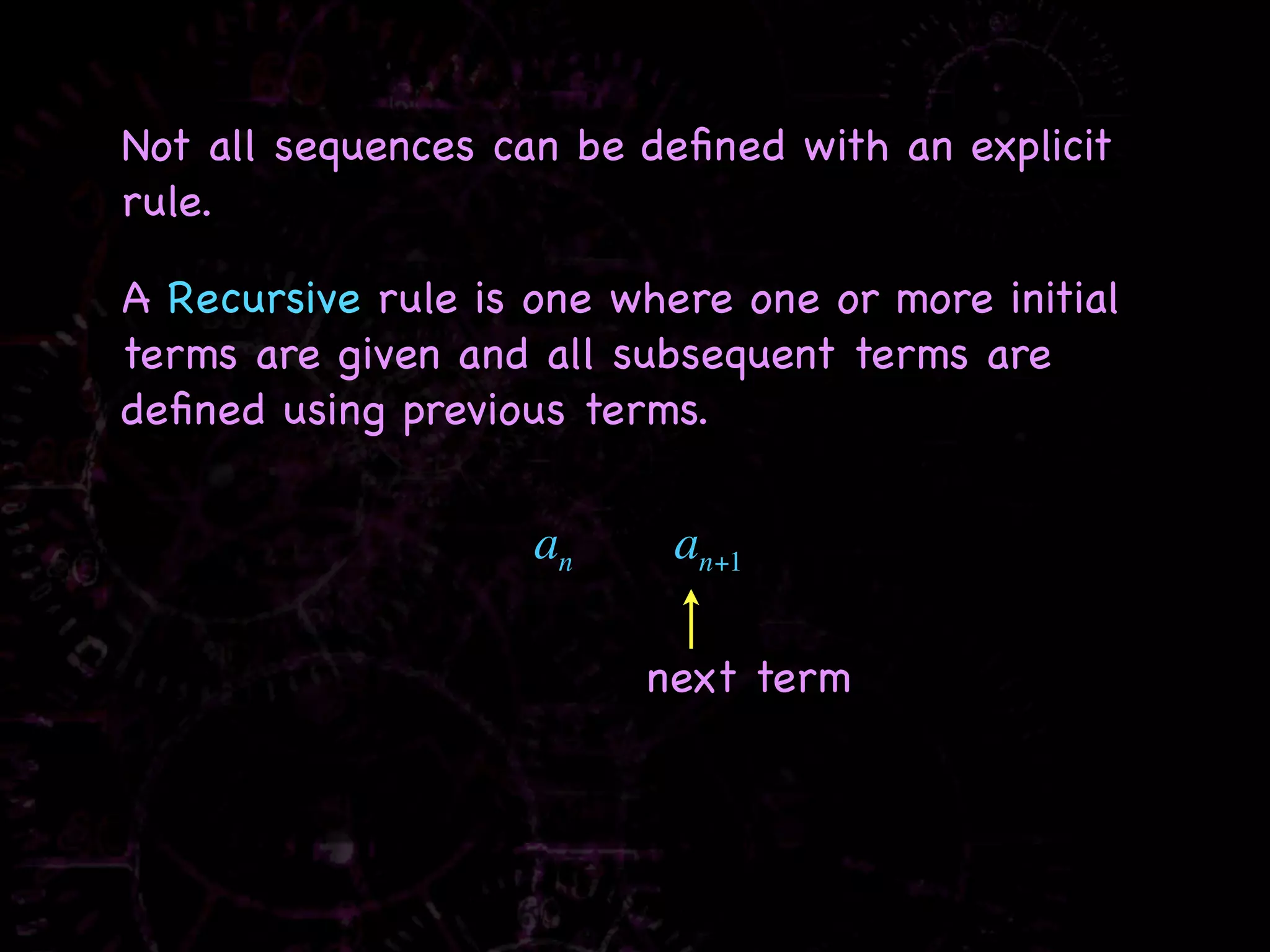
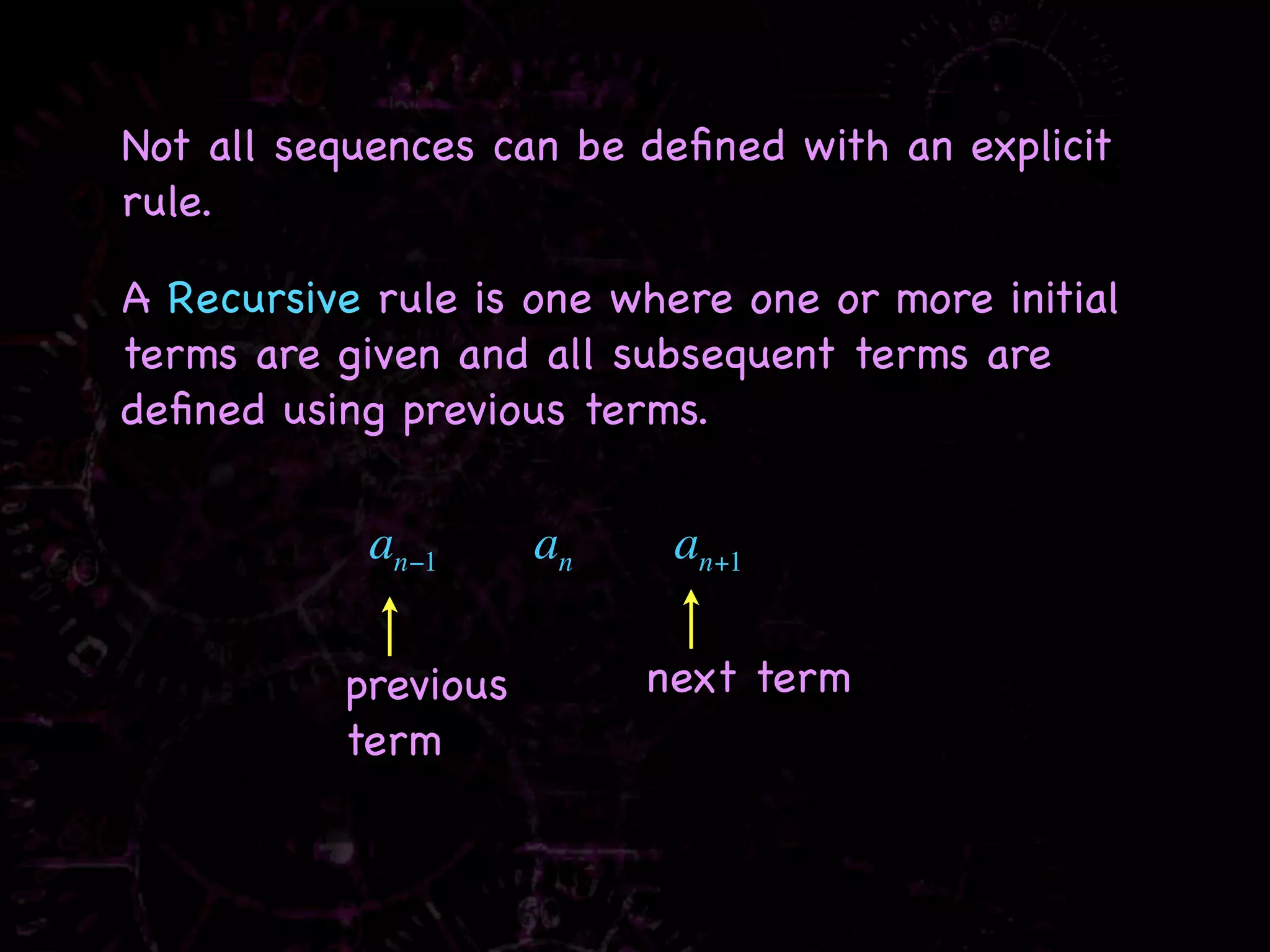
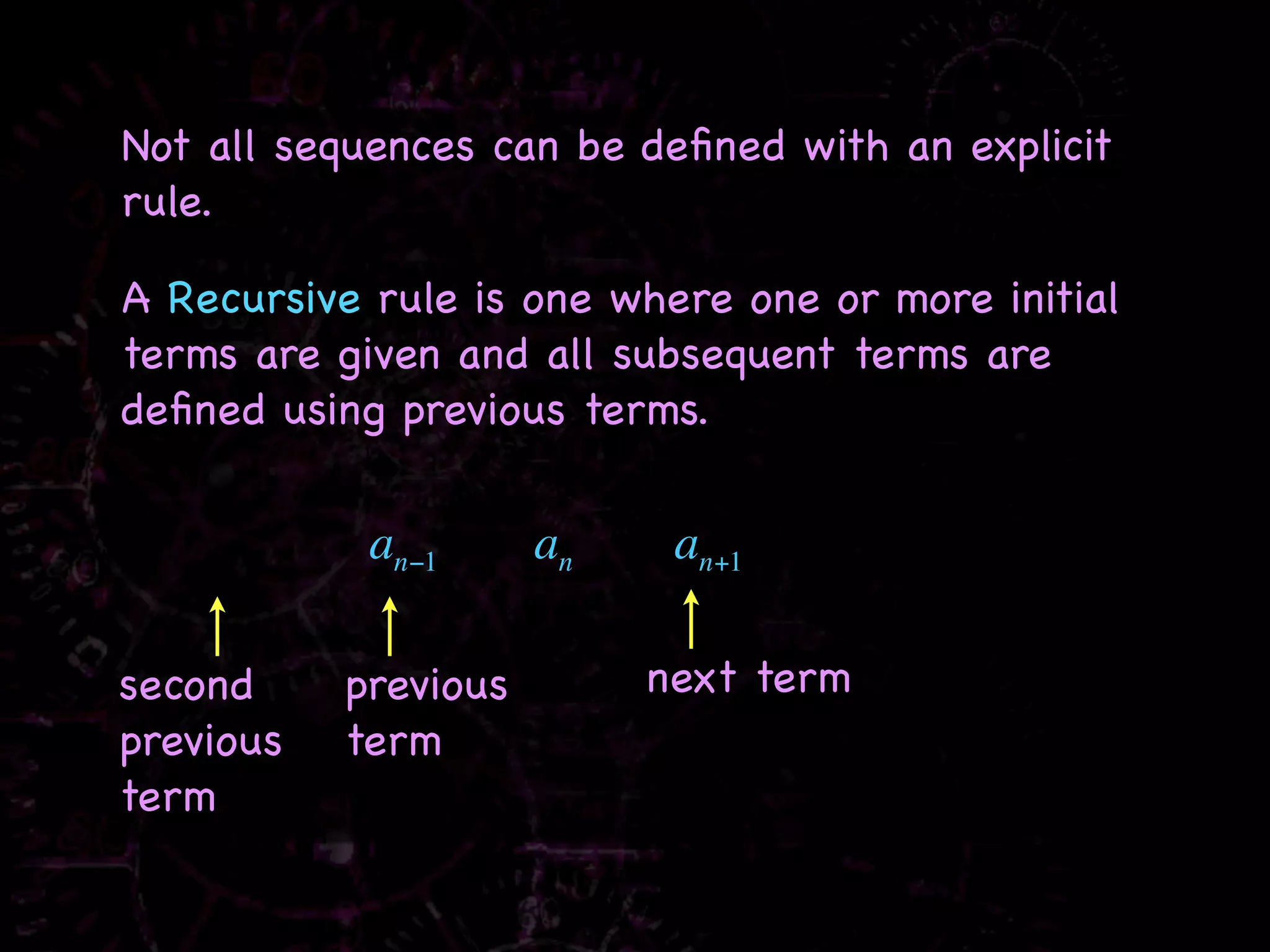
A Recursive rule is one where one or more initial
terms are given and all subsequent terms are
defined using previous terms.
Not all sequences can be defined with an explicit
rule.

A Recursive rule is one where one or more initial
terms are given and all subsequent terms are
defined using previous terms.


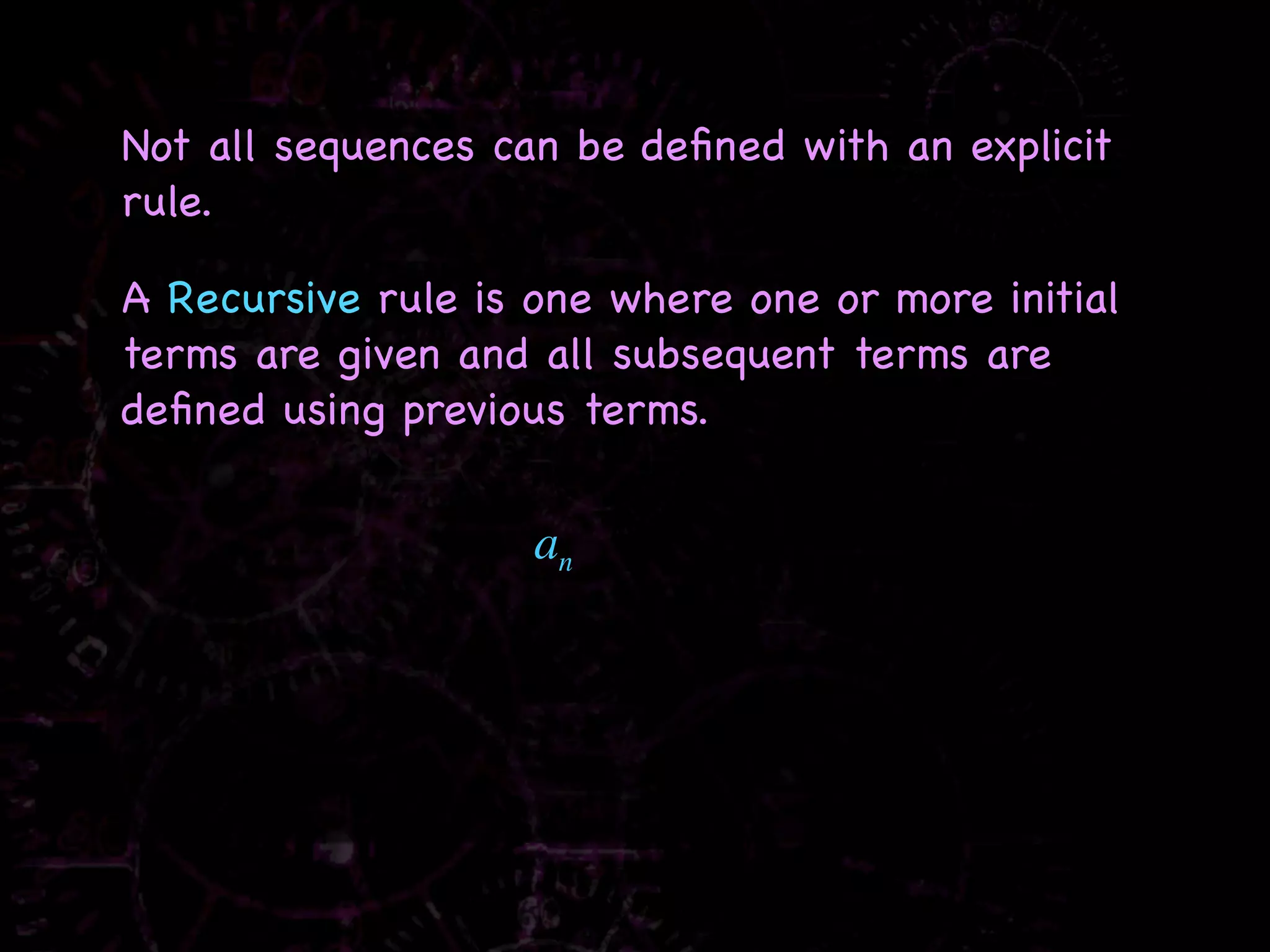
                    an
Not all sequences can be defined with an explicit
rule.

A Recursive rule is one where one or more initial
terms are given and all subsequent terms are
defined using previous terms.


                    an

                         next term
Not all sequences can be defined with an explicit
rule.

A Recursive rule is one where one or more initial
terms are given and all subsequent terms are
defined using previous terms.


                    an     an+1

                         next term
Not all sequences can be defined with an explicit
rule.

A Recursive rule is one where one or more initial
terms are given and all subsequent terms are
defined using previous terms.


                     an    an+1

          previous        next term
          term
Not all sequences can be defined with an explicit
rule.

A Recursive rule is one where one or more initial
terms are given and all subsequent terms are
defined using previous terms.


            an−1     an    an+1

          previous        next term
          term
Not all sequences can be defined with an explicit
rule.

A Recursive rule is one where one or more initial
terms are given and all subsequent terms are
defined using previous terms.


            an−1      an    an+1

second     previous        next term
previous   term
term
Not all sequences can be defined with an explicit
rule.

A Recursive rule is one where one or more initial
terms are given and all subsequent terms are
defined using previous terms.


    an−2    an−1      an    an+1

second     previous        next term
previous   term
term
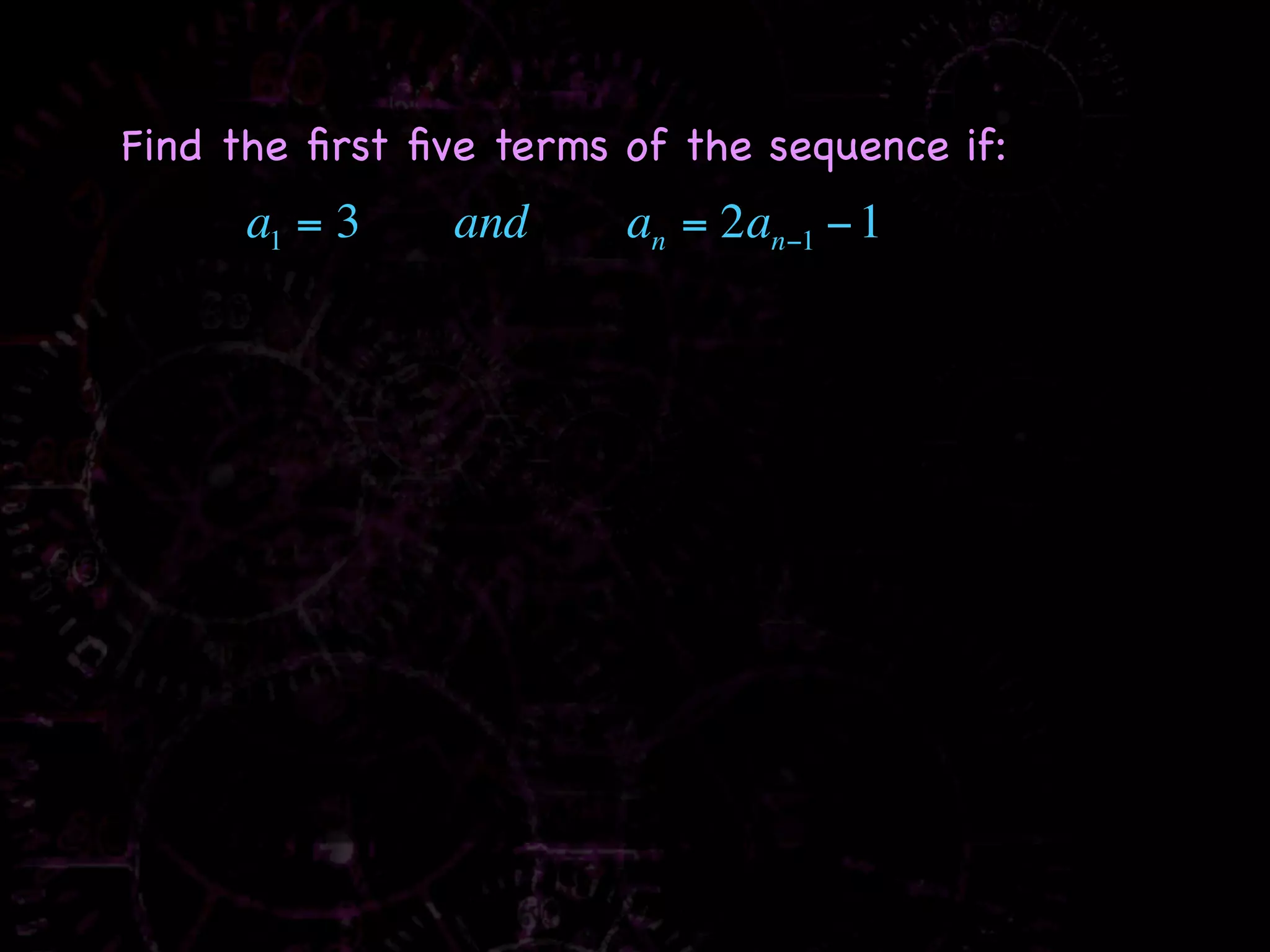
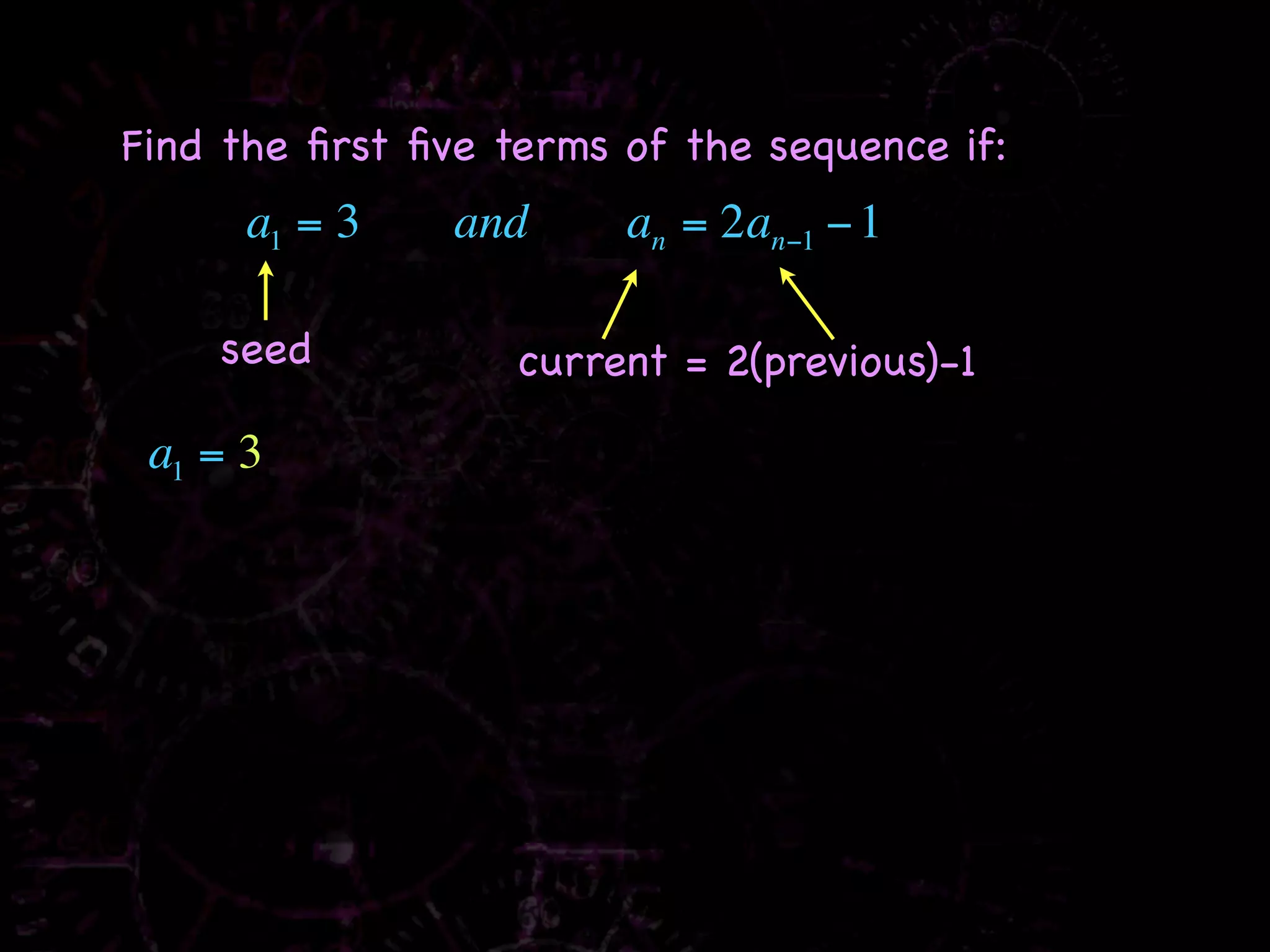
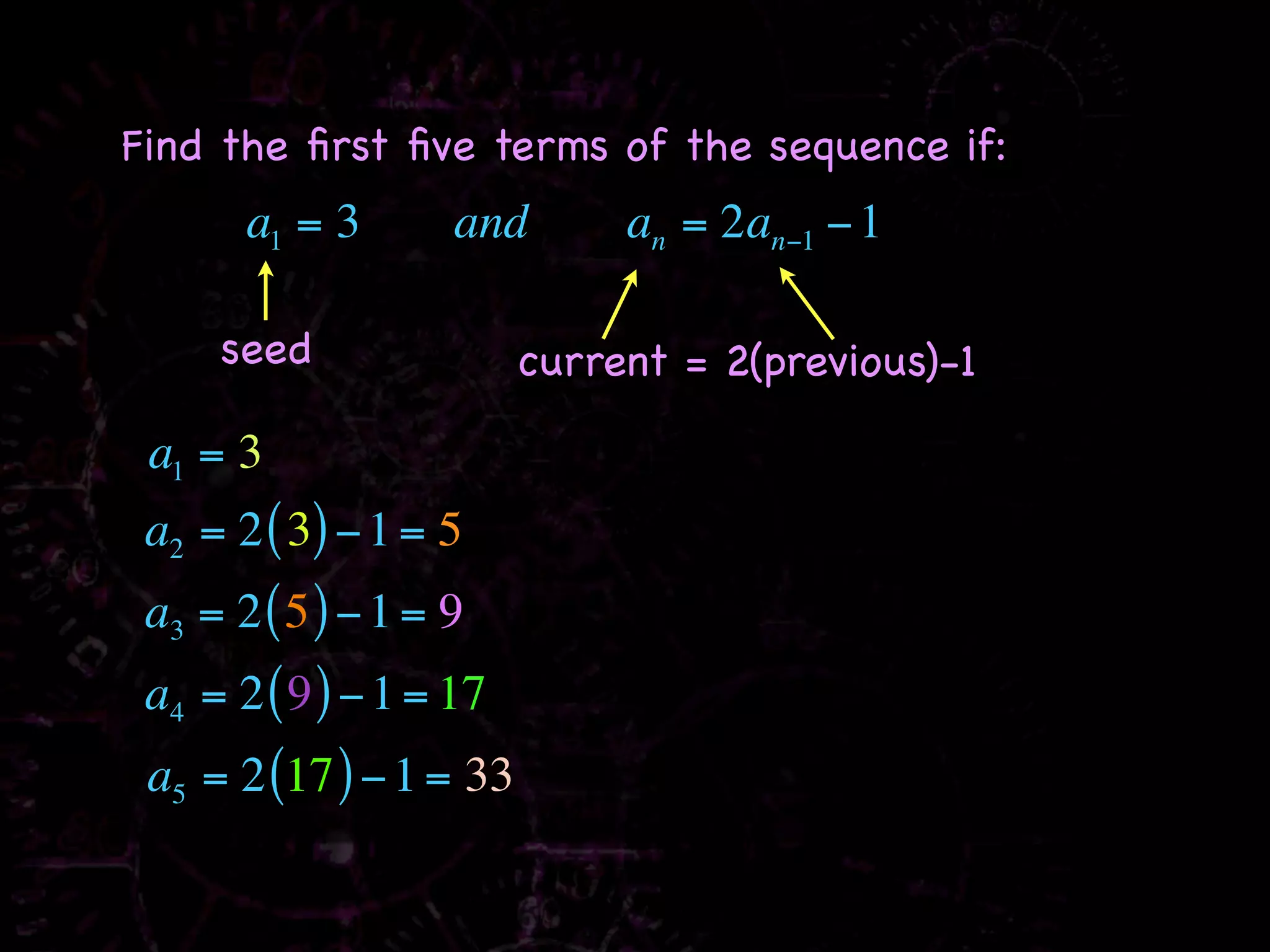
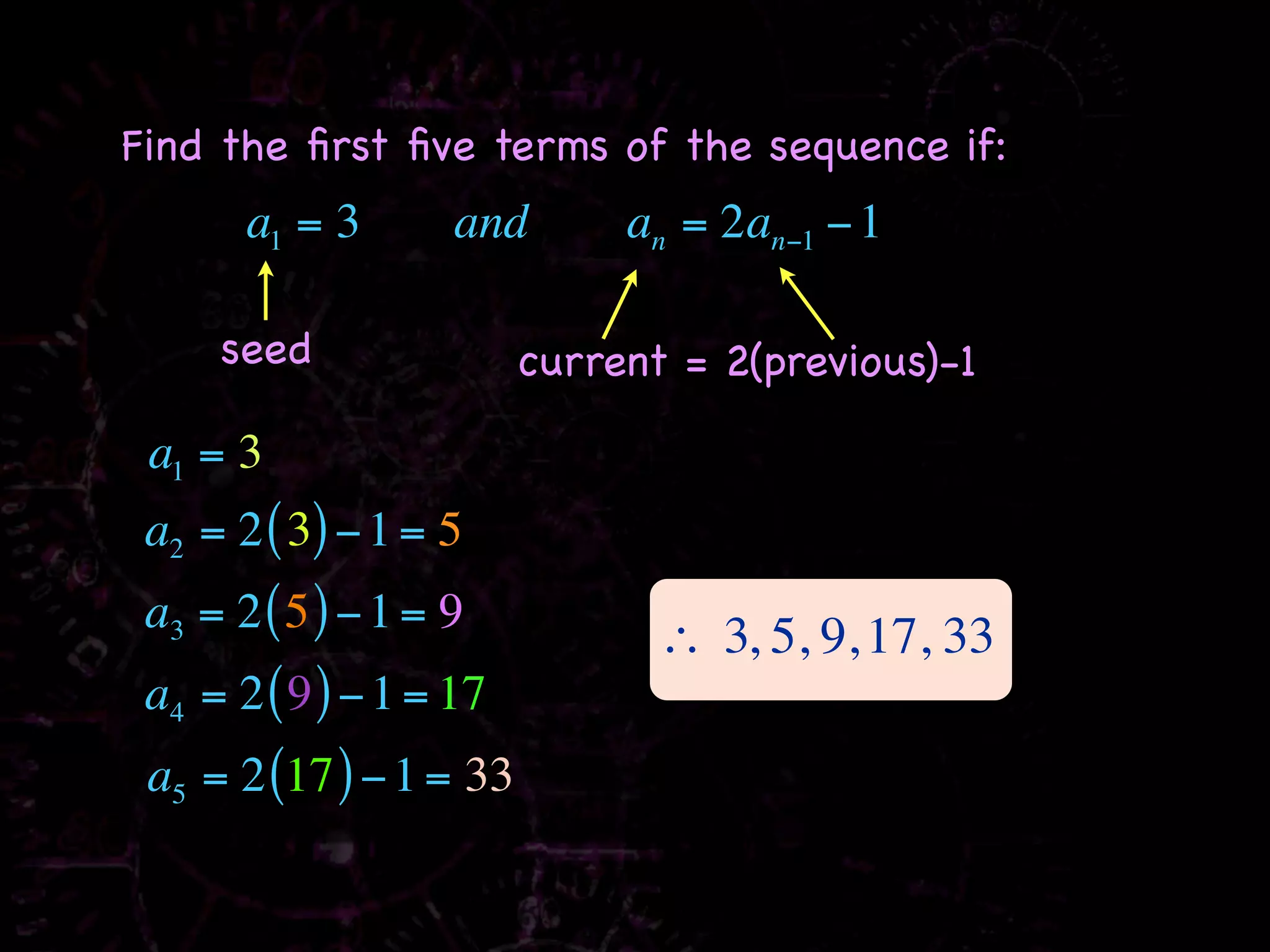
Find the first five terms of the sequence if:
      a1 = 3    and     an = 2an−1 − 1
Find the first five terms of the sequence if:
      a1 = 3    and     an = 2an−1 − 1

    seed
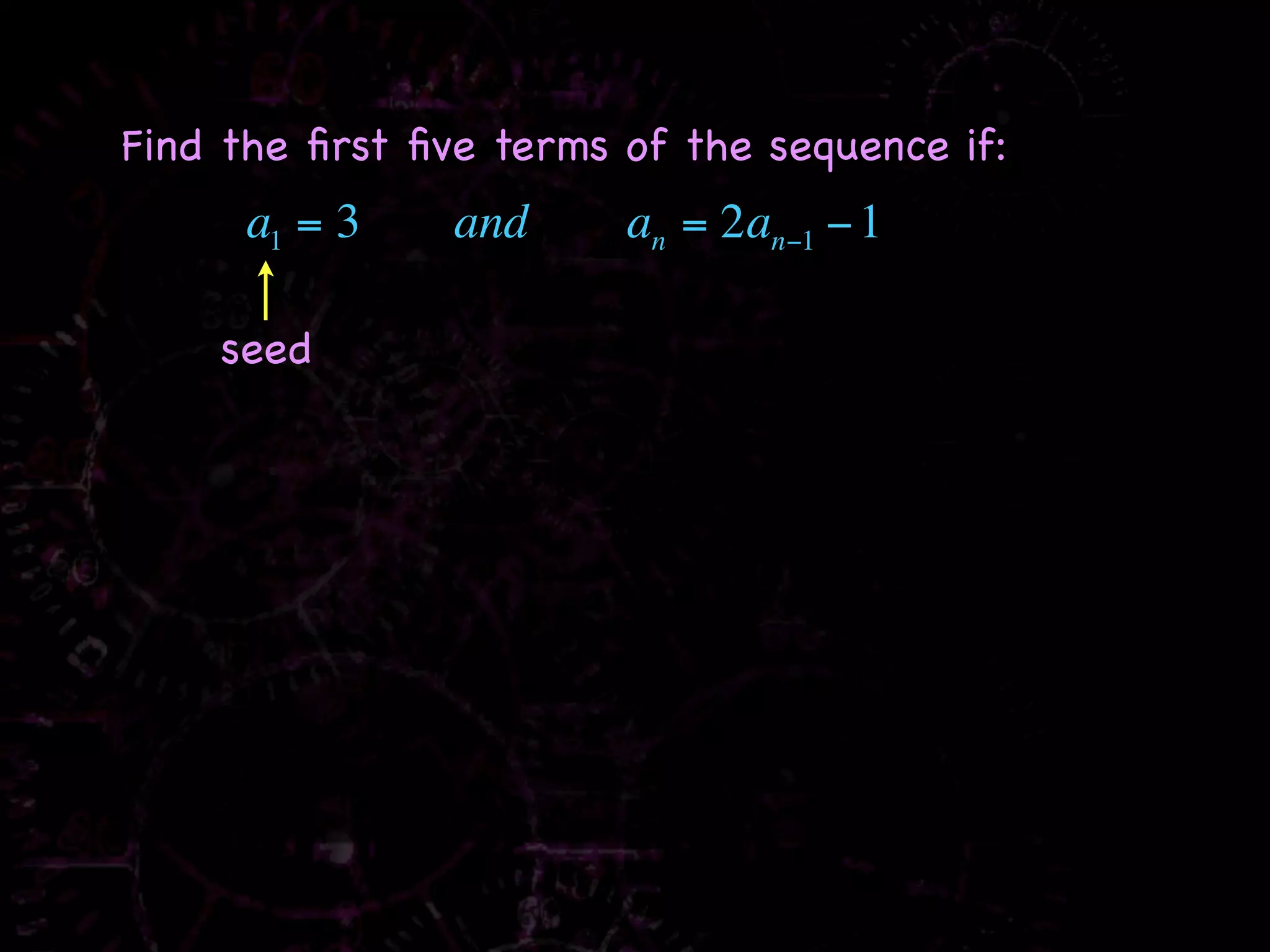
Find the first five terms of the sequence if:
      a1 = 3    and     an = 2an−1 − 1

    seed           current = 2(previous)-1
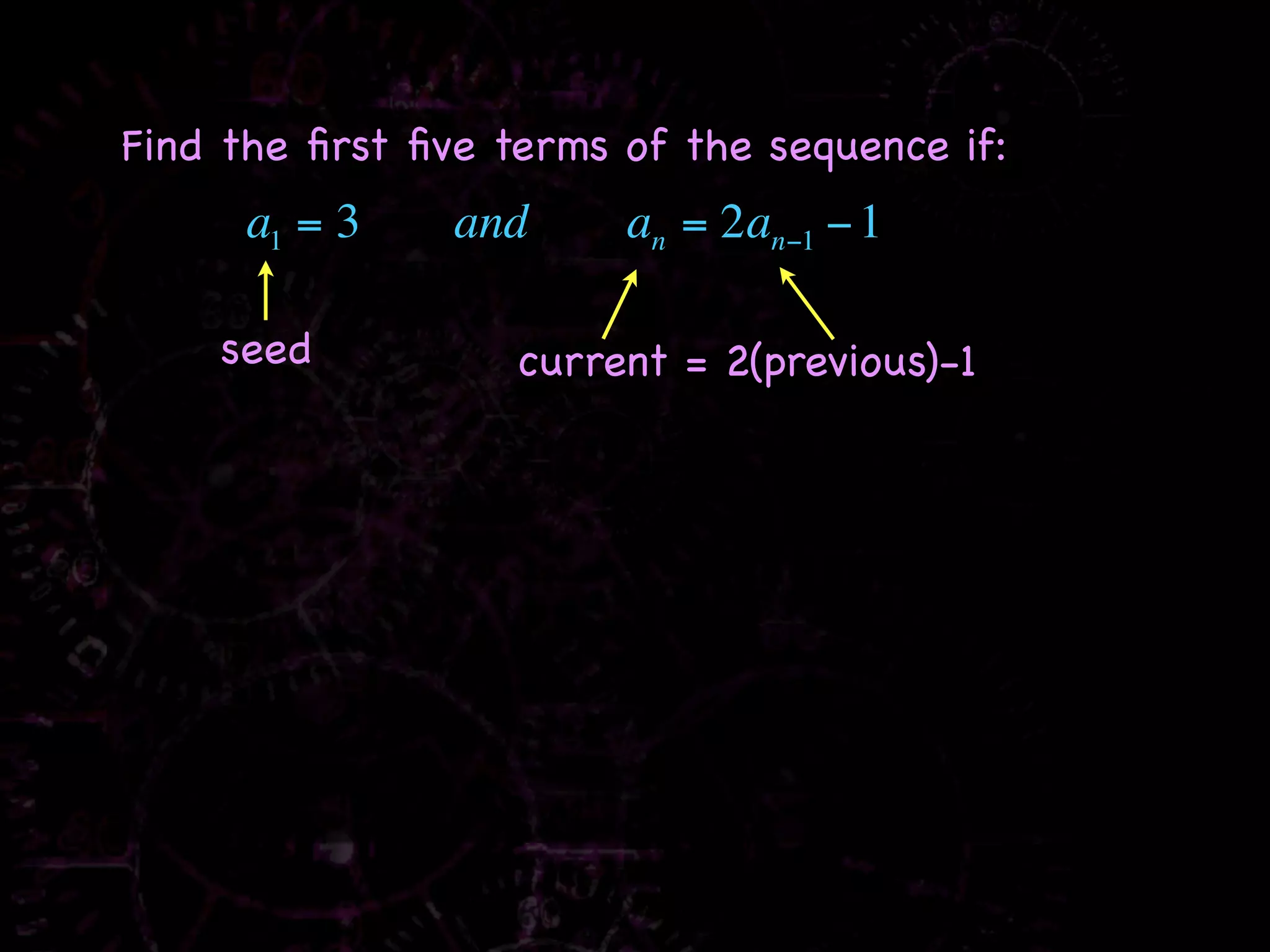
Find the first five terms of the sequence if:
      a1 = 3    and     an = 2an−1 − 1

    seed           current = 2(previous)-1

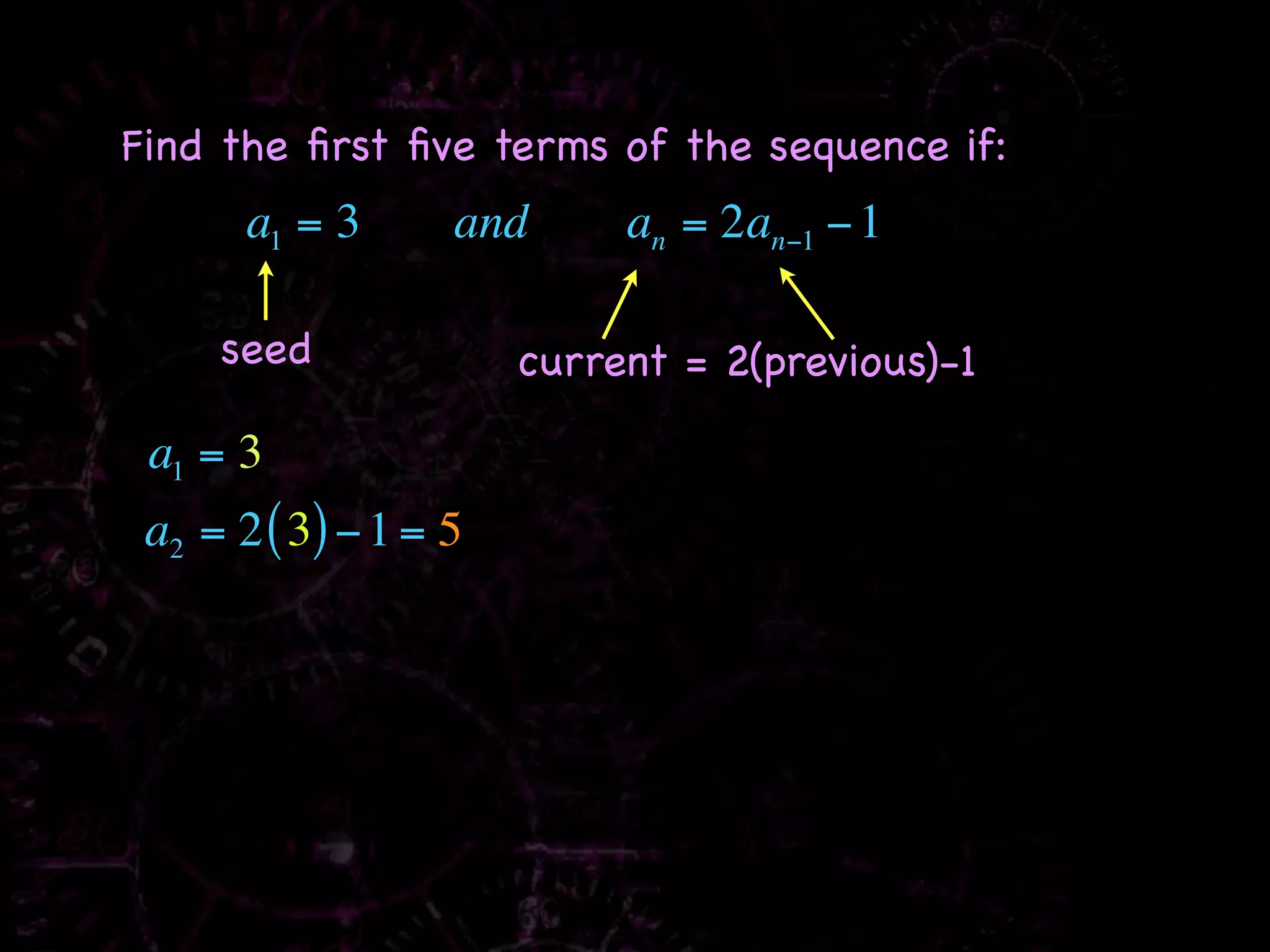
 a1 = 3
Find the first five terms of the sequence if:
       a1 = 3      and      an = 2an−1 − 1

     seed              current = 2(previous)-1

 a1 = 3
 a2 = 2 ( 3) − 1 = 5
Find the first five terms of the sequence if:
       a1 = 3       and      an = 2an−1 − 1

     seed               current = 2(previous)-1

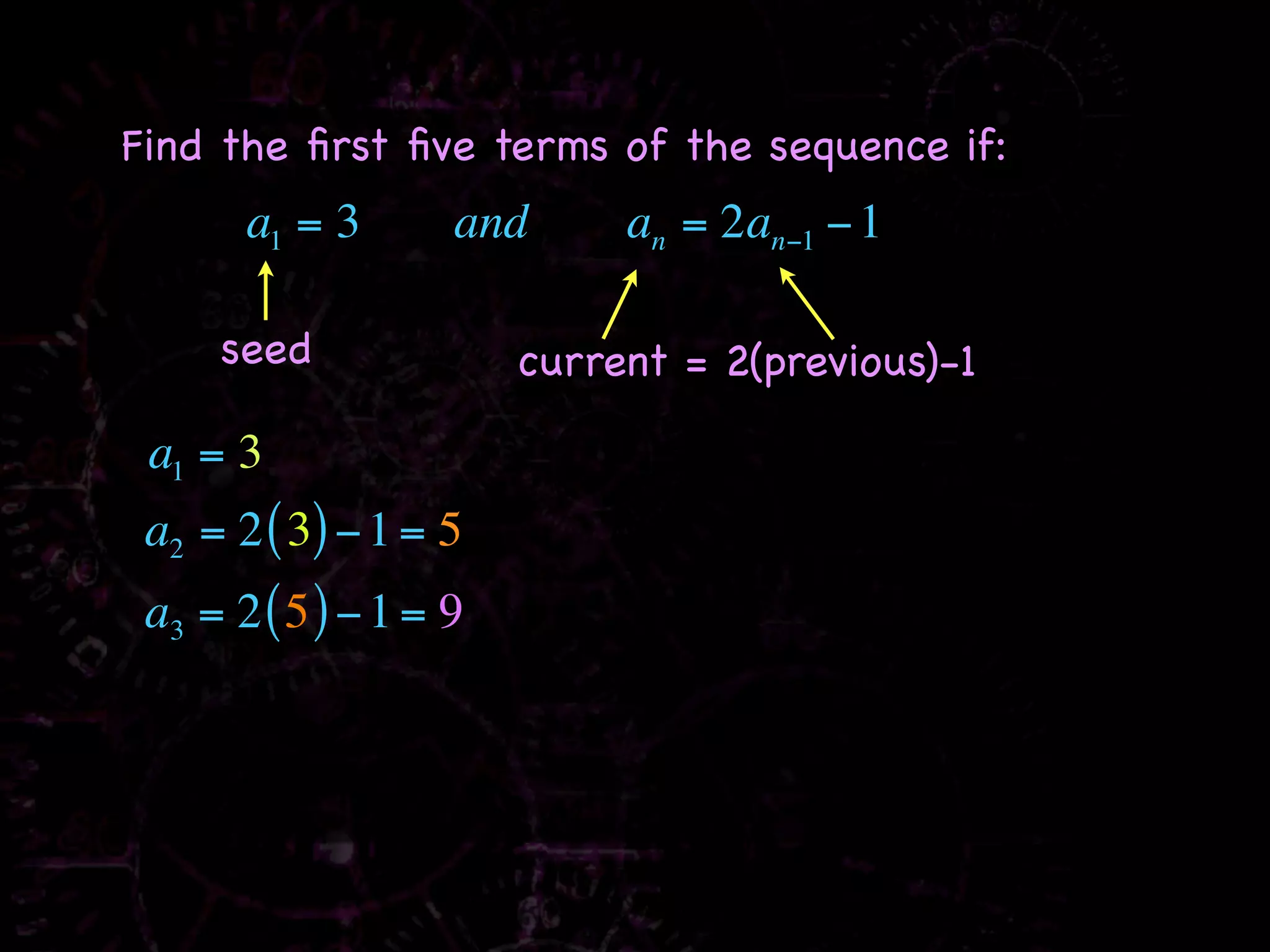
 a1 = 3
 a2 = 2 ( 3) − 1 = 5
 a3 = 2 ( 5 ) − 1 = 9
Find the first five terms of the sequence if:
       a1 = 3       and       an = 2an−1 − 1

     seed                current = 2(previous)-1

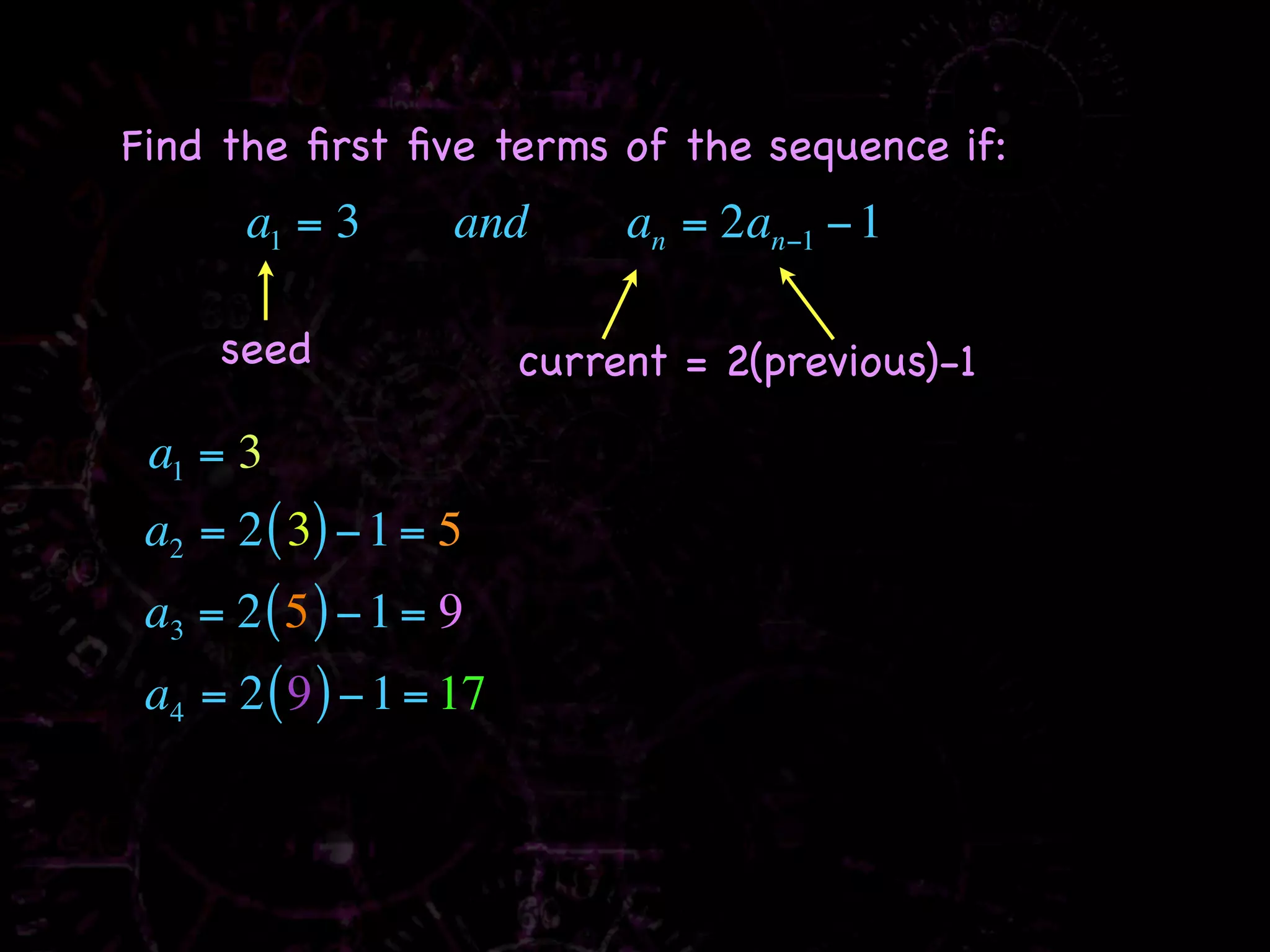
 a1 = 3
 a2 = 2 ( 3) − 1 = 5
 a3 = 2 ( 5 ) − 1 = 9
 a4 = 2 ( 9 ) − 1 = 17
Find the first five terms of the sequence if:
       a1 = 3       and       an = 2an−1 − 1

     seed                current = 2(previous)-1

 a1 = 3
 a2 = 2 ( 3) − 1 = 5
 a3 = 2 ( 5 ) − 1 = 9
 a4 = 2 ( 9 ) − 1 = 17
 a5 = 2 (17 ) − 1 = 33
Find the first five terms of the sequence if:
       a1 = 3       and       an = 2an−1 − 1

     seed                current = 2(previous)-1

 a1 = 3
 a2 = 2 ( 3) − 1 = 5
 a3 = 2 ( 5 ) − 1 = 9
                                ∴ 3, 5, 9, 17, 33
 a4 = 2 ( 9 ) − 1 = 17
 a5 = 2 (17 ) − 1 = 33
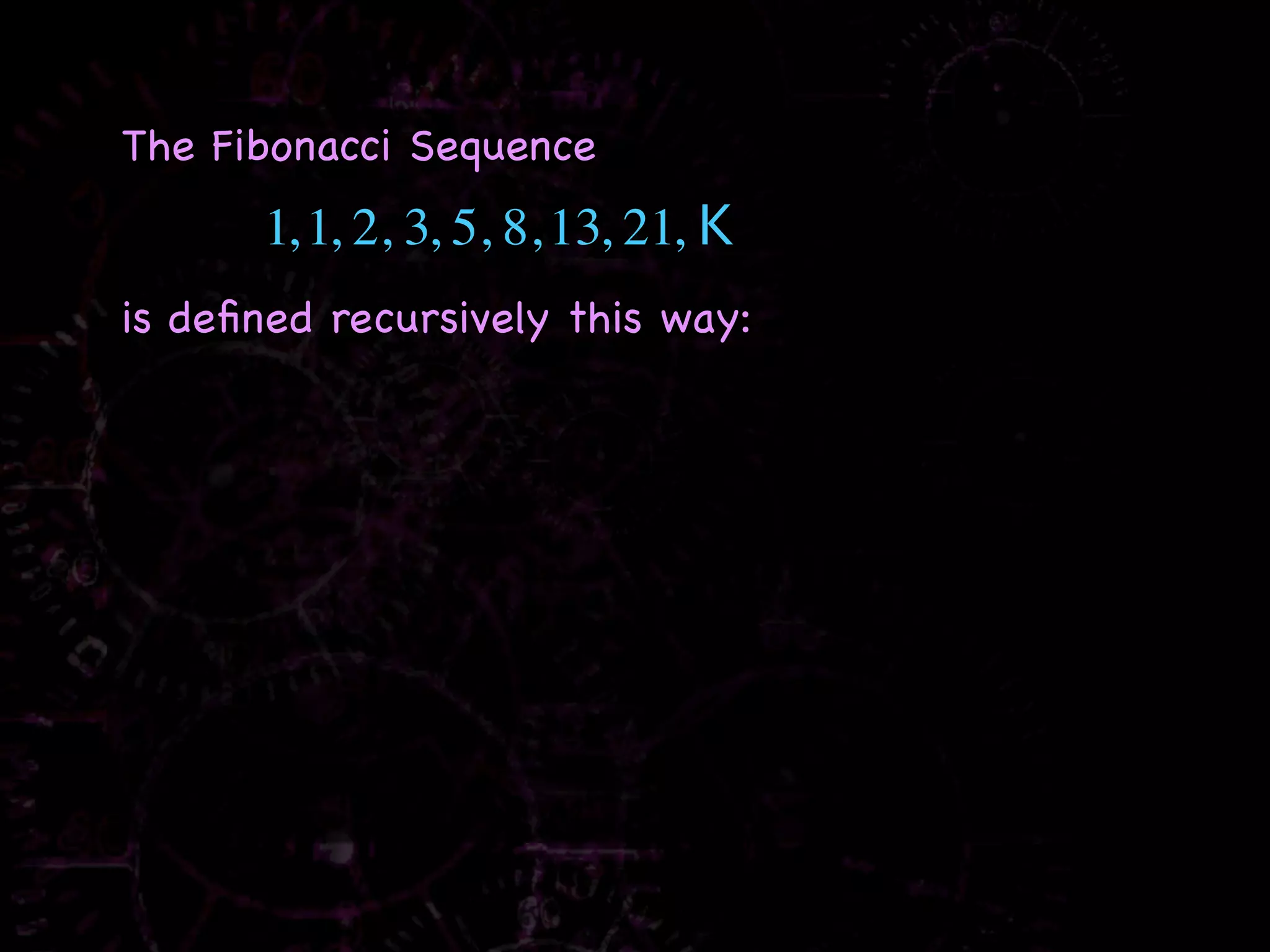
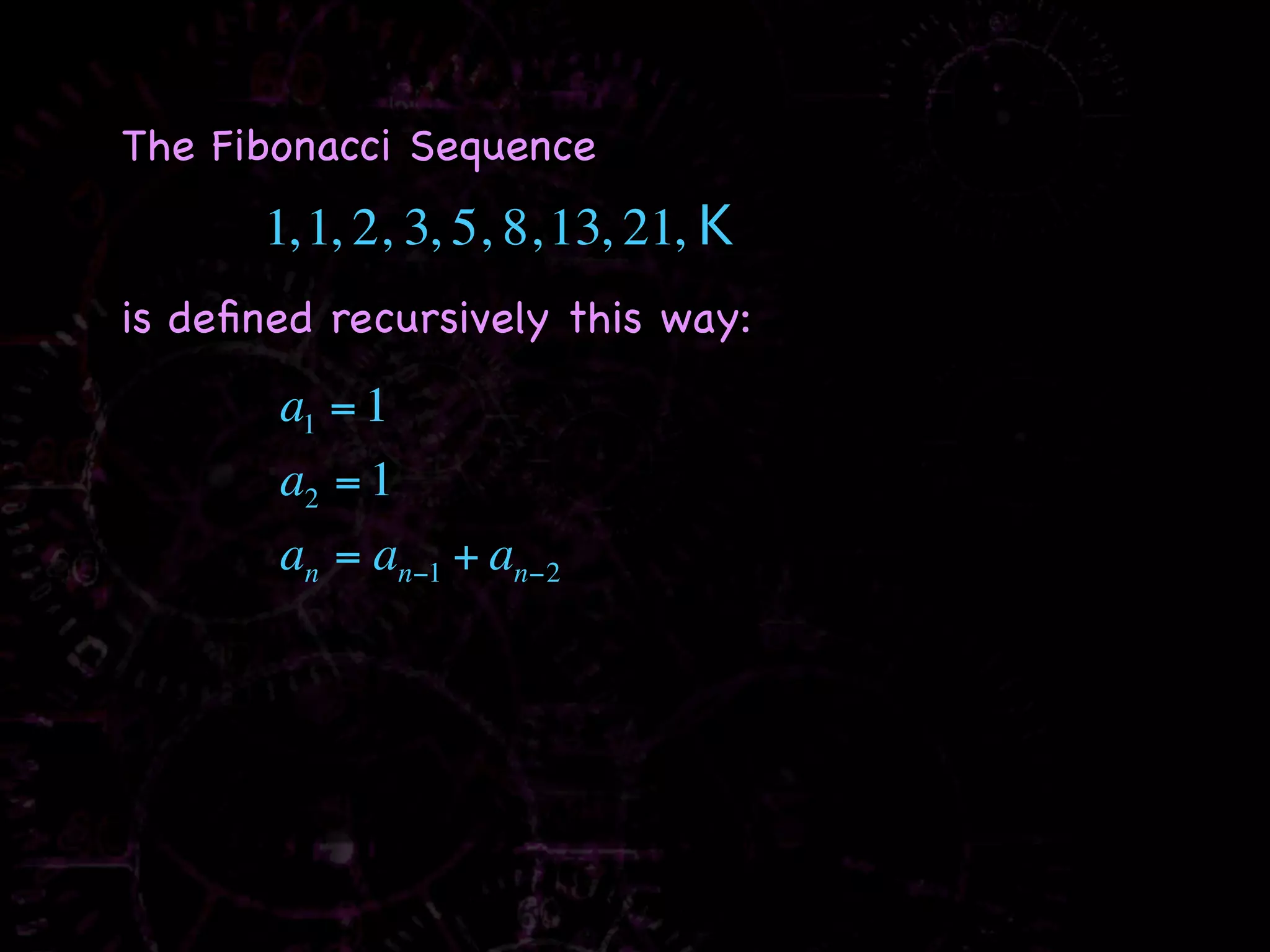
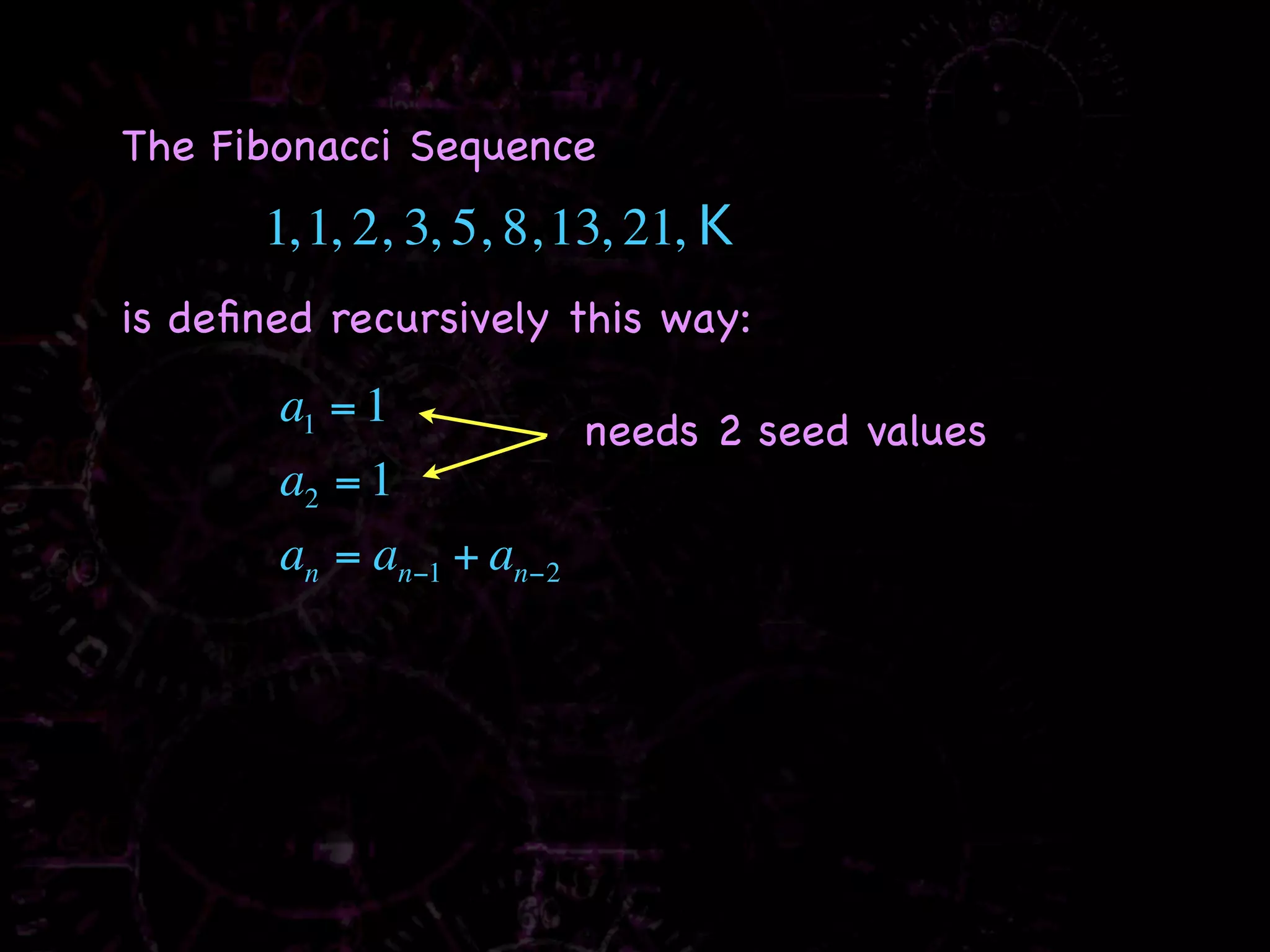
The Fibonacci Sequence
      1, 1, 2, 3, 5, 8, 13, 21, K
is defined recursively this way:
The Fibonacci Sequence
      1, 1, 2, 3, 5, 8, 13, 21, K
is defined recursively this way:
       a1 = 1
       a2 = 1
       an = an−1 + an−2
The Fibonacci Sequence
      1, 1, 2, 3, 5, 8, 13, 21, K
is defined recursively this way:
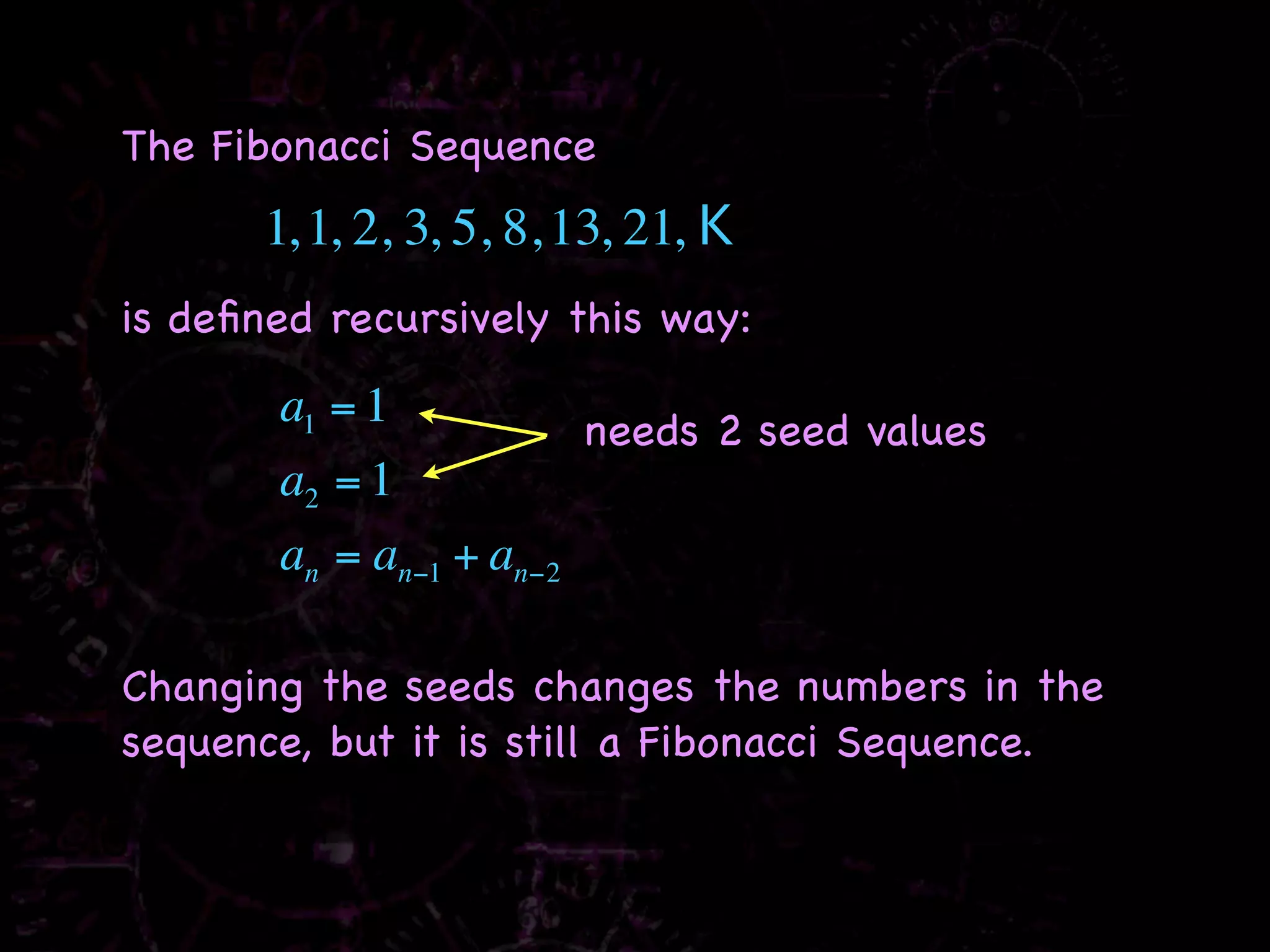
       a1 = 1           needs 2 seed values
       a2 = 1
       an = an−1 + an−2
The Fibonacci Sequence
      1, 1, 2, 3, 5, 8, 13, 21, K
is defined recursively this way:
       a1 = 1           needs 2 seed values
       a2 = 1
       an = an−1 + an−2

Changing the seeds changes the numbers in the
sequence, but it is still a Fibonacci Sequence.
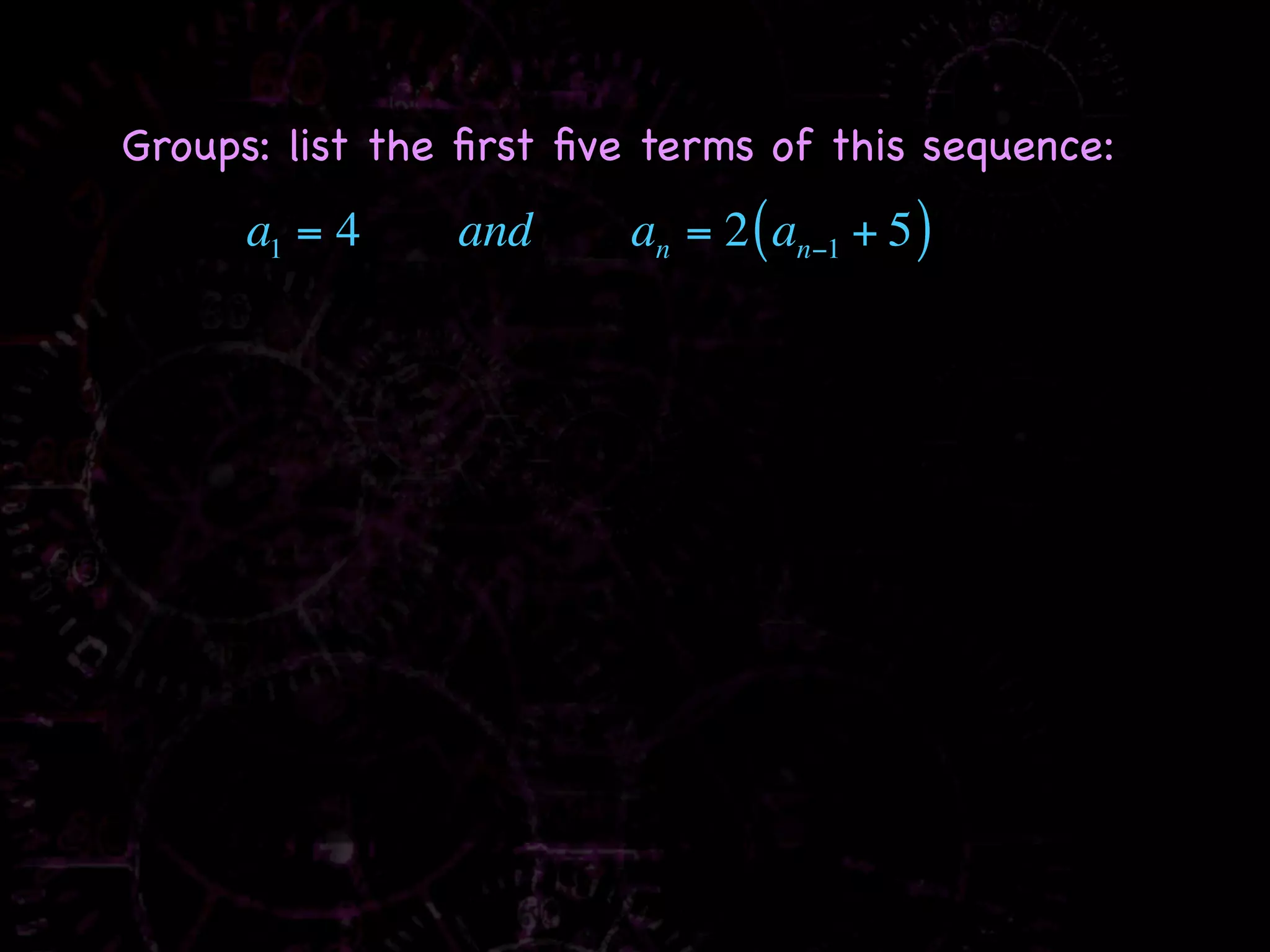
Groups: list the first five terms of this sequence:
      a1 = 4    and      an = 2 ( an−1 + 5 )
Groups: list the first five terms of this sequence:
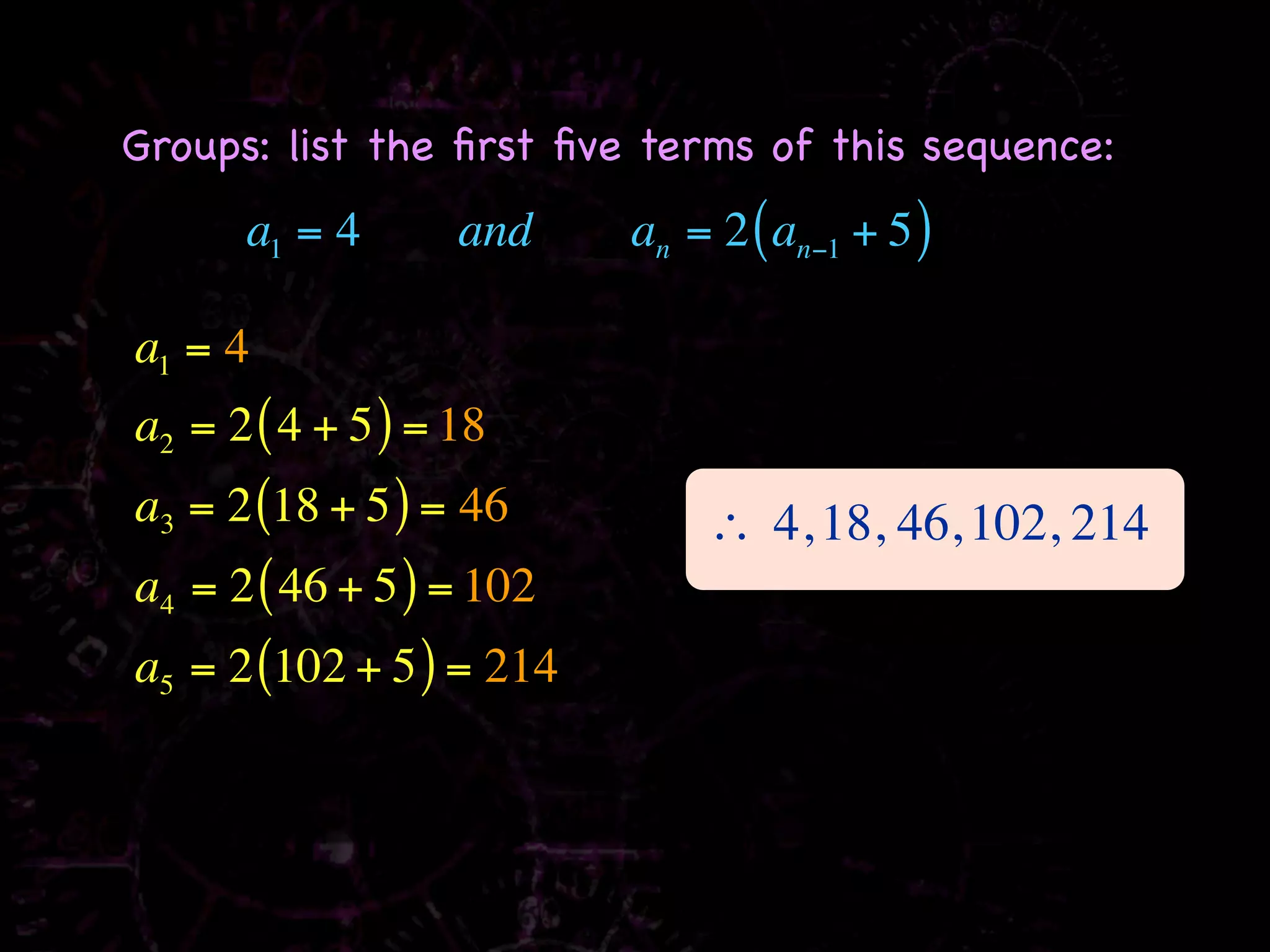
      a1 = 4       and    an = 2 ( an−1 + 5 )

a1 = 4
a2 = 2 ( 4 + 5 ) = 18
a3 = 2 (18 + 5 ) = 46         ∴ 4, 18, 46, 102, 214
a4 = 2 ( 46 + 5 ) = 102
a5 = 2 (102 + 5 ) = 214
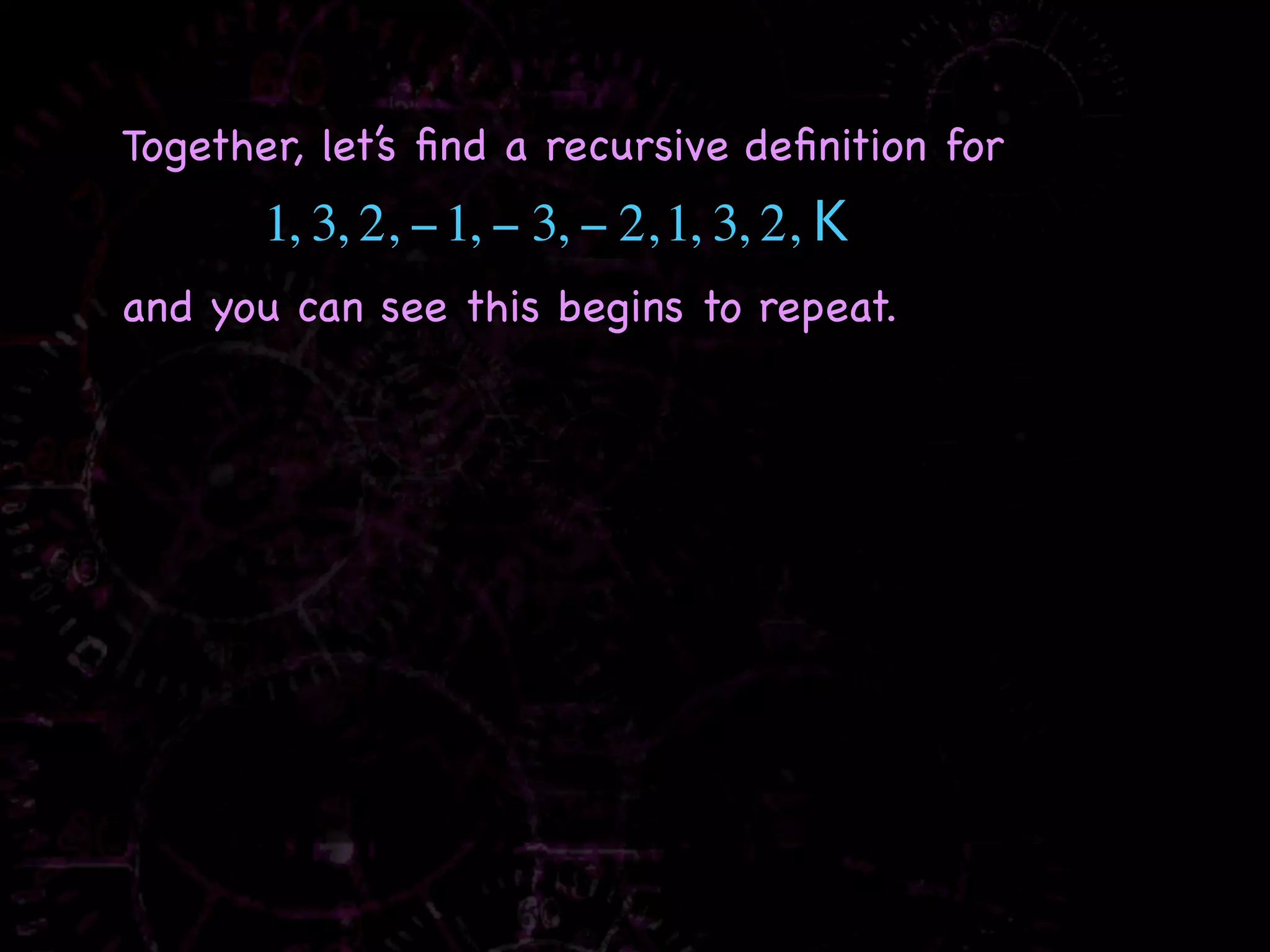
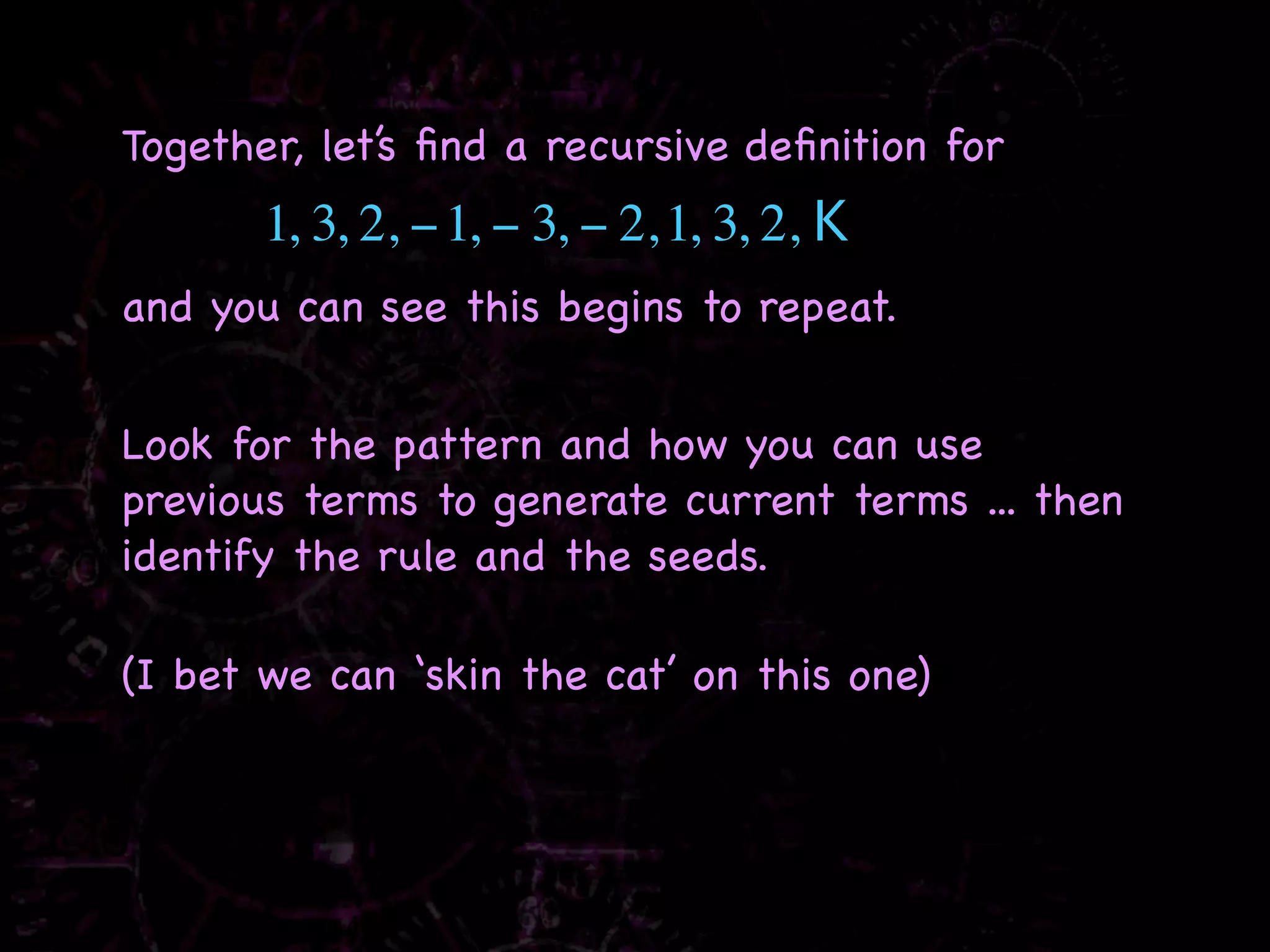
Together, let’s find a recursive definition for
       1, 3, 2, − 1, − 3, − 2, 1, 3, 2, K
and you can see this begins to repeat.
Together, let’s find a recursive definition for
       1, 3, 2, − 1, − 3, − 2, 1, 3, 2, K
and you can see this begins to repeat.


Look for the pattern and how you can use
previous terms to generate current terms ... then
identify the rule and the seeds.

(I bet we can ‘skin the cat’ on this one)
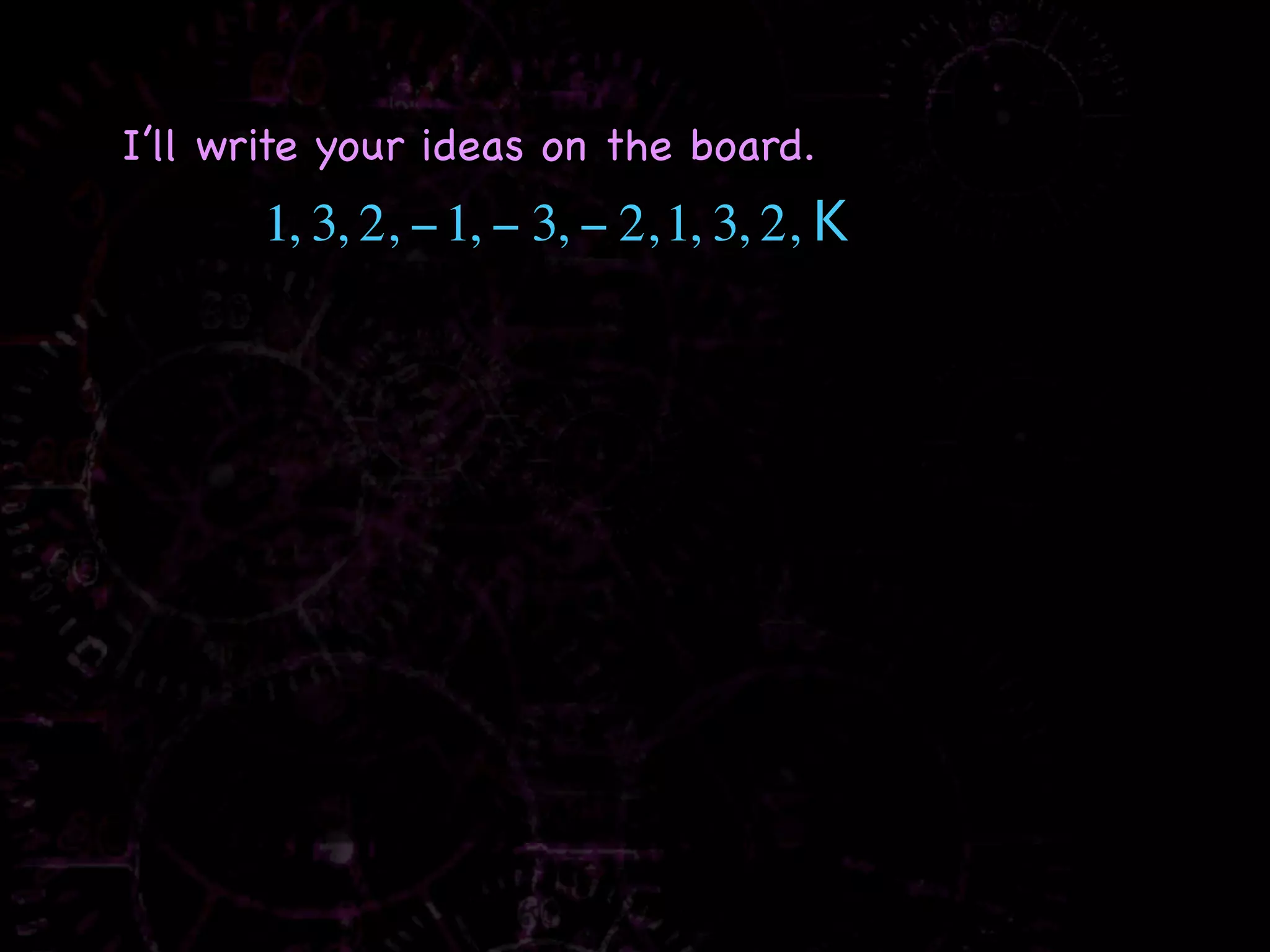
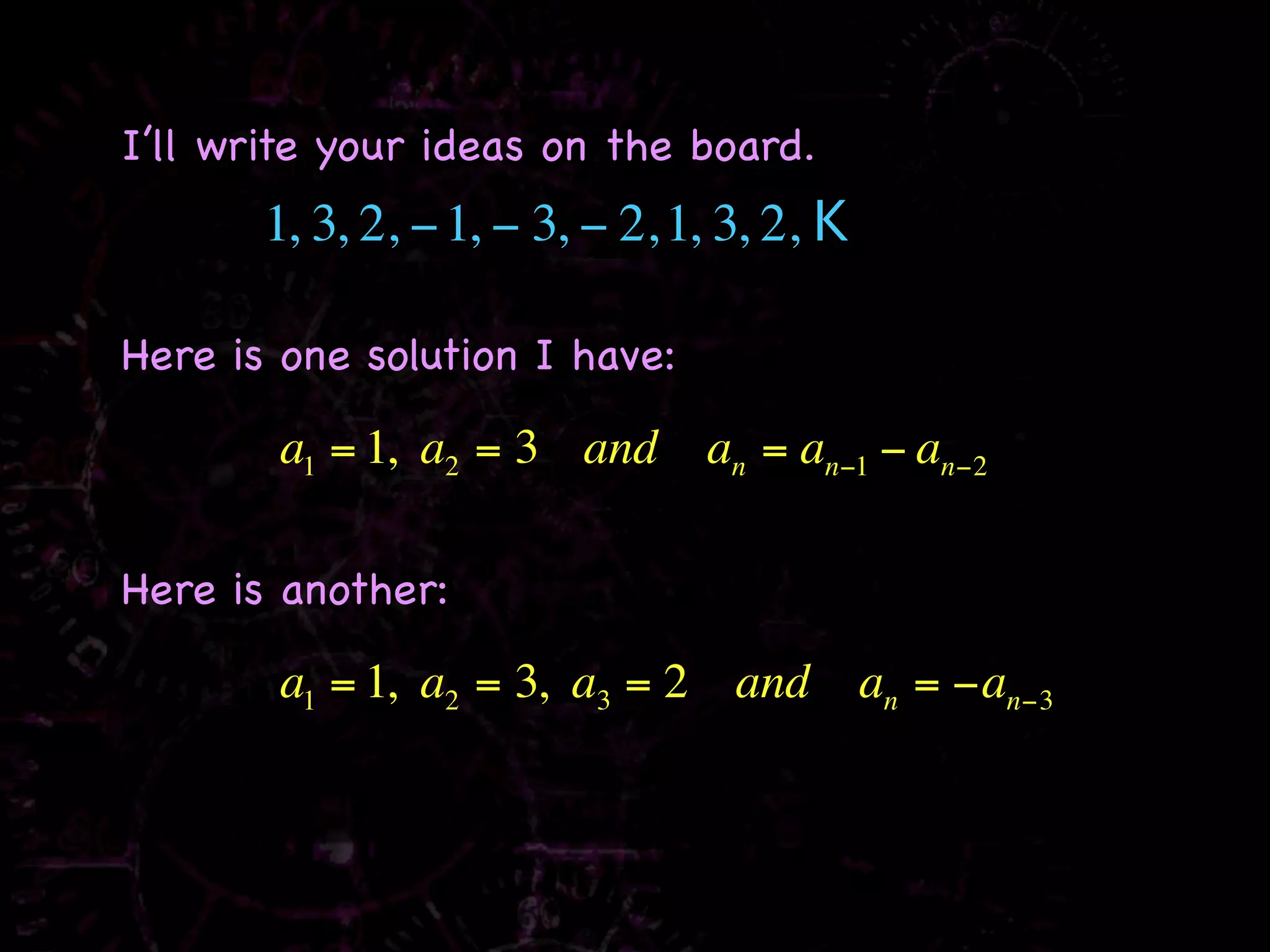
I’ll write your ideas on the board.
       1, 3, 2, − 1, − 3, − 2, 1, 3, 2, K
I’ll write your ideas on the board.
       1, 3, 2, − 1, − 3, − 2, 1, 3, 2, K

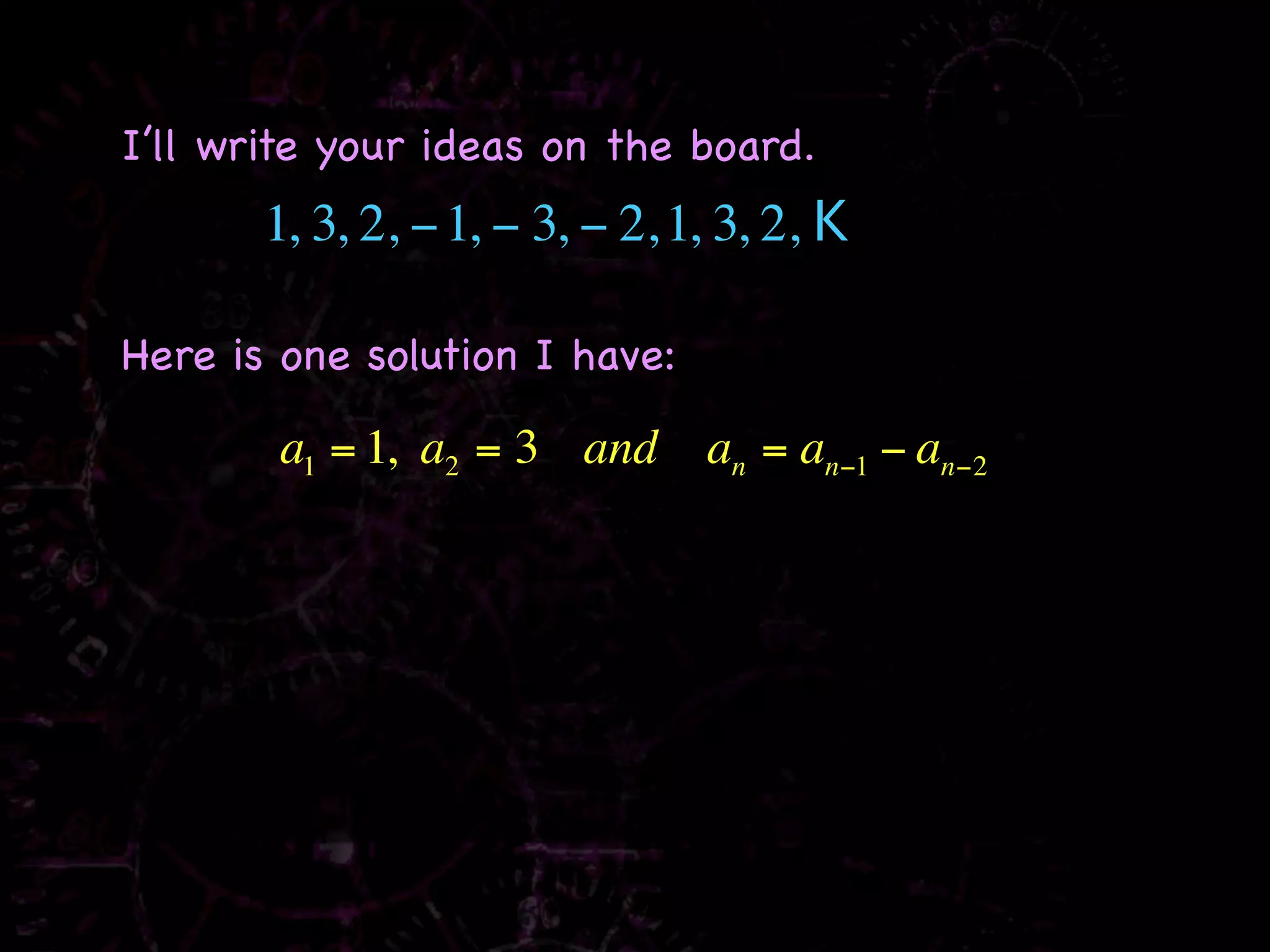
Here is one solution I have:

        a1 = 1, a2 = 3 and      an = an−1 − an−2
I’ll write your ideas on the board.
       1, 3, 2, − 1, − 3, − 2, 1, 3, 2, K

Here is one solution I have:

        a1 = 1, a2 = 3 and      an = an−1 − an−2

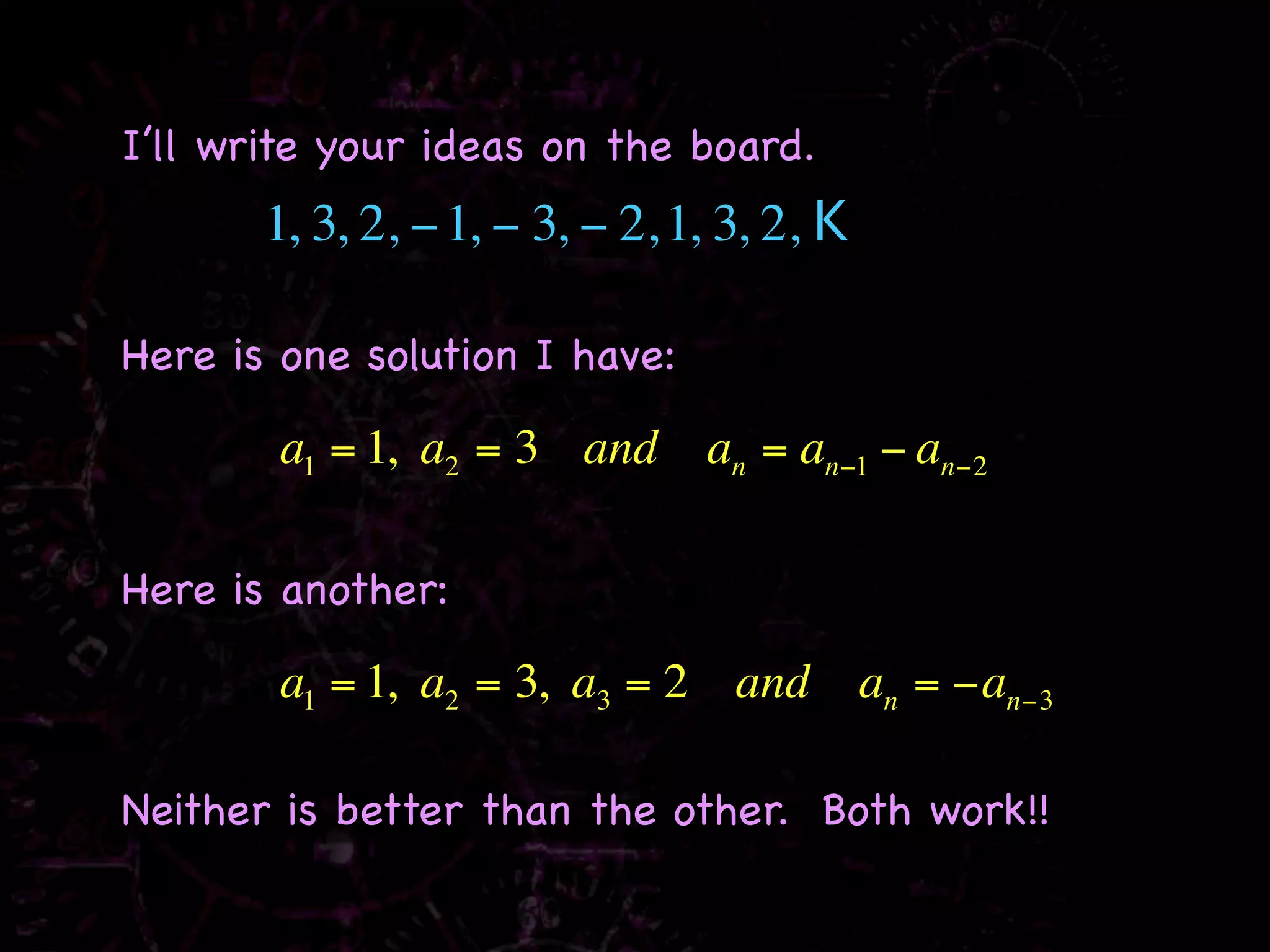
Here is another:

        a1 = 1, a2 = 3, a3 = 2 and          an = −an−3
I’ll write your ideas on the board.
       1, 3, 2, − 1, − 3, − 2, 1, 3, 2, K

Here is one solution I have:

        a1 = 1, a2 = 3 and      an = an−1 − an−2

Here is another:

        a1 = 1, a2 = 3, a3 = 2 and          an = −an−3

Neither is better than the other. Both work!!
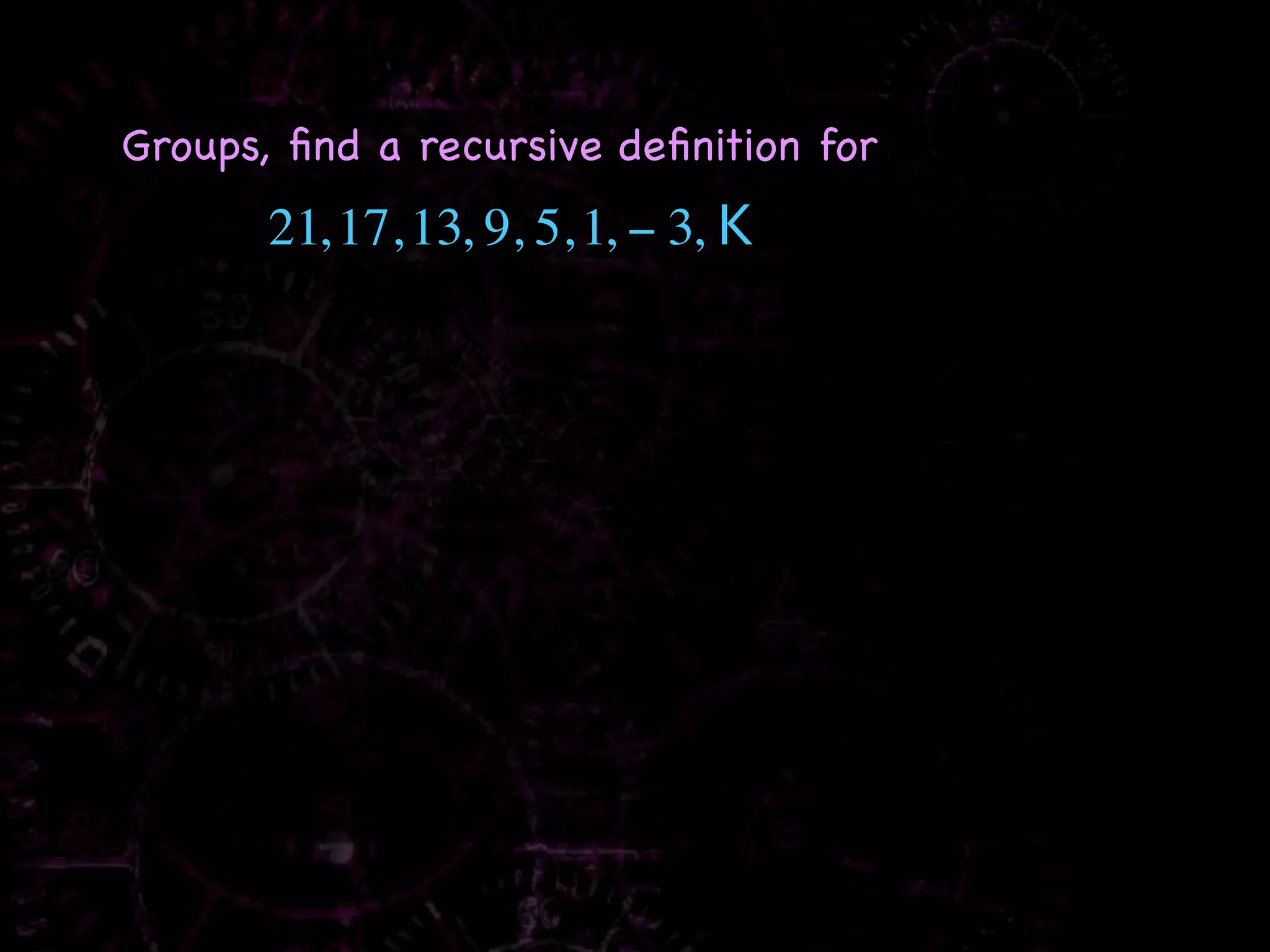
Groups, find a recursive definition for
       21, 17, 13, 9, 5, 1, − 3, K
Groups, find a recursive definition for
       21, 17, 13, 9, 5, 1, − 3, K

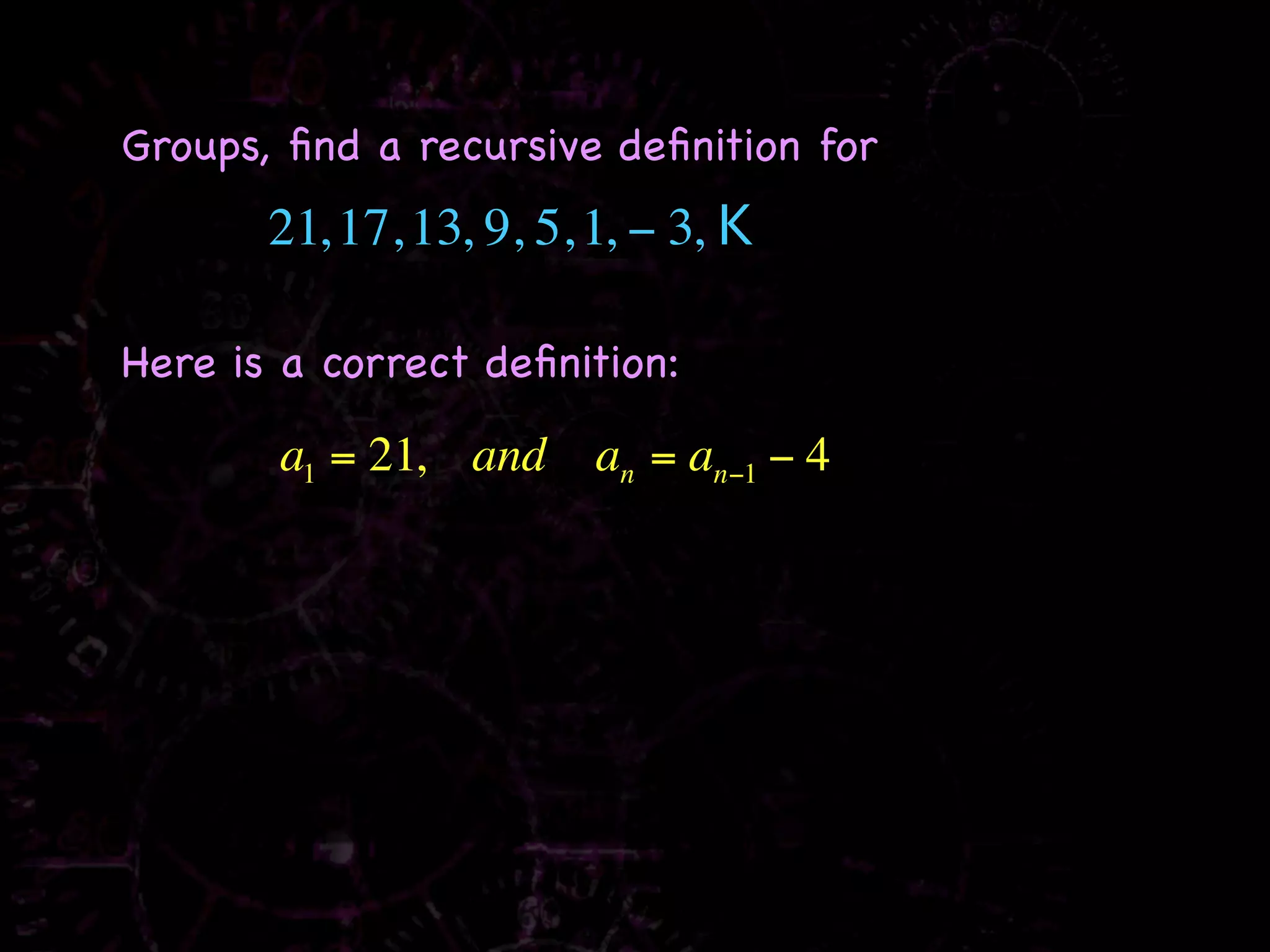
Here is a correct definition:

       a1 = 21, and      an = an−1 − 4
HW #2

“Never tell people how to do things. Tell them what to
do and they will surprise you with their ingenuity.”
                                       George Patton

1104 ch 11 day 4

  • 1.
    11.1 Sequences &Summation Notation Day Two John 14:15 "If you love me, you will keep my commandments."
  • 2.
    Not all sequencescan be defined with an explicit rule.
  • 3.
    Not all sequencescan be defined with an explicit rule. A Recursive rule is one where one or more initial terms are given and all subsequent terms are defined using previous terms.
  • 4.
    Not all sequencescan be defined with an explicit rule. A Recursive rule is one where one or more initial terms are given and all subsequent terms are defined using previous terms. an
  • 5.
    Not all sequencescan be defined with an explicit rule. A Recursive rule is one where one or more initial terms are given and all subsequent terms are defined using previous terms. an next term
  • 6.
    Not all sequencescan be defined with an explicit rule. A Recursive rule is one where one or more initial terms are given and all subsequent terms are defined using previous terms. an an+1 next term
  • 7.
    Not all sequencescan be defined with an explicit rule. A Recursive rule is one where one or more initial terms are given and all subsequent terms are defined using previous terms. an an+1 previous next term term
  • 8.
    Not all sequencescan be defined with an explicit rule. A Recursive rule is one where one or more initial terms are given and all subsequent terms are defined using previous terms. an−1 an an+1 previous next term term
  • 9.
    Not all sequencescan be defined with an explicit rule. A Recursive rule is one where one or more initial terms are given and all subsequent terms are defined using previous terms. an−1 an an+1 second previous next term previous term term
  • 10.
    Not all sequencescan be defined with an explicit rule. A Recursive rule is one where one or more initial terms are given and all subsequent terms are defined using previous terms. an−2 an−1 an an+1 second previous next term previous term term
  • 11.
    Find the firstfive terms of the sequence if: a1 = 3 and an = 2an−1 − 1
  • 12.
    Find the firstfive terms of the sequence if: a1 = 3 and an = 2an−1 − 1 seed
  • 13.
    Find the firstfive terms of the sequence if: a1 = 3 and an = 2an−1 − 1 seed current = 2(previous)-1
  • 14.
    Find the firstfive terms of the sequence if: a1 = 3 and an = 2an−1 − 1 seed current = 2(previous)-1 a1 = 3
  • 15.
    Find the firstfive terms of the sequence if: a1 = 3 and an = 2an−1 − 1 seed current = 2(previous)-1 a1 = 3 a2 = 2 ( 3) − 1 = 5
  • 16.
    Find the firstfive terms of the sequence if: a1 = 3 and an = 2an−1 − 1 seed current = 2(previous)-1 a1 = 3 a2 = 2 ( 3) − 1 = 5 a3 = 2 ( 5 ) − 1 = 9
  • 17.
    Find the firstfive terms of the sequence if: a1 = 3 and an = 2an−1 − 1 seed current = 2(previous)-1 a1 = 3 a2 = 2 ( 3) − 1 = 5 a3 = 2 ( 5 ) − 1 = 9 a4 = 2 ( 9 ) − 1 = 17
  • 18.
    Find the firstfive terms of the sequence if: a1 = 3 and an = 2an−1 − 1 seed current = 2(previous)-1 a1 = 3 a2 = 2 ( 3) − 1 = 5 a3 = 2 ( 5 ) − 1 = 9 a4 = 2 ( 9 ) − 1 = 17 a5 = 2 (17 ) − 1 = 33
  • 19.
    Find the firstfive terms of the sequence if: a1 = 3 and an = 2an−1 − 1 seed current = 2(previous)-1 a1 = 3 a2 = 2 ( 3) − 1 = 5 a3 = 2 ( 5 ) − 1 = 9 ∴ 3, 5, 9, 17, 33 a4 = 2 ( 9 ) − 1 = 17 a5 = 2 (17 ) − 1 = 33
  • 20.
    The Fibonacci Sequence 1, 1, 2, 3, 5, 8, 13, 21, K is defined recursively this way:
  • 21.
    The Fibonacci Sequence 1, 1, 2, 3, 5, 8, 13, 21, K is defined recursively this way: a1 = 1 a2 = 1 an = an−1 + an−2
  • 22.
    The Fibonacci Sequence 1, 1, 2, 3, 5, 8, 13, 21, K is defined recursively this way: a1 = 1 needs 2 seed values a2 = 1 an = an−1 + an−2
  • 23.
    The Fibonacci Sequence 1, 1, 2, 3, 5, 8, 13, 21, K is defined recursively this way: a1 = 1 needs 2 seed values a2 = 1 an = an−1 + an−2 Changing the seeds changes the numbers in the sequence, but it is still a Fibonacci Sequence.
  • 24.
    Groups: list thefirst five terms of this sequence: a1 = 4 and an = 2 ( an−1 + 5 )
  • 25.
    Groups: list thefirst five terms of this sequence: a1 = 4 and an = 2 ( an−1 + 5 ) a1 = 4 a2 = 2 ( 4 + 5 ) = 18 a3 = 2 (18 + 5 ) = 46 ∴ 4, 18, 46, 102, 214 a4 = 2 ( 46 + 5 ) = 102 a5 = 2 (102 + 5 ) = 214
  • 26.
    Together, let’s finda recursive definition for 1, 3, 2, − 1, − 3, − 2, 1, 3, 2, K and you can see this begins to repeat.
  • 27.
    Together, let’s finda recursive definition for 1, 3, 2, − 1, − 3, − 2, 1, 3, 2, K and you can see this begins to repeat. Look for the pattern and how you can use previous terms to generate current terms ... then identify the rule and the seeds. (I bet we can ‘skin the cat’ on this one)
  • 28.
    I’ll write yourideas on the board. 1, 3, 2, − 1, − 3, − 2, 1, 3, 2, K
  • 29.
    I’ll write yourideas on the board. 1, 3, 2, − 1, − 3, − 2, 1, 3, 2, K Here is one solution I have: a1 = 1, a2 = 3 and an = an−1 − an−2
  • 30.
    I’ll write yourideas on the board. 1, 3, 2, − 1, − 3, − 2, 1, 3, 2, K Here is one solution I have: a1 = 1, a2 = 3 and an = an−1 − an−2 Here is another: a1 = 1, a2 = 3, a3 = 2 and an = −an−3
  • 31.
    I’ll write yourideas on the board. 1, 3, 2, − 1, − 3, − 2, 1, 3, 2, K Here is one solution I have: a1 = 1, a2 = 3 and an = an−1 − an−2 Here is another: a1 = 1, a2 = 3, a3 = 2 and an = −an−3 Neither is better than the other. Both work!!
  • 32.
    Groups, find arecursive definition for 21, 17, 13, 9, 5, 1, − 3, K
  • 33.
    Groups, find arecursive definition for 21, 17, 13, 9, 5, 1, − 3, K Here is a correct definition: a1 = 21, and an = an−1 − 4
  • 34.
    HW #2 “Never tellpeople how to do things. Tell them what to do and they will surprise you with their ingenuity.” George Patton