FROM PRODUCTIVITY BRIEFCASES HELP DESK
LABOUR
PRODUCTIVITY
LABOUR PRODUCTIVITY
 A large proportion of the high cost
in construction work is as a result of
excessive labour costs.
 These costs can be reduced if
productivity on site is increased by
improving labour efficiency.
LABOUR PRODUCTIVITY
 Labour productivity is determined by a
complexity of factors.
 One of these factors is the type and size
of the project.
 It includes the layout and complexity of the
project.
 A large construction site requiring a large
number of workers will be relatively harder
to manage than a smaller size.
LABOUR PRODUCTIVITY
 The difficulties in managing manpower on a
large scale may result in productivity loss
(Thomas and Jansma, 1985).
 There are four main factors that affect labour
productivity;
1. The duration of worker’s effort.
2. The intensity of worker’s effort.
3. The effectiveness of worker’s effort combined
with the technology used.
4. The efficiency of worker’s effort, which can be
described as a measure of how much the
worker is utilising his ability.
LABOUR PRODUCTIVITY
 Work on a complex project (e.g. such as the
construction of a major shopping centre)
becomes more difficult as the project advances.
 Off-site pre-fabrication units will reduce the
number of labour hours required.
Other factors such as:
 the level of skill amongst the workers;
 the length of the workday;
 Innovative work practices can increase
productivity.
LABOUR PRODUCTIVITY
 In view of Olomolaiye et al (1998):
 The personal attribution of workers contribute to
the factors that directly affect productivity.
These attributes as:
 worker’s skills
 experience
 training
 qualifications
 Innate (inborn) physical and mental ability.
 The intensity of the application of both skills and
innate ability to the production process.
LABOUR PRODUCTIVITY
Thomas et al (1992) investigated the level of labour
productivity for masonry activities from seven countries.
Case study showed that:
 little difference in productivity amongst the seven
countries.
 The aim of investigation was to show that productivity in
 Australia
 Canada
 England
 Finland,
 Scotland
 Sweden and the United State-was similar.
LABOUR PRODUCTIVITY
 The site with the highest level of
disruption will have the worse level of
productivity.
 Other investigations show that labour
disruption accounts for more than
50% of the variability in daily crew
productivity.
LABOUR PRODUCTIVITY
 An excessive number of staff can be disruptive.
 It also has the effect of reducing the level of
productivity.
The results of a model based survey of contractors
(planning engineers) in France, Germany and UK
Showed that :
 the working schedule of UK and German
contractors may be excessive;
 can have an impact on construction productivity
level.
LABOUR PRODUCTIVITY
 The survey also identified that in the UK the
labour force employed on site are:
 26% directly employed
 74% sub-contracted
 In France 93% of the labour force on site are
directly employed.
 In France 7% are sub-contractors.
 This trend goes back to year 2000 to 2003
and recently there has been some changes
to above figures.
LABOUR PRODUCTIVITY
 Employment practice has an impact on
the cohesiveness amongst the workforce.
Some of the Important contributors towards
Labour productivity are:
 a culture of cohesiveness
 common goal
 strong sense of a team working
 towards a common goal
LABOUR PRODUCTIVITY
 A culture of team working involving all
workers is to achieve a common goal.
 A common goal on construction site is to
achieve KPIs.
 Labour productivity can also be improved
if operatives on site avoid conflict.
 Conflict on site can hamper the progress
of work.
 Team working reduces conflict and will
greatly facilitate increased productivity.
LABOUR PRODUCTIVITY
 The importance of a directly or indirectly
employed workforce.
 and the effect on the dynamics of
productivity is reiterated in several
research work.
 The growth in the construction sector is
relatively stagnant.
 The job security can be very bad during
any recession for construction workforce.
LABOUR PRODUCTIVITY
 This is based on a number of observations.
 One such observation is the limited use of
mass production.
 The reasons for high productivity amongst
major contractors are:
 Scheduled overtime is avoided
 The labour force is directly employed
 They are a mainly skilled work force
LABOUR PRODUCTIVITY
 Maximum 40 hour per week is the norm
rather than the exception.
 There are also other factors such as:
 high salary
 job security
which are also important reasons for high
productivity amongst major construction
firms.
LABOUR PRODUCTIVITY
Impact of Changes on Labour
Productivity
 Any changes made to the original
scope of work are costly.
 They will have an effect on labour
productivity.
 Although some changes are inevitable,
the impact on site productivity is
nonetheless significant.
LABOUR PRODUCTIVITY
 The impact of changes in quantitative
terms has been measured by researchers.
 Changes impacts on the labour force’s
efficiency.
 The relationship between change and
various types of disruption would result in
productivity decline.
LABOUR PRODUCTIVITY
 The increase in the percentage of work
hours spent on changes will lead to a 10-
20% loss in productivity.
 Changes are considered an indirect factor
influencing productivity.
 It has also been realised that changes in
themselves do not decrease productivity
or efficiency.
 It is the manpower involved in the process.
LABOUR PRODUCTIVITY
 If a change occurs in the final stage of a
construction project:
 the crew must stop working until the
changes are carried out first.
 Also the work method may require
changes as well as more co-ordination
being required.
LABOUR PRODUCTIVITY
 If changes occur:
 routine work will change,
 processes will slow down
 the total work hours will be several times
greater.
 On average, there is a 30% loss of
efficiency when changes are being
performed, although it is possible to carry
out many changes without a loss of
efficiency.
LABOUR PRODUCTIVITY
 The variables affecting efficiency are
believed to be the time of the change.
 Productivity can decline if there are:
 repeat works
 disruption
 the presence of change
LABOUR PRODUCTIVITY
 The impact of change on the construction site
will often result in disputes.
 Changes should be kept to a minimum.
Improving Productivity by Training Methods
 Training is considered to be an influential factor
in high productivity on construction sites.
 The growth in labour only sub-contracting in UK
construction sector.
 The level and quality of training within the
industry.
LABOUR PRODUCTIVITY
 Productivity within the UK construction
industry compared with West Germany
and France is partly the result of low levels
of training labour force receive in UK
amongst small firms.
 Large UK firms have a good training
policy.
LABOUR PRODUCTIVITY
 Improving the knowledge and skill of
workers on construction sites.
 Motivated work force.
 Including the quality of management all
can improve the productivity.
 Site worker’s training is considered to be
an important factor in improving site
productivity.
LABOUR PRODUCTIVITY
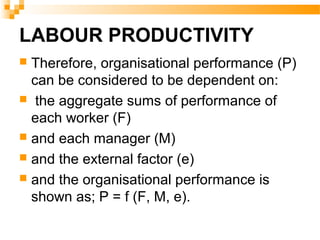
 Therefore, organisational performance (P)
can be considered to be dependent on:
 the aggregate sums of performance of
each worker (F)
 and each manager (M)
 and the external factor (e)
 and the organisational performance is
shown as; P = f (F, M, e).
LABOUR PRODUCTIVITY
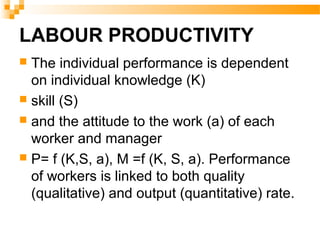
 The individual performance is dependent
on individual knowledge (K)
 skill (S)
 and the attitude to the work (a) of each
worker and manager
 P= f (K,S, a), M =f (K, S, a). Performance
of workers is linked to both quality
(qualitative) and output (quantitative) rate.
LABOUR PRODUCTIVITY
 Productivity and the quality of work can be
improved by:
 giving appropriate training to upgrade the:
 knowledge
 skills
 and attitude of workers and managers.
056 Labour Productivity

056 Labour Productivity

  • 1.
    FROM PRODUCTIVITY BRIEFCASESHELP DESK LABOUR PRODUCTIVITY
  • 2.
    LABOUR PRODUCTIVITY  Alarge proportion of the high cost in construction work is as a result of excessive labour costs.  These costs can be reduced if productivity on site is increased by improving labour efficiency.
  • 3.
    LABOUR PRODUCTIVITY  Labourproductivity is determined by a complexity of factors.  One of these factors is the type and size of the project.  It includes the layout and complexity of the project.  A large construction site requiring a large number of workers will be relatively harder to manage than a smaller size.
  • 4.
    LABOUR PRODUCTIVITY  Thedifficulties in managing manpower on a large scale may result in productivity loss (Thomas and Jansma, 1985).  There are four main factors that affect labour productivity; 1. The duration of worker’s effort. 2. The intensity of worker’s effort. 3. The effectiveness of worker’s effort combined with the technology used. 4. The efficiency of worker’s effort, which can be described as a measure of how much the worker is utilising his ability.
  • 5.
    LABOUR PRODUCTIVITY  Workon a complex project (e.g. such as the construction of a major shopping centre) becomes more difficult as the project advances.  Off-site pre-fabrication units will reduce the number of labour hours required. Other factors such as:  the level of skill amongst the workers;  the length of the workday;  Innovative work practices can increase productivity.
  • 6.
    LABOUR PRODUCTIVITY  Inview of Olomolaiye et al (1998):  The personal attribution of workers contribute to the factors that directly affect productivity. These attributes as:  worker’s skills  experience  training  qualifications  Innate (inborn) physical and mental ability.  The intensity of the application of both skills and innate ability to the production process.
  • 7.
    LABOUR PRODUCTIVITY Thomas etal (1992) investigated the level of labour productivity for masonry activities from seven countries. Case study showed that:  little difference in productivity amongst the seven countries.  The aim of investigation was to show that productivity in  Australia  Canada  England  Finland,  Scotland  Sweden and the United State-was similar.
  • 8.
    LABOUR PRODUCTIVITY  Thesite with the highest level of disruption will have the worse level of productivity.  Other investigations show that labour disruption accounts for more than 50% of the variability in daily crew productivity.
  • 9.
    LABOUR PRODUCTIVITY  Anexcessive number of staff can be disruptive.  It also has the effect of reducing the level of productivity. The results of a model based survey of contractors (planning engineers) in France, Germany and UK Showed that :  the working schedule of UK and German contractors may be excessive;  can have an impact on construction productivity level.
  • 10.
    LABOUR PRODUCTIVITY  Thesurvey also identified that in the UK the labour force employed on site are:  26% directly employed  74% sub-contracted  In France 93% of the labour force on site are directly employed.  In France 7% are sub-contractors.  This trend goes back to year 2000 to 2003 and recently there has been some changes to above figures.
  • 11.
    LABOUR PRODUCTIVITY  Employmentpractice has an impact on the cohesiveness amongst the workforce. Some of the Important contributors towards Labour productivity are:  a culture of cohesiveness  common goal  strong sense of a team working  towards a common goal
  • 12.
    LABOUR PRODUCTIVITY  Aculture of team working involving all workers is to achieve a common goal.  A common goal on construction site is to achieve KPIs.  Labour productivity can also be improved if operatives on site avoid conflict.  Conflict on site can hamper the progress of work.  Team working reduces conflict and will greatly facilitate increased productivity.
  • 13.
    LABOUR PRODUCTIVITY  Theimportance of a directly or indirectly employed workforce.  and the effect on the dynamics of productivity is reiterated in several research work.  The growth in the construction sector is relatively stagnant.  The job security can be very bad during any recession for construction workforce.
  • 14.
    LABOUR PRODUCTIVITY  Thisis based on a number of observations.  One such observation is the limited use of mass production.  The reasons for high productivity amongst major contractors are:  Scheduled overtime is avoided  The labour force is directly employed  They are a mainly skilled work force
  • 15.
    LABOUR PRODUCTIVITY  Maximum40 hour per week is the norm rather than the exception.  There are also other factors such as:  high salary  job security which are also important reasons for high productivity amongst major construction firms.
  • 16.
    LABOUR PRODUCTIVITY Impact ofChanges on Labour Productivity  Any changes made to the original scope of work are costly.  They will have an effect on labour productivity.  Although some changes are inevitable, the impact on site productivity is nonetheless significant.
  • 17.
    LABOUR PRODUCTIVITY  Theimpact of changes in quantitative terms has been measured by researchers.  Changes impacts on the labour force’s efficiency.  The relationship between change and various types of disruption would result in productivity decline.
  • 18.
    LABOUR PRODUCTIVITY  Theincrease in the percentage of work hours spent on changes will lead to a 10- 20% loss in productivity.  Changes are considered an indirect factor influencing productivity.  It has also been realised that changes in themselves do not decrease productivity or efficiency.  It is the manpower involved in the process.
  • 19.
    LABOUR PRODUCTIVITY  Ifa change occurs in the final stage of a construction project:  the crew must stop working until the changes are carried out first.  Also the work method may require changes as well as more co-ordination being required.
  • 20.
    LABOUR PRODUCTIVITY  Ifchanges occur:  routine work will change,  processes will slow down  the total work hours will be several times greater.  On average, there is a 30% loss of efficiency when changes are being performed, although it is possible to carry out many changes without a loss of efficiency.
  • 21.
    LABOUR PRODUCTIVITY  Thevariables affecting efficiency are believed to be the time of the change.  Productivity can decline if there are:  repeat works  disruption  the presence of change
  • 22.
    LABOUR PRODUCTIVITY  Theimpact of change on the construction site will often result in disputes.  Changes should be kept to a minimum. Improving Productivity by Training Methods  Training is considered to be an influential factor in high productivity on construction sites.  The growth in labour only sub-contracting in UK construction sector.  The level and quality of training within the industry.
  • 23.
    LABOUR PRODUCTIVITY  Productivitywithin the UK construction industry compared with West Germany and France is partly the result of low levels of training labour force receive in UK amongst small firms.  Large UK firms have a good training policy.
  • 24.
    LABOUR PRODUCTIVITY  Improvingthe knowledge and skill of workers on construction sites.  Motivated work force.  Including the quality of management all can improve the productivity.  Site worker’s training is considered to be an important factor in improving site productivity.
  • 25.
    LABOUR PRODUCTIVITY  Therefore,organisational performance (P) can be considered to be dependent on:  the aggregate sums of performance of each worker (F)  and each manager (M)  and the external factor (e)  and the organisational performance is shown as; P = f (F, M, e).
  • 26.
    LABOUR PRODUCTIVITY  Theindividual performance is dependent on individual knowledge (K)  skill (S)  and the attitude to the work (a) of each worker and manager  P= f (K,S, a), M =f (K, S, a). Performance of workers is linked to both quality (qualitative) and output (quantitative) rate.
  • 27.
    LABOUR PRODUCTIVITY  Productivityand the quality of work can be improved by:  giving appropriate training to upgrade the:  knowledge  skills  and attitude of workers and managers.