PRODUCTIVITY IMPROVEMENT
IN CONSTRUCTION
ABSTRACT:
 The productivity level of construction industry is mostly depending
upon three factors they are labour characteristics, management systems
and external issues.
 It is important to develop innovative practices to improve construction
productivity.
 Factors affecting and theories on improvement of construction
productivity such as labour factor, management factors and external
factors.
 On reviews it is noted that there are lot of different methods and
strategies for improvement of construction productivity
INTRODUCTION:
 Construction industry is world's most largest and challenging industry.
 Human resource has a strategic role in increasing productivity in
construction industry.
 The construction projects are mostly labour based with basic use of hand
tools and equipment’s in which labour cost consists of about 30% to 50%
of total project cost.
 Indian construction industry is one of fastest growing sector globally.
 India shares about 8% of total GDP and also provides employment to
around 35 million peoples directly or indirectly.
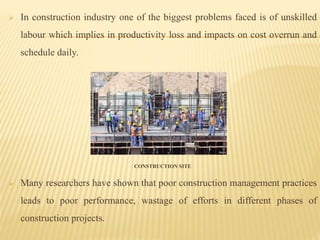
 In construction industry one of the biggest problems faced is of unskilled
labour which implies in productivity loss and impacts on cost overrun and
schedule daily.
CONSTRUCTION SITE
 Many researchers have shown that poor construction management practices
leads to poor performance, wastage of efforts in different phases of
construction projects.
METHODS OF IMPROVING PRODUCTIVITY:
 Training for labours
 Optimizing site facilities
 Availability of resources
 Competition between crews, areas or shifts
 Good supervision and optimum manpower
 Short interval scheduling
 Cost reporting and work sampling of critical activities
 Enough tools in working place and proper planning
 Time lapse film analysis for critical activities
LITERATURE OF REVIEW
 Arditi and Mochtar (2000): Several researchers studied the factors
affecting construction productivity in order to find the potentials for
productivity improvement. Indonesian indicated that certain functions
including procurement practices, cost control, scheduling and management
integration need much improvement.
 Lbbs (2005): Studied the impact of construction changes on productivity.
Project change is disruptive and detrimental to labor productivity.
 Moselhi et al (2005): conducted a study to investigate the impact of
change orders on construction productivity and introduced a new neural
network model for quantifying this impact.
 Kazaz and Ulubeyli (2007): Have studied the factors affecting
productivity among members of the construction workforce in Turkey.
The results show that monetary factors remain pre-eminent in influencing
productivity, but that socio-psychological factors appear to be of
increasing importance in this developing economy.
 Tran (2011): Conducted a thorough study into labour productivity in the
New Zealand construction industry. He stated that productivity growth is
strongly correlated to economic growth and increase welfare.
Productivity growth in the construction sector may have significant effect
on the affordability of housing in the country.
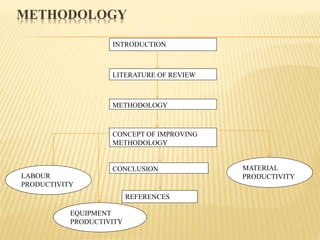
METHODOLOGY
INTRODUCTION
LABOUR
PRODUCTIVITY
MATERIAL
PRODUCTIVITY
LITERATURE OF REVIEW
CONCLUSION
CONCEPT OF IMPROVING
METHODOLOGY
REFERENCES
METHODOLOGY
EQUIPMENT
PRODUCTIVITY
CONCEPT OF IMPROVING PRODUCTIVITY
TYPES OF PRODUCTIVITY:
1. Labour productivity
2. Material productivity
3. Equipment productivity
1. LABOUR PRODUCTIVITY:
CHARACTERISTICS:
 Quality of Work - caliber of work produced or accomplished.
 Quantity of Work - volume of acceptable work
 Judgment - soundness of conclusions, decisions and actions.
 Initiative - ability to take effective action without being told.
 Delegating - effectiveness in delegating work appropriately.
 Profit and Cost Sensitivity - ability to seek out, generate and implement
profit-making ideas.
 Leadership - ability to develop in others the willingness and desire to
work towards common objectives.
TYPES OF LABOUR:
 Skilled – Labours.
 Semiskilled – Labours.
 Unskilled – Labours.
2. MATERIAL PRODUCTIVITY:
 Materials Productivity management is an important element in project
planning and control. Materials represent a major expense in
construction, so minimizing procurement or purchase costs presents
important opportunities for reducing costs.
OBJECTIVES:
 Primary objectives
 Secondary objectives
ELEMENTS OF MATERIAL PRODUCTIVITY:
a) Materials planning,
b) Inventory control.
c) Purchasing.
d) Stores management.
3. EQUIPEMENT MANAGEMENT:
Productivity in construction is often broadly defined as output per
labour/equipment hour.
TYPES OF EQUIPEMENTS USED IN CONSTRUCTION:
 Surveying equipments.
 Earth excavators.
 Tipper equipment.
 Tunneling equipment.
 Lifting equipment.
 Concrete mixer equipment etc.,
SURVEYING EARTH EXCAVATOR TIPPER EQUIPEMENT
EQUIPEMENT
TIPPER EQUIPEMENT TUNNELING EQUIPEMENT CONCRETE MIX EQUIPEMENT
CONCLUSION
 From the above literature it is concluded that there are many methods of
increasing productivity in construction industry. There is enormous study on
the methods which improve the productivity which consists of material
tracking, healthy and safe working condition and effective management
systems.
 It is seen that some methods are more efficient in the context of increasing
productivity like,
 Automatic materials tracking
 Work sampling method
 Collaboration between industries
 Construction productivity improvement officer
REFERENCES
 [1] S. G. Vekaria "Labour Productivity in Construction”
www.ijaresm.net ISSN: 2394-1766
 [2] Yogendra Kumar, "Productivity Analysis of Small Construction
Projects in India" Asian journal of applied sciences, 2013, ISSN:
1996-3343, 2013 PP-1-6.
 [3] Markus Liberda, Janaka Ruwanpura and George Jergeas
“Construction Productivity Improvement: A Study of Human,
Management and External Issues” ©ASCE 2003 PP 524-531
 [4] Sherif Mohamed, Korb Srinavin "Forecasting Labor
Productivity Changes in Construction Using the PMV Index"
International Journal of Industrial Ergonomics 35, 2005, pp-
345–351
 [5] David Grau, Carlos H. Caldas " Assessing the Impact of
Materials Tracking Technologies on
THANK YOU

Productivity improvement in construction

  • 1.
  • 2.
    ABSTRACT:  The productivitylevel of construction industry is mostly depending upon three factors they are labour characteristics, management systems and external issues.  It is important to develop innovative practices to improve construction productivity.  Factors affecting and theories on improvement of construction productivity such as labour factor, management factors and external factors.  On reviews it is noted that there are lot of different methods and strategies for improvement of construction productivity
  • 3.
    INTRODUCTION:  Construction industryis world's most largest and challenging industry.  Human resource has a strategic role in increasing productivity in construction industry.  The construction projects are mostly labour based with basic use of hand tools and equipment’s in which labour cost consists of about 30% to 50% of total project cost.  Indian construction industry is one of fastest growing sector globally.  India shares about 8% of total GDP and also provides employment to around 35 million peoples directly or indirectly.
  • 4.
     In constructionindustry one of the biggest problems faced is of unskilled labour which implies in productivity loss and impacts on cost overrun and schedule daily. CONSTRUCTION SITE  Many researchers have shown that poor construction management practices leads to poor performance, wastage of efforts in different phases of construction projects.
  • 5.
    METHODS OF IMPROVINGPRODUCTIVITY:  Training for labours  Optimizing site facilities  Availability of resources  Competition between crews, areas or shifts  Good supervision and optimum manpower  Short interval scheduling  Cost reporting and work sampling of critical activities  Enough tools in working place and proper planning  Time lapse film analysis for critical activities
  • 6.
    LITERATURE OF REVIEW Arditi and Mochtar (2000): Several researchers studied the factors affecting construction productivity in order to find the potentials for productivity improvement. Indonesian indicated that certain functions including procurement practices, cost control, scheduling and management integration need much improvement.  Lbbs (2005): Studied the impact of construction changes on productivity. Project change is disruptive and detrimental to labor productivity.  Moselhi et al (2005): conducted a study to investigate the impact of change orders on construction productivity and introduced a new neural network model for quantifying this impact.
  • 7.
     Kazaz andUlubeyli (2007): Have studied the factors affecting productivity among members of the construction workforce in Turkey. The results show that monetary factors remain pre-eminent in influencing productivity, but that socio-psychological factors appear to be of increasing importance in this developing economy.  Tran (2011): Conducted a thorough study into labour productivity in the New Zealand construction industry. He stated that productivity growth is strongly correlated to economic growth and increase welfare. Productivity growth in the construction sector may have significant effect on the affordability of housing in the country.
  • 8.
    METHODOLOGY INTRODUCTION LABOUR PRODUCTIVITY MATERIAL PRODUCTIVITY LITERATURE OF REVIEW CONCLUSION CONCEPTOF IMPROVING METHODOLOGY REFERENCES METHODOLOGY EQUIPMENT PRODUCTIVITY
  • 9.
    CONCEPT OF IMPROVINGPRODUCTIVITY TYPES OF PRODUCTIVITY: 1. Labour productivity 2. Material productivity 3. Equipment productivity
  • 10.
    1. LABOUR PRODUCTIVITY: CHARACTERISTICS: Quality of Work - caliber of work produced or accomplished.  Quantity of Work - volume of acceptable work  Judgment - soundness of conclusions, decisions and actions.  Initiative - ability to take effective action without being told.  Delegating - effectiveness in delegating work appropriately.  Profit and Cost Sensitivity - ability to seek out, generate and implement profit-making ideas.  Leadership - ability to develop in others the willingness and desire to work towards common objectives.
  • 11.
    TYPES OF LABOUR: Skilled – Labours.  Semiskilled – Labours.  Unskilled – Labours.
  • 12.
    2. MATERIAL PRODUCTIVITY: Materials Productivity management is an important element in project planning and control. Materials represent a major expense in construction, so minimizing procurement or purchase costs presents important opportunities for reducing costs. OBJECTIVES:  Primary objectives  Secondary objectives
  • 13.
    ELEMENTS OF MATERIALPRODUCTIVITY: a) Materials planning, b) Inventory control. c) Purchasing. d) Stores management.
  • 14.
    3. EQUIPEMENT MANAGEMENT: Productivityin construction is often broadly defined as output per labour/equipment hour. TYPES OF EQUIPEMENTS USED IN CONSTRUCTION:  Surveying equipments.  Earth excavators.  Tipper equipment.  Tunneling equipment.  Lifting equipment.  Concrete mixer equipment etc.,
  • 15.
    SURVEYING EARTH EXCAVATORTIPPER EQUIPEMENT EQUIPEMENT TIPPER EQUIPEMENT TUNNELING EQUIPEMENT CONCRETE MIX EQUIPEMENT
  • 16.
    CONCLUSION  From theabove literature it is concluded that there are many methods of increasing productivity in construction industry. There is enormous study on the methods which improve the productivity which consists of material tracking, healthy and safe working condition and effective management systems.  It is seen that some methods are more efficient in the context of increasing productivity like,  Automatic materials tracking  Work sampling method  Collaboration between industries  Construction productivity improvement officer
  • 17.
    REFERENCES  [1] S.G. Vekaria "Labour Productivity in Construction” www.ijaresm.net ISSN: 2394-1766  [2] Yogendra Kumar, "Productivity Analysis of Small Construction Projects in India" Asian journal of applied sciences, 2013, ISSN: 1996-3343, 2013 PP-1-6.  [3] Markus Liberda, Janaka Ruwanpura and George Jergeas “Construction Productivity Improvement: A Study of Human, Management and External Issues” ©ASCE 2003 PP 524-531
  • 18.
     [4] SherifMohamed, Korb Srinavin "Forecasting Labor Productivity Changes in Construction Using the PMV Index" International Journal of Industrial Ergonomics 35, 2005, pp- 345–351  [5] David Grau, Carlos H. Caldas " Assessing the Impact of Materials Tracking Technologies on
  • 19.