Construction Productivity Productivity Measurement and Benchmarking
Productivity By popular definition productivity simply refers to the general efficiency of an organization or individual The output of any aspect of production per unit of input Economic measure of output of a worker, machine, or an entire national economy in the creation of goods and services to produce wealth In the business world, productivity measures investment in capital, such as buildings, machines, raw materials & in labour against the profits from the sale of the product

Productivity A company that most minimizes input and maximizes output has the highest productivity A total concept that addresses the key elements of competition i.e. innovation, cost, quality and delivery Should be viewed as value adding in addition to optimizing Construction is a labour intensive process Manpower is one of the productive resources in construction Construction productivity largely depends upon human performance Reliable measures of productivity is output per work-hour being achieved by workers
Why is Productivity Important? Extremely vital performance measurement tool within the construction industry Due to size of construction industry productivity trends carry immense consequences for the economy as a whole Productivity growth is important to an individual enterprise, an industry or an economy Construction industry accounts for 3 – 8% of the GDP in most countries
Why is Productivity Important? Productivity improvement in construction industry may have a significant impact on improving GDP Productivity growth is the key determinant of international competitiveness in the long term Improving relative productivity growth improves a country’s competitive position The construction industry – most challenging and demanding still many opportunities for productivity improvement
Factors Affecting Construction Labour Productivity Project uniqueness Technology Management Labour organization Real wage trends Construction training
Factors having adverse effect on productivity Overtime and or Fatigue Errors and omissions in plans and specifications Multitude of change orders Design complexity and Design completeness Stacking of trades Dilution of supervision High accident rate Jurisdictional disputes Work rules and restrictive work practices Availability of skilled labour Reassignment of manpower from task to task Material location – above ground level/above floor level Adverse temperature or weather Inadequate lighting
Regulations of various types High absenteeism High turnover Material shortages Ground water level Attitude of the workforce Crew size and composition Economic conditions & level of unemployment Size and duration of the project Timeliness of decisions Impractical QA / QC tolerances Uncontrolled breaks Time of the day & day of the week Inadequate temporary facilities: parking, change / rest rooms etc
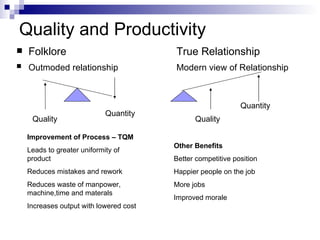
Quality and Productivity Folklore True Relationship Outmoded relationship Modern view of Relationship Quality Quantity Quality Quantity Improvement of Process – TQM Leads to greater uniformity of product Reduces mistakes and rework Reduces waste of manpower, machine,time and materals Increases output with lowered cost Other Benefits Better competitive position Happier people on the job More jobs Improved morale
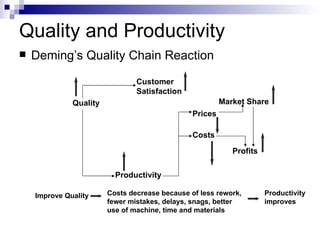
Quality and Productivity Deming’s Quality Chain Reaction Quality Customer Satisfaction Market Share Productivity Prices Costs Profits Improve Quality  Costs decrease because of less rework, fewer mistakes, delays, snags, better use of machine, time and materials Productivity improves
Productivity and Safety Worldwide – construction industry produces more injuries than other industries Construction industry – often criticized for poor performance (low productivity, waste, health and safety problems) Strongest relations exist between work organizational factors, working conditions & health & absenteeism Research shows that occupational safety and health improved (less health complaints and less accidents) when working conditions and work organization ameliorated Improving safety improves productivity
Methods of Improving Productivity The following factors can lead to the improvement in productivity: Training programs for labour Incentives in contract for good performance Enough tools in working place and proper planning Optimizing site facilities Availability of resources Competition between crews, areas or shifts Good supervision and optimum manpower Short interval scheduling Innovative materials and equipment Time lapse film analysis for critical activities Cost reporting and work sampling of critical activities
Time and motion studies to improve efficiency, reduce fatigue and work smarter Safety programs Use of precast and prestressing concrete elements Critical path method of planning, scheduling and control Value engineering Worker motivation programs Constructability review of design Standardization Preplanning activities Effective utilization of sub-contractors
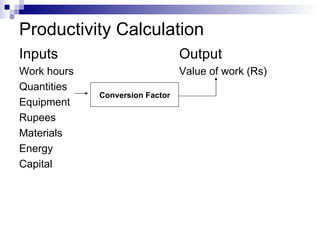
Productivity Calculation Inputs Output Work hours Value of work (Rs) Quantities Equipment Rupees Materials Energy Capital Conversion Factor
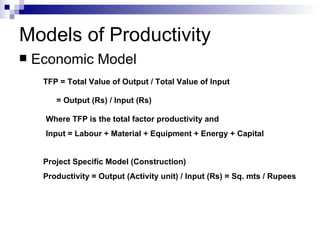
Models of Productivity Economic Model TFP = Total Value of Output / Total Value of Input  = Output (Rs) / Input (Rs) Where TFP is the total factor productivity and  Input = Labour + Material + Equipment + Energy + Capital Project Specific Model (Construction) Productivity = Output (Activity unit) / Input (Rs) = Sq. mts / Rupees
Activity Oriented Model Measured in terms of Labour Productivity Can be measured in two ways: a) Output / Input or b) Input / Output Input can be in terms of Cost or Man hours and Output can be in terms of Unit of work performed Generally the second model i.e. Input / Output is used to measure the productivity but again the choice depends on the monitoring party
Input and output being the same the productivity comparison depends on the following factors Size of the Job Material Availability Schedule of Activities Connection or interlinking of activities Support operations Location Therefore a comparison of productivity can only be made if the conditions are similar and also the activities are similar.
Major causes leading to poor productivity Congestion Sequencing Lack of materials A high variability in the unit productivity value is an indication of poor productivity and a low variability indicates good productivity
Productivity Benchmarking Benchmarking is a systematic process of searching for the best practices, innovative ideas and highly effective operating procedures that lead to superior performance Purpose of Benchmarking a) Analyze the operations to - Identify the critical cost components and areas for improvement - Reduction in the cycle time of activities b) To get knowledge of the competition & industry leaders c) To incorporate the best of the best – learn & emulate the best d) To gain superiority over competitors
Types of Benchmarking Internal - Comparison among similar operations within one’s own organization Competitive - This is comparison to the best of the direct competitors Functional - Comparison of the methods with the companies with similar processes in the same function outside one’s country
Types of Benchmarking Generic -  Comparison of work processes to others who have innovative, exemplar work processes Cooperative -  Contacting the best in class firms and asking them for knowledge sharing Collaborative -  A group of firms sharing knowledge about a particular activity
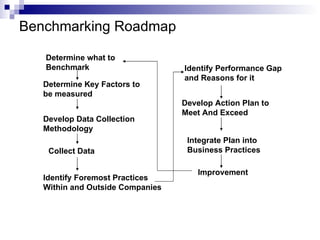
Benchmarking Roadmap Determine what to Benchmark Determine Key Factors to be measured Develop Data Collection Methodology Collect Data Identify Foremost Practices Within and Outside Companies Identify Performance Gap and Reasons for it Develop Action Plan to Meet And Exceed Integrate Plan into Business Practices Improvement
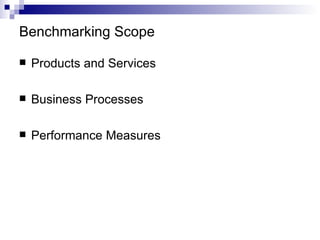
Benchmarking Scope Products and Services Business Processes Performance Measures
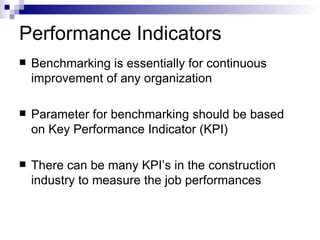
Performance Indicators Benchmarking is essentially for continuous improvement of any organization Parameter for benchmarking should be based on Key Performance Indicator (KPI) There can be many KPI’s in the construction industry to measure the job performances
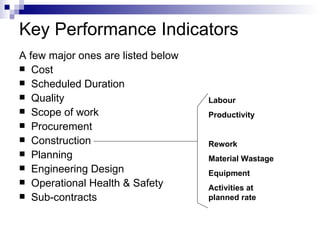
Key Performance Indicators A few major ones are listed below Cost Scheduled Duration Quality Scope of work Procurement Construction Planning Engineering Design Operational Health & Safety Sub-contracts Labour Productivity Rework Material Wastage Equipment Activities at planned rate
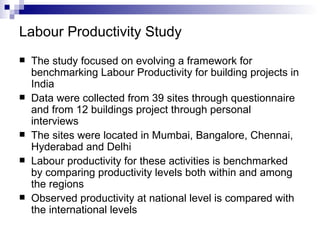
Labour Productivity Study The study focused on evolving a framework for benchmarking Labour Productivity for building projects in India Data were collected from 39 sites through questionnaire and from 12 buildings project through personal interviews The sites were located in Mumbai, Bangalore, Chennai, Hyderabad and Delhi Labour productivity for these activities is benchmarked by comparing productivity levels both within and among the regions Observed productivity at national level is compared with the international levels
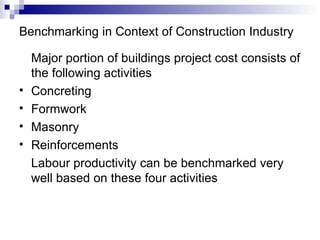
Benchmarking in Context of Construction Industry Major portion of buildings project cost consists of the following activities Concreting Formwork Masonry Reinforcements Labour productivity can be benchmarked very well based on these four activities
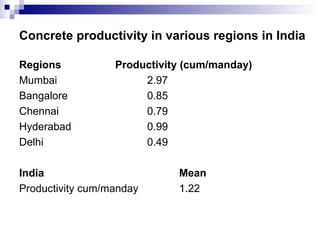
Concrete productivity in various regions in India Regions Productivity (cum/manday) Mumbai 2.97 Bangalore 0.85 Chennai 0.79 Hyderabad 0.99 Delhi 0.49 India Mean Productivity cum/manday 1.22
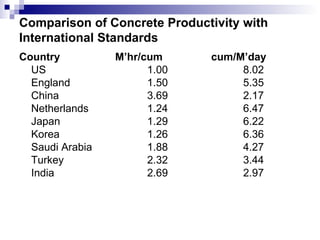
Comparison of Concrete Productivity with International Standards Country M’hr/cum cum/M’day US 1.00 8.02 England 1.50 5.35 China 3.69 2.17 Netherlands 1.24 6.47 Japan 1.29 6.22 Korea 1.26 6.36 Saudi Arabia 1.88 4.27 Turkey 2.32 3.44 India 2.69 2.97
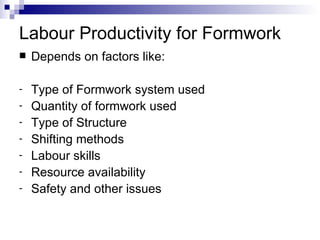
Labour Productivity for Formwork Depends on factors like: Type of Formwork system used Quantity of formwork used Type of Structure Shifting methods Labour skills Resource availability Safety and other issues
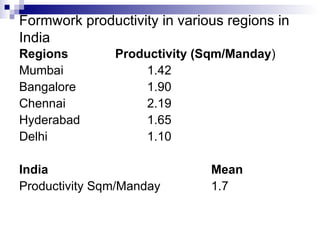
Formwork productivity in various regions in India Regions Productivity (Sqm/Manday ) Mumbai 1.42 Bangalore 1.90 Chennai 2.19 Hyderabad 1.65 Delhi 1.10 India Mean Productivity Sqm/Manday 1.7
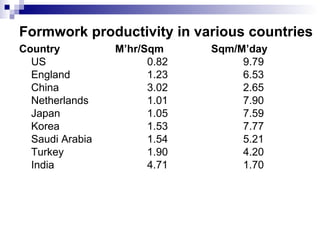
Formwork productivity in various countries Country M’hr/Sqm Sqm/M’day US 0.82 9.79 England 1.23 6.53 China 3.02 2.65 Netherlands 1.01 7.90 Japan 1.05 7.59 Korea 1.53 7.77 Saudi Arabia 1.54 5.21 Turkey 1.90 4.20 India 4.71 1.70
Labour Productivity for Masonry Depends on factors like Size of Block Method of shifting Lead and shift Labour skill Type of Structure Safety and other issues
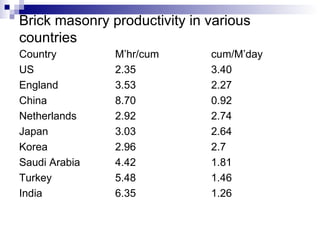
Brick masonry productivity in various countries Country M’hr/cum cum/M’day US 2.35 3.40 England 3.53 2.27 China 8.70 0.92 Netherlands 2.92 2.74 Japan 3.03 2.64 Korea 2.96 2.7 Saudi Arabia 4.42 1.81 Turkey 5.48 1.46 India 6.35 1.26
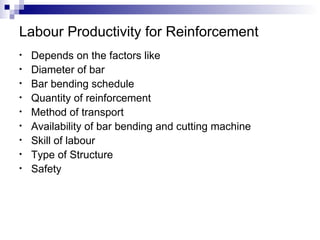
Labour Productivity for Reinforcement Depends on the factors like Diameter of bar Bar bending schedule Quantity of reinforcement Method of transport Availability of bar bending and cutting machine Skill of labour Type of Structure Safety
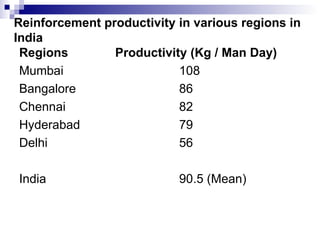
Reinforcement productivity in various regions in India Regions Productivity (Kg / Man Day) Mumbai 108 Bangalore 86 Chennai 82 Hyderabad 79 Delhi 56 India 90.5 (Mean)
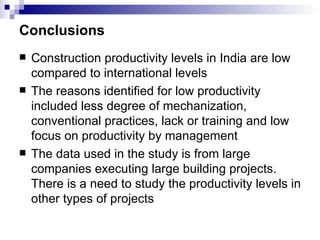
Conclusions Construction productivity levels in India are low compared to international levels The reasons identified for low productivity included less degree of mechanization, conventional practices, lack or training and low focus on productivity by management The data used in the study is from large companies executing large building projects.  There is a need to study the productivity levels in other types of projects
Thank You

Construction productivity

  • 1.
    Construction Productivity ProductivityMeasurement and Benchmarking
  • 2.
    Productivity By populardefinition productivity simply refers to the general efficiency of an organization or individual The output of any aspect of production per unit of input Economic measure of output of a worker, machine, or an entire national economy in the creation of goods and services to produce wealth In the business world, productivity measures investment in capital, such as buildings, machines, raw materials & in labour against the profits from the sale of the product
  • 3.
    Productivity A companythat most minimizes input and maximizes output has the highest productivity A total concept that addresses the key elements of competition i.e. innovation, cost, quality and delivery Should be viewed as value adding in addition to optimizing Construction is a labour intensive process Manpower is one of the productive resources in construction Construction productivity largely depends upon human performance Reliable measures of productivity is output per work-hour being achieved by workers
  • 4.
    Why is ProductivityImportant? Extremely vital performance measurement tool within the construction industry Due to size of construction industry productivity trends carry immense consequences for the economy as a whole Productivity growth is important to an individual enterprise, an industry or an economy Construction industry accounts for 3 – 8% of the GDP in most countries
  • 5.
    Why is ProductivityImportant? Productivity improvement in construction industry may have a significant impact on improving GDP Productivity growth is the key determinant of international competitiveness in the long term Improving relative productivity growth improves a country’s competitive position The construction industry – most challenging and demanding still many opportunities for productivity improvement
  • 6.
    Factors Affecting ConstructionLabour Productivity Project uniqueness Technology Management Labour organization Real wage trends Construction training
  • 7.
    Factors having adverseeffect on productivity Overtime and or Fatigue Errors and omissions in plans and specifications Multitude of change orders Design complexity and Design completeness Stacking of trades Dilution of supervision High accident rate Jurisdictional disputes Work rules and restrictive work practices Availability of skilled labour Reassignment of manpower from task to task Material location – above ground level/above floor level Adverse temperature or weather Inadequate lighting
  • 8.
    Regulations of varioustypes High absenteeism High turnover Material shortages Ground water level Attitude of the workforce Crew size and composition Economic conditions & level of unemployment Size and duration of the project Timeliness of decisions Impractical QA / QC tolerances Uncontrolled breaks Time of the day & day of the week Inadequate temporary facilities: parking, change / rest rooms etc
  • 9.
    Quality and ProductivityFolklore True Relationship Outmoded relationship Modern view of Relationship Quality Quantity Quality Quantity Improvement of Process – TQM Leads to greater uniformity of product Reduces mistakes and rework Reduces waste of manpower, machine,time and materals Increases output with lowered cost Other Benefits Better competitive position Happier people on the job More jobs Improved morale
  • 10.
    Quality and ProductivityDeming’s Quality Chain Reaction Quality Customer Satisfaction Market Share Productivity Prices Costs Profits Improve Quality Costs decrease because of less rework, fewer mistakes, delays, snags, better use of machine, time and materials Productivity improves
  • 11.
    Productivity and SafetyWorldwide – construction industry produces more injuries than other industries Construction industry – often criticized for poor performance (low productivity, waste, health and safety problems) Strongest relations exist between work organizational factors, working conditions & health & absenteeism Research shows that occupational safety and health improved (less health complaints and less accidents) when working conditions and work organization ameliorated Improving safety improves productivity
  • 12.
    Methods of ImprovingProductivity The following factors can lead to the improvement in productivity: Training programs for labour Incentives in contract for good performance Enough tools in working place and proper planning Optimizing site facilities Availability of resources Competition between crews, areas or shifts Good supervision and optimum manpower Short interval scheduling Innovative materials and equipment Time lapse film analysis for critical activities Cost reporting and work sampling of critical activities
  • 13.
    Time and motionstudies to improve efficiency, reduce fatigue and work smarter Safety programs Use of precast and prestressing concrete elements Critical path method of planning, scheduling and control Value engineering Worker motivation programs Constructability review of design Standardization Preplanning activities Effective utilization of sub-contractors
  • 14.
    Productivity Calculation InputsOutput Work hours Value of work (Rs) Quantities Equipment Rupees Materials Energy Capital Conversion Factor
  • 15.
    Models of ProductivityEconomic Model TFP = Total Value of Output / Total Value of Input = Output (Rs) / Input (Rs) Where TFP is the total factor productivity and Input = Labour + Material + Equipment + Energy + Capital Project Specific Model (Construction) Productivity = Output (Activity unit) / Input (Rs) = Sq. mts / Rupees
  • 16.
    Activity Oriented ModelMeasured in terms of Labour Productivity Can be measured in two ways: a) Output / Input or b) Input / Output Input can be in terms of Cost or Man hours and Output can be in terms of Unit of work performed Generally the second model i.e. Input / Output is used to measure the productivity but again the choice depends on the monitoring party
  • 17.
    Input and outputbeing the same the productivity comparison depends on the following factors Size of the Job Material Availability Schedule of Activities Connection or interlinking of activities Support operations Location Therefore a comparison of productivity can only be made if the conditions are similar and also the activities are similar.
  • 18.
    Major causes leadingto poor productivity Congestion Sequencing Lack of materials A high variability in the unit productivity value is an indication of poor productivity and a low variability indicates good productivity
  • 19.
    Productivity Benchmarking Benchmarkingis a systematic process of searching for the best practices, innovative ideas and highly effective operating procedures that lead to superior performance Purpose of Benchmarking a) Analyze the operations to - Identify the critical cost components and areas for improvement - Reduction in the cycle time of activities b) To get knowledge of the competition & industry leaders c) To incorporate the best of the best – learn & emulate the best d) To gain superiority over competitors
  • 20.
    Types of BenchmarkingInternal - Comparison among similar operations within one’s own organization Competitive - This is comparison to the best of the direct competitors Functional - Comparison of the methods with the companies with similar processes in the same function outside one’s country
  • 21.
    Types of BenchmarkingGeneric - Comparison of work processes to others who have innovative, exemplar work processes Cooperative - Contacting the best in class firms and asking them for knowledge sharing Collaborative - A group of firms sharing knowledge about a particular activity
  • 22.
    Benchmarking Roadmap Determinewhat to Benchmark Determine Key Factors to be measured Develop Data Collection Methodology Collect Data Identify Foremost Practices Within and Outside Companies Identify Performance Gap and Reasons for it Develop Action Plan to Meet And Exceed Integrate Plan into Business Practices Improvement
  • 23.
    Benchmarking Scope Productsand Services Business Processes Performance Measures
  • 24.
    Performance Indicators Benchmarkingis essentially for continuous improvement of any organization Parameter for benchmarking should be based on Key Performance Indicator (KPI) There can be many KPI’s in the construction industry to measure the job performances
  • 25.
    Key Performance IndicatorsA few major ones are listed below Cost Scheduled Duration Quality Scope of work Procurement Construction Planning Engineering Design Operational Health & Safety Sub-contracts Labour Productivity Rework Material Wastage Equipment Activities at planned rate
  • 26.
    Labour Productivity StudyThe study focused on evolving a framework for benchmarking Labour Productivity for building projects in India Data were collected from 39 sites through questionnaire and from 12 buildings project through personal interviews The sites were located in Mumbai, Bangalore, Chennai, Hyderabad and Delhi Labour productivity for these activities is benchmarked by comparing productivity levels both within and among the regions Observed productivity at national level is compared with the international levels
  • 27.
    Benchmarking in Contextof Construction Industry Major portion of buildings project cost consists of the following activities Concreting Formwork Masonry Reinforcements Labour productivity can be benchmarked very well based on these four activities
  • 28.
    Concrete productivity invarious regions in India Regions Productivity (cum/manday) Mumbai 2.97 Bangalore 0.85 Chennai 0.79 Hyderabad 0.99 Delhi 0.49 India Mean Productivity cum/manday 1.22
  • 29.
    Comparison of ConcreteProductivity with International Standards Country M’hr/cum cum/M’day US 1.00 8.02 England 1.50 5.35 China 3.69 2.17 Netherlands 1.24 6.47 Japan 1.29 6.22 Korea 1.26 6.36 Saudi Arabia 1.88 4.27 Turkey 2.32 3.44 India 2.69 2.97
  • 30.
    Labour Productivity forFormwork Depends on factors like: Type of Formwork system used Quantity of formwork used Type of Structure Shifting methods Labour skills Resource availability Safety and other issues
  • 31.
    Formwork productivity invarious regions in India Regions Productivity (Sqm/Manday ) Mumbai 1.42 Bangalore 1.90 Chennai 2.19 Hyderabad 1.65 Delhi 1.10 India Mean Productivity Sqm/Manday 1.7
  • 32.
    Formwork productivity invarious countries Country M’hr/Sqm Sqm/M’day US 0.82 9.79 England 1.23 6.53 China 3.02 2.65 Netherlands 1.01 7.90 Japan 1.05 7.59 Korea 1.53 7.77 Saudi Arabia 1.54 5.21 Turkey 1.90 4.20 India 4.71 1.70
  • 33.
    Labour Productivity forMasonry Depends on factors like Size of Block Method of shifting Lead and shift Labour skill Type of Structure Safety and other issues
  • 34.
    Brick masonry productivityin various countries Country M’hr/cum cum/M’day US 2.35 3.40 England 3.53 2.27 China 8.70 0.92 Netherlands 2.92 2.74 Japan 3.03 2.64 Korea 2.96 2.7 Saudi Arabia 4.42 1.81 Turkey 5.48 1.46 India 6.35 1.26
  • 35.
    Labour Productivity forReinforcement Depends on the factors like Diameter of bar Bar bending schedule Quantity of reinforcement Method of transport Availability of bar bending and cutting machine Skill of labour Type of Structure Safety
  • 36.
    Reinforcement productivity invarious regions in India Regions Productivity (Kg / Man Day) Mumbai 108 Bangalore 86 Chennai 82 Hyderabad 79 Delhi 56 India 90.5 (Mean)
  • 37.
    Conclusions Construction productivitylevels in India are low compared to international levels The reasons identified for low productivity included less degree of mechanization, conventional practices, lack or training and low focus on productivity by management The data used in the study is from large companies executing large building projects. There is a need to study the productivity levels in other types of projects
  • 38.