CONTROLLING PRODUCTIVITY IN
CONSTRUCTION PROJECTS
Labor Productivity Improvement in Construction Projects using
WBS & OBS integration
Essam, Bio
2
• Essam Lotfi is a Project Manager-MEP at Trojan general contracting in UAE.
• BSc. in Electrical Engineering, Power Distribution through Zagazig University, Egypt since
2001. Pursued and achieved his certificates in Project Management (PMP®) from PMI-
USA since 2013, and certificate in Cost Management (CCP®) from AACE International
since june-2014.
• 15 years extensive hands on experience in various aspects of projects and project
management within maintenance, power distribution networks monitoring and
supervision and construction projects as well.
• Authored, Co-Authored at PMWorld Library, PWLJ.
• Volunteered at PMI-Global Congress EMEA-2014 – Dubai, 5th to 8th May 2014.
• Technical presentation at PMI-AGC 15th International conference –Bahrain 19th to 21st
January 2015.
• Technical presentation at 54th AACEi-SF Bay Annual Western Winter Workshop, Lake
Tahoe, Nevada, USA
• Technical presentation 55th AACEi-SF Bay Annual Western Winter Workshop, Indian
Wells, CA, USA
• Independent Project Management and cost engineering/Control Instructor.
• Common causes of loss in productivity.
• Using earned value implementation in labor productivity
monitoring & Controlling.
• Labor productivity improvement using WBS & OBS
integration model.
Outlines
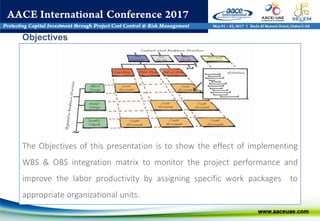
The Objectives of this presentation is to show the effect of implementing
WBS & OBS integration matrix to monitor the project performance and
improve the labor productivity by assigning specific work packages to
appropriate organizational units.
Objectives
Team Member Role Reporting To Responsibilities
Project Manager (PM) 1- Lead project Team Organization Management 1- Monitor Cost
2- Monitor Time
3- Achieve Planned cost
4- Achieve Planned Time
Construction Manager (CM) 1-Lead Activities Execution Project Manager (PM) 1-Monitor progress
2- Monitor Progress 2-Momitor Subcontractors
Performance
3-prepare payments
4-Follow issues with consultant
Project Engineer (PE) 1- Lead Drawing approvals Construction Manager (CM) 1- Deliver Drawings & materials
2- Lead material approvals As per project requirements
3- Follow material delivery 2-Issue Materials orders.
4- Distribute activities 3- Follow materials delivery
4- Distribute activities with related
Materials & Drawings.
5- Conform Quality.
Site Engineer (SE)
1-Leads Supervisors
Project Engineer (PE)
1- Distribute supervisors & Technicians
2- Lead Technicians 2- Follow planned Activities.
3- Lead Store 3- Issue materials from stores
4- Achieve progress
5- Perform Quality
Supervisors 1- Lead Technicians Site Engineer (SE) 1- Perform Drawings
2- Supervise installation 2- Control Technicians productivity
3- Control Materials installation
4- Achieve Quality
9
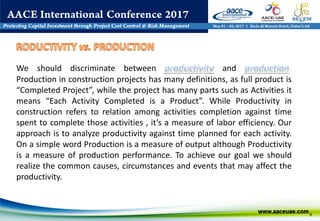
We should discriminate between and .
Production in construction projects has many definitions, as full product is
“Completed Project”, while the project has many parts such as Activities it
means “Each Activity Completed is a Product”. While Productivity in
construction refers to relation among activities completion against time
spent to complete those activities , it’s a measure of labor efficiency. Our
approach is to analyze productivity against time planned for each activity.
On a simple word Production is a measure of output although Productivity
is a measure of production performance. To achieve our goal we should
realize the common causes, circumstances and events that may affect the
productivity.
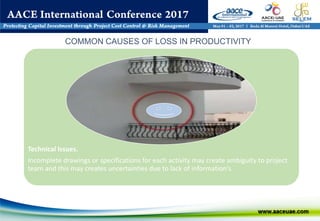
Technical Issues.
Incomplete drawings or specifications for each activity may create ambiguity to project
team and this may creates uncertainties due to lack of information’s.
COMMON CAUSES OF LOSS IN PRODUCTIVITY
Missed Supervision.
”Relocation of work force before task is completed”. And over loading supervisors with
multitasks in different areas. This two major categories resulting missed supervision and low
performance as well.
COMMON CAUSES OF LOSS IN PRODUCTIVITY
Wrong Distribution of resources.
The right materials, tools, equipment's and any other resources must be provided
to that location in order to have the desired productivity. Unplanned distribution
result in delays due to shifting wrong materials and any other resources to the area
of subject matter work is required.
COMMON CAUSES OF LOSS IN PRODUCTIVITY
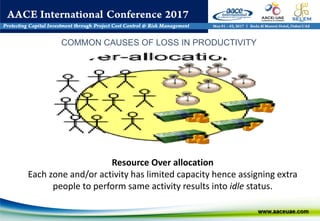
Resource Over allocation
Each zone and/or activity has limited capacity hence assigning extra
people to perform same activity results into idle status.
COMMON CAUSES OF LOSS IN PRODUCTIVITY
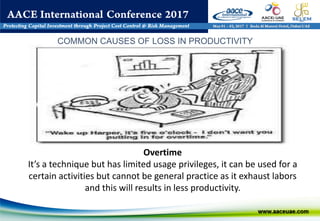
Overtime
It’s a technique but has limited usage privileges, it can be used for a
certain activities but cannot be general practice as it exhaust labors
and this will results in less productivity.
COMMON CAUSES OF LOSS IN PRODUCTIVITY
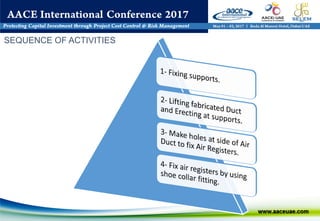
Installation of Air Duct (Shoe Collar) for Exhaust system at parking area
,Normally follow the following criteria
SEQUENCE OF ACTIVITIES
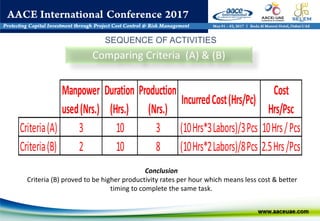
Comparing Criteria (A) & (B)
Manpower
used(Nrs.)
Duration
(Hrs.)
Production
(Nrs.)
IncurredCost(Hrs/Pc)
Cost
Hrs/Psc
Criteria(A) 3 10 3 (10Hrs*3Labors)/3Pcs 10Hrs/Pcs
Criteria(B) 2 10 8 (10Hrs*2Labors)/8Pcs 2.5Hrs/Pcs
Conclusion
Criteria (B) proved to be higher productivity rates per hour which means less cost & better
timing to complete the same task.
SEQUENCE OF ACTIVITIES
19
Effect of Learning Curve in Labor Productivity
Learning Curve
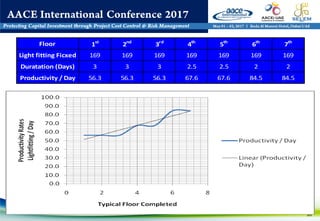
It’s a technique achieved by repeating same activity in different zones by a fixed group of
technicians, in case those groups got interrupted before completing same activity in all
zones the productivity of those groups will be lower when we assign them again to the
previous activity zone, Look at the following example to find the implications of interrupting
learning curve.
Example
In residential tower has typical floors, we assigned a group of
technicians to fix light fitting under supervision of one supervisor,
we noticed the following,
20
Floor 1st
2nd
3rd
4th
5th
6th
7th
Light fitting Ficxed 169 169 169 169 169 169 169
Duratation (Days) 3 3 3 2.5 2.5 2 2
Productivity / Day 56.3 56.3 56.3 67.6 67.6 84.5 84.5
21
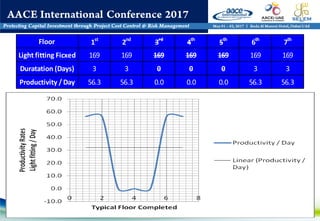
Floor 1st
2nd
3rd
4th
5th
6th
7th
Light fitting Ficxed 169 169 169 169 169 169 169
Duratation (Days) 3 3 0 0 0 3 3
Productivity / Day 56.3 56.3 0.0 0.0 0.0 56.3 56.3
22
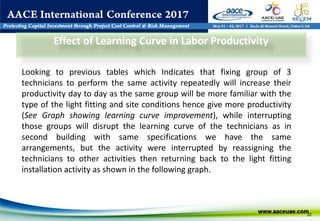
Effect of Learning Curve in Labor Productivity
Looking to previous tables which Indicates that fixing group of 3
technicians to perform the same activity repeatedly will increase their
productivity day to day as the same group will be more familiar with the
type of the light fitting and site conditions hence give more productivity
(See Graph showing learning curve improvement), while interrupting
those groups will disrupt the learning curve of the technicians as in
second building with same specifications we have the same
arrangements, but the activity were interrupted by reassigning the
technicians to other activities then returning back to the light fitting
installation activity as shown in the following graph.
23
EARNED VALUE IMPLEMENTATION
24
ActivityName
PlannedManpower
TotalGroup
Productivity
Rate/Group/Day
Unit
TargetDuration/Days
Actualay1
Actualay2
Actualay3
Actualay4
Actualay5
Actualay6
Actualay7
Actualay8
Actualay9
Actualay10
Actualay11
Actualay12
Actualay13
Actualay14
ManpowerCumulative
Completedfloors
plannedtarget
Targetfloors
BalanceWork
Earned
Value Of
Manpow
er Hours
Lightfixtures
TypicalFloor
24 3G 1
Floor
11 13 13 13 13 13 13 13 13 14 15 15 14 5 2 169 8 6.5 11 3 360.0
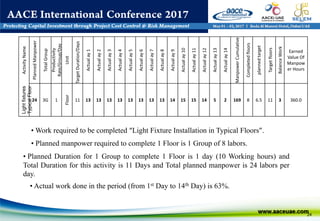
• Work required to be completed “Light Fixture Installation in Typical Floors”.
• Planned manpower required to complete 1 Floor is 1 Group of 8 labors.
• Planned Duration for 1 Group to complete 1 Floor is 1 day (10 Working hours) and
Total Duration for this activity is 11 Days and Total planned manpower is 24 labors per
day.
• Actual work done in the period (from 1st Day to 14th Day) is 63%.
25
ActivityName
PlannedManpower
TotalGroup
Productivity
Rate/Group/Day
Unit
TargetDuration/Days
Actualay1
Actualay2
Actualay3
Actualay4
Actualay5
Actualay6
Actualay7
Actualay8
Actualay9
Actualay10
Actualay11
Actualay12
Actualay13
Actualay14
ManpowerCumulative
Completedfloors
plannedtarget
Targetfloors
BalanceWork
Earned
Value Of
Manpow
er Hours
Lightfixtures
TypicalFloor
24 3G 1
Floor
11 13 13 13 13 13 13 13 13 14 15 15 14 5 2 169 8 6.5 11 3 360.0
• Actual consumed manpower in the period (from 1st Day to 14th Day) is 169 labors.
• Planned work to be completed is 33 floors in 11 days using 3 groups (24 labors) per day
or total 264 labors.
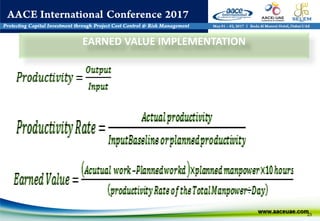
• Apply earned value calculations using Earned Value Equation. the actual spent
manpower 169 should give 8 floor where the planned should be 6.3 floors using the same
number of manpower, which means although we are behind schedule the productivity
achieved by the available manpower achieved 136 hours under budget
EARNED VALUE
26
Productivity Improvement
As we see from the example a clear scope for specific single organizational
component in the organizational break down structure (OBS) will give the right
framework of monitoring project performance and labor productivity as well,
further to this it’s apparent that this model reflects avoidance of many causes
of productivity loss. Such as miss of supervision and resource wrong
distribution. This will bring to mind where the necessity of WBS & OBS
integration matrix is and what the real effect of direct labor cost control is?,
here we come to the objective of this Presentation which is how to improve
labor direct cost using WBS & OBS integration and how it can be implemented.
27
Productivity Improvement
 To monitor labor performance during construction you must have
clear framework.
 This framework requires all team members to know their roles and
responsibilities thru. RAM.
 Use WBS & OBS integration matrix to assign specific resources to
specific task
28
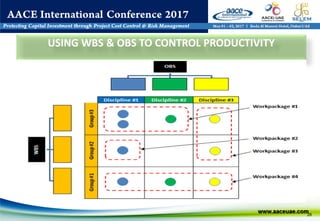
USING WBS & OBS TO CONTROL PRODUCTIVITY
29
Working Example
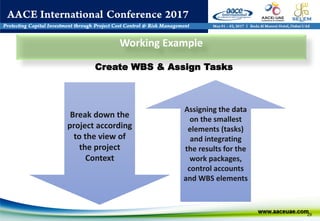
Create WBS & Assign Tasks
Assigning the data
on the smallest
elements (tasks)
and integrating
the results for the
work packages,
control accounts
and WBS elements
Break down the
project according
to the view of
the project
Context
30
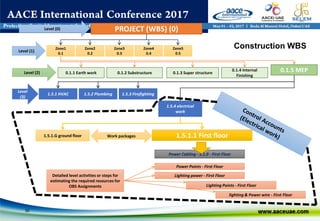
Construction WBS
PROJECT (WBS) (0)
Zone1
0.1
Zone2
0.2
Zone3
0.3
Zone4
0.4
Zone5
0.5
Level (0)
Level (1)
0.1.1 Earth work 0.1.2 Substructure 0.1.3 Super structure
0.1.4 Internal
Finishing
0.1.5 MEP
1.5.1 HVAC 1.5.2 Plumbing 1.5.3 Firefighting
1.5.4 electrical
work
1.5.1.G ground floor 1.5.1.1 First floor
Level (2)
Level
(3)
Power Cabling - 3.1.0 - First Floor
Lighting Points - First Floor
Power Points - First Floor
lighting & Power wire - First Floor
Lighting power - First FloorDetailed level activities or steps for
estimating the required resources for
OBS Assignments
Work packages
31
Date: Duty OT
Electricial
SL. Res. Engineer Foreman
Group
(M.U.I.xx)
ID No Employee Name Designation P A Zone Villa Description Of Work
Actual
Qty
Target
Qty
Duty
Over
Time
Bonus
Hours
Remarks
1 □ □
2 □ □
3 □ □
4 □ □
5 □ □
6 □ □
7 □ □
8 □ □
Charge hand
Electrician
Assistant Electrician
Total
Create Assignment sheet of each OBS Unit
32
Collect the WBS-OBS assignment progress
33
Collect the WBS-OBS assignment progress Daily Basis
34
WBS-OBS Variance Analysis in Daily Basis
The previous figure shows that each and every work package is assigned to specific group to
facilitate resource control including manpower and performance monitoring and this scheme
should be incorporated with the roles and responsibility matrix. Hence WBS & OBS integration
technique will results in:
 All team members will understand the required activities and tasks to be performed.
 All team members will be aware of their responsibilities.
 Well define scope, WBS decomposition and activities duration will avoid over manning and
excessive overtime as well.
 Well defined scope and WBS will avoid wrong sequence of activity and give high rate of
manpower productivity.
 Fixing specific groups will avoid learning curve disturbance and strengthen it and results in
high productivity rate due to awareness of the activities
USING WBS & OBS TO CONTROL PRODUCTIVITY
WBS & OBS integration technique is arises as useful methodology to achieve productivity improvement, and this
will results in:
Invest the manpower by continues appraisals’
Give the organization a clear idea about recourse pool availability for other projects within the organization
Manpower productivity rates improvement will give the organization to bid competitive prices for new projects
acquisition.
A high productivity rates prevent outsourcing.
A high productivity rate gives the organization standard index of activities duration which will results in right cost
and time estimation.
High productivity rates and targets completion on time will give the organization chance to award the team
members which will motivate team members.
CONCLUSION
THANK YOU FOR ATTENDING
THE PRESENTATION

Controling productivity in construction projects

  • 1.
    CONTROLLING PRODUCTIVITY IN CONSTRUCTIONPROJECTS Labor Productivity Improvement in Construction Projects using WBS & OBS integration
  • 2.
    Essam, Bio 2 • EssamLotfi is a Project Manager-MEP at Trojan general contracting in UAE. • BSc. in Electrical Engineering, Power Distribution through Zagazig University, Egypt since 2001. Pursued and achieved his certificates in Project Management (PMP®) from PMI- USA since 2013, and certificate in Cost Management (CCP®) from AACE International since june-2014. • 15 years extensive hands on experience in various aspects of projects and project management within maintenance, power distribution networks monitoring and supervision and construction projects as well. • Authored, Co-Authored at PMWorld Library, PWLJ. • Volunteered at PMI-Global Congress EMEA-2014 – Dubai, 5th to 8th May 2014. • Technical presentation at PMI-AGC 15th International conference –Bahrain 19th to 21st January 2015. • Technical presentation at 54th AACEi-SF Bay Annual Western Winter Workshop, Lake Tahoe, Nevada, USA • Technical presentation 55th AACEi-SF Bay Annual Western Winter Workshop, Indian Wells, CA, USA • Independent Project Management and cost engineering/Control Instructor.
  • 3.
    • Common causesof loss in productivity. • Using earned value implementation in labor productivity monitoring & Controlling. • Labor productivity improvement using WBS & OBS integration model. Outlines
  • 4.
    The Objectives ofthis presentation is to show the effect of implementing WBS & OBS integration matrix to monitor the project performance and improve the labor productivity by assigning specific work packages to appropriate organizational units. Objectives
  • 7.
    Team Member RoleReporting To Responsibilities Project Manager (PM) 1- Lead project Team Organization Management 1- Monitor Cost 2- Monitor Time 3- Achieve Planned cost 4- Achieve Planned Time Construction Manager (CM) 1-Lead Activities Execution Project Manager (PM) 1-Monitor progress 2- Monitor Progress 2-Momitor Subcontractors Performance 3-prepare payments 4-Follow issues with consultant Project Engineer (PE) 1- Lead Drawing approvals Construction Manager (CM) 1- Deliver Drawings & materials 2- Lead material approvals As per project requirements 3- Follow material delivery 2-Issue Materials orders. 4- Distribute activities 3- Follow materials delivery 4- Distribute activities with related Materials & Drawings. 5- Conform Quality. Site Engineer (SE) 1-Leads Supervisors Project Engineer (PE) 1- Distribute supervisors & Technicians 2- Lead Technicians 2- Follow planned Activities. 3- Lead Store 3- Issue materials from stores 4- Achieve progress 5- Perform Quality Supervisors 1- Lead Technicians Site Engineer (SE) 1- Perform Drawings 2- Supervise installation 2- Control Technicians productivity 3- Control Materials installation 4- Achieve Quality
  • 9.
    9 We should discriminatebetween and . Production in construction projects has many definitions, as full product is “Completed Project”, while the project has many parts such as Activities it means “Each Activity Completed is a Product”. While Productivity in construction refers to relation among activities completion against time spent to complete those activities , it’s a measure of labor efficiency. Our approach is to analyze productivity against time planned for each activity. On a simple word Production is a measure of output although Productivity is a measure of production performance. To achieve our goal we should realize the common causes, circumstances and events that may affect the productivity.
  • 10.
    Technical Issues. Incomplete drawingsor specifications for each activity may create ambiguity to project team and this may creates uncertainties due to lack of information’s. COMMON CAUSES OF LOSS IN PRODUCTIVITY
  • 11.
    Missed Supervision. ”Relocation ofwork force before task is completed”. And over loading supervisors with multitasks in different areas. This two major categories resulting missed supervision and low performance as well. COMMON CAUSES OF LOSS IN PRODUCTIVITY
  • 12.
    Wrong Distribution ofresources. The right materials, tools, equipment's and any other resources must be provided to that location in order to have the desired productivity. Unplanned distribution result in delays due to shifting wrong materials and any other resources to the area of subject matter work is required. COMMON CAUSES OF LOSS IN PRODUCTIVITY
  • 13.
    Resource Over allocation Eachzone and/or activity has limited capacity hence assigning extra people to perform same activity results into idle status. COMMON CAUSES OF LOSS IN PRODUCTIVITY
  • 14.
    Overtime It’s a techniquebut has limited usage privileges, it can be used for a certain activities but cannot be general practice as it exhaust labors and this will results in less productivity. COMMON CAUSES OF LOSS IN PRODUCTIVITY
  • 15.
    Installation of AirDuct (Shoe Collar) for Exhaust system at parking area ,Normally follow the following criteria SEQUENCE OF ACTIVITIES
  • 16.
  • 17.
  • 18.
    Comparing Criteria (A)& (B) Manpower used(Nrs.) Duration (Hrs.) Production (Nrs.) IncurredCost(Hrs/Pc) Cost Hrs/Psc Criteria(A) 3 10 3 (10Hrs*3Labors)/3Pcs 10Hrs/Pcs Criteria(B) 2 10 8 (10Hrs*2Labors)/8Pcs 2.5Hrs/Pcs Conclusion Criteria (B) proved to be higher productivity rates per hour which means less cost & better timing to complete the same task. SEQUENCE OF ACTIVITIES
  • 19.
    19 Effect of LearningCurve in Labor Productivity Learning Curve It’s a technique achieved by repeating same activity in different zones by a fixed group of technicians, in case those groups got interrupted before completing same activity in all zones the productivity of those groups will be lower when we assign them again to the previous activity zone, Look at the following example to find the implications of interrupting learning curve. Example In residential tower has typical floors, we assigned a group of technicians to fix light fitting under supervision of one supervisor, we noticed the following,
  • 20.
    20 Floor 1st 2nd 3rd 4th 5th 6th 7th Light fittingFicxed 169 169 169 169 169 169 169 Duratation (Days) 3 3 3 2.5 2.5 2 2 Productivity / Day 56.3 56.3 56.3 67.6 67.6 84.5 84.5
  • 21.
    21 Floor 1st 2nd 3rd 4th 5th 6th 7th Light fittingFicxed 169 169 169 169 169 169 169 Duratation (Days) 3 3 0 0 0 3 3 Productivity / Day 56.3 56.3 0.0 0.0 0.0 56.3 56.3
  • 22.
    22 Effect of LearningCurve in Labor Productivity Looking to previous tables which Indicates that fixing group of 3 technicians to perform the same activity repeatedly will increase their productivity day to day as the same group will be more familiar with the type of the light fitting and site conditions hence give more productivity (See Graph showing learning curve improvement), while interrupting those groups will disrupt the learning curve of the technicians as in second building with same specifications we have the same arrangements, but the activity were interrupted by reassigning the technicians to other activities then returning back to the light fitting installation activity as shown in the following graph.
  • 23.
  • 24.
    24 ActivityName PlannedManpower TotalGroup Productivity Rate/Group/Day Unit TargetDuration/Days Actualay1 Actualay2 Actualay3 Actualay4 Actualay5 Actualay6 Actualay7 Actualay8 Actualay9 Actualay10 Actualay11 Actualay12 Actualay13 Actualay14 ManpowerCumulative Completedfloors plannedtarget Targetfloors BalanceWork Earned Value Of Manpow er Hours Lightfixtures TypicalFloor 243G 1 Floor 11 13 13 13 13 13 13 13 13 14 15 15 14 5 2 169 8 6.5 11 3 360.0 • Work required to be completed “Light Fixture Installation in Typical Floors”. • Planned manpower required to complete 1 Floor is 1 Group of 8 labors. • Planned Duration for 1 Group to complete 1 Floor is 1 day (10 Working hours) and Total Duration for this activity is 11 Days and Total planned manpower is 24 labors per day. • Actual work done in the period (from 1st Day to 14th Day) is 63%.
  • 25.
    25 ActivityName PlannedManpower TotalGroup Productivity Rate/Group/Day Unit TargetDuration/Days Actualay1 Actualay2 Actualay3 Actualay4 Actualay5 Actualay6 Actualay7 Actualay8 Actualay9 Actualay10 Actualay11 Actualay12 Actualay13 Actualay14 ManpowerCumulative Completedfloors plannedtarget Targetfloors BalanceWork Earned Value Of Manpow er Hours Lightfixtures TypicalFloor 243G 1 Floor 11 13 13 13 13 13 13 13 13 14 15 15 14 5 2 169 8 6.5 11 3 360.0 • Actual consumed manpower in the period (from 1st Day to 14th Day) is 169 labors. • Planned work to be completed is 33 floors in 11 days using 3 groups (24 labors) per day or total 264 labors. • Apply earned value calculations using Earned Value Equation. the actual spent manpower 169 should give 8 floor where the planned should be 6.3 floors using the same number of manpower, which means although we are behind schedule the productivity achieved by the available manpower achieved 136 hours under budget EARNED VALUE
  • 26.
    26 Productivity Improvement As wesee from the example a clear scope for specific single organizational component in the organizational break down structure (OBS) will give the right framework of monitoring project performance and labor productivity as well, further to this it’s apparent that this model reflects avoidance of many causes of productivity loss. Such as miss of supervision and resource wrong distribution. This will bring to mind where the necessity of WBS & OBS integration matrix is and what the real effect of direct labor cost control is?, here we come to the objective of this Presentation which is how to improve labor direct cost using WBS & OBS integration and how it can be implemented.
  • 27.
    27 Productivity Improvement  Tomonitor labor performance during construction you must have clear framework.  This framework requires all team members to know their roles and responsibilities thru. RAM.  Use WBS & OBS integration matrix to assign specific resources to specific task
  • 28.
    28 USING WBS &OBS TO CONTROL PRODUCTIVITY
  • 29.
    29 Working Example Create WBS& Assign Tasks Assigning the data on the smallest elements (tasks) and integrating the results for the work packages, control accounts and WBS elements Break down the project according to the view of the project Context
  • 30.
    30 Construction WBS PROJECT (WBS)(0) Zone1 0.1 Zone2 0.2 Zone3 0.3 Zone4 0.4 Zone5 0.5 Level (0) Level (1) 0.1.1 Earth work 0.1.2 Substructure 0.1.3 Super structure 0.1.4 Internal Finishing 0.1.5 MEP 1.5.1 HVAC 1.5.2 Plumbing 1.5.3 Firefighting 1.5.4 electrical work 1.5.1.G ground floor 1.5.1.1 First floor Level (2) Level (3) Power Cabling - 3.1.0 - First Floor Lighting Points - First Floor Power Points - First Floor lighting & Power wire - First Floor Lighting power - First FloorDetailed level activities or steps for estimating the required resources for OBS Assignments Work packages
  • 31.
    31 Date: Duty OT Electricial SL.Res. Engineer Foreman Group (M.U.I.xx) ID No Employee Name Designation P A Zone Villa Description Of Work Actual Qty Target Qty Duty Over Time Bonus Hours Remarks 1 □ □ 2 □ □ 3 □ □ 4 □ □ 5 □ □ 6 □ □ 7 □ □ 8 □ □ Charge hand Electrician Assistant Electrician Total Create Assignment sheet of each OBS Unit
  • 32.
    32 Collect the WBS-OBSassignment progress
  • 33.
    33 Collect the WBS-OBSassignment progress Daily Basis
  • 34.
  • 35.
    The previous figureshows that each and every work package is assigned to specific group to facilitate resource control including manpower and performance monitoring and this scheme should be incorporated with the roles and responsibility matrix. Hence WBS & OBS integration technique will results in:  All team members will understand the required activities and tasks to be performed.  All team members will be aware of their responsibilities.  Well define scope, WBS decomposition and activities duration will avoid over manning and excessive overtime as well.  Well defined scope and WBS will avoid wrong sequence of activity and give high rate of manpower productivity.  Fixing specific groups will avoid learning curve disturbance and strengthen it and results in high productivity rate due to awareness of the activities USING WBS & OBS TO CONTROL PRODUCTIVITY
  • 36.
    WBS & OBSintegration technique is arises as useful methodology to achieve productivity improvement, and this will results in: Invest the manpower by continues appraisals’ Give the organization a clear idea about recourse pool availability for other projects within the organization Manpower productivity rates improvement will give the organization to bid competitive prices for new projects acquisition. A high productivity rates prevent outsourcing. A high productivity rate gives the organization standard index of activities duration which will results in right cost and time estimation. High productivity rates and targets completion on time will give the organization chance to award the team members which will motivate team members. CONCLUSION
  • 37.
    THANK YOU FORATTENDING THE PRESENTATION