Vesicular Transport
Guided by;
Dr. M.M. Khan sir (H.O.D.)
Dr. Indu Ma’am
Dr. Pushpalata Ma’am
Dr. Rashmi Ma’am
Dr. Samreen Ma’am
Dr. Majid Sir
Dr. Sanjeev Sir
Presented by;
Aisha Riyaz
INTRODUCTION
 Vesicular transport is the special category of Active Transport, But is Independent of
concentration gradient across the cell membrane.
 The substances are transported across but NOT THROUGH the Cell membrane in the form
of VESICLES.
CATEGORIES OF VESICULAR TRANSPORT :
 Endocytosis.
 Exocytosis.
 Transcytosis.
ENDOCYTOSIS
 It is defined as the transport mechanism by which the MACROMOLECULES enters the cell.
 Macromolecules are very large and thus can’t pass through the cell membrane either by
Active or Passive Transport.
 Such substances are transported into the cell by Endocytosis.
 TYPES OF ENDOCYTOSIS :
1- Pinocytosis
2- Phagocytosis
3- Receptor-mediated endocytosis.
1. PINOCYTOSIS
 It is a process by which Macromolecules are taken into the cell.
 It is also called Cell Drinking, because macromolecules are taken along with the
droplets of extracellular fluid in the vesicle.
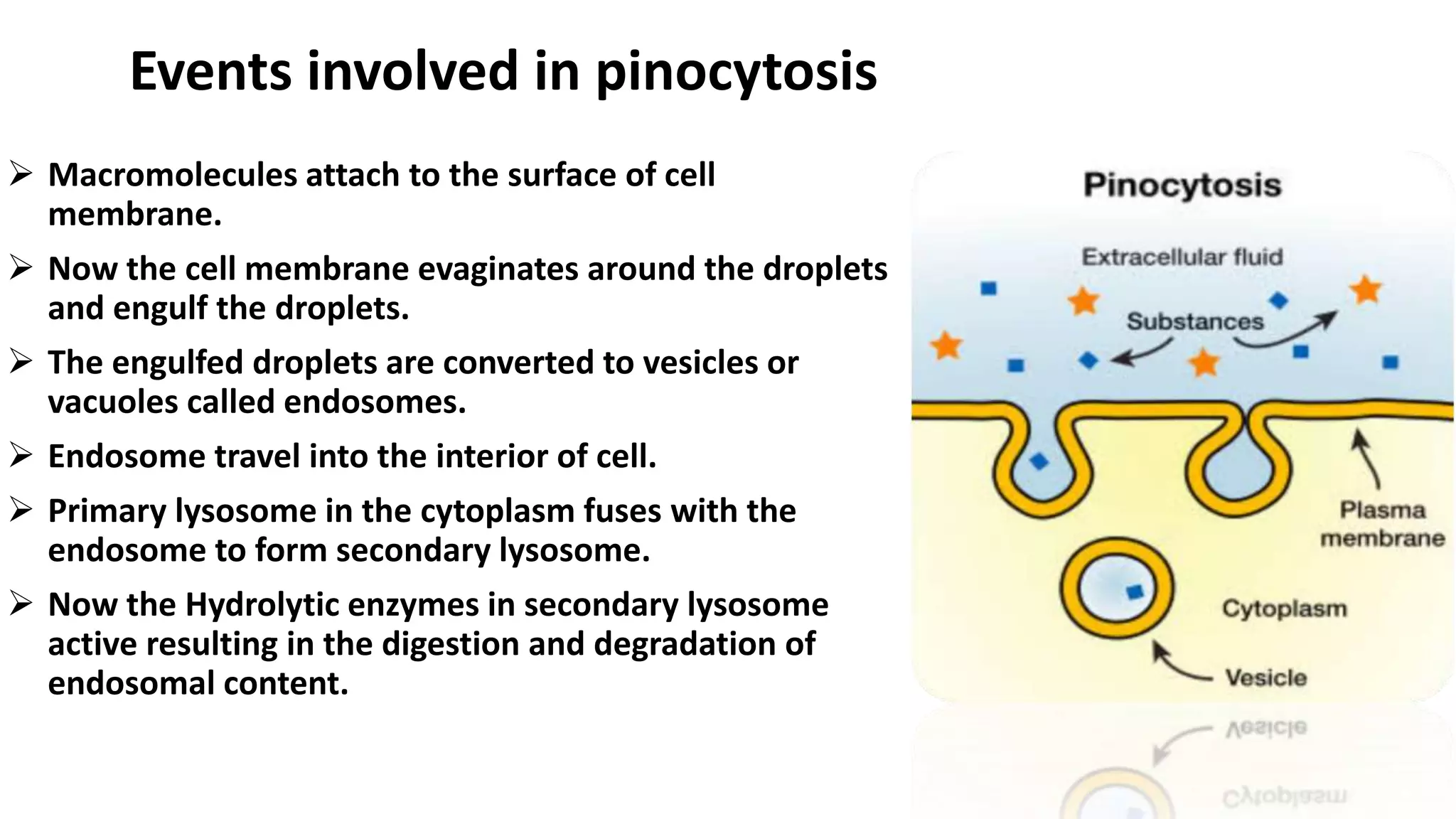
Events involved in pinocytosis
 Macromolecules attach to the surface of cell
membrane.
 Now the cell membrane evaginates around the droplets
and engulf the droplets.
 The engulfed droplets are converted to vesicles or
vacuoles called endosomes.
 Endosome travel into the interior of cell.
 Primary lysosome in the cytoplasm fuses with the
endosome to form secondary lysosome.
 Now the Hydrolytic enzymes in secondary lysosome
active resulting in the digestion and degradation of
endosomal content.
2. PHAGOCYTOSIS
 It is the process in which, particles larger than Macromolecules like Bacteria or
Antigen, are engulf into the cell.
 It is also called ‘CELL EATING’.
 Only few cells like Neutrophils, monocytes ( WBCs) and Tissue Macrophages
shows Phagocytosis
HOW WHITE BLOOD CELLS PERFORM PHAGOCYTOSIS?
White blood cells, Neutrophils and Monocytes are the first line of Defense Mechanism of
the body when any Infection occurs.
 So, during any Infection or injury to the tissue, these cells shows the following steps :
1. DIAPEDESIS: leukocytes squeeze out through the narrow blood vessels to reach the
site of infection.
2. AMOEBOID MOVEMENT: Cells shows amoebic movement by bulging out of the
cytoplasm and change in shape.
3. CHEMOTAXIS: It is the attraction of these cells towards the injured tissue by the
chemical substances released at the site of injury.
4. PHAGOCYTOSIS: Neutrophils and monocytes engulf the foreign bodies by means of
phagocytosis.
EVENTS INVOLVED IN PHAGOCYTOSIS
 When a microbe enters the body, first the phagocytic
cell send cytoplasmic extension (pseudopodium) around
bacteria.
 Then, these particles are engulfed and are converted
into large Endosome called vacuoles or PHAGOSOMES.
 Phagosomes travel into the interior of the cell.
 Primary lysosome fuses with phagosome to form
secondary lysosomes.
 Hydrolytic enzymes in the secondary lysosomes are
activated resulting in the digestion of phagosomal
content.
3. RECEPTOR-MEDIATED ENDOCYTOSIS
 It is a transport of macromolecules with the help of a receptor protein.
 Surface of the cell membrane has some pits which contain a receptor protein
called CLATHRIN.
 Each pit with receptor protein called receptor coated pits.
 Some receptor protein in cell membrane other than Clathrin are Caveolin which
are concerned with the transport of Vitamins into the cell.
Events involved in receptor-mediated endocytosis
 Ligand molecule bind with receptor to form ligand-
receptor complex.
 Ligand-receptor complex get aggregated in the clathrin
coated pits.
 This whole pit detached from the cell membrane and
become coated vesicle (Endosome) in the cytoplasm.
 Later, receptor protein detached from the endosome
 Endosome fuses with the Primary lysosome to form
secondary lysosome.
 Hydrolytic enzymes in the secondary lysosome
activated resulting in the release of Ligand in
cytoplasm.
Exocytosis
 It is the process by which substance are expelled from the cell by
means of secretory vesicle.
 This is the reverse of endocytosis.
Mechanism of Exocytosis
 Secretory substances are stored in the form of secretory vesicle in the cytoplasm.
 When required, the vesicle approaches the cell membrane and get fused with it.
 Later, the content released out of the cell.
 ROLE OF CALCIUM IONS IN EXOCYTOSIS:
 Calcium ions play an important role in transmission of impulse at Neuromuscular
Junction.
 When the action potential reaches the axon terminal, the voltage gated calcium
channels open, and calcium enter from synaptic cleft into the axonal bulb
 This cause the exocytosis of synaptic vesicle and release of Acetyl choline
(neurotransmitter) into the synaptic cleft.
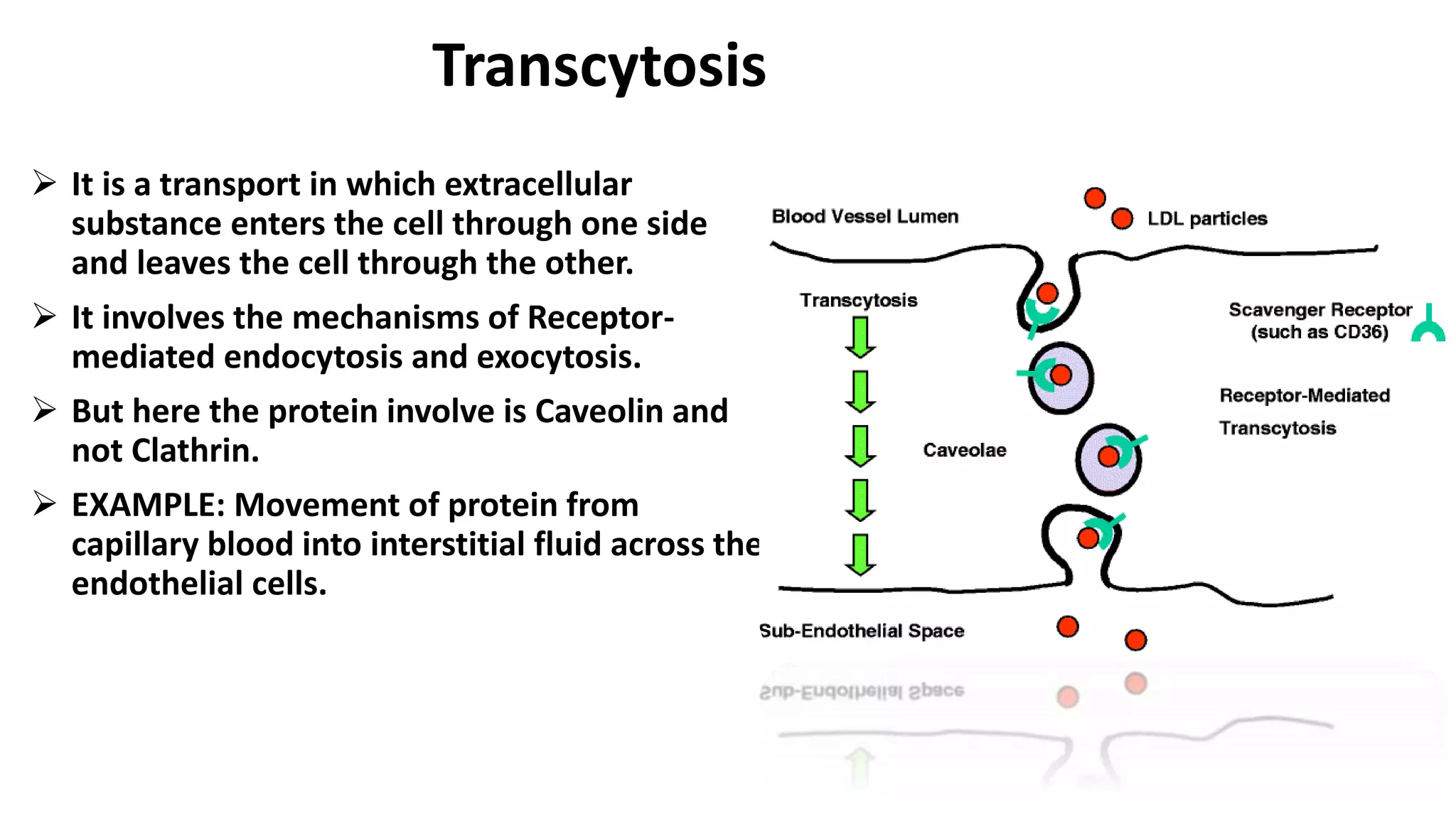
Transcytosis
 It is a transport in which extracellular
substance enters the cell through one side
and leaves the cell through the other.
 It involves the mechanisms of Receptor-
mediated endocytosis and exocytosis.
 But here the protein involve is Caveolin and
not Clathrin.
 EXAMPLE: Movement of protein from
capillary blood into interstitial fluid across the
endothelial cells.
REFERENCE
 A.K. Jain
 Sembulingam
THANKYOU

05. VESICULAR TRANSPORT - Ayesha Riyaz.pptx

  • 1.
    Vesicular Transport Guided by; Dr.M.M. Khan sir (H.O.D.) Dr. Indu Ma’am Dr. Pushpalata Ma’am Dr. Rashmi Ma’am Dr. Samreen Ma’am Dr. Majid Sir Dr. Sanjeev Sir Presented by; Aisha Riyaz
  • 2.
    INTRODUCTION  Vesicular transportis the special category of Active Transport, But is Independent of concentration gradient across the cell membrane.  The substances are transported across but NOT THROUGH the Cell membrane in the form of VESICLES. CATEGORIES OF VESICULAR TRANSPORT :  Endocytosis.  Exocytosis.  Transcytosis.
  • 3.
    ENDOCYTOSIS  It isdefined as the transport mechanism by which the MACROMOLECULES enters the cell.  Macromolecules are very large and thus can’t pass through the cell membrane either by Active or Passive Transport.  Such substances are transported into the cell by Endocytosis.  TYPES OF ENDOCYTOSIS : 1- Pinocytosis 2- Phagocytosis 3- Receptor-mediated endocytosis.
  • 4.
    1. PINOCYTOSIS  Itis a process by which Macromolecules are taken into the cell.  It is also called Cell Drinking, because macromolecules are taken along with the droplets of extracellular fluid in the vesicle.
  • 5.
    Events involved inpinocytosis  Macromolecules attach to the surface of cell membrane.  Now the cell membrane evaginates around the droplets and engulf the droplets.  The engulfed droplets are converted to vesicles or vacuoles called endosomes.  Endosome travel into the interior of cell.  Primary lysosome in the cytoplasm fuses with the endosome to form secondary lysosome.  Now the Hydrolytic enzymes in secondary lysosome active resulting in the digestion and degradation of endosomal content.
  • 6.
    2. PHAGOCYTOSIS  Itis the process in which, particles larger than Macromolecules like Bacteria or Antigen, are engulf into the cell.  It is also called ‘CELL EATING’.  Only few cells like Neutrophils, monocytes ( WBCs) and Tissue Macrophages shows Phagocytosis
  • 7.
    HOW WHITE BLOODCELLS PERFORM PHAGOCYTOSIS? White blood cells, Neutrophils and Monocytes are the first line of Defense Mechanism of the body when any Infection occurs.  So, during any Infection or injury to the tissue, these cells shows the following steps : 1. DIAPEDESIS: leukocytes squeeze out through the narrow blood vessels to reach the site of infection. 2. AMOEBOID MOVEMENT: Cells shows amoebic movement by bulging out of the cytoplasm and change in shape. 3. CHEMOTAXIS: It is the attraction of these cells towards the injured tissue by the chemical substances released at the site of injury. 4. PHAGOCYTOSIS: Neutrophils and monocytes engulf the foreign bodies by means of phagocytosis.
  • 8.
    EVENTS INVOLVED INPHAGOCYTOSIS  When a microbe enters the body, first the phagocytic cell send cytoplasmic extension (pseudopodium) around bacteria.  Then, these particles are engulfed and are converted into large Endosome called vacuoles or PHAGOSOMES.  Phagosomes travel into the interior of the cell.  Primary lysosome fuses with phagosome to form secondary lysosomes.  Hydrolytic enzymes in the secondary lysosomes are activated resulting in the digestion of phagosomal content.
  • 9.
    3. RECEPTOR-MEDIATED ENDOCYTOSIS It is a transport of macromolecules with the help of a receptor protein.  Surface of the cell membrane has some pits which contain a receptor protein called CLATHRIN.  Each pit with receptor protein called receptor coated pits.  Some receptor protein in cell membrane other than Clathrin are Caveolin which are concerned with the transport of Vitamins into the cell.
  • 10.
    Events involved inreceptor-mediated endocytosis  Ligand molecule bind with receptor to form ligand- receptor complex.  Ligand-receptor complex get aggregated in the clathrin coated pits.  This whole pit detached from the cell membrane and become coated vesicle (Endosome) in the cytoplasm.  Later, receptor protein detached from the endosome  Endosome fuses with the Primary lysosome to form secondary lysosome.  Hydrolytic enzymes in the secondary lysosome activated resulting in the release of Ligand in cytoplasm.
  • 11.
    Exocytosis  It isthe process by which substance are expelled from the cell by means of secretory vesicle.  This is the reverse of endocytosis.
  • 12.
    Mechanism of Exocytosis Secretory substances are stored in the form of secretory vesicle in the cytoplasm.  When required, the vesicle approaches the cell membrane and get fused with it.  Later, the content released out of the cell.  ROLE OF CALCIUM IONS IN EXOCYTOSIS:  Calcium ions play an important role in transmission of impulse at Neuromuscular Junction.  When the action potential reaches the axon terminal, the voltage gated calcium channels open, and calcium enter from synaptic cleft into the axonal bulb  This cause the exocytosis of synaptic vesicle and release of Acetyl choline (neurotransmitter) into the synaptic cleft.
  • 13.
    Transcytosis  It isa transport in which extracellular substance enters the cell through one side and leaves the cell through the other.  It involves the mechanisms of Receptor- mediated endocytosis and exocytosis.  But here the protein involve is Caveolin and not Clathrin.  EXAMPLE: Movement of protein from capillary blood into interstitial fluid across the endothelial cells.
  • 14.
  • 15.