

Presented By:
T.SATYAVATHI
M.PHARMACY II SEMESTER
DEPT.OF PHARMACEUTICS
1
CONTENTS
Introduction
Receptor-Mediated Endocytosis and Exocytosis
Ligands that enter by receptor mediated endocytosis
Conclusion
References
2
INTRODUCTION
3
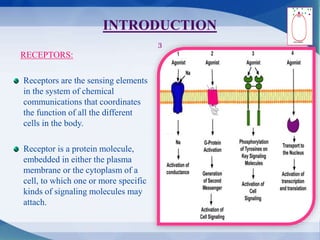
RECEPTORS:
Receptors are the sensing elements
in the system of chemical
communications that coordinates
the function of all the different
cells in the body.
Receptor is a protein molecule,
embedded in either the plasma
membrane or the cytoplasm of a
cell, to which one or more specific
kinds of signaling molecules may
attach.
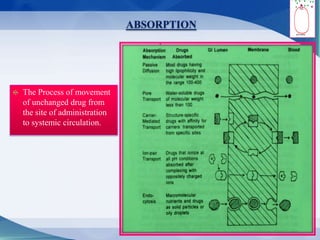
ABSORPTION
4
The Process of movement
of unchanged drug from
the site of administration
to systemic circulation.
Pathogens use the endocytic pathway to get into cells
e.g.: flu virus
Salmonella ?
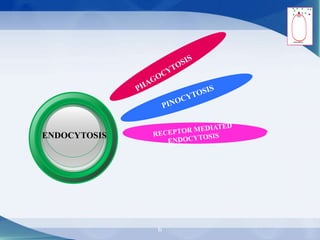
ENDOCYTOSIS
6
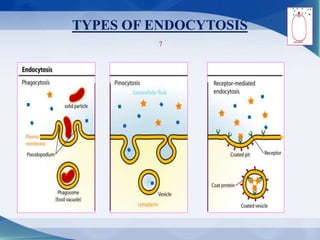
TYPES OF ENDOCYTOSIS
7
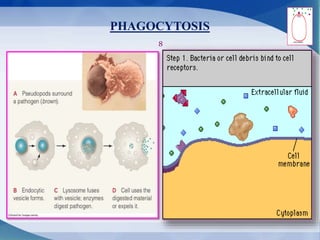
PHAGOCYTOSIS
8
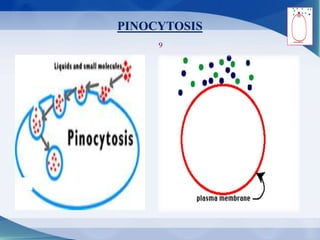
PINOCYTOSIS
9
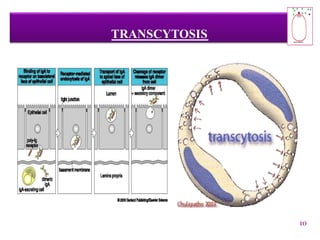
TRANSCYTOSIS
10
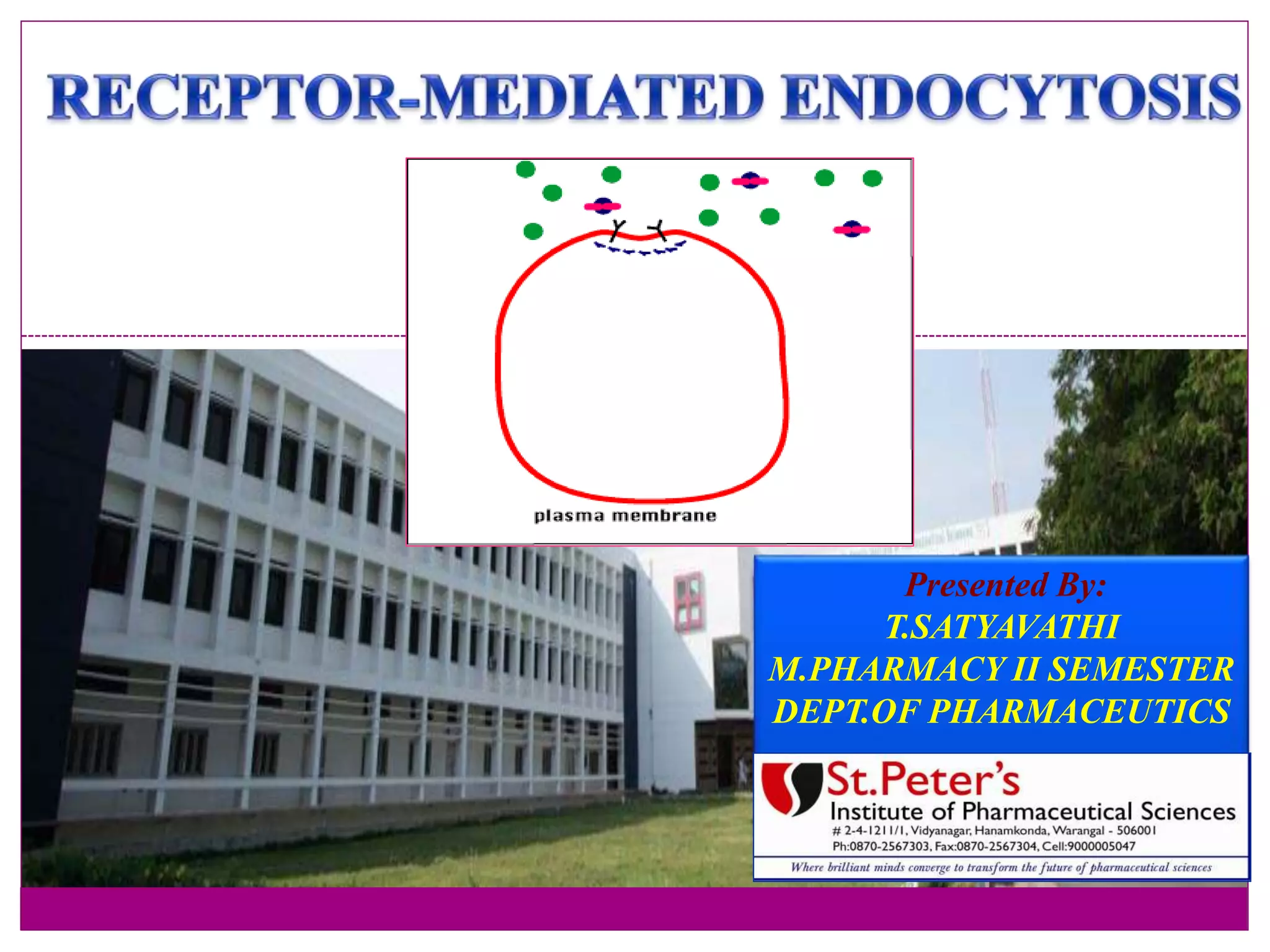
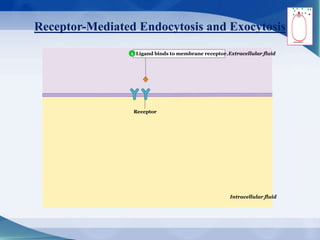
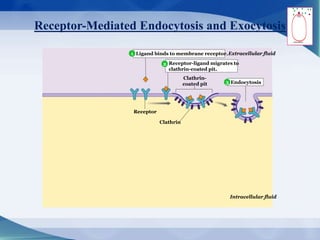
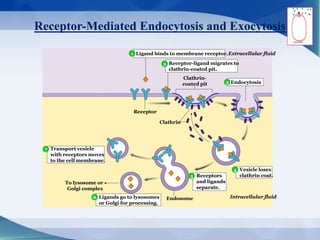
Receptor-Mediated Endocytosis and Exocytosis
Ligand binds to membrane receptor.Extracellular fluid
Intracellular fluid
Receptor
1
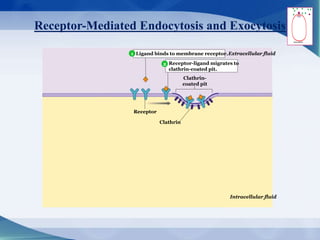
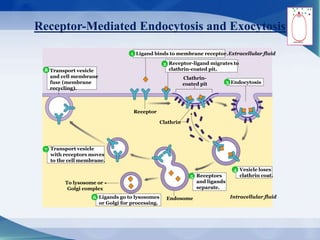
Receptor-Mediated Endocytosis and Exocytosis
Ligand binds to membrane receptor.
Clathrin-
coated pit
Extracellular fluid
Intracellular fluid
Receptor-ligand migrates to
clathrin-coated pit.
Clathrin
Receptor
1
2
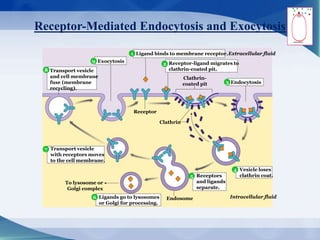
Receptor-Mediated Endocytosis and Exocytosis
Ligand binds to membrane receptor.
Clathrin-
coated pit
Extracellular fluid
Intracellular fluid
Receptor-ligand migrates to
clathrin-coated pit.
Endocytosis
Clathrin
Receptor
1
2
3
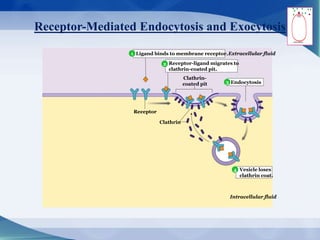
Receptor-Mediated Endocytosis and Exocytosis
Ligand binds to membrane receptor.
Clathrin-
coated pit
Extracellular fluid
Intracellular fluid
Receptor-ligand migrates to
clathrin-coated pit.
Endocytosis
Vesicle loses
clathrin coat.
Clathrin
Receptor
4
1
2
3
4
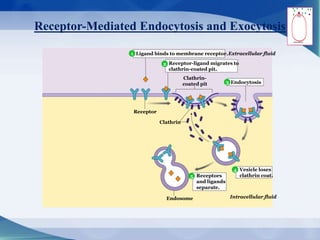
Receptor-Mediated Endocytosis and Exocytosis
Ligand binds to membrane receptor.
Clathrin-
coated pit
Extracellular fluid
Intracellular fluid
Receptor-ligand migrates to
clathrin-coated pit.
Endocytosis
Vesicle loses
clathrin coat.
Clathrin
Endosome
Receptors
and ligands
separate.
Receptor
4
1
2
3
4
5
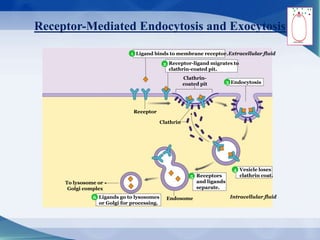
Receptor-Mediated Endocytosis and Exocytosis
Ligand binds to membrane receptor.
Clathrin-
coated pit
Extracellular fluid
Intracellular fluid
To lysosome or
Golgi complex
Receptor-ligand migrates to
clathrin-coated pit.
Endocytosis
Vesicle loses
clathrin coat.
Ligands go to lysosomes
or Golgi for processing.
Clathrin
Endosome
Receptors
and ligands
separate.
Receptor
4
1
2
3
4
6
5
Receptor-Mediated Endocytosis and Exocytosis
Ligand binds to membrane receptor.
Clathrin-
coated pit
Extracellular fluid
Intracellular fluid
To lysosome or
Golgi complex
Receptor-ligand migrates to
clathrin-coated pit.
Endocytosis
Vesicle loses
clathrin coat.
Ligands go to lysosomes
or Golgi for processing.
Transport vesicle
with receptors moves
to the cell membrane.
Clathrin
Endosome
Receptors
and ligands
separate.
Receptor
4
1
2
3
4
7
6
5
Receptor-Mediated Endocytosis and Exocytosis
Ligand binds to membrane receptor.
Clathrin-
coated pit
Extracellular fluid
Intracellular fluid
To lysosome or
Golgi complex
Receptor-ligand migrates to
clathrin-coated pit.
Endocytosis
Vesicle loses
clathrin coat.
Ligands go to lysosomes
or Golgi for processing.
Transport vesicle
with receptors moves
to the cell membrane.
Transport vesicle
and cell membrane
fuse (membrane
recycling).
Clathrin
Endosome
Receptors
and ligands
separate.
Receptor
4
1
2
3
4
8
7
6
5
Receptor-Mediated Endocytosis and Exocytosis
Ligand binds to membrane receptor.
Clathrin-
coated pit
Extracellular fluid
Intracellular fluid
To lysosome or
Golgi complex
Receptor-ligand migrates to
clathrin-coated pit.
Endocytosis
Vesicle loses
clathrin coat.
Ligands go to lysosomes
or Golgi for processing.
Transport vesicle
with receptors moves
to the cell membrane.
Transport vesicle
and cell membrane
fuse (membrane
recycling).
Exocytosis
Clathrin
Endosome
Receptors
and ligands
separate.
Receptor
4
1
2
3
4
9
8
7
6
5
20
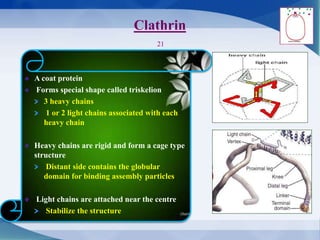
Clathrin
21
A coat protein
Forms special shape called triskelion
3 heavy chains
1 or 2 light chains associated with each
heavy chain
Heavy chains are rigid and form a cage type
structure
Distant side contains the globular
domain for binding assembly particles
Light chains are attached near the centre
Stabilize the structure
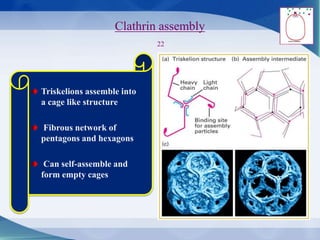
Clathrin assembly
22
Triskelions assemble into
a cage like structure
Fibrous network of
pentagons and hexagons
Can self-assemble and
form empty cages
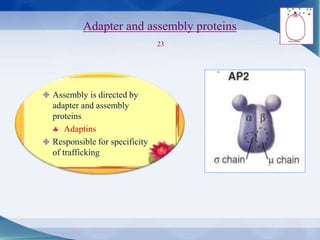
Adapter and assembly proteins
23
Assembly is directed by
adapter and assembly
proteins
 Adaptins
Responsible for specificity
of trafficking
24
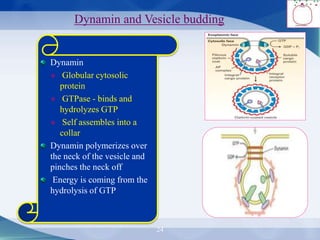
Dynamin and Vesicle budding
Dynamin
 Globular cytosolic
protein
 GTPase - binds and
hydrolyzes GTP
 Self assembles into a
collar
Dynamin polymerizes over
the neck of the vesicle and
pinches the neck off
Energy is coming from the
hydrolysis of GTP
25
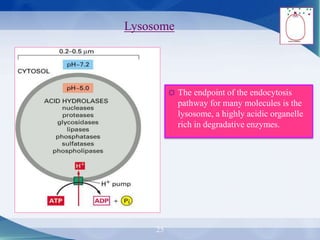
Lysosome
☼ The endpoint of the endocytosis
pathway for many molecules is the
lysosome, a highly acidic organelle
rich in degradative enzymes.
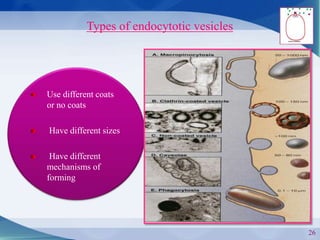
Types of endocytotic vesicles
26
Use different coats
or no coats
Have different sizes
Have different
mechanisms of
forming
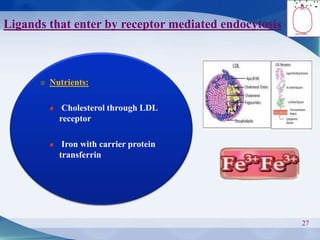
Ligands that enter by receptor mediated endocytosis
27
Nutrients:
Cholesterol through LDL
receptor
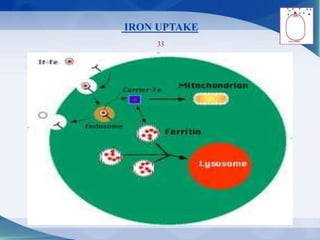
Iron with carrier protein
transferrin
Termination of signalling by receptor
mediated endocytosis
28
Hormones and growth factors to terminate signalling:
Insulin
Catecholamines
Prolactin
Growth hormone
Epidermal growth factor
Nerve growth factor
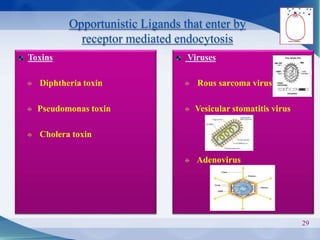
Opportunistic Ligands that enter by
receptor mediated endocytosis
29
Toxins
Diphtheria toxin
Pseudomonas toxin
Cholera toxin
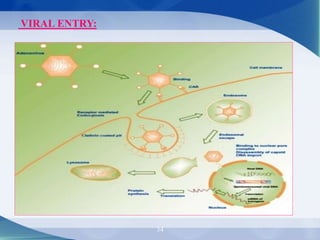
Viruses
Rous sarcoma virus
Vesicular stomatitis virus
Adenovirus
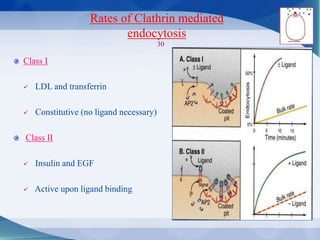
Rates of Clathrin mediated
endocytosis
30
Class I
 LDL and transferrin
 Constitutive (no ligand necessary)
Class II
 Insulin and EGF
 Active upon ligand binding
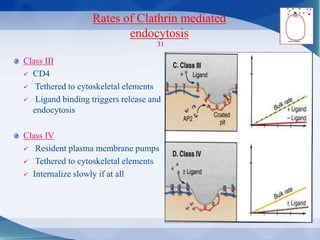
Rates of Clathrin mediated
endocytosis
31
Class III
 CD4
 Tethered to cytoskeletal elements
 Ligand binding triggers release and
endocytosis
Class IV
 Resident plasma membrane pumps
 Tethered to cytoskeletal elements
 Internalize slowly if at all
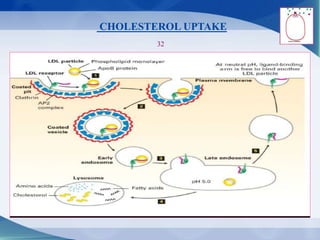
CHOLESTEROL UPTAKE
32
IRON UPTAKE
33
34
VIRAL ENTRY:
35
36
CONCLUSION
 Receptor-mediated endocytosis is a mechanism used by cells for the
internalization of selected plasma-membrane proteins.
 It is widely used for the specific uptake of certain substances required by the cell
such as LDL via the LDL receptor or iron via transferrin receptor etc.
 The coated pits serve as a mechanism for concentrating the randomly distributed
cell surface receptors for efficient internalization of the ligand. An assortment of
endocytic vesicles (coated and/or smooth) carry the receptor-ligand complexes
into the cells.
37
REFERENCES
 Rang and Dale’s Pharmacology H.P.Rang, M.M.Dale, J.M.Ritter,
R.J.Flower.2007:6th edition:Pg:24-28.
 D.M.Brahmankar , Sunil B.Jaiswal. Biopharmaceutics and Pharmacokinetics A
Treatise. Published by M.K.Jain.1995:1st edition: Pg:5-8
 Principles of Anatomy and Physiology Gerard J.Tortora, Bryan
H.DERRICKSON.2006: 11th edition, volume 1:Pg:72-74
 Aulton’s Pharmaceutics The Design and Manufacture of Medicines. Edited by
Michael E.Aulton.2007:3rd edition: Pg :283
38
REFERENCES
39
Websites :
 www.utm.utoronto.ca/~w3bio315/RME/examples.html
 www.uta.edu/biology/wilk/classnotes/cellphys/endocytosis.pdf
 www-esbs.u-strasbg.fr/notesdecours/1ere-annee/Cell.../Ch_23.pdf
 http://en.wikipedia.org/wiki/Receptor-mediated endocytosis
40

Receptor Mediated Endocytosis

  • 1.
    Presented By: T.SATYAVATHI M.PHARMACY IISEMESTER DEPT.OF PHARMACEUTICS 1
  • 2.
    CONTENTS Introduction Receptor-Mediated Endocytosis andExocytosis Ligands that enter by receptor mediated endocytosis Conclusion References 2
  • 3.
    INTRODUCTION 3 RECEPTORS: Receptors are thesensing elements in the system of chemical communications that coordinates the function of all the different cells in the body. Receptor is a protein molecule, embedded in either the plasma membrane or the cytoplasm of a cell, to which one or more specific kinds of signaling molecules may attach.
  • 4.
    ABSORPTION 4 The Process ofmovement of unchanged drug from the site of administration to systemic circulation.
  • 5.
    Pathogens use theendocytic pathway to get into cells e.g.: flu virus Salmonella ?
  • 6.
  • 7.
  • 8.
  • 9.
  • 10.
  • 11.
    Receptor-Mediated Endocytosis andExocytosis Ligand binds to membrane receptor.Extracellular fluid Intracellular fluid Receptor 1
  • 12.
    Receptor-Mediated Endocytosis andExocytosis Ligand binds to membrane receptor. Clathrin- coated pit Extracellular fluid Intracellular fluid Receptor-ligand migrates to clathrin-coated pit. Clathrin Receptor 1 2
  • 13.
    Receptor-Mediated Endocytosis andExocytosis Ligand binds to membrane receptor. Clathrin- coated pit Extracellular fluid Intracellular fluid Receptor-ligand migrates to clathrin-coated pit. Endocytosis Clathrin Receptor 1 2 3
  • 14.
    Receptor-Mediated Endocytosis andExocytosis Ligand binds to membrane receptor. Clathrin- coated pit Extracellular fluid Intracellular fluid Receptor-ligand migrates to clathrin-coated pit. Endocytosis Vesicle loses clathrin coat. Clathrin Receptor 4 1 2 3 4
  • 15.
    Receptor-Mediated Endocytosis andExocytosis Ligand binds to membrane receptor. Clathrin- coated pit Extracellular fluid Intracellular fluid Receptor-ligand migrates to clathrin-coated pit. Endocytosis Vesicle loses clathrin coat. Clathrin Endosome Receptors and ligands separate. Receptor 4 1 2 3 4 5
  • 16.
    Receptor-Mediated Endocytosis andExocytosis Ligand binds to membrane receptor. Clathrin- coated pit Extracellular fluid Intracellular fluid To lysosome or Golgi complex Receptor-ligand migrates to clathrin-coated pit. Endocytosis Vesicle loses clathrin coat. Ligands go to lysosomes or Golgi for processing. Clathrin Endosome Receptors and ligands separate. Receptor 4 1 2 3 4 6 5
  • 17.
    Receptor-Mediated Endocytosis andExocytosis Ligand binds to membrane receptor. Clathrin- coated pit Extracellular fluid Intracellular fluid To lysosome or Golgi complex Receptor-ligand migrates to clathrin-coated pit. Endocytosis Vesicle loses clathrin coat. Ligands go to lysosomes or Golgi for processing. Transport vesicle with receptors moves to the cell membrane. Clathrin Endosome Receptors and ligands separate. Receptor 4 1 2 3 4 7 6 5
  • 18.
    Receptor-Mediated Endocytosis andExocytosis Ligand binds to membrane receptor. Clathrin- coated pit Extracellular fluid Intracellular fluid To lysosome or Golgi complex Receptor-ligand migrates to clathrin-coated pit. Endocytosis Vesicle loses clathrin coat. Ligands go to lysosomes or Golgi for processing. Transport vesicle with receptors moves to the cell membrane. Transport vesicle and cell membrane fuse (membrane recycling). Clathrin Endosome Receptors and ligands separate. Receptor 4 1 2 3 4 8 7 6 5
  • 19.
    Receptor-Mediated Endocytosis andExocytosis Ligand binds to membrane receptor. Clathrin- coated pit Extracellular fluid Intracellular fluid To lysosome or Golgi complex Receptor-ligand migrates to clathrin-coated pit. Endocytosis Vesicle loses clathrin coat. Ligands go to lysosomes or Golgi for processing. Transport vesicle with receptors moves to the cell membrane. Transport vesicle and cell membrane fuse (membrane recycling). Exocytosis Clathrin Endosome Receptors and ligands separate. Receptor 4 1 2 3 4 9 8 7 6 5
  • 20.
  • 21.
    Clathrin 21 A coat protein Formsspecial shape called triskelion 3 heavy chains 1 or 2 light chains associated with each heavy chain Heavy chains are rigid and form a cage type structure Distant side contains the globular domain for binding assembly particles Light chains are attached near the centre Stabilize the structure
  • 22.
    Clathrin assembly 22 Triskelions assembleinto a cage like structure Fibrous network of pentagons and hexagons Can self-assemble and form empty cages
  • 23.
    Adapter and assemblyproteins 23 Assembly is directed by adapter and assembly proteins  Adaptins Responsible for specificity of trafficking
  • 24.
    24 Dynamin and Vesiclebudding Dynamin  Globular cytosolic protein  GTPase - binds and hydrolyzes GTP  Self assembles into a collar Dynamin polymerizes over the neck of the vesicle and pinches the neck off Energy is coming from the hydrolysis of GTP
  • 25.
    25 Lysosome ☼ The endpointof the endocytosis pathway for many molecules is the lysosome, a highly acidic organelle rich in degradative enzymes.
  • 26.
    Types of endocytoticvesicles 26 Use different coats or no coats Have different sizes Have different mechanisms of forming
  • 27.
    Ligands that enterby receptor mediated endocytosis 27 Nutrients: Cholesterol through LDL receptor Iron with carrier protein transferrin
  • 28.
    Termination of signallingby receptor mediated endocytosis 28 Hormones and growth factors to terminate signalling: Insulin Catecholamines Prolactin Growth hormone Epidermal growth factor Nerve growth factor
  • 29.
    Opportunistic Ligands thatenter by receptor mediated endocytosis 29 Toxins Diphtheria toxin Pseudomonas toxin Cholera toxin Viruses Rous sarcoma virus Vesicular stomatitis virus Adenovirus
  • 30.
    Rates of Clathrinmediated endocytosis 30 Class I  LDL and transferrin  Constitutive (no ligand necessary) Class II  Insulin and EGF  Active upon ligand binding
  • 31.
    Rates of Clathrinmediated endocytosis 31 Class III  CD4  Tethered to cytoskeletal elements  Ligand binding triggers release and endocytosis Class IV  Resident plasma membrane pumps  Tethered to cytoskeletal elements  Internalize slowly if at all
  • 32.
  • 33.
  • 34.
  • 35.
  • 36.
  • 37.
    CONCLUSION  Receptor-mediated endocytosisis a mechanism used by cells for the internalization of selected plasma-membrane proteins.  It is widely used for the specific uptake of certain substances required by the cell such as LDL via the LDL receptor or iron via transferrin receptor etc.  The coated pits serve as a mechanism for concentrating the randomly distributed cell surface receptors for efficient internalization of the ligand. An assortment of endocytic vesicles (coated and/or smooth) carry the receptor-ligand complexes into the cells. 37
  • 38.
    REFERENCES  Rang andDale’s Pharmacology H.P.Rang, M.M.Dale, J.M.Ritter, R.J.Flower.2007:6th edition:Pg:24-28.  D.M.Brahmankar , Sunil B.Jaiswal. Biopharmaceutics and Pharmacokinetics A Treatise. Published by M.K.Jain.1995:1st edition: Pg:5-8  Principles of Anatomy and Physiology Gerard J.Tortora, Bryan H.DERRICKSON.2006: 11th edition, volume 1:Pg:72-74  Aulton’s Pharmaceutics The Design and Manufacture of Medicines. Edited by Michael E.Aulton.2007:3rd edition: Pg :283 38
  • 39.
    REFERENCES 39 Websites :  www.utm.utoronto.ca/~w3bio315/RME/examples.html www.uta.edu/biology/wilk/classnotes/cellphys/endocytosis.pdf  www-esbs.u-strasbg.fr/notesdecours/1ere-annee/Cell.../Ch_23.pdf  http://en.wikipedia.org/wiki/Receptor-mediated endocytosis
  • 40.