Drafting Schedule for a phase based on competencies
Resource faculty
Instructions for the resource person
• These generic slides to be used in sessions
• Resource faculty(s) can add their names in title slide
• Do not remove acknowledgement slide
• Do not remove logo
• The slides given can be edited if required keeping in view the LOs of the session as
per program
• Pls add reference wherever needed when you edit
• In each session, try to make it interactive, add activity as needed, the provided slides
can be used accordingly
• If the resource faculty is well experienced and wish to use less text, then can edit
slides accordingly
• Local context examples can be used
• Suggested reading(s) link should be shared with participants atleast 1
week before the workshop
• Pls remove this slide when you present in the workshop
Session Objectives
Understand steps in drafting time table for an academic year.
What is the meaning of a time table?
Concept
What is Teaching Schedule?
• A list of the times when particular activities or events will happen.
• A schedule of events that organizes teaching activities throughout the day,
week, term or year.
• Teaching schedule shows exactly what is to be done at a particular time.
• A teaching schedule consists of a list of the complete set of offered
courses, as well as the time and place of each course offered.
Need
• The teaching schedule shows exactly what is to be done at a
particular time.
• It directs the attention of the learner one thing at a time.
• Learner’s energy is automatically directed in a particular direction
which prevents wastage of time and energy.
• To inform teachers when and where they teach each course.
• To enable learner to enroll in a subset of courses without schedule
conflicts.
Steps In Drafting Time Table
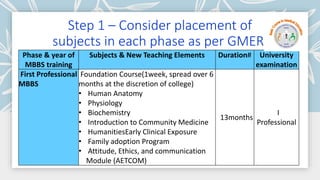
Step 1 – Consider placement of
subjects in each phase as per GMER.
Phase & year of
MBBS training
Subjects & New Teaching Elements Duration# University
examination
First Professional
MBBS
Foundation Course(1week, spread over 6
months at the discretion of college)
• Human Anatomy
• Physiology
• Biochemistry
• Introduction to Community Medicine
• HumanitiesEarly Clinical Exposure
• Family adoption Program
• Attitude, Ethics, and communication
Module (AETCOM)
13months
I
Professional
Step 2 – Consider number of teaching hours
alloted to each subject phase wise in GMER.
Subject Lectures Small
GroupTeaching/T
utorials/Integrate
dLearning/Practic
al(Hours)
Self-
directedlear
ning(Hours)
Total
Human Anatomy 220 410 20 650
Physiology* 138 308 15 461
Biochemistry 80 150 15 245
EarlyClinicalExposure** 60 - 0 60
Community Medicine
(+FamilyadoptionProgram)
20 20(+27)=47 67(40+27)
(AETCOM)*** - 26 - 26
Sports and
extracurricularactivities
- - - 10
Formative Assessment
andTermexaminations
- - - 80
Total 518 941 50 1638#
Step 3- Consider the allotted duration for
the phase in the academic calendar from NMC.
eg. Academic Calendar for Phase I for MBBS, 2022-23 batch.
Step 4 – Calculate available teaching hours.
• Time alloted for teaching per day - 7 hours
• In a week teaching is conducted for 6 days.
• Total teaching hours per week - 42 hrs.
• Accordingly, calculate teaching hours available for teaching in each phase as
per duration alloted.
• All holidays, vacation period, examination period must be deducted from
the available teaching hours.
l
Step 5- Preparation of master time schedule.
• As per the alloted hours for each subject in a phase allot teaching slots in
weekly time schedule.
• Get it verified from all concerned HODs.
• Prepare monthly teaching schedule.
• Prepare yearly teaching schedule.
Step 6 – Depiction of CBME inclusions.
• Didactic lectures - As L1-L2
• Practicals
• ECE
• Integration
• SDL
• AETCOM
• FAP
• Simulation Labs
• Clinics
• Sports
• Examinations - PCT and Prelims.
MASTER TIME TABLE weekly plan-example
DATE DAYS 9AMTO10AM 10AMTO11AM 11AMTO12NOON 12NOONTO1PM
Monday PHYSIOLOGY ANATOMY RESEARCH L
Tuesday ANATOMY PHYSIOLOGY ANATOMY U
Wednesday BIOCHEMISTRY ANATOMY PHYSIOLOGY N
Thursday ANATOMY PHYSIOLOGY BIOCHEMISTRY C
Friday H
CommunityMedicine SVL
FAPVisit
PRACTICAL
(DEEMEDTOBEUNIVERSITY)
JAWAHARLALNEHRUMEDICALCOLLEGE
FIRSTMBBS(2022)batch
PRACTICAL
DISSECTION
DISSECTION
PRACTICAL
1PMTO3PM 3PMTo5PM
PRACTICAL DISSECTION
PRACTICAL
PRACTICAL DISSECTION
AETCOM
EarlyClinicalExposure(ECE)
BYrotation(BetweenAnat/Phys/Biochem)
Saturday LUNCH Sports
Once this is final, copy it for the number of weeks in the phase e.g. 42 times
Alignment is done by depts
• Rest in integration, So AIT
modules are made and
slots added.
• Non-aligned topics are
highlighted in different
color
MASTER TIME TABLE-depts add competencies, TLM etc
Once this is final, copy it for the number of weeks in the phase e.g. 42 times
Step 7- Get it verified from all concerned
HODs.
Step 8 – Available for implementation
Benchmarks are targets that have to be fulfilled. They cannot be fulfilled in an indefinite period of time, so there are
timetables in benchmarks.
“Benchmarks are targets that have to be fulfilled. They cannot be
fulfilled in an indefinite period of time, so there are timetables.”
Suggested Reading
• Competency based undergraduate curriculum for the Indian medical graduate. Module 3,
assessment. Available at https://www.nmc.org.in/wp-
content/uploads/2020/08/Module_Competence_based_02.09.2019.pdf
• NMC module 4. Alignment and Integration. https://www.nmc.org.in/wp-
content/uploads/2020/08/Alignment-and-Integration_03.10.2019.pdf
Thanks
Acknowledgments
NMC EXECUTIVE COMMITTEE ON FDP
• Dr. Aruna Vanikar, President UGMEB, Chairperson EC-FDP, NMC New Delhi
• Dr. Vijayendra Kumar, Member UGMEB, Co-Chair EC-FDP
• Dr. Praveen R Singh, Assistant Dean, Professor Anatomy & Convener, NC PSMC Karamsad, Convener EC-FDP
• Dr. Dinesh K Badyal, Vice-Principal, Professor Pharmacology, Convener NC CMC Ludhiana, Member EC-FDP
• Dr. Sunita Vagha, Dean, faculty of Medicine & Prof. & Head Pathology Datta Meghe IMS, Sawangi, Wardha, Member EC-FDP
• Dr. Praveen Iyer, Professor (Addl) Anatomy and Convener NC Seth GSMC & KEMH, Mumbai, Member EC-FDP
• Dr. Pankaj Shah, Prof. & Head Community Medicine and Co-Convener NC SRMC & RI, Chennai, Member EC-FDP
• Col. (Dr.) Naveen Chaudhary, Offg Senior Consultant, Academic Cell, UGMEB. Coordinator EC-FDP
This learning resource material is to aid the resource faculty to conduct the sessions in the course and they are
encouraged to use creativity, activities to engage participants and achieve the learning objectives of the session.
DO NOT share this material outside MEU/CC/NC/RC group, to any other group, or WhatsApp groups.

BCME_12_Drafting schedule Final.pptx resource faculty

  • 1.
    Drafting Schedule fora phase based on competencies Resource faculty
  • 2.
    Instructions for theresource person • These generic slides to be used in sessions • Resource faculty(s) can add their names in title slide • Do not remove acknowledgement slide • Do not remove logo • The slides given can be edited if required keeping in view the LOs of the session as per program • Pls add reference wherever needed when you edit • In each session, try to make it interactive, add activity as needed, the provided slides can be used accordingly • If the resource faculty is well experienced and wish to use less text, then can edit slides accordingly • Local context examples can be used • Suggested reading(s) link should be shared with participants atleast 1 week before the workshop • Pls remove this slide when you present in the workshop
  • 3.
    Session Objectives Understand stepsin drafting time table for an academic year.
  • 4.
    What is themeaning of a time table? Concept What is Teaching Schedule? • A list of the times when particular activities or events will happen. • A schedule of events that organizes teaching activities throughout the day, week, term or year. • Teaching schedule shows exactly what is to be done at a particular time. • A teaching schedule consists of a list of the complete set of offered courses, as well as the time and place of each course offered.
  • 5.
    Need • The teachingschedule shows exactly what is to be done at a particular time. • It directs the attention of the learner one thing at a time. • Learner’s energy is automatically directed in a particular direction which prevents wastage of time and energy. • To inform teachers when and where they teach each course. • To enable learner to enroll in a subset of courses without schedule conflicts.
  • 6.
  • 7.
    Step 1 –Consider placement of subjects in each phase as per GMER. Phase & year of MBBS training Subjects & New Teaching Elements Duration# University examination First Professional MBBS Foundation Course(1week, spread over 6 months at the discretion of college) • Human Anatomy • Physiology • Biochemistry • Introduction to Community Medicine • HumanitiesEarly Clinical Exposure • Family adoption Program • Attitude, Ethics, and communication Module (AETCOM) 13months I Professional
  • 8.
    Step 2 –Consider number of teaching hours alloted to each subject phase wise in GMER. Subject Lectures Small GroupTeaching/T utorials/Integrate dLearning/Practic al(Hours) Self- directedlear ning(Hours) Total Human Anatomy 220 410 20 650 Physiology* 138 308 15 461 Biochemistry 80 150 15 245 EarlyClinicalExposure** 60 - 0 60 Community Medicine (+FamilyadoptionProgram) 20 20(+27)=47 67(40+27) (AETCOM)*** - 26 - 26 Sports and extracurricularactivities - - - 10 Formative Assessment andTermexaminations - - - 80 Total 518 941 50 1638#
  • 9.
    Step 3- Considerthe allotted duration for the phase in the academic calendar from NMC. eg. Academic Calendar for Phase I for MBBS, 2022-23 batch.
  • 10.
    Step 4 –Calculate available teaching hours. • Time alloted for teaching per day - 7 hours • In a week teaching is conducted for 6 days. • Total teaching hours per week - 42 hrs. • Accordingly, calculate teaching hours available for teaching in each phase as per duration alloted. • All holidays, vacation period, examination period must be deducted from the available teaching hours.
  • 11.
    l Step 5- Preparationof master time schedule. • As per the alloted hours for each subject in a phase allot teaching slots in weekly time schedule. • Get it verified from all concerned HODs. • Prepare monthly teaching schedule. • Prepare yearly teaching schedule.
  • 12.
    Step 6 –Depiction of CBME inclusions. • Didactic lectures - As L1-L2 • Practicals • ECE • Integration • SDL • AETCOM • FAP • Simulation Labs • Clinics • Sports • Examinations - PCT and Prelims.
  • 13.
    MASTER TIME TABLEweekly plan-example DATE DAYS 9AMTO10AM 10AMTO11AM 11AMTO12NOON 12NOONTO1PM Monday PHYSIOLOGY ANATOMY RESEARCH L Tuesday ANATOMY PHYSIOLOGY ANATOMY U Wednesday BIOCHEMISTRY ANATOMY PHYSIOLOGY N Thursday ANATOMY PHYSIOLOGY BIOCHEMISTRY C Friday H CommunityMedicine SVL FAPVisit PRACTICAL (DEEMEDTOBEUNIVERSITY) JAWAHARLALNEHRUMEDICALCOLLEGE FIRSTMBBS(2022)batch PRACTICAL DISSECTION DISSECTION PRACTICAL 1PMTO3PM 3PMTo5PM PRACTICAL DISSECTION PRACTICAL PRACTICAL DISSECTION AETCOM EarlyClinicalExposure(ECE) BYrotation(BetweenAnat/Phys/Biochem) Saturday LUNCH Sports Once this is final, copy it for the number of weeks in the phase e.g. 42 times
  • 14.
    Alignment is doneby depts • Rest in integration, So AIT modules are made and slots added. • Non-aligned topics are highlighted in different color
  • 15.
    MASTER TIME TABLE-deptsadd competencies, TLM etc Once this is final, copy it for the number of weeks in the phase e.g. 42 times
  • 16.
    Step 7- Getit verified from all concerned HODs. Step 8 – Available for implementation
  • 17.
    Benchmarks are targetsthat have to be fulfilled. They cannot be fulfilled in an indefinite period of time, so there are timetables in benchmarks. “Benchmarks are targets that have to be fulfilled. They cannot be fulfilled in an indefinite period of time, so there are timetables.”
  • 18.
    Suggested Reading • Competencybased undergraduate curriculum for the Indian medical graduate. Module 3, assessment. Available at https://www.nmc.org.in/wp- content/uploads/2020/08/Module_Competence_based_02.09.2019.pdf • NMC module 4. Alignment and Integration. https://www.nmc.org.in/wp- content/uploads/2020/08/Alignment-and-Integration_03.10.2019.pdf
  • 19.
    Thanks Acknowledgments NMC EXECUTIVE COMMITTEEON FDP • Dr. Aruna Vanikar, President UGMEB, Chairperson EC-FDP, NMC New Delhi • Dr. Vijayendra Kumar, Member UGMEB, Co-Chair EC-FDP • Dr. Praveen R Singh, Assistant Dean, Professor Anatomy & Convener, NC PSMC Karamsad, Convener EC-FDP • Dr. Dinesh K Badyal, Vice-Principal, Professor Pharmacology, Convener NC CMC Ludhiana, Member EC-FDP • Dr. Sunita Vagha, Dean, faculty of Medicine & Prof. & Head Pathology Datta Meghe IMS, Sawangi, Wardha, Member EC-FDP • Dr. Praveen Iyer, Professor (Addl) Anatomy and Convener NC Seth GSMC & KEMH, Mumbai, Member EC-FDP • Dr. Pankaj Shah, Prof. & Head Community Medicine and Co-Convener NC SRMC & RI, Chennai, Member EC-FDP • Col. (Dr.) Naveen Chaudhary, Offg Senior Consultant, Academic Cell, UGMEB. Coordinator EC-FDP This learning resource material is to aid the resource faculty to conduct the sessions in the course and they are encouraged to use creativity, activities to engage participants and achieve the learning objectives of the session. DO NOT share this material outside MEU/CC/NC/RC group, to any other group, or WhatsApp groups.