CRITICAL PATH
ANALYSIS
CRITICAL PATH ANALYSIS ("CPA") IS A WIDELY-USED PROJECT
MANAGEMENT TOOL THAT USES NETWORK ANALYSIS TO HELP PROJECT
MANAGERS TO HANDLE COMPLEX AND TIME-SENSITIVE OPERATIONS.
Introduction
Many larger businesses get involved in projects that are complex and involve significant
investment and risk. As the complexity and risk increases it becomes even more necessary
to identify the relationships between the activities involved and to work out the most
efficient way of completing the project.
- A list of all activities required to
complete the project
- The time (duration) that each activity
will take to completion
- The dependencies between the
activities.
- The longest path of planned
activities to the end of the project
- The earliest and latest that each
activity can start and finish without
making the project longer.
- The sequence of project activities
which add up to the longest overall
duration.
- The critical path determines the
shortest time possible to complete the
project.
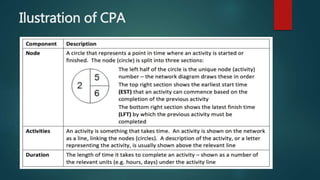
Ilustration of CPA
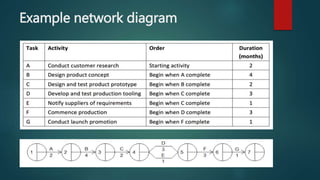
Example network diagram
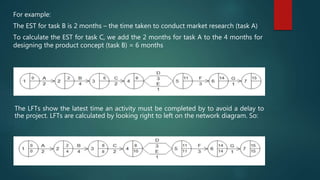
For example:
The EST for task B is 2 months – the time taken to conduct market research (task A)
To calculate the EST for task C, we add the 2 months for task A to the 4 months for
designing the product concept (task B) = 6 months
The LFTs show the latest time an activity must be completed by to avoid a delay to
the project. LFTs are calculated by looking right to left on the network diagram. So:
Free float: is the length of time an
activity can be delayed without
delaying the start of the following
activities. This is calculated by the
formula:
Free float = EST (next activity) -
duration - EST (this activity)
Total float: is the amount of time
an activity can be delayed
without delaying the whole
project duration. This is
calculated by the formula:
Total float = LFT - duration - EST
Take task C as an example:
The LFT of C is 10
The duration is 2
The EST of C is 6 and therefore:
Total float for C = 10 – 2 – 6 = 2
Take task B as an example:
The EST of the next activity after B is 6
The duration of B is 4
The EST at the start of B is 0 and, therefore:
Free float for B = 6 – 4 – 0 = 2
Evaluating CPA
- Most importantly helps
reduce the risk and costs of
complex projects
- Encourages careful
assessment of the requirements
of each activity in a project.
- Help spot which activities
have some slack ("float") and
could therefore transfer some
resources, better allocation of
resources.
- A decision-making tool and a
planning tool – all in one!
- Reliability of CPA largely
based on accurate estimates
and assumptions made.
- CPA does not guarantee the
success of a project – that still
needs to be managed properly.
- Resources may not actually
be as flexible as management
hope when they come to
address the network float.
- Too many activities may the
network diagram too
complicated. Activities might
themselves have to be broken
AdvantagesofCPA
DisadvantagesofCPA
Conclusion
CPA or network analysis is a planning and control
technique to assist with project management. It cannot
guarantee a successful project by itself and, as with any
plan, requires skilled and motivated staff to put it into
effect.

Project management - CPA

  • 1.
    CRITICAL PATH ANALYSIS CRITICAL PATHANALYSIS ("CPA") IS A WIDELY-USED PROJECT MANAGEMENT TOOL THAT USES NETWORK ANALYSIS TO HELP PROJECT MANAGERS TO HANDLE COMPLEX AND TIME-SENSITIVE OPERATIONS.
  • 2.
    Introduction Many larger businessesget involved in projects that are complex and involve significant investment and risk. As the complexity and risk increases it becomes even more necessary to identify the relationships between the activities involved and to work out the most efficient way of completing the project.
  • 3.
    - A listof all activities required to complete the project - The time (duration) that each activity will take to completion - The dependencies between the activities. - The longest path of planned activities to the end of the project - The earliest and latest that each activity can start and finish without making the project longer. - The sequence of project activities which add up to the longest overall duration. - The critical path determines the shortest time possible to complete the project.
  • 4.
  • 5.
  • 6.
    For example: The ESTfor task B is 2 months – the time taken to conduct market research (task A) To calculate the EST for task C, we add the 2 months for task A to the 4 months for designing the product concept (task B) = 6 months The LFTs show the latest time an activity must be completed by to avoid a delay to the project. LFTs are calculated by looking right to left on the network diagram. So:
  • 7.
    Free float: isthe length of time an activity can be delayed without delaying the start of the following activities. This is calculated by the formula: Free float = EST (next activity) - duration - EST (this activity) Total float: is the amount of time an activity can be delayed without delaying the whole project duration. This is calculated by the formula: Total float = LFT - duration - EST
  • 8.
    Take task Cas an example: The LFT of C is 10 The duration is 2 The EST of C is 6 and therefore: Total float for C = 10 – 2 – 6 = 2 Take task B as an example: The EST of the next activity after B is 6 The duration of B is 4 The EST at the start of B is 0 and, therefore: Free float for B = 6 – 4 – 0 = 2
  • 9.
    Evaluating CPA - Mostimportantly helps reduce the risk and costs of complex projects - Encourages careful assessment of the requirements of each activity in a project. - Help spot which activities have some slack ("float") and could therefore transfer some resources, better allocation of resources. - A decision-making tool and a planning tool – all in one! - Reliability of CPA largely based on accurate estimates and assumptions made. - CPA does not guarantee the success of a project – that still needs to be managed properly. - Resources may not actually be as flexible as management hope when they come to address the network float. - Too many activities may the network diagram too complicated. Activities might themselves have to be broken AdvantagesofCPA DisadvantagesofCPA
  • 10.
    Conclusion CPA or networkanalysis is a planning and control technique to assist with project management. It cannot guarantee a successful project by itself and, as with any plan, requires skilled and motivated staff to put it into effect.