Critical Path Method
&
Programme Evaluation
Review Technique
What is Critical Path??
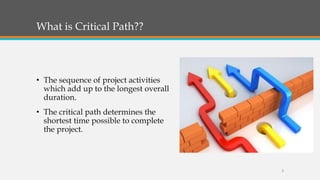
• The sequence of project activities
which add up to the longest overall
duration.
• The critical path determines the
shortest time possible to complete
the project.
2
What is Critical Path Method??
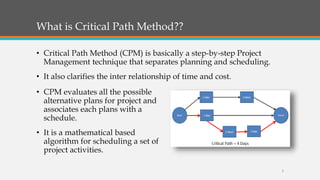
• Critical Path Method (CPM) is basically a step-by-step Project
Management technique that separates planning and scheduling.
• It also clarifies the inter relationship of time and cost.
• CPM evaluates all the possible
alternative plans for project and
associates each plans with a
schedule.
• It is a mathematical based
algorithm for scheduling a set of
project activities.
3
Where is it used??
And many more…
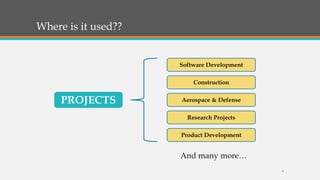
PROJECTS
Software Development
Construction
Aerospace & Defense
Research Projects
Product Development
4
Why CPM is important??
• According to Dr. Larry Bennett (1978), the critical path method also
has three main benefits for project managers. They are…
Identifies the Most
Important Tasks
Helps to Reduce
Timelines
Compares Planned with
Actual
5
Key Steps in the Critical Path Method...
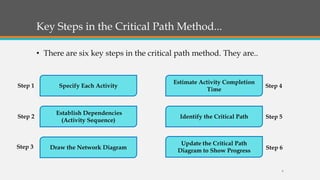
• There are six key steps in the critical path method. They are..
Specify Each Activity
Step 1
Draw the Network Diagram
Step 3
Establish Dependencies
(Activity Sequence)
Step 2
Update the Critical Path
Diagram to Show Progress Step 6
Identify the Critical Path Step 5
Estimate Activity Completion
Time
Step 4
6
Key Steps in the Critical Path Method...
• Step 1 : Specify Each Activity
• The first step is to identify the main deliverables of a project. Then
you can start breaking down the high-level activities into smaller
chunks of work.
7
Key Steps in the Critical Path Method...
• Step 2 : Establish Dependencies (Activity Sequence)
• Some activities will depend on the completion of others. Listing the
immediate predecessors of each activity will help you identify the
correct order.
8
Key Steps in the Critical Path Method...
• Step 3 : Draw the Network Diagram
• Once you have identified the activities and their dependencies, you
can draw the critical path analysis chart (CPA), known as the
network diagram.
9
Key Steps in the Critical Path Method...
• Step 4 : Estimate Activity Completion Time
• Using past experience or the knowledge of an experienced team
member, you must now estimate the time required to complete
each activity. If you are managing a smaller project, you will most
likely estimate time in days. If you are working with a complex
project, you may have to measure time in weeks.
10
Key Steps in the Critical Path Method...
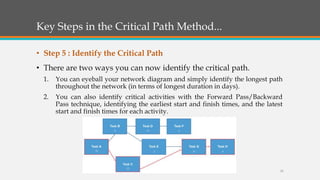
• Step 5 : Identify the Critical Path
• There are two ways you can now identify the critical path.
1. You can eyeball your network diagram and simply identify the longest path
throughout the network (in terms of longest duration in days).
2. You can also identify critical activities with the Forward Pass/Backward
Pass technique, identifying the earliest start and finish times, and the latest
start and finish times for each activity.
11
Key Steps in the Critical Path Method...
• Step 6 : Update the Critical Path Diagram to Show Progress
• As the project progresses, you will learn the actual activity
completion times. The network diagram can then be updated to
include this information (rather than continuing to use
estimations).
12
Calculation of CPM
• Earliest Start Time (EST)
• Earliest Finish Time (EFT)
• Latest start time (LST)
• Latest Finish Time (LFT)
• The longest path of planned
activities to the end of the
project.
• The earliest and latest that each
activity can start and finish
without making the project
longer.
• We have to determine “critical”
activities.
• Crashing the critical path.
Need to find the following for each activity:
13
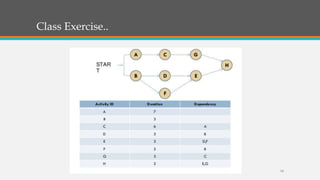
Class Exercise..
14
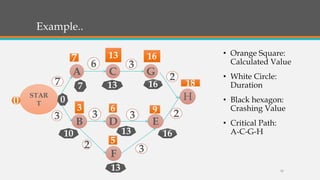
Example..
• Orange Square:
Calculated Value
• White Circle:
Duration
• Black hexagon:
Crashing Value
• Critical Path:
A-C-G-H
A C
STAR
T
G
B D E
H
7
3
6 3
F
3 3
2 3
2
2
7 13 16
3 6
5
9
18
16
13
7
0
16
13
13
10
0
15
Advantages of CPM
• Consistent framework for planning, scheduling, monitoring, and
controlling project.
• Helps proper communications between departments and
functions.
• Determines expected project completion date.
•Determines the dates on which tasks may be started or must be
started if the project is to stay in schedule.
•Shows which tasks must be coordinated to avoid resource or
timing conflicts.
•Shows which tasks may run in parallel to meet project
completion date.
16
Disadvantages of CPM
• Reliability of CPM largely based on accurate estimates and
assumptions made.
• CPM does not guarantee the success of project.
• Resources may not actually be as flexible as management hope
when they come to address network float.
• Too many activities may the network diagram too complicated.
• Activities might themselves have to be broken down into mini
projects.
17
PERT
INTRODUCTION
• PERT was developed in the late 1950 by the US Navy submarine
missile programme and was applied in 1958
• PERT shows the time taken by each component of project &the total
time required for its completion.
• PERT breaks down theproject into events, activity & lays down their
proper sequence relationship & duration in the form of network.
• PERT is a technique of representing project plan innetwork.
• This is represented in a graphic form known as network diagram.
18
Defination
19
• The programme (or project) evaluation and review technique
commonly abbreviated as ‘PERT’; is a statistical tool, used in
project management, which was designed to analyze and
represent the tasks involved in completing a given project & to
illustrate the flow of events in a project
Need for PERT
• Prediction of deliverables
• Planning resource requirement
• Controlling resource allocation
• Internal programme review
• Performance evaluation
• Uniform wide acceptance
• Reduction in cost
• Saving time
20
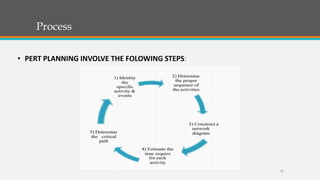
Process
• PERT PLANNING INVOLVE THE FOLOWING STEPS:
21
Advantages & Disadvantages
22
Advantages
• Simple to understand and use.
• Identify the activities that need closer attention
• Determine the flexibility available with activities
• Show potential risk with activities
• Provide good documentation of the project activities
• Help to set priorities among activities & resource allocation as per priority
Disadvantages
• The cost of setting up such systemare extensive.
• It is difficult to estimate accurate time & cost of various
activities involved in a project
Thank You
23

CPM and pert(IT)-SOWFTWARE PROJECT MANAGEMENT

  • 1.
    Critical Path Method & ProgrammeEvaluation Review Technique
  • 2.
    What is CriticalPath?? • The sequence of project activities which add up to the longest overall duration. • The critical path determines the shortest time possible to complete the project. 2
  • 3.
    What is CriticalPath Method?? • Critical Path Method (CPM) is basically a step-by-step Project Management technique that separates planning and scheduling. • It also clarifies the inter relationship of time and cost. • CPM evaluates all the possible alternative plans for project and associates each plans with a schedule. • It is a mathematical based algorithm for scheduling a set of project activities. 3
  • 4.
    Where is itused?? And many more… PROJECTS Software Development Construction Aerospace & Defense Research Projects Product Development 4
  • 5.
    Why CPM isimportant?? • According to Dr. Larry Bennett (1978), the critical path method also has three main benefits for project managers. They are… Identifies the Most Important Tasks Helps to Reduce Timelines Compares Planned with Actual 5
  • 6.
    Key Steps inthe Critical Path Method... • There are six key steps in the critical path method. They are.. Specify Each Activity Step 1 Draw the Network Diagram Step 3 Establish Dependencies (Activity Sequence) Step 2 Update the Critical Path Diagram to Show Progress Step 6 Identify the Critical Path Step 5 Estimate Activity Completion Time Step 4 6
  • 7.
    Key Steps inthe Critical Path Method... • Step 1 : Specify Each Activity • The first step is to identify the main deliverables of a project. Then you can start breaking down the high-level activities into smaller chunks of work. 7
  • 8.
    Key Steps inthe Critical Path Method... • Step 2 : Establish Dependencies (Activity Sequence) • Some activities will depend on the completion of others. Listing the immediate predecessors of each activity will help you identify the correct order. 8
  • 9.
    Key Steps inthe Critical Path Method... • Step 3 : Draw the Network Diagram • Once you have identified the activities and their dependencies, you can draw the critical path analysis chart (CPA), known as the network diagram. 9
  • 10.
    Key Steps inthe Critical Path Method... • Step 4 : Estimate Activity Completion Time • Using past experience or the knowledge of an experienced team member, you must now estimate the time required to complete each activity. If you are managing a smaller project, you will most likely estimate time in days. If you are working with a complex project, you may have to measure time in weeks. 10
  • 11.
    Key Steps inthe Critical Path Method... • Step 5 : Identify the Critical Path • There are two ways you can now identify the critical path. 1. You can eyeball your network diagram and simply identify the longest path throughout the network (in terms of longest duration in days). 2. You can also identify critical activities with the Forward Pass/Backward Pass technique, identifying the earliest start and finish times, and the latest start and finish times for each activity. 11
  • 12.
    Key Steps inthe Critical Path Method... • Step 6 : Update the Critical Path Diagram to Show Progress • As the project progresses, you will learn the actual activity completion times. The network diagram can then be updated to include this information (rather than continuing to use estimations). 12
  • 13.
    Calculation of CPM •Earliest Start Time (EST) • Earliest Finish Time (EFT) • Latest start time (LST) • Latest Finish Time (LFT) • The longest path of planned activities to the end of the project. • The earliest and latest that each activity can start and finish without making the project longer. • We have to determine “critical” activities. • Crashing the critical path. Need to find the following for each activity: 13
  • 14.
  • 15.
    Example.. • Orange Square: CalculatedValue • White Circle: Duration • Black hexagon: Crashing Value • Critical Path: A-C-G-H A C STAR T G B D E H 7 3 6 3 F 3 3 2 3 2 2 7 13 16 3 6 5 9 18 16 13 7 0 16 13 13 10 0 15
  • 16.
    Advantages of CPM •Consistent framework for planning, scheduling, monitoring, and controlling project. • Helps proper communications between departments and functions. • Determines expected project completion date. •Determines the dates on which tasks may be started or must be started if the project is to stay in schedule. •Shows which tasks must be coordinated to avoid resource or timing conflicts. •Shows which tasks may run in parallel to meet project completion date. 16
  • 17.
    Disadvantages of CPM •Reliability of CPM largely based on accurate estimates and assumptions made. • CPM does not guarantee the success of project. • Resources may not actually be as flexible as management hope when they come to address network float. • Too many activities may the network diagram too complicated. • Activities might themselves have to be broken down into mini projects. 17
  • 18.
    PERT INTRODUCTION • PERT wasdeveloped in the late 1950 by the US Navy submarine missile programme and was applied in 1958 • PERT shows the time taken by each component of project &the total time required for its completion. • PERT breaks down theproject into events, activity & lays down their proper sequence relationship & duration in the form of network. • PERT is a technique of representing project plan innetwork. • This is represented in a graphic form known as network diagram. 18
  • 19.
    Defination 19 • The programme(or project) evaluation and review technique commonly abbreviated as ‘PERT’; is a statistical tool, used in project management, which was designed to analyze and represent the tasks involved in completing a given project & to illustrate the flow of events in a project
  • 20.
    Need for PERT •Prediction of deliverables • Planning resource requirement • Controlling resource allocation • Internal programme review • Performance evaluation • Uniform wide acceptance • Reduction in cost • Saving time 20
  • 21.
    Process • PERT PLANNINGINVOLVE THE FOLOWING STEPS: 21
  • 22.
    Advantages & Disadvantages 22 Advantages •Simple to understand and use. • Identify the activities that need closer attention • Determine the flexibility available with activities • Show potential risk with activities • Provide good documentation of the project activities • Help to set priorities among activities & resource allocation as per priority Disadvantages • The cost of setting up such systemare extensive. • It is difficult to estimate accurate time & cost of various activities involved in a project
  • 23.