


Games for Learning
Design Principles for Student Engagement
in Blended Learning Models
Max Holecheck Ayu Othman
UX Designer Art Director
Dr. Tim Hudson
Senior Director of Curriculum Design
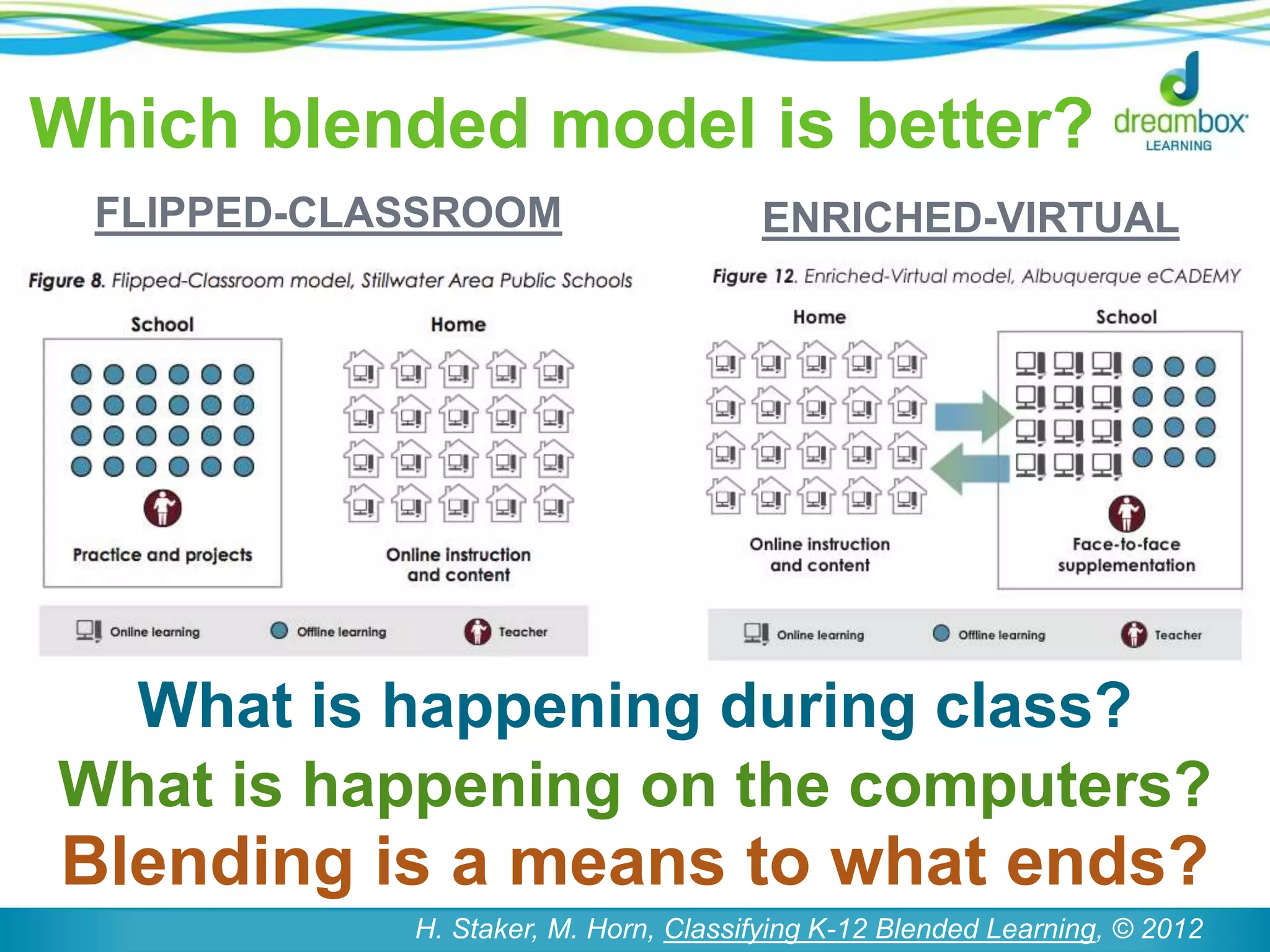
Which blended model is better?
FLIPPED-CLASSROOM ENRICHED-VIRTUAL
Blending is a means to what ends?
What is happening during class?
What is happening on the computers?
H. Staker, M. Horn, Classifying K-12 Blended Learning, © 2012
The Quality of Digital
Learning Experiences
is just as important as
the Quality of
Classroom Learning
Experiences
Principles of Game
Design can be used
to Improve Student
Engagement in
Learning
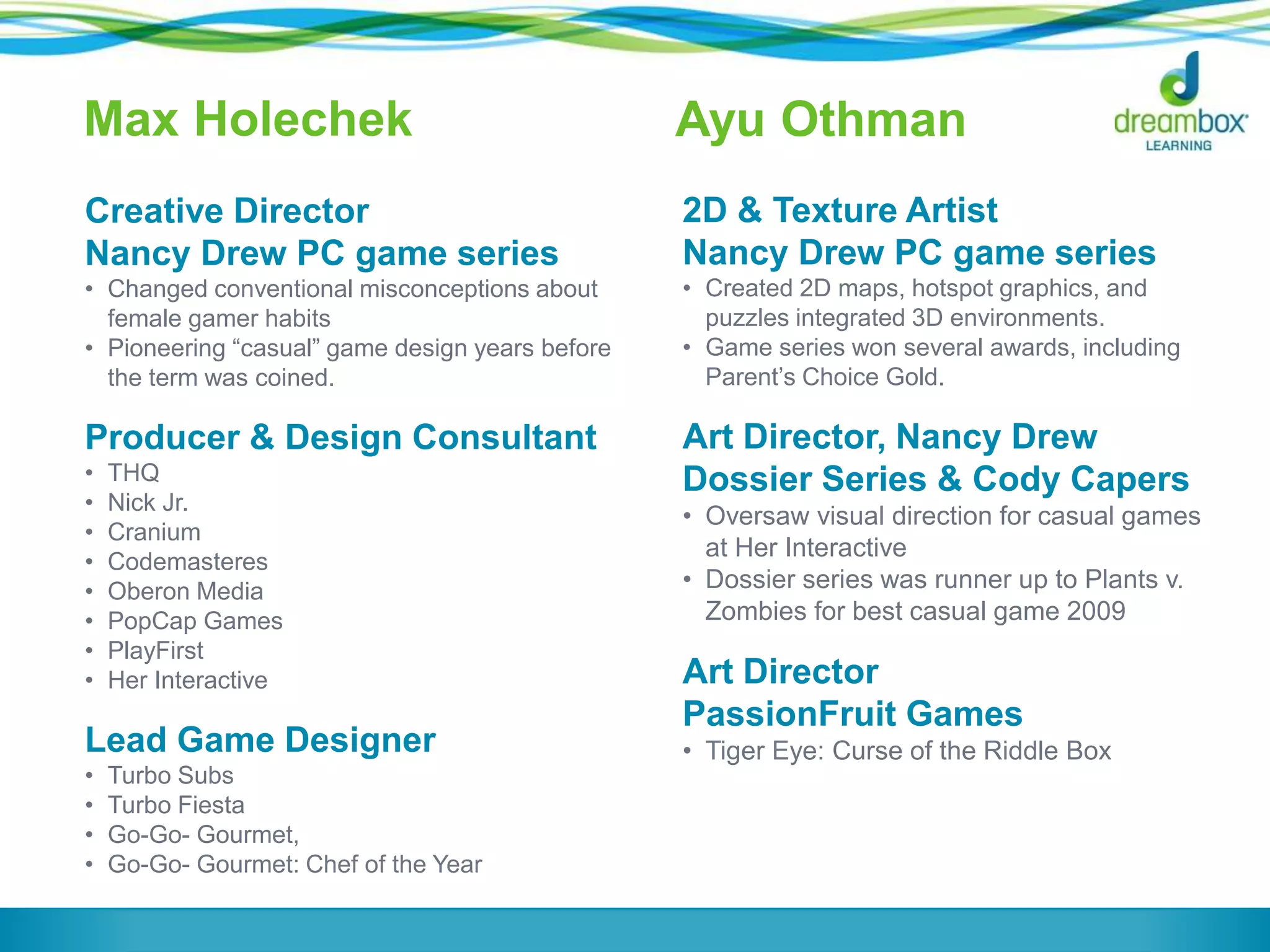
Max Holechek
Creative Director
Nancy Drew PC game series
• Changed conventional misconceptions about
female gamer habits
• Pioneering “casual” game design years before
the term was coined.
Producer & Design Consultant
• THQ
• Nick Jr.
• Cranium
• Codemasteres
• Oberon Media
• PopCap Games
• PlayFirst
• Her Interactive
Lead Game Designer
• Turbo Subs
• Turbo Fiesta
• Go-Go- Gourmet,
• Go-Go- Gourmet: Chef of the Year
Ayu Othman
2D & Texture Artist
Nancy Drew PC game series
• Created 2D maps, hotspot graphics, and
puzzles integrated 3D environments.
• Game series won several awards, including
Parent’s Choice Gold.
Art Director, Nancy Drew
Dossier Series & Cody Capers
• Oversaw visual direction for casual games
at Her Interactive
• Dossier series was runner up to Plants v.
Zombies for best casual game 2009
Art Director
PassionFruit Games
• Tiger Eye: Curse of the Riddle Box
Games for Learning – Design Principles
How can I make learning seem
more like a game?
(Not the right question, unless you
understand what you’re asking.)
FUN!
“When the fun goes out of
play, most often so does the
learning.”
- Joanne E. Oppenheim (Kids and Play, ch. 1, 1984)
What is “Fun?”
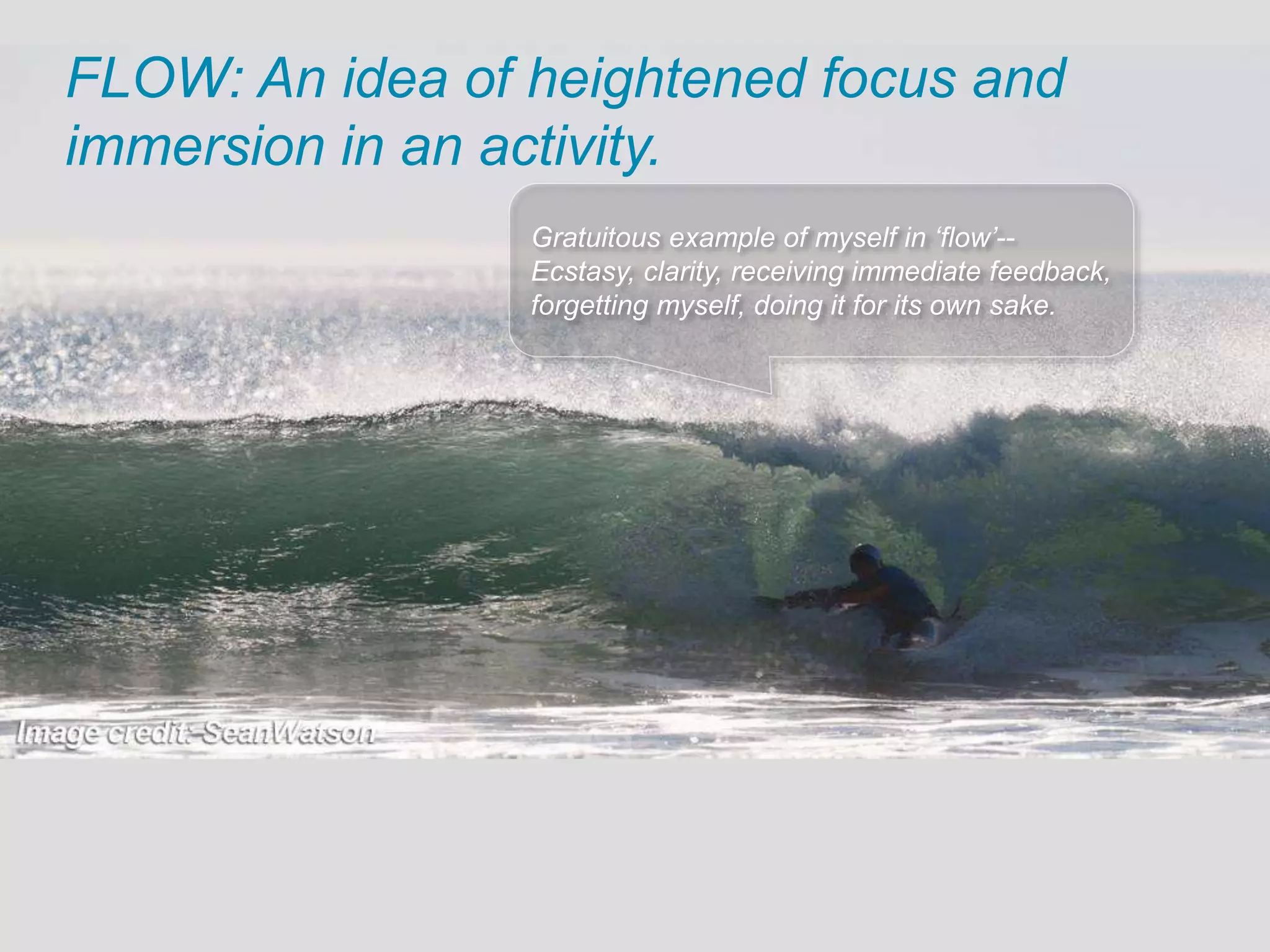
FLOW
An idea of heightened focus and
immersion in an activity.
Gratuitous example of myself in ‘flow’--
Ecstasy, clarity, receiving immediate feedback,
forgetting myself, doing it for its own sake.
FLOW: An idea of heightened focus and
immersion in an activity.
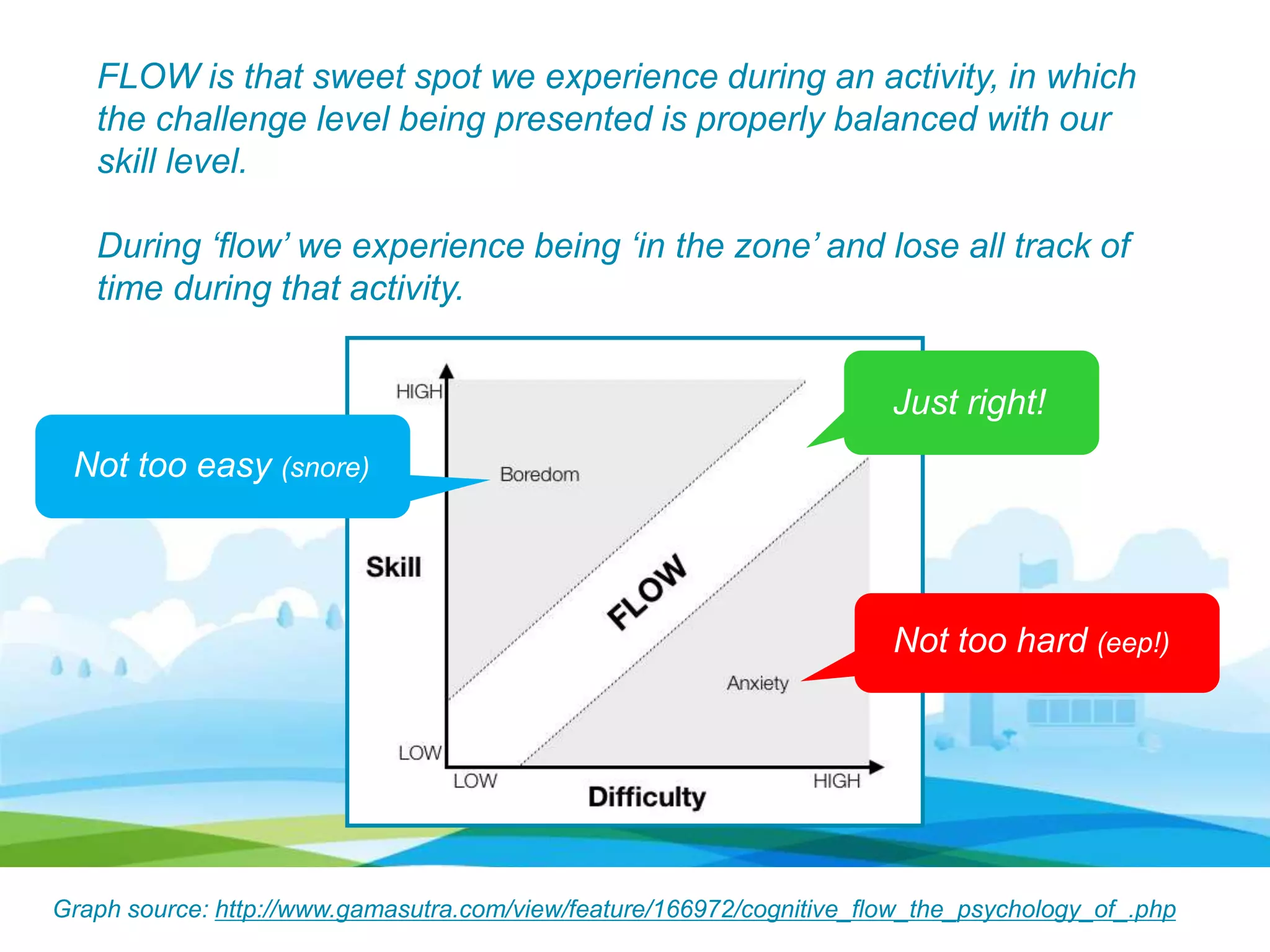
FLOW is that sweet spot we experience during an activity, in which
the challenge level being presented is properly balanced with our
skill level.
During ‘flow’ we experience being ‘in the zone’ and lose all track of
time during that activity.
Graph source: http://www.gamasutra.com/view/feature/166972/cognitive_flow_the_psychology_of_.php
Not too easy (snore)
Not too hard (eep!)
Just right!
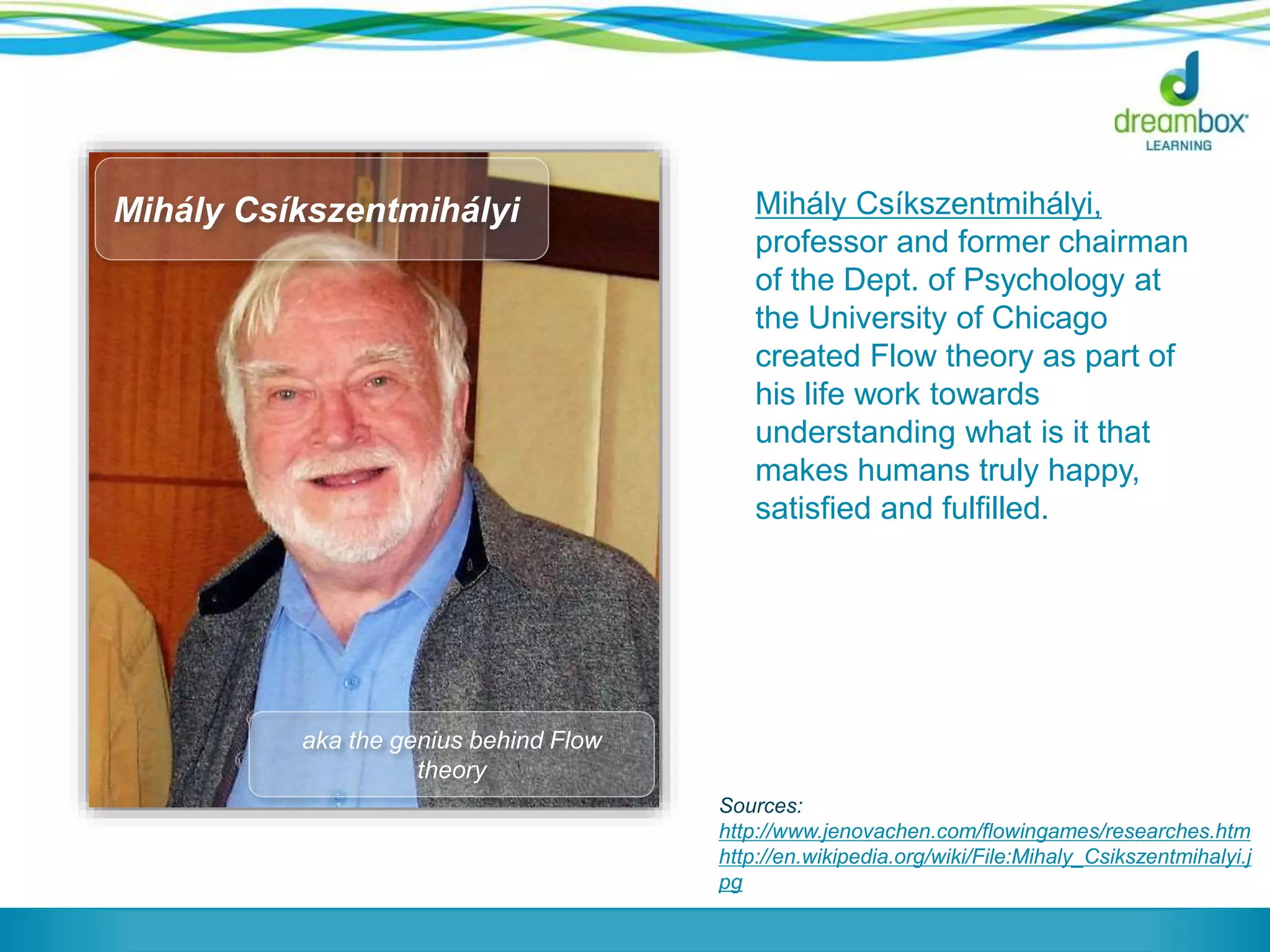
Mihály Csíkszentmihályi,
professor and former chairman
of the Dept. of Psychology at
the University of Chicago
created Flow theory as part of
his life work towards
understanding what is it that
makes humans truly happy,
satisfied and fulfilled.
Sources:
http://www.jenovachen.com/flowingames/researches.htm
http://en.wikipedia.org/wiki/File:Mihaly_Csikszentmihalyi.j
pg
aka the genius behind Flow
theory
Mihály Csíkszentmihályi
Elements of Flow
• A challenge activity that requires skills
• The merging of action and awareness
• Clear goals
• Direct feedback
• Concentration on the task at hand
• The sense of control
• The loss of self-consciousness
• The transformation of time
Source: http://www.jenovachen.com/flowingames/foundation.htm
Great teachers and coaches already utilize
elements of Flow theory in engaging their
students.
What is a game?
A system in which players engage in an artificial
conflict, defined by rules, that results in a
quantifiable outcome.
Source: •Salen, K. and E. Zimmerman. Rules of Play : Game Design Fundamentals. The MIT Press. (2003)
What is a good game?
A carefully designed system that invokes flow in
players as they engage in an artificial conflict,
defined by rules, that results in a quantifiable
outcome.
Source: •Salen, K. and E. Zimmerman. Rules of Play : Game Design Fundamentals. The MIT Press. (2003)
..and Ayu & Max

Relevance to the player and game’s goals
Understanding upon a glance
Get out of the player’s way
Learning through safe exploration
Use rewards for perseverance and replay-ability
Good Casual Game Design Principles
Relevance to the player and game’s goals
• Contextualize your game
Good Casual Game Design Principles
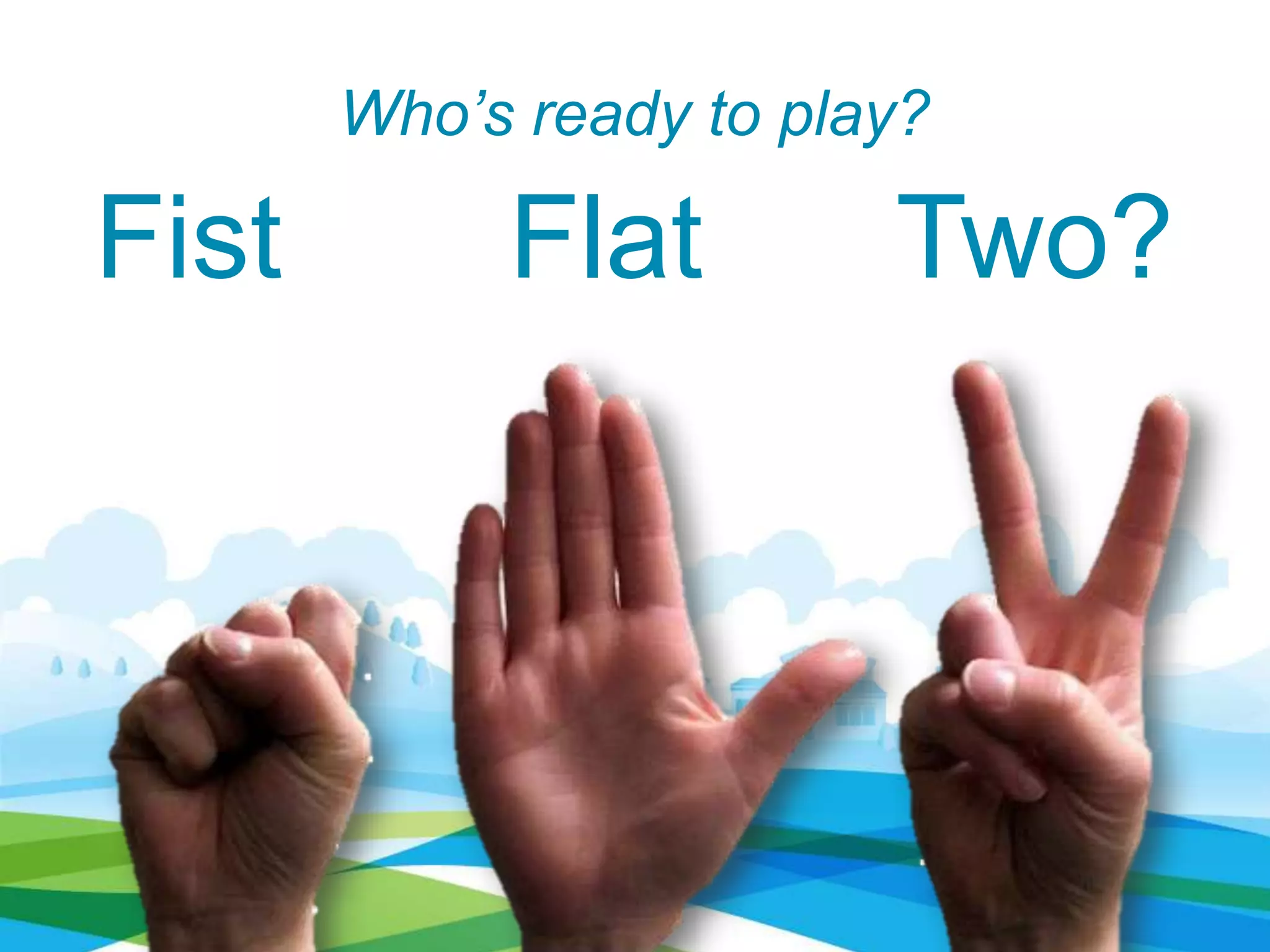
Who’s ready to play?
Fist Flat Two?
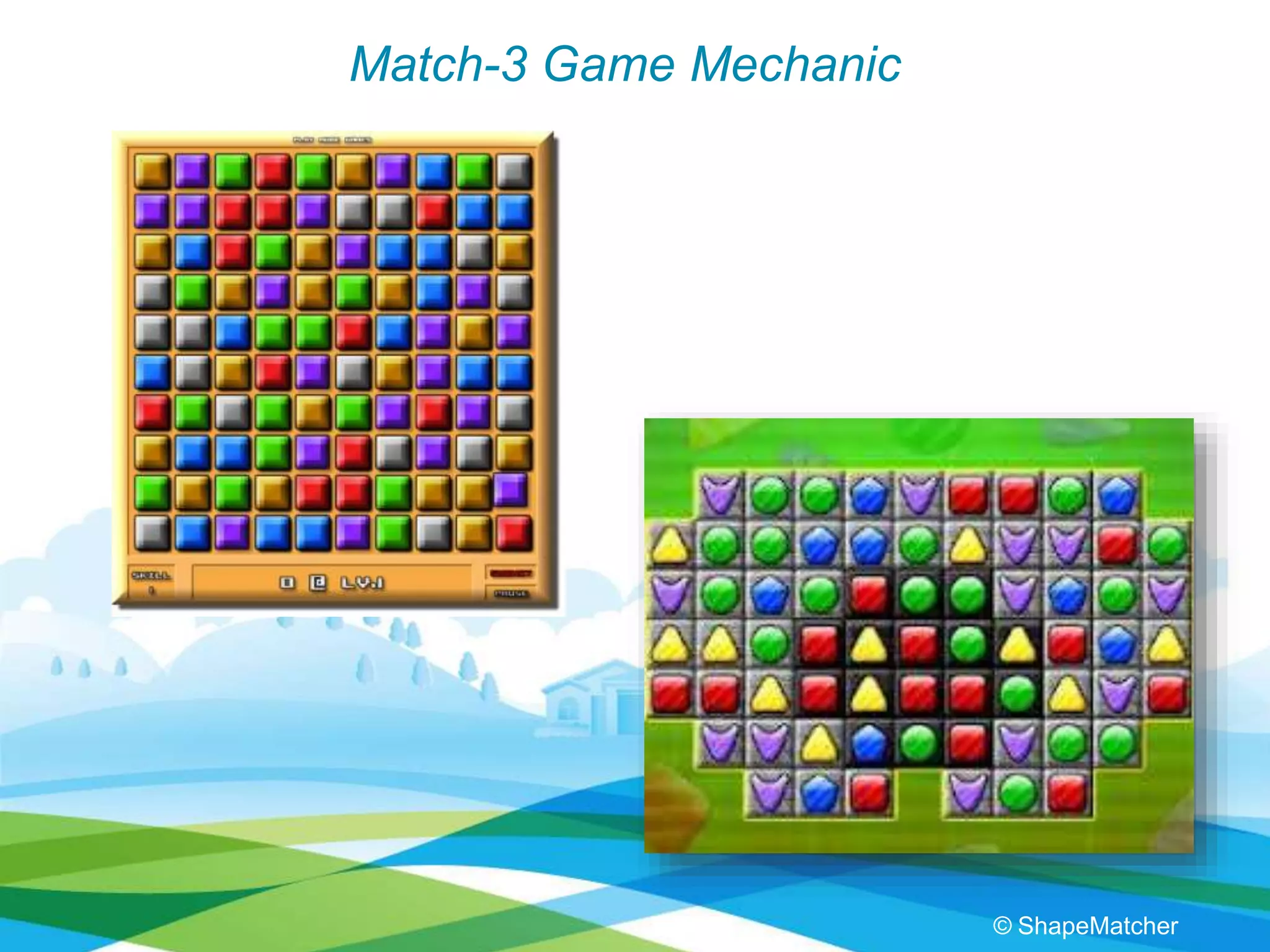
Match-3 Game Mechanic
© ShapeMatcher
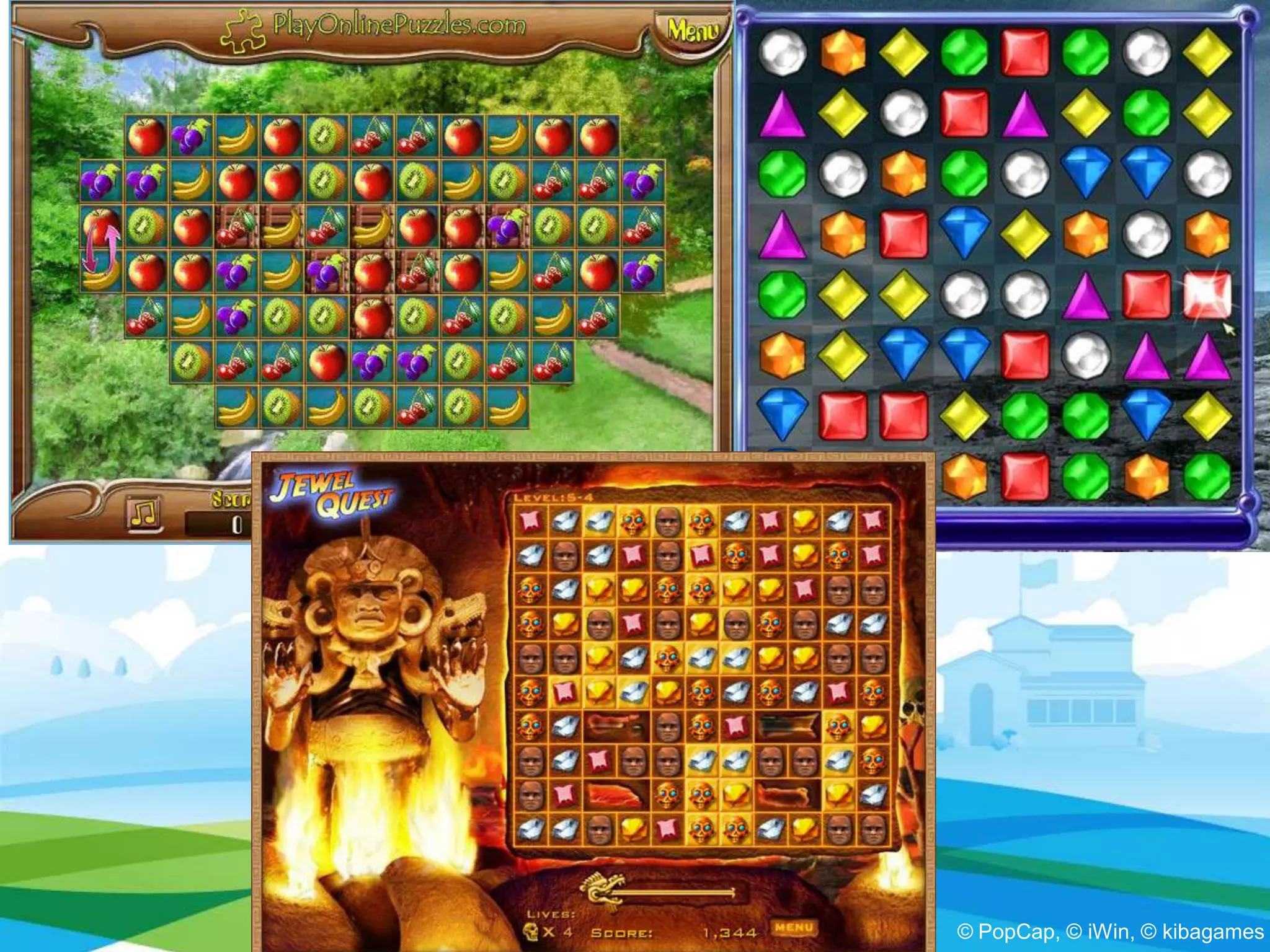
© PopCap, © iWin, © kibagames
Relevance to the player and game’s goals
• Contextualize your game
• Don’t Assume your Assumptions are Valid
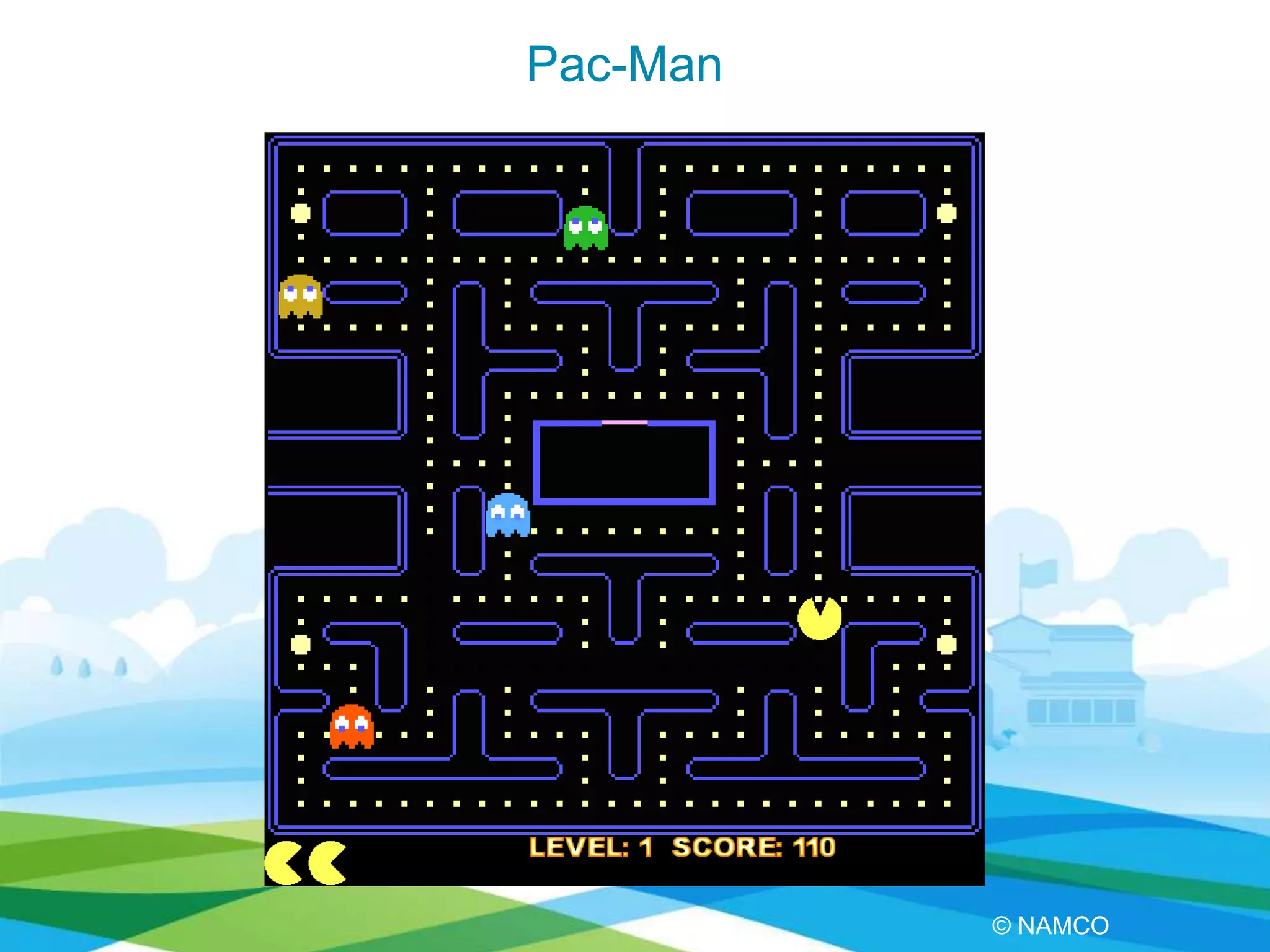
• The player only gets 3 lives, right?
• Being penalized & vanquished is just part of learning/playing a game!
Good Casual Game Design Principles
Pac-Man
© NAMCO
Relevance to the player and game’s goals
• Contextualize your game
• Don’t Assume your Assumptions are Valid
• The player only gets 3 lives, right?
• Being penalized & vanquished is just part of learning/playing a game!
• Classroom application: Plan Backward from Learning Goals
Good Casual Game Design Principles
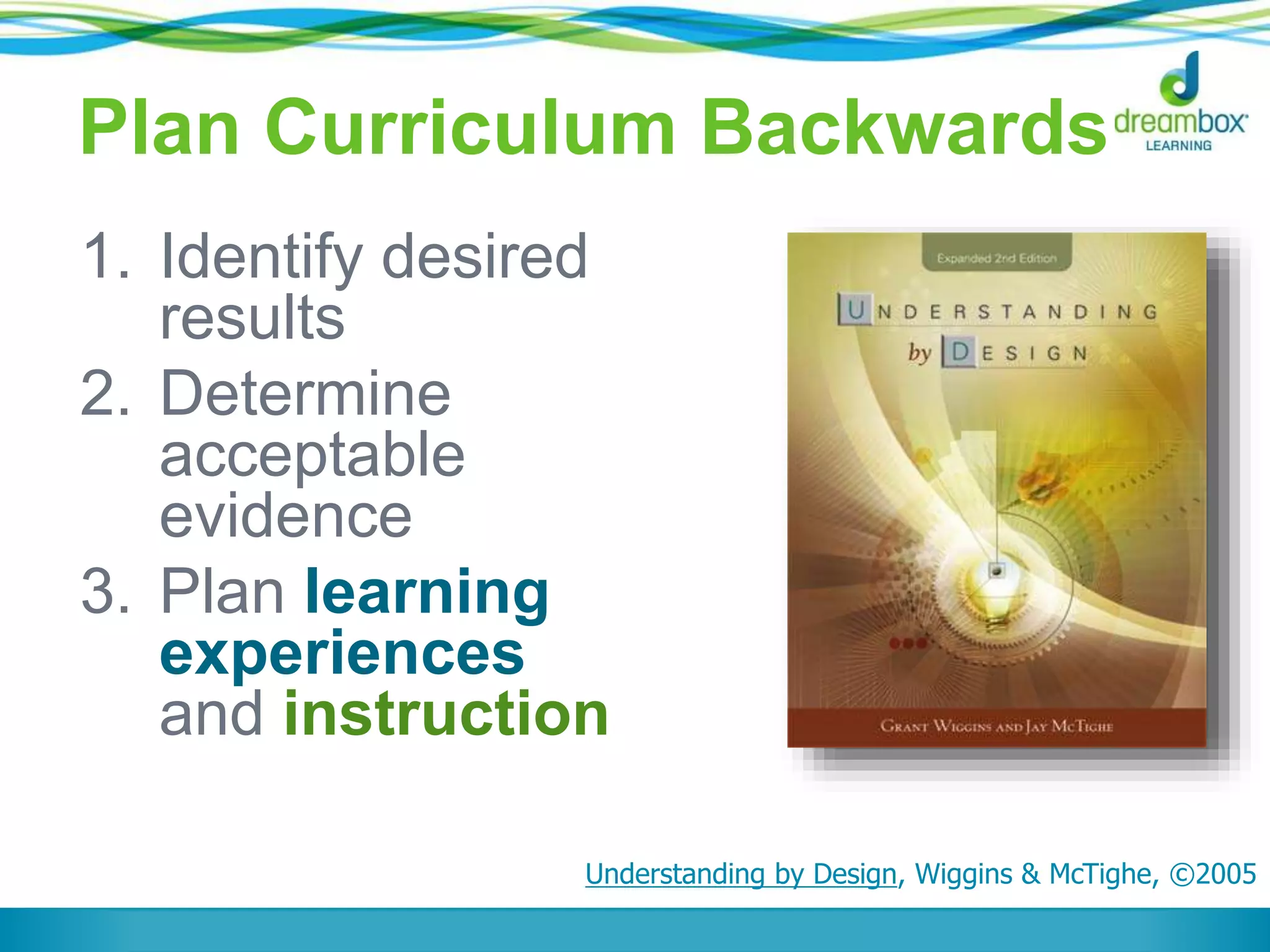
Plan Curriculum Backwards
1. Identify desired
results
2. Determine
acceptable
evidence
3. Plan learning
experiences
and instruction
Understanding by Design, Wiggins & McTighe, ©2005
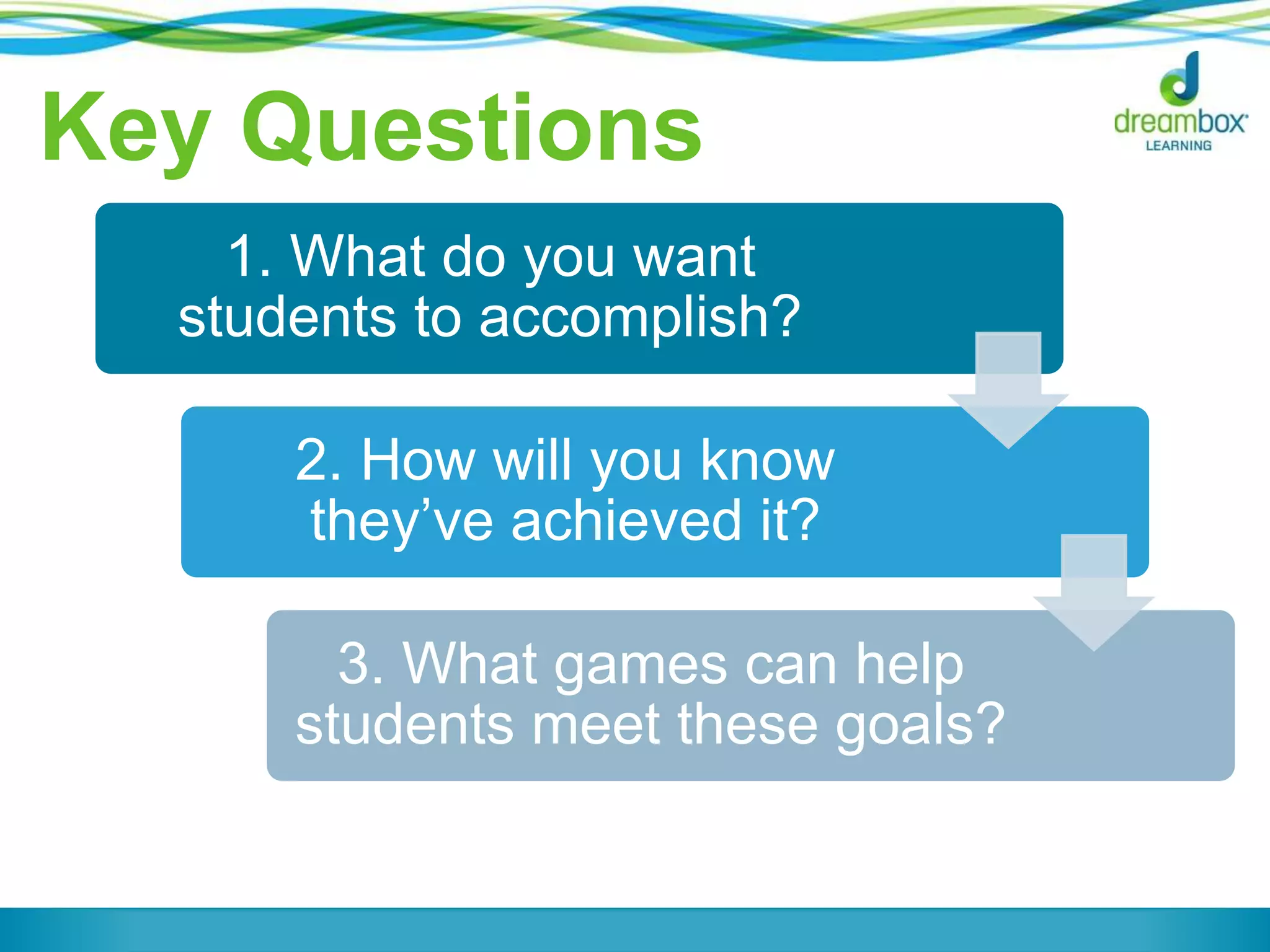
Key Questions
1. What do you want
students to accomplish?
2. How will you know
they’ve achieved it?
3. What games can help
students meet these goals?
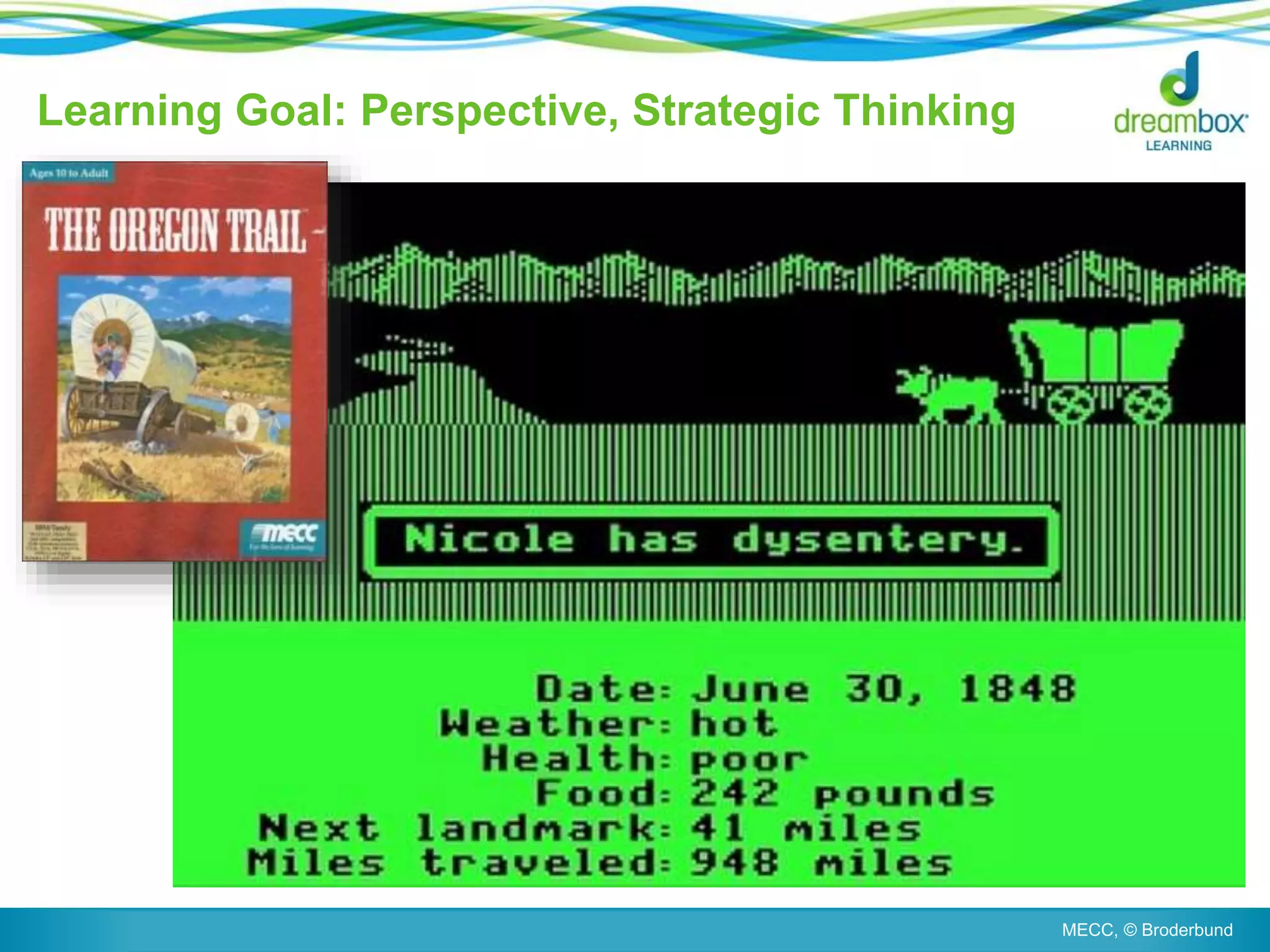
Learning Goal: Perspective, Strategic Thinking
MECC, © Broderbund
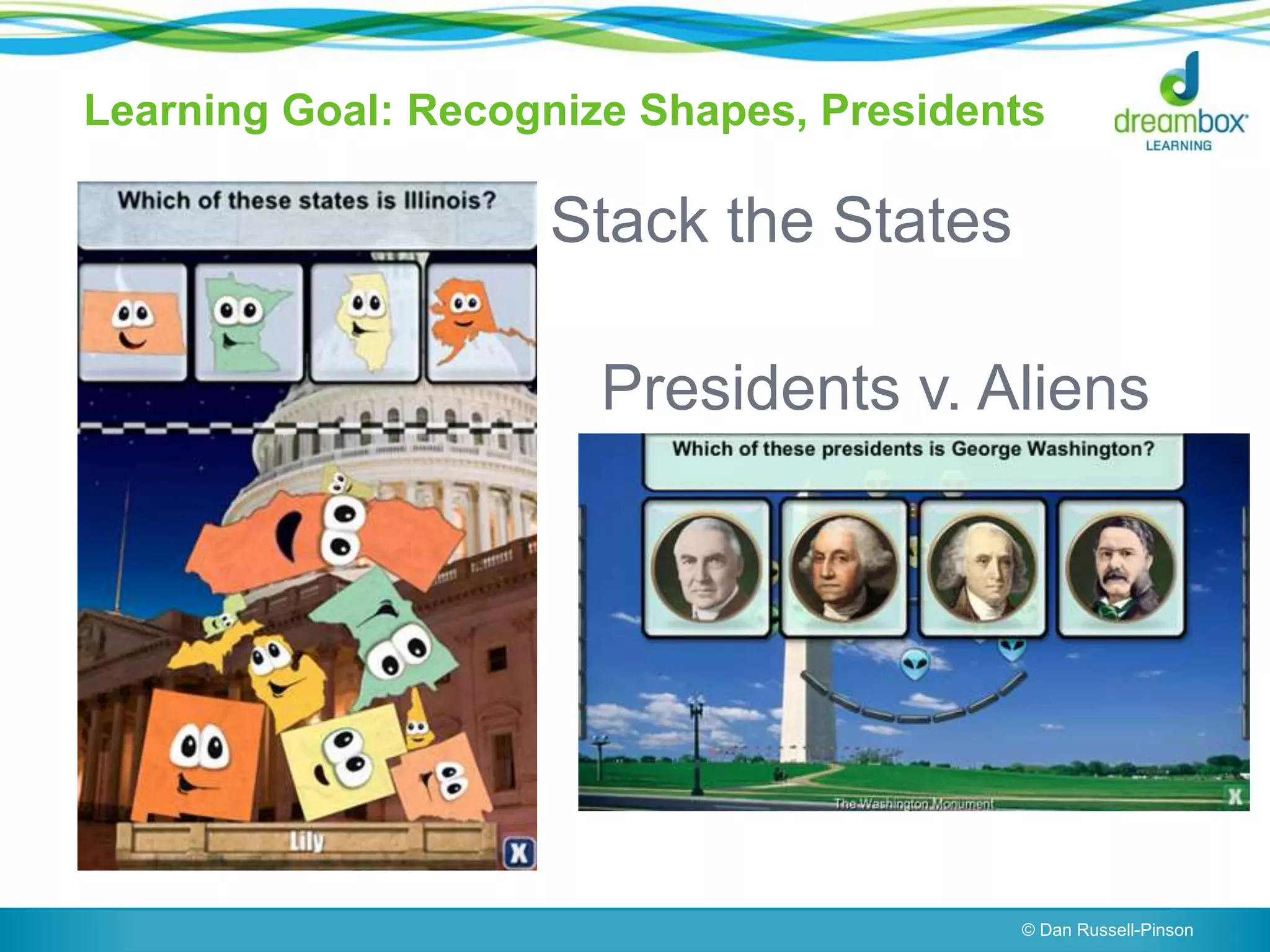
Learning Goal: Recognize Shapes, Presidents
© Dan Russell-Pinson
Stack the States
Presidents v. Aliens
Learning Goal: Geography, Culture, Inquiry
www.mobygames.com ©Broderbund
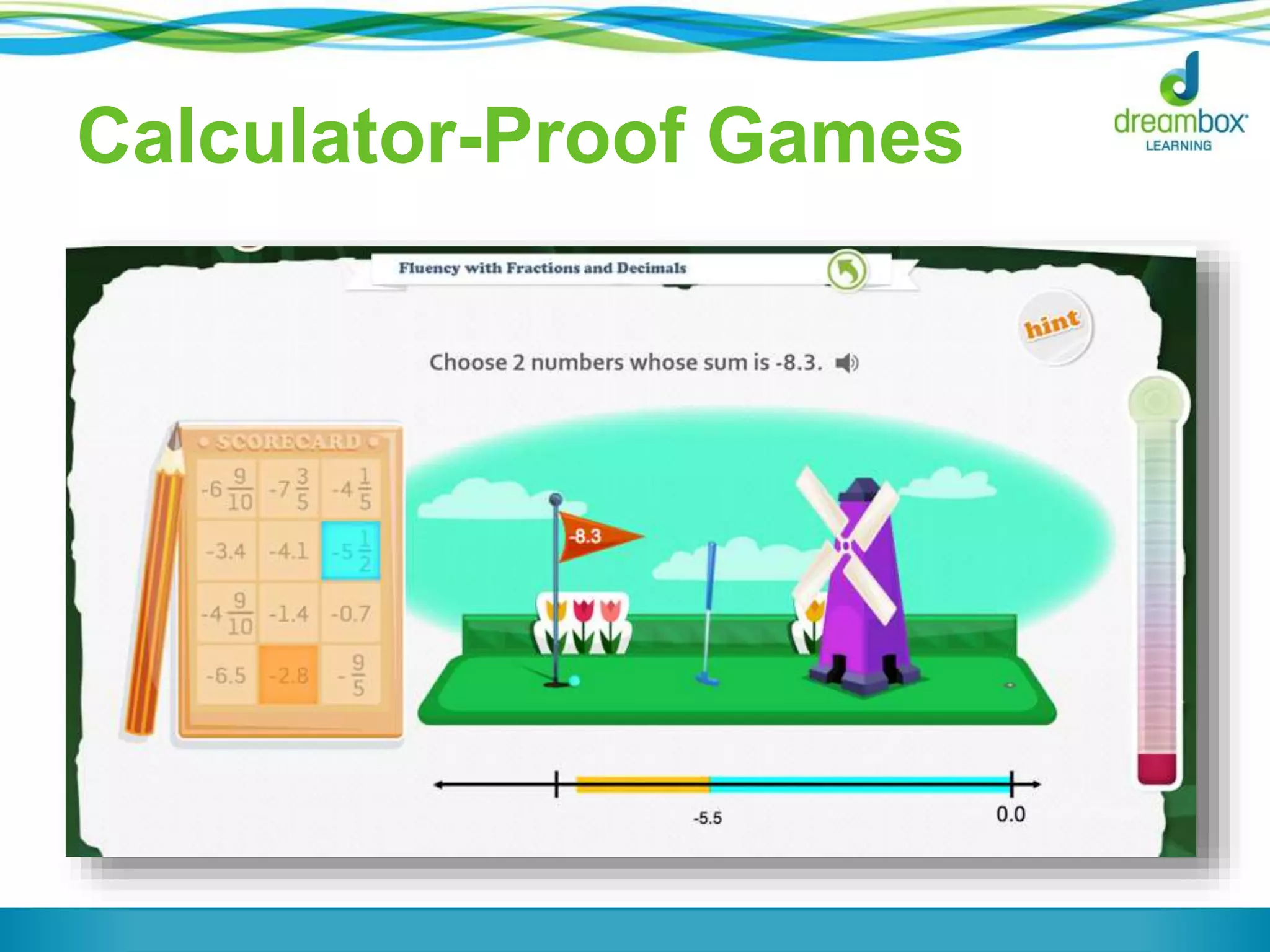
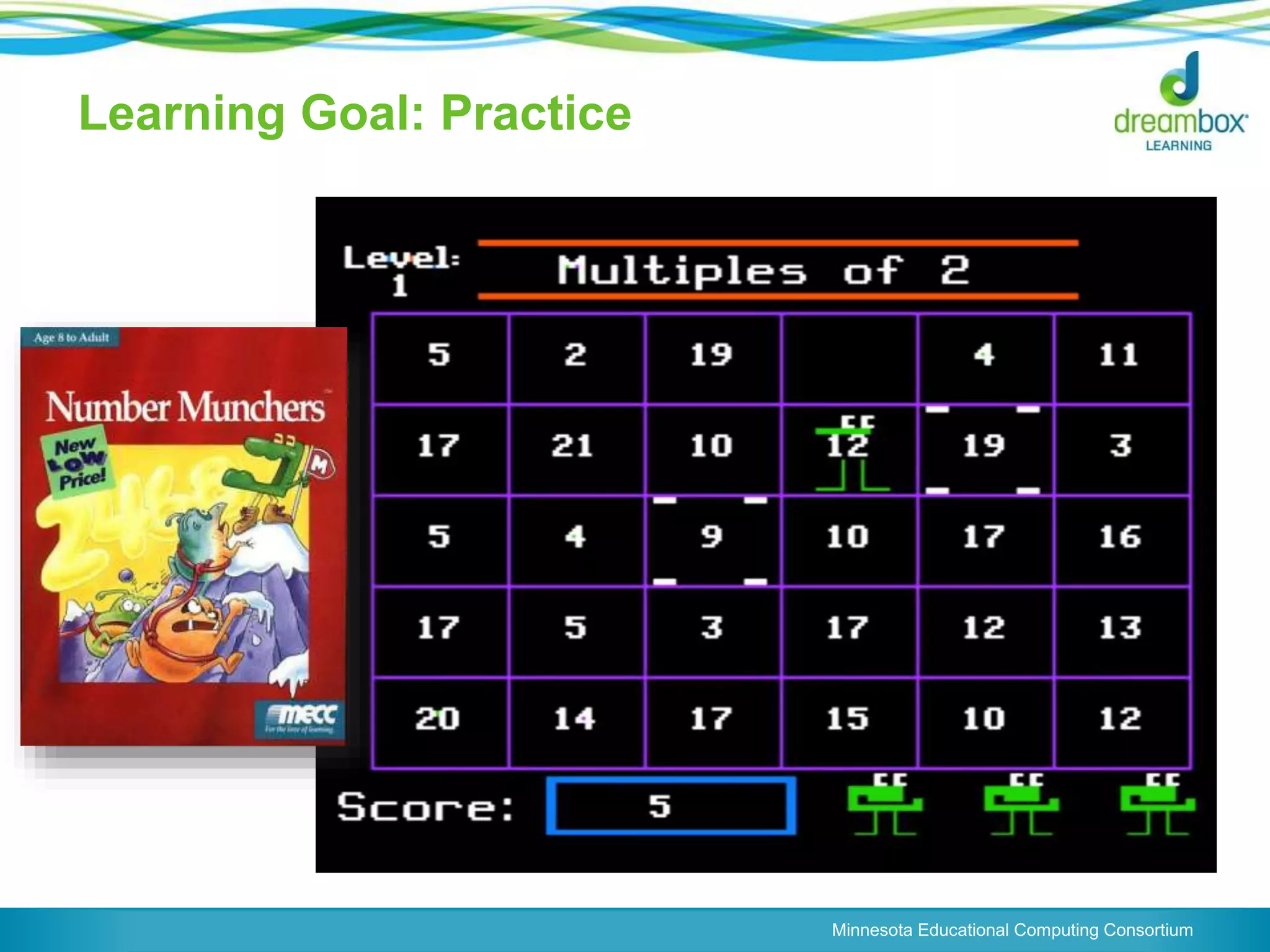
Learning Goal: Practice
Minnesota Educational Computing Consortium
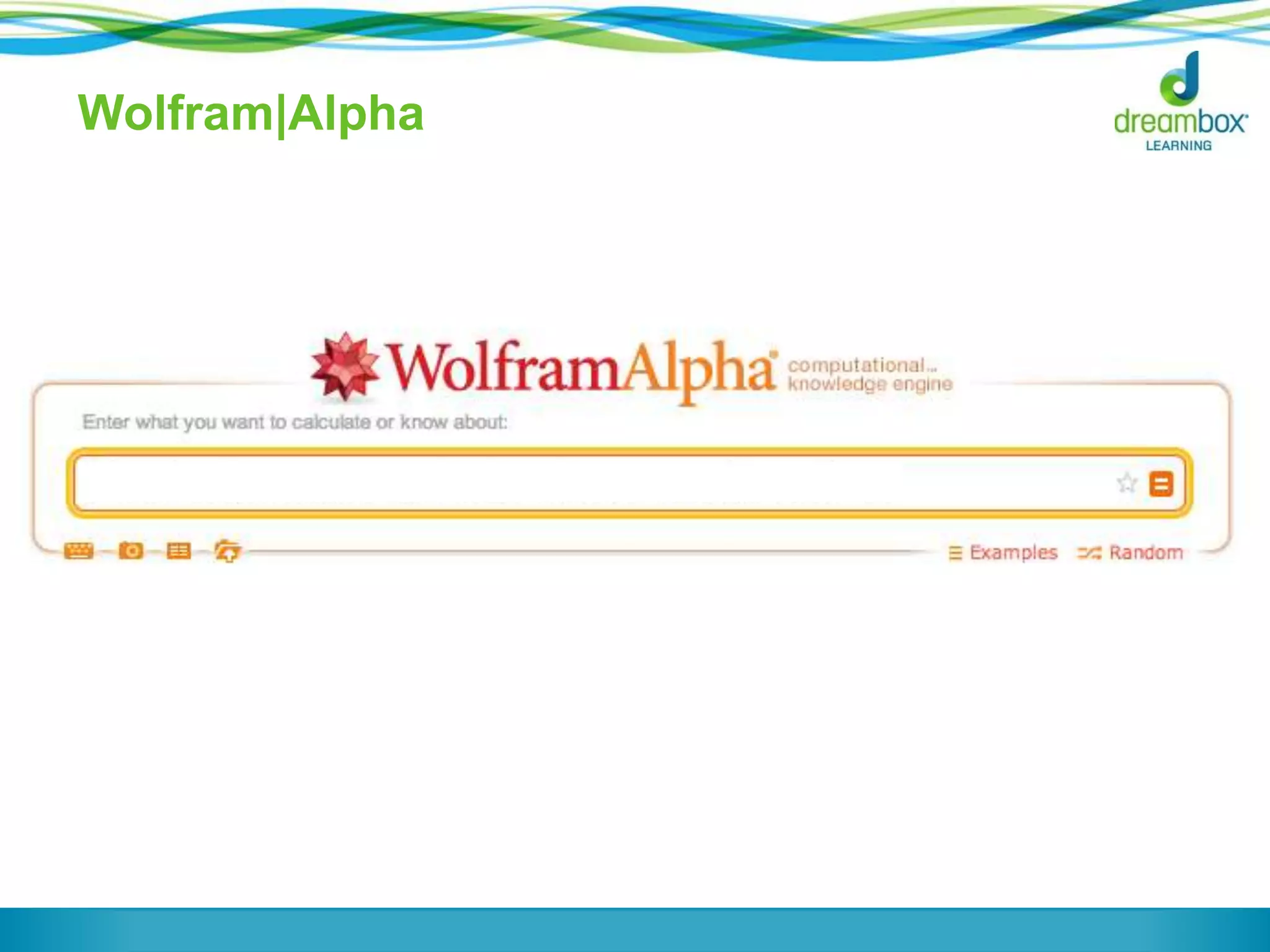
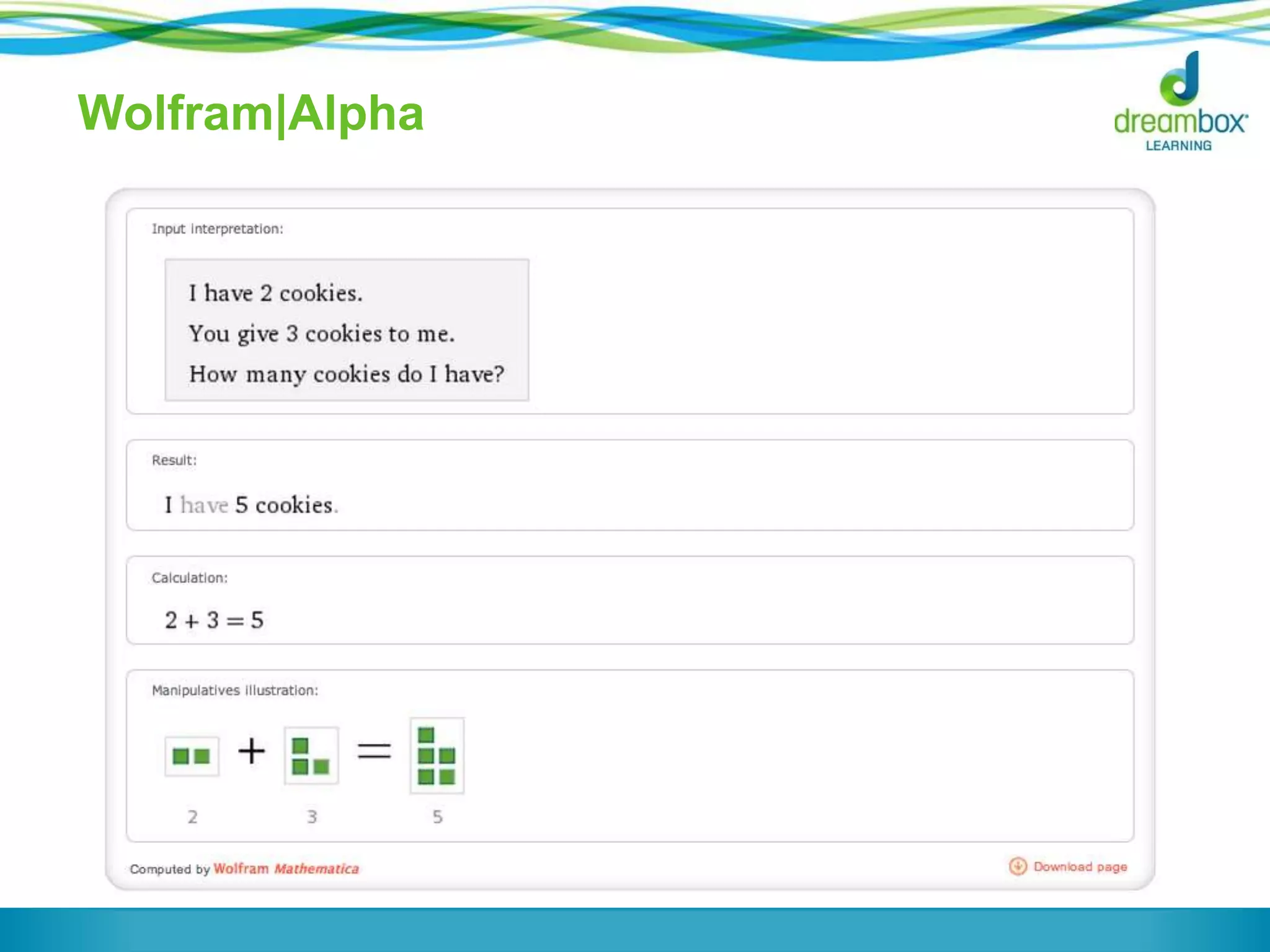
Wolfram|Alpha
Wolfram|Alpha
Better Goals for Students
David Bressoud, Mathematical Association of
America (www.maa.org/columns)
• “The existence of Wolfram|Alpha [and calculators]
does push instructors to be more honest about
their use of standard problems executed by
memorizing algorithmic procedures.
• “If a student feels that she or he has learned
nothing that cannot be pulled directly from
Wolfram|Alpha, then the course really has been
a waste of time.”
Calculator-Proof Games
Classifying Learning Games
No Prior Instruction
Needed
• Learning Experiences
• Usually Conceptual
• Simulation, Situation
• Critical Thinking Focus
• Mostly Self-Directed
• Realization Focus
• Content Specific
• Learning Context &
Content first, THEN game
is added afterward
Prior Instruction
Required
• Practice
• Often Rote
• “Flash Card” Design
• Often Memory Focus
• Mostly Teacher-Directed
• Recall Focus
• Possibly Interchangeable
Content
• Game Design comes first,
THEN content is added
afterward
Good Casual Game Design Principles
Understanding Upon a Glance
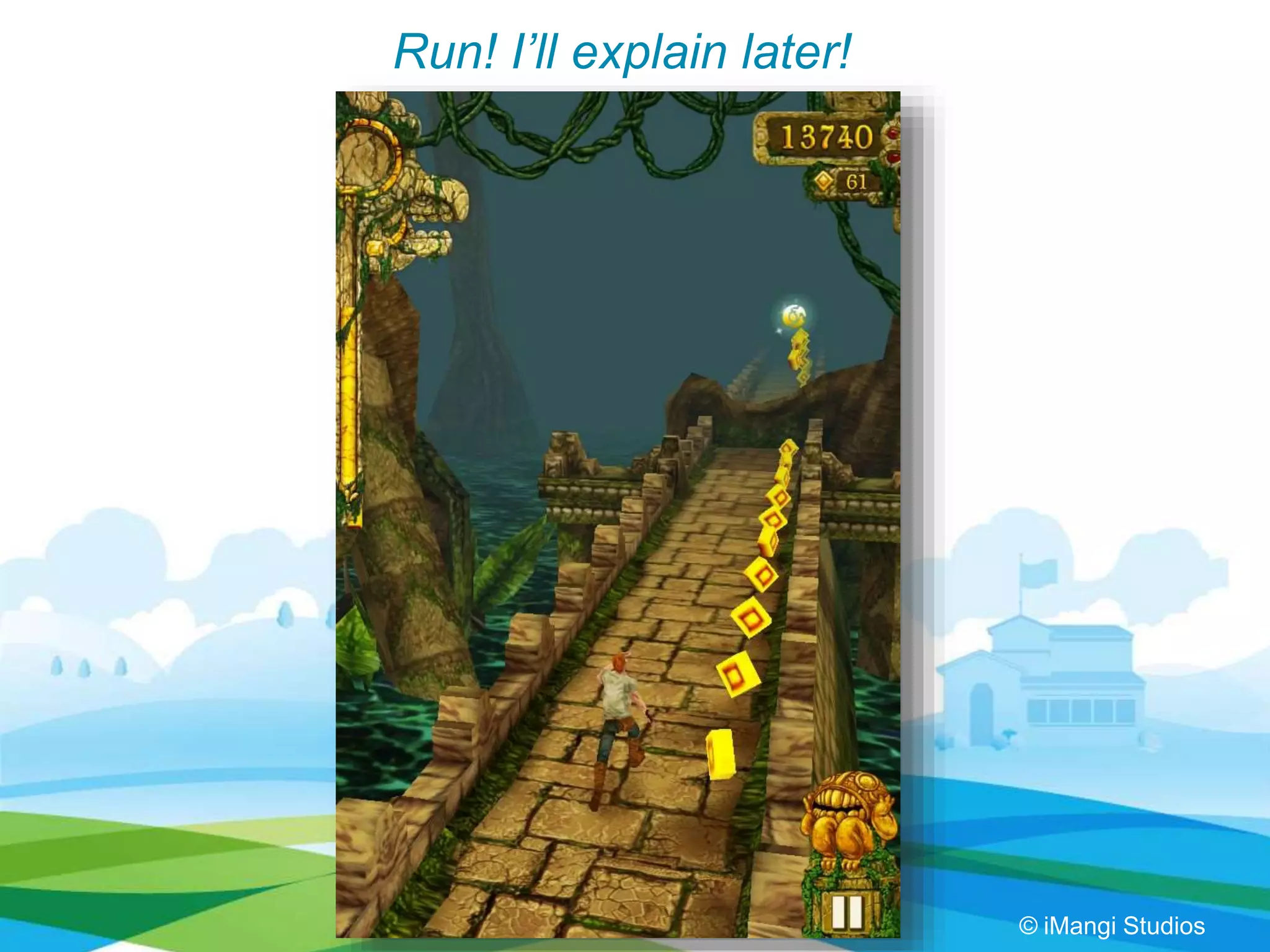
• Players can learn to play the game within 15 seconds
• Layout, simplicity of elements, and highlight use instruct visually.
• If your game looks like an XL spreadsheet, start over.
• Simple, minimal, elegant rule sets. If the game incorporates more or more
complex rules, stagger them in slowly and in later levels. (Flow!)
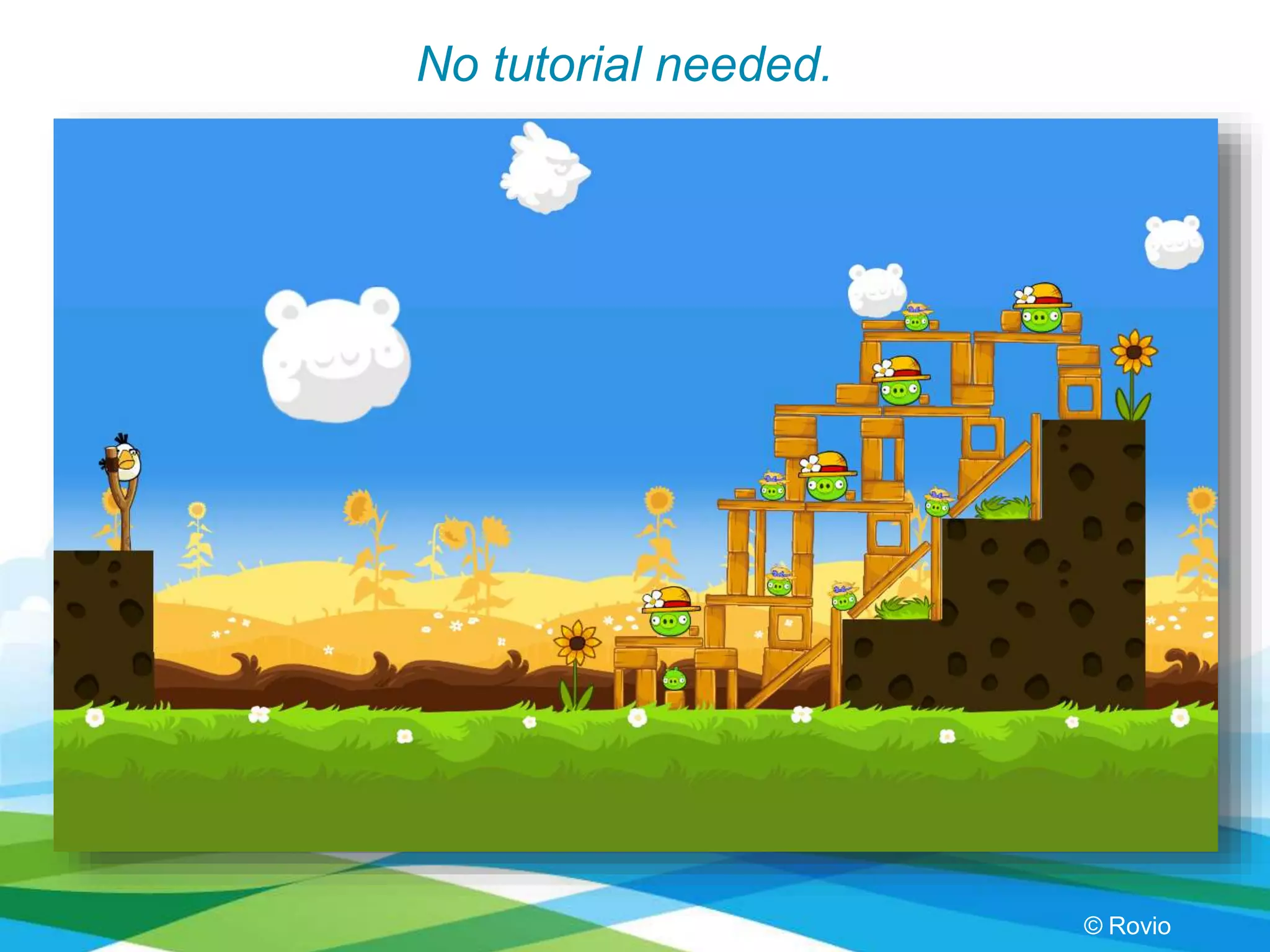
No tutorial needed.
© Rovio
Run! I’ll explain later!
© iMangi Studios
Good Casual Game Design Principles
Understanding Upon a Glance
• Minimal, transparent, very intuitive player input
• PC: Avoid/limit keyboard or right button input
• Touch screen: Limit number of gestures
• Never change already introduced UI behavior
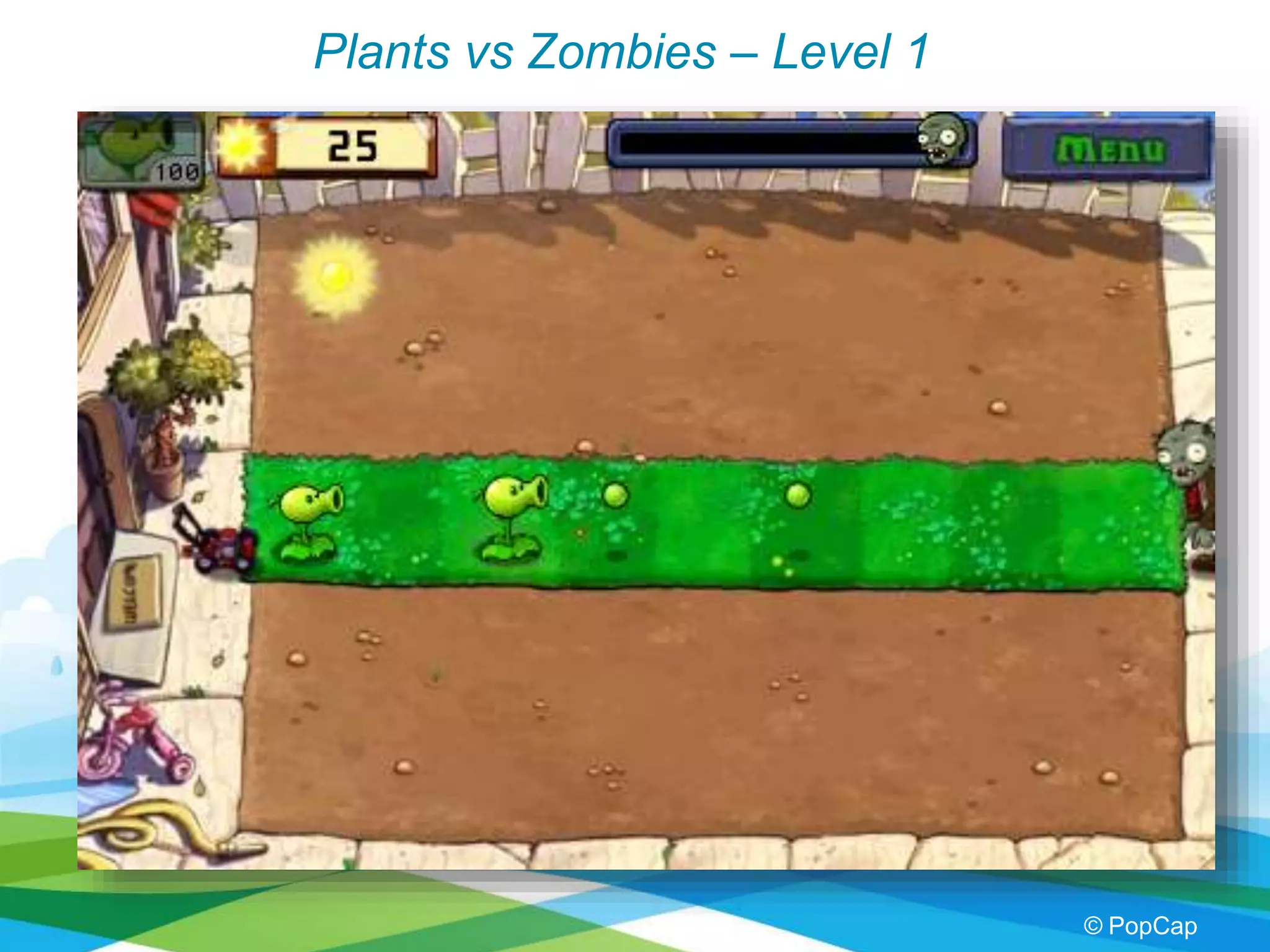
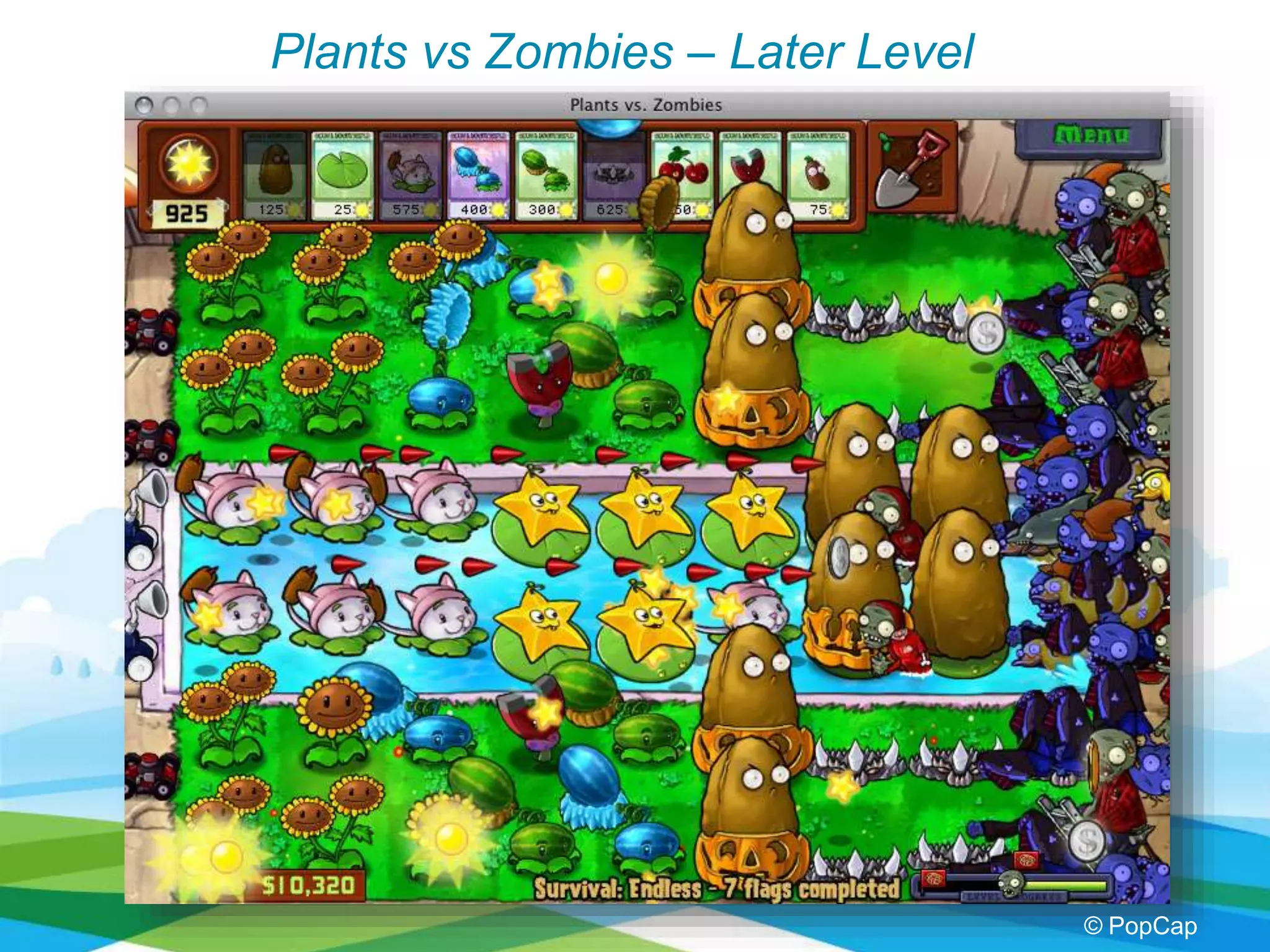
• Gradually introduce new features and rules
• Build upon existing learning and create combination behaviors
Plants vs Zombies – Level 1
© PopCap
Plants vs Zombies – Later Level
© PopCap
Good Casual Game Design Principles
Get out of the player’s way
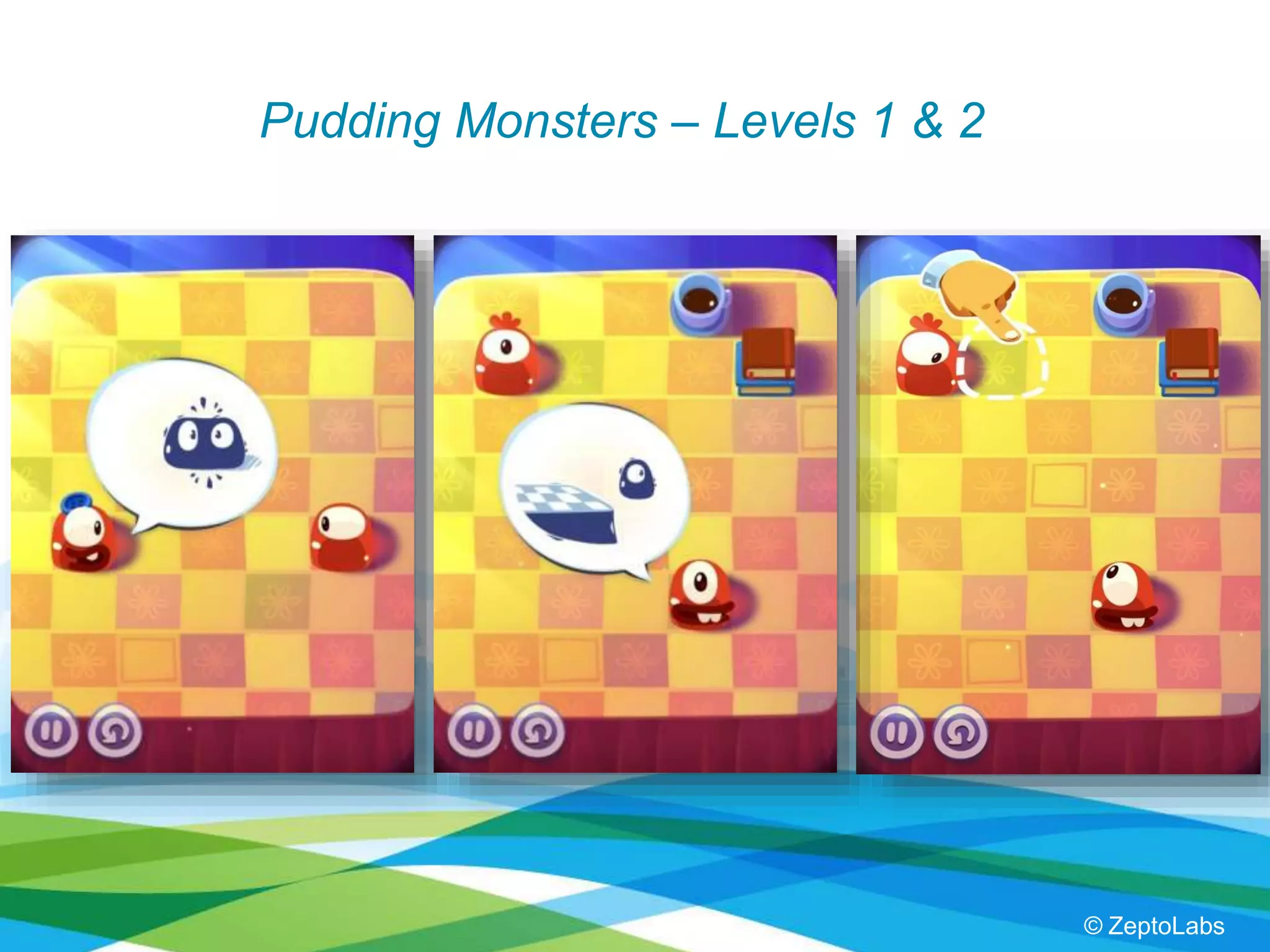
• Keep reading to minimum
• Use simple, elegant visuals/animations to convey instructions, if you can.
• If text must be used, then keep it concise and in simple language.
Pudding Monsters – Levels 1 & 2
© ZeptoLabs
Good Casual Game Design Principles
Get out of the player’s way
• Keep reading to minimum
• Use simple, elegant visuals/animations to convey instructions, if you can.
• If text must be used, then keep it concise and in simple language.
• No lengthy story exposition - Nobody cares about your writing skill
• No long, front-loaded tutorials
• Classroom application: Front-Loading Explanation is Disengaging
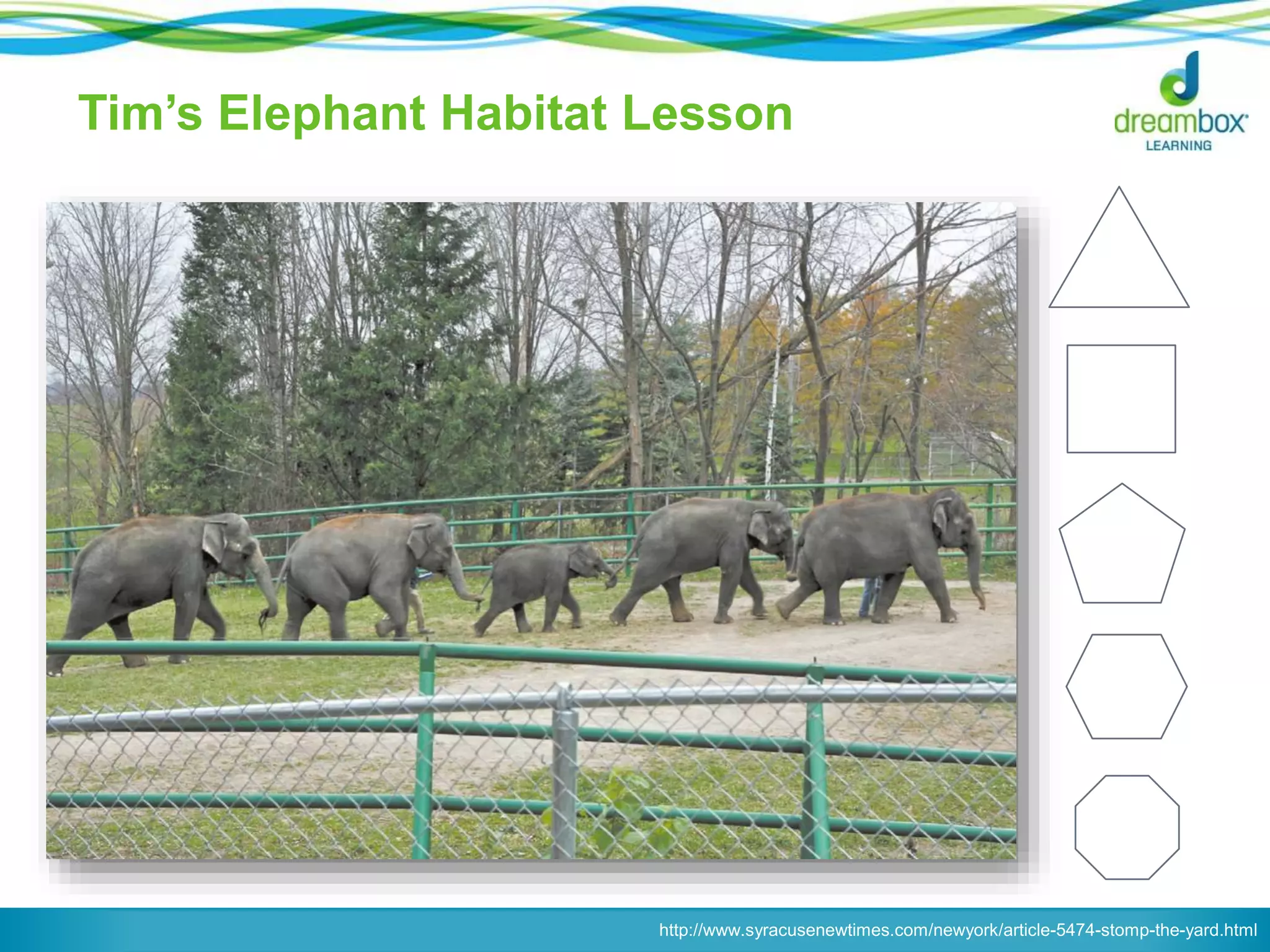
Tim’s Elephant Habitat Lesson
http://www.syracusenewtimes.com/newyork/article-5474-stomp-the-yard.html
In the Classroom: Quick Task Entry
• If your classroom learning tasks require more
than 1 minute of directions, there is probably too
high of a barrier to engagement.
• Try redesigning the task to create a simpler
entry point.
• It may require more class time to complete the
task, but it results in more engagement, better
thinking, and better learning.
Common Experience
From a 5th grade teacher in NY:
“I had a lot of good people teaching me math when I
was a student – earnest and funny and caring. But
the math they taught me wasn’t good math. Every
class was the same for eight years:
‘Get out your homework, go over the
homework, here’s the new set of exercises,
here’s how to do them. Now get started. I’ll
be around.’”
p. 55, Teaching What Matters Most, Strong, Silver, & Perini, ©2001
Let Me
Show You
How To Do
X
Now You
Go Do
X
Can You
Independently
Do
X?
Maybe You
Need to Be
Shown X
Again
You Know
X
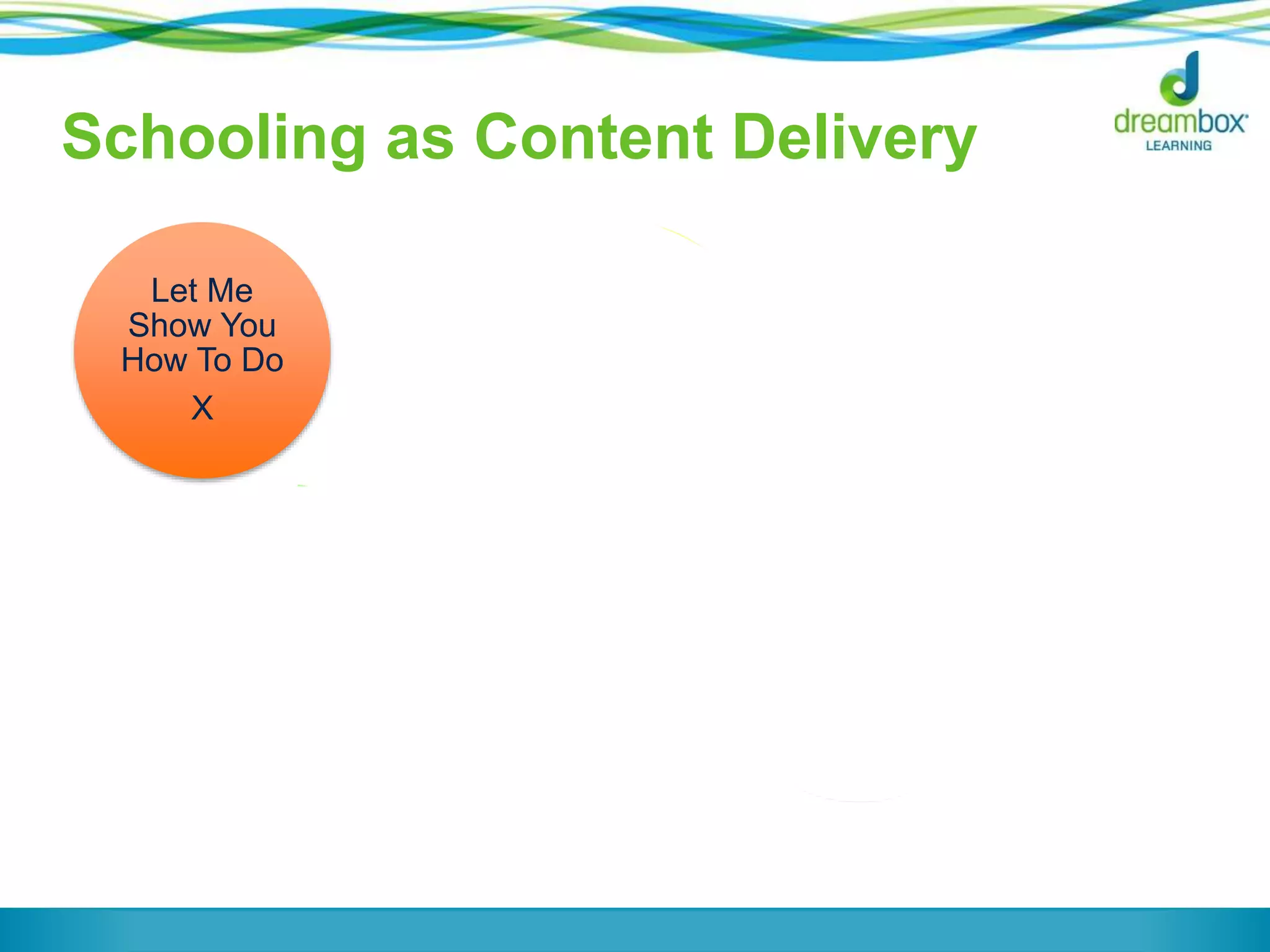
Schooling as Content Delivery
Let Me
Show You
How To Do
X
Now You
Go Do
X
Can You
Independently
Do
X?
Maybe You
Need to Be
Shown X
Again
You Know
X
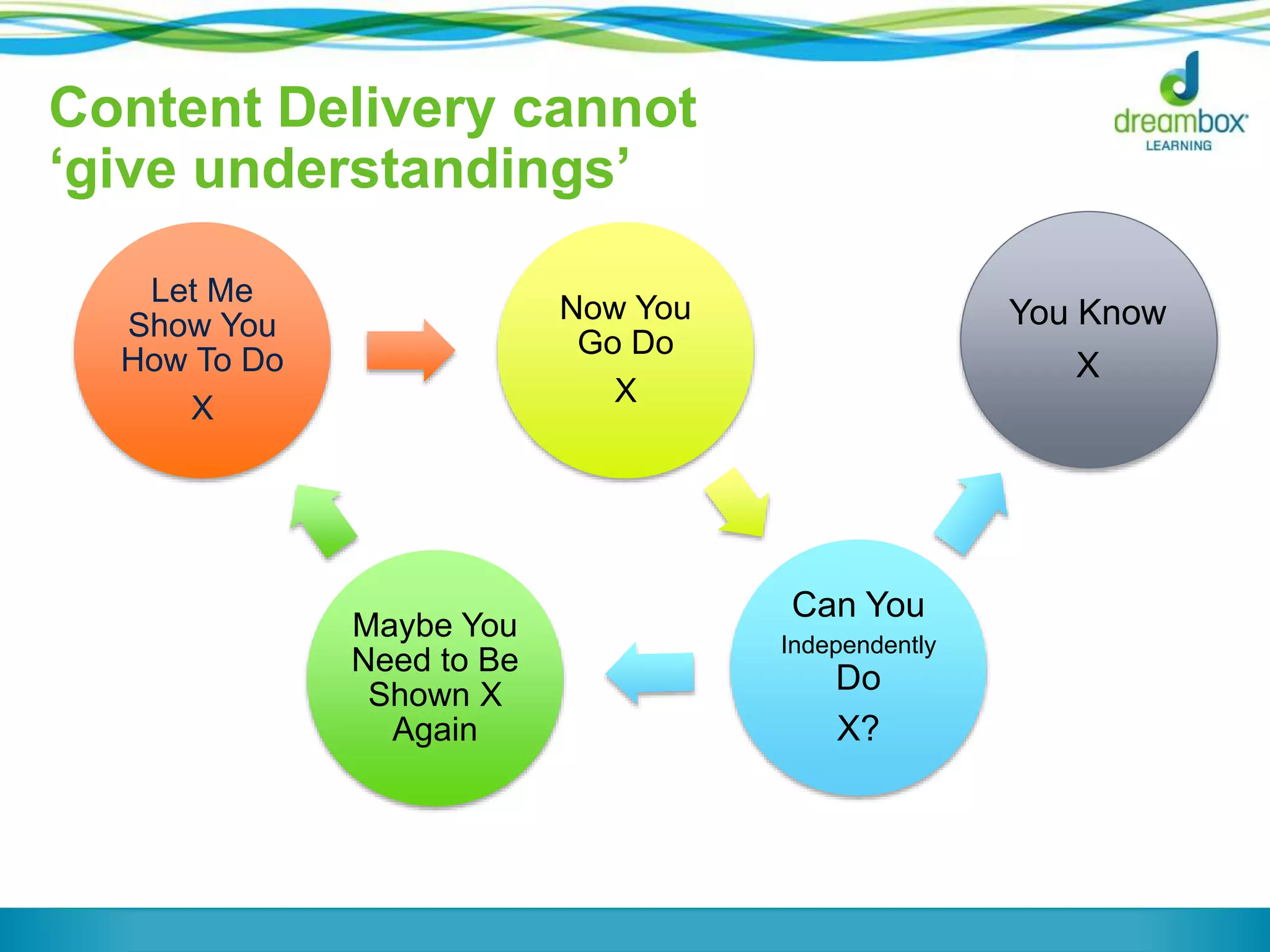
Content Delivery cannot
‘give understandings’
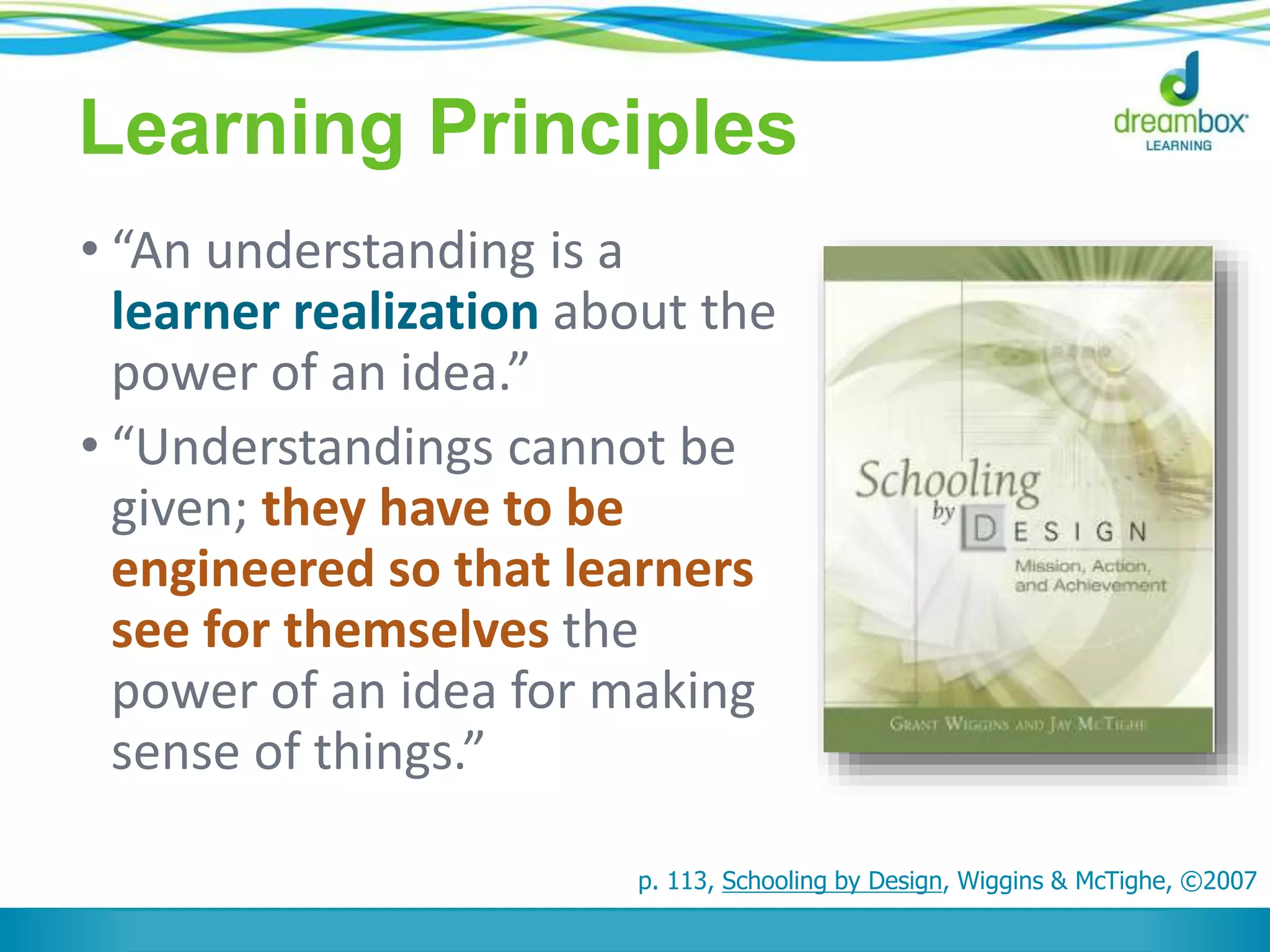
Learning Principles
• “An understanding is a
learner realization about the
power of an idea.”
• “Understandings cannot be
given; they have to be
engineered so that learners
see for themselves the
power of an idea for making
sense of things.”
p. 113, Schooling by Design, Wiggins & McTighe, ©2007
Pros & Cons
Benefit of Blended
Learning
Becoming MORE thoughtful
and strategic about the use
of precious class time
Danger of Blended
Learning
Becoming LESS thoughtful
and strategic about how
students learn and make
sense of things
Engaging Learning
Student
Engages
within a
Context
Student
Transfers
&
Predicts
Student
Receives
Feedback
Adapt &
Differentiate
Student
Independently
Transfers
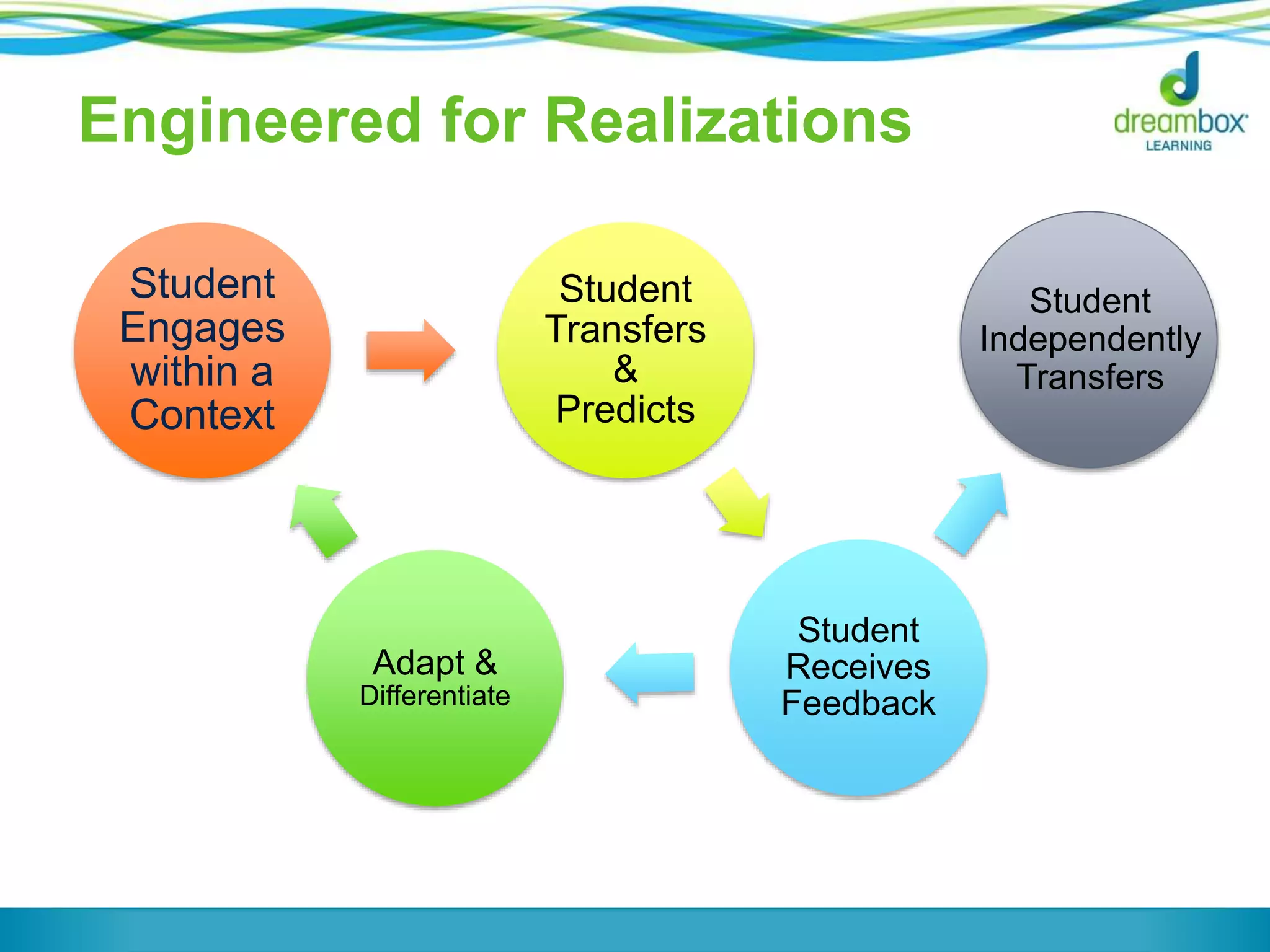
Engineered for Realizations
Student
Engages
within a
Context
Student
Transfers
&
Predicts
Student
Receives
Feedback
Adapt &
Differentiate
Student
Independently
Transfers
Casual Game Design Principles
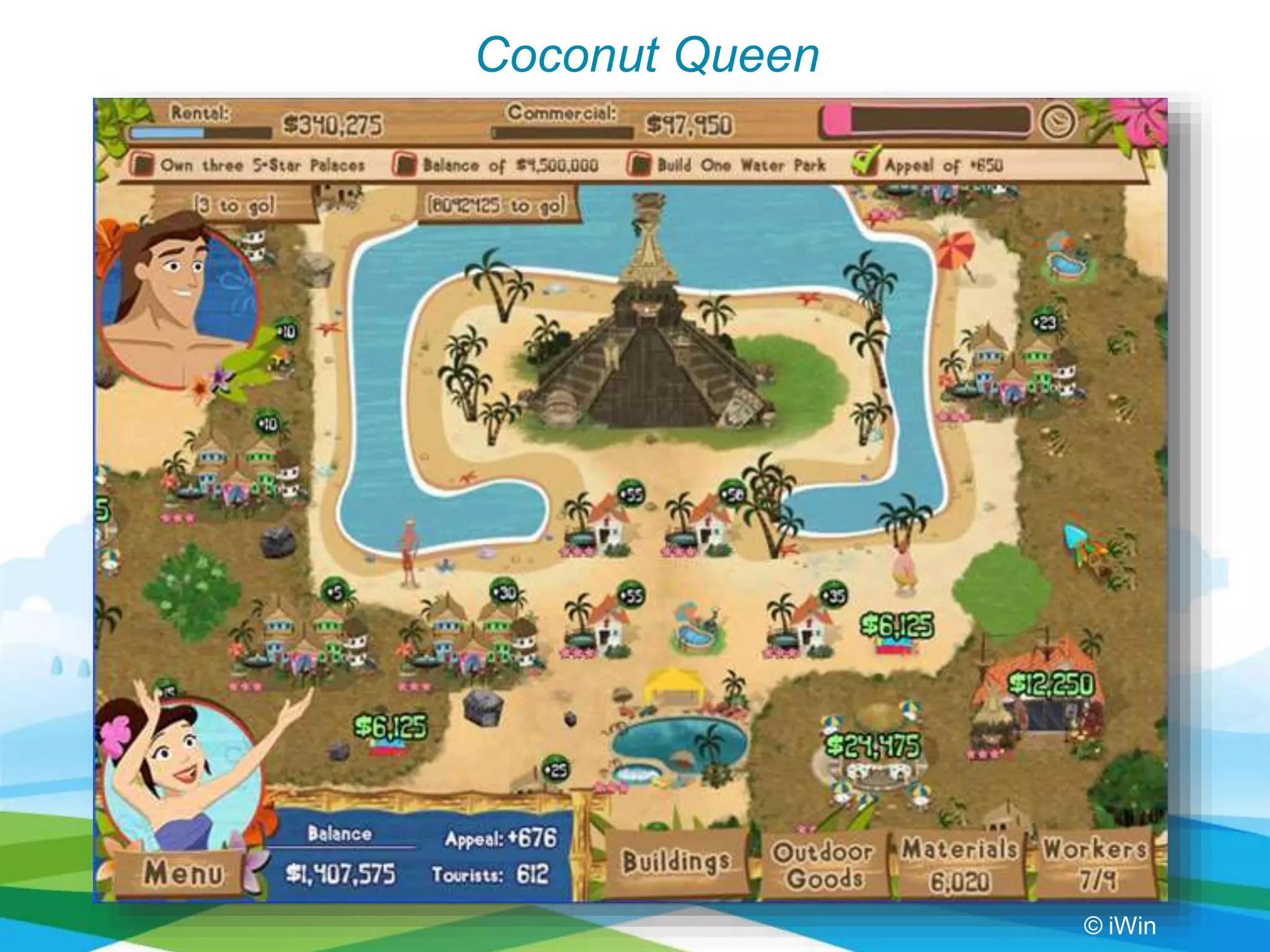
3. Learning through safe exploration
• Player should feel safe exploring, always.
• The player always makes informed decisions, because everything to
be known can be seen
• Nothing is going on off-screen or behind the scene that can hinder the
player’s progress.
Coconut Queen
© iWin
Casual Game Design Principles
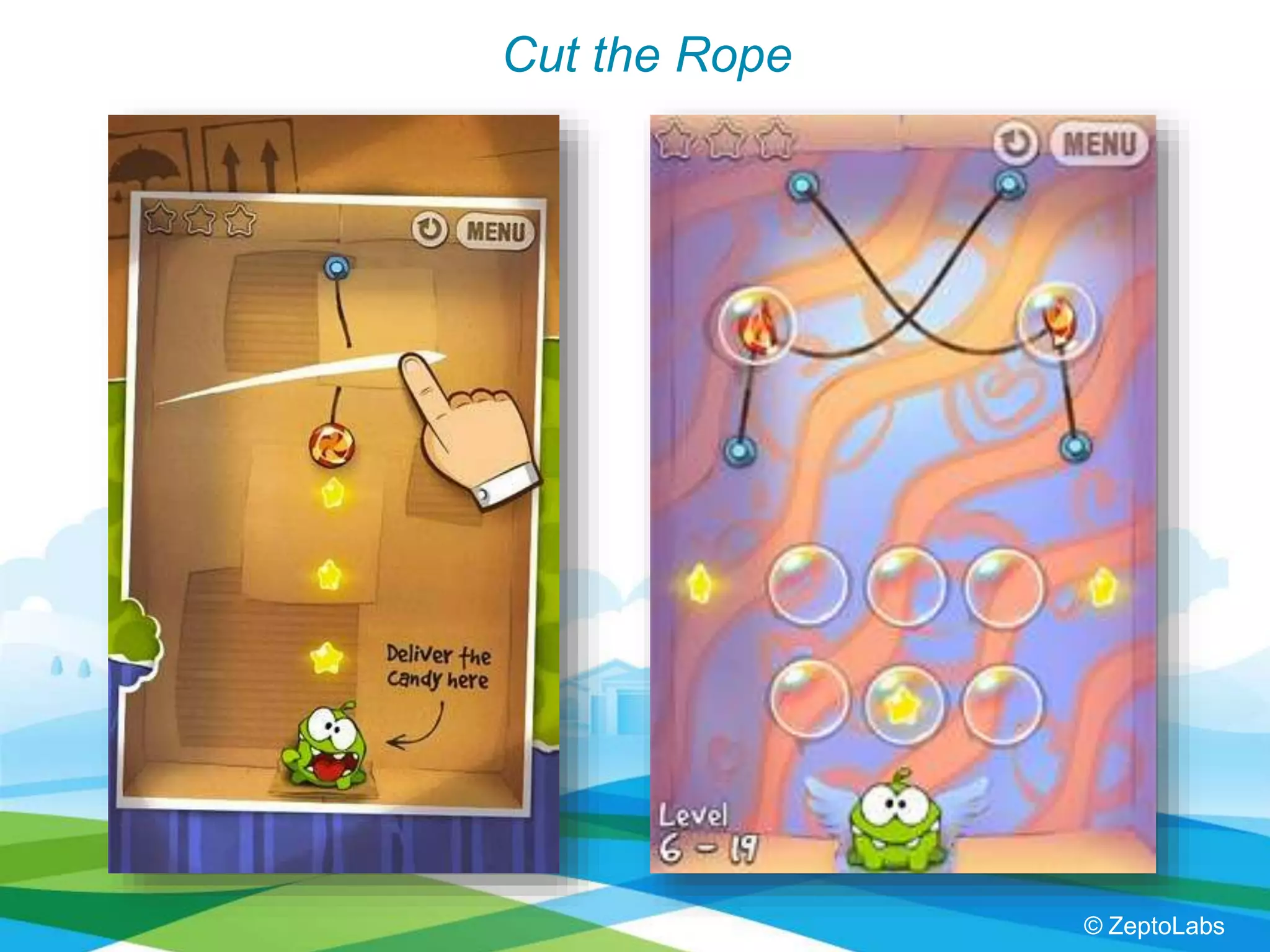
3. Learning through safe exploration
• Use trial and error/failure as a tool to lead to “aha” moment for the
player.
• If the player loses or performs below their expectations, make it
absolutely clear why that happened and how they can do better.
Cut the Rope
© ZeptoLabs
Casual Game Design Principles
3. Learning through safe exploration
• Use trial and error/failure as a tool to lead to “aha” moment for the
player.
• If the player loses or performs below their expectations, make it
absolutely clear why that happened and how they can do better.
• Classroom application: Engage in Exploration First
Learning Myth
“Presentation of an explanation, no matter how
brilliantly worded, will not connect ideas unless
students have had ample opportunities to
wrestle with examples.”
From Best Practices, 3rd Ed., by Zemelman, Daniels, and Hyde, ©2005
From Understanding by Design, Wiggins & McTighe, ©2005
“If I cover it clearly, they
will ‘get it.’”
Don’t Start by Telling
“Providing students with opportunities
to first grapple with specific information
relevant to a topic has been shown to
create a ‘time for telling’ that enables
them to learn much more from an
organizing lecture.”
• How People Learn, p. 58
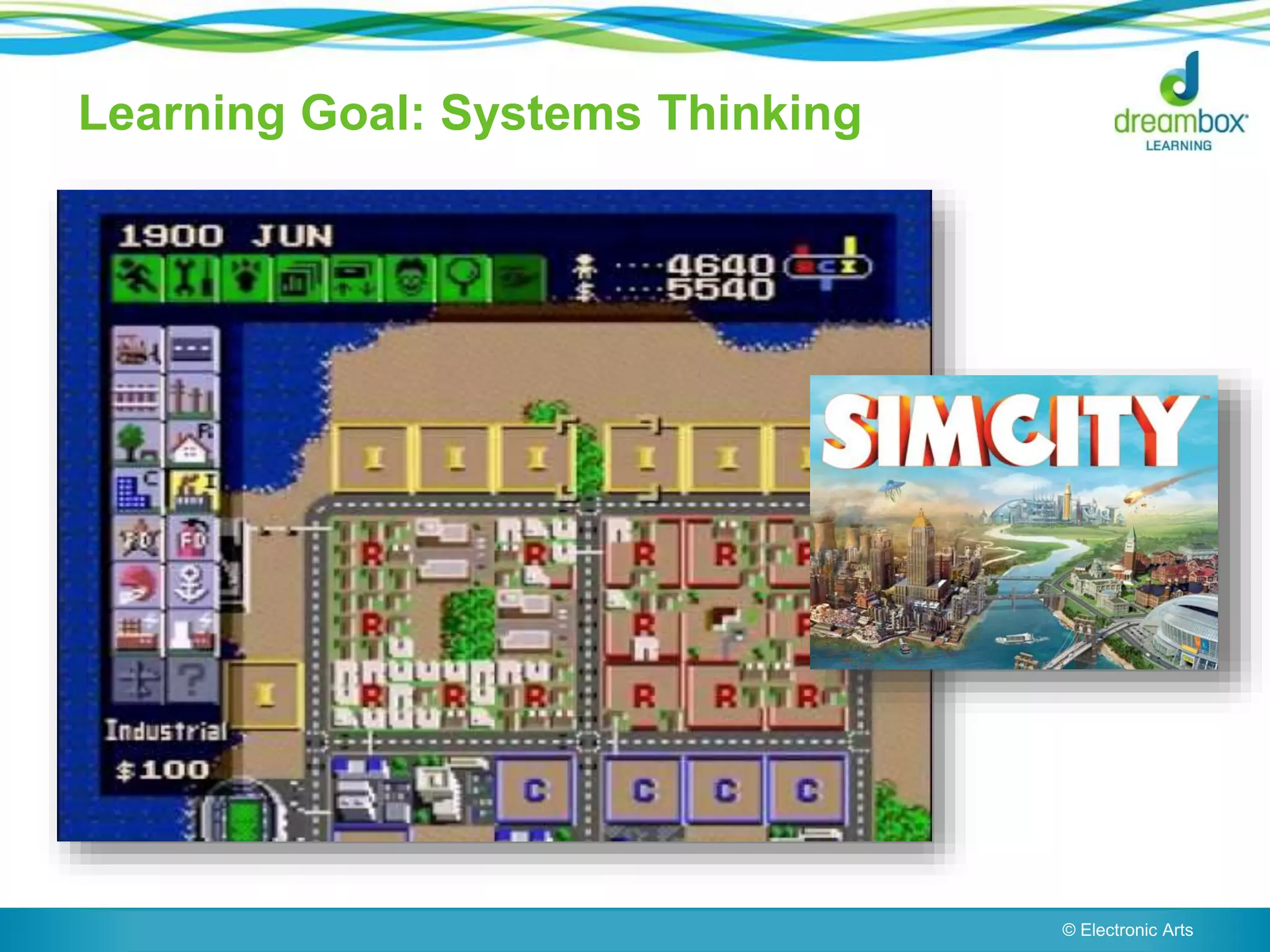
Learning Goal: Systems Thinking
© Electronic Arts
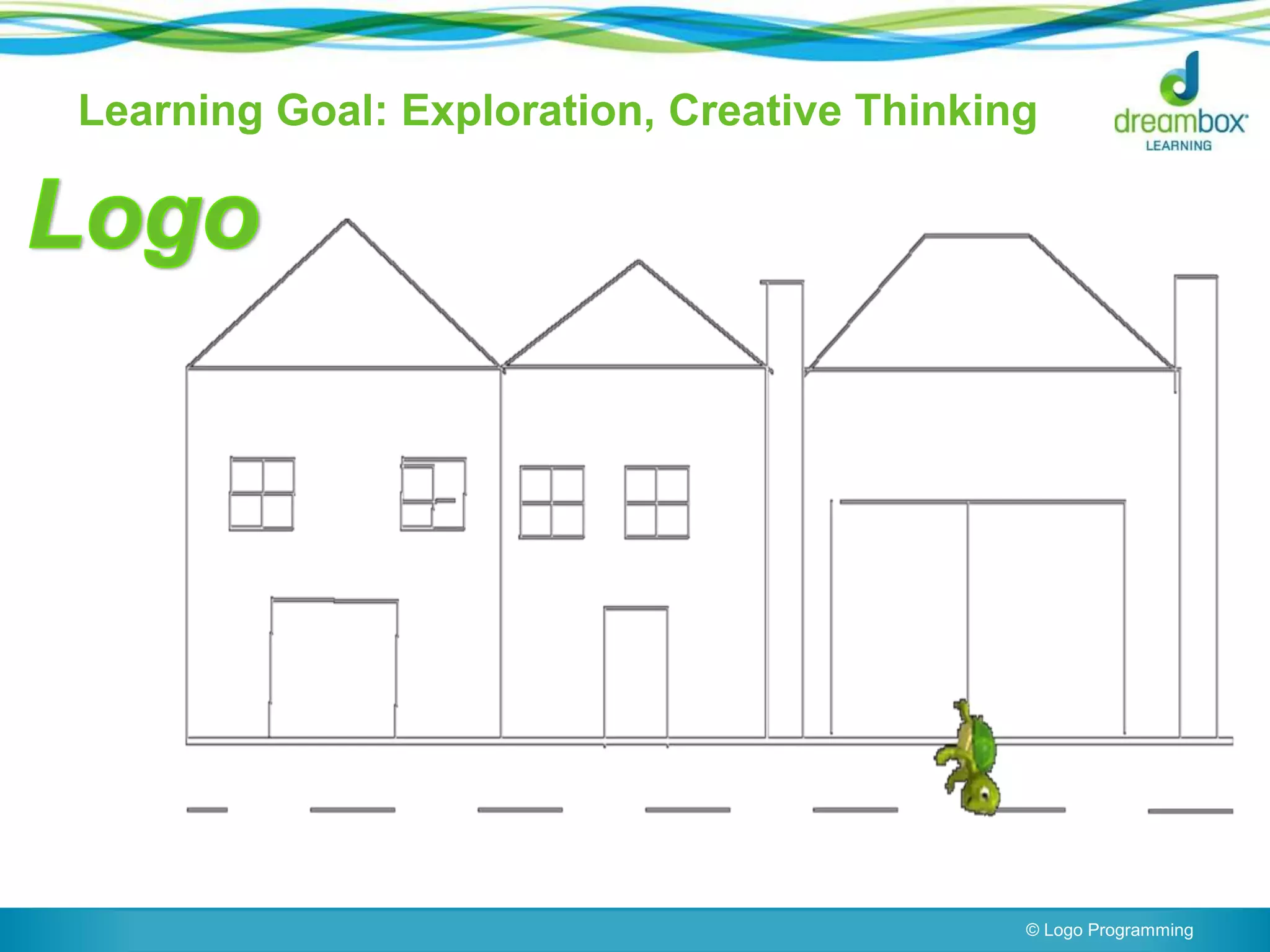
Learning Goal: Exploration, Creative Thinking
© Logo Programming
For Additional Game Ideas
Common Sense Media
• commonsensemedia.org
• 2013 ON for Learning Award Winners
• 50 Apps, games, and websites that received highest
ratings for learning potential
63
Casual Game Design Principles
4. Use Rewards for Engagement and Replay Motivation
• Early and frequent in-game rewards
• Maximize replay value
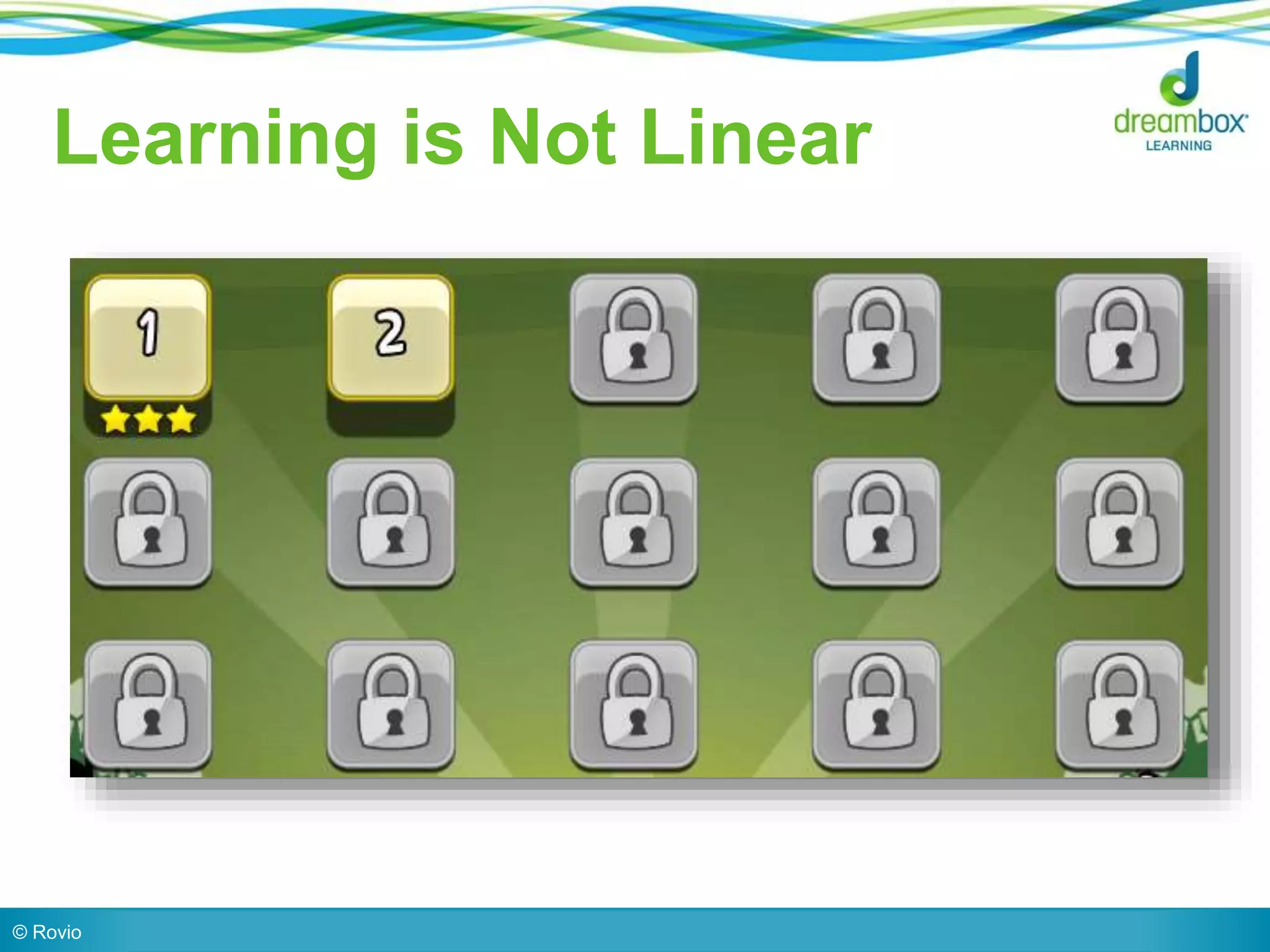
• Level pass, versus 1-3 stars
• Dangle the carrot to “try again”
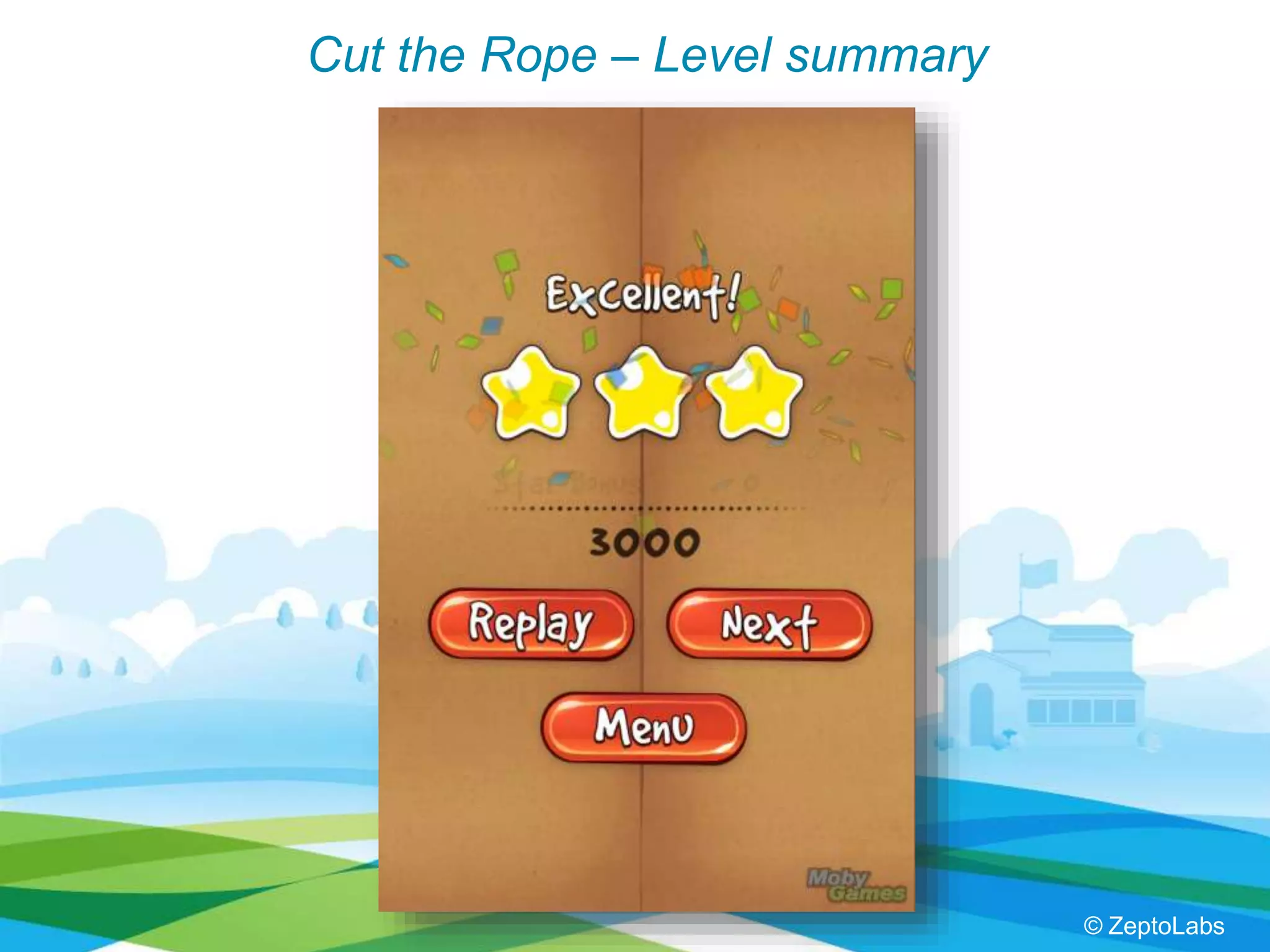
Cut the Rope – Level summary
© ZeptoLabs
Casual Game Design Principles
4. Use Rewards for Engagement and Replay Motivation
• Early and frequent in-game rewards
• Maximize replay value
• Level pass, versus 1-3 stars
• Dangle the carrot to “try again”
• Classroom application: Re-Think Assessment & Grading Practices
Learning is Not Linear
© Rovio
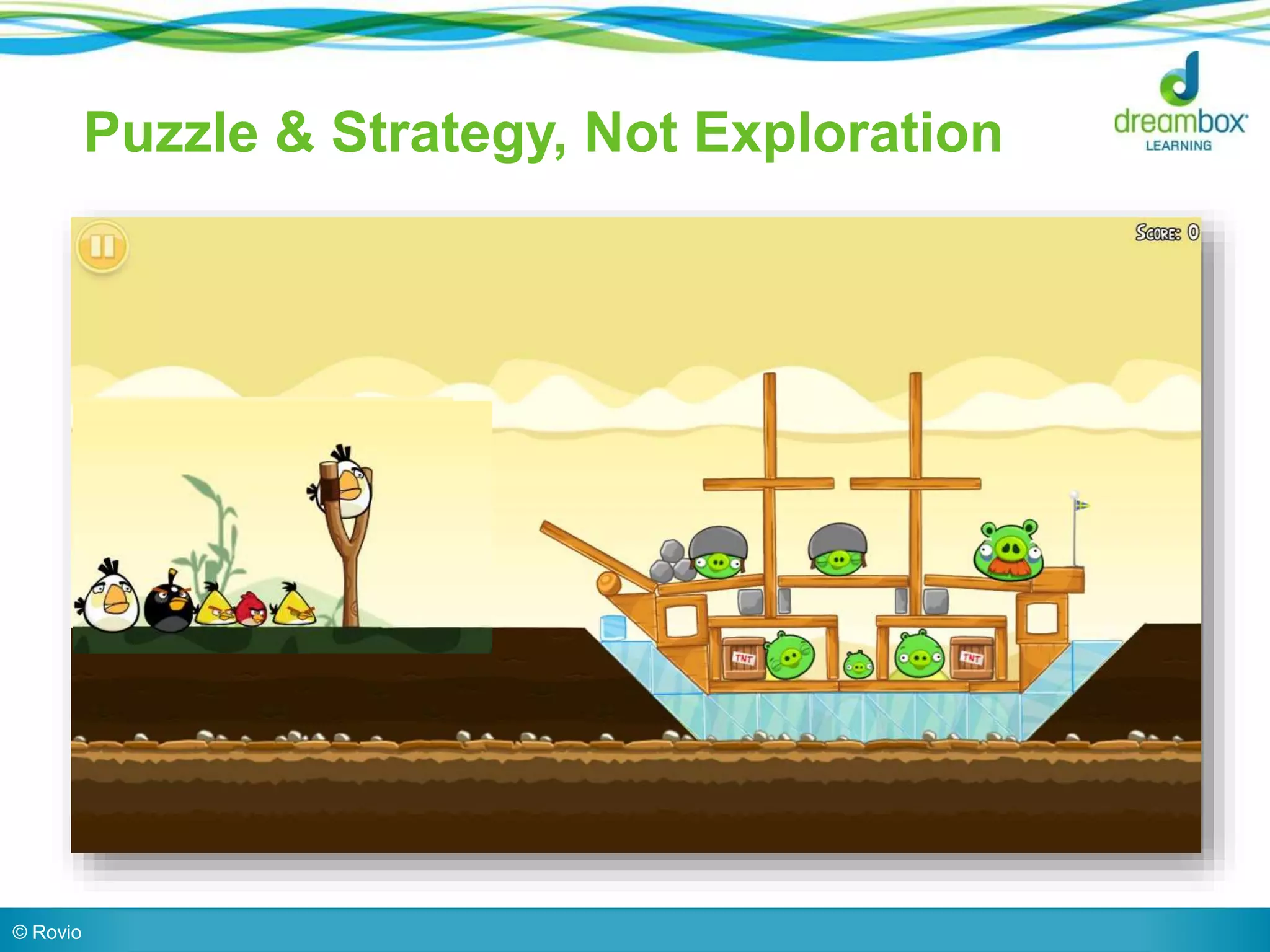
Puzzle & Strategy, Not Exploration
© Rovio
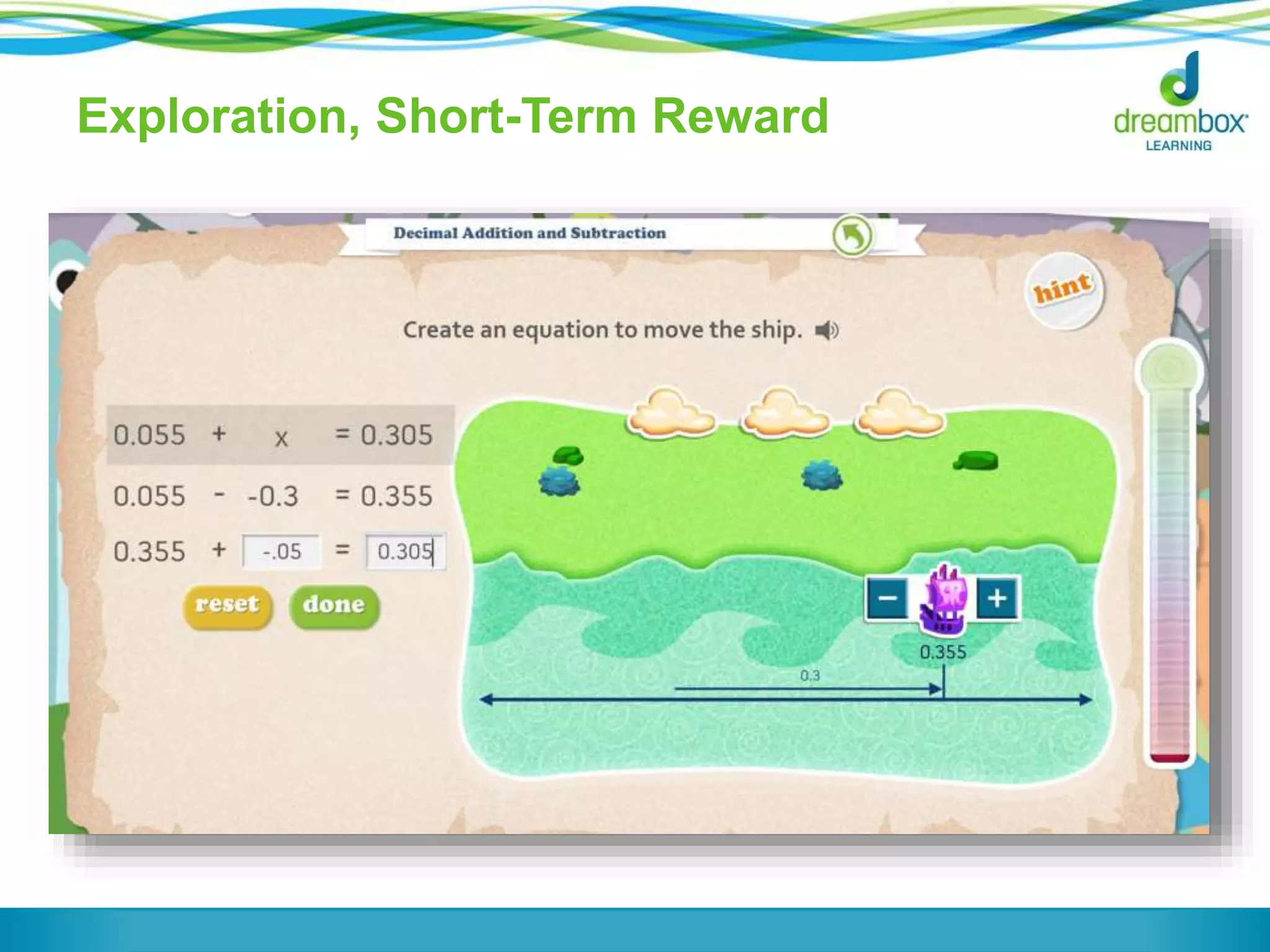
Exploration, Short-Term Reward
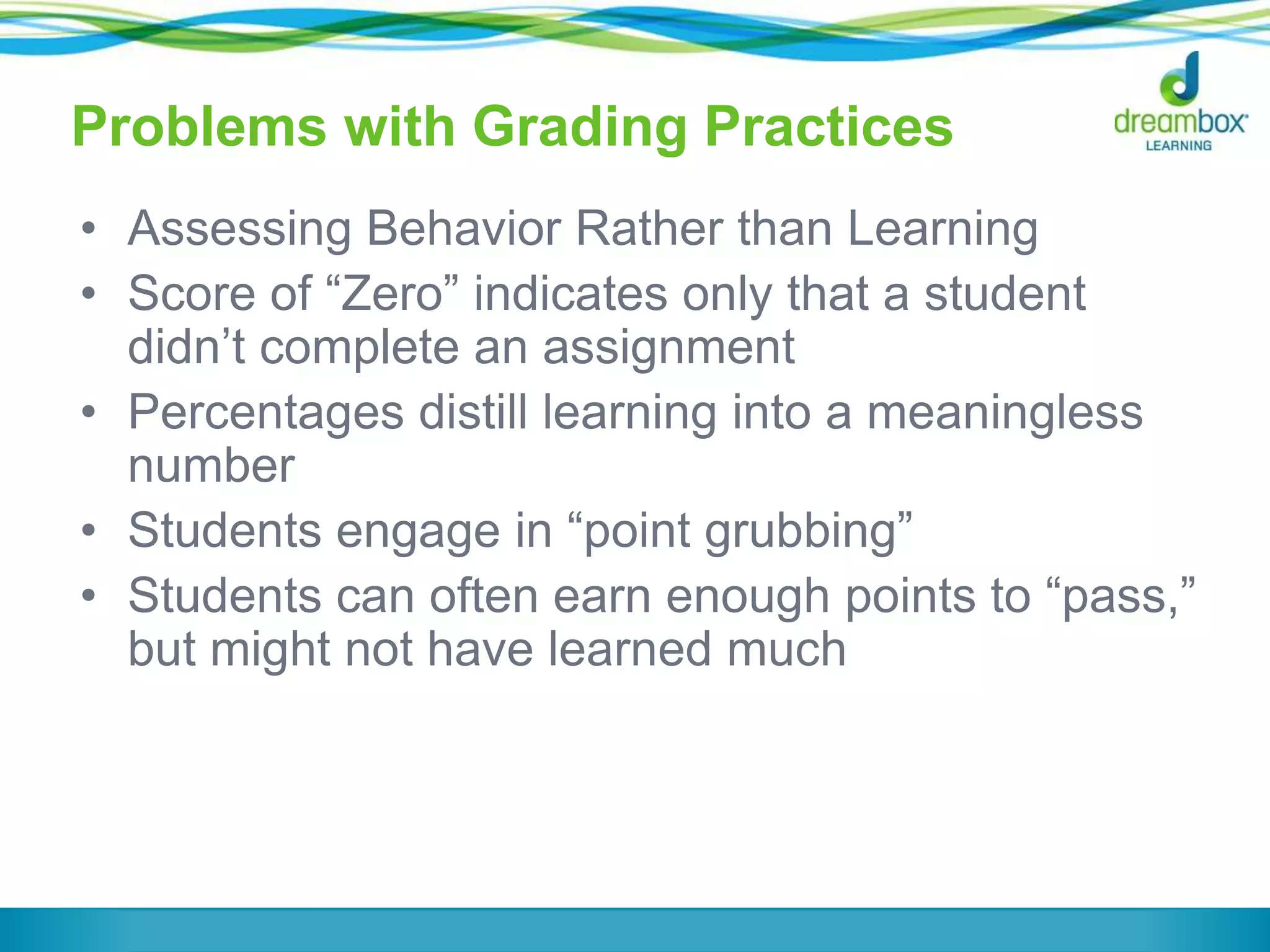
Problems with Grading Practices
• Assessing Behavior Rather than Learning
• Score of “Zero” indicates only that a student
didn’t complete an assignment
• Percentages distill learning into a meaningless
number
• Students engage in “point grubbing”
• Students can often earn enough points to “pass,”
but might not have learned much
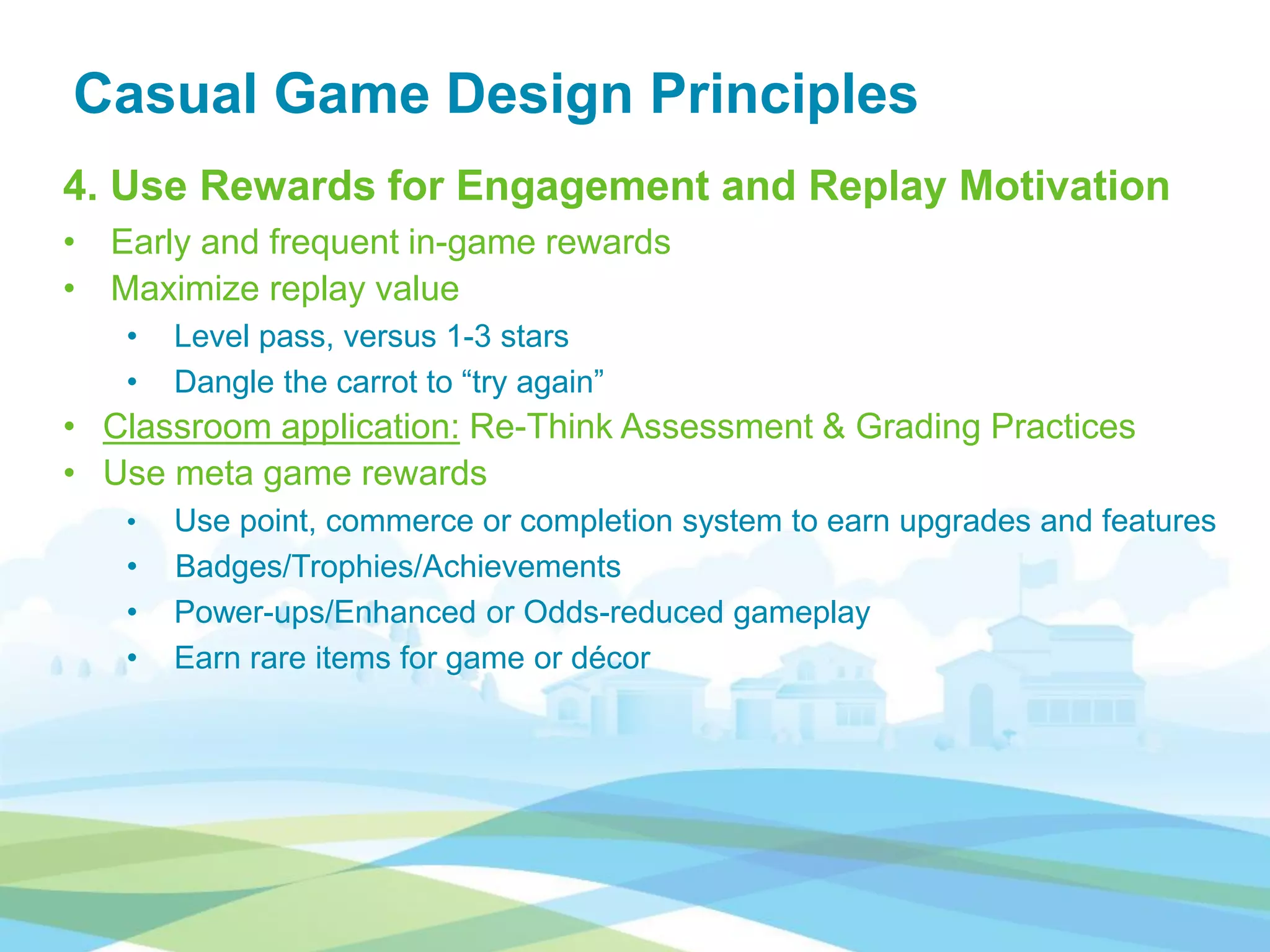
Casual Game Design Principles
4. Use Rewards for Engagement and Replay Motivation
• Early and frequent in-game rewards
• Maximize replay value
• Level pass, versus 1-3 stars
• Dangle the carrot to “try again”
• Classroom application: Re-Think Assessment & Grading Practices
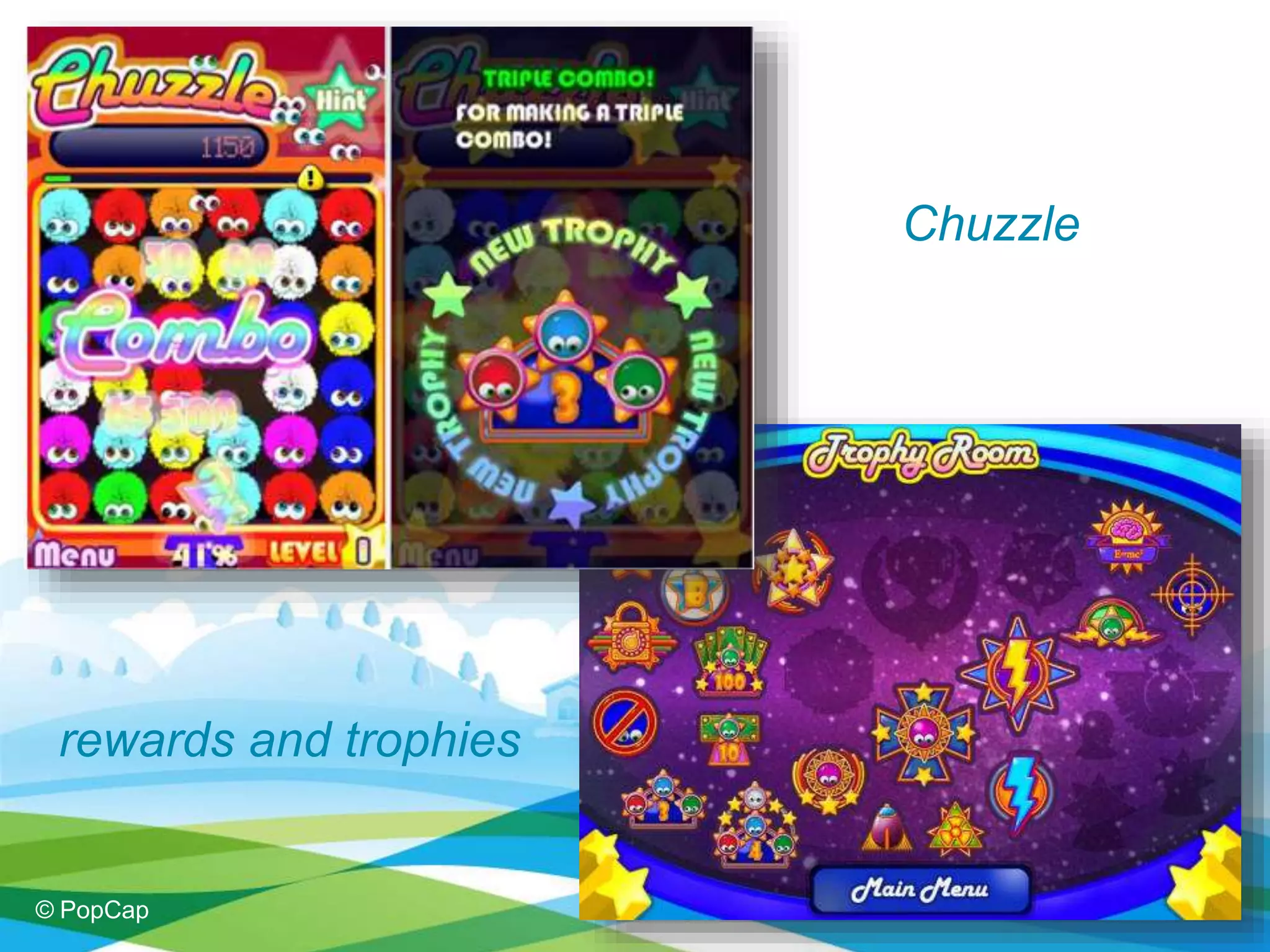
• Use meta game rewards
• Use point, commerce or completion system to earn upgrades and features
• Badges/Trophies/Achievements
• Power-ups/Enhanced or Odds-reduced gameplay
• Earn rare items for game or décor
Chuzzle
rewards and trophies
© PopCap
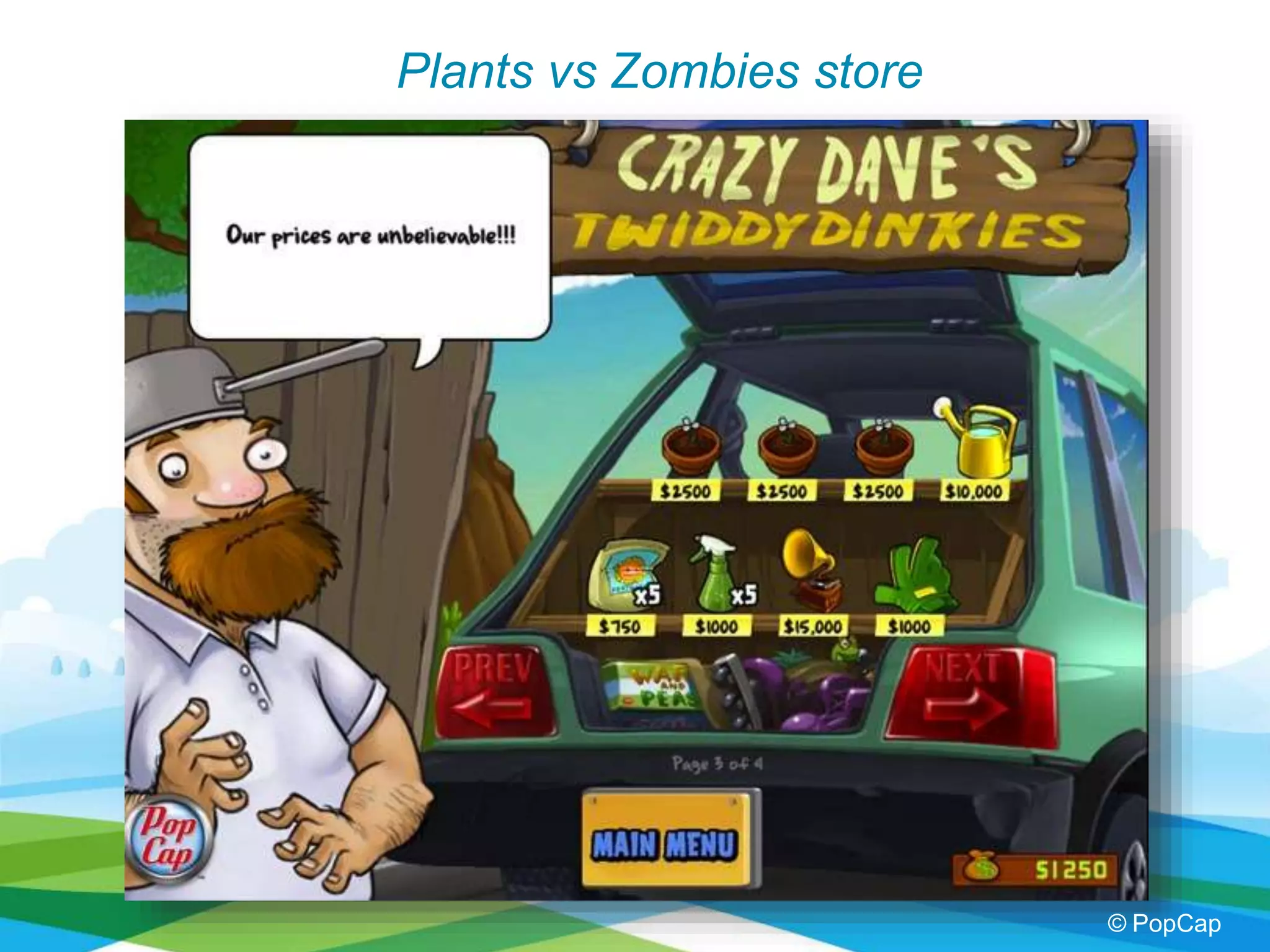
Plants vs Zombies store
© PopCap
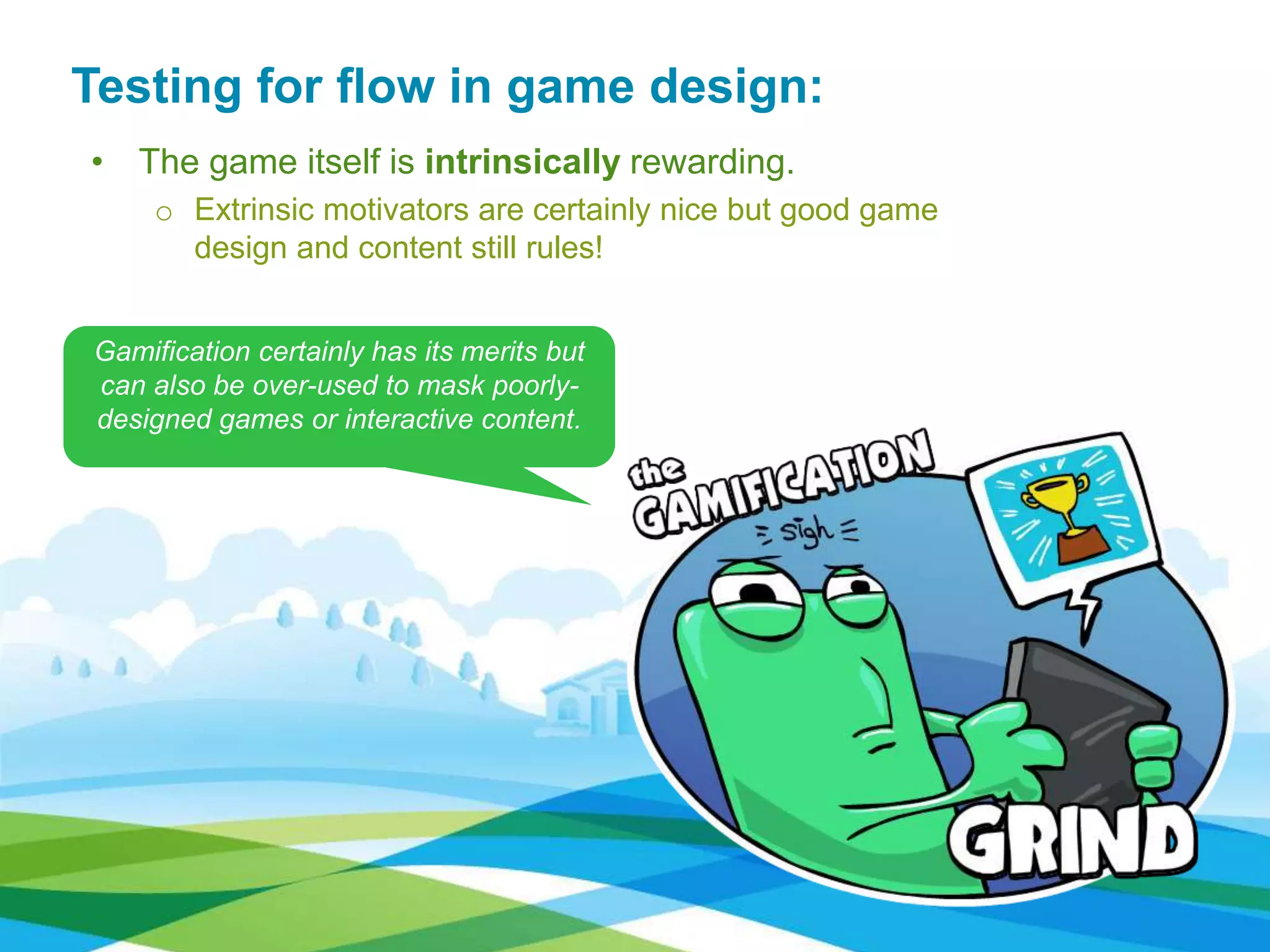
• The game itself is intrinsically rewarding.
o Extrinsic motivators are certainly nice but good game
design and content still rules!
Testing for flow in game design:
Gamification certainly has its merits but
can also be over-used to mask poorly-
designed games or interactive content.
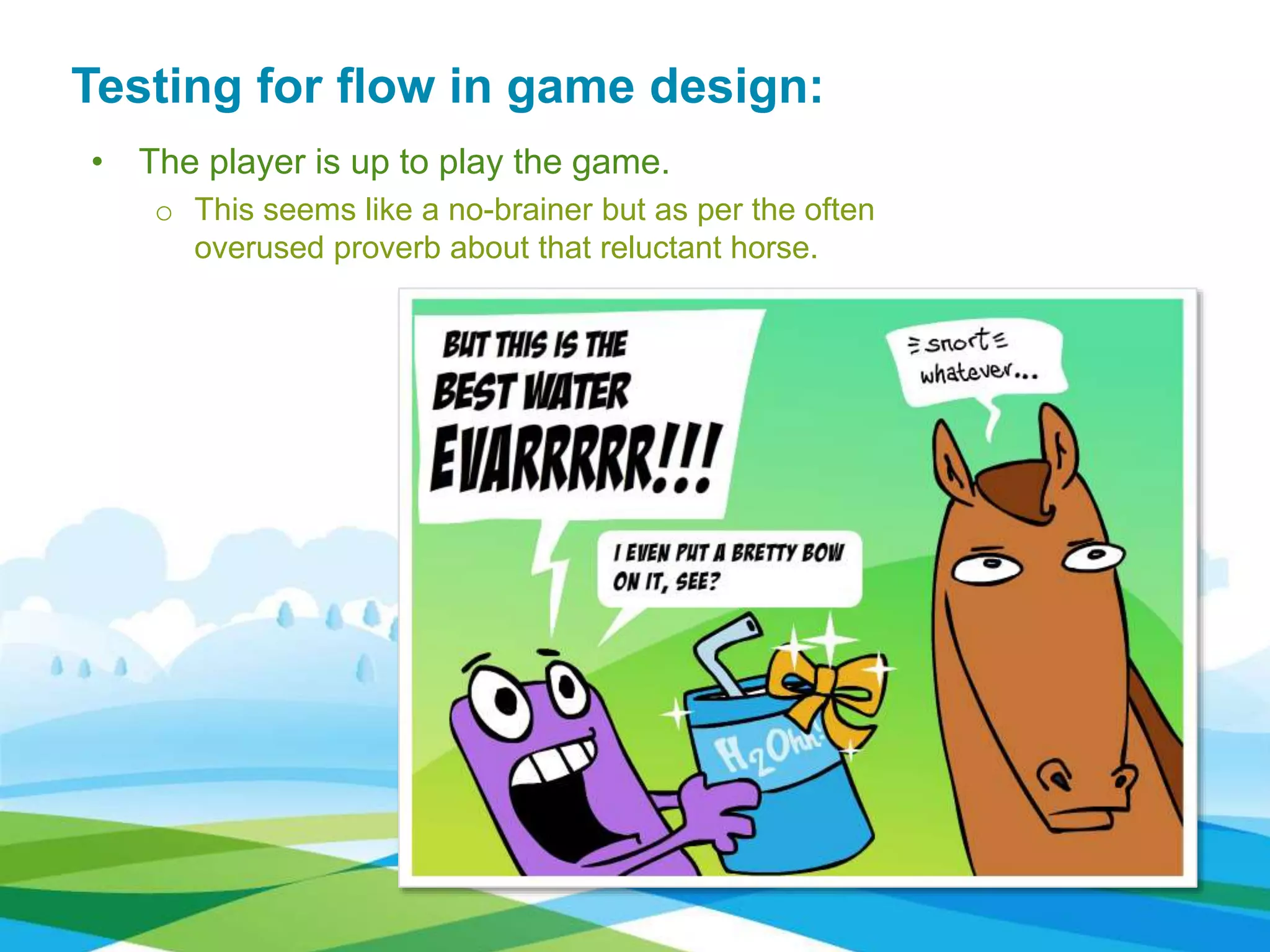
• The player is up to play the game.
o This seems like a no-brainer but as per the often
overused proverb about that reluctant horse.
Testing for flow in game design:
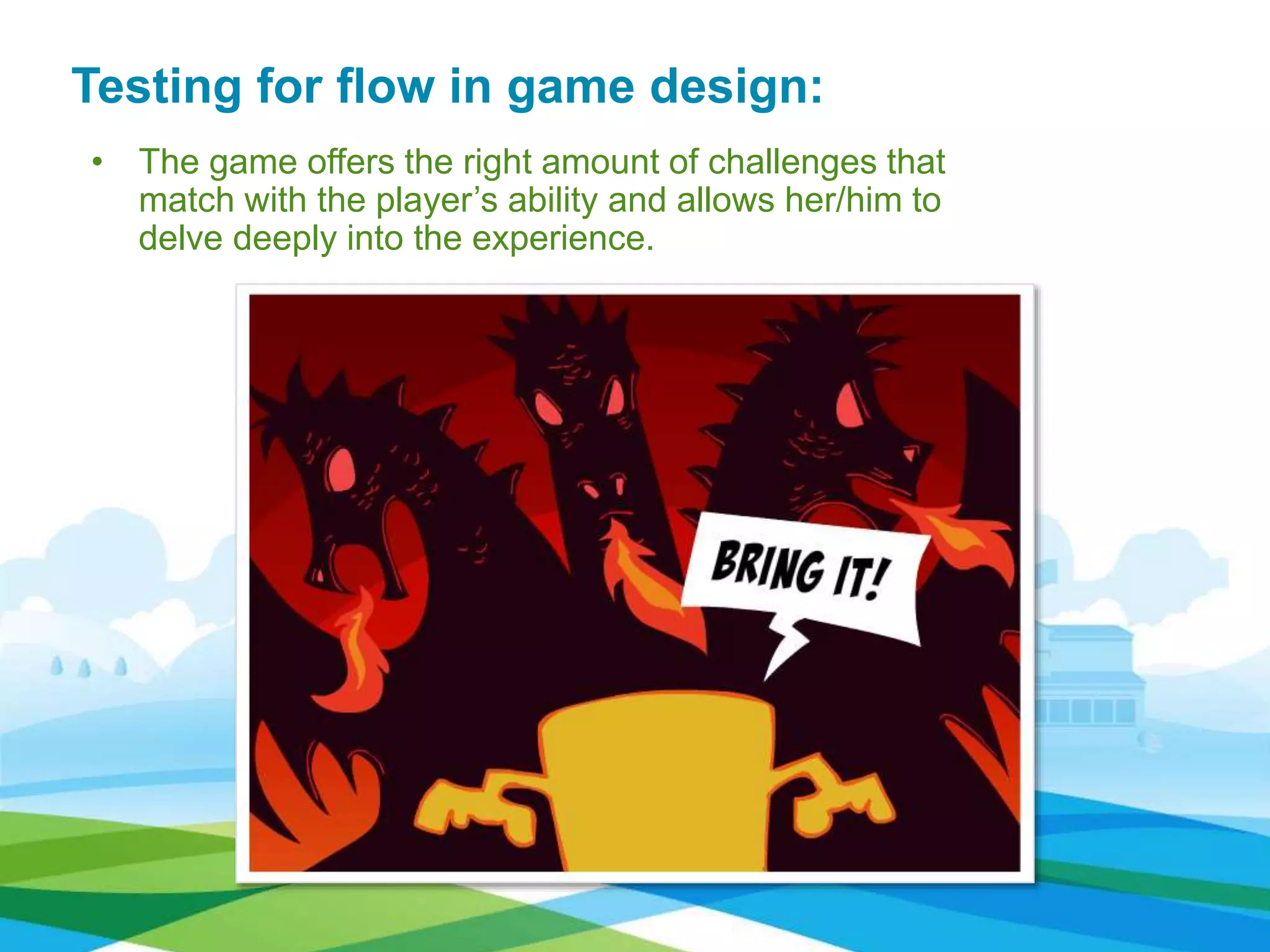
• The game offers the right amount of challenges that
match with the player’s ability and allows her/him to
delve deeply into the experience.
Testing for flow in game design:
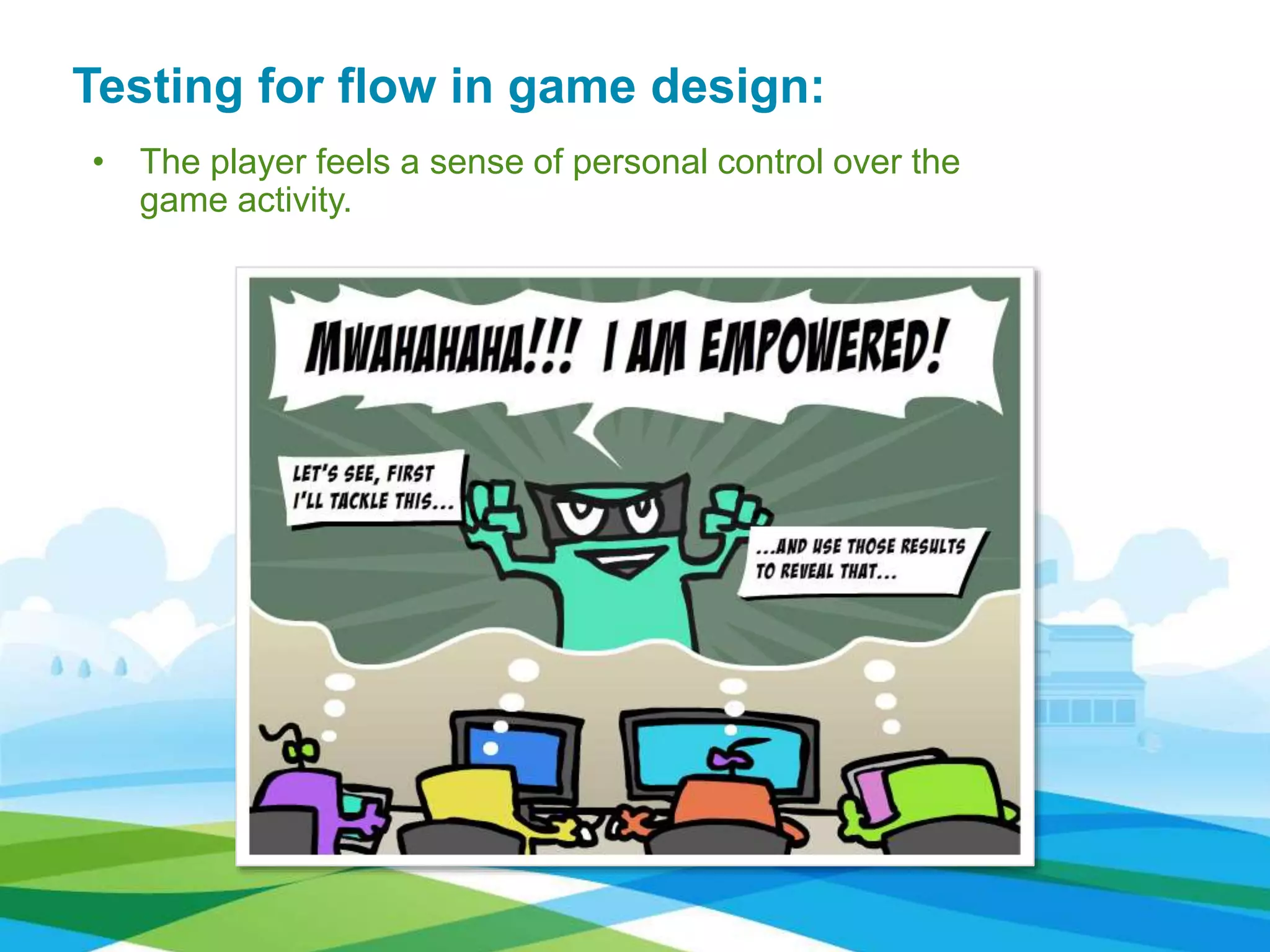
• The player feels a sense of personal control over the
game activity.
Testing for flow in game design:
Q & A
smax@dreambox.com
ayu@dreambox.com
timh@dreambox.com
@DocHudsonMath
www.dreambox.com
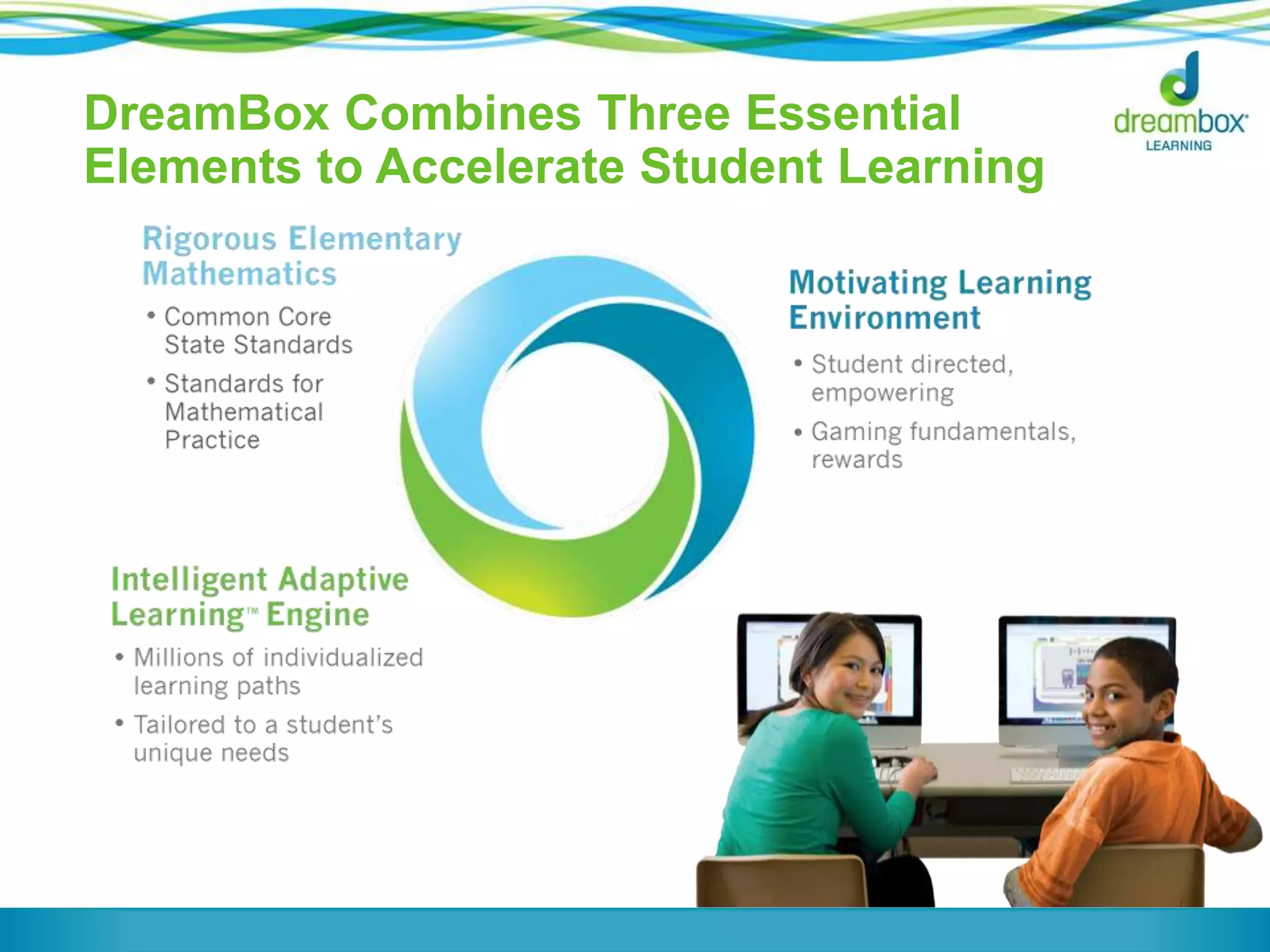
DreamBox Combines Three Essential
Elements to Accelerate Student Learning

Games for Learning – Design Principles for Student Engagement in Blended Learning Models

  • 1.
    Games for Learning DesignPrinciples for Student Engagement in Blended Learning Models Max Holecheck Ayu Othman UX Designer Art Director Dr. Tim Hudson Senior Director of Curriculum Design
  • 2.
    Which blended modelis better? FLIPPED-CLASSROOM ENRICHED-VIRTUAL Blending is a means to what ends? What is happening during class? What is happening on the computers? H. Staker, M. Horn, Classifying K-12 Blended Learning, © 2012
  • 3.
    The Quality ofDigital Learning Experiences is just as important as the Quality of Classroom Learning Experiences
  • 4.
    Principles of Game Designcan be used to Improve Student Engagement in Learning
  • 5.
    Max Holechek Creative Director NancyDrew PC game series • Changed conventional misconceptions about female gamer habits • Pioneering “casual” game design years before the term was coined. Producer & Design Consultant • THQ • Nick Jr. • Cranium • Codemasteres • Oberon Media • PopCap Games • PlayFirst • Her Interactive Lead Game Designer • Turbo Subs • Turbo Fiesta • Go-Go- Gourmet, • Go-Go- Gourmet: Chef of the Year Ayu Othman 2D & Texture Artist Nancy Drew PC game series • Created 2D maps, hotspot graphics, and puzzles integrated 3D environments. • Game series won several awards, including Parent’s Choice Gold. Art Director, Nancy Drew Dossier Series & Cody Capers • Oversaw visual direction for casual games at Her Interactive • Dossier series was runner up to Plants v. Zombies for best casual game 2009 Art Director PassionFruit Games • Tiger Eye: Curse of the Riddle Box
  • 6.
    Games for Learning– Design Principles How can I make learning seem more like a game? (Not the right question, unless you understand what you’re asking.)
  • 7.
  • 8.
    “When the fungoes out of play, most often so does the learning.” - Joanne E. Oppenheim (Kids and Play, ch. 1, 1984)
  • 9.
  • 10.
    FLOW An idea ofheightened focus and immersion in an activity.
  • 11.
    Gratuitous example ofmyself in ‘flow’-- Ecstasy, clarity, receiving immediate feedback, forgetting myself, doing it for its own sake. FLOW: An idea of heightened focus and immersion in an activity.
  • 12.
    FLOW is thatsweet spot we experience during an activity, in which the challenge level being presented is properly balanced with our skill level. During ‘flow’ we experience being ‘in the zone’ and lose all track of time during that activity. Graph source: http://www.gamasutra.com/view/feature/166972/cognitive_flow_the_psychology_of_.php Not too easy (snore) Not too hard (eep!) Just right!
  • 13.
    Mihály Csíkszentmihályi, professor andformer chairman of the Dept. of Psychology at the University of Chicago created Flow theory as part of his life work towards understanding what is it that makes humans truly happy, satisfied and fulfilled. Sources: http://www.jenovachen.com/flowingames/researches.htm http://en.wikipedia.org/wiki/File:Mihaly_Csikszentmihalyi.j pg aka the genius behind Flow theory Mihály Csíkszentmihályi
  • 14.
    Elements of Flow •A challenge activity that requires skills • The merging of action and awareness • Clear goals • Direct feedback • Concentration on the task at hand • The sense of control • The loss of self-consciousness • The transformation of time Source: http://www.jenovachen.com/flowingames/foundation.htm Great teachers and coaches already utilize elements of Flow theory in engaging their students.
  • 15.
    What is agame? A system in which players engage in an artificial conflict, defined by rules, that results in a quantifiable outcome. Source: •Salen, K. and E. Zimmerman. Rules of Play : Game Design Fundamentals. The MIT Press. (2003)
  • 16.
    What is agood game? A carefully designed system that invokes flow in players as they engage in an artificial conflict, defined by rules, that results in a quantifiable outcome. Source: •Salen, K. and E. Zimmerman. Rules of Play : Game Design Fundamentals. The MIT Press. (2003) ..and Ayu & Max 
  • 17.
    Relevance to theplayer and game’s goals Understanding upon a glance Get out of the player’s way Learning through safe exploration Use rewards for perseverance and replay-ability Good Casual Game Design Principles
  • 18.
    Relevance to theplayer and game’s goals • Contextualize your game Good Casual Game Design Principles
  • 19.
    Who’s ready toplay? Fist Flat Two?
  • 20.
  • 21.
    © PopCap, ©iWin, © kibagames
  • 22.
    Relevance to theplayer and game’s goals • Contextualize your game • Don’t Assume your Assumptions are Valid • The player only gets 3 lives, right? • Being penalized & vanquished is just part of learning/playing a game! Good Casual Game Design Principles
  • 23.
  • 24.
    Relevance to theplayer and game’s goals • Contextualize your game • Don’t Assume your Assumptions are Valid • The player only gets 3 lives, right? • Being penalized & vanquished is just part of learning/playing a game! • Classroom application: Plan Backward from Learning Goals Good Casual Game Design Principles
  • 25.
    Plan Curriculum Backwards 1.Identify desired results 2. Determine acceptable evidence 3. Plan learning experiences and instruction Understanding by Design, Wiggins & McTighe, ©2005
  • 26.
    Key Questions 1. Whatdo you want students to accomplish? 2. How will you know they’ve achieved it? 3. What games can help students meet these goals?
  • 27.
    Learning Goal: Perspective,Strategic Thinking MECC, © Broderbund
  • 28.
    Learning Goal: RecognizeShapes, Presidents © Dan Russell-Pinson Stack the States Presidents v. Aliens
  • 29.
    Learning Goal: Geography,Culture, Inquiry www.mobygames.com ©Broderbund
  • 30.
    Learning Goal: Practice MinnesotaEducational Computing Consortium
  • 31.
  • 32.
  • 33.
    Better Goals forStudents David Bressoud, Mathematical Association of America (www.maa.org/columns) • “The existence of Wolfram|Alpha [and calculators] does push instructors to be more honest about their use of standard problems executed by memorizing algorithmic procedures. • “If a student feels that she or he has learned nothing that cannot be pulled directly from Wolfram|Alpha, then the course really has been a waste of time.”
  • 34.
  • 35.
    Classifying Learning Games NoPrior Instruction Needed • Learning Experiences • Usually Conceptual • Simulation, Situation • Critical Thinking Focus • Mostly Self-Directed • Realization Focus • Content Specific • Learning Context & Content first, THEN game is added afterward Prior Instruction Required • Practice • Often Rote • “Flash Card” Design • Often Memory Focus • Mostly Teacher-Directed • Recall Focus • Possibly Interchangeable Content • Game Design comes first, THEN content is added afterward
  • 36.
    Good Casual GameDesign Principles Understanding Upon a Glance • Players can learn to play the game within 15 seconds • Layout, simplicity of elements, and highlight use instruct visually. • If your game looks like an XL spreadsheet, start over. • Simple, minimal, elegant rule sets. If the game incorporates more or more complex rules, stagger them in slowly and in later levels. (Flow!)
  • 37.
  • 38.
    Run! I’ll explainlater! © iMangi Studios
  • 39.
    Good Casual GameDesign Principles Understanding Upon a Glance • Minimal, transparent, very intuitive player input • PC: Avoid/limit keyboard or right button input • Touch screen: Limit number of gestures • Never change already introduced UI behavior • Gradually introduce new features and rules • Build upon existing learning and create combination behaviors
  • 40.
    Plants vs Zombies– Level 1 © PopCap
  • 41.
    Plants vs Zombies– Later Level © PopCap
  • 42.
    Good Casual GameDesign Principles Get out of the player’s way • Keep reading to minimum • Use simple, elegant visuals/animations to convey instructions, if you can. • If text must be used, then keep it concise and in simple language.
  • 43.
    Pudding Monsters –Levels 1 & 2 © ZeptoLabs
  • 44.
    Good Casual GameDesign Principles Get out of the player’s way • Keep reading to minimum • Use simple, elegant visuals/animations to convey instructions, if you can. • If text must be used, then keep it concise and in simple language. • No lengthy story exposition - Nobody cares about your writing skill • No long, front-loaded tutorials • Classroom application: Front-Loading Explanation is Disengaging
  • 45.
    Tim’s Elephant HabitatLesson http://www.syracusenewtimes.com/newyork/article-5474-stomp-the-yard.html
  • 46.
    In the Classroom:Quick Task Entry • If your classroom learning tasks require more than 1 minute of directions, there is probably too high of a barrier to engagement. • Try redesigning the task to create a simpler entry point. • It may require more class time to complete the task, but it results in more engagement, better thinking, and better learning.
  • 47.
    Common Experience From a5th grade teacher in NY: “I had a lot of good people teaching me math when I was a student – earnest and funny and caring. But the math they taught me wasn’t good math. Every class was the same for eight years: ‘Get out your homework, go over the homework, here’s the new set of exercises, here’s how to do them. Now get started. I’ll be around.’” p. 55, Teaching What Matters Most, Strong, Silver, & Perini, ©2001
  • 48.
    Let Me Show You HowTo Do X Now You Go Do X Can You Independently Do X? Maybe You Need to Be Shown X Again You Know X Schooling as Content Delivery
  • 49.
    Let Me Show You HowTo Do X Now You Go Do X Can You Independently Do X? Maybe You Need to Be Shown X Again You Know X Content Delivery cannot ‘give understandings’
  • 50.
    Learning Principles • “Anunderstanding is a learner realization about the power of an idea.” • “Understandings cannot be given; they have to be engineered so that learners see for themselves the power of an idea for making sense of things.” p. 113, Schooling by Design, Wiggins & McTighe, ©2007
  • 51.
    Pros & Cons Benefitof Blended Learning Becoming MORE thoughtful and strategic about the use of precious class time Danger of Blended Learning Becoming LESS thoughtful and strategic about how students learn and make sense of things
  • 52.
  • 53.
    Engineered for Realizations Student Engages withina Context Student Transfers & Predicts Student Receives Feedback Adapt & Differentiate Student Independently Transfers
  • 54.
    Casual Game DesignPrinciples 3. Learning through safe exploration • Player should feel safe exploring, always. • The player always makes informed decisions, because everything to be known can be seen • Nothing is going on off-screen or behind the scene that can hinder the player’s progress.
  • 55.
  • 56.
    Casual Game DesignPrinciples 3. Learning through safe exploration • Use trial and error/failure as a tool to lead to “aha” moment for the player. • If the player loses or performs below their expectations, make it absolutely clear why that happened and how they can do better.
  • 57.
    Cut the Rope ©ZeptoLabs
  • 58.
    Casual Game DesignPrinciples 3. Learning through safe exploration • Use trial and error/failure as a tool to lead to “aha” moment for the player. • If the player loses or performs below their expectations, make it absolutely clear why that happened and how they can do better. • Classroom application: Engage in Exploration First
  • 59.
    Learning Myth “Presentation ofan explanation, no matter how brilliantly worded, will not connect ideas unless students have had ample opportunities to wrestle with examples.” From Best Practices, 3rd Ed., by Zemelman, Daniels, and Hyde, ©2005 From Understanding by Design, Wiggins & McTighe, ©2005 “If I cover it clearly, they will ‘get it.’”
  • 60.
    Don’t Start byTelling “Providing students with opportunities to first grapple with specific information relevant to a topic has been shown to create a ‘time for telling’ that enables them to learn much more from an organizing lecture.” • How People Learn, p. 58
  • 61.
    Learning Goal: SystemsThinking © Electronic Arts
  • 62.
    Learning Goal: Exploration,Creative Thinking © Logo Programming
  • 63.
    For Additional GameIdeas Common Sense Media • commonsensemedia.org • 2013 ON for Learning Award Winners • 50 Apps, games, and websites that received highest ratings for learning potential 63
  • 64.
    Casual Game DesignPrinciples 4. Use Rewards for Engagement and Replay Motivation • Early and frequent in-game rewards • Maximize replay value • Level pass, versus 1-3 stars • Dangle the carrot to “try again”
  • 65.
    Cut the Rope– Level summary © ZeptoLabs
  • 66.
    Casual Game DesignPrinciples 4. Use Rewards for Engagement and Replay Motivation • Early and frequent in-game rewards • Maximize replay value • Level pass, versus 1-3 stars • Dangle the carrot to “try again” • Classroom application: Re-Think Assessment & Grading Practices
  • 67.
    Learning is NotLinear © Rovio
  • 68.
    Puzzle & Strategy,Not Exploration © Rovio
  • 69.
  • 70.
    Problems with GradingPractices • Assessing Behavior Rather than Learning • Score of “Zero” indicates only that a student didn’t complete an assignment • Percentages distill learning into a meaningless number • Students engage in “point grubbing” • Students can often earn enough points to “pass,” but might not have learned much
  • 71.
    Casual Game DesignPrinciples 4. Use Rewards for Engagement and Replay Motivation • Early and frequent in-game rewards • Maximize replay value • Level pass, versus 1-3 stars • Dangle the carrot to “try again” • Classroom application: Re-Think Assessment & Grading Practices • Use meta game rewards • Use point, commerce or completion system to earn upgrades and features • Badges/Trophies/Achievements • Power-ups/Enhanced or Odds-reduced gameplay • Earn rare items for game or décor
  • 72.
  • 73.
    Plants vs Zombiesstore © PopCap
  • 74.
    • The gameitself is intrinsically rewarding. o Extrinsic motivators are certainly nice but good game design and content still rules! Testing for flow in game design: Gamification certainly has its merits but can also be over-used to mask poorly- designed games or interactive content.
  • 75.
    • The playeris up to play the game. o This seems like a no-brainer but as per the often overused proverb about that reluctant horse. Testing for flow in game design:
  • 76.
    • The gameoffers the right amount of challenges that match with the player’s ability and allows her/him to delve deeply into the experience. Testing for flow in game design:
  • 77.
    • The playerfeels a sense of personal control over the game activity. Testing for flow in game design:
  • 78.
  • 79.
    DreamBox Combines ThreeEssential Elements to Accelerate Student Learning

Editor's Notes

  • #2 Candyland and Cootie are examples of nostalgic, pervasive, and terrible games. Gamification has been used (and overused) in digital products, but often with equally boring results. The same has plagued most educational toys and games for years. Why? Because the focus should not be on the game. Where should the focus be?
  • #7 Candyland and Cootie are examples of nostalgic, pervasive, and terrible games. Gamification has been used (and overused) in digital products, but often with equally boring results. The same has plagued most educational toys and games for years. Why? Because the focus should not be on the game. Where should the focus be?
  • #8 On fun, of course.
  • #9 Full quote:"PLAYING SHOULD BE FUN! In our great eagerness to teach our children we studiously look for "educational" toys, games with built-in lessons, books with a "message." Often these "tools" are less interesting and stimulating than the child's natural curiosity and playfulness. Play is by its very nature educational. And it should be pleasurable. When the fun goes out of play, most often so does the learning.“ - Joanne E. Oppenheim (Kids and Play, ch. 1, 1984)”
  • #10 Max has historically described “fun” as a word we use to describe our “complete engagement.” Ayu is here to present a term and theory to describe both…
  • #14 Wikipedia: Mihaly Csikszentmihalyi (pron.: /ˈmiːhaɪ ˌtʃiːksɛntməˈhaɪ.iː/ mee-hy cheek-sent-mə-hy-ee; Hungarian: Csíkszentmihályi Mihály [ˈtʃiːksɛntmihaːji ˈmihaːj]; born September 29, 1934, in Fiume, Italy – now Rijeka, Croatia) is aHungarian psychology professor, who emigrated to the United States at the age of 22. Now at Claremont Graduate University, he is the former head of the department of psychology at the University of Chicago and of the department of sociology and anthropology at Lake Forest College.
  • #16 Now that we understand flow, let’s loop back to the topic of games. What is a game?
  • #17 Add flow to that system, and you’ve got yourself a GOOD game.
  • #18 Note: Casual games are the kind you most often play on your smart phone; simple, engrossing experiences designed so they can be picked up and put down after a few minutes of play. Opposed to complex, hardcore console games that potentially require a lifestyle change in order to complete. There are more good game design principles than can be described within our timeframe, but here are a few.
  • #20 Rock Paper Scissors give context to meaningless, unrelated hand gestures.
  • #21 Yawn.
  • #22 Forest foraging! Movie-style archeology! Gather gems to create wormholes through the space/time continuum!
  • #24 3 Lives were invented in the pursuit of shaking kids down for their quarters. Also, being penalized & vanquished is not a default part of learning/playing a game. Task the average person to make a game and they’ll have rules like: “If you land on this space, you lose everything you’ve collected, you go back to Start, and you have to hold five bees in your mouth until you roll a 6.”
  • #27 These are the 3 planning stages the Steering Committee has used to develop the Strategic Plan. First, we used our Mission, Vision, and Commitments to frame our goals. Next, we established the indicators of success for judging progress. The third stage gets into the specifics of a plan, outlining actions that need to happen to accomplish the goal.
  • #35 Lastly, we get to the generalized distributive property lesson – a 6th grade Common Core Standard that actually is a challenge for many Algebra 1 students. We bring in variables and students realize that “FOIL-ing” – which we never call it in the product for a number of good reasons – is nothing more than the partial products they’ve been doing since 3rd grade – it’s the same as the multiplication algorithm, too. It’s a natural progression with connections to much of their prior knowledge. When you think of middle and high school teachers showing students how to FOIL – and maybe wondering why kids struggle with it – we should think about all of these many lessons, models, and very strategic lessons that have been built into DreamBox for students to work with over the course of 4 years. When we talk about gaps in student understanding or holes in prior knowledge, we oversimplify the complexity of what’s lost by thinking “skill gaps” are easily remedied. Students need to access great models and manipulatives over the course of many years as they develop into mathematicians.
  • #65 Meta game rewards have been proven to be successful and rewarding with players within video games. Meta game rewards integrated onto media that are not games (such as websites) has been dubbed “gamification.” It’s prevalence has led to some misguided industry generalities that anything can be come a game if Meta game rewards are added to it.
  • #67 Meta game rewards have been proven to be successful and rewarding with players within video games. Meta game rewards integrated onto media that are not games (such as websites) has been dubbed “gamification.” It’s prevalence has led to some misguided industry generalities that anything can be come a game if Meta game rewards are added to it.
  • #72 Meta game rewards have been proven to be successful and rewarding with players within video games. Meta game rewards integrated onto media that are not games (such as websites) has been dubbed “gamification.” It’s prevalence has led to some misguided industry generalities that anything can be come a game if Meta game rewards are added to it.
  • #73 Meta game rewards have been proven to be successful and rewarding with players within video games. Meta game rewards integrated onto media that are not games (such as websites) has been dubbed “gamification.” It’s prevalence has led to some misguided industry generalities that anything can be come a game if Meta game rewards are added to it.
  • #74 Meta game rewards have been proven to be successful and rewarding with players within video games. Meta game rewards integrated onto media that are not games (such as websites) has been dubbed “gamification.” It’s prevalence has led to some misguided industry generalities that anything can be come a game if Meta game rewards are added to it.
  • #75 Good game design also incorporates Flow methodology, whether on purpose or unconsciously.
  • #80 DreamBox Learning’s intelligent adaptive learning program accelerates student learning. DreamBox combines a rigorous mathematics curriculum, motivating learning environments and an intelligent adaptive learning™ engine which has the power to deliver millions of individualized learning paths- each one tailored to a student’s unique needs. The result is a program that supports teachers in differentiating instruction for each student in the class, and truly personalized instruction for every student, from struggling to advanced, enabling each child to excel in mathematics. And DreamBox supports teachers and administrators with real time reporting on student progress and proficiency.