Personalized and
Adaptive Math Learning
Recent Research and
What It Means for Your
StudentsTim Hudson, PhD
Vice President of Learning
DreamBox Learning
@DocHudsonMath
• Define Personalized Learning and
Adaptive Learning
• Present recent third-party research
findings
• Interpret research studies involving digital
programs in which students are learning
along a personalized path and pace
• Share ideas for conducting evaluations of
adaptive or personalized programs in your
own context
• Understand the importance of classroom
teachers in implementing adaptive math
programs, whether in a blended learning
model or not
Defining
Personalized
Learning
“…one would think that by 2025, age-graded schools and the
familiar teaching and learning that occurs today in K-12 and
universities would have exited the rear door. Not so.
Blended instruction, personalized learning, and flipped
classrooms will reinforce the age-graded school, the 19th
century organizational innovation that is rock-solid in 2015.”
Larry Cuban, December 2015
Stanford University, Professor Emeritus of Education
From “Predictions, Dumb and Otherwise, about Technology in Schools in 2025”
www.larrycuban.wordpress.com
Next Generation Learning & Schooling is at Risk
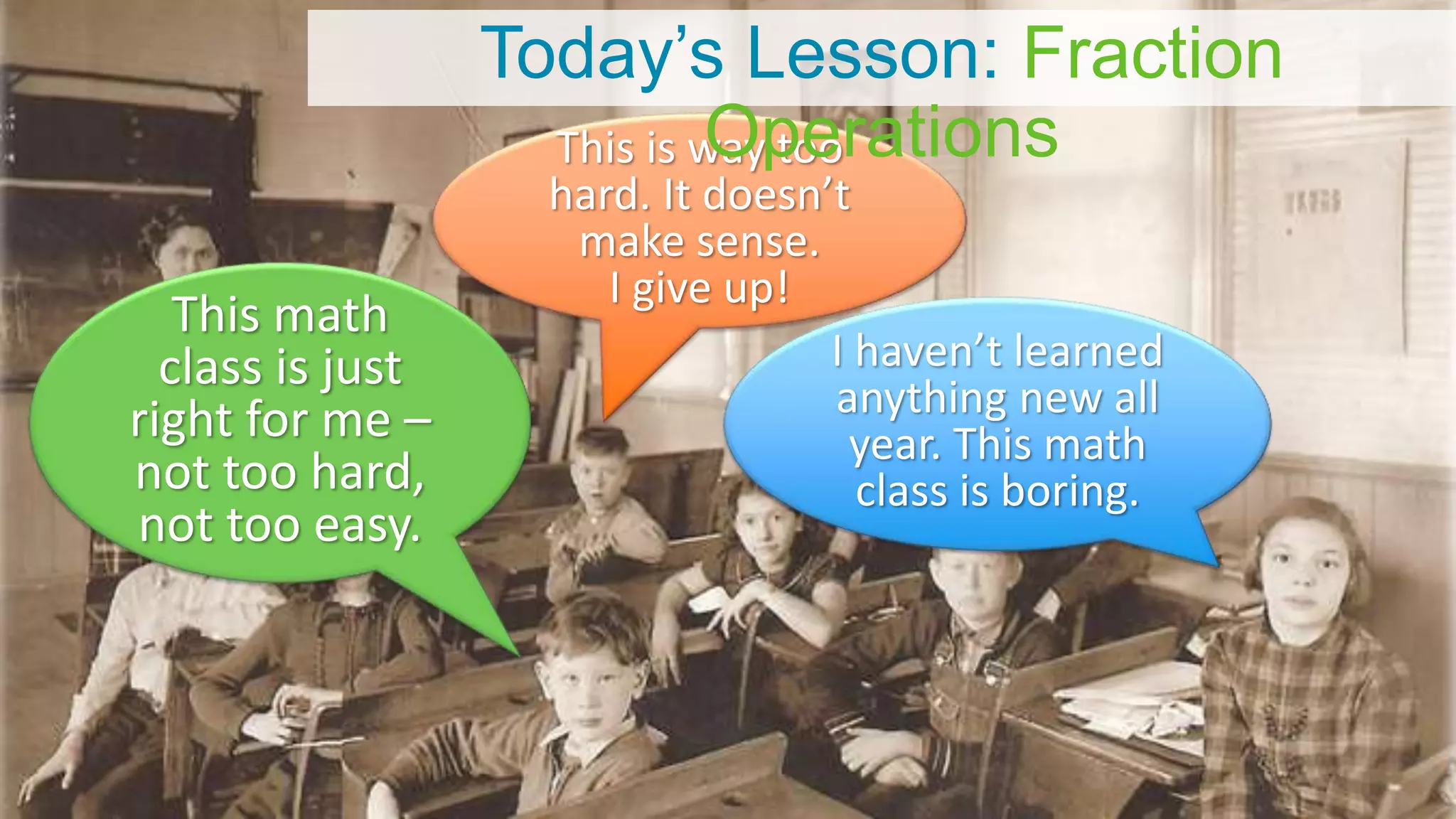
Today’s Lesson: Fraction
Operations
I haven’t learned
anything new all
year. This math
class is boring.
This is way too
hard. It doesn’t
make sense.
I give up!
This math
class is just
right for me –
not too hard,
not too easy.
Today’s Lesson: Fraction
Operations
Today’s Lesson: Fraction
Operations
Why?
Today’s Lesson: Fraction
Operations
Why?
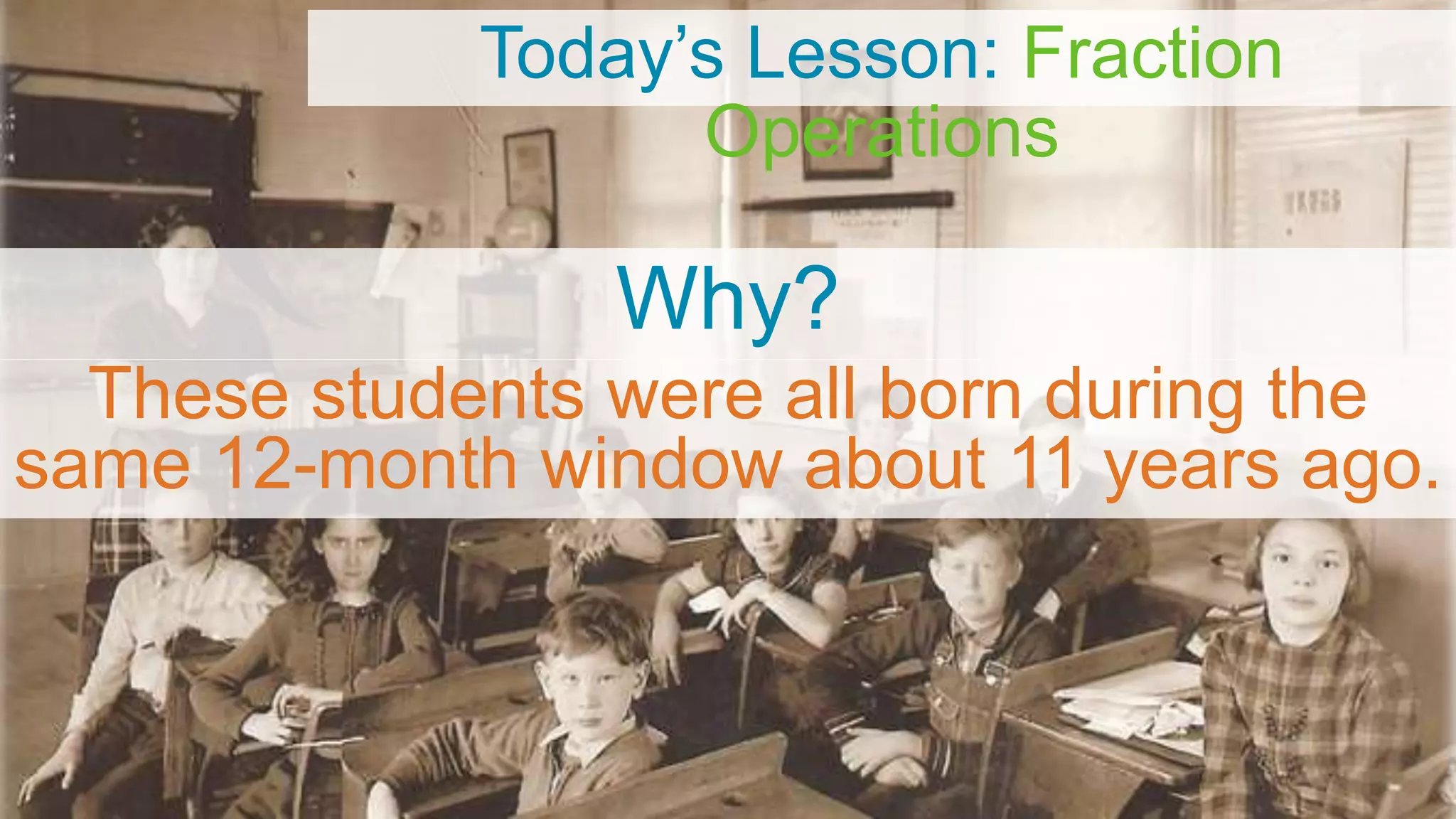
These students were all born during the
same 12-month window about 11 years ago.
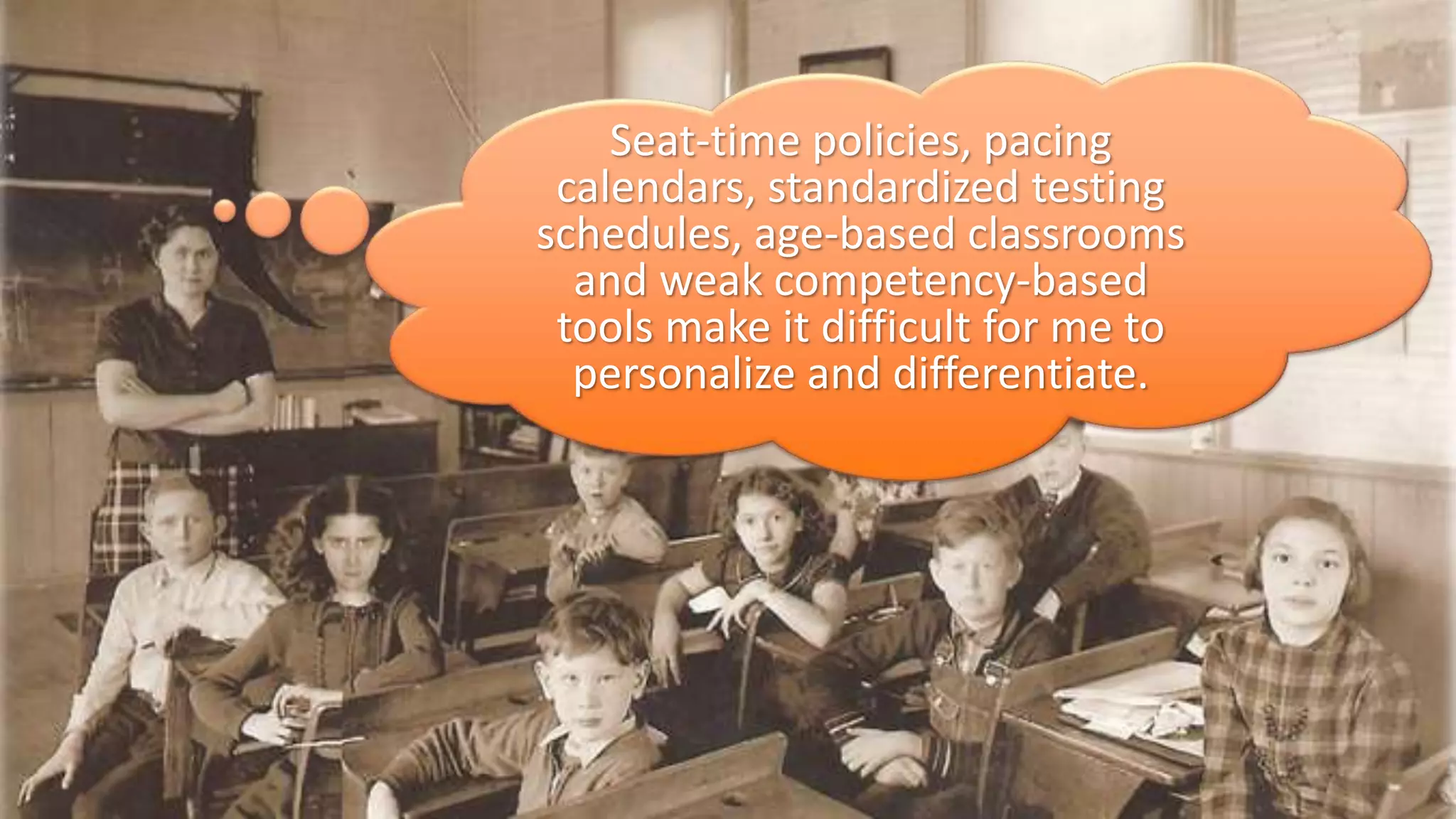
Seat-time policies, pacing
calendars, standardized testing
schedules, age-based classrooms
and weak competency-based
tools make it difficult for me to
personalize and differentiate.
.
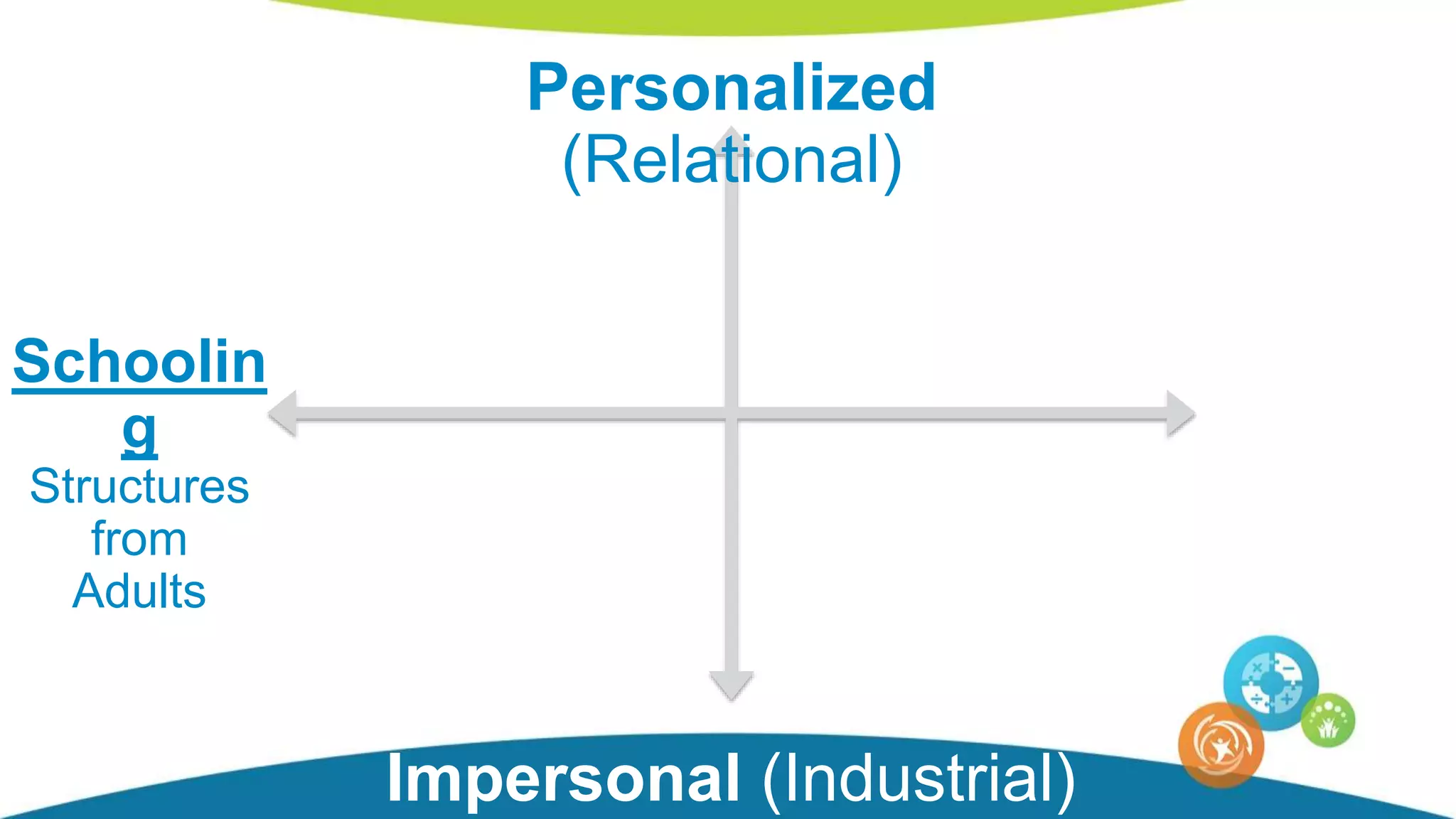
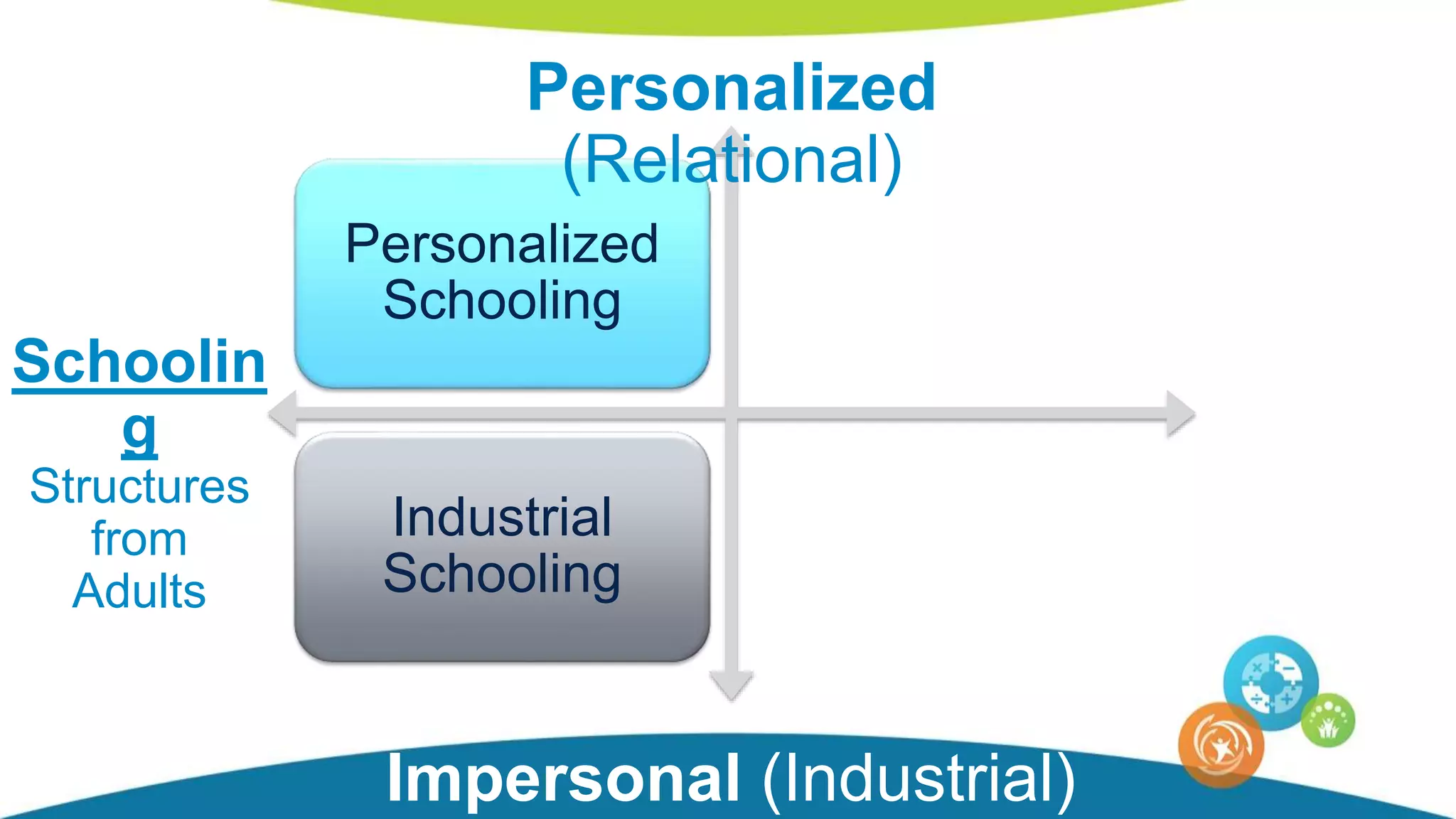
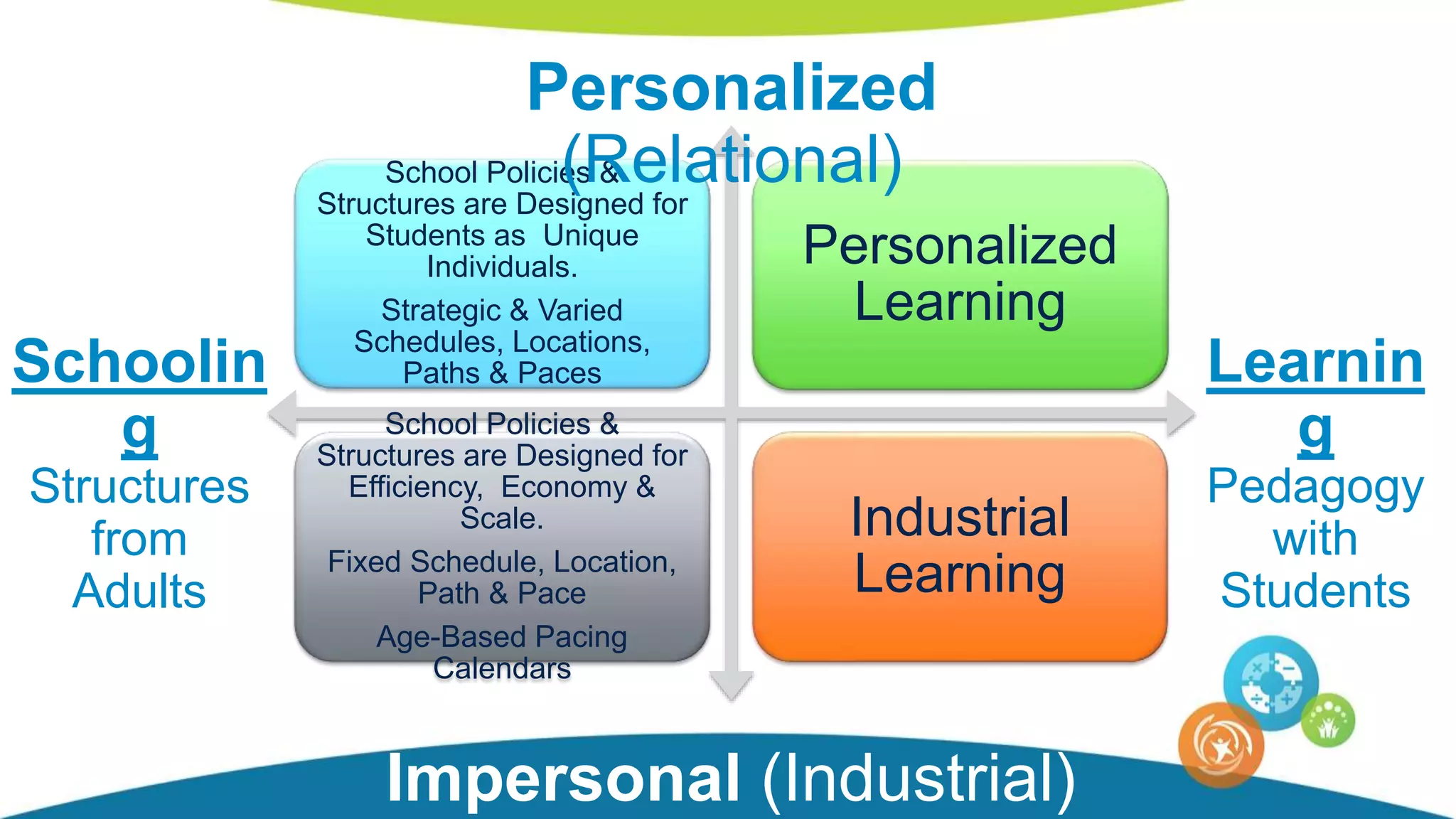
Personalized
(Relational)
Impersonal (Industrial)
Schoolin
g
Structures
from
Adults
Personalized
Schooling
Personalized
Learning
Industrial
Schooling
Industrial
Learning
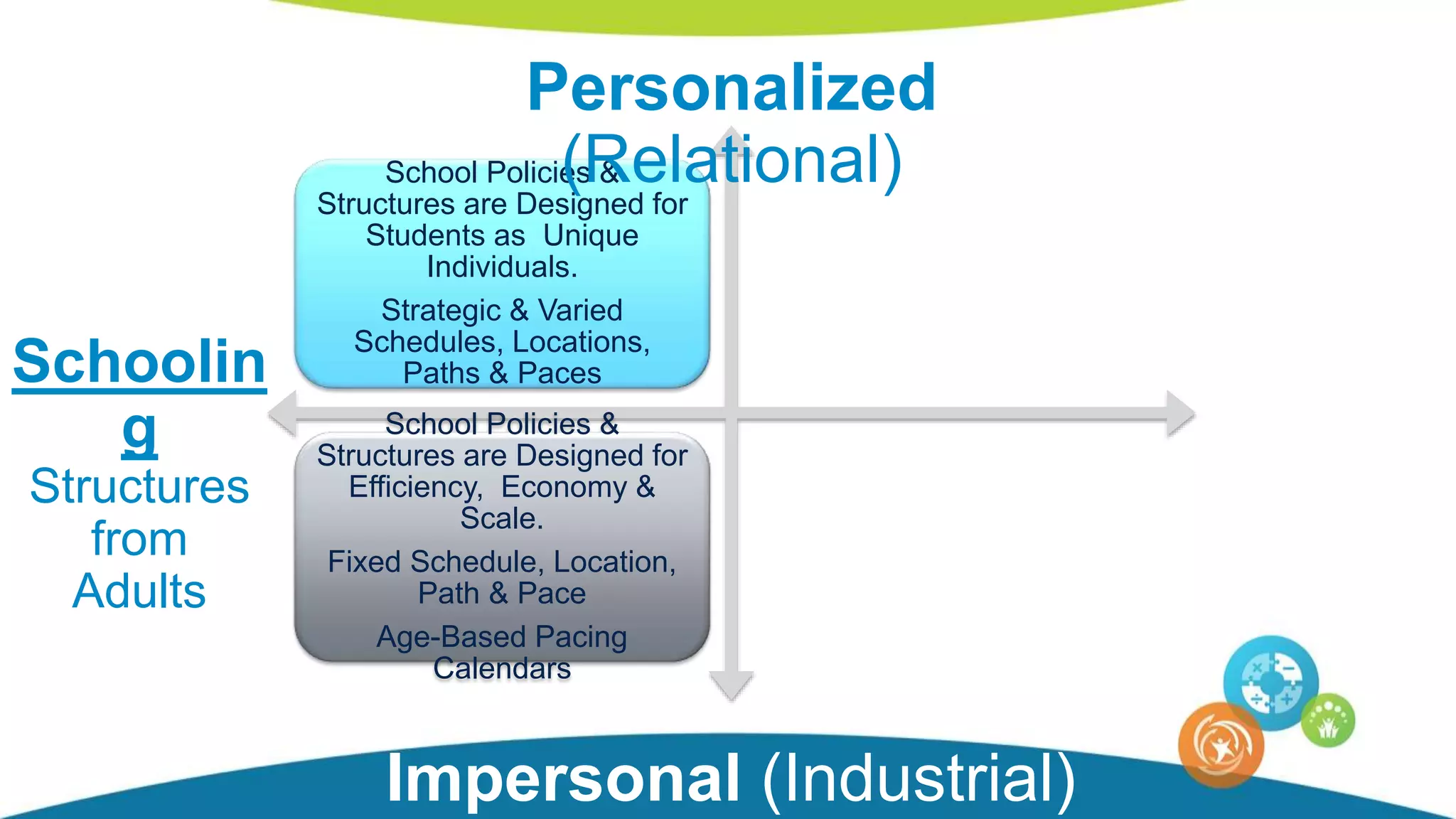
Personalized
(Relational)
Impersonal (Industrial)
Schoolin
g
Structures
from
Adults
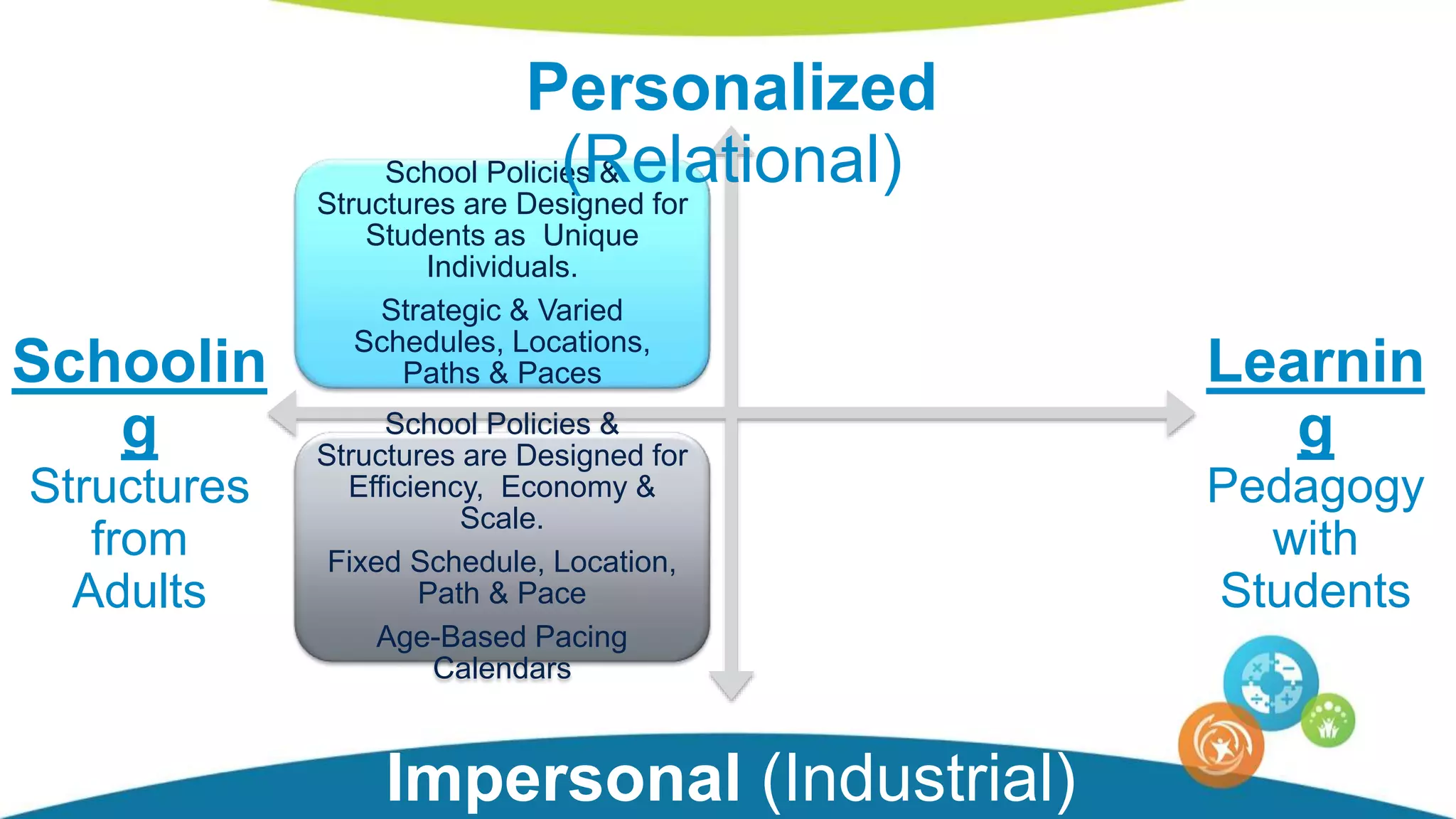
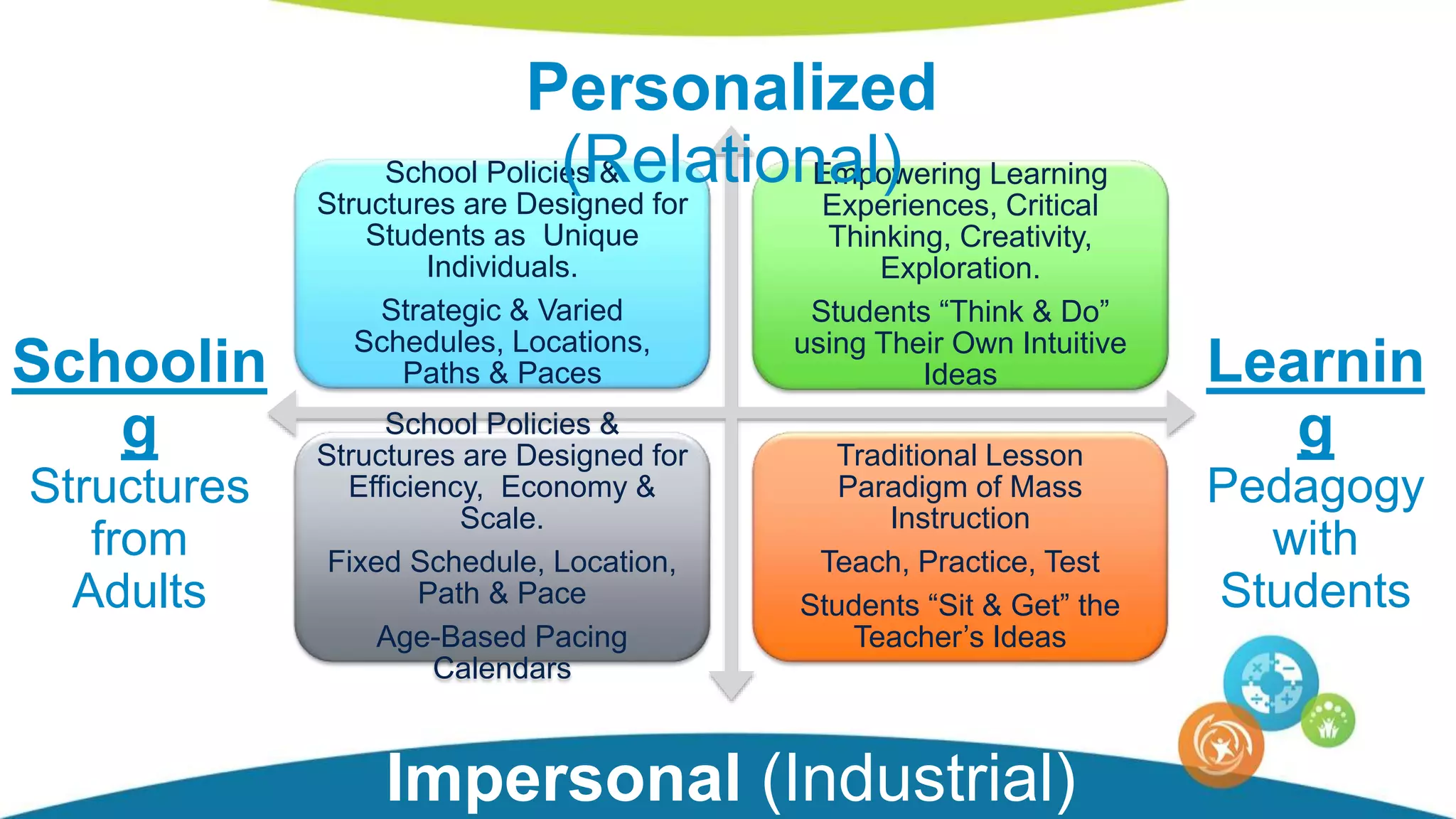
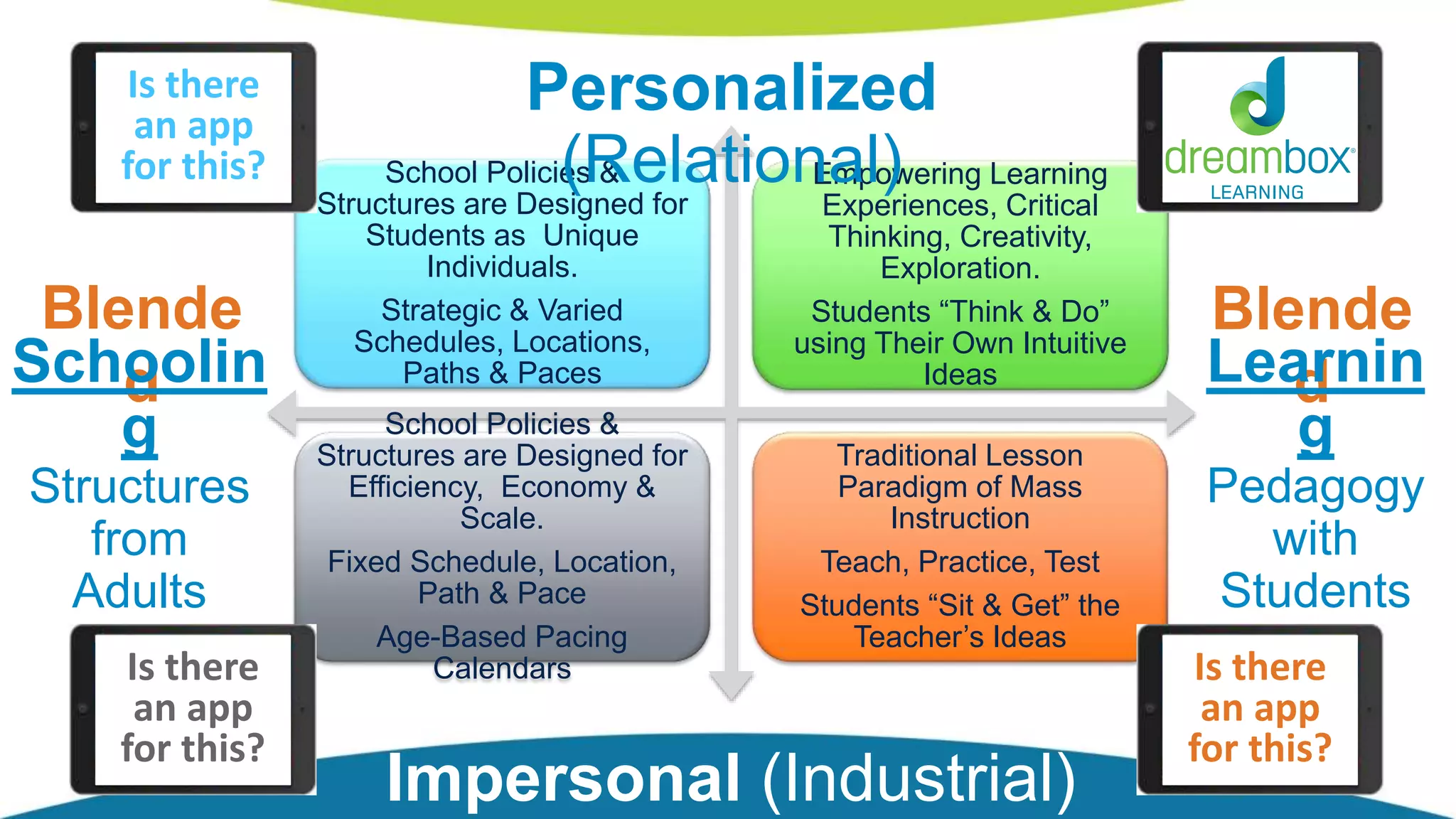
School Policies &
Structures are Designed for
Students as Unique
Individuals.
Strategic & Varied
Schedules, Locations,
Paths & Paces
Empowering Learning
Experiences, Critical
Thinking, Creativity,
Exploration.
Students “Think & Do”
using Their Own Intuitive
Ideas
School Policies &
Structures are Designed for
Efficiency, Economy &
Scale.
Fixed Schedule, Location,
Path & Pace
Age-Based Pacing
Calendars
Traditional Lesson
Paradigm of Mass
Instruction
Teach, Practice, Test
Students “Sit & Get” the
Teacher’s Ideas
Personalized
(Relational)
Impersonal (Industrial)
Schoolin
g
Structures
from
Adults
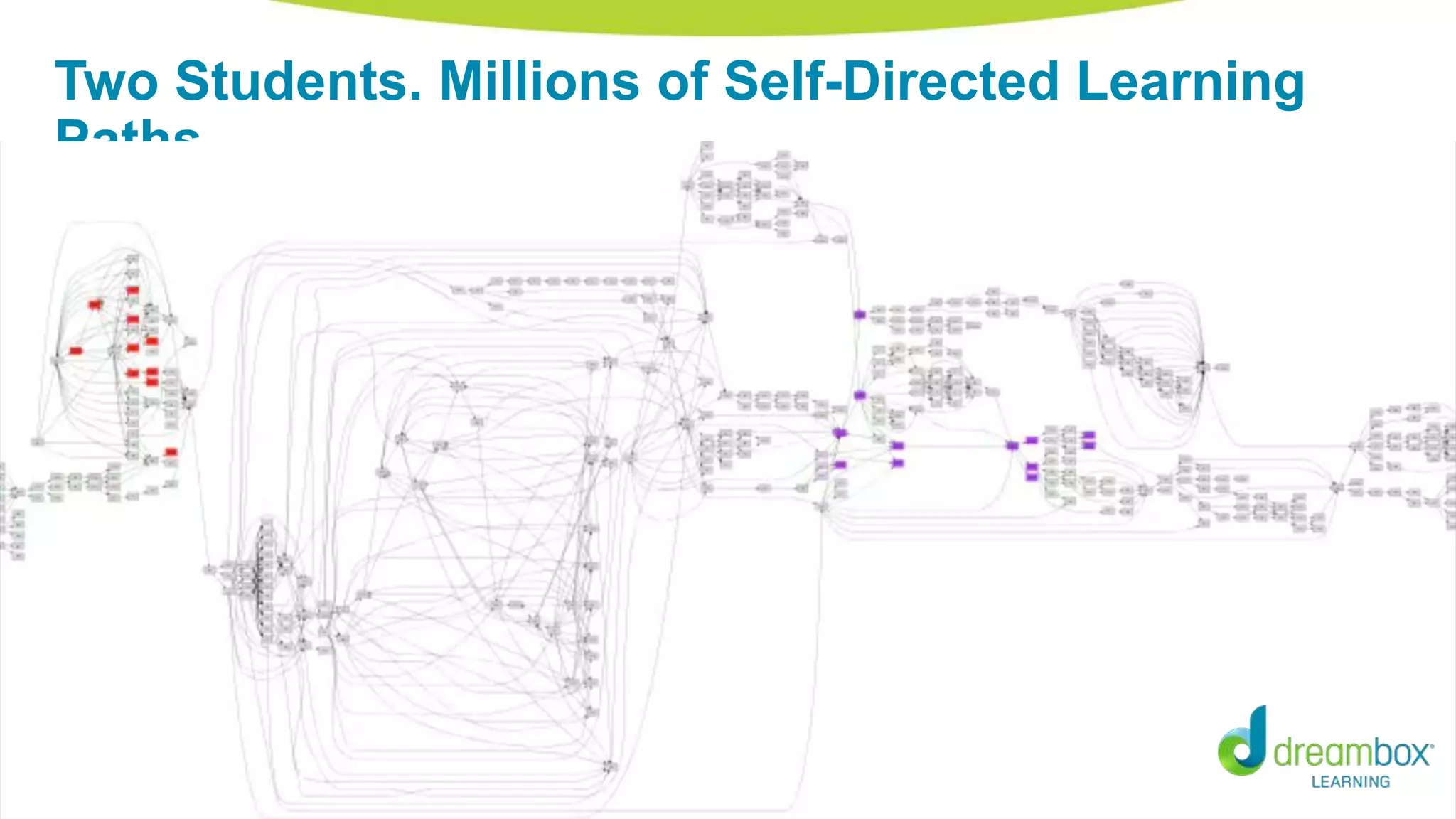
Two Students. Millions of Self-Directed Learning
Paths.
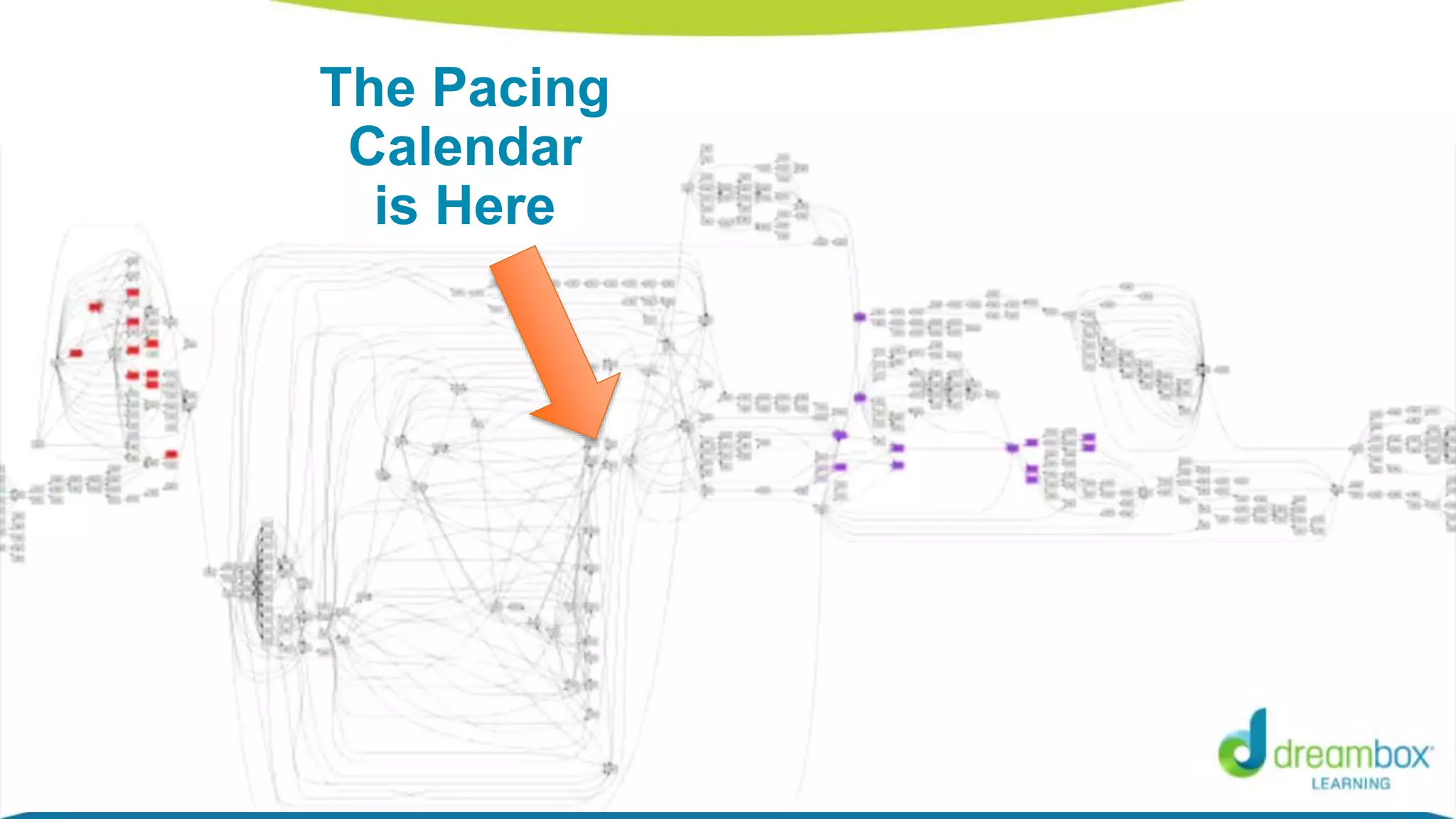
The Pacing
Calendar
is Here
School Policies &
Structures are Designed for
Students as Unique
Individuals.
Strategic & Varied
Schedules, Locations,
Paths & Paces
Empowering Learning
Experiences, Critical
Thinking, Creativity,
Exploration.
Students “Think & Do”
using Their Own Intuitive
Ideas
School Policies &
Structures are Designed for
Efficiency, Economy &
Scale.
Fixed Schedule, Location,
Path & Pace
Age-Based Pacing
Calendars
Traditional Lesson
Paradigm of Mass
Instruction
Teach, Practice, Test
Students “Sit & Get” the
Teacher’s Ideas
Personalized
(Relational)
Impersonal (Industrial)
Schoolin
g
Structures
from
Adults
Learnin
g
Pedagogy
with
Students
Today’s Lesson: Fraction
Operations
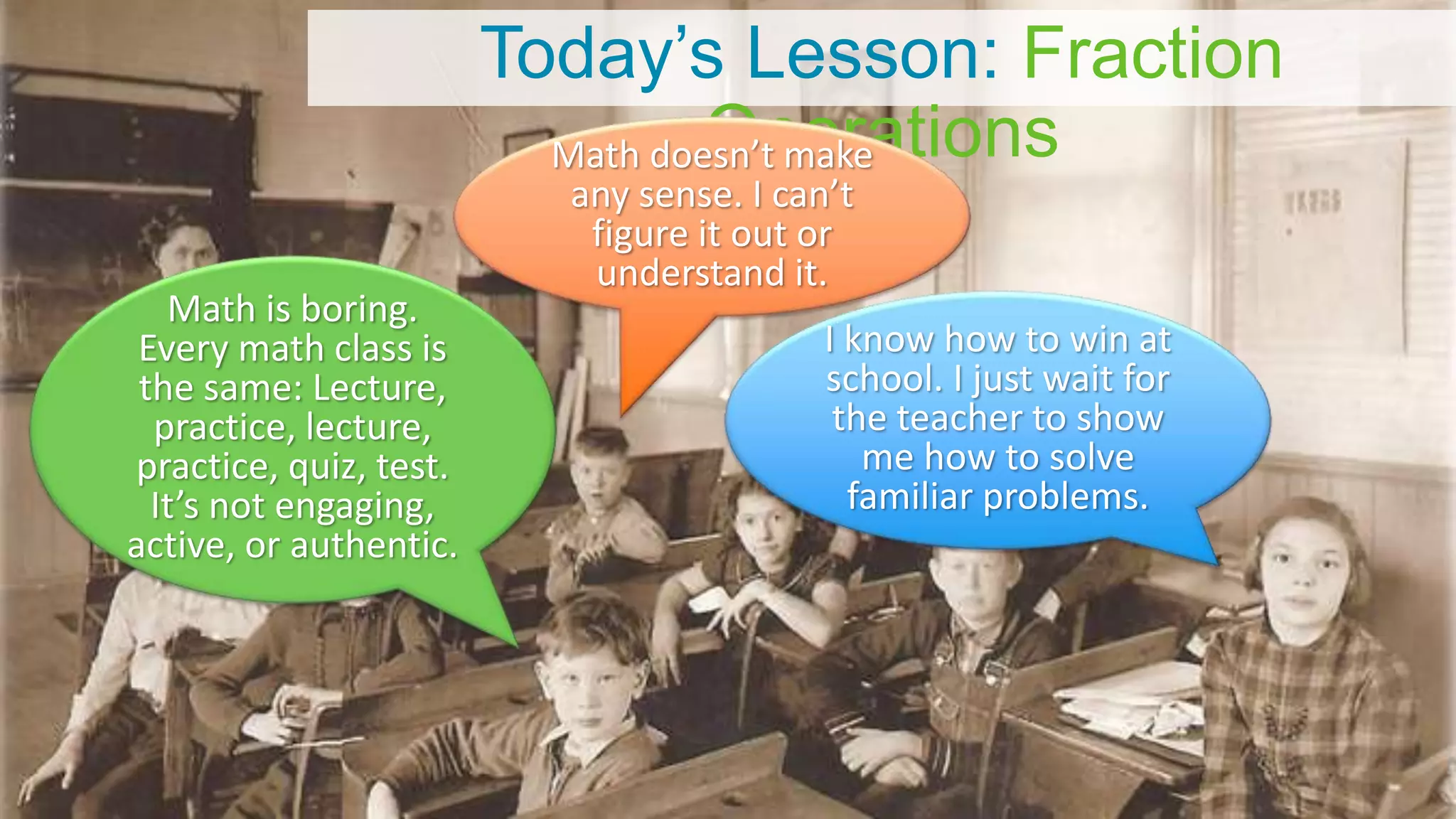
Math is boring.
Every math class is
the same: Lecture,
practice, lecture,
practice, quiz, test.
It’s not engaging,
active, or authentic.
I know how to win at
school. I just wait for
the teacher to show
me how to solve
familiar problems.
Math doesn’t make
any sense. I can’t
figure it out or
understand it.
School Policies &
Structures are Designed for
Students as Unique
Individuals.
Strategic & Varied
Schedules, Locations,
Paths & Paces
Personalized
Learning
School Policies &
Structures are Designed for
Efficiency, Economy &
Scale.
Fixed Schedule, Location,
Path & Pace
Age-Based Pacing
Calendars
Industrial
Learning
Personalized
(Relational)
Impersonal (Industrial)
Learnin
g
Pedagogy
with
Students
Schoolin
g
Structures
from
Adults
School Policies &
Structures are Designed for
Students as Unique
Individuals.
Strategic & Varied
Schedules, Locations,
Paths & Paces
Empowering Learning
Experiences, Critical
Thinking, Creativity,
Exploration.
Students “Think & Do”
using Their Own Intuitive
Ideas
School Policies &
Structures are Designed for
Efficiency, Economy &
Scale.
Fixed Schedule, Location,
Path & Pace
Age-Based Pacing
Calendars
Traditional Lesson
Paradigm of Mass
Instruction
Teach, Practice, Test
Students “Sit & Get” the
Teacher’s Ideas
Personalized
(Relational)
Impersonal (Industrial)
Learnin
g
Pedagogy
with
Students
Schoolin
g
Structures
from
Adults
School Policies &
Structures are Designed for
Students as Unique
Individuals.
Strategic & Varied
Schedules, Locations,
Paths & Paces
Empowering Learning
Experiences, Critical
Thinking, Creativity,
Exploration.
Students “Think & Do”
using Their Own Intuitive
Ideas
School Policies &
Structures are Designed for
Efficiency, Economy &
Scale.
Fixed Schedule, Location,
Path & Pace
Age-Based Pacing
Calendars
Traditional Lesson
Paradigm of Mass
Instruction
Teach, Practice, Test
Students “Sit & Get” the
Teacher’s Ideas
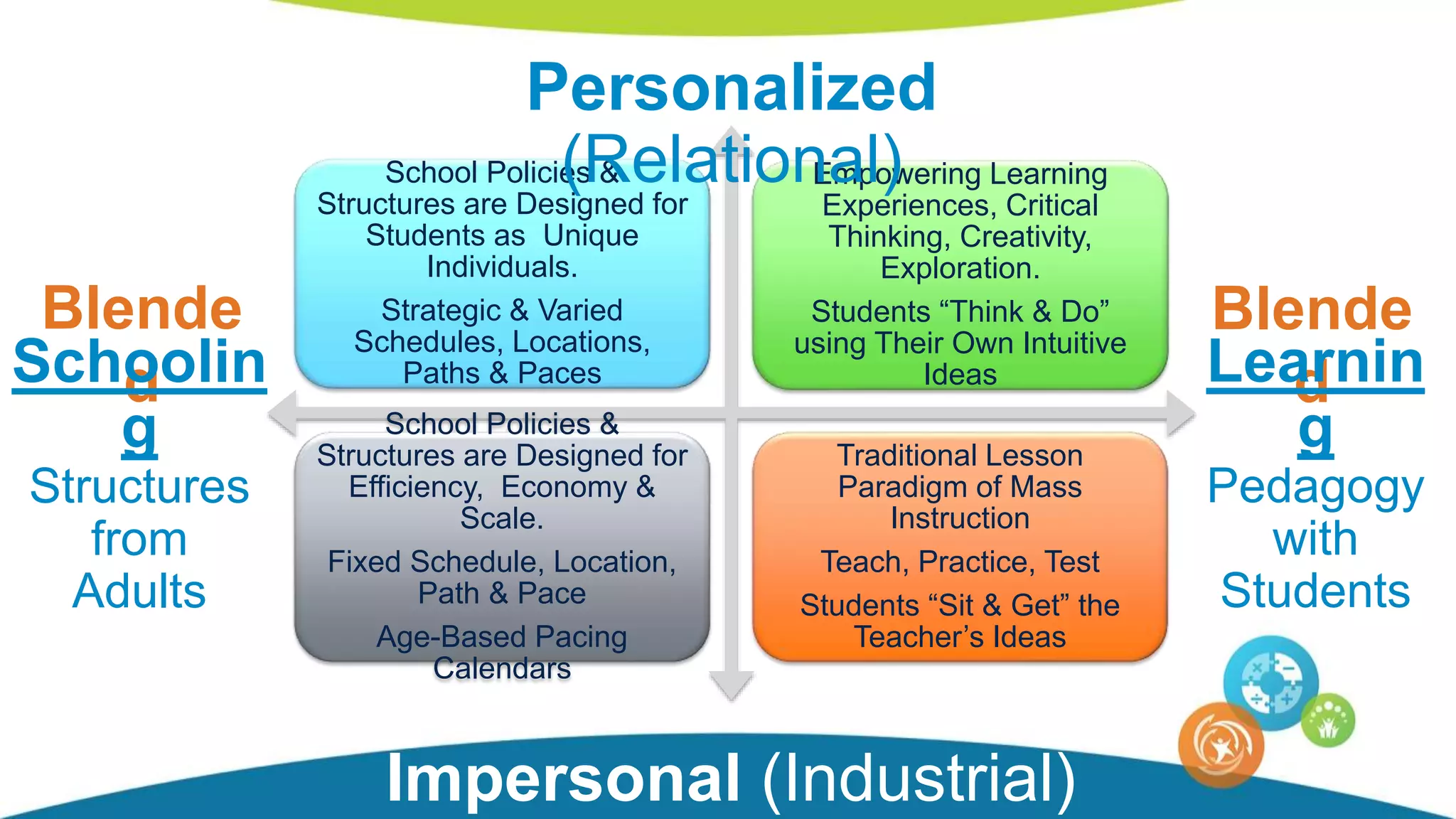
Blende
d
Blende
d
Personalized
(Relational)
Impersonal (Industrial)
Learnin
g
Pedagogy
with
Students
Schoolin
g
Structures
from
Adults
School Policies &
Structures are Designed for
Students as Unique
Individuals.
Strategic & Varied
Schedules, Locations,
Paths & Paces
Empowering Learning
Experiences, Critical
Thinking, Creativity,
Exploration.
Students “Think & Do”
using Their Own Intuitive
Ideas
School Policies &
Structures are Designed for
Efficiency, Economy &
Scale.
Fixed Schedule, Location,
Path & Pace
Age-Based Pacing
Calendars
Traditional Lesson
Paradigm of Mass
Instruction
Teach, Practice, Test
Students “Sit & Get” the
Teacher’s Ideas
Blende
d
Blende
d
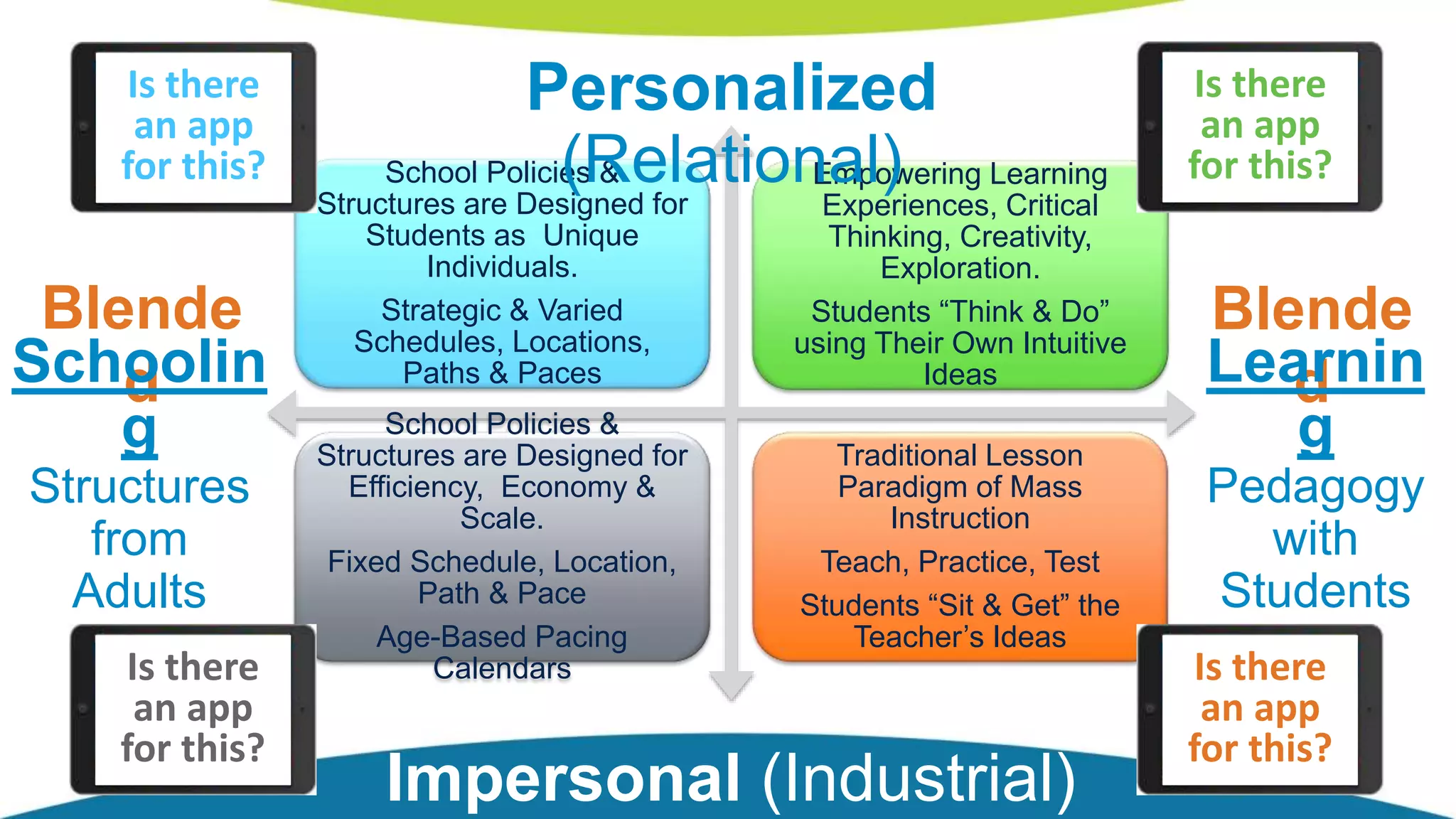
Is there
an app
for this?
Is there
an app
for this?
Is there
an app
for this?
Is there
an app
for this?
Personalized
(Relational)
Impersonal (Industrial)
Learnin
g
Pedagogy
with
Students
Schoolin
g
Structures
from
Adults
School Policies &
Structures are Designed for
Students as Unique
Individuals.
Strategic & Varied
Schedules, Locations,
Paths & Paces
Empowering Learning
Experiences, Critical
Thinking, Creativity,
Exploration.
Students “Think & Do”
using Their Own Intuitive
Ideas
School Policies &
Structures are Designed for
Efficiency, Economy &
Scale.
Fixed Schedule, Location,
Path & Pace
Age-Based Pacing
Calendars
Traditional Lesson
Paradigm of Mass
Instruction
Teach, Practice, Test
Students “Sit & Get” the
Teacher’s Ideas
Blende
d
Blende
d
Is there
an app
for this?
Is there
an app
for this?
Is there
an app
for this?
Is there
an app
for this?
Personalized
(Relational)
Impersonal (Industrial)
Learnin
g
Pedagogy
with
Students
Schoolin
g
Structures
from
Adults
Defining
Adaptive Learning
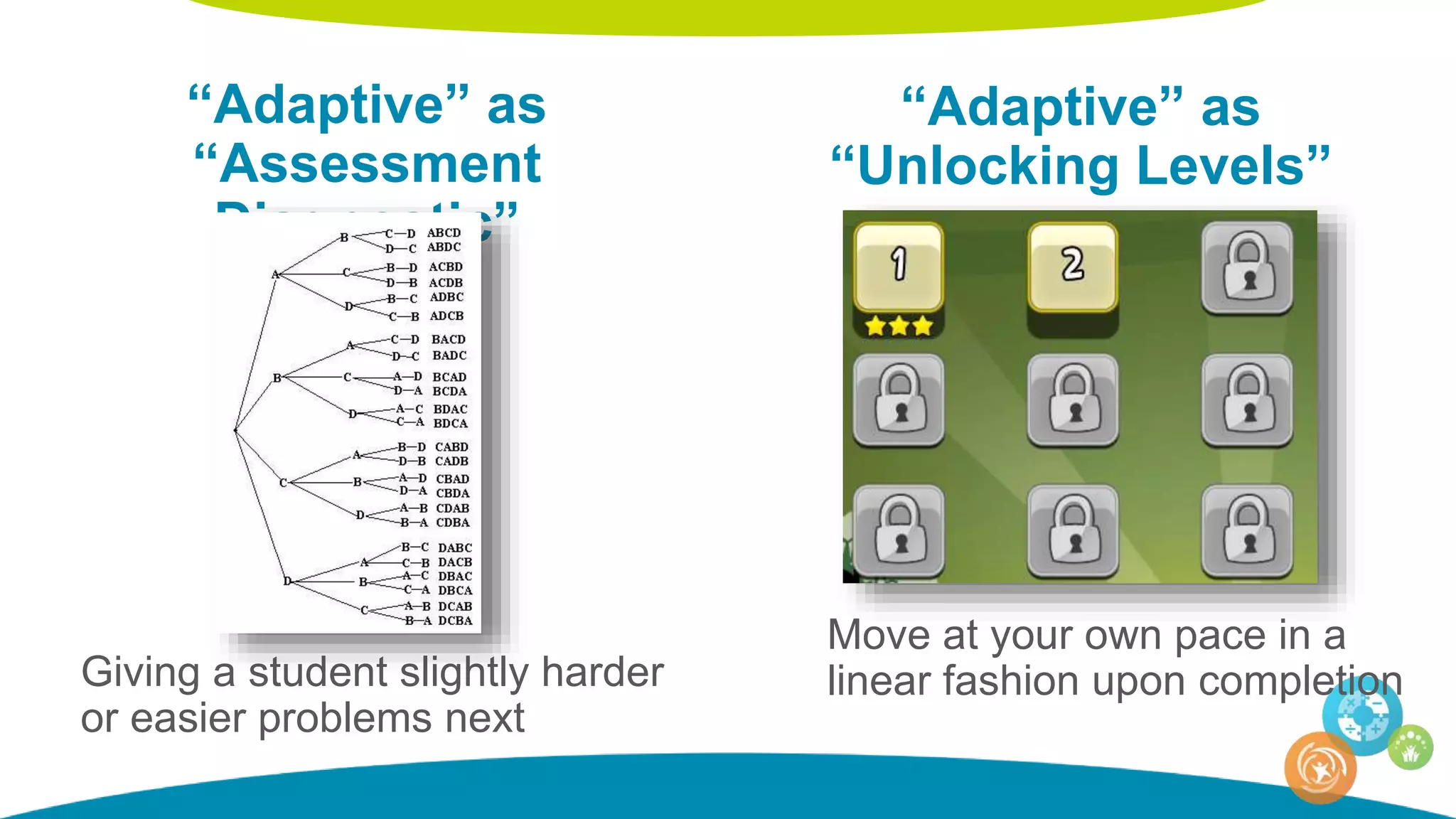
“Adaptive” as
“Assessment
Diagnostic”
Giving a student slightly harder
or easier problems next
“Adaptive” as
“Unlocking Levels”
Move at your own pace in a
linear fashion upon completion
“Adaptive” as
“Recommendation”
Making recommendations for
lessons, videos, readings, or
assignments to do next, often
crowd-sourced and/or using big
data algorithms to choose content.
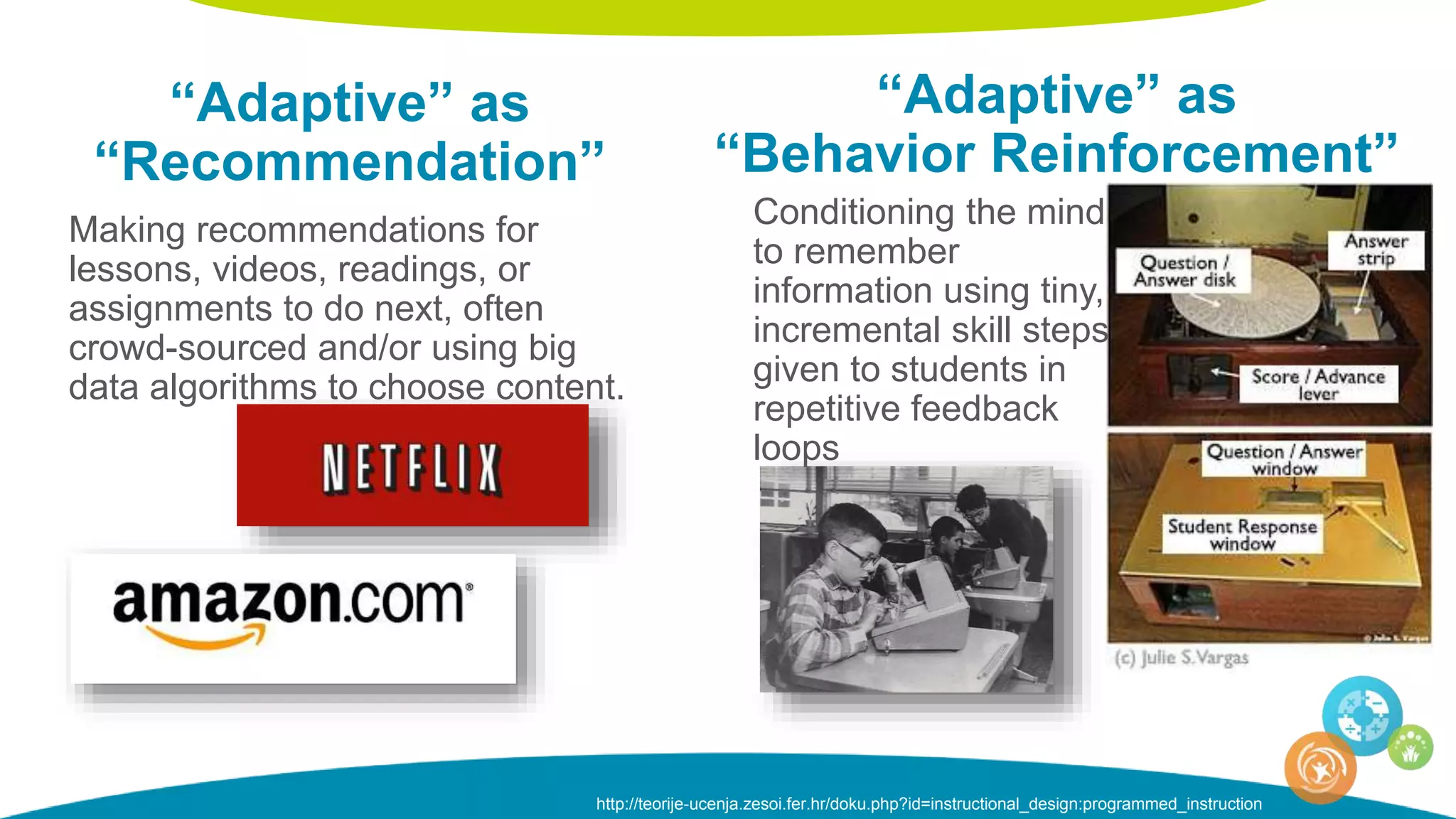
“Adaptive” as
“Behavior Reinforcement”
Conditioning the mind
to remember
information using tiny,
incremental skill steps
given to students in
repetitive feedback
loops
http://teorije-ucenja.zesoi.fer.hr/doku.php?id=instructional_design:programmed_instruction
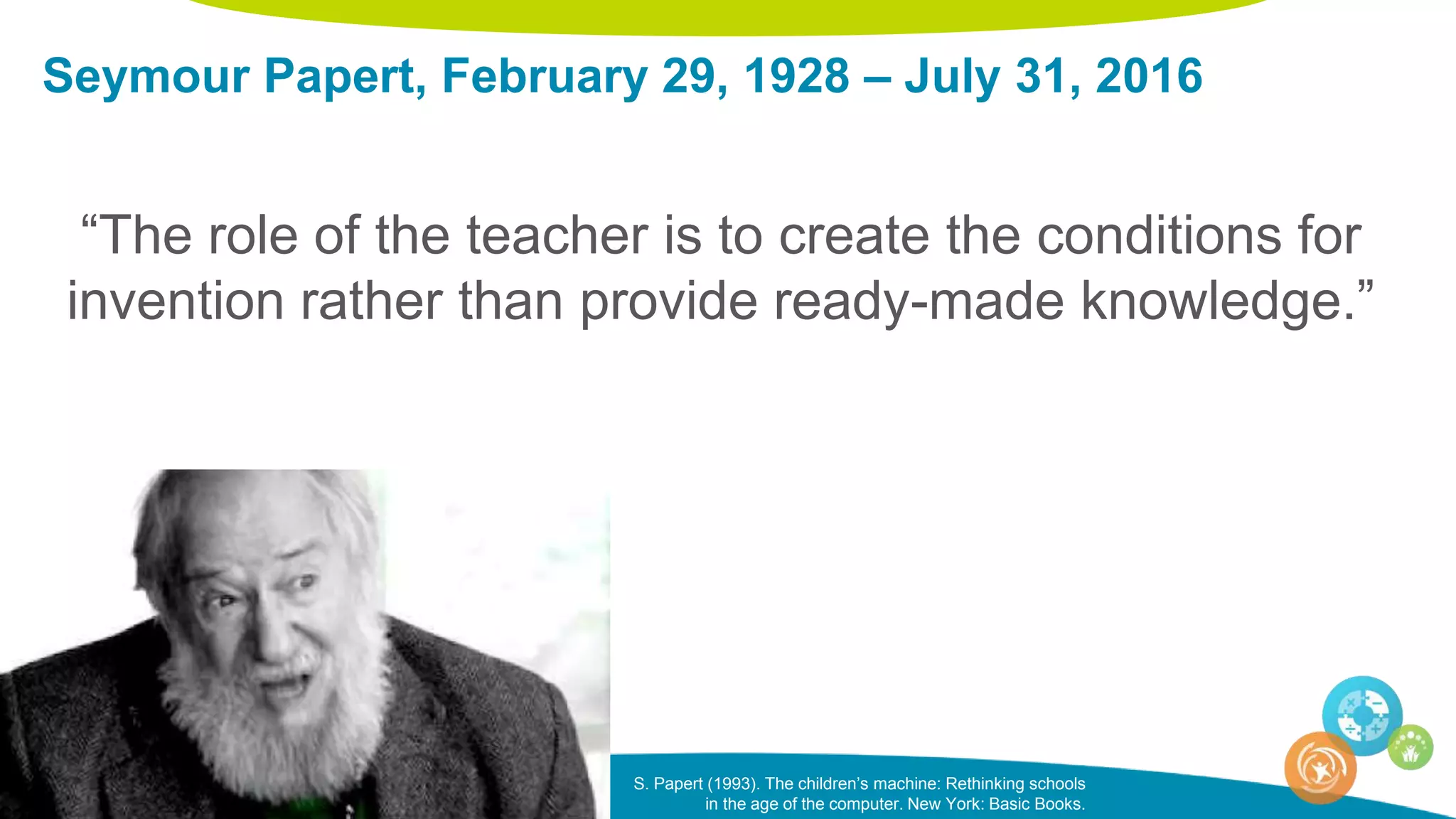
Seymour Papert, February 29, 1928 – July 31, 2016
“The role of the teacher is to create the conditions for
invention rather than provide ready-made knowledge.”
S. Papert (1993). The children’s machine: Rethinking schools
in the age of the computer. New York: Basic Books.
Seymour Papert, February 29, 1928 – July 31, 2016
S. Papert. Constructionism vs. Instructionism. http://www.papert.org/articles/const_inst/const_inst1.html
“But children, what can they make with mathematics?
Not much. They sit in class and they write numbers on
pieces of paper. That's not making anything very
exciting. So we've tried to find ways that children can
use mathematics to make something -- something
interesting, so that the children's relationship to
mathematics is more like the engineer's, or the
scientist's, or the banker's, or all the important people
who use mathematics constructively to construct
something.”
What happens in each lesson?
“True virtual manipulatives allow more than
simply a viewing of objects on the computer
screen. They allow increased engagement,
forcing the user to interact with dynamic
objects. Through this interaction students
have opportunities to make meaning and
see relationships as a result of their own
actions. And it is this interactive engagement
with a dynamic representation that is the key to
the knowledge construction process.”
From Virtual Manipulatives In The K-12 Classroom, Moyer, Bolyard, Spikell, 2002
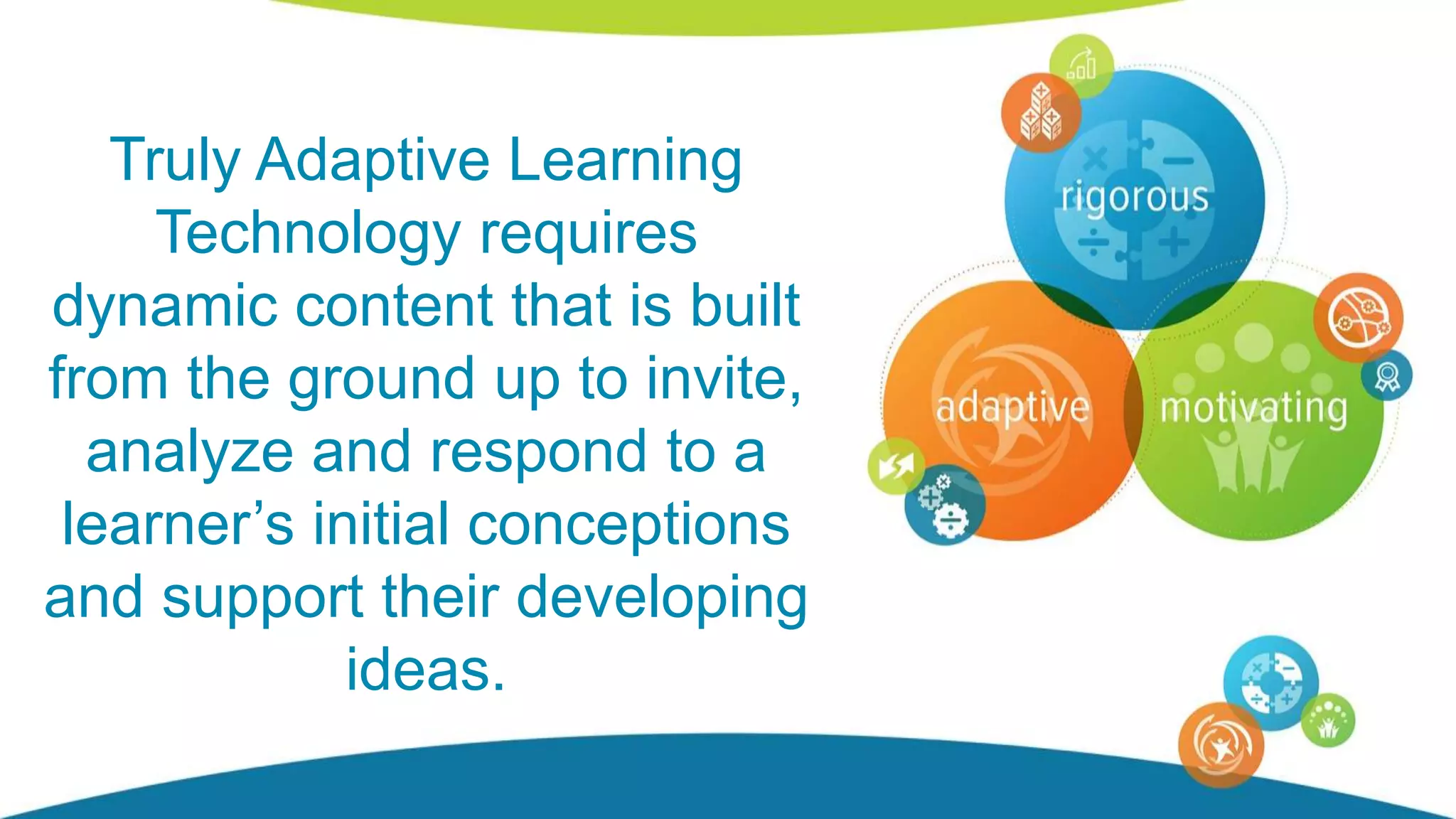
Truly Adaptive Learning
Technology requires
dynamic content that is built
from the ground up to invite,
analyze and respond to a
learner’s initial conceptions
and support their developing
ideas.
Recent Research
about
Personalized
Learning
& Adaptive Learning
Tools for
Interpreting Similar
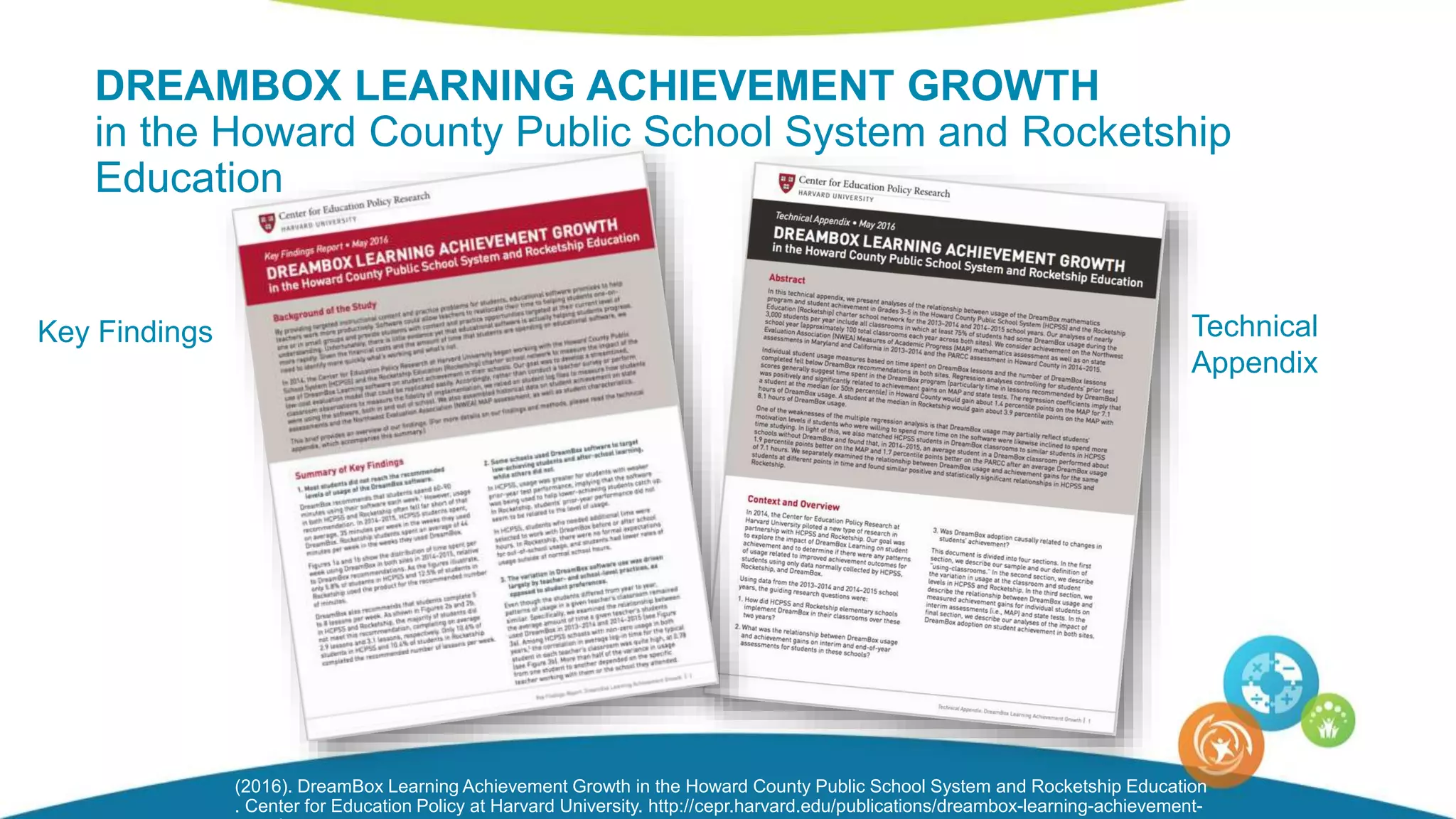
DREAMBOX LEARNING ACHIEVEMENT GROWTH
in the Howard County Public School System and Rocketship
Education
Key Findings Technical
Appendix
(2016). DreamBox Learning Achievement Growth in the Howard County Public School System and Rocketship Education
. Center for Education Policy at Harvard University. http://cepr.harvard.edu/publications/dreambox-learning-achievement-
Other Resources
• Lessons Learned From Early
Implementations of Adaptive
Courseware
• College-Level Study found “no discernible
impact on grades” or course completion
• Conducted by SRI. 19,500 students, 280
instructors, 14 universities, April 2016
• https://www.sri.com/sites/default/files/broch
ures/almap_final_report.pdf
• EdSurge Adaptive Learning
Overview
• https://www.edsurge.com/research/special-
reports/adaptive-learning/
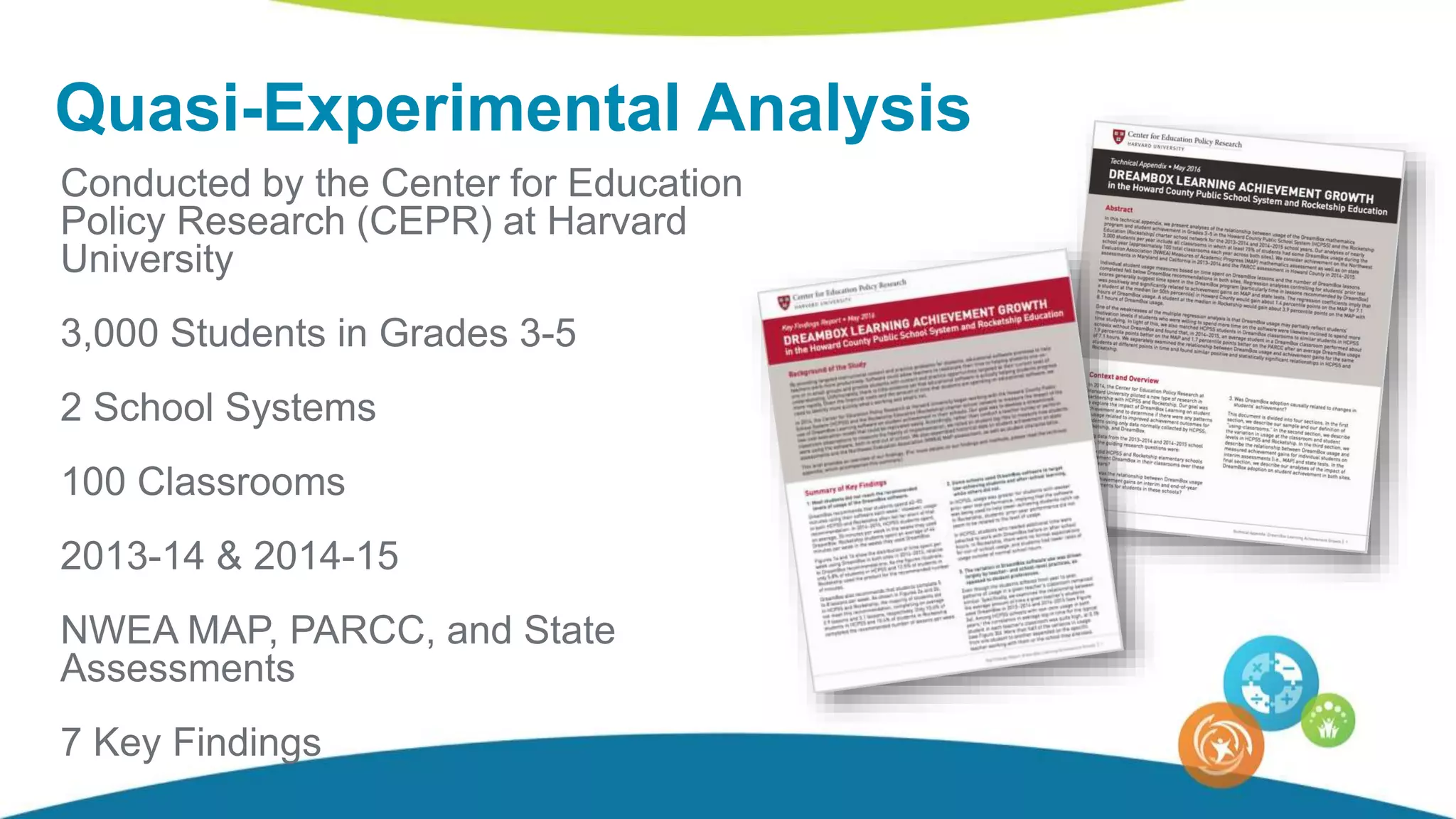
Conducted by the Center for Education
Policy Research (CEPR) at Harvard
University
3,000 Students in Grades 3-5
2 School Systems
100 Classrooms
2013-14 & 2014-15
NWEA MAP, PARCC, and State
Assessments
7 Key Findings
Quasi-Experimental Analysis
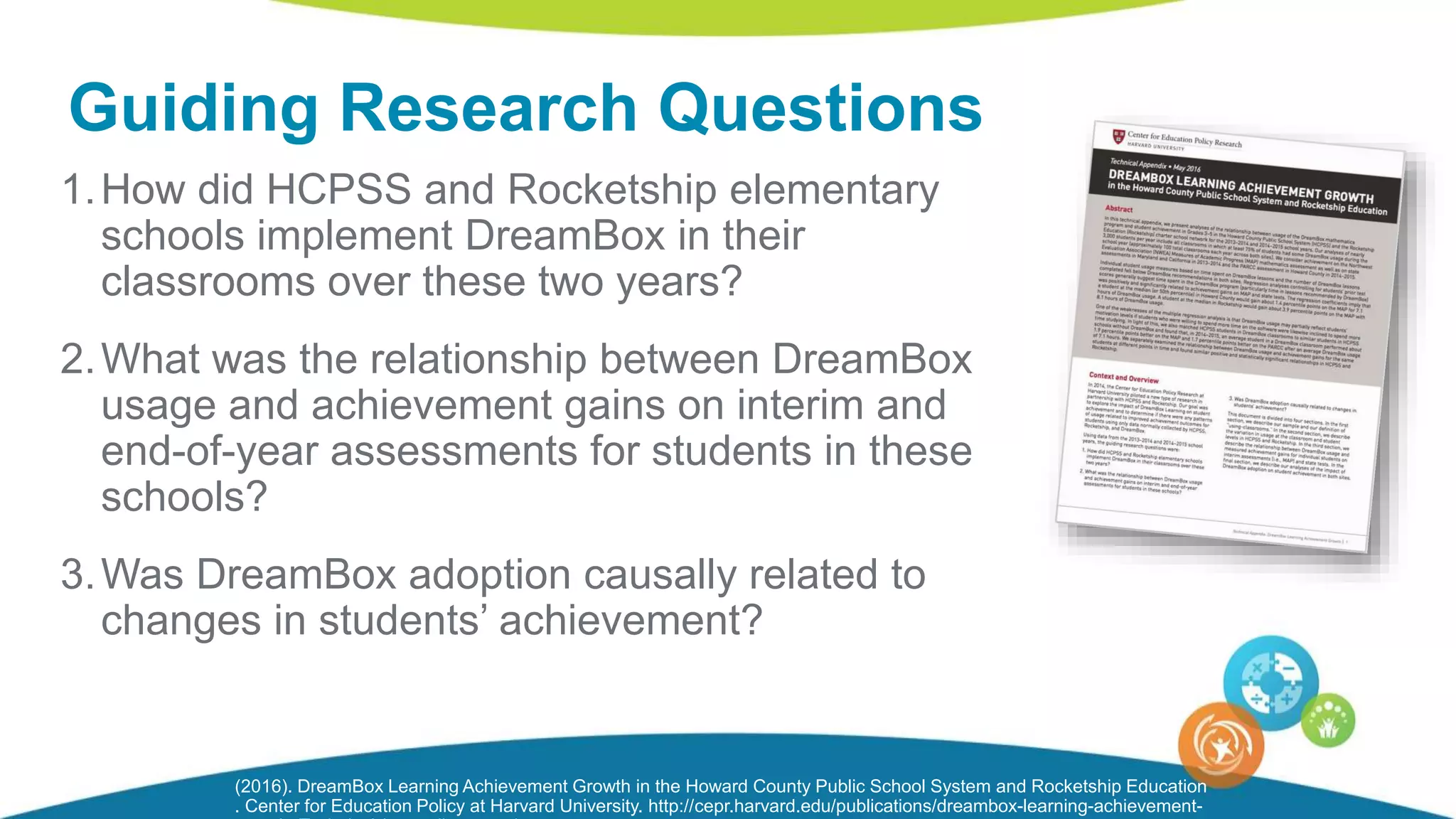
1.How did HCPSS and Rocketship elementary
schools implement DreamBox in their
classrooms over these two years?
2.What was the relationship between DreamBox
usage and achievement gains on interim and
end-of-year assessments for students in these
schools?
3.Was DreamBox adoption causally related to
changes in students’ achievement?
Guiding Research Questions
(2016). DreamBox Learning Achievement Growth in the Howard County Public School System and Rocketship Education
. Center for Education Policy at Harvard University. http://cepr.harvard.edu/publications/dreambox-learning-achievement-
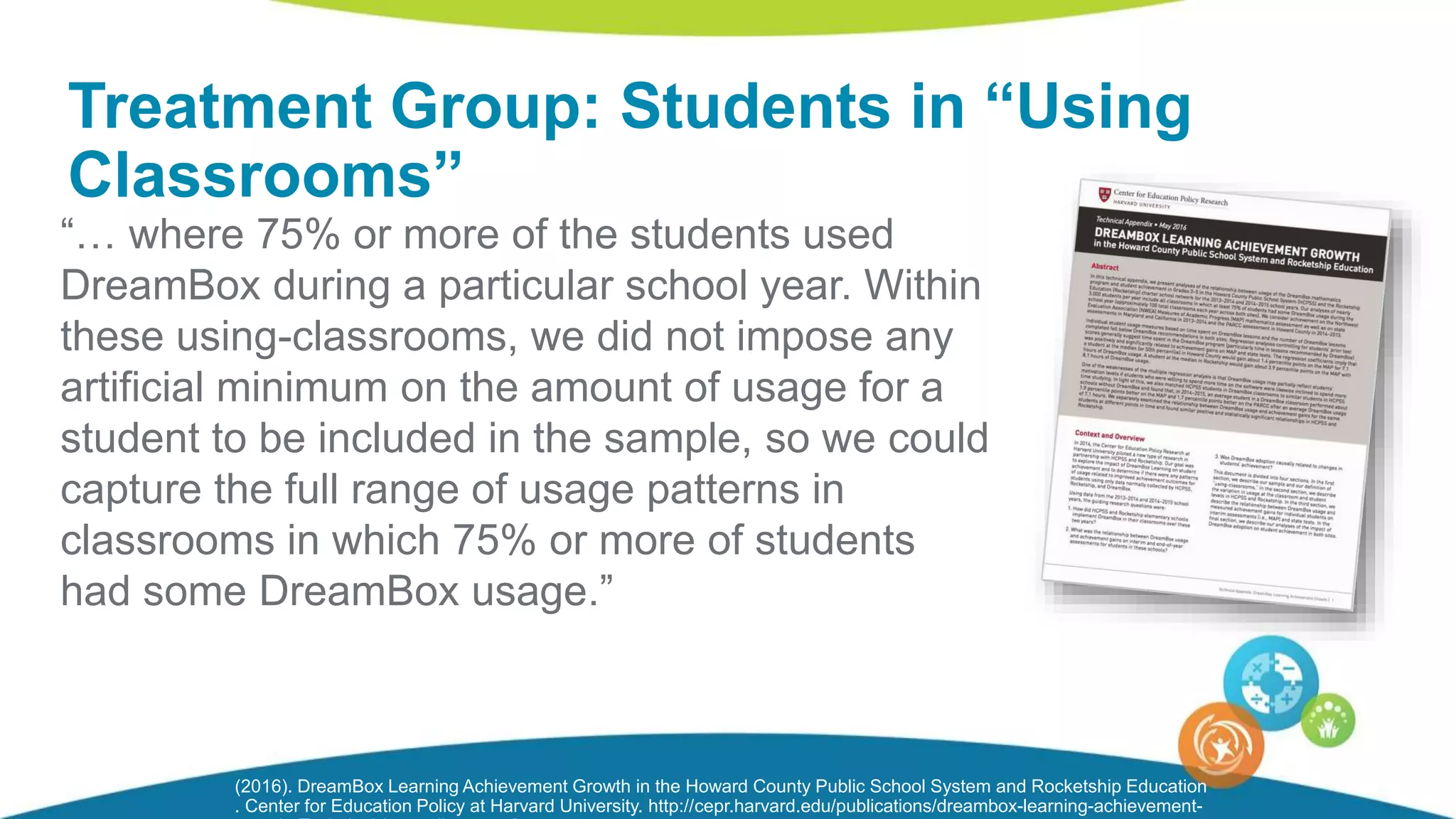
“… where 75% or more of the students used
DreamBox during a particular school year. Within
these using-classrooms, we did not impose any
artificial minimum on the amount of usage for a
student to be included in the sample, so we could
capture the full range of usage patterns in
classrooms in which 75% or more of students
had some DreamBox usage.”
Treatment Group: Students in “Using
Classrooms”
(2016). DreamBox Learning Achievement Growth in the Howard County Public School System and Rocketship Education
. Center for Education Policy at Harvard University. http://cepr.harvard.edu/publications/dreambox-learning-achievement-
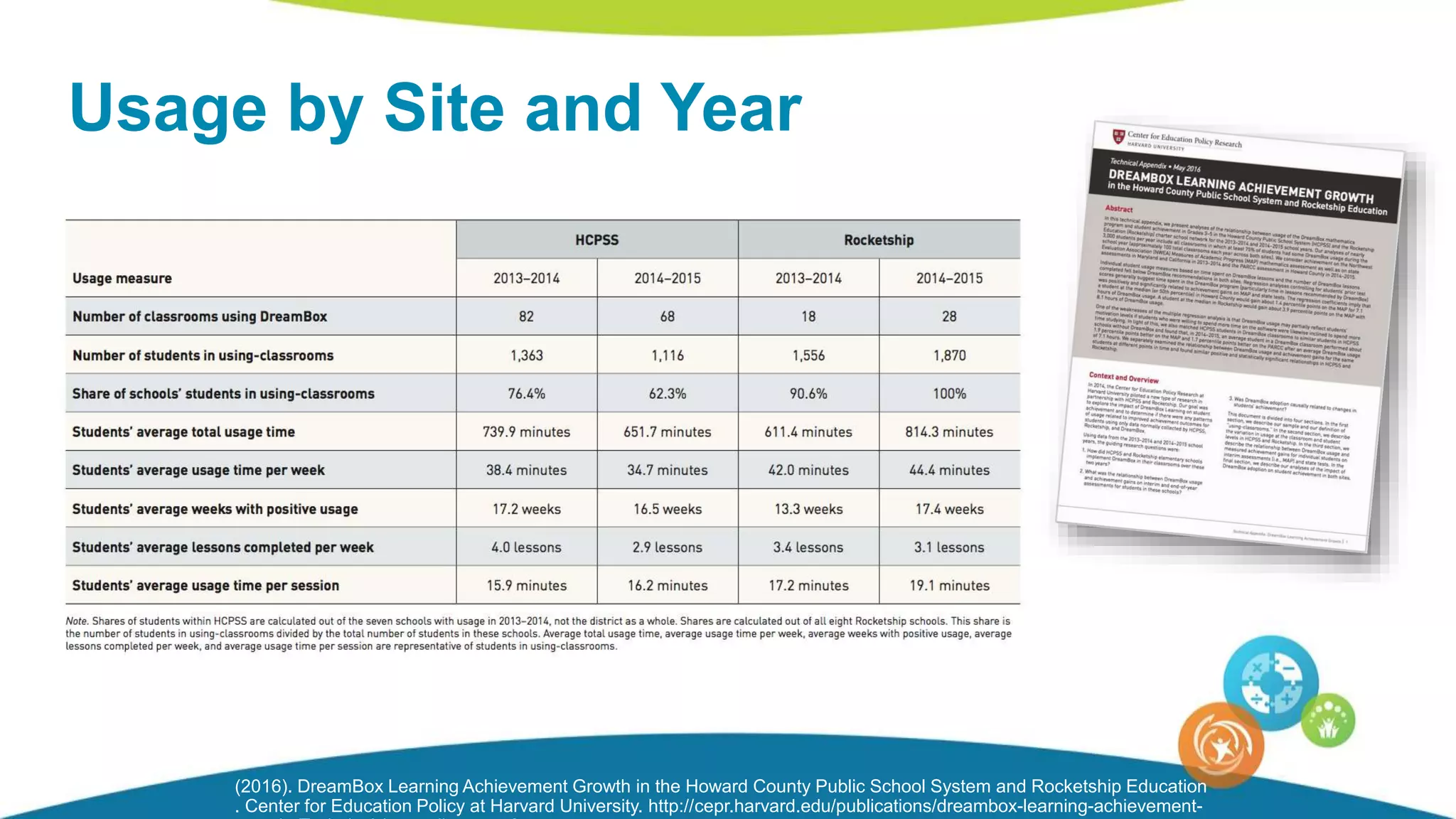
Usage by Site and Year
(2016). DreamBox Learning Achievement Growth in the Howard County Public School System and Rocketship Education
. Center for Education Policy at Harvard University. http://cepr.harvard.edu/publications/dreambox-learning-achievement-
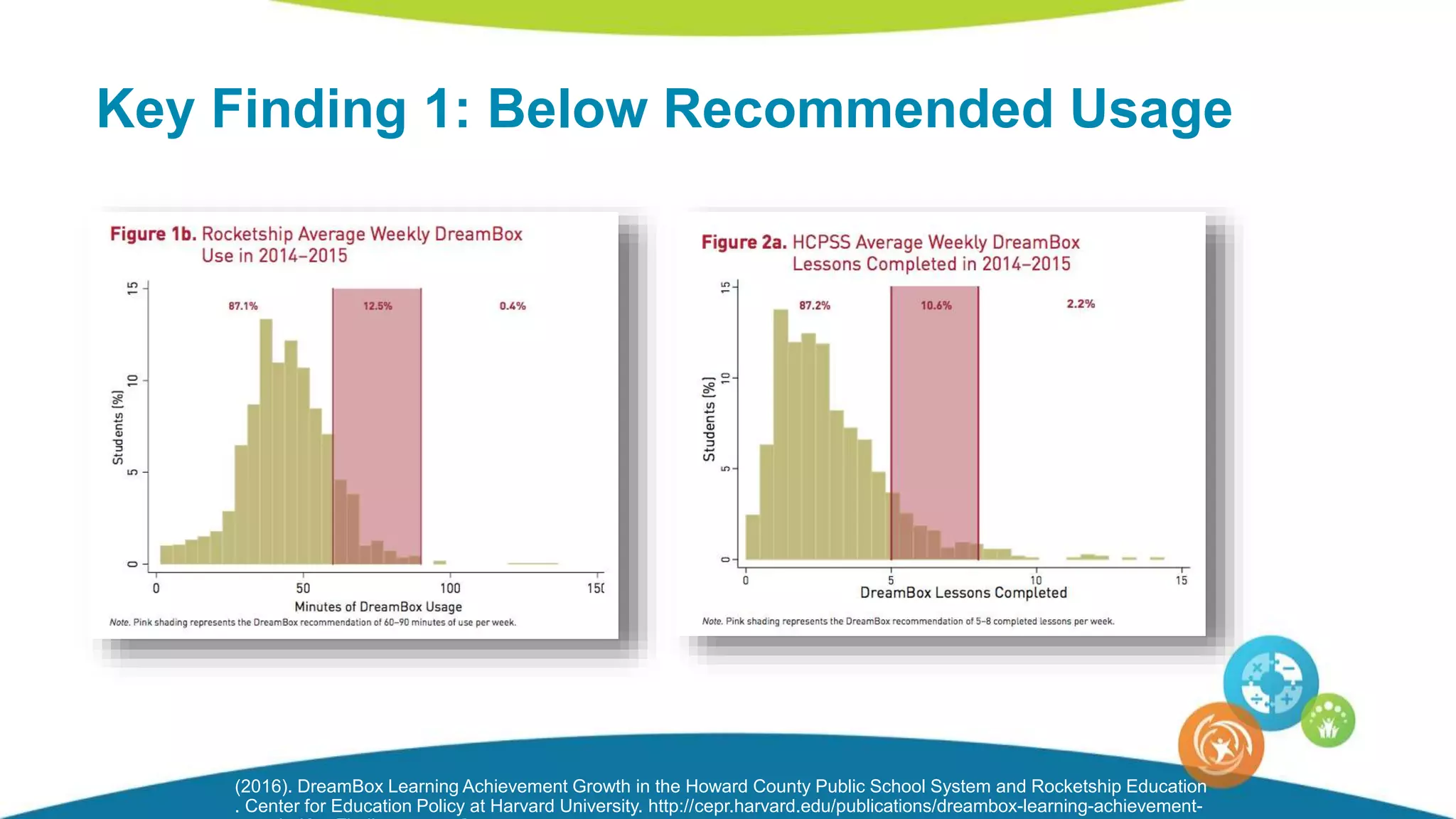
Key Finding 1: Below Recommended Usage
(2016). DreamBox Learning Achievement Growth in the Howard County Public School System and Rocketship Education
. Center for Education Policy at Harvard University. http://cepr.harvard.edu/publications/dreambox-learning-achievement-
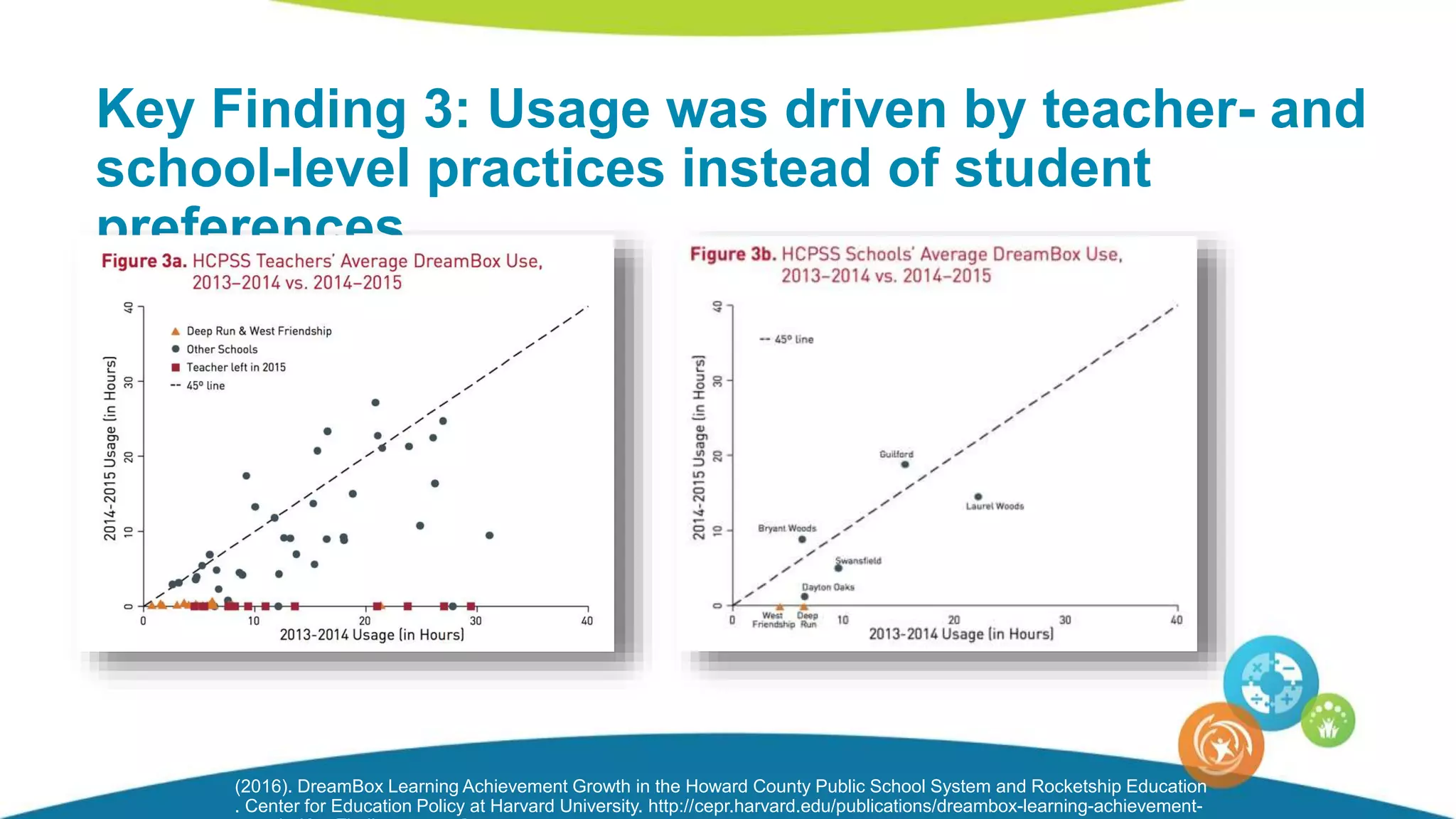
Key Finding 3: Usage was driven by teacher- and
school-level practices instead of student
preferences
(2016). DreamBox Learning Achievement Growth in the Howard County Public School System and Rocketship Education
. Center for Education Policy at Harvard University. http://cepr.harvard.edu/publications/dreambox-learning-achievement-
Implication
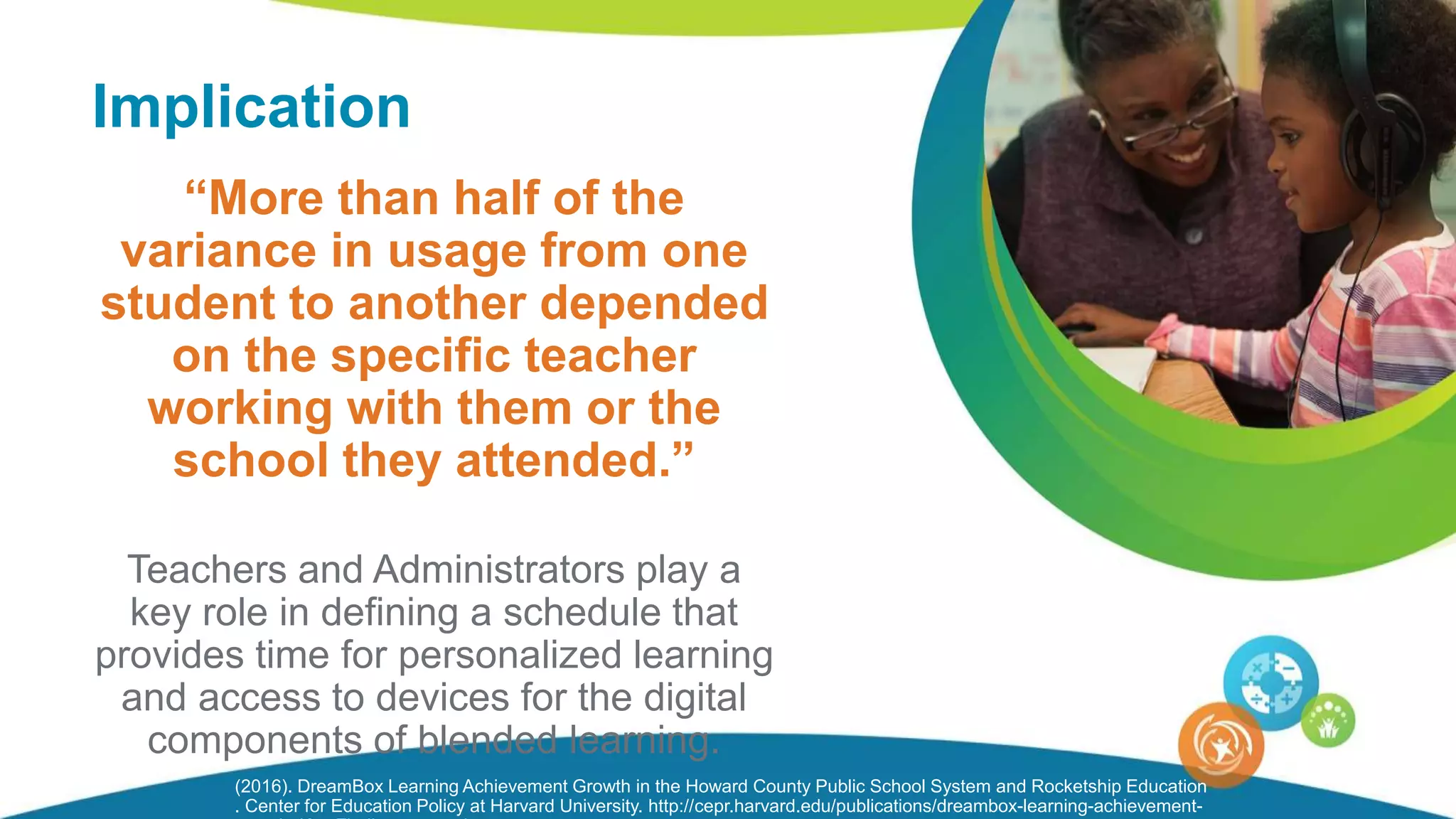
“More than half of the
variance in usage from one
student to another depended
on the specific teacher
working with them or the
school they attended.”
Teachers and Administrators play a
key role in defining a schedule that
provides time for personalized learning
and access to devices for the digital
components of blended learning.
(2016). DreamBox Learning Achievement Growth in the Howard County Public School System and Rocketship Education
. Center for Education Policy at Harvard University. http://cepr.harvard.edu/publications/dreambox-learning-achievement-
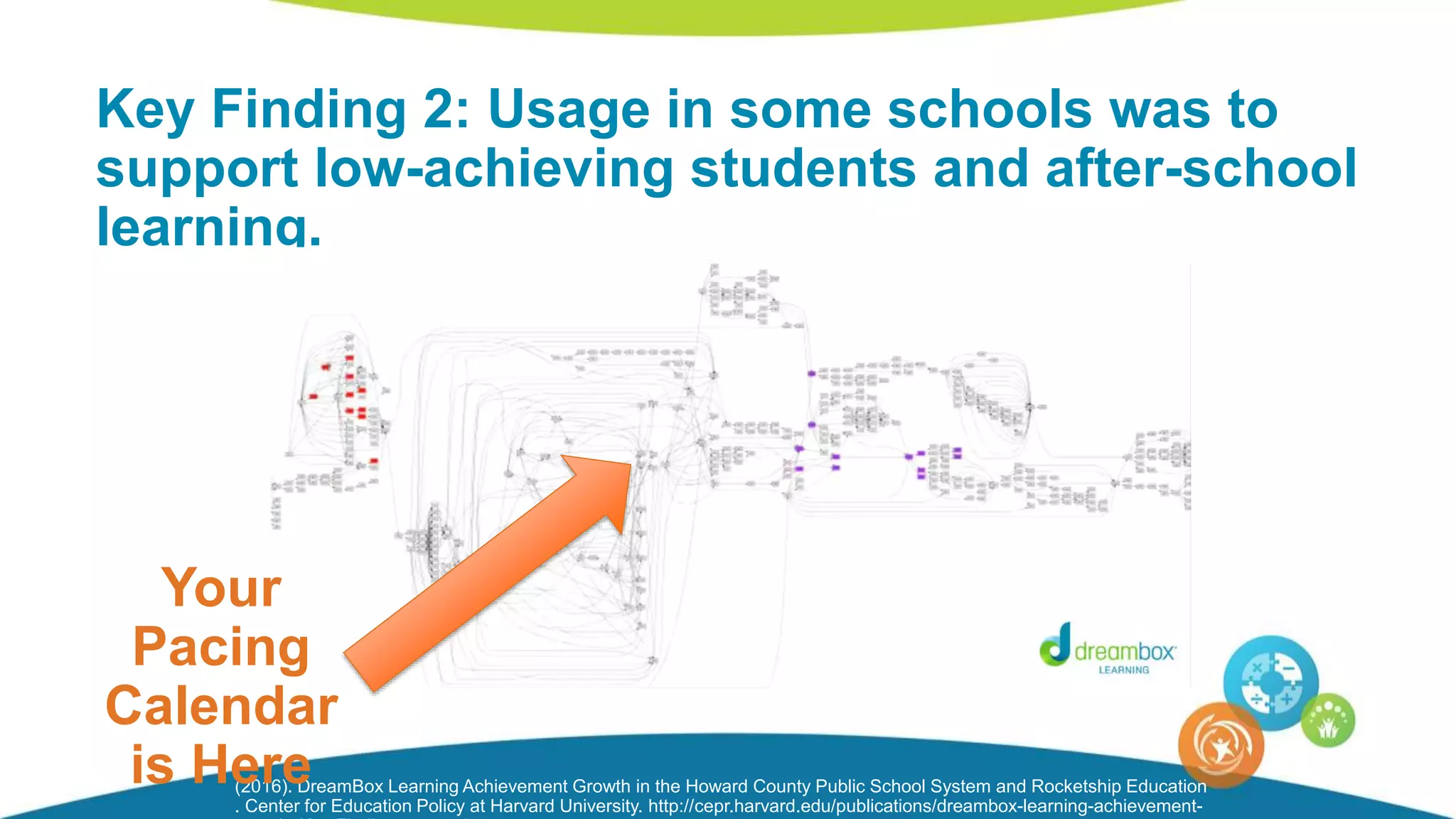
Key Finding 2: Usage in some schools was to
support low-achieving students and after-school
learning.
(2016). DreamBox Learning Achievement Growth in the Howard County Public School System and Rocketship Education
. Center for Education Policy at Harvard University. http://cepr.harvard.edu/publications/dreambox-learning-achievement-
Your
Pacing
Calendar
is Here
Key Findings 4 & 5More usage resulted in
larger achievement
gains
Completing recommended
lessons resulted in faster
achievement gains
(2016). DreamBox Learning Achievement Growth in the Howard County Public School System and Rocketship Education
. Center for Education Policy at Harvard University. http://cepr.harvard.edu/publications/dreambox-learning-achievement-
Key Findings 4 & 5More usage resulted in
larger achievement
gains
Completing recommended
lessons resulted in faster
achievement gains
(2016). DreamBox Learning Achievement Growth in the Howard County Public School System and Rocketship Education
. Center for Education Policy at Harvard University. http://cepr.harvard.edu/publications/dreambox-learning-achievement-
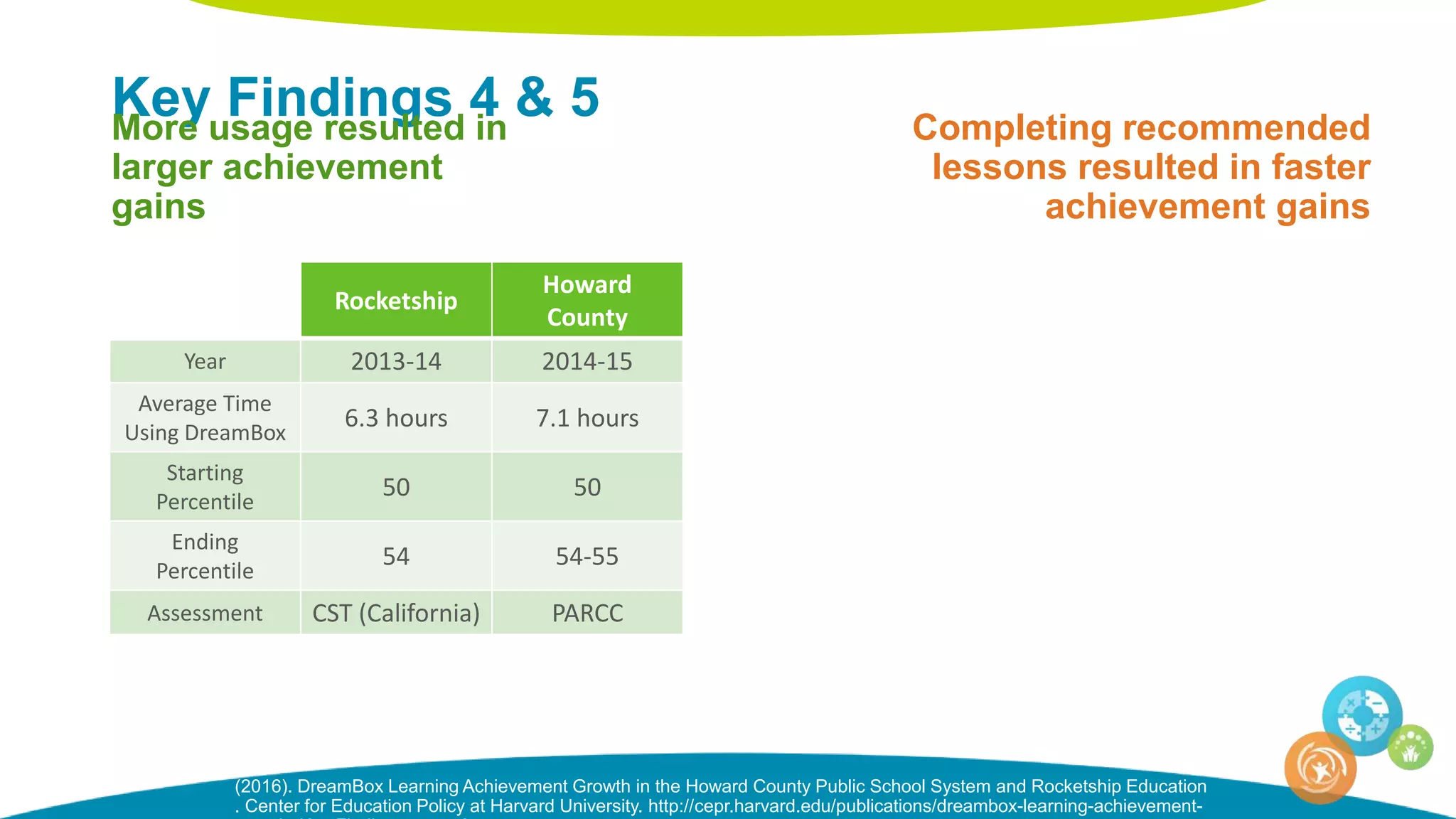
Rocketship
Howard
County
Year 2013-14 2014-15
Average Time
Using DreamBox
6.3 hours 7.1 hours
Starting
Percentile
50 50
Ending
Percentile
54 54-55
Assessment CST (California) PARCC
Key Findings 4 & 5More usage resulted in
larger achievement
gains
Completing recommended
lessons resulted in faster
achievement gains
(2016). DreamBox Learning Achievement Growth in the Howard County Public School System and Rocketship Education
. Center for Education Policy at Harvard University. http://cepr.harvard.edu/publications/dreambox-learning-achievement-
Rocketship
Howard
County
Year 2013-14 2014-15
Average Time
Using DreamBox
6.3 hours 7.1 hours
Starting
Percentile
50 50
Ending
Percentile
54 54-55
Assessment CST (California) PARCC
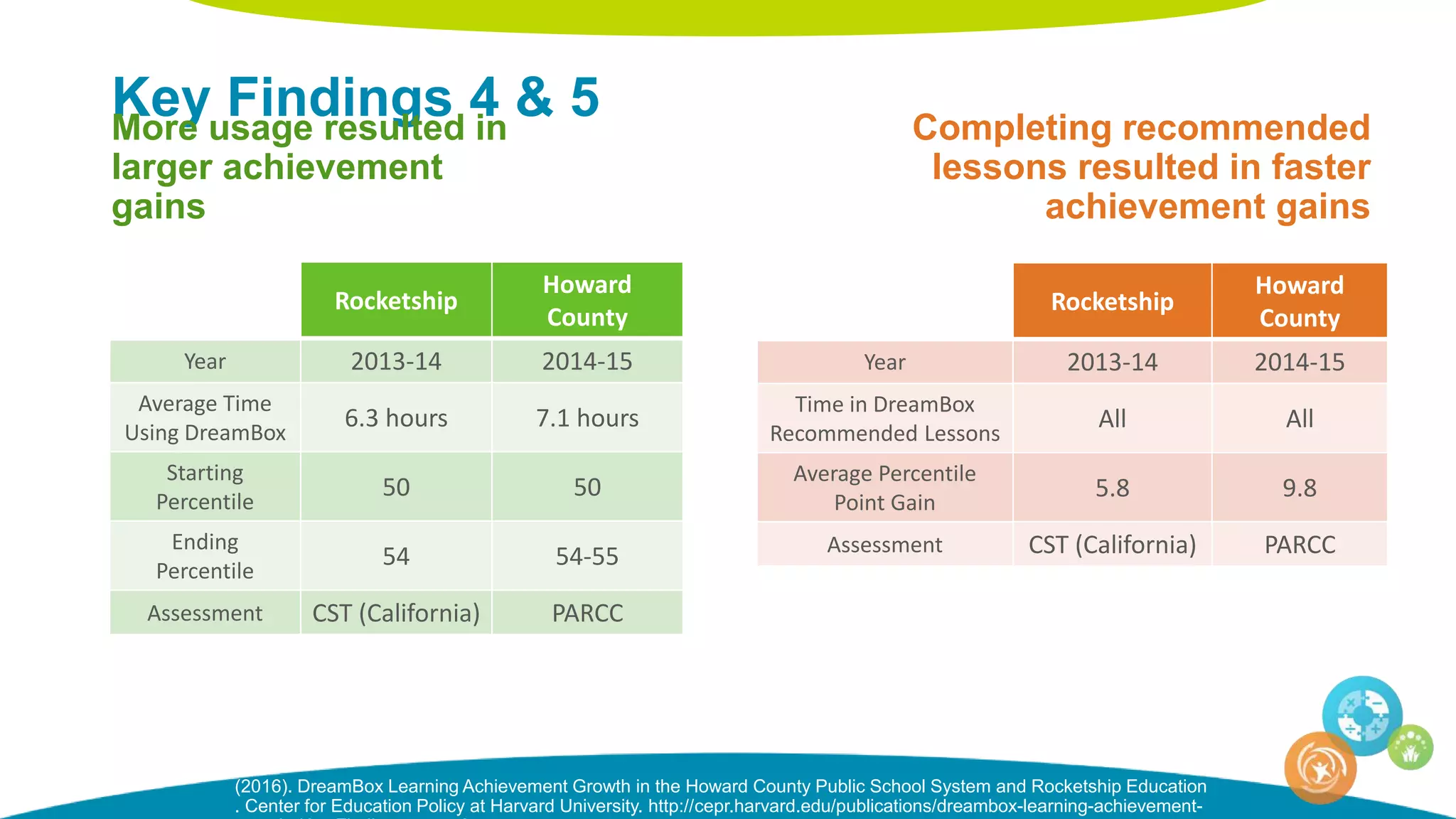
Rocketship
Howard
County
Year 2013-14 2014-15
Time in DreamBox
Recommended Lessons
All All
Average Percentile
Point Gain
5.8 9.8
Assessment CST (California) PARCC
Key Question:
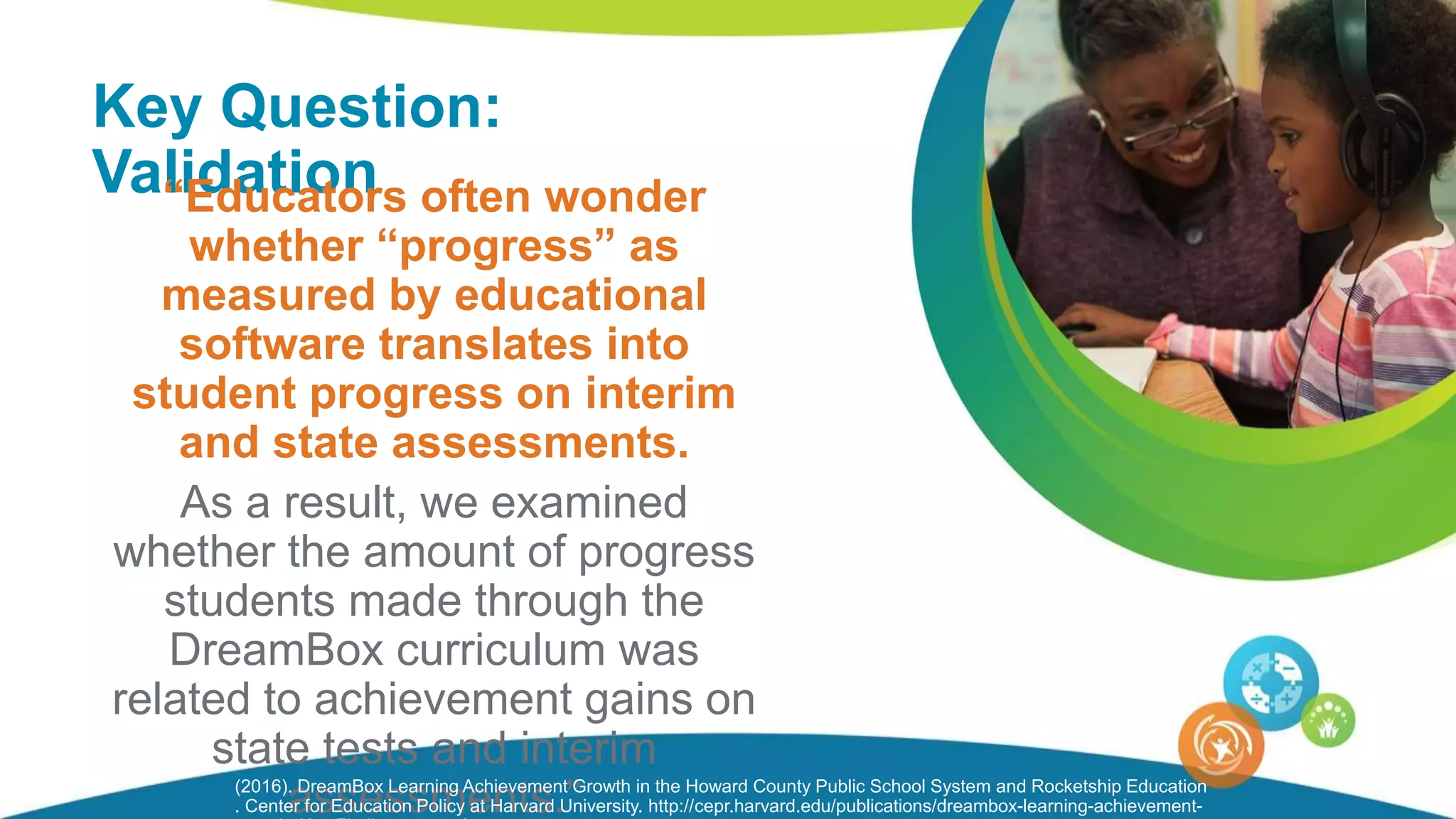
Validation“Educators often wonder
whether “progress” as
measured by educational
software translates into
student progress on interim
and state assessments.
As a result, we examined
whether the amount of progress
students made through the
DreamBox curriculum was
related to achievement gains on
state tests and interim
assessments.”(2016). DreamBox Learning Achievement Growth in the Howard County Public School System and Rocketship Education
. Center for Education Policy at Harvard University. http://cepr.harvard.edu/publications/dreambox-learning-achievement-
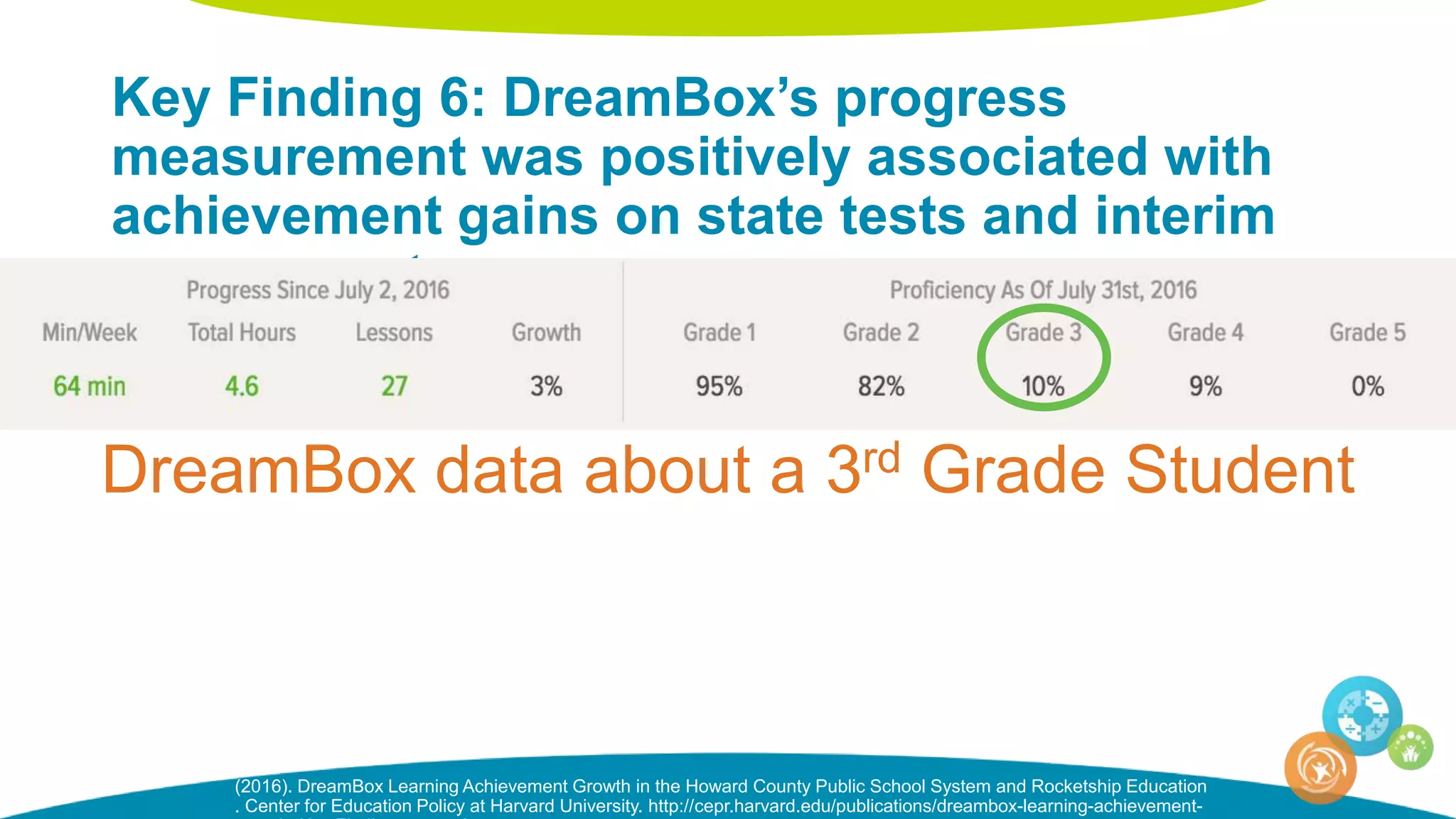
Key Finding 6: DreamBox’s progress
measurement was positively associated with
achievement gains on state tests and interim
assessments
(2016). DreamBox Learning Achievement Growth in the Howard County Public School System and Rocketship Education
. Center for Education Policy at Harvard University. http://cepr.harvard.edu/publications/dreambox-learning-achievement-
DreamBox data about a 3rd Grade Student
Key Finding 6: DreamBox’s progress
measurement was positively associated with
achievement gains on state tests and interim
assessments
(2016). DreamBox Learning Achievement Growth in the Howard County Public School System and Rocketship Education
. Center for Education Policy at Harvard University. http://cepr.harvard.edu/publications/dreambox-learning-achievement-
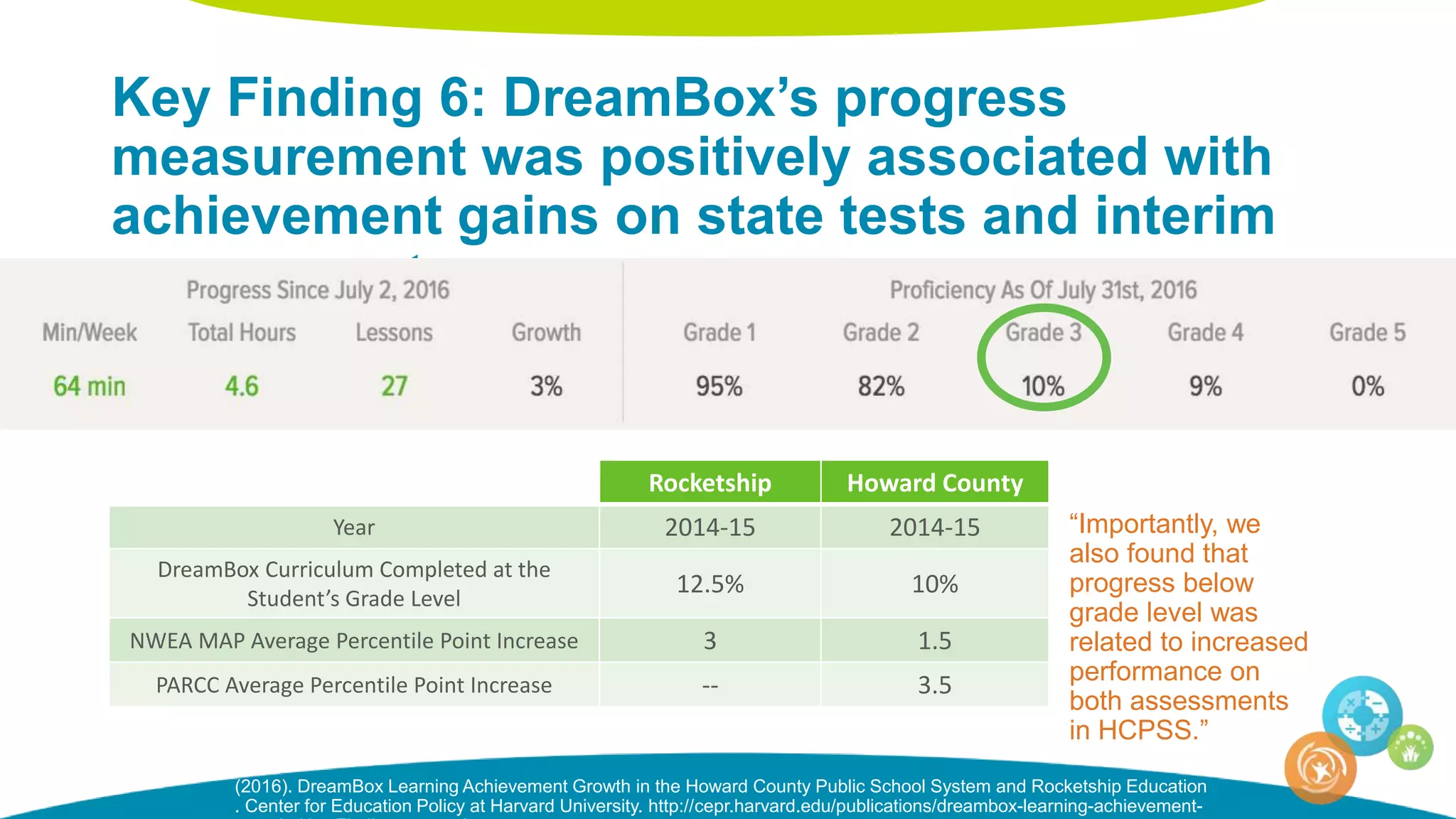
Rocketship Howard County
Year 2014-15 2014-15
DreamBox Curriculum Completed at the
Student’s Grade Level
12.5% 10%
NWEA MAP Average Percentile Point Increase 3 1.5
PARCC Average Percentile Point Increase -- 3.5
“Importantly, we
also found that
progress below
grade level was
related to increased
performance on
both assessments
in HCPSS.”
Implication
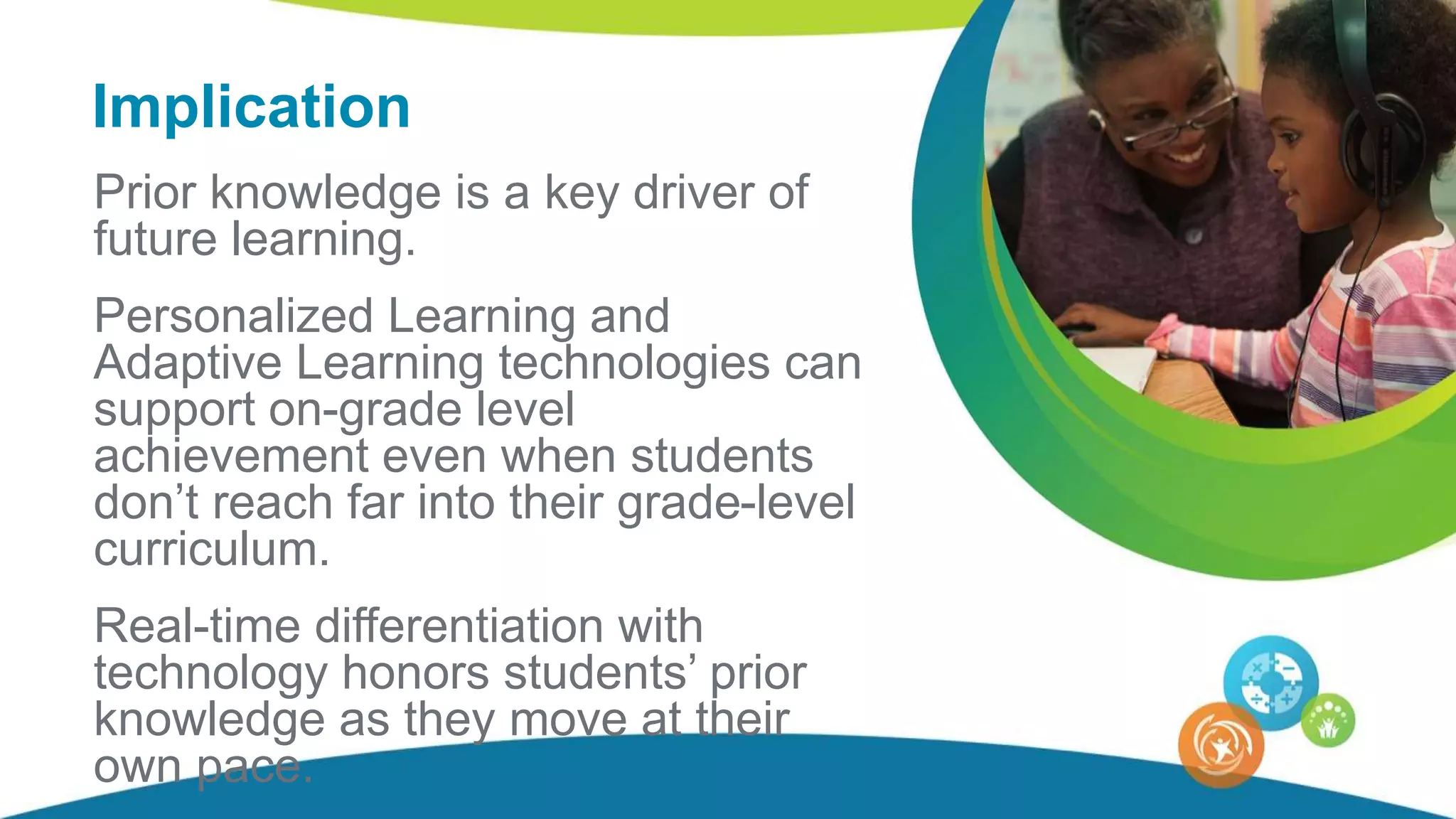
Prior knowledge is a key driver of
future learning.
Personalized Learning and
Adaptive Learning technologies can
support on-grade level
achievement even when students
don’t reach far into their grade-level
curriculum.
Real-time differentiation with
technology honors students’ prior
knowledge as they move at their
own pace.
Key Finding 7: Evidence for
causal impact is encouraging
but mixedOther Variables
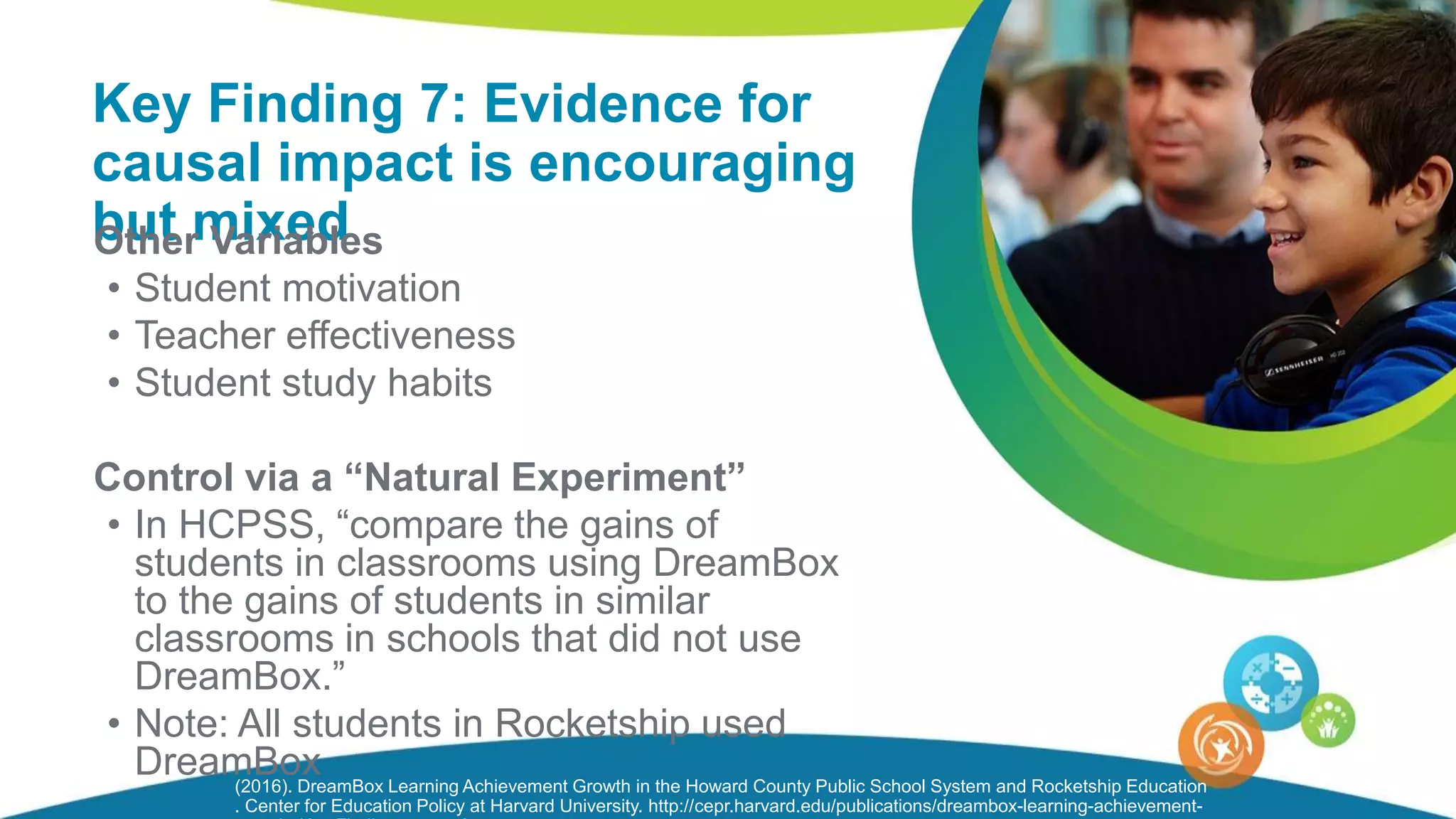
• Student motivation
• Teacher effectiveness
• Student study habits
Control via a “Natural Experiment”
• In HCPSS, “compare the gains of
students in classrooms using DreamBox
to the gains of students in similar
classrooms in schools that did not use
DreamBox.”
• Note: All students in Rocketship used
DreamBox(2016). DreamBox Learning Achievement Growth in the Howard County Public School System and Rocketship Education
. Center for Education Policy at Harvard University. http://cepr.harvard.edu/publications/dreambox-learning-achievement-
http://cepr.harvard.edu/publications/dreambox-learning-achievement-growth, Technical Appendix, page 13
Considerations for Designing
& Conducting Your Own
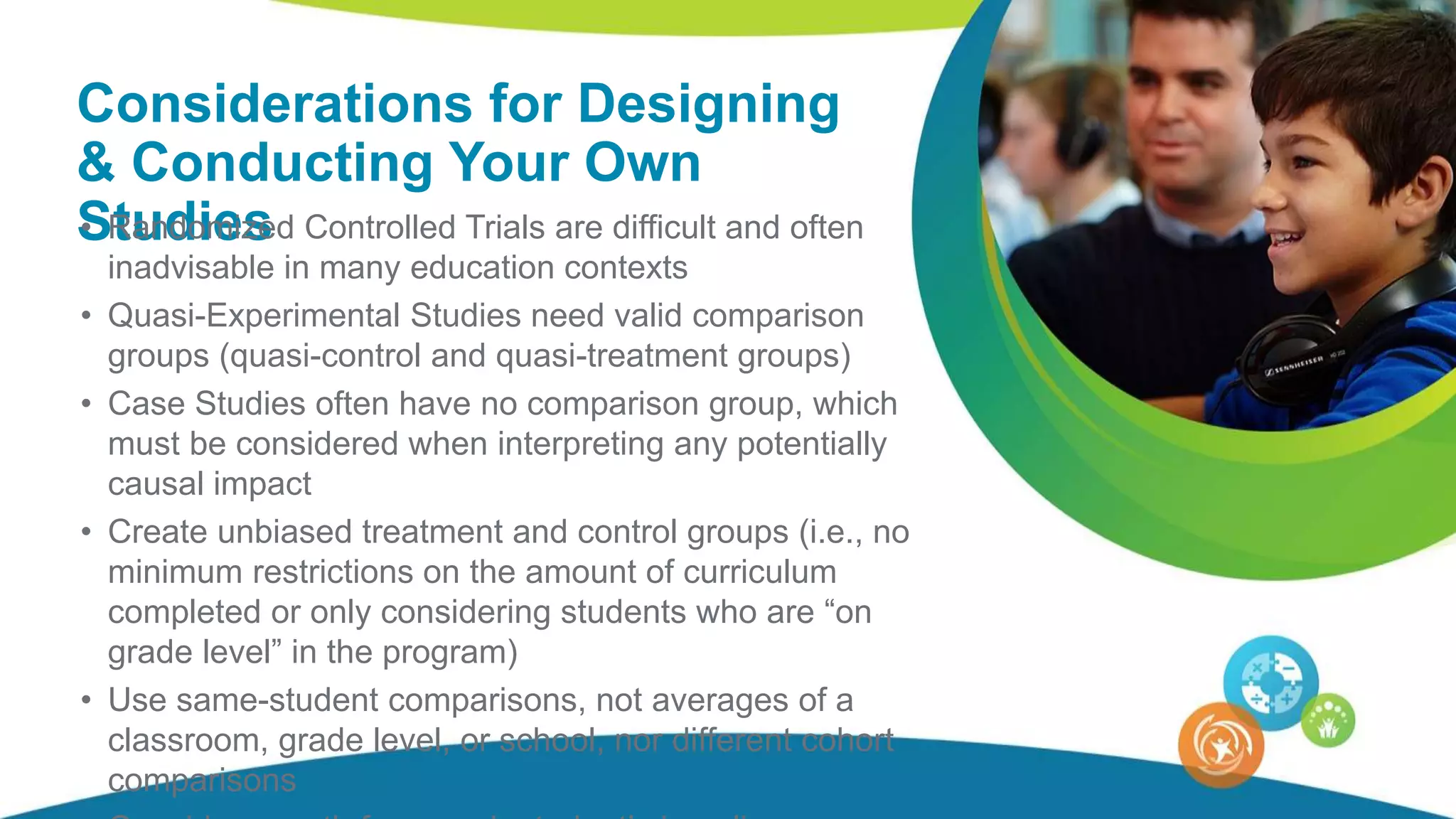
Studies• Randomized Controlled Trials are difficult and often
inadvisable in many education contexts
• Quasi-Experimental Studies need valid comparison
groups (quasi-control and quasi-treatment groups)
• Case Studies often have no comparison group, which
must be considered when interpreting any potentially
causal impact
• Create unbiased treatment and control groups (i.e., no
minimum restrictions on the amount of curriculum
completed or only considering students who are “on
grade level” in the program)
• Use same-student comparisons, not averages of a
classroom, grade level, or school, nor different cohort
comparisons
Questions
Tim Hudson, PhD
Vice President of Learning
DreamBox Learning
@DocHudsonMath
Thank You!
DreamBox Learning® K–8 Math
Transformative Learning Experiences available in English & Spanish
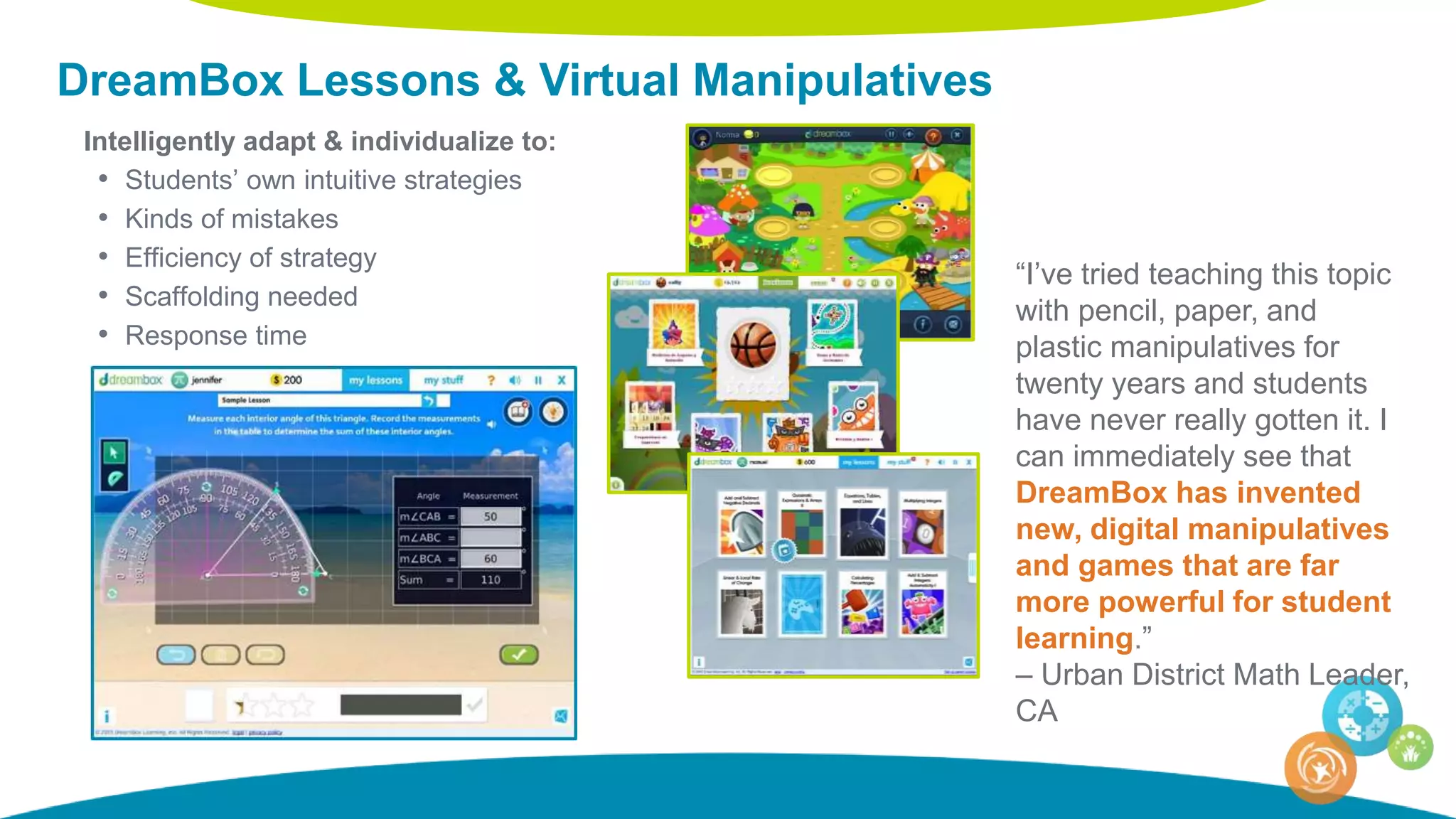
DreamBox Lessons & Virtual Manipulatives
Intelligently adapt & individualize to:
• Students’ own intuitive strategies
• Kinds of mistakes
• Efficiency of strategy
• Scaffolding needed
• Response time
“I’ve tried teaching this topic
with pencil, paper, and
plastic manipulatives for
twenty years and students
have never really gotten it. I
can immediately see that
DreamBox has invented
new, digital manipulatives
and games that are far
more powerful for student
learning.”
– Urban District Math Leader,
CA
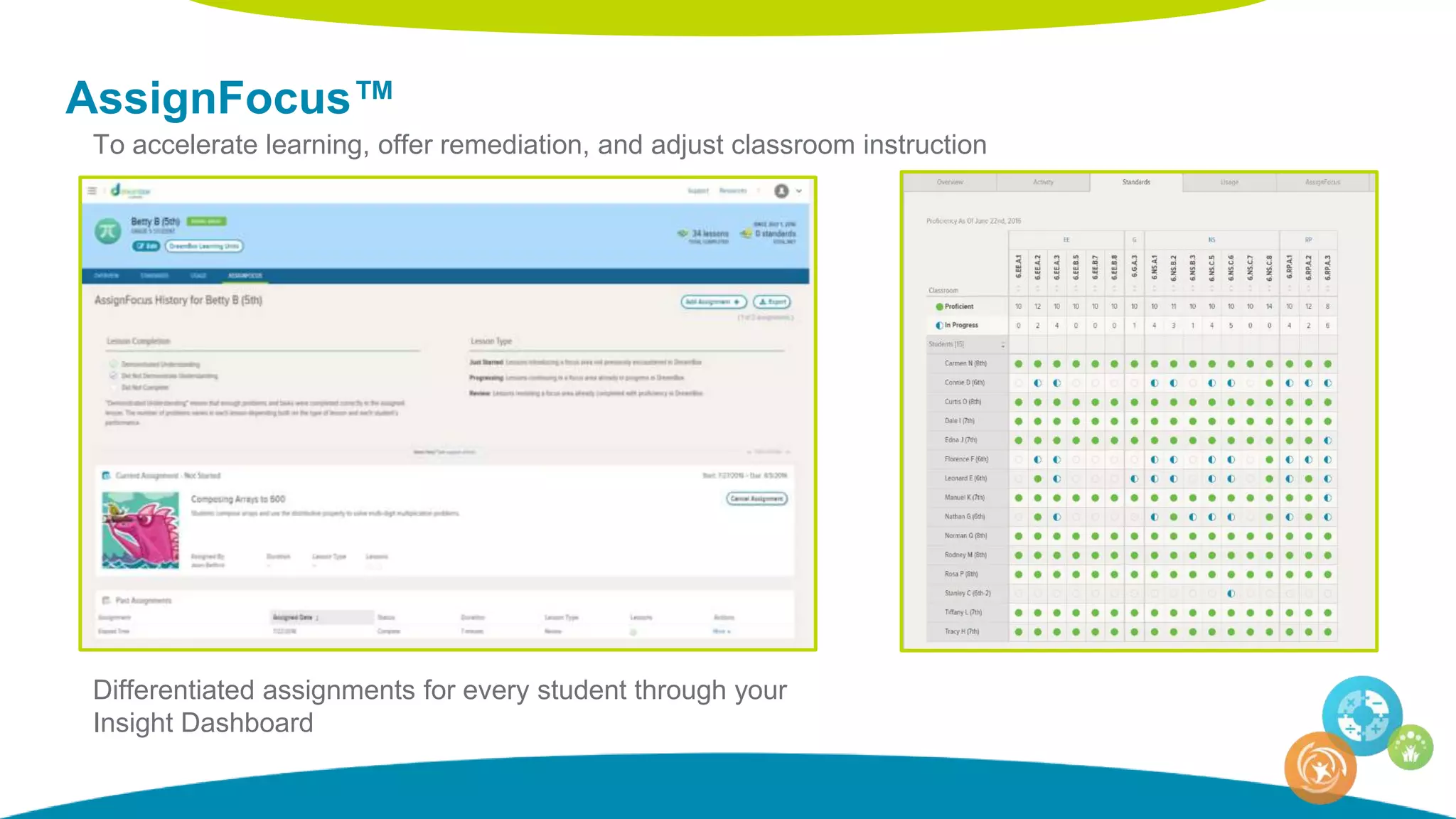
AssignFocus™
Differentiated assignments for every student through your
Insight Dashboard
To accelerate learning, offer remediation, and adjust classroom instruction
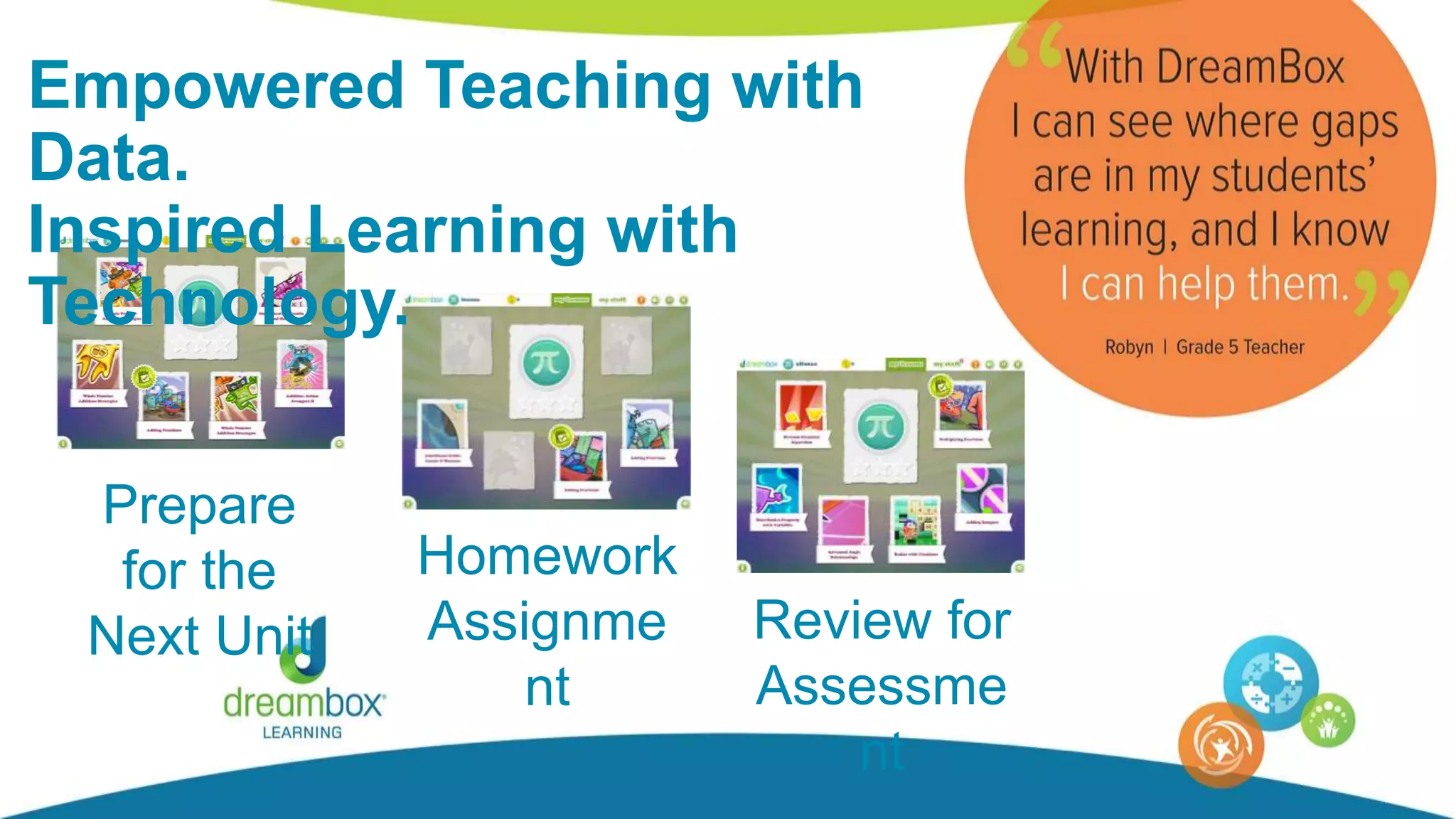
Prepare
for the
Next Unit
Homework
Assignme
nt
Review for
Assessme
nt
Empowered Teaching with
Data.
Inspired Learning with
Technology.
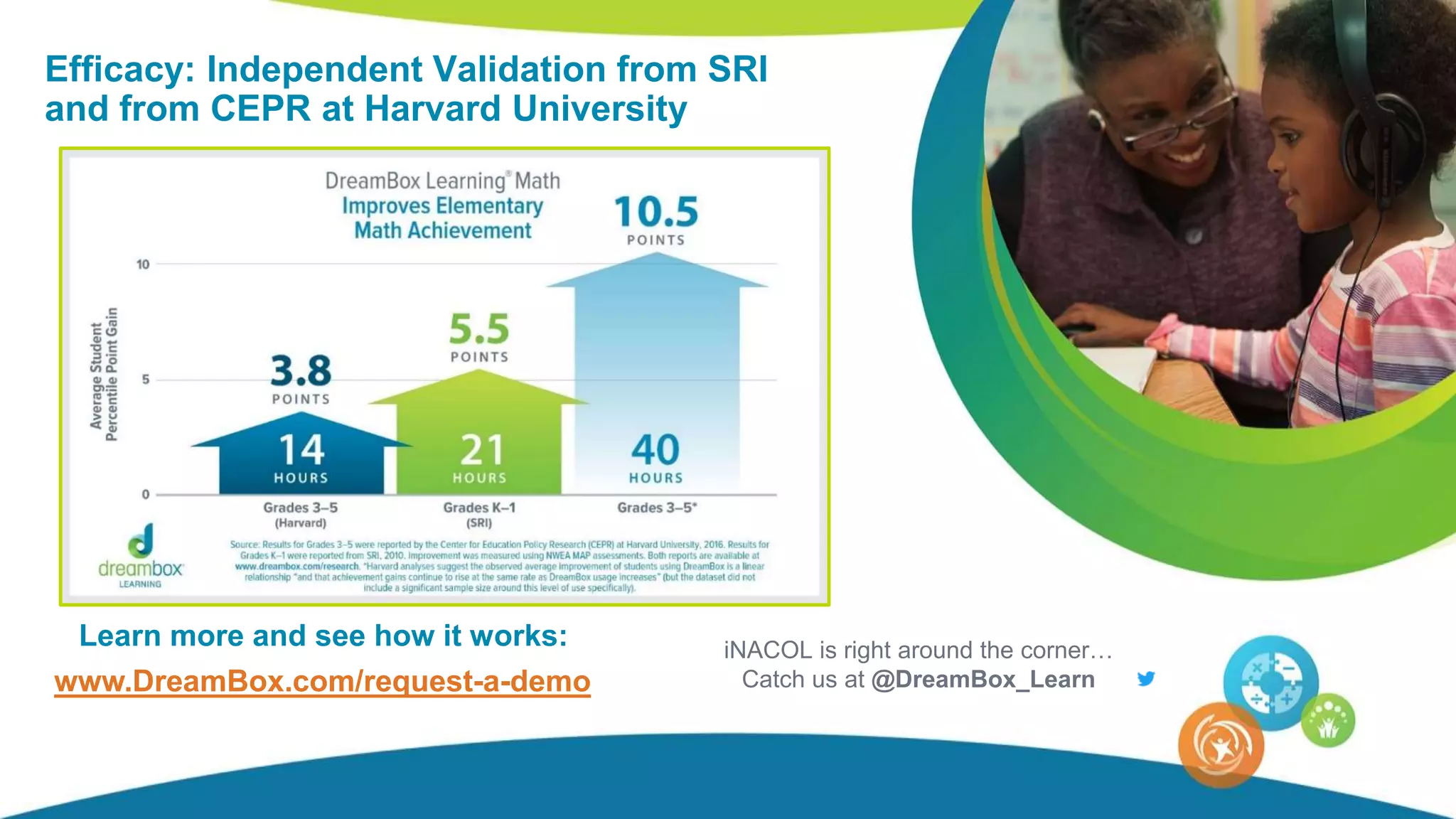
iNACOL is right around the corner…
Catch us at @DreamBox_Learn
Learn more and see how it works:
www.DreamBox.com/request-a-demo
Efficacy: Independent Validation from SRI
and from CEPR at Harvard University
We value your feedback!
Let us know how we’re doing:
www.surveymonkey.com/r/GC6ZCM7

Personalized and Adaptive Math Learning: Recent Research and What It Means for Your Students

  • 1.
    Personalized and Adaptive MathLearning Recent Research and What It Means for Your StudentsTim Hudson, PhD Vice President of Learning DreamBox Learning @DocHudsonMath
  • 2.
    • Define PersonalizedLearning and Adaptive Learning • Present recent third-party research findings • Interpret research studies involving digital programs in which students are learning along a personalized path and pace • Share ideas for conducting evaluations of adaptive or personalized programs in your own context • Understand the importance of classroom teachers in implementing adaptive math programs, whether in a blended learning model or not
  • 3.
  • 4.
    “…one would thinkthat by 2025, age-graded schools and the familiar teaching and learning that occurs today in K-12 and universities would have exited the rear door. Not so. Blended instruction, personalized learning, and flipped classrooms will reinforce the age-graded school, the 19th century organizational innovation that is rock-solid in 2015.” Larry Cuban, December 2015 Stanford University, Professor Emeritus of Education From “Predictions, Dumb and Otherwise, about Technology in Schools in 2025” www.larrycuban.wordpress.com Next Generation Learning & Schooling is at Risk
  • 5.
  • 6.
    I haven’t learned anythingnew all year. This math class is boring. This is way too hard. It doesn’t make sense. I give up! This math class is just right for me – not too hard, not too easy. Today’s Lesson: Fraction Operations
  • 7.
  • 8.
    Today’s Lesson: Fraction Operations Why? Thesestudents were all born during the same 12-month window about 11 years ago.
  • 9.
    Seat-time policies, pacing calendars,standardized testing schedules, age-based classrooms and weak competency-based tools make it difficult for me to personalize and differentiate.
  • 10.
  • 11.
  • 12.
    School Policies & Structuresare Designed for Students as Unique Individuals. Strategic & Varied Schedules, Locations, Paths & Paces Empowering Learning Experiences, Critical Thinking, Creativity, Exploration. Students “Think & Do” using Their Own Intuitive Ideas School Policies & Structures are Designed for Efficiency, Economy & Scale. Fixed Schedule, Location, Path & Pace Age-Based Pacing Calendars Traditional Lesson Paradigm of Mass Instruction Teach, Practice, Test Students “Sit & Get” the Teacher’s Ideas Personalized (Relational) Impersonal (Industrial) Schoolin g Structures from Adults
  • 13.
    Two Students. Millionsof Self-Directed Learning Paths.
  • 14.
  • 15.
    School Policies & Structuresare Designed for Students as Unique Individuals. Strategic & Varied Schedules, Locations, Paths & Paces Empowering Learning Experiences, Critical Thinking, Creativity, Exploration. Students “Think & Do” using Their Own Intuitive Ideas School Policies & Structures are Designed for Efficiency, Economy & Scale. Fixed Schedule, Location, Path & Pace Age-Based Pacing Calendars Traditional Lesson Paradigm of Mass Instruction Teach, Practice, Test Students “Sit & Get” the Teacher’s Ideas Personalized (Relational) Impersonal (Industrial) Schoolin g Structures from Adults Learnin g Pedagogy with Students
  • 16.
    Today’s Lesson: Fraction Operations Mathis boring. Every math class is the same: Lecture, practice, lecture, practice, quiz, test. It’s not engaging, active, or authentic. I know how to win at school. I just wait for the teacher to show me how to solve familiar problems. Math doesn’t make any sense. I can’t figure it out or understand it.
  • 17.
    School Policies & Structuresare Designed for Students as Unique Individuals. Strategic & Varied Schedules, Locations, Paths & Paces Personalized Learning School Policies & Structures are Designed for Efficiency, Economy & Scale. Fixed Schedule, Location, Path & Pace Age-Based Pacing Calendars Industrial Learning Personalized (Relational) Impersonal (Industrial) Learnin g Pedagogy with Students Schoolin g Structures from Adults
  • 18.
    School Policies & Structuresare Designed for Students as Unique Individuals. Strategic & Varied Schedules, Locations, Paths & Paces Empowering Learning Experiences, Critical Thinking, Creativity, Exploration. Students “Think & Do” using Their Own Intuitive Ideas School Policies & Structures are Designed for Efficiency, Economy & Scale. Fixed Schedule, Location, Path & Pace Age-Based Pacing Calendars Traditional Lesson Paradigm of Mass Instruction Teach, Practice, Test Students “Sit & Get” the Teacher’s Ideas Personalized (Relational) Impersonal (Industrial) Learnin g Pedagogy with Students Schoolin g Structures from Adults
  • 19.
    School Policies & Structuresare Designed for Students as Unique Individuals. Strategic & Varied Schedules, Locations, Paths & Paces Empowering Learning Experiences, Critical Thinking, Creativity, Exploration. Students “Think & Do” using Their Own Intuitive Ideas School Policies & Structures are Designed for Efficiency, Economy & Scale. Fixed Schedule, Location, Path & Pace Age-Based Pacing Calendars Traditional Lesson Paradigm of Mass Instruction Teach, Practice, Test Students “Sit & Get” the Teacher’s Ideas Blende d Blende d Personalized (Relational) Impersonal (Industrial) Learnin g Pedagogy with Students Schoolin g Structures from Adults
  • 20.
    School Policies & Structuresare Designed for Students as Unique Individuals. Strategic & Varied Schedules, Locations, Paths & Paces Empowering Learning Experiences, Critical Thinking, Creativity, Exploration. Students “Think & Do” using Their Own Intuitive Ideas School Policies & Structures are Designed for Efficiency, Economy & Scale. Fixed Schedule, Location, Path & Pace Age-Based Pacing Calendars Traditional Lesson Paradigm of Mass Instruction Teach, Practice, Test Students “Sit & Get” the Teacher’s Ideas Blende d Blende d Is there an app for this? Is there an app for this? Is there an app for this? Is there an app for this? Personalized (Relational) Impersonal (Industrial) Learnin g Pedagogy with Students Schoolin g Structures from Adults
  • 21.
    School Policies & Structuresare Designed for Students as Unique Individuals. Strategic & Varied Schedules, Locations, Paths & Paces Empowering Learning Experiences, Critical Thinking, Creativity, Exploration. Students “Think & Do” using Their Own Intuitive Ideas School Policies & Structures are Designed for Efficiency, Economy & Scale. Fixed Schedule, Location, Path & Pace Age-Based Pacing Calendars Traditional Lesson Paradigm of Mass Instruction Teach, Practice, Test Students “Sit & Get” the Teacher’s Ideas Blende d Blende d Is there an app for this? Is there an app for this? Is there an app for this? Is there an app for this? Personalized (Relational) Impersonal (Industrial) Learnin g Pedagogy with Students Schoolin g Structures from Adults
  • 22.
  • 23.
    “Adaptive” as “Assessment Diagnostic” Giving astudent slightly harder or easier problems next “Adaptive” as “Unlocking Levels” Move at your own pace in a linear fashion upon completion
  • 24.
    “Adaptive” as “Recommendation” Making recommendationsfor lessons, videos, readings, or assignments to do next, often crowd-sourced and/or using big data algorithms to choose content. “Adaptive” as “Behavior Reinforcement” Conditioning the mind to remember information using tiny, incremental skill steps given to students in repetitive feedback loops http://teorije-ucenja.zesoi.fer.hr/doku.php?id=instructional_design:programmed_instruction
  • 25.
    Seymour Papert, February29, 1928 – July 31, 2016 “The role of the teacher is to create the conditions for invention rather than provide ready-made knowledge.” S. Papert (1993). The children’s machine: Rethinking schools in the age of the computer. New York: Basic Books.
  • 26.
    Seymour Papert, February29, 1928 – July 31, 2016 S. Papert. Constructionism vs. Instructionism. http://www.papert.org/articles/const_inst/const_inst1.html “But children, what can they make with mathematics? Not much. They sit in class and they write numbers on pieces of paper. That's not making anything very exciting. So we've tried to find ways that children can use mathematics to make something -- something interesting, so that the children's relationship to mathematics is more like the engineer's, or the scientist's, or the banker's, or all the important people who use mathematics constructively to construct something.”
  • 27.
    What happens ineach lesson?
  • 28.
    “True virtual manipulativesallow more than simply a viewing of objects on the computer screen. They allow increased engagement, forcing the user to interact with dynamic objects. Through this interaction students have opportunities to make meaning and see relationships as a result of their own actions. And it is this interactive engagement with a dynamic representation that is the key to the knowledge construction process.” From Virtual Manipulatives In The K-12 Classroom, Moyer, Bolyard, Spikell, 2002
  • 29.
    Truly Adaptive Learning Technologyrequires dynamic content that is built from the ground up to invite, analyze and respond to a learner’s initial conceptions and support their developing ideas.
  • 30.
    Recent Research about Personalized Learning & AdaptiveLearning Tools for Interpreting Similar
  • 31.
    DREAMBOX LEARNING ACHIEVEMENTGROWTH in the Howard County Public School System and Rocketship Education Key Findings Technical Appendix (2016). DreamBox Learning Achievement Growth in the Howard County Public School System and Rocketship Education . Center for Education Policy at Harvard University. http://cepr.harvard.edu/publications/dreambox-learning-achievement-
  • 32.
    Other Resources • LessonsLearned From Early Implementations of Adaptive Courseware • College-Level Study found “no discernible impact on grades” or course completion • Conducted by SRI. 19,500 students, 280 instructors, 14 universities, April 2016 • https://www.sri.com/sites/default/files/broch ures/almap_final_report.pdf • EdSurge Adaptive Learning Overview • https://www.edsurge.com/research/special- reports/adaptive-learning/
  • 33.
    Conducted by theCenter for Education Policy Research (CEPR) at Harvard University 3,000 Students in Grades 3-5 2 School Systems 100 Classrooms 2013-14 & 2014-15 NWEA MAP, PARCC, and State Assessments 7 Key Findings Quasi-Experimental Analysis
  • 34.
    1.How did HCPSSand Rocketship elementary schools implement DreamBox in their classrooms over these two years? 2.What was the relationship between DreamBox usage and achievement gains on interim and end-of-year assessments for students in these schools? 3.Was DreamBox adoption causally related to changes in students’ achievement? Guiding Research Questions (2016). DreamBox Learning Achievement Growth in the Howard County Public School System and Rocketship Education . Center for Education Policy at Harvard University. http://cepr.harvard.edu/publications/dreambox-learning-achievement-
  • 35.
    “… where 75%or more of the students used DreamBox during a particular school year. Within these using-classrooms, we did not impose any artificial minimum on the amount of usage for a student to be included in the sample, so we could capture the full range of usage patterns in classrooms in which 75% or more of students had some DreamBox usage.” Treatment Group: Students in “Using Classrooms” (2016). DreamBox Learning Achievement Growth in the Howard County Public School System and Rocketship Education . Center for Education Policy at Harvard University. http://cepr.harvard.edu/publications/dreambox-learning-achievement-
  • 36.
    Usage by Siteand Year (2016). DreamBox Learning Achievement Growth in the Howard County Public School System and Rocketship Education . Center for Education Policy at Harvard University. http://cepr.harvard.edu/publications/dreambox-learning-achievement-
  • 37.
    Key Finding 1:Below Recommended Usage (2016). DreamBox Learning Achievement Growth in the Howard County Public School System and Rocketship Education . Center for Education Policy at Harvard University. http://cepr.harvard.edu/publications/dreambox-learning-achievement-
  • 38.
    Key Finding 3:Usage was driven by teacher- and school-level practices instead of student preferences (2016). DreamBox Learning Achievement Growth in the Howard County Public School System and Rocketship Education . Center for Education Policy at Harvard University. http://cepr.harvard.edu/publications/dreambox-learning-achievement-
  • 39.
    Implication “More than halfof the variance in usage from one student to another depended on the specific teacher working with them or the school they attended.” Teachers and Administrators play a key role in defining a schedule that provides time for personalized learning and access to devices for the digital components of blended learning. (2016). DreamBox Learning Achievement Growth in the Howard County Public School System and Rocketship Education . Center for Education Policy at Harvard University. http://cepr.harvard.edu/publications/dreambox-learning-achievement-
  • 40.
    Key Finding 2:Usage in some schools was to support low-achieving students and after-school learning. (2016). DreamBox Learning Achievement Growth in the Howard County Public School System and Rocketship Education . Center for Education Policy at Harvard University. http://cepr.harvard.edu/publications/dreambox-learning-achievement- Your Pacing Calendar is Here
  • 41.
    Key Findings 4& 5More usage resulted in larger achievement gains Completing recommended lessons resulted in faster achievement gains (2016). DreamBox Learning Achievement Growth in the Howard County Public School System and Rocketship Education . Center for Education Policy at Harvard University. http://cepr.harvard.edu/publications/dreambox-learning-achievement-
  • 42.
    Key Findings 4& 5More usage resulted in larger achievement gains Completing recommended lessons resulted in faster achievement gains (2016). DreamBox Learning Achievement Growth in the Howard County Public School System and Rocketship Education . Center for Education Policy at Harvard University. http://cepr.harvard.edu/publications/dreambox-learning-achievement- Rocketship Howard County Year 2013-14 2014-15 Average Time Using DreamBox 6.3 hours 7.1 hours Starting Percentile 50 50 Ending Percentile 54 54-55 Assessment CST (California) PARCC
  • 43.
    Key Findings 4& 5More usage resulted in larger achievement gains Completing recommended lessons resulted in faster achievement gains (2016). DreamBox Learning Achievement Growth in the Howard County Public School System and Rocketship Education . Center for Education Policy at Harvard University. http://cepr.harvard.edu/publications/dreambox-learning-achievement- Rocketship Howard County Year 2013-14 2014-15 Average Time Using DreamBox 6.3 hours 7.1 hours Starting Percentile 50 50 Ending Percentile 54 54-55 Assessment CST (California) PARCC Rocketship Howard County Year 2013-14 2014-15 Time in DreamBox Recommended Lessons All All Average Percentile Point Gain 5.8 9.8 Assessment CST (California) PARCC
  • 44.
    Key Question: Validation“Educators oftenwonder whether “progress” as measured by educational software translates into student progress on interim and state assessments. As a result, we examined whether the amount of progress students made through the DreamBox curriculum was related to achievement gains on state tests and interim assessments.”(2016). DreamBox Learning Achievement Growth in the Howard County Public School System and Rocketship Education . Center for Education Policy at Harvard University. http://cepr.harvard.edu/publications/dreambox-learning-achievement-
  • 45.
    Key Finding 6:DreamBox’s progress measurement was positively associated with achievement gains on state tests and interim assessments (2016). DreamBox Learning Achievement Growth in the Howard County Public School System and Rocketship Education . Center for Education Policy at Harvard University. http://cepr.harvard.edu/publications/dreambox-learning-achievement- DreamBox data about a 3rd Grade Student
  • 46.
    Key Finding 6:DreamBox’s progress measurement was positively associated with achievement gains on state tests and interim assessments (2016). DreamBox Learning Achievement Growth in the Howard County Public School System and Rocketship Education . Center for Education Policy at Harvard University. http://cepr.harvard.edu/publications/dreambox-learning-achievement- Rocketship Howard County Year 2014-15 2014-15 DreamBox Curriculum Completed at the Student’s Grade Level 12.5% 10% NWEA MAP Average Percentile Point Increase 3 1.5 PARCC Average Percentile Point Increase -- 3.5 “Importantly, we also found that progress below grade level was related to increased performance on both assessments in HCPSS.”
  • 47.
    Implication Prior knowledge isa key driver of future learning. Personalized Learning and Adaptive Learning technologies can support on-grade level achievement even when students don’t reach far into their grade-level curriculum. Real-time differentiation with technology honors students’ prior knowledge as they move at their own pace.
  • 48.
    Key Finding 7:Evidence for causal impact is encouraging but mixedOther Variables • Student motivation • Teacher effectiveness • Student study habits Control via a “Natural Experiment” • In HCPSS, “compare the gains of students in classrooms using DreamBox to the gains of students in similar classrooms in schools that did not use DreamBox.” • Note: All students in Rocketship used DreamBox(2016). DreamBox Learning Achievement Growth in the Howard County Public School System and Rocketship Education . Center for Education Policy at Harvard University. http://cepr.harvard.edu/publications/dreambox-learning-achievement-
  • 49.
  • 50.
    Considerations for Designing &Conducting Your Own Studies• Randomized Controlled Trials are difficult and often inadvisable in many education contexts • Quasi-Experimental Studies need valid comparison groups (quasi-control and quasi-treatment groups) • Case Studies often have no comparison group, which must be considered when interpreting any potentially causal impact • Create unbiased treatment and control groups (i.e., no minimum restrictions on the amount of curriculum completed or only considering students who are “on grade level” in the program) • Use same-student comparisons, not averages of a classroom, grade level, or school, nor different cohort comparisons
  • 51.
    Questions Tim Hudson, PhD VicePresident of Learning DreamBox Learning @DocHudsonMath
  • 52.
  • 53.
    DreamBox Learning® K–8Math Transformative Learning Experiences available in English & Spanish
  • 54.
    DreamBox Lessons &Virtual Manipulatives Intelligently adapt & individualize to: • Students’ own intuitive strategies • Kinds of mistakes • Efficiency of strategy • Scaffolding needed • Response time “I’ve tried teaching this topic with pencil, paper, and plastic manipulatives for twenty years and students have never really gotten it. I can immediately see that DreamBox has invented new, digital manipulatives and games that are far more powerful for student learning.” – Urban District Math Leader, CA
  • 55.
    AssignFocus™ Differentiated assignments forevery student through your Insight Dashboard To accelerate learning, offer remediation, and adjust classroom instruction
  • 56.
    Prepare for the Next Unit Homework Assignme nt Reviewfor Assessme nt Empowered Teaching with Data. Inspired Learning with Technology.
  • 57.
    iNACOL is rightaround the corner… Catch us at @DreamBox_Learn Learn more and see how it works: www.DreamBox.com/request-a-demo Efficacy: Independent Validation from SRI and from CEPR at Harvard University
  • 58.
    We value yourfeedback! Let us know how we’re doing: www.surveymonkey.com/r/GC6ZCM7

Editor's Notes

  • #32 http://cepr.harvard.edu/publications/dreambox-learning-achievement-growth
  • #54 DreamBox Learning provides a new class of intelligent adaptive learning technology is the true game changer in education. Combines 3 essential elements 1) Mathematics- CCSSM & Standards for Mathematical Practice- unlike other programs that provide drill and practice DreamBox builds both conceptual understanding and procedural fluency 2) Motivating (persist and progress) 3) Powerful intelligent adaptive learning engine providing millions of personalized learning paths—each one—tailored to a student’s unique needs. Notes: DreamBox curriculum aligns with these Common Core Standards: Counting and Cardinality, Comparing, Operations and Algebraic Thinking, Number and Operations in Base Ten, and Number and Operations in Fractions.
  • #55 Truly Adaptive Learning Technology requires dynamic content that is built from the ground up to invite, analyze and respond to a learner’s initial conceptions and support their developing ideas.
  • #56 With our AssignFocus feature, you can create an assignment to introduce or reinforce concepts, to fill learning gaps, or provide an additional challenge. DreamBox Learning enables you to automatically differentiate lessons for your entire class, small group, or an individual student directly from your Insight Dashboard. With over 2,300 engaging, standards-aligned lessons that are proven to build problem solving strategies, hone critical-thinking skills, and develop math fluency, you know have a powerful new way to provide instruction, practice, and
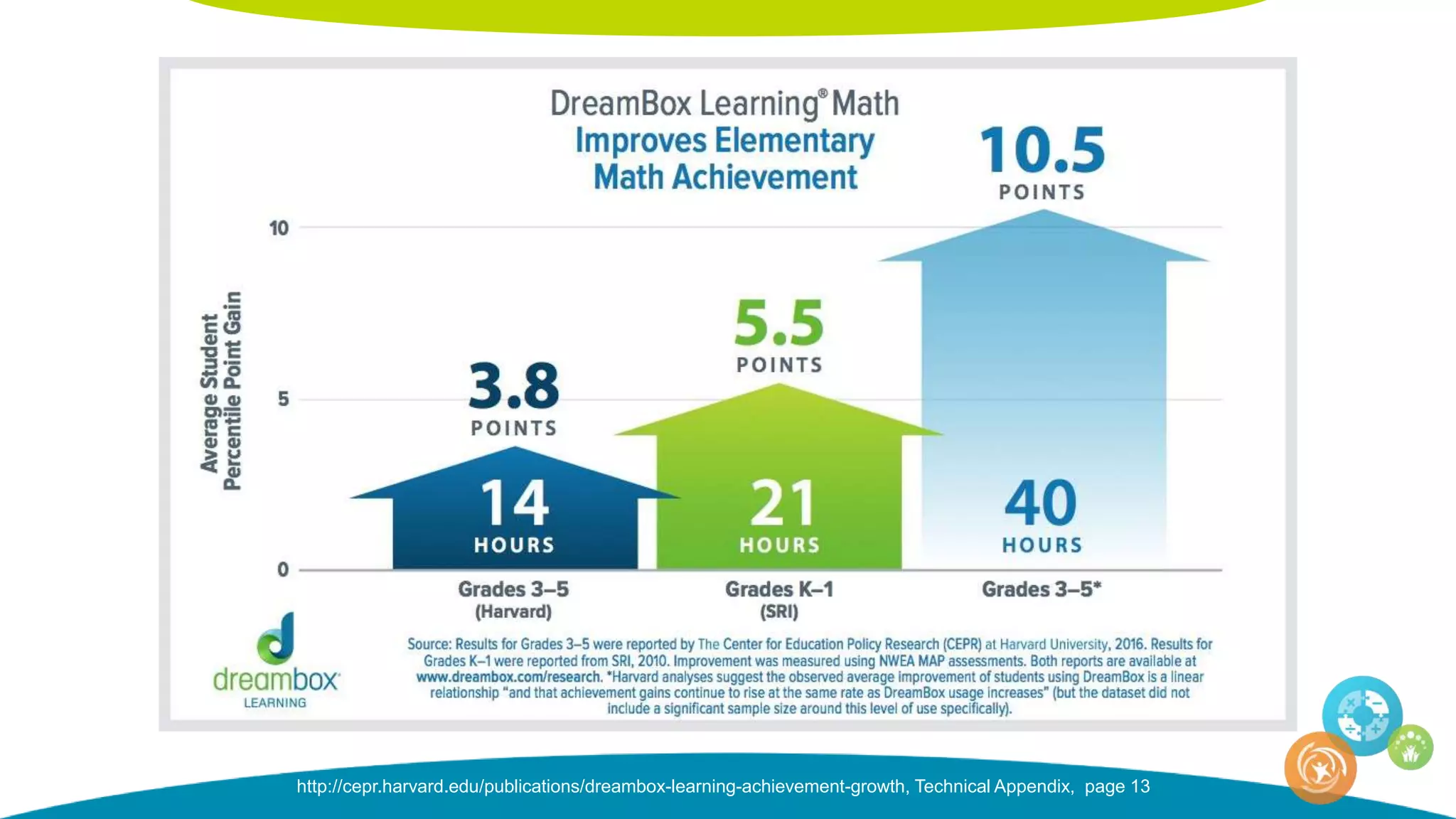
  • #58 A NEW study from the Center for Education Policy Research at Harvard University suggests DreamBox Learning Math increases student outcomes. Study suggests students using DreamBox Learning Math for 14 hours can increase achievement on NWEA MAP assessments by nearly 4 percentile points. You can download the study on our site to learn more or request a demo to see how DBL works!