Leading, Implementing, and
Sustaining Innovations in
Personalized Learning
Tim Hudson, PhD
Vice President of Learning
@DocHudsonMath
Supporting the collaborative development of effective
personalized learning models: Ideas that help leaders
create and sustain innovations that benefit students,
teachers, parents, and school culture.
• Mission and Vision: What are our schools and programs
“in business” to accomplish?
• Effort with Impact: How can data drive ongoing
improvement in student achievement and personalized
learning models?
• Pedagogy and Technology: When does technology
appropriately support personalized learning in
pedagogically sound ways?
Is your school or district implementing
personalized learning?
Is your school or district implementing
personalized learning?
differentiated instruction?
Is your school or district implementing
personalized learning?
differentiated instruction?
blended learning?
Is your school or district implementing
personalized learning?
differentiated instruction?
blended learning?
competency-based learning?
Is your school or district implementing
personalized learning?
differentiated instruction?
blended learning?
competency-based learning?
WHY?
• We are personalizing learning in order to ________________________________.
• Differentiated instruction will ensure that ________________________________.
• Blended learning is our model for guaranteeing ___________________________.
• Competency-based learning helps us achieve ____________________________.
Is Our Mission Clear?
Leading, Implementing, &
Sustaining Personalized Learning
requires a clear and consistent
commitment to Mission & Vision
•“Not schooling by habit or
impulse.”
•“Without a commitment to
mission, we don’t really have a
school; we just have a home for
freelance tutors of subjects.”
Plan Schooling Backwards
p. 11, 25, Wiggins & McTighe, © 2007
“Our mission is to ensure success for all our
students. We will do whatever it takes to ensure
their success –
Schooling by Habit?
Revisiting Professional Learning Communities at Work, ©2008, DuFour, DuFour, Eaker, pp. 114-115
“Our mission is to ensure success for all our
students. We will do whatever it takes to ensure
their success –
provided we don’t have to change the schedule,
modify any of our existing practices, or adopt any
new practices.”
Schooling by Habit?
Revisiting Professional Learning Communities at Work, ©2008, DuFour, DuFour, Eaker, pp. 114-115
The Mission of the Parkway School District is
to ensure all students are
capable, curious, and confident learners
who understand and respond to the
challenges of an ever-changing world.
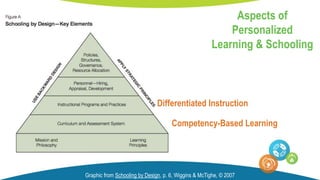
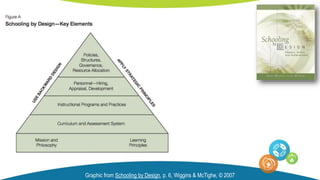
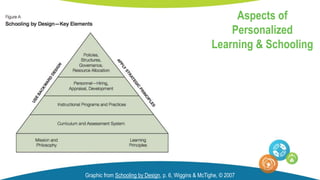
Graphic from Schooling by Design, p. 6, Wiggins & McTighe, © 2007
Aspects of
Personalized
Learning & Schooling
Graphic from Schooling by Design, p. 6, Wiggins & McTighe, © 2007
Aspects of
Personalized
Learning & Schooling
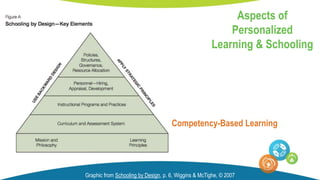
Competency-Based Learning
Graphic from Schooling by Design, p. 6, Wiggins & McTighe, © 2007
“People must learn to recognize when they
understand and when they need more
information…[People] learn to take control
of their own learning by defining learning
goals and monitor their progress in
achieving them… Transfer can be
improved by helping students become
more aware of themselves as learners who
actively monitor their learning…”
How People Learn, p. 12, 18, 67
Competency-Based Learning
Graphic from Schooling by Design, p. 6, Wiggins & McTighe, © 2007
Differentiated Instruction
Aspects of
Personalized
Learning & Schooling
Competency-Based Learning
Graphic from Schooling by Design, p. 6, Wiggins & McTighe, © 2007
Competency-Based Learning
Differentiated Instruction
“…the contemporary view of learning is that people construct
new knowledge and understandings based on what they
already know and believe… A critical feature of effective
teaching is that it elicits… pre-existing understanding of the
subject matter to be taught and provides opportunities to build
on – or challenge – the initial understanding… [A person’s]
initial conceptions then provide the foundation on which the
more formal understanding of the subject matter is built.”
How People Learn, p. 10, 13-15, 19
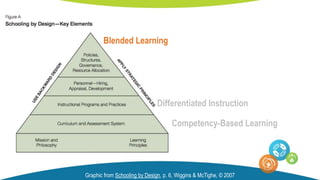
Graphic from Schooling by Design, p. 6, Wiggins & McTighe, © 2007
Differentiated Instruction
Blended Learning
Competency-Based Learning
Graphic from Schooling by Design, p. 6, Wiggins & McTighe, © 2007
Differentiated Instruction
Blended Learning
“…pay close attention to the individual
progress of each [person] and devise tasks
that are appropriate…Present [learners] with
‘just manageable difficulties’ – that is,
challenging enough to maintain
engagement, but not so difficult as to lead to
discouragement.”
How People Learn, p. 24
Competency-Based Learning
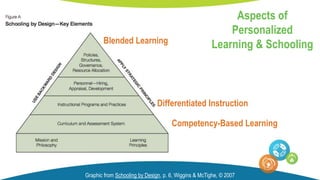
Graphic from Schooling by Design, p. 6, Wiggins & McTighe, © 2007
Competency-Based Learning
Differentiated Instruction
Blended Learning
Aspects of
Personalized
Learning & Schooling
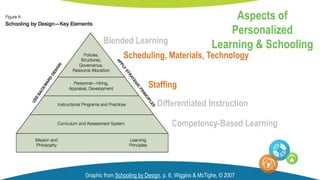
Graphic from Schooling by Design, p. 6, Wiggins & McTighe, © 2007
Competency-Based Learning
Differentiated Instruction
Staffing
Scheduling, Materials, Technology
Blended Learning
Aspects of
Personalized
Learning & Schooling
Leading, Implementing, &
Sustaining Personalized Learning
requires flexibility, creativity and
innovation to achieve the Mission
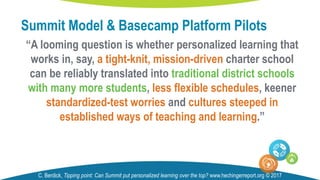
“A looming question is whether personalized learning that
works in, say, a tight-knit, mission-driven charter school
can be reliably translated into traditional district schools
with many more students, less flexible schedules, keener
standardized-test worries and cultures steeped in
established ways of teaching and learning.”
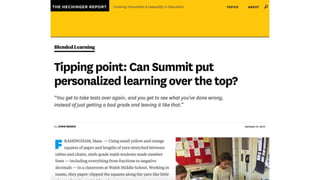
Summit Model & Basecamp Platform Pilots
C. Berdick, Tipping point: Can Summit put personalized learning over the top? www.hechingerreport.org © 2017
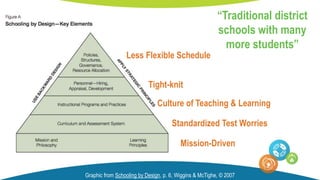
Graphic from Schooling by Design, p. 6, Wiggins & McTighe, © 2007
Mission-Driven
Standardized Test Worries
Culture of Teaching & Learning
Tight-knit
Less Flexible Schedule
“Traditional district
schools with many
more students”
The only prerequisites for would-be Basecamp schools are:
1. Commitment to Summit’s grading policy
• 30 percent of grades on mastery of content; students take tests only when they feel
ready and, if they fail, can re-take them until they pass
• 70 percent of grades on students’ use of various cognitive skills, such as making
inferences and clearly communicating their ideas
2. One-to-one ratio of computers to students
3. Team of at least four teachers covering the core academic subjects for about
100 students
Summit Model & Basecamp Platform Pilots
C. Berdick, Tipping point: Can Summit put personalized learning over the top? www.hechingerreport.org © 2017
Graphic from Schooling by Design, p. 6, Wiggins & McTighe, © 2007
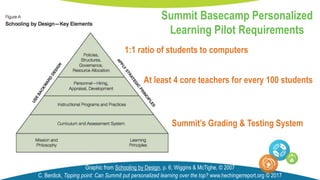
Summit’s Grading & Testing System
At least 4 core teachers for every 100 students
1:1 ratio of students to computers
Summit Basecamp Personalized
Learning Pilot Requirements
C. Berdick, Tipping point: Can Summit put personalized learning over the top? www.hechingerreport.org © 2017
Basecamp schools are creative with scheduling, finding
myriad ways to fit in personalized-learning time, mentoring
and projects while carving out extra time for teachers to
plan lessons jointly and confer about students.
Summit Model & Basecamp Platform Pilots
C. Berdick, Tipping point: Can Summit put personalized learning over the top? www.hechingerreport.org © 2017
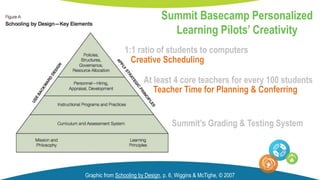
Graphic from Schooling by Design, p. 6, Wiggins & McTighe, © 2007
Summit’s Grading & Testing System
At least 4 core teachers for every 100 students
1:1 ratio of students to computers
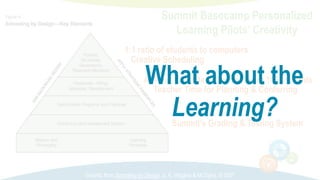
Summit Basecamp Personalized
Learning Pilots’ Creativity
Creative Scheduling
Teacher Time for Planning & Conferring
Graphic from Schooling by Design, p. 6, Wiggins & McTighe, © 2007
Summit’s Grading & Testing System
At least 4 core teachers for every 100 students
1:1 ratio of students to computers
Summit Basecamp Personalized
Learning Pilots’ Creativity
Creative Scheduling
Teacher Time for Planning & Conferring
What about the
Learning?
Graphic from Schooling by Design, p. 6, Wiggins & McTighe, © 2007
Summit’s Grading & Testing System
At least 4 core teachers for every 100 students
1:1 ratio of students to computers
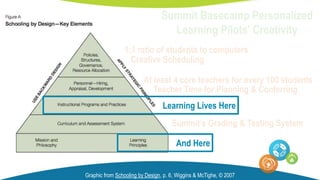
Summit Basecamp Personalized
Learning Pilots’ Creativity
Creative Scheduling
Teacher Time for Planning & Conferring
Learning Lives Here
And Here
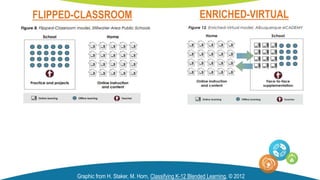
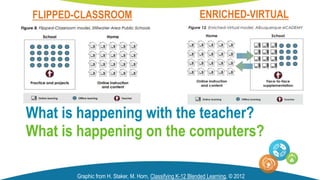
FLIPPED-CLASSROOM ENRICHED-VIRTUAL
Graphic from H. Staker, M. Horn, Classifying K-12 Blended Learning, © 2012
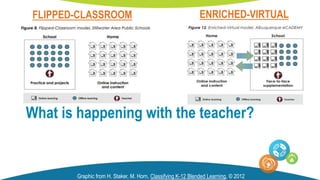
FLIPPED-CLASSROOM ENRICHED-VIRTUAL
What is happening with the teacher?
Graphic from H. Staker, M. Horn, Classifying K-12 Blended Learning, © 2012
FLIPPED-CLASSROOM ENRICHED-VIRTUAL
What is happening with the teacher?
What is happening on the computers?
Graphic from H. Staker, M. Horn, Classifying K-12 Blended Learning, © 2012
FLIPPED-CLASSROOM ENRICHED-VIRTUAL
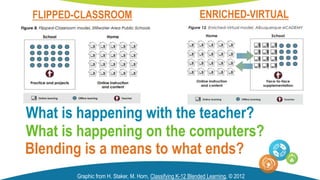
Blending is a means to what ends?
What is happening with the teacher?
What is happening on the computers?
Graphic from H. Staker, M. Horn, Classifying K-12 Blended Learning, © 2012
Leading, Implementing, &
Sustaining Personalized Learning
requires a clear definition and
shared understanding of what
“Personalized Learning” means
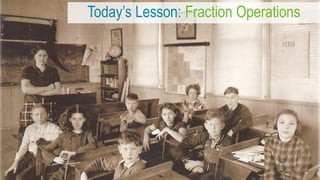
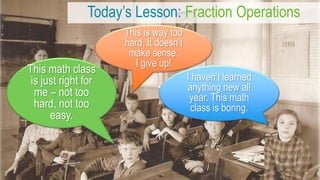
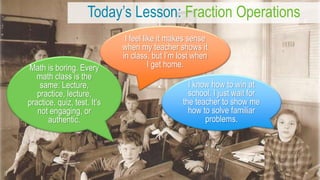
Today’s Lesson: Fraction Operations
I haven’t learned
anything new all
year. This math
class is boring.
This is way too
hard. It doesn’t
make sense.
I give up!
This math class
is just right for
me – not too
hard, not too
easy.
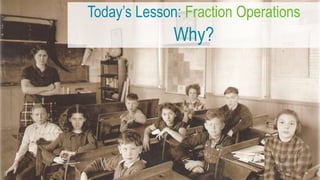
Today’s Lesson: Fraction Operations
Why?
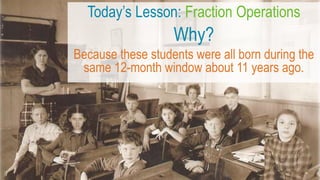
Today’s Lesson: Fraction Operations
Why?
Because these students were all born during the
same 12-month window about 11 years ago.
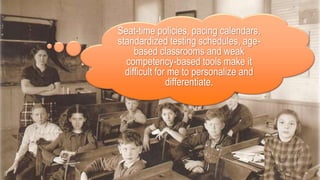
Seat-time policies, pacing calendars,
standardized testing schedules, age-
based classrooms and weak
competency-based tools make it
difficult for me to personalize and
differentiate.
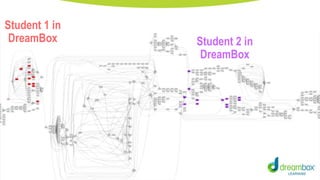
Student 1 in
DreamBox Student 2 in
DreamBox
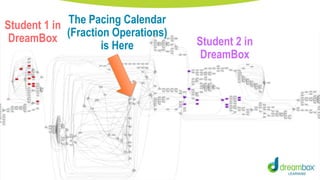
The Pacing Calendar
(Fraction Operations)
is Here
Student 1 in
DreamBox Student 2 in
DreamBox
Personalized
Schooling
Personalized
Learning
Industrial
Schooling
Industrial
Learning
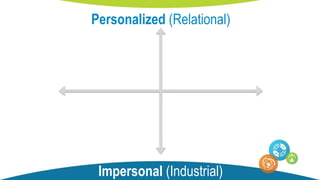
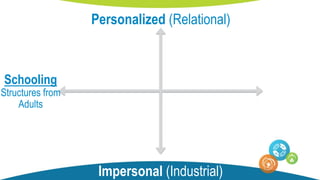
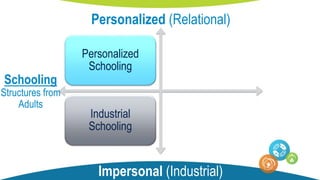
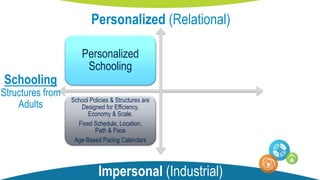
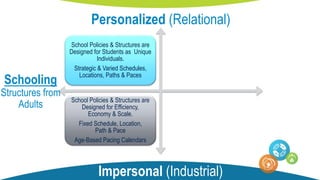
Personalized (Relational)
Impersonal (Industrial)
Personalized
Schooling
Personalized
Learning
Industrial
Schooling
Industrial
Learning
Personalized (Relational)
Impersonal (Industrial)
Schooling
Structures from
Adults
Personalized
Schooling
Personalized
Learning
Industrial
Schooling
Industrial
Learning
Personalized (Relational)
Impersonal (Industrial)
Schooling
Structures from
Adults
Personalized
Schooling
Empowering Learning
Experiences, Critical Thinking,
Creativity, Exploration.
Students “Think & Do” using Their
Own Intuitive Ideas
School Policies & Structures are
Designed for Efficiency,
Economy & Scale.
Fixed Schedule, Location,
Path & Pace
Age-Based Pacing Calendars
Traditional Lesson Paradigm of
Mass Instruction
Teach, Practice, Test
Students “Sit & Get” the
Teacher’s Ideas
Personalized (Relational)
Impersonal (Industrial)
Schooling
Structures from
Adults
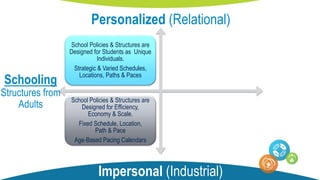
School Policies & Structures are
Designed for Students as Unique
Individuals.
Strategic & Varied Schedules,
Locations, Paths & Paces
Personalized
Learning
School Policies & Structures are
Designed for Efficiency,
Economy & Scale.
Fixed Schedule, Location,
Path & Pace
Age-Based Pacing Calendars
Industrial
Learning
Personalized (Relational)
Impersonal (Industrial)
Schooling
Structures from
Adults
Today’s Lesson: Fraction Operations
Math is boring. Every
math class is the
same: Lecture,
practice, lecture,
practice, quiz, test. It’s
not engaging, or
authentic.
I know how to win at
school. I just wait for
the teacher to show me
how to solve familiar
problems.
I feel like it makes sense
when my teacher shows it
in class, but I’m lost when
I get home.
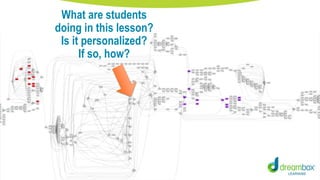
What are students
doing in this lesson?
Is it personalized?
If so, how?
School Policies & Structures are
Designed for Students as Unique
Individuals.
Strategic & Varied Schedules,
Locations, Paths & Paces
Personalized
Learning
School Policies & Structures are
Designed for Efficiency,
Economy & Scale.
Fixed Schedule, Location,
Path & Pace
Age-Based Pacing Calendars
Industrial
Learning
Personalized (Relational)
Impersonal (Industrial)
Schooling
Structures from
Adults
School Policies & Structures are
Designed for Students as Unique
Individuals.
Strategic & Varied Schedules,
Locations, Paths & Paces
Personalized
Learning
School Policies & Structures are
Designed for Efficiency,
Economy & Scale.
Fixed Schedule, Location,
Path & Pace
Age-Based Pacing Calendars
Industrial
Learning
Personalized (Relational)
Impersonal (Industrial)
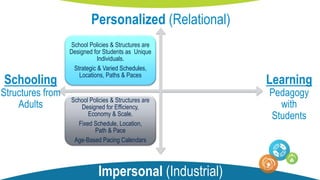
Learning
Pedagogy
with
Students
Schooling
Structures from
Adults
School Policies & Structures are
Designed for Students as Unique
Individuals.
Strategic & Varied Schedules,
Locations, Paths & Paces
Personalized
Learning
School Policies & Structures are
Designed for Efficiency,
Economy & Scale.
Fixed Schedule, Location,
Path & Pace
Age-Based Pacing Calendars
Industrial
Learning
Personalized (Relational)
Impersonal (Industrial)
Learning
Pedagogy
with
Students
Schooling
Structures from
Adults
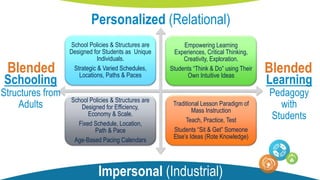
School Policies & Structures are
Designed for Students as Unique
Individuals.
Strategic & Varied Schedules,
Locations, Paths & Paces
Personalized
Learning
School Policies & Structures are
Designed for Efficiency,
Economy & Scale.
Fixed Schedule, Location,
Path & Pace
Age-Based Pacing Calendars
Traditional Lesson Paradigm of
Mass Instruction
Teach, Practice, Test
Students “Sit & Get” Someone
Else’s Ideas (Rote Knowledge)
Personalized (Relational)
Impersonal (Industrial)
Learning
Pedagogy
with
Students
Schooling
Structures from
Adults
School Policies & Structures are
Designed for Students as Unique
Individuals.
Strategic & Varied Schedules,
Locations, Paths & Paces
Empowering Learning
Experiences, Critical Thinking,
Creativity, Exploration.
Students “Think & Do” using Their
Own Intuitive Ideas
School Policies & Structures are
Designed for Efficiency,
Economy & Scale.
Fixed Schedule, Location,
Path & Pace
Age-Based Pacing Calendars
Traditional Lesson Paradigm of
Mass Instruction
Teach, Practice, Test
Students “Sit & Get” Someone
Else’s Ideas (Rote Knowledge)
Personalized (Relational)
Impersonal (Industrial)
Learning
Pedagogy
with
Students
Schooling
Structures from
Adults
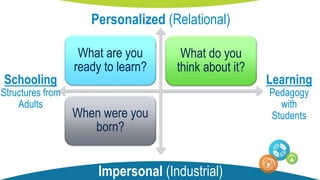
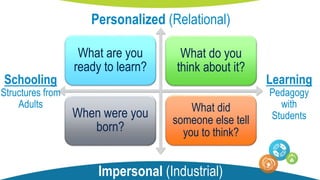
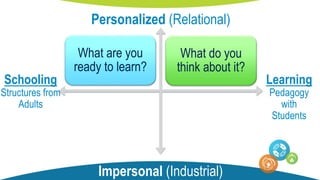
What are you
ready to learn?
What do you
think about it?
When were you
born?
What did
someone else tell
you to think?
Personalized (Relational)
Impersonal (Industrial)
Learning
Pedagogy
with
Students
Schooling
Structures from
Adults
What are you
ready to learn?
What do you
think about it?
When were you
born?
What did
someone else tell
you to think?
Personalized (Relational)
Impersonal (Industrial)
Learning
Pedagogy
with
Students
Schooling
Structures from
Adults
What are you
ready to learn?
What do you
think about it?
When were you
born?
What did
someone else tell
you to think?
Personalized (Relational)
Impersonal (Industrial)
Learning
Pedagogy
with
Students
Schooling
Structures from
Adults
What are you
ready to learn?
What do you
think about it?
When were you
born?
What did
someone else tell
you to think?
Personalized (Relational)
Impersonal (Industrial)
Learning
Pedagogy
with
Students
Schooling
Structures from
Adults
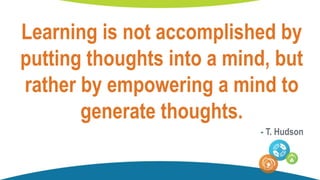
Learning is not accomplished by
putting thoughts into a mind, but
rather by empowering a mind to
generate thoughts.
- T. Hudson
Leading, Implementing, &
Sustaining Personalized Learning
requires a commitment to sound
pedagogy both with and without
technology
School Policies & Structures are
Designed for Students as Unique
Individuals.
Strategic & Varied Schedules,
Locations, Paths & Paces
Empowering Learning
Experiences, Critical Thinking,
Creativity, Exploration.
Students “Think & Do” using Their
Own Intuitive Ideas
School Policies & Structures are
Designed for Efficiency,
Economy & Scale.
Fixed Schedule, Location,
Path & Pace
Age-Based Pacing Calendars
Traditional Lesson Paradigm of
Mass Instruction
Teach, Practice, Test
Students “Sit & Get” Someone
Else’s Ideas (Rote Knowledge)
Personalized (Relational)
Impersonal (Industrial)
Learning
Pedagogy
with
Students
Schooling
Structures from
Adults
School Policies & Structures are
Designed for Students as Unique
Individuals.
Strategic & Varied Schedules,
Locations, Paths & Paces
Empowering Learning
Experiences, Critical Thinking,
Creativity, Exploration.
Students “Think & Do” using Their
Own Intuitive Ideas
School Policies & Structures are
Designed for Efficiency,
Economy & Scale.
Fixed Schedule, Location,
Path & Pace
Age-Based Pacing Calendars
Traditional Lesson Paradigm of
Mass Instruction
Teach, Practice, Test
Students “Sit & Get” Someone
Else’s Ideas (Rote Knowledge)
BlendedBlended
Personalized (Relational)
Impersonal (Industrial)
Learning
Pedagogy
with
Students
Schooling
Structures from
Adults
School Policies & Structures are
Designed for Students as Unique
Individuals.
Strategic & Varied Schedules,
Locations, Paths & Paces
Empowering Learning
Experiences, Critical Thinking,
Creativity, Exploration.
Students “Think & Do” using Their
Own Intuitive Ideas
School Policies & Structures are
Designed for Efficiency,
Economy & Scale.
Fixed Schedule, Location,
Path & Pace
Age-Based Pacing Calendars
Traditional Lesson Paradigm of
Mass Instruction
Teach, Practice, Test
Students “Sit & Get” Someone
Else’s Ideas (Rote Knowledge)
BlendedBlended
Is there
an app for
this?
Is there
an app for
this?
Is there
an app for
this?
Is there
an app for
this?
Personalized (Relational)
Impersonal (Industrial)
Learning
Pedagogy
with
Students
Schooling
Structures from
Adults
School Policies & Structures are
Designed for Students as Unique
Individuals.
Strategic & Varied Schedules,
Locations, Paths & Paces
Empowering Learning
Experiences, Critical Thinking,
Creativity, Exploration.
Students “Think & Do” using Their
Own Intuitive Ideas
School Policies & Structures are
Designed for Efficiency,
Economy & Scale.
Fixed Schedule, Location,
Path & Pace
Age-Based Pacing Calendars
Traditional Lesson Paradigm of
Mass Instruction
Teach, Practice, Test
Students “Sit & Get” Someone
Else’s Ideas (Rote Knowledge)
BlendedBlended
Is there
an app for
this?
Is there
an app for
this?
Is there
an app for
this?
Is there
an app for
this?
Personalized (Relational)
Impersonal (Industrial)
Learning
Pedagogy
with
Students
Schooling
Structures from
Adults
“True virtual manipulatives allow more than simply a
viewing of objects on the computer screen. They allow
increased engagement, forcing the user to interact with
dynamic objects. Through this interaction students
have opportunities to make meaning and see
relationships as a result of their own actions. And it is
this interactive engagement with a dynamic
representation that is the key to the knowledge
construction process.”
From Virtual Manipulatives In The K-12 Classroom, Moyer, Bolyard, Spikell, 2002
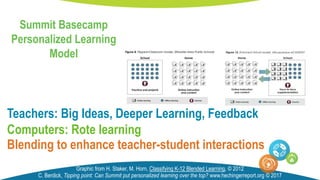
Back at Summit Denali… the goal of personalized-learning time is
not to replace teacher-student interactions but to enhance them. By
offloading some rote learning to a computer — such as memorizing
the steps of cell division or the formulas for sine, cosine and
tangent — “we can make the most of the connections between
teachers and kids,” he said. “We want more of those interactions to
be about big ideas, deeper learning and the sort of feedback that
you can only get from a real, live adult.”
Summit Model & Basecamp Platform Pilots
C. Berdick, Tipping point: Can Summit put personalized learning over the top? www.hechingerreport.org © 2017
Back at Summit Denali… the goal of personalized-learning time is
not to replace teacher-student interactions but to enhance them. By
offloading some rote learning to a computer — such as memorizing
the steps of cell division or the formulas for sine, cosine and
tangent — “we can make the most of the connections between
teachers and kids,” he said. “We want more of those interactions to
be about big ideas, deeper learning and the sort of feedback that
you can only get from a real, live adult.”
Summit Model & Basecamp Platform Pilots
C. Berdick, Tipping point: Can Summit put personalized learning over the top? www.hechingerreport.org © 2017
• the use of memory usually with little intelligence
• mechanical or unthinking routine or repetition
Rote Learning Defined (Merriam Webster)
www.merriam-webster.com/dictionary/rote
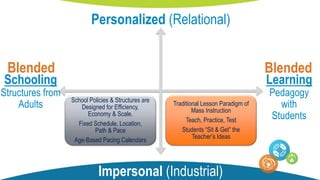
School Policies & Structures are
Designed for Students as Unique
Individuals.
Strategic & Varied Schedules,
Locations, Paths & Paces
Empowering Learning
Experiences, Critical Thinking,
Creativity, Exploration.
Students “Think & Do” using Their
Own Intuitive Ideas
School Policies & Structures are
Designed for Efficiency,
Economy & Scale.
Fixed Schedule, Location,
Path & Pace
Age-Based Pacing Calendars
Traditional Lesson Paradigm of
Mass Instruction
Teach, Practice, Test
Students “Sit & Get” Someone
Else’s Ideas (Rote Knowledge)
BlendedBlended
Personalized (Relational)
Impersonal (Industrial)
Learning
Pedagogy
with
Students
Schooling
Structures from
Adults
School Policies & Structures are
Designed for Students as Unique
Individuals.
Strategic & Varied Schedules,
Locations, Paths & Paces
Empowering Learning
Experiences, Critical Thinking,
Creativity, Exploration.
Students “Think & Do” using Their
Own Intuitive Ideas
School Policies & Structures are
Designed for Efficiency,
Economy & Scale.
Fixed Schedule, Location,
Path & Pace
Age-Based Pacing Calendars
Traditional Lesson Paradigm of
Mass Instruction
Teach, Practice, Test
Students “Sit & Get” Someone
Else’s Ideas (Rote Knowledge)
BlendedBlended
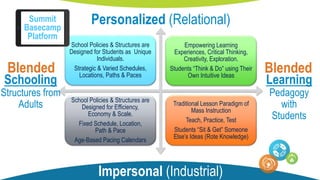
Summit
Basecamp
Platform
Personalized (Relational)
Impersonal (Industrial)
Learning
Pedagogy
with
Students
Schooling
Structures from
Adults
School Policies & Structures are
Designed for Students as Unique
Individuals.
Strategic & Varied Schedules,
Locations, Paths & Paces
Empowering Learning
Experiences, Critical Thinking,
Creativity, Exploration.
Students “Think & Do” using Their
Own Intuitive Ideas
School Policies & Structures are
Designed for Efficiency,
Economy & Scale.
Fixed Schedule, Location,
Path & Pace
Age-Based Pacing Calendars
Traditional Lesson Paradigm of
Mass Instruction
Teach, Practice, Test
Students “Sit & Get” Someone
Else’s Ideas (Rote Knowledge)
BlendedBlended
Summit
Basecamp
Platform
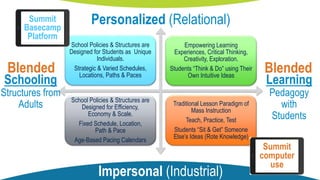
Summit
computer
use
Personalized (Relational)
Impersonal (Industrial)
Learning
Pedagogy
with
Students
Schooling
Structures from
Adults
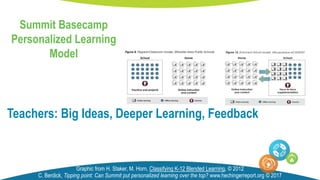
Teachers: Big Ideas, Deeper Learning, Feedback
Graphic from H. Staker, M. Horn, Classifying K-12 Blended Learning, © 2012
Summit Basecamp
Personalized Learning
Model
C. Berdick, Tipping point: Can Summit put personalized learning over the top? www.hechingerreport.org © 2017
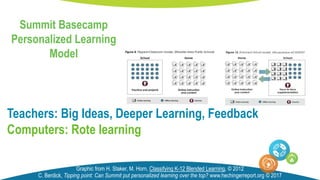
Teachers: Big Ideas, Deeper Learning, Feedback
Computers: Rote learning
Graphic from H. Staker, M. Horn, Classifying K-12 Blended Learning, © 2012
Summit Basecamp
Personalized Learning
Model
C. Berdick, Tipping point: Can Summit put personalized learning over the top? www.hechingerreport.org © 2017
Blending to enhance teacher-student interactions
Teachers: Big Ideas, Deeper Learning, Feedback
Computers: Rote learning
Graphic from H. Staker, M. Horn, Classifying K-12 Blended Learning, © 2012
Summit Basecamp
Personalized Learning
Model
C. Berdick, Tipping point: Can Summit put personalized learning over the top? www.hechingerreport.org © 2017
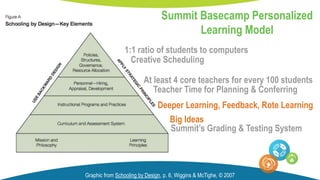
Graphic from Schooling by Design, p. 6, Wiggins & McTighe, © 2007
Summit’s Grading & Testing System
At least 4 core teachers for every 100 students
1:1 ratio of students to computers
Summit Basecamp Personalized
Learning Model
Creative Scheduling
Teacher Time for Planning & Conferring
Big Ideas
Deeper Learning, Feedback, Rote Learning
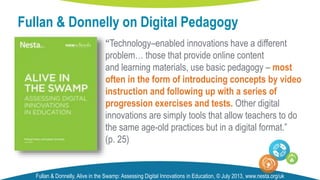
“Technology–enabled innovations have a different
problem… those that provide online content
and learning materials, use basic pedagogy – most
often in the form of introducing concepts by video
instruction and following up with a series of
progression exercises and tests. Other digital
innovations are simply tools that allow teachers to do
the same age-old practices but in a digital format.”
(p. 25)
Fullan & Donnelly on Digital Pedagogy
Fullan & Donnelly, Alive in the Swamp: Assessing Digital Innovations in Education, © July 2013, www.nesta.org/uk
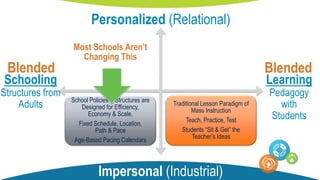
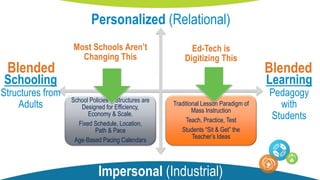
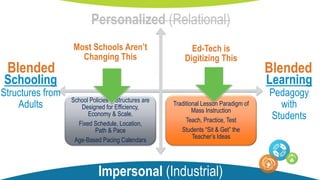
Most Schools Aren’t
Changing This
Ed-Tech is
Digitizing This
School Policies & Structures are
Designed for Efficiency,
Economy & Scale.
Fixed Schedule, Location,
Path & Pace
Age-Based Pacing Calendars
Traditional Lesson Paradigm of
Mass Instruction
Teach, Practice, Test
Students “Sit & Get” the
Teacher’s Ideas
Impersonal (Industrial)
Learning
Pedagogy
with
Students
Schooling
Structures from
Adults
Personalized (Relational)
BlendedBlended
Most Schools Aren’t
Changing This
Ed-Tech is
Digitizing This
School Policies & Structures are
Designed for Efficiency,
Economy & Scale.
Fixed Schedule, Location,
Path & Pace
Age-Based Pacing Calendars
Traditional Lesson Paradigm of
Mass Instruction
Teach, Practice, Test
Students “Sit & Get” the
Teacher’s Ideas
Impersonal (Industrial)
Learning
Pedagogy
with
Students
Schooling
Structures from
Adults
Personalized (Relational)
BlendedBlended
Most Schools Aren’t
Changing This
Ed-Tech is
Digitizing This
School Policies & Structures are
Designed for Efficiency,
Economy & Scale.
Fixed Schedule, Location,
Path & Pace
Age-Based Pacing Calendars
Traditional Lesson Paradigm of
Mass Instruction
Teach, Practice, Test
Students “Sit & Get” the
Teacher’s Ideas
Impersonal (Industrial)
Learning
Pedagogy
with
Students
Schooling
Structures from
Adults
Personalized (Relational)
BlendedBlended
Most Schools Aren’t
Changing This
Ed-Tech is
Digitizing This
School Policies & Structures are
Designed for Efficiency,
Economy & Scale.
Fixed Schedule, Location,
Path & Pace
Age-Based Pacing Calendars
Traditional Lesson Paradigm of
Mass Instruction
Teach, Practice, Test
Students “Sit & Get” the
Teacher’s Ideas
Impersonal (Industrial)
Learning
Pedagogy
with
Students
Schooling
Structures from
Adults
Personalized (Relational)
BlendedBlended
Leading, Implementing, &
Sustaining Personalized Learning
requires ongoing data-driven
improvement
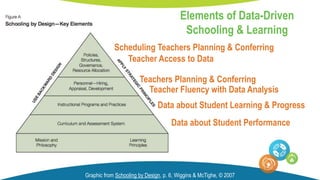
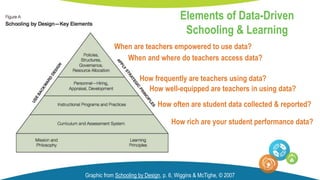
Graphic from Schooling by Design, p. 6, Wiggins & McTighe, © 2007
Elements of Data-Driven
Schooling & Learning
Teachers Planning & Conferring
Data about Student Performance
Data about Student Learning & Progress
Scheduling Teachers Planning & Conferring
Teacher Fluency with Data Analysis
Teacher Access to Data
Graphic from Schooling by Design, p. 6, Wiggins & McTighe, © 2007
Elements of Data-Driven
Schooling & Learning
How frequently are teachers using data?
How rich are your student performance data?
How often are student data collected & reported?
When are teachers empowered to use data?
How well-equipped are teachers in using data?
When and where do teachers access data?
Leading, Implementing, &
Sustaining Personalized Learning
requires continuous professional
learning about how other leaders
and schools are designing for
Personalized Learning
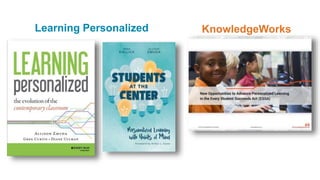
Learning Personalized KnowledgeWorks
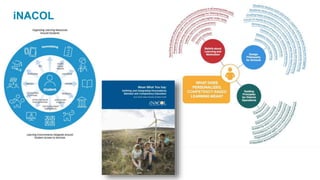
iNACOL
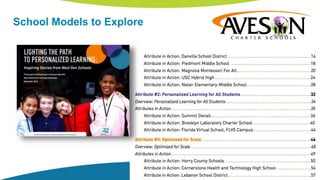
School Models to Explore
Leading, Implementing, & Sustaining Personalized Learning requires:
1. a clear and consistent commitment to Mission & Vision
2. flexibility, creativity and innovation to achieve the Mission
3. a clear definition and shared understanding of what “Personalized
Learning” means
4. a commitment to sound pedagogy both with and without technology
5. ongoing data-driven improvement
6. continuous professional learning about how other leaders and schools
are designing for Personalized Learning
Thank you!
Tim Hudson, PhD
Vice President of Learning
@DocHudsonMath
Free Resources at dreambox.com/white-papers
DreamBox Learning® K–8 Math
Available in English & Spanish
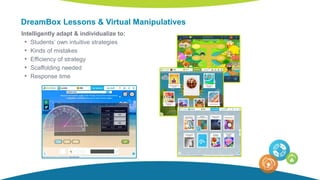
Intelligently adapt & individualize to:
• Students’ own intuitive strategies
• Kinds of mistakes
• Efficiency of strategy
• Scaffolding needed
• Response time
DreamBox Lessons & Virtual Manipulatives
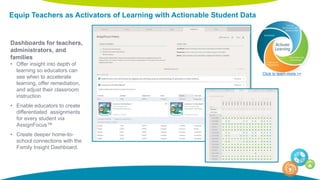
Equip Teachers as Activators of Learning with Actionable Student Data
Click to learn more >>
Dashboards for teachers,
administrators, and
families
• Offer insight into depth of
learning so educators can
see when to accelerate
learning, offer remediation,
and adjust their classroom
instruction
• Enable educators to create
differentiated assignments
for every student via
AssignFocus™
• Create deeper home-to-
school connections with the
Family Insight Dashboard.
Nurture Teachers’ Confidence as Math Practitioners
Through comprehensive and ongoing professional development,
we walk side by side with educators to align professional learning
to their instructional goals, deepen math understanding, and refine
instructional practice.
“I love doing online courses that allow me to
work on my teaching practices. One-on-one
support is given to students to work at their
own pace.”
Jessica | Teacher
Center of HOPE, CO
Customized professional learning that goes beyond
product training to:
• Support successful blended learning implementations
• Increase efficacy of instructional practice
• Expand math teaching “toolkits” by helping educators to learn
multiple teaching strategies.
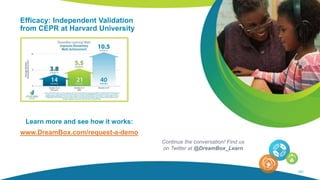
Efficacy: Independent Validation
from CEPR at Harvard University
101
Continue the conversation! Find us
on Twitter at @DreamBox_Learn
Learn more and see how it works:
www.DreamBox.com/request-a-demo
We value your feedback!
Let us know how we’re doing:
www.surveymonkey.com/r/GC6ZCM7

Leading, Implementing, and Sustaining Innovations in Personalized Learning

  • 1.
    Leading, Implementing, and SustainingInnovations in Personalized Learning Tim Hudson, PhD Vice President of Learning @DocHudsonMath
  • 2.
    Supporting the collaborativedevelopment of effective personalized learning models: Ideas that help leaders create and sustain innovations that benefit students, teachers, parents, and school culture. • Mission and Vision: What are our schools and programs “in business” to accomplish? • Effort with Impact: How can data drive ongoing improvement in student achievement and personalized learning models? • Pedagogy and Technology: When does technology appropriately support personalized learning in pedagogically sound ways?
  • 3.
    Is your schoolor district implementing personalized learning?
  • 4.
    Is your schoolor district implementing personalized learning? differentiated instruction?
  • 5.
    Is your schoolor district implementing personalized learning? differentiated instruction? blended learning?
  • 6.
    Is your schoolor district implementing personalized learning? differentiated instruction? blended learning? competency-based learning?
  • 7.
    Is your schoolor district implementing personalized learning? differentiated instruction? blended learning? competency-based learning? WHY?
  • 8.
    • We arepersonalizing learning in order to ________________________________. • Differentiated instruction will ensure that ________________________________. • Blended learning is our model for guaranteeing ___________________________. • Competency-based learning helps us achieve ____________________________. Is Our Mission Clear?
  • 9.
    Leading, Implementing, & SustainingPersonalized Learning requires a clear and consistent commitment to Mission & Vision
  • 10.
    •“Not schooling byhabit or impulse.” •“Without a commitment to mission, we don’t really have a school; we just have a home for freelance tutors of subjects.” Plan Schooling Backwards p. 11, 25, Wiggins & McTighe, © 2007
  • 11.
    “Our mission isto ensure success for all our students. We will do whatever it takes to ensure their success – Schooling by Habit? Revisiting Professional Learning Communities at Work, ©2008, DuFour, DuFour, Eaker, pp. 114-115
  • 12.
    “Our mission isto ensure success for all our students. We will do whatever it takes to ensure their success – provided we don’t have to change the schedule, modify any of our existing practices, or adopt any new practices.” Schooling by Habit? Revisiting Professional Learning Communities at Work, ©2008, DuFour, DuFour, Eaker, pp. 114-115
  • 13.
    The Mission ofthe Parkway School District is to ensure all students are capable, curious, and confident learners who understand and respond to the challenges of an ever-changing world.
  • 14.
    Graphic from Schoolingby Design, p. 6, Wiggins & McTighe, © 2007
  • 15.
    Graphic from Schoolingby Design, p. 6, Wiggins & McTighe, © 2007 Aspects of Personalized Learning & Schooling
  • 16.
    Graphic from Schoolingby Design, p. 6, Wiggins & McTighe, © 2007 Aspects of Personalized Learning & Schooling Competency-Based Learning
  • 17.
    Graphic from Schoolingby Design, p. 6, Wiggins & McTighe, © 2007 “People must learn to recognize when they understand and when they need more information…[People] learn to take control of their own learning by defining learning goals and monitor their progress in achieving them… Transfer can be improved by helping students become more aware of themselves as learners who actively monitor their learning…” How People Learn, p. 12, 18, 67 Competency-Based Learning
  • 18.
    Graphic from Schoolingby Design, p. 6, Wiggins & McTighe, © 2007 Differentiated Instruction Aspects of Personalized Learning & Schooling Competency-Based Learning
  • 19.
    Graphic from Schoolingby Design, p. 6, Wiggins & McTighe, © 2007 Competency-Based Learning Differentiated Instruction “…the contemporary view of learning is that people construct new knowledge and understandings based on what they already know and believe… A critical feature of effective teaching is that it elicits… pre-existing understanding of the subject matter to be taught and provides opportunities to build on – or challenge – the initial understanding… [A person’s] initial conceptions then provide the foundation on which the more formal understanding of the subject matter is built.” How People Learn, p. 10, 13-15, 19
  • 20.
    Graphic from Schoolingby Design, p. 6, Wiggins & McTighe, © 2007 Differentiated Instruction Blended Learning Competency-Based Learning
  • 21.
    Graphic from Schoolingby Design, p. 6, Wiggins & McTighe, © 2007 Differentiated Instruction Blended Learning “…pay close attention to the individual progress of each [person] and devise tasks that are appropriate…Present [learners] with ‘just manageable difficulties’ – that is, challenging enough to maintain engagement, but not so difficult as to lead to discouragement.” How People Learn, p. 24 Competency-Based Learning
  • 22.
    Graphic from Schoolingby Design, p. 6, Wiggins & McTighe, © 2007 Competency-Based Learning Differentiated Instruction Blended Learning Aspects of Personalized Learning & Schooling
  • 23.
    Graphic from Schoolingby Design, p. 6, Wiggins & McTighe, © 2007 Competency-Based Learning Differentiated Instruction Staffing Scheduling, Materials, Technology Blended Learning Aspects of Personalized Learning & Schooling
  • 24.
    Leading, Implementing, & SustainingPersonalized Learning requires flexibility, creativity and innovation to achieve the Mission
  • 26.
    “A looming questionis whether personalized learning that works in, say, a tight-knit, mission-driven charter school can be reliably translated into traditional district schools with many more students, less flexible schedules, keener standardized-test worries and cultures steeped in established ways of teaching and learning.” Summit Model & Basecamp Platform Pilots C. Berdick, Tipping point: Can Summit put personalized learning over the top? www.hechingerreport.org © 2017
  • 27.
    Graphic from Schoolingby Design, p. 6, Wiggins & McTighe, © 2007 Mission-Driven Standardized Test Worries Culture of Teaching & Learning Tight-knit Less Flexible Schedule “Traditional district schools with many more students”
  • 28.
    The only prerequisitesfor would-be Basecamp schools are: 1. Commitment to Summit’s grading policy • 30 percent of grades on mastery of content; students take tests only when they feel ready and, if they fail, can re-take them until they pass • 70 percent of grades on students’ use of various cognitive skills, such as making inferences and clearly communicating their ideas 2. One-to-one ratio of computers to students 3. Team of at least four teachers covering the core academic subjects for about 100 students Summit Model & Basecamp Platform Pilots C. Berdick, Tipping point: Can Summit put personalized learning over the top? www.hechingerreport.org © 2017
  • 29.
    Graphic from Schoolingby Design, p. 6, Wiggins & McTighe, © 2007 Summit’s Grading & Testing System At least 4 core teachers for every 100 students 1:1 ratio of students to computers Summit Basecamp Personalized Learning Pilot Requirements C. Berdick, Tipping point: Can Summit put personalized learning over the top? www.hechingerreport.org © 2017
  • 30.
    Basecamp schools arecreative with scheduling, finding myriad ways to fit in personalized-learning time, mentoring and projects while carving out extra time for teachers to plan lessons jointly and confer about students. Summit Model & Basecamp Platform Pilots C. Berdick, Tipping point: Can Summit put personalized learning over the top? www.hechingerreport.org © 2017
  • 31.
    Graphic from Schoolingby Design, p. 6, Wiggins & McTighe, © 2007 Summit’s Grading & Testing System At least 4 core teachers for every 100 students 1:1 ratio of students to computers Summit Basecamp Personalized Learning Pilots’ Creativity Creative Scheduling Teacher Time for Planning & Conferring
  • 32.
    Graphic from Schoolingby Design, p. 6, Wiggins & McTighe, © 2007 Summit’s Grading & Testing System At least 4 core teachers for every 100 students 1:1 ratio of students to computers Summit Basecamp Personalized Learning Pilots’ Creativity Creative Scheduling Teacher Time for Planning & Conferring What about the Learning?
  • 33.
    Graphic from Schoolingby Design, p. 6, Wiggins & McTighe, © 2007 Summit’s Grading & Testing System At least 4 core teachers for every 100 students 1:1 ratio of students to computers Summit Basecamp Personalized Learning Pilots’ Creativity Creative Scheduling Teacher Time for Planning & Conferring Learning Lives Here And Here
  • 34.
    FLIPPED-CLASSROOM ENRICHED-VIRTUAL Graphic fromH. Staker, M. Horn, Classifying K-12 Blended Learning, © 2012
  • 35.
    FLIPPED-CLASSROOM ENRICHED-VIRTUAL What ishappening with the teacher? Graphic from H. Staker, M. Horn, Classifying K-12 Blended Learning, © 2012
  • 36.
    FLIPPED-CLASSROOM ENRICHED-VIRTUAL What ishappening with the teacher? What is happening on the computers? Graphic from H. Staker, M. Horn, Classifying K-12 Blended Learning, © 2012
  • 37.
    FLIPPED-CLASSROOM ENRICHED-VIRTUAL Blending isa means to what ends? What is happening with the teacher? What is happening on the computers? Graphic from H. Staker, M. Horn, Classifying K-12 Blended Learning, © 2012
  • 38.
    Leading, Implementing, & SustainingPersonalized Learning requires a clear definition and shared understanding of what “Personalized Learning” means
  • 40.
  • 41.
    I haven’t learned anythingnew all year. This math class is boring. This is way too hard. It doesn’t make sense. I give up! This math class is just right for me – not too hard, not too easy. Today’s Lesson: Fraction Operations
  • 42.
  • 43.
    Today’s Lesson: FractionOperations Why? Because these students were all born during the same 12-month window about 11 years ago.
  • 44.
    Seat-time policies, pacingcalendars, standardized testing schedules, age- based classrooms and weak competency-based tools make it difficult for me to personalize and differentiate.
  • 45.
    Student 1 in DreamBoxStudent 2 in DreamBox
  • 46.
    The Pacing Calendar (FractionOperations) is Here Student 1 in DreamBox Student 2 in DreamBox
  • 47.
  • 48.
  • 49.
  • 50.
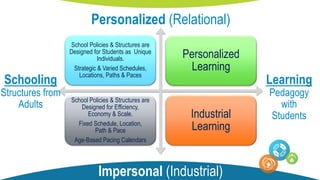
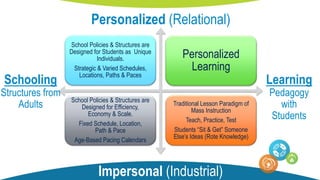
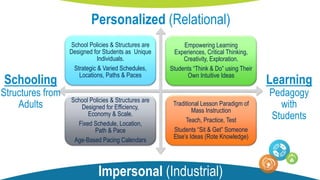
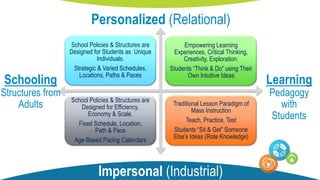
    Personalized Schooling Empowering Learning Experiences, CriticalThinking, Creativity, Exploration. Students “Think & Do” using Their Own Intuitive Ideas School Policies & Structures are Designed for Efficiency, Economy & Scale. Fixed Schedule, Location, Path & Pace Age-Based Pacing Calendars Traditional Lesson Paradigm of Mass Instruction Teach, Practice, Test Students “Sit & Get” the Teacher’s Ideas Personalized (Relational) Impersonal (Industrial) Schooling Structures from Adults
  • 51.
    School Policies &Structures are Designed for Students as Unique Individuals. Strategic & Varied Schedules, Locations, Paths & Paces Personalized Learning School Policies & Structures are Designed for Efficiency, Economy & Scale. Fixed Schedule, Location, Path & Pace Age-Based Pacing Calendars Industrial Learning Personalized (Relational) Impersonal (Industrial) Schooling Structures from Adults
  • 52.
    Today’s Lesson: FractionOperations Math is boring. Every math class is the same: Lecture, practice, lecture, practice, quiz, test. It’s not engaging, or authentic. I know how to win at school. I just wait for the teacher to show me how to solve familiar problems. I feel like it makes sense when my teacher shows it in class, but I’m lost when I get home.
  • 53.
    What are students doingin this lesson? Is it personalized? If so, how?
  • 54.
    School Policies &Structures are Designed for Students as Unique Individuals. Strategic & Varied Schedules, Locations, Paths & Paces Personalized Learning School Policies & Structures are Designed for Efficiency, Economy & Scale. Fixed Schedule, Location, Path & Pace Age-Based Pacing Calendars Industrial Learning Personalized (Relational) Impersonal (Industrial) Schooling Structures from Adults
  • 55.
    School Policies &Structures are Designed for Students as Unique Individuals. Strategic & Varied Schedules, Locations, Paths & Paces Personalized Learning School Policies & Structures are Designed for Efficiency, Economy & Scale. Fixed Schedule, Location, Path & Pace Age-Based Pacing Calendars Industrial Learning Personalized (Relational) Impersonal (Industrial) Learning Pedagogy with Students Schooling Structures from Adults
  • 56.
    School Policies &Structures are Designed for Students as Unique Individuals. Strategic & Varied Schedules, Locations, Paths & Paces Personalized Learning School Policies & Structures are Designed for Efficiency, Economy & Scale. Fixed Schedule, Location, Path & Pace Age-Based Pacing Calendars Industrial Learning Personalized (Relational) Impersonal (Industrial) Learning Pedagogy with Students Schooling Structures from Adults
  • 57.
    School Policies &Structures are Designed for Students as Unique Individuals. Strategic & Varied Schedules, Locations, Paths & Paces Personalized Learning School Policies & Structures are Designed for Efficiency, Economy & Scale. Fixed Schedule, Location, Path & Pace Age-Based Pacing Calendars Traditional Lesson Paradigm of Mass Instruction Teach, Practice, Test Students “Sit & Get” Someone Else’s Ideas (Rote Knowledge) Personalized (Relational) Impersonal (Industrial) Learning Pedagogy with Students Schooling Structures from Adults
  • 58.
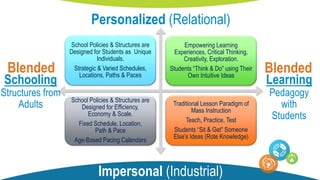
    School Policies &Structures are Designed for Students as Unique Individuals. Strategic & Varied Schedules, Locations, Paths & Paces Empowering Learning Experiences, Critical Thinking, Creativity, Exploration. Students “Think & Do” using Their Own Intuitive Ideas School Policies & Structures are Designed for Efficiency, Economy & Scale. Fixed Schedule, Location, Path & Pace Age-Based Pacing Calendars Traditional Lesson Paradigm of Mass Instruction Teach, Practice, Test Students “Sit & Get” Someone Else’s Ideas (Rote Knowledge) Personalized (Relational) Impersonal (Industrial) Learning Pedagogy with Students Schooling Structures from Adults
  • 59.
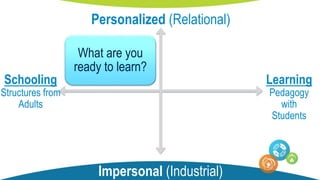
    What are you readyto learn? What do you think about it? When were you born? What did someone else tell you to think? Personalized (Relational) Impersonal (Industrial) Learning Pedagogy with Students Schooling Structures from Adults
  • 60.
    What are you readyto learn? What do you think about it? When were you born? What did someone else tell you to think? Personalized (Relational) Impersonal (Industrial) Learning Pedagogy with Students Schooling Structures from Adults
  • 61.
    What are you readyto learn? What do you think about it? When were you born? What did someone else tell you to think? Personalized (Relational) Impersonal (Industrial) Learning Pedagogy with Students Schooling Structures from Adults
  • 62.
    What are you readyto learn? What do you think about it? When were you born? What did someone else tell you to think? Personalized (Relational) Impersonal (Industrial) Learning Pedagogy with Students Schooling Structures from Adults
  • 63.
    Learning is notaccomplished by putting thoughts into a mind, but rather by empowering a mind to generate thoughts. - T. Hudson
  • 64.
    Leading, Implementing, & SustainingPersonalized Learning requires a commitment to sound pedagogy both with and without technology
  • 65.
    School Policies &Structures are Designed for Students as Unique Individuals. Strategic & Varied Schedules, Locations, Paths & Paces Empowering Learning Experiences, Critical Thinking, Creativity, Exploration. Students “Think & Do” using Their Own Intuitive Ideas School Policies & Structures are Designed for Efficiency, Economy & Scale. Fixed Schedule, Location, Path & Pace Age-Based Pacing Calendars Traditional Lesson Paradigm of Mass Instruction Teach, Practice, Test Students “Sit & Get” Someone Else’s Ideas (Rote Knowledge) Personalized (Relational) Impersonal (Industrial) Learning Pedagogy with Students Schooling Structures from Adults
  • 66.
    School Policies &Structures are Designed for Students as Unique Individuals. Strategic & Varied Schedules, Locations, Paths & Paces Empowering Learning Experiences, Critical Thinking, Creativity, Exploration. Students “Think & Do” using Their Own Intuitive Ideas School Policies & Structures are Designed for Efficiency, Economy & Scale. Fixed Schedule, Location, Path & Pace Age-Based Pacing Calendars Traditional Lesson Paradigm of Mass Instruction Teach, Practice, Test Students “Sit & Get” Someone Else’s Ideas (Rote Knowledge) BlendedBlended Personalized (Relational) Impersonal (Industrial) Learning Pedagogy with Students Schooling Structures from Adults
  • 67.
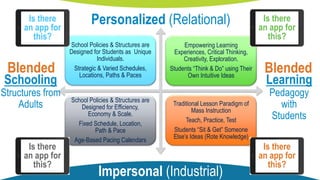
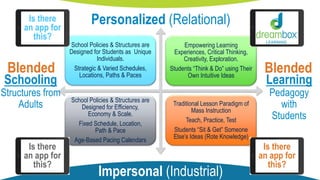
    School Policies &Structures are Designed for Students as Unique Individuals. Strategic & Varied Schedules, Locations, Paths & Paces Empowering Learning Experiences, Critical Thinking, Creativity, Exploration. Students “Think & Do” using Their Own Intuitive Ideas School Policies & Structures are Designed for Efficiency, Economy & Scale. Fixed Schedule, Location, Path & Pace Age-Based Pacing Calendars Traditional Lesson Paradigm of Mass Instruction Teach, Practice, Test Students “Sit & Get” Someone Else’s Ideas (Rote Knowledge) BlendedBlended Is there an app for this? Is there an app for this? Is there an app for this? Is there an app for this? Personalized (Relational) Impersonal (Industrial) Learning Pedagogy with Students Schooling Structures from Adults
  • 68.
    School Policies &Structures are Designed for Students as Unique Individuals. Strategic & Varied Schedules, Locations, Paths & Paces Empowering Learning Experiences, Critical Thinking, Creativity, Exploration. Students “Think & Do” using Their Own Intuitive Ideas School Policies & Structures are Designed for Efficiency, Economy & Scale. Fixed Schedule, Location, Path & Pace Age-Based Pacing Calendars Traditional Lesson Paradigm of Mass Instruction Teach, Practice, Test Students “Sit & Get” Someone Else’s Ideas (Rote Knowledge) BlendedBlended Is there an app for this? Is there an app for this? Is there an app for this? Is there an app for this? Personalized (Relational) Impersonal (Industrial) Learning Pedagogy with Students Schooling Structures from Adults
  • 70.
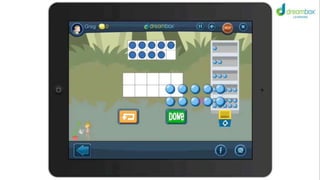
    “True virtual manipulativesallow more than simply a viewing of objects on the computer screen. They allow increased engagement, forcing the user to interact with dynamic objects. Through this interaction students have opportunities to make meaning and see relationships as a result of their own actions. And it is this interactive engagement with a dynamic representation that is the key to the knowledge construction process.” From Virtual Manipulatives In The K-12 Classroom, Moyer, Bolyard, Spikell, 2002
  • 71.
    Back at SummitDenali… the goal of personalized-learning time is not to replace teacher-student interactions but to enhance them. By offloading some rote learning to a computer — such as memorizing the steps of cell division or the formulas for sine, cosine and tangent — “we can make the most of the connections between teachers and kids,” he said. “We want more of those interactions to be about big ideas, deeper learning and the sort of feedback that you can only get from a real, live adult.” Summit Model & Basecamp Platform Pilots C. Berdick, Tipping point: Can Summit put personalized learning over the top? www.hechingerreport.org © 2017
  • 72.
    Back at SummitDenali… the goal of personalized-learning time is not to replace teacher-student interactions but to enhance them. By offloading some rote learning to a computer — such as memorizing the steps of cell division or the formulas for sine, cosine and tangent — “we can make the most of the connections between teachers and kids,” he said. “We want more of those interactions to be about big ideas, deeper learning and the sort of feedback that you can only get from a real, live adult.” Summit Model & Basecamp Platform Pilots C. Berdick, Tipping point: Can Summit put personalized learning over the top? www.hechingerreport.org © 2017
  • 73.
    • the useof memory usually with little intelligence • mechanical or unthinking routine or repetition Rote Learning Defined (Merriam Webster) www.merriam-webster.com/dictionary/rote
  • 74.
    School Policies &Structures are Designed for Students as Unique Individuals. Strategic & Varied Schedules, Locations, Paths & Paces Empowering Learning Experiences, Critical Thinking, Creativity, Exploration. Students “Think & Do” using Their Own Intuitive Ideas School Policies & Structures are Designed for Efficiency, Economy & Scale. Fixed Schedule, Location, Path & Pace Age-Based Pacing Calendars Traditional Lesson Paradigm of Mass Instruction Teach, Practice, Test Students “Sit & Get” Someone Else’s Ideas (Rote Knowledge) BlendedBlended Personalized (Relational) Impersonal (Industrial) Learning Pedagogy with Students Schooling Structures from Adults
  • 75.
    School Policies &Structures are Designed for Students as Unique Individuals. Strategic & Varied Schedules, Locations, Paths & Paces Empowering Learning Experiences, Critical Thinking, Creativity, Exploration. Students “Think & Do” using Their Own Intuitive Ideas School Policies & Structures are Designed for Efficiency, Economy & Scale. Fixed Schedule, Location, Path & Pace Age-Based Pacing Calendars Traditional Lesson Paradigm of Mass Instruction Teach, Practice, Test Students “Sit & Get” Someone Else’s Ideas (Rote Knowledge) BlendedBlended Summit Basecamp Platform Personalized (Relational) Impersonal (Industrial) Learning Pedagogy with Students Schooling Structures from Adults
  • 76.
    School Policies &Structures are Designed for Students as Unique Individuals. Strategic & Varied Schedules, Locations, Paths & Paces Empowering Learning Experiences, Critical Thinking, Creativity, Exploration. Students “Think & Do” using Their Own Intuitive Ideas School Policies & Structures are Designed for Efficiency, Economy & Scale. Fixed Schedule, Location, Path & Pace Age-Based Pacing Calendars Traditional Lesson Paradigm of Mass Instruction Teach, Practice, Test Students “Sit & Get” Someone Else’s Ideas (Rote Knowledge) BlendedBlended Summit Basecamp Platform Summit computer use Personalized (Relational) Impersonal (Industrial) Learning Pedagogy with Students Schooling Structures from Adults
  • 77.
    Teachers: Big Ideas,Deeper Learning, Feedback Graphic from H. Staker, M. Horn, Classifying K-12 Blended Learning, © 2012 Summit Basecamp Personalized Learning Model C. Berdick, Tipping point: Can Summit put personalized learning over the top? www.hechingerreport.org © 2017
  • 78.
    Teachers: Big Ideas,Deeper Learning, Feedback Computers: Rote learning Graphic from H. Staker, M. Horn, Classifying K-12 Blended Learning, © 2012 Summit Basecamp Personalized Learning Model C. Berdick, Tipping point: Can Summit put personalized learning over the top? www.hechingerreport.org © 2017
  • 79.
    Blending to enhanceteacher-student interactions Teachers: Big Ideas, Deeper Learning, Feedback Computers: Rote learning Graphic from H. Staker, M. Horn, Classifying K-12 Blended Learning, © 2012 Summit Basecamp Personalized Learning Model C. Berdick, Tipping point: Can Summit put personalized learning over the top? www.hechingerreport.org © 2017
  • 80.
    Graphic from Schoolingby Design, p. 6, Wiggins & McTighe, © 2007 Summit’s Grading & Testing System At least 4 core teachers for every 100 students 1:1 ratio of students to computers Summit Basecamp Personalized Learning Model Creative Scheduling Teacher Time for Planning & Conferring Big Ideas Deeper Learning, Feedback, Rote Learning
  • 81.
    “Technology–enabled innovations havea different problem… those that provide online content and learning materials, use basic pedagogy – most often in the form of introducing concepts by video instruction and following up with a series of progression exercises and tests. Other digital innovations are simply tools that allow teachers to do the same age-old practices but in a digital format.” (p. 25) Fullan & Donnelly on Digital Pedagogy Fullan & Donnelly, Alive in the Swamp: Assessing Digital Innovations in Education, © July 2013, www.nesta.org/uk
  • 82.
    Most Schools Aren’t ChangingThis Ed-Tech is Digitizing This School Policies & Structures are Designed for Efficiency, Economy & Scale. Fixed Schedule, Location, Path & Pace Age-Based Pacing Calendars Traditional Lesson Paradigm of Mass Instruction Teach, Practice, Test Students “Sit & Get” the Teacher’s Ideas Impersonal (Industrial) Learning Pedagogy with Students Schooling Structures from Adults Personalized (Relational) BlendedBlended
  • 83.
    Most Schools Aren’t ChangingThis Ed-Tech is Digitizing This School Policies & Structures are Designed for Efficiency, Economy & Scale. Fixed Schedule, Location, Path & Pace Age-Based Pacing Calendars Traditional Lesson Paradigm of Mass Instruction Teach, Practice, Test Students “Sit & Get” the Teacher’s Ideas Impersonal (Industrial) Learning Pedagogy with Students Schooling Structures from Adults Personalized (Relational) BlendedBlended
  • 84.
    Most Schools Aren’t ChangingThis Ed-Tech is Digitizing This School Policies & Structures are Designed for Efficiency, Economy & Scale. Fixed Schedule, Location, Path & Pace Age-Based Pacing Calendars Traditional Lesson Paradigm of Mass Instruction Teach, Practice, Test Students “Sit & Get” the Teacher’s Ideas Impersonal (Industrial) Learning Pedagogy with Students Schooling Structures from Adults Personalized (Relational) BlendedBlended
  • 85.
    Most Schools Aren’t ChangingThis Ed-Tech is Digitizing This School Policies & Structures are Designed for Efficiency, Economy & Scale. Fixed Schedule, Location, Path & Pace Age-Based Pacing Calendars Traditional Lesson Paradigm of Mass Instruction Teach, Practice, Test Students “Sit & Get” the Teacher’s Ideas Impersonal (Industrial) Learning Pedagogy with Students Schooling Structures from Adults Personalized (Relational) BlendedBlended
  • 86.
    Leading, Implementing, & SustainingPersonalized Learning requires ongoing data-driven improvement
  • 87.
    Graphic from Schoolingby Design, p. 6, Wiggins & McTighe, © 2007 Elements of Data-Driven Schooling & Learning Teachers Planning & Conferring Data about Student Performance Data about Student Learning & Progress Scheduling Teachers Planning & Conferring Teacher Fluency with Data Analysis Teacher Access to Data
  • 88.
    Graphic from Schoolingby Design, p. 6, Wiggins & McTighe, © 2007
  • 89.
    Graphic from Schoolingby Design, p. 6, Wiggins & McTighe, © 2007 Elements of Data-Driven Schooling & Learning How frequently are teachers using data? How rich are your student performance data? How often are student data collected & reported? When are teachers empowered to use data? How well-equipped are teachers in using data? When and where do teachers access data?
  • 90.
    Leading, Implementing, & SustainingPersonalized Learning requires continuous professional learning about how other leaders and schools are designing for Personalized Learning
  • 91.
  • 92.
  • 93.
  • 94.
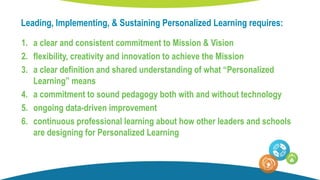
    Leading, Implementing, &Sustaining Personalized Learning requires: 1. a clear and consistent commitment to Mission & Vision 2. flexibility, creativity and innovation to achieve the Mission 3. a clear definition and shared understanding of what “Personalized Learning” means 4. a commitment to sound pedagogy both with and without technology 5. ongoing data-driven improvement 6. continuous professional learning about how other leaders and schools are designing for Personalized Learning
  • 95.
    Thank you! Tim Hudson,PhD Vice President of Learning @DocHudsonMath
  • 96.
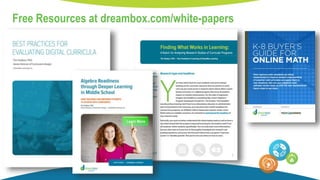
    Free Resources atdreambox.com/white-papers
  • 97.
    DreamBox Learning® K–8Math Available in English & Spanish
  • 98.
    Intelligently adapt &individualize to: • Students’ own intuitive strategies • Kinds of mistakes • Efficiency of strategy • Scaffolding needed • Response time DreamBox Lessons & Virtual Manipulatives
  • 99.
    Equip Teachers asActivators of Learning with Actionable Student Data Click to learn more >> Dashboards for teachers, administrators, and families • Offer insight into depth of learning so educators can see when to accelerate learning, offer remediation, and adjust their classroom instruction • Enable educators to create differentiated assignments for every student via AssignFocus™ • Create deeper home-to- school connections with the Family Insight Dashboard.
  • 100.
    Nurture Teachers’ Confidenceas Math Practitioners Through comprehensive and ongoing professional development, we walk side by side with educators to align professional learning to their instructional goals, deepen math understanding, and refine instructional practice. “I love doing online courses that allow me to work on my teaching practices. One-on-one support is given to students to work at their own pace.” Jessica | Teacher Center of HOPE, CO Customized professional learning that goes beyond product training to: • Support successful blended learning implementations • Increase efficacy of instructional practice • Expand math teaching “toolkits” by helping educators to learn multiple teaching strategies.
  • 101.
    Efficacy: Independent Validation fromCEPR at Harvard University 101 Continue the conversation! Find us on Twitter at @DreamBox_Learn Learn more and see how it works: www.DreamBox.com/request-a-demo
  • 102.
    We value yourfeedback! Let us know how we’re doing: www.surveymonkey.com/r/GC6ZCM7

Editor's Notes

  • #59  ----- Meeting Notes (9/17/16 09:46) ----- 20-22 minutes
  • #66  ----- Meeting Notes (9/17/16 09:46) ----- 20-22 minutes