Game Designer’s Journey
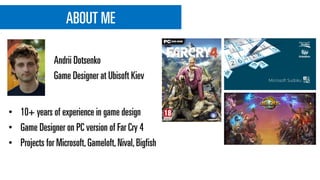
Andrii Dotsenko
Game Designer at Ubisoft Kiev
ABOUT ME
• 10+ years of experience in game design
• Game Designer on PC version of Far Cry 4
• Projects for Microsoft,Gameloft,Nival,Bigfish
GAME DESIGN IN UBISOFT KIEV
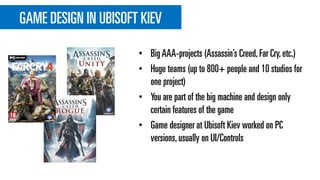
• BigAAA-projects (Assassin’s Creed,Far Cry,etc.)
• Huge teams (up to 800+ people and 10 studios for
one project)
• You are part of the big machine and design only
certain features of the game
• Game designer at Ubisoft Kiev worked on PC
versions,usually on UI/Controls
WHO IS GAME DESIGNER?
“The role of all Game Design professionals at Ubisoft is to imagine and develop compelling
and engaging rules for our games. From conception to release, they design high quality
game systems and mechanics that are adapted to the audience and will enable players to
live their own unique, fun and rich gaming experiences”.​
• Imagine and develop compelling and engaging rules for the game
• Design game systems and mechanics and adapt them to the audience
• Create unique,fun and rich gaming experiences for players
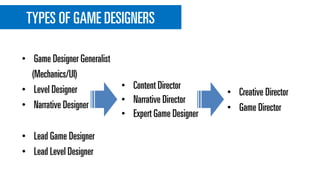
TYPES OF GAME DESIGNERS
• Game Designer Generalist
(Mechanics/UI)
• Level Designer
• Narrative Designer
• Content Director
• Narrative Director
• Expert Game Designer
• Creative Director
• Game Director
• Lead Game Designer
• Lead Level Designer
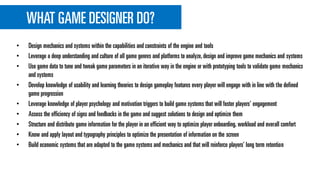
WHAT GAME DESIGNER DO?
• Design mechanics and systems within the capabilities and constraints of the engine and tools
• Leverage a deep understanding and culture of all game genres and platforms to analyze,design and improve game mechanics and systems
• Use game data to tune and tweak game parameters in an iterative way in the engine or with prototyping tools to validate game mechanics
and systems
• Develop knowledge of usability and learning theories to design gameplay features every player will engage with in line with the defined
game progression
• Leverage knowledge of player psychology and motivation triggers to build game systems that will foster players' engagement
• Assess the efficiency of signs and feedbacks in the game and suggest solutions to design and optimize them
• Structure and distribute game information for the player in an efficient way to optimize player onboarding, workload and overall comfort
• Know and apply layout and typography principles to optimize the presentation of information on the screen
• Build economic systems that are adapted to the game systems and mechanics and that will reinforce players’ long term retention
BUTWHERE SHOULD I START?
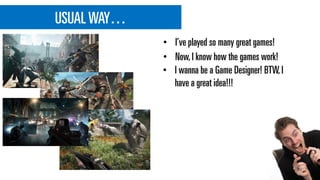
USUALWAY…
• Now,I know how the games work!
• I wanna be a Game Designer! BTW,I
have a great idea!!!
• I’ve played so many great games!
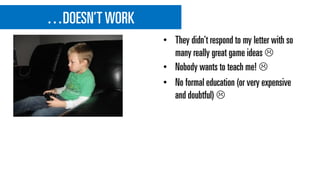
…DOESN’T WORK
• Nobody wants to teach me! 
• No formal education (or very expensive
and doubtful) 
• They didn’t respond to my letter with so
many really great game ideas 
SOLUTION:IWILL EDUCATE MYSELF!
I’ve seen an article/interview about game
design,so people can learn it somehow!
I can do this too!
…and that’s where our journey begins
“Self-education is, I firmly believe, the
only kind of education there is”.​
(Isaak Asimov)
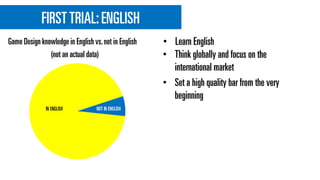
FIRSTTRIAL:ENGLISH
• Think globally and focus on the
international market
• Set a high quality bar from the very
beginning
Game Design knowledge in English vs.not in English
(not an actual data)
IN ENGLISH NOT IN ENGLISH
• Learn English
NO ENGLISH = GAME OVER
WHERE CAN I FINDTHE KNOWLEDGE?
• First 10 pages of Google/Youtube search
about“Game Design”/”Game Design
Book”/”Game Design Blog”contains
80% of the necessary information.
• Not being lazy!
• Google it! (thanks,Cap.!)
WHAT SHOULD I LOOK FOR?
• Post-mortems (look for best practices)
• De-construct existing games
(fundamental knowledge will help you)
• Learn how to systemize knowledge
• Focus on tools that will help you crafting
player experience
• Fundamental knowledge (how people
think,act,make decisions,perceive
information,etc.).Technologies change
fast; people change very slowly.
THE SECRET KNOWLEDGE
• gdcvault.com
• gamasutra.com
• coursera.org
• academia.edu
• gamedesignersvault.com
• Google it! (Game Design/Game Design
Book/Game Design Blog)
I’M READY! I HAVE SO MANY IDEAS!
• I’ve even read a book about game
design!
• Now,I certainly know how the games
work!
• With all this knowledge,I have even
more great ideas than before!
• Now,they will answer to my letters!
• I’ve read 10/50/100 game design
articles!
NO.
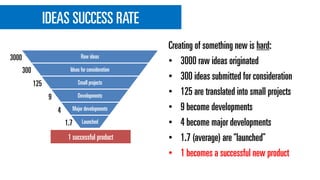
IDEAS SUCCESS RATE
Creating of something new is hard:
• 3000 raw ideas originated
• 300 ideas submitted for consideration
• 125 are translated into small projects
• 9 become developments
• 4 become major developments
• 1.7 (average) are“launched”
• 1 becomes a successful new product
Raw ideas
Ideas for consideration
Small projects
Developments
Major developments
Launched
1 successful product
3000
300
125
9
4
1.7
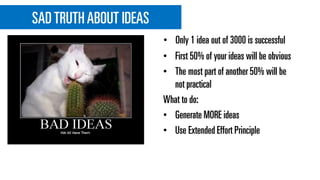
SAD TRUTHABOUT IDEAS
• First 50% of your ideas will be obvious
• The most part of another 50% will be
not practical
What to do:
• Generate MORE ideas
• Use Extended Effort Principle
• Only 1 idea out of 3000 is successful
GOT AN IDEA? PROVE IT!
Ok,let’s assume that you have really good
idea…and then you suddenly realize that
nobody believes you!
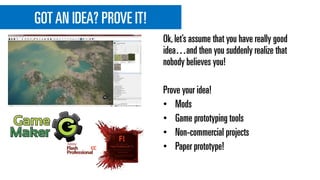
Prove your idea!
• Mods
• Game prototyping tools
• Non-commercial projects
• Paper prototype!
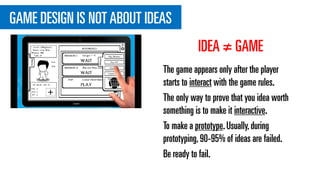
GAME DESIGN IS NOT ABOUT IDEAS
The game appears only after the player
starts to interact with the game rules.
The only way to prove that you idea worth
something is to make it interactive.
To make a prototype.Usually,during
prototyping,90-95% of ideas are failed.
Be ready to fail.
IDEA ≠ GAME
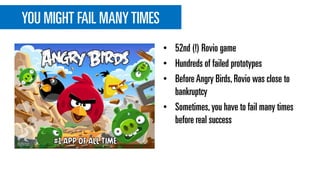
YOU MIGHT FAIL MANYTIMES
• 52nd (!) Rovio game
• Hundreds of failed prototypes
• BeforeAngry Birds,Rovio was close to
bankruptcy
• Sometimes,you have to fail many times
before real success
SECONDTRIAL:YOU’RE NOT ALONE
You will need other people to make the game
(programmers,artists,management,
business,etc.).
Learn to communicate with all of them.
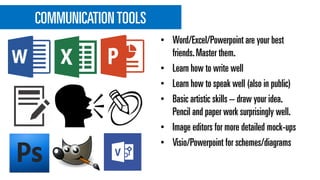
COMMUNICATIONTOOLS
• Word/Excel/Powerpoint are your best
friends.Master them.
• Learn how to write well
• Learn how to speak well (also in public)
• Basic artistic skills – draw your idea.
Pencil and paper work surprisingly well.
• Image editors for more detailed mock-ups
• Visio/Powerpoint for schemes/diagrams
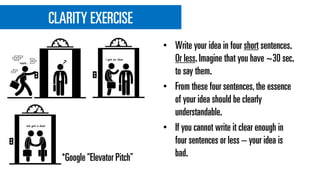
CLARITY EXERCISE
• Write your idea in four short sentences.
Or less.Imagine that you have ~30 sec.
to say them.
• From these four sentences,the essence
of your idea should be clearly
understandable.
• If you cannot write it clear enough in
four sentences or less – your idea is
bad.*Google“Elevator Pitch”
THEY DON’T LISTENTO ME!
• They want to implement their own ideas
instead of mine!
• They do everything in their own way!
• I’m a DESIGNER,why don’t they listen to
me?
• They criticize my ideas every time!
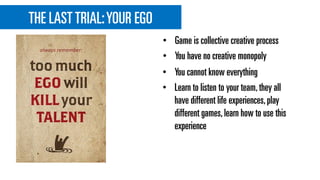
THE LASTTRIAL:YOUR EGO
• You cannot know everything
• Learn to listen to your team,they all
have different life experiences,play
different games,learn how to use this
experience
• Game is collective creative process
• You have no creative monopoly
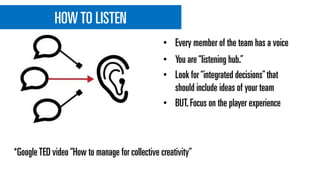
HOWTO LISTEN
• You are“listening hub.”
• Look for“integrated decisions”that
should include ideas of your team
• BUT.Focus on the player experience
• Every member of the team has a voice
*GoogleTED video“How to manage for collective creativity”
GAME DESIGN IS HARDTO LEARN
Game Design requires from you developing
of very specific mindset.Usually,you need at
least two years and some amount of failed
projects to develop such mindset.
You need to learn how to craft and
communicate the player experience,and
what tools you should use to create it.
FINDTHE ENTRANCE
In many cases,you will not start you career,
as a game designer.
First thing that you need to do is to find the
entrance to the industry:
• Find modding/non-commercial projects
communities where you can get basic
skills
• Try to find internship/part-time job in the
game industry
GAME DESIGN IS PERSONAL
All the game design methods do not work
without you.
In many cases,your success as a game
designer depends on personal qualities.
Especially,on the early stage of your career.
You are in the heart of the project,develop
motivation,commitment,and ability to solve
complex problems.
GAME DESIGN IS RISKY
Game Design is the hardest and the riskiest
career path in the game industry.
Sometimes not very rewarding.
In the most cases,much more boring than you
expect.
Follow this way,only if you absolutely sure 
ThankYou
FORTHOSE WHOARE LAZY
Game Design books:
• Jesse Schell,The Art of Game Design:A
Book of Lenses
• Brenda Brathwaite,Challenges for Game
Designers
• Raph Koster,Theory of Fun for Game
Design
• Scott Rogers,Level Up! The Guide to Great
Video Game Design
Useful links:
• Google it! (Game Design/Game Design
Book/Game Design Blog)
• gdcvault.com
• gamasutra.com
• coursera.org
• academia.edu
• gamedesignersvault.com

Game Designer's Journey

  • 1.
  • 2.
    Andrii Dotsenko Game Designerat Ubisoft Kiev ABOUT ME • 10+ years of experience in game design • Game Designer on PC version of Far Cry 4 • Projects for Microsoft,Gameloft,Nival,Bigfish
  • 3.
    GAME DESIGN INUBISOFT KIEV • BigAAA-projects (Assassin’s Creed,Far Cry,etc.) • Huge teams (up to 800+ people and 10 studios for one project) • You are part of the big machine and design only certain features of the game • Game designer at Ubisoft Kiev worked on PC versions,usually on UI/Controls
  • 4.
    WHO IS GAMEDESIGNER? “The role of all Game Design professionals at Ubisoft is to imagine and develop compelling and engaging rules for our games. From conception to release, they design high quality game systems and mechanics that are adapted to the audience and will enable players to live their own unique, fun and rich gaming experiences”.​ • Imagine and develop compelling and engaging rules for the game • Design game systems and mechanics and adapt them to the audience • Create unique,fun and rich gaming experiences for players
  • 5.
    TYPES OF GAMEDESIGNERS • Game Designer Generalist (Mechanics/UI) • Level Designer • Narrative Designer • Content Director • Narrative Director • Expert Game Designer • Creative Director • Game Director • Lead Game Designer • Lead Level Designer
  • 6.
    WHAT GAME DESIGNERDO? • Design mechanics and systems within the capabilities and constraints of the engine and tools • Leverage a deep understanding and culture of all game genres and platforms to analyze,design and improve game mechanics and systems • Use game data to tune and tweak game parameters in an iterative way in the engine or with prototyping tools to validate game mechanics and systems • Develop knowledge of usability and learning theories to design gameplay features every player will engage with in line with the defined game progression • Leverage knowledge of player psychology and motivation triggers to build game systems that will foster players' engagement • Assess the efficiency of signs and feedbacks in the game and suggest solutions to design and optimize them • Structure and distribute game information for the player in an efficient way to optimize player onboarding, workload and overall comfort • Know and apply layout and typography principles to optimize the presentation of information on the screen • Build economic systems that are adapted to the game systems and mechanics and that will reinforce players’ long term retention
  • 7.
  • 8.
    USUALWAY… • Now,I knowhow the games work! • I wanna be a Game Designer! BTW,I have a great idea!!! • I’ve played so many great games!
  • 9.
    …DOESN’T WORK • Nobodywants to teach me!  • No formal education (or very expensive and doubtful)  • They didn’t respond to my letter with so many really great game ideas 
  • 10.
    SOLUTION:IWILL EDUCATE MYSELF! I’veseen an article/interview about game design,so people can learn it somehow! I can do this too! …and that’s where our journey begins “Self-education is, I firmly believe, the only kind of education there is”.​ (Isaak Asimov)
  • 11.
    FIRSTTRIAL:ENGLISH • Think globallyand focus on the international market • Set a high quality bar from the very beginning Game Design knowledge in English vs.not in English (not an actual data) IN ENGLISH NOT IN ENGLISH • Learn English
  • 12.
    NO ENGLISH =GAME OVER
  • 13.
    WHERE CAN IFINDTHE KNOWLEDGE? • First 10 pages of Google/Youtube search about“Game Design”/”Game Design Book”/”Game Design Blog”contains 80% of the necessary information. • Not being lazy! • Google it! (thanks,Cap.!)
  • 14.
    WHAT SHOULD ILOOK FOR? • Post-mortems (look for best practices) • De-construct existing games (fundamental knowledge will help you) • Learn how to systemize knowledge • Focus on tools that will help you crafting player experience • Fundamental knowledge (how people think,act,make decisions,perceive information,etc.).Technologies change fast; people change very slowly.
  • 15.
    THE SECRET KNOWLEDGE •gdcvault.com • gamasutra.com • coursera.org • academia.edu • gamedesignersvault.com • Google it! (Game Design/Game Design Book/Game Design Blog)
  • 16.
    I’M READY! IHAVE SO MANY IDEAS! • I’ve even read a book about game design! • Now,I certainly know how the games work! • With all this knowledge,I have even more great ideas than before! • Now,they will answer to my letters! • I’ve read 10/50/100 game design articles!
  • 17.
  • 18.
    IDEAS SUCCESS RATE Creatingof something new is hard: • 3000 raw ideas originated • 300 ideas submitted for consideration • 125 are translated into small projects • 9 become developments • 4 become major developments • 1.7 (average) are“launched” • 1 becomes a successful new product Raw ideas Ideas for consideration Small projects Developments Major developments Launched 1 successful product 3000 300 125 9 4 1.7
  • 19.
    SAD TRUTHABOUT IDEAS •First 50% of your ideas will be obvious • The most part of another 50% will be not practical What to do: • Generate MORE ideas • Use Extended Effort Principle • Only 1 idea out of 3000 is successful
  • 20.
    GOT AN IDEA?PROVE IT! Ok,let’s assume that you have really good idea…and then you suddenly realize that nobody believes you! Prove your idea! • Mods • Game prototyping tools • Non-commercial projects • Paper prototype!
  • 21.
    GAME DESIGN ISNOT ABOUT IDEAS The game appears only after the player starts to interact with the game rules. The only way to prove that you idea worth something is to make it interactive. To make a prototype.Usually,during prototyping,90-95% of ideas are failed. Be ready to fail. IDEA ≠ GAME
  • 22.
    YOU MIGHT FAILMANYTIMES • 52nd (!) Rovio game • Hundreds of failed prototypes • BeforeAngry Birds,Rovio was close to bankruptcy • Sometimes,you have to fail many times before real success
  • 23.
    SECONDTRIAL:YOU’RE NOT ALONE Youwill need other people to make the game (programmers,artists,management, business,etc.). Learn to communicate with all of them.
  • 24.
    COMMUNICATIONTOOLS • Word/Excel/Powerpoint areyour best friends.Master them. • Learn how to write well • Learn how to speak well (also in public) • Basic artistic skills – draw your idea. Pencil and paper work surprisingly well. • Image editors for more detailed mock-ups • Visio/Powerpoint for schemes/diagrams
  • 25.
    CLARITY EXERCISE • Writeyour idea in four short sentences. Or less.Imagine that you have ~30 sec. to say them. • From these four sentences,the essence of your idea should be clearly understandable. • If you cannot write it clear enough in four sentences or less – your idea is bad.*Google“Elevator Pitch”
  • 26.
    THEY DON’T LISTENTOME! • They want to implement their own ideas instead of mine! • They do everything in their own way! • I’m a DESIGNER,why don’t they listen to me? • They criticize my ideas every time!
  • 27.
    THE LASTTRIAL:YOUR EGO •You cannot know everything • Learn to listen to your team,they all have different life experiences,play different games,learn how to use this experience • Game is collective creative process • You have no creative monopoly
  • 28.
    HOWTO LISTEN • Youare“listening hub.” • Look for“integrated decisions”that should include ideas of your team • BUT.Focus on the player experience • Every member of the team has a voice *GoogleTED video“How to manage for collective creativity”
  • 29.
    GAME DESIGN ISHARDTO LEARN Game Design requires from you developing of very specific mindset.Usually,you need at least two years and some amount of failed projects to develop such mindset. You need to learn how to craft and communicate the player experience,and what tools you should use to create it.
  • 30.
    FINDTHE ENTRANCE In manycases,you will not start you career, as a game designer. First thing that you need to do is to find the entrance to the industry: • Find modding/non-commercial projects communities where you can get basic skills • Try to find internship/part-time job in the game industry
  • 31.
    GAME DESIGN ISPERSONAL All the game design methods do not work without you. In many cases,your success as a game designer depends on personal qualities. Especially,on the early stage of your career. You are in the heart of the project,develop motivation,commitment,and ability to solve complex problems.
  • 32.
    GAME DESIGN ISRISKY Game Design is the hardest and the riskiest career path in the game industry. Sometimes not very rewarding. In the most cases,much more boring than you expect. Follow this way,only if you absolutely sure 
  • 33.
  • 34.
    FORTHOSE WHOARE LAZY GameDesign books: • Jesse Schell,The Art of Game Design:A Book of Lenses • Brenda Brathwaite,Challenges for Game Designers • Raph Koster,Theory of Fun for Game Design • Scott Rogers,Level Up! The Guide to Great Video Game Design Useful links: • Google it! (Game Design/Game Design Book/Game Design Blog) • gdcvault.com • gamasutra.com • coursera.org • academia.edu • gamedesignersvault.com