“There is no reason that a
generation that can
memorize over 100
Pokemon characters
with all their
characteristics, history,
and evolution can’t
learn the names,
populations, and
relationships of all the
101 nations of the world.”
-Prensky 2001

Game Based
Learning
A 21st Century Tool for
Education
What is Game Based
Learning?






Competitive exercises either pitting students
against each other or challenging themselves
in order to receive a higher score, motivating
them to learn more.
Often have a fantasy element engaging
players in a learning activity involving a
storyline.
In an effective educational game, learning
material must be essential to scoring and
winning.
Why Game Based Learning?
 The

majority of students play games on a
regular basis.
 Games engage students.
 Games provide quick and specific
feedback.
 Consequences of a mistake are not
serious or lasting.
What is flow?
 Being

fully immersed in a feeling of
energized focus, full involvement, and
enjoyment.
 Being completely involved in an activity
for its own sake
 Completely focused motivation
 In the “zone”
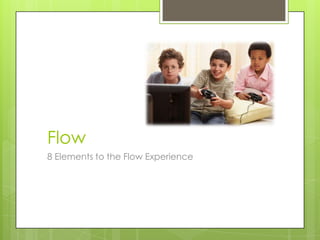
Flow
8 Elements to the Flow Experience
1. Clear goals and
feedback
Unless goals are
set, it is not
enjoyable
 Feedback sends
the message that
the learner has
succeeded in his
goal.


2. Concentration on
task at hand
 Is

able to forget
unpleasant
aspects of life.
 Only small amount
of information may
be allowed into
awareness.
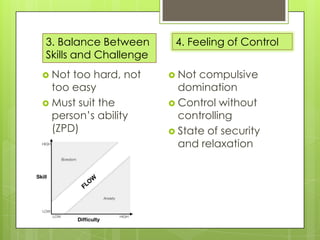
3. Balance Between
Skills and Challenge
 Not

too hard, not
too easy
 Must suit the
person’s ability
(ZPD)

4. Feeling of Control
 Not

compulsive
domination
 Control without
controlling
 State of security
and relaxation
5. Effortlessness
May look
challenging but
learner doesn’t feel
strain.
 Activity runs
smoothly guided
by inner logic.


6. Altered Perception
of Time
Time is on hold.
 Hours can feel like
minutes or seconds
can feel like much
longer – timeless.

7. Merging of Action
and Awareness
 Activity

becomes
spontaneous
 Unaware of being
separate from the
activity; totally
immersed
 Requires intense
concentration

8. IROI - Immediate
Return on
Investment
 Achieving

goal is

fulfilling.
 Activity itself is also
fulfilling.
Flow in Games
 Players

engaged on multiple levels.
 Rewards, obstacles, stories, character
traits are created.
 Difficulty is increased as gamer skills
increase.
 Users have control of learning
environment.
Future of Education?
“The essence of what’s going on now is the
adoption of brain science…It turns out that
if you teach in a different way, you can get
outcomes that are 10 – 20 times more
efficient and stickier.” Noah Bushnell, Founder of Brainrush.
“I think we can look at what happens in game
play and we should try to model that and make
more of our education system like that, where
we present kids with authentic challenges, give
them freedom to really explore those
challenges, and invent solutions.”Scot Osterweil,
Creative Director of Education Arcade, Professor MIT Media Lab
Resources
Aviva, Rutkin H. "Three Questions for Tech Education Pioneer Scot
Osterweil." MIT Technology Review. MIT, 12 Oct. 2013. Web. 10 Nov.
2013
Burzick, Andreas MPS MM"The 8 Elements of Flow." The 8 Elements of Flow. N.p., n.d. Web.
10 Nov. 2013.
"Cognitive Flow: The Psychology of Great Game Design." Gamasutra. N.p.,n.d. Web. 04
Nov. 2013.
Csikszentmihalyi, Mihaly. "Flow: The Psychology of Optimal Experience.” Global Learning
Communities 2000: n. pag. Print.
Farber, Matthew. "Gamifying Student Engagement." Edutopia (2013): n. pag. Web.
"Flow Theory." - EduTech Wiki. N.p., n.d. Web. 19 Oct. 2013.
"Greater Good." Eight Tips for Fostering Flow in the Classroom. University of California
Berkeley, n.d. Web. 19 Oct. 2013.

Prensky, Marc. Digital Natives, Digital Immigrants. S.l.: Marc Prensky, 2001. Print.

Game based learning

  • 1.
    “There is noreason that a generation that can memorize over 100 Pokemon characters with all their characteristics, history, and evolution can’t learn the names, populations, and relationships of all the 101 nations of the world.” -Prensky 2001 Game Based Learning A 21st Century Tool for Education
  • 2.
    What is GameBased Learning?    Competitive exercises either pitting students against each other or challenging themselves in order to receive a higher score, motivating them to learn more. Often have a fantasy element engaging players in a learning activity involving a storyline. In an effective educational game, learning material must be essential to scoring and winning.
  • 3.
    Why Game BasedLearning?  The majority of students play games on a regular basis.  Games engage students.  Games provide quick and specific feedback.  Consequences of a mistake are not serious or lasting.
  • 4.
    What is flow? Being fully immersed in a feeling of energized focus, full involvement, and enjoyment.  Being completely involved in an activity for its own sake  Completely focused motivation  In the “zone”
  • 5.
    Flow 8 Elements tothe Flow Experience
  • 6.
    1. Clear goalsand feedback Unless goals are set, it is not enjoyable  Feedback sends the message that the learner has succeeded in his goal.  2. Concentration on task at hand  Is able to forget unpleasant aspects of life.  Only small amount of information may be allowed into awareness.
  • 7.
    3. Balance Between Skillsand Challenge  Not too hard, not too easy  Must suit the person’s ability (ZPD) 4. Feeling of Control  Not compulsive domination  Control without controlling  State of security and relaxation
  • 8.
    5. Effortlessness May look challengingbut learner doesn’t feel strain.  Activity runs smoothly guided by inner logic.  6. Altered Perception of Time Time is on hold.  Hours can feel like minutes or seconds can feel like much longer – timeless. 
  • 9.
    7. Merging ofAction and Awareness  Activity becomes spontaneous  Unaware of being separate from the activity; totally immersed  Requires intense concentration 8. IROI - Immediate Return on Investment  Achieving goal is fulfilling.  Activity itself is also fulfilling.
  • 10.
    Flow in Games Players engaged on multiple levels.  Rewards, obstacles, stories, character traits are created.  Difficulty is increased as gamer skills increase.  Users have control of learning environment.
  • 11.
    Future of Education? “Theessence of what’s going on now is the adoption of brain science…It turns out that if you teach in a different way, you can get outcomes that are 10 – 20 times more efficient and stickier.” Noah Bushnell, Founder of Brainrush. “I think we can look at what happens in game play and we should try to model that and make more of our education system like that, where we present kids with authentic challenges, give them freedom to really explore those challenges, and invent solutions.”Scot Osterweil, Creative Director of Education Arcade, Professor MIT Media Lab
  • 12.
    Resources Aviva, Rutkin H."Three Questions for Tech Education Pioneer Scot Osterweil." MIT Technology Review. MIT, 12 Oct. 2013. Web. 10 Nov. 2013 Burzick, Andreas MPS MM"The 8 Elements of Flow." The 8 Elements of Flow. N.p., n.d. Web. 10 Nov. 2013. "Cognitive Flow: The Psychology of Great Game Design." Gamasutra. N.p.,n.d. Web. 04 Nov. 2013. Csikszentmihalyi, Mihaly. "Flow: The Psychology of Optimal Experience.” Global Learning Communities 2000: n. pag. Print. Farber, Matthew. "Gamifying Student Engagement." Edutopia (2013): n. pag. Web. "Flow Theory." - EduTech Wiki. N.p., n.d. Web. 19 Oct. 2013. "Greater Good." Eight Tips for Fostering Flow in the Classroom. University of California Berkeley, n.d. Web. 19 Oct. 2013. Prensky, Marc. Digital Natives, Digital Immigrants. S.l.: Marc Prensky, 2001. Print.