21st Century
Learning Design
making the new australian curriculum even more relevant
Sunday, 28 April 13
Innovative Teaching
and Learning
Research (ITL)
Student Centered Learning | Extend Learning
ICT for Learning
Sunday, 28 April 13
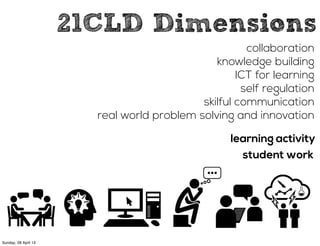
21CLD Dimensions
collaboration
knowledge building
ICT for learning
self regulation
skilful communication
real world problem solving and innovation
learning activity
student work
Sunday, 28 April 13
Collaboration
interdependent | shared responsibility | decisions
learning activity
Sunday, 28 April 13
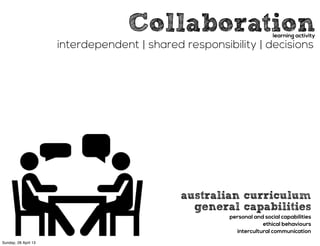
Collaboration
interdependent | shared responsibility | decisions
learning activity
australian curriculum
general capabilities
personal and social capabilities
ethical behaviours
intercultural communication
Sunday, 28 April 13
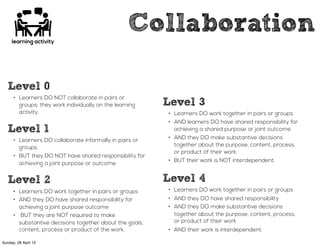
Level 3
• Learners DO work together in pairs or groups
• AND learners DO have shared responsibility for
achieving a shared purpose or joint outcome
• AND they DO make substantive decisions
together about the purpose, content, process,
or product of their work
• BUT their work is NOT interdependent.
Level 4
• Learners DO work together in pairs or groups
• AND they DO have shared responsibility
• AND they DO make substantive decisions
together about the purpose, content, process,
or product of their work
• AND their work is interdependent.
Level 0
• Learners DO NOT collaborate in pairs or
groups: they work individually on the learning
activity.
Level 1
• Learners DO collaborate informally in pairs or
groups
• BUT they DO NOT have shared responsibility for
achieving a joint purpose or outcome.
Level 2
• Learners DO work together in pairs or groups
• AND they DO have shared responsibility for
achieving a joint purpose outcome
• BUT they are NOT required to make
substantive decisions together about the goals,
content, process or product of the work.
Collaborationlearning activity
Sunday, 28 April 13
Knowledge
Construction
interdisciplinary | build | new
learning activity
Thinking designed by factor[e] design initiative from The Noun Project
Sunday, 28 April 13
Knowledge
Construction
interdisciplinary | build | new
learning activity
Thinking designed by factor[e] design initiative from The Noun Project
australian curriculum
general capabilities
Literacy
Numeracy
intercultural communication
Sunday, 28 April 13
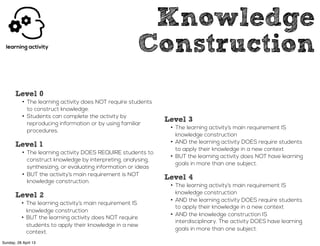
Level 0
• The learning activity does NOT require students
to construct knowledge.
• Students can complete the activity by
reproducing information or by using familiar
procedures.
Level 1
• The learning activity DOES REQUIRE students to
construct knowledge by interpreting, analysing,
synthesizing, or evaluating information or ideas
• BUT the activity’s main requirement is NOT
knowledge construction.
Level 2
• The learning activity’s main requirement IS
knowledge construction
• BUT the learning activity does NOT require
students to apply their knowledge in a new
context.
Level 3
• The learning activity’s main requirement IS
knowledge construction
• AND the learning activity DOES require students
to apply their knowledge in a new context
• BUT the learning activity does NOT have learning
goals in more than one subject.
Level 4
• The learning activity’s main requirement IS
knowledge construction
• AND the learning activity DOES require students
to apply their knowledge in a new context
• AND the knowledge construction IS
interdisciplinary. The activity DOES have learning
goals in more than one subject.
Knowledge
Constructionlearning activity
Sunday, 28 April 13
ICT for LearningLearning Activity
multimodal | ethical | freedom
Computer designed by Alyssa Mahlberg from The Noun Project
Sunday, 28 April 13
ICT for LearningLearning Activity
multimodal | ethical | freedom
Computer designed by Alyssa Mahlberg from The Noun Project
australian curriculum
general capabilities
ICT
ethical behaviours
literacy
numeracy
Sunday, 28 April 13
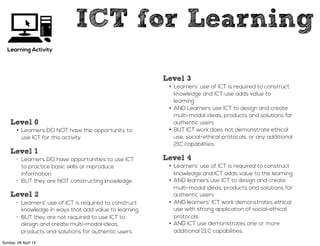
Level 0
• Learners DO NOT have the opportunity to
use ICT for this activity
Level 1
• Learners DO have opportunities to use ICT
to practice basic skills or reproduce
information
• BUT they are NOT constructing knowledge. 
Level 2
• Learners’ use of ICT is required to construct
knowledge in ways that add value to learning.
• BUT they are not required to use ICT to
design and create multi-modal ideas,
products and solutions for authentic users
Level 3
• Learners’ use of ICT is required to construct
knowledge and ICT use adds value to
learning
• AND Learners use ICT to design and create
multi-modal ideas, products and solutions for
authentic users
• BUT ICT work does not demonstrate ethical
use, social-ethical protocols, or any additional
21C capabilities.
Level 4
• Learners’ use of ICT is required to construct
knowledge and ICT adds value to the learning
• AND learners use ICT to design and create
multi-modal ideas, products and solutions for
authentic users
• AND learners’ ICT work demonstrates ethical
use with strong application of social-ethical
protocols
• AND ICT use demonstrates one or more
additional 21 C capabilities.
ICT for Learning
Learning Activity
Sunday, 28 April 13
Self Regulation
time | intentions | plan
learning activity
Thinking designed by MichaelV. Suriano from The Noun Project
Sunday, 28 April 13
Self Regulation
time | intentions | plan
learning activity
Thinking designed by MichaelV. Suriano from The Noun Project
australian curriculum
general capabilities
personal and social capabilities
ethical behaviours
critical and creative thinking
Sunday, 28 April 13
Level 0
• Pre-requisites for self regulation are NOT in
place.
• Learning activities DO NOT provide
substantive time and opportunity for
learners to develop self-regulation skills.
Level 1
• Learning activities DO provide substantive
time and opportunity for learners to develop
self-regulation skills
• BUT learners do NOT know the learning
intentions and associated success criteria in
advance of the learning work.
Level 2
• Learning activities DO provide substantive
time and opportunity for learners to develop
self-regulation skills
• AND learners DO know the learning
intentions and associated success criteria in
advance of the learning work
• BUT learners DO NOT have the opportunity
to plan their own work. 
Level 3
• Learning activities DO provide substantive
time and opportunity for learners to develop
self-regulation skills
• AND learners DO know the learning
intentions and associated success criteria in
advance of the learning work
• AND learners DO have the opportunity to
plan their own work.
• BUT learners do not have the opportunity to
use feedback to improve their learning work.
Level 4
• Learning activities provide substantive time
and opportunity for learners to develop self-
regulation skills
• AND learners DO know the learning
intentions and associated success criteria in
advance of the learning work.
• AND learners DO have the opportunity to
plan their own work.
• AND learners DO use feedback to improve
their learning work.
Self Regulation
learning activity
Sunday, 28 April 13
Skillful
Communication
coherent | multimodal | authentic audience
student work
Interview designed by Sarah Abraham from The Noun Project
Sunday, 28 April 13
Skillful
Communication
coherent | multimodal | authentic audience
student work
Interview designed by Sarah Abraham from The Noun Project
australian curriculum
general capabilities
personal and social capabilities
intercultural communication
literacy
numeracy
Sunday, 28 April 13
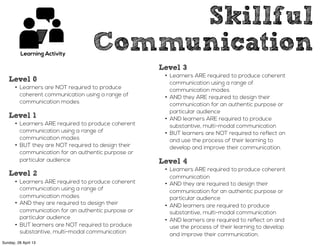
Level 0
• Learners are NOT required to produce
coherent communication using a range of
communication modes
Level 1
• Learners ARE required to produce coherent
communication using a range of
communication modes
• BUT they are NOT required to design their
communication for an authentic purpose or
particular audience
Level 2
• Learners ARE required to produce coherent
communication using a range of
communication modes
• AND they are required to design their
communication for an authentic purpose or
particular audience
• BUT learners are NOT required to produce
substantive, multi-modal communication
Level 3
• Learners ARE required to produce coherent
communication using a range of
communication modes
• AND they ARE required to design their
communication for an authentic purpose or
particular audience
• AND learners ARE required to produce
substantive, multi-modal communication
• BUT learners are NOT required to reflect on
and use the process of their learning to
develop and improve their communication.
Level 4
• Learners ARE required to produce coherent
communication
• AND they are required to design their
communication for an authentic purpose or
particular audience
• AND learners are required to produce
substantive, multi-modal communication
• AND learners are required to reflect on and
use the process of their learning to develop
and improve their communication.
Skillful
CommunicationLearning Activity
Sunday, 28 April 13
Real World
Problem Solving
and Innovation
authentic | solve | share
Learning Activity
Earth designed by Thibault Geffroy from The Noun Project
Sunday, 28 April 13
Real World
Problem Solving
and Innovation
authentic | solve | share
Learning Activity
Earth designed by Thibault Geffroy from The Noun Project
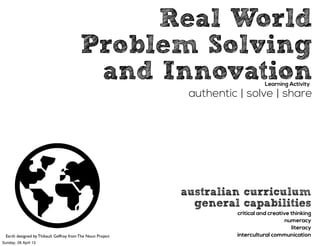
australian curriculum
general capabilities
critical and creative thinking
numeracy
literacy
intercultural communication
Sunday, 28 April 13
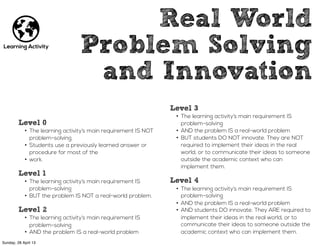
Level 0
• The learning activity’s main requirement IS NOT
problem-solving.
• Students use a previously learned answer or
procedure for most of the
• work.
Level 1
• The learning activity’s main requirement IS
problem-solving
• BUT the problem IS NOT a real-world problem.
Level 2
• The learning activity’s main requirement IS
problem-solving
• AND the problem IS a real-world problem
Level 3
• The learning activity’s main requirement IS
problem-solving
• AND the problem IS a real-world problem
• BUT students DO NOT innovate. They are NOT
required to implement their ideas in the real
world, or to communicate their ideas to someone
outside the academic context who can
implement them.
Level 4
• The learning activity’s main requirement IS
problem-solving
• AND the problem IS a real-world problem
• AND students DO innovate. They ARE required to
implement their ideas in the real world, or to
communicate their ideas to someone outside the
academic context who can implement them.
Real World
Problem Solving
and Innovation
Learning Activity
Sunday, 28 April 13
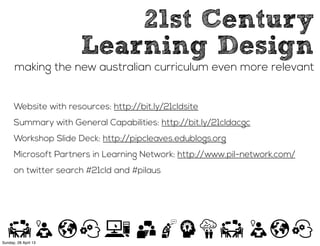
21st Century
Learning Design
making the new australian curriculum even more relevant
Website with resources: http://bit.ly/21cldsite
Summary with General Capabilities: http://bit.ly/21cldacgc
Workshop Slide Deck: http://pipcleaves.edublogs.org
Microsoft Partners in Learning Network: http://www.pil-network.com/
on twitter search #21cld and #pilaus
Sunday, 28 April 13
Sunday, 28 April 13
Sunday, 28 April 13

21st Century Learning Design

  • 1.
    21st Century Learning Design makingthe new australian curriculum even more relevant Sunday, 28 April 13
  • 2.
    Innovative Teaching and Learning Research(ITL) Student Centered Learning | Extend Learning ICT for Learning Sunday, 28 April 13
  • 3.
    21CLD Dimensions collaboration knowledge building ICTfor learning self regulation skilful communication real world problem solving and innovation learning activity student work Sunday, 28 April 13
  • 4.
    Collaboration interdependent | sharedresponsibility | decisions learning activity Sunday, 28 April 13
  • 5.
    Collaboration interdependent | sharedresponsibility | decisions learning activity australian curriculum general capabilities personal and social capabilities ethical behaviours intercultural communication Sunday, 28 April 13
  • 6.
    Level 3 • LearnersDO work together in pairs or groups • AND learners DO have shared responsibility for achieving a shared purpose or joint outcome • AND they DO make substantive decisions together about the purpose, content, process, or product of their work • BUT their work is NOT interdependent. Level 4 • Learners DO work together in pairs or groups • AND they DO have shared responsibility • AND they DO make substantive decisions together about the purpose, content, process, or product of their work • AND their work is interdependent. Level 0 • Learners DO NOT collaborate in pairs or groups: they work individually on the learning activity. Level 1 • Learners DO collaborate informally in pairs or groups • BUT they DO NOT have shared responsibility for achieving a joint purpose or outcome. Level 2 • Learners DO work together in pairs or groups • AND they DO have shared responsibility for achieving a joint purpose outcome • BUT they are NOT required to make substantive decisions together about the goals, content, process or product of the work. Collaborationlearning activity Sunday, 28 April 13
  • 7.
    Knowledge Construction interdisciplinary | build| new learning activity Thinking designed by factor[e] design initiative from The Noun Project Sunday, 28 April 13
  • 8.
    Knowledge Construction interdisciplinary | build| new learning activity Thinking designed by factor[e] design initiative from The Noun Project australian curriculum general capabilities Literacy Numeracy intercultural communication Sunday, 28 April 13
  • 9.
    Level 0 • Thelearning activity does NOT require students to construct knowledge. • Students can complete the activity by reproducing information or by using familiar procedures. Level 1 • The learning activity DOES REQUIRE students to construct knowledge by interpreting, analysing, synthesizing, or evaluating information or ideas • BUT the activity’s main requirement is NOT knowledge construction. Level 2 • The learning activity’s main requirement IS knowledge construction • BUT the learning activity does NOT require students to apply their knowledge in a new context. Level 3 • The learning activity’s main requirement IS knowledge construction • AND the learning activity DOES require students to apply their knowledge in a new context • BUT the learning activity does NOT have learning goals in more than one subject. Level 4 • The learning activity’s main requirement IS knowledge construction • AND the learning activity DOES require students to apply their knowledge in a new context • AND the knowledge construction IS interdisciplinary. The activity DOES have learning goals in more than one subject. Knowledge Constructionlearning activity Sunday, 28 April 13
  • 10.
    ICT for LearningLearningActivity multimodal | ethical | freedom Computer designed by Alyssa Mahlberg from The Noun Project Sunday, 28 April 13
  • 11.
    ICT for LearningLearningActivity multimodal | ethical | freedom Computer designed by Alyssa Mahlberg from The Noun Project australian curriculum general capabilities ICT ethical behaviours literacy numeracy Sunday, 28 April 13
  • 12.
    Level 0 • LearnersDO NOT have the opportunity to use ICT for this activity Level 1 • Learners DO have opportunities to use ICT to practice basic skills or reproduce information • BUT they are NOT constructing knowledge.  Level 2 • Learners’ use of ICT is required to construct knowledge in ways that add value to learning. • BUT they are not required to use ICT to design and create multi-modal ideas, products and solutions for authentic users Level 3 • Learners’ use of ICT is required to construct knowledge and ICT use adds value to learning • AND Learners use ICT to design and create multi-modal ideas, products and solutions for authentic users • BUT ICT work does not demonstrate ethical use, social-ethical protocols, or any additional 21C capabilities. Level 4 • Learners’ use of ICT is required to construct knowledge and ICT adds value to the learning • AND learners use ICT to design and create multi-modal ideas, products and solutions for authentic users • AND learners’ ICT work demonstrates ethical use with strong application of social-ethical protocols • AND ICT use demonstrates one or more additional 21 C capabilities. ICT for Learning Learning Activity Sunday, 28 April 13
  • 13.
    Self Regulation time |intentions | plan learning activity Thinking designed by MichaelV. Suriano from The Noun Project Sunday, 28 April 13
  • 14.
    Self Regulation time |intentions | plan learning activity Thinking designed by MichaelV. Suriano from The Noun Project australian curriculum general capabilities personal and social capabilities ethical behaviours critical and creative thinking Sunday, 28 April 13
  • 15.
    Level 0 • Pre-requisitesfor self regulation are NOT in place. • Learning activities DO NOT provide substantive time and opportunity for learners to develop self-regulation skills. Level 1 • Learning activities DO provide substantive time and opportunity for learners to develop self-regulation skills • BUT learners do NOT know the learning intentions and associated success criteria in advance of the learning work. Level 2 • Learning activities DO provide substantive time and opportunity for learners to develop self-regulation skills • AND learners DO know the learning intentions and associated success criteria in advance of the learning work • BUT learners DO NOT have the opportunity to plan their own work.  Level 3 • Learning activities DO provide substantive time and opportunity for learners to develop self-regulation skills • AND learners DO know the learning intentions and associated success criteria in advance of the learning work • AND learners DO have the opportunity to plan their own work. • BUT learners do not have the opportunity to use feedback to improve their learning work. Level 4 • Learning activities provide substantive time and opportunity for learners to develop self- regulation skills • AND learners DO know the learning intentions and associated success criteria in advance of the learning work. • AND learners DO have the opportunity to plan their own work. • AND learners DO use feedback to improve their learning work. Self Regulation learning activity Sunday, 28 April 13
  • 16.
    Skillful Communication coherent | multimodal| authentic audience student work Interview designed by Sarah Abraham from The Noun Project Sunday, 28 April 13
  • 17.
    Skillful Communication coherent | multimodal| authentic audience student work Interview designed by Sarah Abraham from The Noun Project australian curriculum general capabilities personal and social capabilities intercultural communication literacy numeracy Sunday, 28 April 13
  • 18.
    Level 0 • Learnersare NOT required to produce coherent communication using a range of communication modes Level 1 • Learners ARE required to produce coherent communication using a range of communication modes • BUT they are NOT required to design their communication for an authentic purpose or particular audience Level 2 • Learners ARE required to produce coherent communication using a range of communication modes • AND they are required to design their communication for an authentic purpose or particular audience • BUT learners are NOT required to produce substantive, multi-modal communication Level 3 • Learners ARE required to produce coherent communication using a range of communication modes • AND they ARE required to design their communication for an authentic purpose or particular audience • AND learners ARE required to produce substantive, multi-modal communication • BUT learners are NOT required to reflect on and use the process of their learning to develop and improve their communication. Level 4 • Learners ARE required to produce coherent communication • AND they are required to design their communication for an authentic purpose or particular audience • AND learners are required to produce substantive, multi-modal communication • AND learners are required to reflect on and use the process of their learning to develop and improve their communication. Skillful CommunicationLearning Activity Sunday, 28 April 13
  • 19.
    Real World Problem Solving andInnovation authentic | solve | share Learning Activity Earth designed by Thibault Geffroy from The Noun Project Sunday, 28 April 13
  • 20.
    Real World Problem Solving andInnovation authentic | solve | share Learning Activity Earth designed by Thibault Geffroy from The Noun Project australian curriculum general capabilities critical and creative thinking numeracy literacy intercultural communication Sunday, 28 April 13
  • 21.
    Level 0 • Thelearning activity’s main requirement IS NOT problem-solving. • Students use a previously learned answer or procedure for most of the • work. Level 1 • The learning activity’s main requirement IS problem-solving • BUT the problem IS NOT a real-world problem. Level 2 • The learning activity’s main requirement IS problem-solving • AND the problem IS a real-world problem Level 3 • The learning activity’s main requirement IS problem-solving • AND the problem IS a real-world problem • BUT students DO NOT innovate. They are NOT required to implement their ideas in the real world, or to communicate their ideas to someone outside the academic context who can implement them. Level 4 • The learning activity’s main requirement IS problem-solving • AND the problem IS a real-world problem • AND students DO innovate. They ARE required to implement their ideas in the real world, or to communicate their ideas to someone outside the academic context who can implement them. Real World Problem Solving and Innovation Learning Activity Sunday, 28 April 13
  • 22.
    21st Century Learning Design makingthe new australian curriculum even more relevant Website with resources: http://bit.ly/21cldsite Summary with General Capabilities: http://bit.ly/21cldacgc Workshop Slide Deck: http://pipcleaves.edublogs.org Microsoft Partners in Learning Network: http://www.pil-network.com/ on twitter search #21cld and #pilaus Sunday, 28 April 13
  • 23.
  • 24.