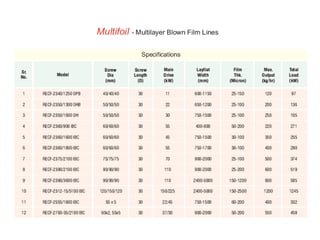
Multi Layer Composite Films Theory Presented by Shrikant Athavale For PG Students , SIES Nerul On 06-11-2010
Introduction Film extrusion is one of the most important processes for plastics accounting for almost a quarter of all thermoplastics consumed Has enjoyed some periods of rapid growth in recent years, particularly within the packaging industry Film is defined as a sheet less than 250  μ m in thickness There are two types of film extrusion: cast film and blown film
Background of Flat Film Forming Dies T-slot Coat hanger Coextrusion Rolling/Cooling of Film Wind up Process dependent properties Model Uses Applications
TOPAS is an amorphous, transparent copolymer based on the polymerization of ethylene and norbornene using metallocene catalysts. Its property profile can be varied over a wide range by adjusting the chemical structure during polymerization. These new materials exhibit a unique combination of properties whose performance benefits include:
High transparency and gloss Excellent moisture and aroma barrier Variable glass transition temperatures from 65°C up to 178°C High stiffness and strength Easy to extrude and thermoform Compatibility with polyolefins Excellent biocompatibility and inertness Resists  acids and alkalis The advantages of Multilayer Films are
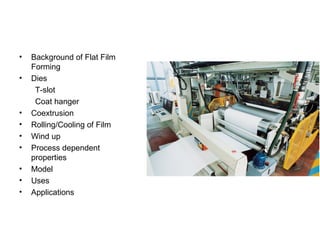
Introduction Cast film extrusion is a continuous operation of melting and conveying a polymer in a heated screw-and-barrel assembly Polymer is extruded through a slit onto a chilled, highly polished turning roll Film is sent to a second roller for cooling on the other side Alternatively, polymer web is passed through a quench tank for cooling Film then passes through a system of rollers, which have different purposes, and is finally wound onto a roll for storage
Dies Most flat dies are of T-slot or coat hanger designs, which contain a manifold to spread the flowing polymer across the width of the die, followed downstream by alternating narrow and open slits to create the desired flow distribution and pressure drop
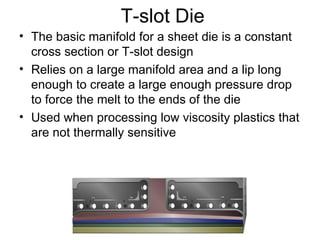
T-slot Die The basic manifold for a sheet die is a constant cross section or T-slot design Relies on a large manifold area and a lip long enough to create a large enough pressure drop to force the melt to the ends of the die Used when processing low viscosity plastics that are not thermally sensitive
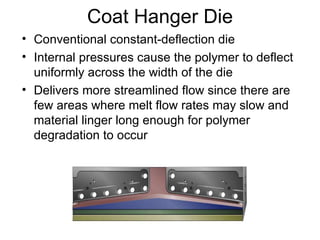
Coat Hanger Die Conventional constant-deflection die Internal pressures cause the polymer to deflect uniformly across the width of the die Delivers more streamlined flow since there are few areas where melt flow rates may slow and material linger long enough for polymer degradation to occur
Coextrusion Most cast film lines today are coextrusion lines, combining layers from as many as 7 extruders into the product through multi-manifold dies, or else single manifold dies with the aid of feedblocks When the materials enter the die, they are no longer confined individually within steel channels. They are in intimate contact with each other and in the fluid state Layers in the final film will be uniform if the adjoining materials have a reasonable rheological match and there is uniform flow distribution inside the die When layer distortion occurs it happens in the die, not the feedblock, during the transition or distribution in shape from the square incoming stream to the wide, thin film shape
 
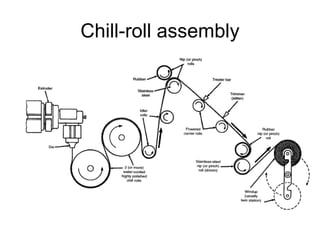
Chill-roll assembly
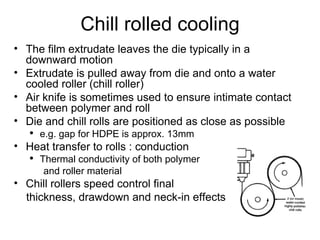
Chill rolled cooling The film extrudate leaves the die typically in a downward motion Extrudate is pulled away from die and onto a water cooled roller (chill roller) Air knife is sometimes used to ensure intimate contact between polymer and roll Die and chill rolls are positioned as close as possible  e.g. gap for HDPE is approx. 13mm Heat transfer to rolls : conduction Thermal conductivity of both polymer  and roller material Chill rollers speed control final  thickness, drawdown and neck-in effects
Contacting the chill roll Optimally, the molten polymer drops onto the chill roll and contacts tangentially The alignment or parallelism of this roll to the die is critical in relation to the falling film Whenever wrinkling of the film occurs on the casting roll surface, it is likely that the first roll must be repositioned
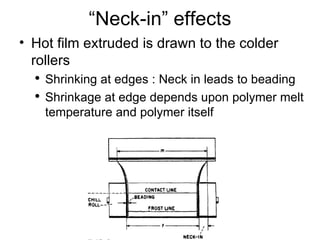
“ Neck-in” effects Hot film extruded is drawn to the colder rollers Shrinking at edges : Neck in leads to beading Shrinkage at edge depends upon polymer melt temperature and polymer itself
Chill rollers High gloss finish – chromium finish for highly polished roll Matte finish – metal rolls are sandblasted, acid etched, or machined Design Criteria: polymer cannot stick to rollers Thermal conductivity and conduction of heat from molten polymer to chilled rollers At least two or more rolls
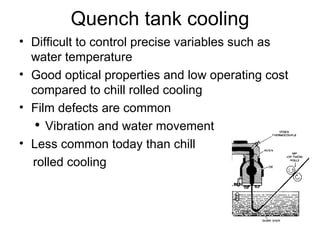
Quench tank cooling Difficult to control precise variables such as water temperature Good optical properties and low operating cost compared to chill rolled cooling Film defects are common  Vibration and water movement Less common today than chill rolled cooling
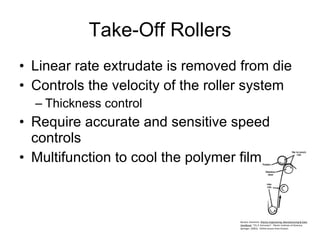
Take-Off Rollers Linear rate extrudate is removed from die Controls the velocity of the roller system Thickness control Require accurate and sensitive speed controls Multifunction to cool the polymer film Rosato, Dominick.  Plastics Engineering, Manufacturing & Data Handbook . “Ch.3: Extrusion”.  Plastic Institute of America.  Springer. (2001).  Online access from Knovel.
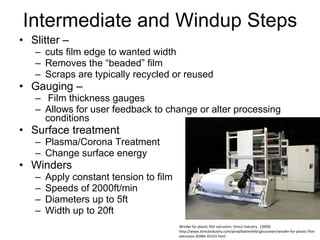
Intermediate and Windup Steps Slitter –  cuts film edge to wanted width Removes the “beaded” film Scraps are typically recycled or reused Gauging – Film thickness gauges Allows for user feedback to change or alter processing conditions Surface treatment  Plasma/Corona Treatment Change surface energy Winders Apply constant tension to film Speeds of 2000ft/min Diameters up to 5ft Width up to 20ft Winder for plastic film extrusion. Direct Industry.  (2009) http://www.directindustry.com/prod/battenfeld-gloucester/winder-for-plastic-film-extrusion-20385-45141.html Winder for plastic film extrusion. Direct Industry.  (2009) http://www.directindustry.com/prod/battenfeld-gloucester/winder-for-plastic-film-extrusion-20385-45141.html
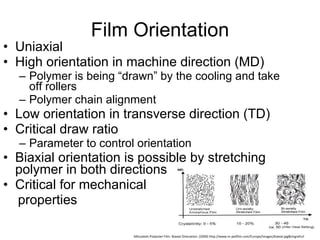
Film Orientation Uniaxial High orientation in machine direction (MD) Polymer is being “drawn” by the cooling and take off rollers Polymer chain alignment  Low orientation in transverse direction (TD) Critical draw ratio Parameter to control orientation Biaxial orientation is possible by stretching polymer in both directions Critical for mechanical  properties  Mitsubishi Polyester Film. Biaxial Orienation. (2009) http://www.m-petfilm.com/Europe/images/biaxial.jpg&imgrefurl
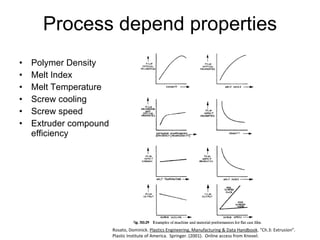
Process depend properties Polymer Density Melt Index Melt Temperature Screw cooling Screw speed Extruder compound efficiency Rosato, Dominick.  Plastics Engineering, Manufacturing & Data Handbook . “Ch.3: Extrusion”.  Plastic Institute of America.  Springer. (2001).  Online access from Knovel.
Optical Properties  Melt temperature (T m ) Lower Relative T m : Hazy, lower elongation at break and tensile strength Higher Relative T m : Glossy finish, higher elongation at break and tensile strength Cooling Rollers: Optimal optical properties: 10 ° C  less than temperature need to melt polymer onto the rollers Must control within 2 ° C   range
Common Polymers Polyolefins are the most widely-used plastics for film extrusion Polyolefins that can be extruded as monolayer and multi-layer film: low density polyethylene (LDPE) linear low density polyethylene (LLDPE) high density polyethylene (HDPE) ethylene copolymers ethylene vinyl acetate (EVA), ethylene methyl acrylate (EMA) polypropylene and propylene copolymers thermoplastic olefins (TPOs)
Benefits Advantages of polyolefin films: Ease of processing Light weight Good toughness and tear resistance Flexibility (even at low temperatures) Outstanding chemical resistance Relatively low cost compared with other plastics
Properties The basic properties of polyolefins can be changed using a broad range of chemical modifiers In addition, polyolefin-based films can be coextruded with various other polymers, including ethylene vinyl alcohol (EVOH), nylon, polyester barrier resins and adhesive tielayers, to produce multilayer films with special, high-performance properties
Forming webs  } improved forming window and uniformity Soft shrink film  } tough, stiff, soft shrink, halogen-free, polyolefin Shrink sleeves and labels  } high shrinkage and stiffness with low shrink force Slip additive  } non-migrating for reduced ambient and hot COF in polyolefin film Sealant films  } additional stiffness, improved seal strength and hot tack Twist wrap  } high end clarity and gloss, excellent deadfold Bags/pouches  } increased stiffness at room temperature and under hot-fill conditions, easy tear, retort performance Medical trays  } high moisture barrier, deep draw, clarity Paperboard coating  } increased moisture barrier, reduced curl Zipper closures  } reduced warping and camber, increased opening force Blister packs  } high moisture barrier, deep draw, halogen-free Critical Applications  Of multilayer Films
Properties Optical properties TOPAS forms clear, colorless films which are finding utility in optical films for a variety of uses such as retardation, polarization, and brightness enhancement. Their light transmittance as shown in Figure 6 extends through the visible spectrum into the near UV and exceeds that of polystyrene (PS), polycarbonate (PC), and nearly equals that of polymethyl methacrylate (PMMA). TOPAS films have low birefringence and very low haze.
Barrier properties TOPAS is being increasingly utilized as a barrier material in packaging. Packaging must preserve the taste, flavor and composition of packaged foods and the composition of non-food items such as fragrances. It must prevent excessive amounts of oxygen, water, solvents, flavors, aromas and other gases or liquids from leaving or entering a package. This has become more important as food packaging has moved away from heavy, inflexible glass and metal containers to those made of plastic. Such packaging often involves sophisticated, multilayer structures containing high-barrier polymers like EVOH and PVdC. These structures can be costly, require adhesive polymers, advanced and expensive processing equipment, and reduce the potential for recycling. TOPAS has one of the highest moisture barriers of any polymeric material. While not considered a high barrier to oxygen or other gases, it is a significantly better barrier than polyethylene and can be used in blends to modify oxygen, carbon dioxide and other gas transmission rates to target specific values such as those required by fruits and vegetables. TOPAS has four to five times better barrier than LDPE over a broad range of permeants and does not require an adhesive in combinations with polyethylenes. Blends with polyethylene having more than 70% TOPAS typically provide over 90% of the barrier of pure TOPAS. This can dramatically improve the performance of a packaging film in preserving the original characteristics of a package’s contents or moderating the transfer or loss of aromas and odors as illustrated in Figure 8. TOPAS barrier layers can compensate for the poor water vapor transmission performance of commonly used oxygen barrier materials such as nylon and EVOH.
performance of a packaging film in preserving the original characteristics of a package’s contents or moderating the transfer or loss of aromas and odors as illustrated in Figure 8. TOPAS barrier layers can compensate for the poor water vapor transmission performance of commonly used oxygen barrier materials such as nylon and EVOH.
Deadfold TOPAS has a high modulus which can be utilized to produce a film with the deadfold characteristics required by twist-wrapped candy. These applications often require an expensive cellophane film. A film having thin outer TOPAS layers (20 to 40% of total thickness) and a PE core has excellent deadfold, clarity, recyclability and a high gloss surface with good metallizability. These TOPAS-based twist films have proven to be processable on commercial highspeed wrapping lines designed for cellophane where conventional polyolefin films fail.
Coefficient of friction TOPAS can reduce the coefficient of friction (COF) to commercially acceptable levels in cast PE films. Blending in ~10% TOPAS by weight can produce medium-slip films useful for vertical form-fill-seal operations (a COF of 0.2 to 0.4). A process melt temperature of no more than about 180°C is needed for blends containing low Tg TOPAS grades, while a higher process melt temperature of up to 240°C can be used for blends with high Tg material. TOPAS resins are thus viable alternatives as non-migratory, non-contaminating slip additives when processed at relatively low temperatures. Lower temperature processing may affect haze, but does not affect printability or sealing properties.
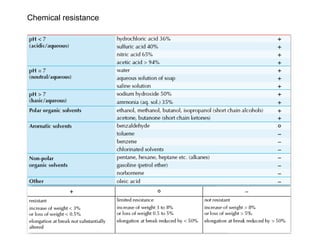
Chemical resistance TOPAS is very pure because the metallocene catalyst used in its production is filtered from most grades after polymerization. It also is extremely low in extractables, e.g. hexane extractables are 0.3% or less and ash is nearly zero. It easily passes the European Pharmacopoeia Section 3.1.3 extractable test for polyolefins. It has excellent organoleptic properties. Tests with various food components have yielded lower extractables and similar scalping levels to those of standard PE resins. As a non-polar material, TOPAS is highly resistant to polar compounds such as water, alcohol and acetone. Like most polyolefins, it is less resistant to nonpolar materials. TOPAS should be tested against specific compounds when chemical resistance is critical in an application.
Chemical resistance
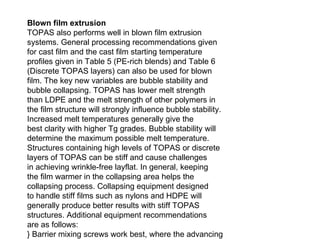
Blown film extrusion TOPAS also performs well in blown film extrusion systems. General processing recommendations given for cast film and the cast film starting temperature profiles given in Table 5 (PE-rich blends) and Table 6 (Discrete TOPAS layers) can also be used for blown film. The key new variables are bubble stability and bubble collapsing. TOPAS has lower melt strength than LDPE and the melt strength of other polymers in the film structure will strongly influence bubble stability. Increased melt temperatures generally give the best clarity with higher Tg grades. Bubble stability will determine the maximum possible melt temperature. Structures containing high levels of TOPAS or discrete layers of TOPAS can be stiff and cause challenges in achieving wrinkle-free layflat. In general, keeping the film warmer in the collapsing area helps the collapsing process. Collapsing equipment designed to handle stiff films such as nylons and HDPE will generally produce better results with stiff TOPAS structures. Additional equipment recommendations are as follows: } Barrier mixing screws work best, where the advancing melt pool is separated from unmelted pellets. Maddock mixing sections have proven effective. } A preferred screw has a screw L/D ratio (screw length to diameter) of 24:1 or above and a low compression ratio for optimum melt homogeneity. A standard blown film tower can be used. } Grooved feed extruders are not preferred but may be used with improved processibility grades such as 8007F-400. Heated feed zones are sometimes required for good processability in grooved feed extruders. } Use typical spiral dies and die gaps of 1.5 to 2.25 mm (60 to 90 mils). } Recommended blow-up ratio (BUR) is 2:1, but good results have been achieved at 1.5:1 to 3.5:1.
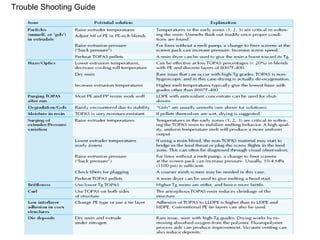
Trouble Shooting Guide
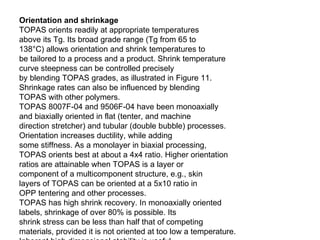
Orientation and shrinkage TOPAS orients readily at appropriate temperatures above its Tg. Its broad grade range (Tg from 65 to 138°C) allows orientation and shrink temperatures to be tailored to a process and a product. Shrink temperature curve steepness can be controlled precisely by blending TOPAS grades, as illustrated in Figure 11. Shrinkage rates can also be influenced by blending TOPAS with other polymers. TOPAS 8007F-04 and 9506F-04 have been monoaxially and biaxially oriented in flat (tenter, and machine direction stretcher) and tubular (double bubble) processes. Orientation increases ductility, while adding some stiffness. As a monolayer in biaxial processing, TOPAS orients best at about a 4x4 ratio. Higher orientation ratios are attainable when TOPAS is a layer or component of a multicomponent structure, e.g., skin layers of TOPAS can be oriented at a 5x10 ratio in OPP tentering and other processes. TOPAS has high shrink recovery. In monoaxially oriented labels, shrinkage of over 80% is possible. Its shrink stress can be less than half that of competing materials, provided it is not oriented at too low a temperature. Inherent high dimensional stability is useful in shrink applications by reducing film shrinkage below its Tg, e.g., in warm storage conditions.
Sealing Heat-sealing capability is usually specified by seal strength, hot tack strength and seal initiation temperature. As it cools, TOPAS transitions from a rubbery to a glassy state to create a high-modulus material at 65°C (TOPAS 9506) to 78°C (TOPAS 8007). This adds significant seal strength at temperatures where PE has low strength and modulus. When blended with PE, TOPAS broadens the seal temperature range of many polyethylenes. Figure 12 shows a typical case where the seal range for pure LLDPE is extended and the seal strength is also noticeably higher. TOPAS often improves hot tack performance (strength of the hot seal after cooling for 0.1 sec.) as much as 100%. Hot tack strength is important in vertical form, fill and seal equipment where contents are dropped into bags while the seal is still hot. The more robust sealing performance with TOPAS is valuable in a wide range of "real-world" packaging situations. When an all-TOPAS surface layer is used in a packaging film, the film can be sealed to itself much like a PE film. For example, TOPAS 8007F-04 seals to itself at a seal initiation temperature of 105°C (defined as seal temperature where 8.8 N seal strength is achieved). The seal strength of the TOPAS-TOPAS seal is similar to that of LDPE and LLDPE. It also has good hot-tack strength. The high modulus of TOPAS means the seal may not be as tough as that of other materials, although the seal will be hermetic.
Sterilization TOPAS can be sterilized by all common methods, including gamma radiation, e-beam or beta irradiation, ethylene oxide and steam as shown in Table 10. It is relatively stable to gamma irradiation at a dosage to 5 Mrad. Its tensile strength, Izod impact strength and other mechanical properties show little change after exposure and after 12 months aging. It does yellow slightly immediately after exposure, but this fades over several days to nearly the initial color. TOPAS 6013 can be steam sterilized, typically at 121°C for 20 minutes. The procedure for sterilizing TOPAS calls for venting the steam with dry air above 120°C. Drying should last about 60 minutes, depend- ing on size and thickness, to gain the desired clarity before cooling to room temperature. For thermal sterilization, air pressure in the autoclave should match the steam pressure. E-beam or beta irradiation causes TOPAS to yellow slightly. The color fades to the original color in about 10 days. The intensity of the color shift is proportional to dosage. TOPAS is unaffected by ethylene oxide sterilization and the temperatures this involves (above 60°C in some cases).
Printing Printing is usually difficult on traditional PE film because it lacks sufficient modulus, is not thermally stable, and must be carefully dried in an oven to drive off the ink solvent. In contrast, TOPAS provides a superior printing surface by improving flatness, increasing temperature resistance and providing a glossy, high quality surface. TOPAS can also be blended with olefins to raise thermal resistance and modulus, which aids web handling and reduces film elongation under tension for better print registration since adding as little as 10% TOPAS to LLDPE doubles film modulus. Like other olefins, TOPAS films require pretreatment with corona or plasma before printing. Their low moisture absorption, high modulus and heat resistance can overcome film processibility problems and deliver more consistent yields. Standard polyolefin ink systems are effective for TOPAS and TOPAS/PE blends.


02.multi layer composite films

  • 1.
    Multi Layer CompositeFilms Theory Presented by Shrikant Athavale For PG Students , SIES Nerul On 06-11-2010
  • 2.
    Introduction Film extrusionis one of the most important processes for plastics accounting for almost a quarter of all thermoplastics consumed Has enjoyed some periods of rapid growth in recent years, particularly within the packaging industry Film is defined as a sheet less than 250 μ m in thickness There are two types of film extrusion: cast film and blown film
  • 3.
    Background of FlatFilm Forming Dies T-slot Coat hanger Coextrusion Rolling/Cooling of Film Wind up Process dependent properties Model Uses Applications
  • 4.
    TOPAS is anamorphous, transparent copolymer based on the polymerization of ethylene and norbornene using metallocene catalysts. Its property profile can be varied over a wide range by adjusting the chemical structure during polymerization. These new materials exhibit a unique combination of properties whose performance benefits include:
  • 5.
    High transparency andgloss Excellent moisture and aroma barrier Variable glass transition temperatures from 65°C up to 178°C High stiffness and strength Easy to extrude and thermoform Compatibility with polyolefins Excellent biocompatibility and inertness Resists acids and alkalis The advantages of Multilayer Films are
  • 6.
    Introduction Cast filmextrusion is a continuous operation of melting and conveying a polymer in a heated screw-and-barrel assembly Polymer is extruded through a slit onto a chilled, highly polished turning roll Film is sent to a second roller for cooling on the other side Alternatively, polymer web is passed through a quench tank for cooling Film then passes through a system of rollers, which have different purposes, and is finally wound onto a roll for storage
  • 7.
    Dies Most flatdies are of T-slot or coat hanger designs, which contain a manifold to spread the flowing polymer across the width of the die, followed downstream by alternating narrow and open slits to create the desired flow distribution and pressure drop
  • 8.
    T-slot Die Thebasic manifold for a sheet die is a constant cross section or T-slot design Relies on a large manifold area and a lip long enough to create a large enough pressure drop to force the melt to the ends of the die Used when processing low viscosity plastics that are not thermally sensitive
  • 9.
    Coat Hanger DieConventional constant-deflection die Internal pressures cause the polymer to deflect uniformly across the width of the die Delivers more streamlined flow since there are few areas where melt flow rates may slow and material linger long enough for polymer degradation to occur
  • 10.
    Coextrusion Most castfilm lines today are coextrusion lines, combining layers from as many as 7 extruders into the product through multi-manifold dies, or else single manifold dies with the aid of feedblocks When the materials enter the die, they are no longer confined individually within steel channels. They are in intimate contact with each other and in the fluid state Layers in the final film will be uniform if the adjoining materials have a reasonable rheological match and there is uniform flow distribution inside the die When layer distortion occurs it happens in the die, not the feedblock, during the transition or distribution in shape from the square incoming stream to the wide, thin film shape
  • 11.
  • 12.
  • 13.
    Chill rolled coolingThe film extrudate leaves the die typically in a downward motion Extrudate is pulled away from die and onto a water cooled roller (chill roller) Air knife is sometimes used to ensure intimate contact between polymer and roll Die and chill rolls are positioned as close as possible e.g. gap for HDPE is approx. 13mm Heat transfer to rolls : conduction Thermal conductivity of both polymer and roller material Chill rollers speed control final thickness, drawdown and neck-in effects
  • 14.
    Contacting the chillroll Optimally, the molten polymer drops onto the chill roll and contacts tangentially The alignment or parallelism of this roll to the die is critical in relation to the falling film Whenever wrinkling of the film occurs on the casting roll surface, it is likely that the first roll must be repositioned
  • 15.
    “ Neck-in” effectsHot film extruded is drawn to the colder rollers Shrinking at edges : Neck in leads to beading Shrinkage at edge depends upon polymer melt temperature and polymer itself
  • 16.
    Chill rollers Highgloss finish – chromium finish for highly polished roll Matte finish – metal rolls are sandblasted, acid etched, or machined Design Criteria: polymer cannot stick to rollers Thermal conductivity and conduction of heat from molten polymer to chilled rollers At least two or more rolls
  • 17.
    Quench tank coolingDifficult to control precise variables such as water temperature Good optical properties and low operating cost compared to chill rolled cooling Film defects are common Vibration and water movement Less common today than chill rolled cooling
  • 18.
    Take-Off Rollers Linearrate extrudate is removed from die Controls the velocity of the roller system Thickness control Require accurate and sensitive speed controls Multifunction to cool the polymer film Rosato, Dominick. Plastics Engineering, Manufacturing & Data Handbook . “Ch.3: Extrusion”. Plastic Institute of America. Springer. (2001). Online access from Knovel.
  • 19.
    Intermediate and WindupSteps Slitter – cuts film edge to wanted width Removes the “beaded” film Scraps are typically recycled or reused Gauging – Film thickness gauges Allows for user feedback to change or alter processing conditions Surface treatment Plasma/Corona Treatment Change surface energy Winders Apply constant tension to film Speeds of 2000ft/min Diameters up to 5ft Width up to 20ft Winder for plastic film extrusion. Direct Industry. (2009) http://www.directindustry.com/prod/battenfeld-gloucester/winder-for-plastic-film-extrusion-20385-45141.html Winder for plastic film extrusion. Direct Industry. (2009) http://www.directindustry.com/prod/battenfeld-gloucester/winder-for-plastic-film-extrusion-20385-45141.html
  • 20.
    Film Orientation UniaxialHigh orientation in machine direction (MD) Polymer is being “drawn” by the cooling and take off rollers Polymer chain alignment Low orientation in transverse direction (TD) Critical draw ratio Parameter to control orientation Biaxial orientation is possible by stretching polymer in both directions Critical for mechanical properties Mitsubishi Polyester Film. Biaxial Orienation. (2009) http://www.m-petfilm.com/Europe/images/biaxial.jpg&imgrefurl
  • 21.
    Process depend propertiesPolymer Density Melt Index Melt Temperature Screw cooling Screw speed Extruder compound efficiency Rosato, Dominick. Plastics Engineering, Manufacturing & Data Handbook . “Ch.3: Extrusion”. Plastic Institute of America. Springer. (2001). Online access from Knovel.
  • 22.
    Optical Properties Melt temperature (T m ) Lower Relative T m : Hazy, lower elongation at break and tensile strength Higher Relative T m : Glossy finish, higher elongation at break and tensile strength Cooling Rollers: Optimal optical properties: 10 ° C less than temperature need to melt polymer onto the rollers Must control within 2 ° C range
  • 23.
    Common Polymers Polyolefinsare the most widely-used plastics for film extrusion Polyolefins that can be extruded as monolayer and multi-layer film: low density polyethylene (LDPE) linear low density polyethylene (LLDPE) high density polyethylene (HDPE) ethylene copolymers ethylene vinyl acetate (EVA), ethylene methyl acrylate (EMA) polypropylene and propylene copolymers thermoplastic olefins (TPOs)
  • 24.
    Benefits Advantages ofpolyolefin films: Ease of processing Light weight Good toughness and tear resistance Flexibility (even at low temperatures) Outstanding chemical resistance Relatively low cost compared with other plastics
  • 25.
    Properties The basicproperties of polyolefins can be changed using a broad range of chemical modifiers In addition, polyolefin-based films can be coextruded with various other polymers, including ethylene vinyl alcohol (EVOH), nylon, polyester barrier resins and adhesive tielayers, to produce multilayer films with special, high-performance properties
  • 26.
    Forming webs } improved forming window and uniformity Soft shrink film } tough, stiff, soft shrink, halogen-free, polyolefin Shrink sleeves and labels } high shrinkage and stiffness with low shrink force Slip additive } non-migrating for reduced ambient and hot COF in polyolefin film Sealant films } additional stiffness, improved seal strength and hot tack Twist wrap } high end clarity and gloss, excellent deadfold Bags/pouches } increased stiffness at room temperature and under hot-fill conditions, easy tear, retort performance Medical trays } high moisture barrier, deep draw, clarity Paperboard coating } increased moisture barrier, reduced curl Zipper closures } reduced warping and camber, increased opening force Blister packs } high moisture barrier, deep draw, halogen-free Critical Applications Of multilayer Films
  • 27.
    Properties Optical propertiesTOPAS forms clear, colorless films which are finding utility in optical films for a variety of uses such as retardation, polarization, and brightness enhancement. Their light transmittance as shown in Figure 6 extends through the visible spectrum into the near UV and exceeds that of polystyrene (PS), polycarbonate (PC), and nearly equals that of polymethyl methacrylate (PMMA). TOPAS films have low birefringence and very low haze.
  • 28.
    Barrier properties TOPASis being increasingly utilized as a barrier material in packaging. Packaging must preserve the taste, flavor and composition of packaged foods and the composition of non-food items such as fragrances. It must prevent excessive amounts of oxygen, water, solvents, flavors, aromas and other gases or liquids from leaving or entering a package. This has become more important as food packaging has moved away from heavy, inflexible glass and metal containers to those made of plastic. Such packaging often involves sophisticated, multilayer structures containing high-barrier polymers like EVOH and PVdC. These structures can be costly, require adhesive polymers, advanced and expensive processing equipment, and reduce the potential for recycling. TOPAS has one of the highest moisture barriers of any polymeric material. While not considered a high barrier to oxygen or other gases, it is a significantly better barrier than polyethylene and can be used in blends to modify oxygen, carbon dioxide and other gas transmission rates to target specific values such as those required by fruits and vegetables. TOPAS has four to five times better barrier than LDPE over a broad range of permeants and does not require an adhesive in combinations with polyethylenes. Blends with polyethylene having more than 70% TOPAS typically provide over 90% of the barrier of pure TOPAS. This can dramatically improve the performance of a packaging film in preserving the original characteristics of a package’s contents or moderating the transfer or loss of aromas and odors as illustrated in Figure 8. TOPAS barrier layers can compensate for the poor water vapor transmission performance of commonly used oxygen barrier materials such as nylon and EVOH.
  • 29.
    performance of apackaging film in preserving the original characteristics of a package’s contents or moderating the transfer or loss of aromas and odors as illustrated in Figure 8. TOPAS barrier layers can compensate for the poor water vapor transmission performance of commonly used oxygen barrier materials such as nylon and EVOH.
  • 30.
    Deadfold TOPAS hasa high modulus which can be utilized to produce a film with the deadfold characteristics required by twist-wrapped candy. These applications often require an expensive cellophane film. A film having thin outer TOPAS layers (20 to 40% of total thickness) and a PE core has excellent deadfold, clarity, recyclability and a high gloss surface with good metallizability. These TOPAS-based twist films have proven to be processable on commercial highspeed wrapping lines designed for cellophane where conventional polyolefin films fail.
  • 31.
    Coefficient of frictionTOPAS can reduce the coefficient of friction (COF) to commercially acceptable levels in cast PE films. Blending in ~10% TOPAS by weight can produce medium-slip films useful for vertical form-fill-seal operations (a COF of 0.2 to 0.4). A process melt temperature of no more than about 180°C is needed for blends containing low Tg TOPAS grades, while a higher process melt temperature of up to 240°C can be used for blends with high Tg material. TOPAS resins are thus viable alternatives as non-migratory, non-contaminating slip additives when processed at relatively low temperatures. Lower temperature processing may affect haze, but does not affect printability or sealing properties.
  • 32.
    Chemical resistance TOPASis very pure because the metallocene catalyst used in its production is filtered from most grades after polymerization. It also is extremely low in extractables, e.g. hexane extractables are 0.3% or less and ash is nearly zero. It easily passes the European Pharmacopoeia Section 3.1.3 extractable test for polyolefins. It has excellent organoleptic properties. Tests with various food components have yielded lower extractables and similar scalping levels to those of standard PE resins. As a non-polar material, TOPAS is highly resistant to polar compounds such as water, alcohol and acetone. Like most polyolefins, it is less resistant to nonpolar materials. TOPAS should be tested against specific compounds when chemical resistance is critical in an application.
  • 33.
  • 34.
    Blown film extrusionTOPAS also performs well in blown film extrusion systems. General processing recommendations given for cast film and the cast film starting temperature profiles given in Table 5 (PE-rich blends) and Table 6 (Discrete TOPAS layers) can also be used for blown film. The key new variables are bubble stability and bubble collapsing. TOPAS has lower melt strength than LDPE and the melt strength of other polymers in the film structure will strongly influence bubble stability. Increased melt temperatures generally give the best clarity with higher Tg grades. Bubble stability will determine the maximum possible melt temperature. Structures containing high levels of TOPAS or discrete layers of TOPAS can be stiff and cause challenges in achieving wrinkle-free layflat. In general, keeping the film warmer in the collapsing area helps the collapsing process. Collapsing equipment designed to handle stiff films such as nylons and HDPE will generally produce better results with stiff TOPAS structures. Additional equipment recommendations are as follows: } Barrier mixing screws work best, where the advancing melt pool is separated from unmelted pellets. Maddock mixing sections have proven effective. } A preferred screw has a screw L/D ratio (screw length to diameter) of 24:1 or above and a low compression ratio for optimum melt homogeneity. A standard blown film tower can be used. } Grooved feed extruders are not preferred but may be used with improved processibility grades such as 8007F-400. Heated feed zones are sometimes required for good processability in grooved feed extruders. } Use typical spiral dies and die gaps of 1.5 to 2.25 mm (60 to 90 mils). } Recommended blow-up ratio (BUR) is 2:1, but good results have been achieved at 1.5:1 to 3.5:1.
  • 35.
  • 36.
    Orientation and shrinkageTOPAS orients readily at appropriate temperatures above its Tg. Its broad grade range (Tg from 65 to 138°C) allows orientation and shrink temperatures to be tailored to a process and a product. Shrink temperature curve steepness can be controlled precisely by blending TOPAS grades, as illustrated in Figure 11. Shrinkage rates can also be influenced by blending TOPAS with other polymers. TOPAS 8007F-04 and 9506F-04 have been monoaxially and biaxially oriented in flat (tenter, and machine direction stretcher) and tubular (double bubble) processes. Orientation increases ductility, while adding some stiffness. As a monolayer in biaxial processing, TOPAS orients best at about a 4x4 ratio. Higher orientation ratios are attainable when TOPAS is a layer or component of a multicomponent structure, e.g., skin layers of TOPAS can be oriented at a 5x10 ratio in OPP tentering and other processes. TOPAS has high shrink recovery. In monoaxially oriented labels, shrinkage of over 80% is possible. Its shrink stress can be less than half that of competing materials, provided it is not oriented at too low a temperature. Inherent high dimensional stability is useful in shrink applications by reducing film shrinkage below its Tg, e.g., in warm storage conditions.
  • 37.
    Sealing Heat-sealing capabilityis usually specified by seal strength, hot tack strength and seal initiation temperature. As it cools, TOPAS transitions from a rubbery to a glassy state to create a high-modulus material at 65°C (TOPAS 9506) to 78°C (TOPAS 8007). This adds significant seal strength at temperatures where PE has low strength and modulus. When blended with PE, TOPAS broadens the seal temperature range of many polyethylenes. Figure 12 shows a typical case where the seal range for pure LLDPE is extended and the seal strength is also noticeably higher. TOPAS often improves hot tack performance (strength of the hot seal after cooling for 0.1 sec.) as much as 100%. Hot tack strength is important in vertical form, fill and seal equipment where contents are dropped into bags while the seal is still hot. The more robust sealing performance with TOPAS is valuable in a wide range of "real-world" packaging situations. When an all-TOPAS surface layer is used in a packaging film, the film can be sealed to itself much like a PE film. For example, TOPAS 8007F-04 seals to itself at a seal initiation temperature of 105°C (defined as seal temperature where 8.8 N seal strength is achieved). The seal strength of the TOPAS-TOPAS seal is similar to that of LDPE and LLDPE. It also has good hot-tack strength. The high modulus of TOPAS means the seal may not be as tough as that of other materials, although the seal will be hermetic.
  • 38.
    Sterilization TOPAS canbe sterilized by all common methods, including gamma radiation, e-beam or beta irradiation, ethylene oxide and steam as shown in Table 10. It is relatively stable to gamma irradiation at a dosage to 5 Mrad. Its tensile strength, Izod impact strength and other mechanical properties show little change after exposure and after 12 months aging. It does yellow slightly immediately after exposure, but this fades over several days to nearly the initial color. TOPAS 6013 can be steam sterilized, typically at 121°C for 20 minutes. The procedure for sterilizing TOPAS calls for venting the steam with dry air above 120°C. Drying should last about 60 minutes, depend- ing on size and thickness, to gain the desired clarity before cooling to room temperature. For thermal sterilization, air pressure in the autoclave should match the steam pressure. E-beam or beta irradiation causes TOPAS to yellow slightly. The color fades to the original color in about 10 days. The intensity of the color shift is proportional to dosage. TOPAS is unaffected by ethylene oxide sterilization and the temperatures this involves (above 60°C in some cases).
  • 39.
    Printing Printing isusually difficult on traditional PE film because it lacks sufficient modulus, is not thermally stable, and must be carefully dried in an oven to drive off the ink solvent. In contrast, TOPAS provides a superior printing surface by improving flatness, increasing temperature resistance and providing a glossy, high quality surface. TOPAS can also be blended with olefins to raise thermal resistance and modulus, which aids web handling and reduces film elongation under tension for better print registration since adding as little as 10% TOPAS to LLDPE doubles film modulus. Like other olefins, TOPAS films require pretreatment with corona or plasma before printing. Their low moisture absorption, high modulus and heat resistance can overcome film processibility problems and deliver more consistent yields. Standard polyolefin ink systems are effective for TOPAS and TOPAS/PE blends.
  • 40.
  • 41.
  • 42.
  • 43.
  • 44.
  • 45.
  • 46.
  • 47.
  • 48.