This document discusses various coating methods used in industries. It begins by outlining the basic steps in a coating process, which includes preparing the coating solution, loading the substrate, applying the coating, drying, and winding. It then describes different coating methods like reverse roll, gravure, slot die, and air knife. Factors to consider when selecting a coating method include the substrate, solution properties, coverage needs, and production volume. The document also covers topics like covered rollers, considerations for selecting roll coating methods, and how roll coaters work.
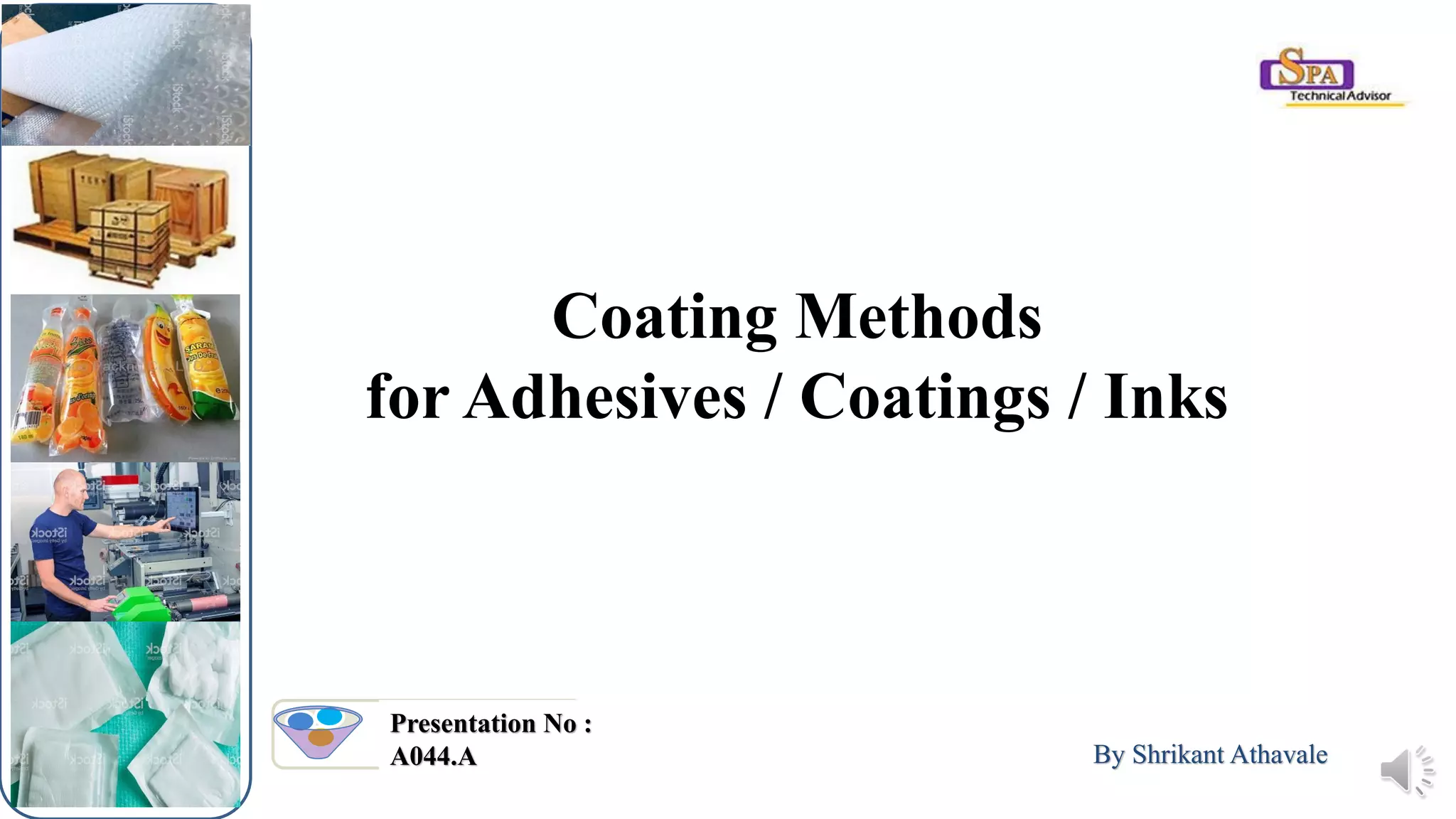
Introduction to presentation and the significance of coating technology in various industries.
Outlines the basic steps in the coating process, including preparation, application, and drying.
Discusses additional operations in coating like surface treatment and machine variations based on size.
Various coating methods like reverse roll and knife over roll, with emphasis on the suitability of each method based on the substrate and requirements.
Important factors such as adhesive type, coating thickness, and substrate types affecting method choice.
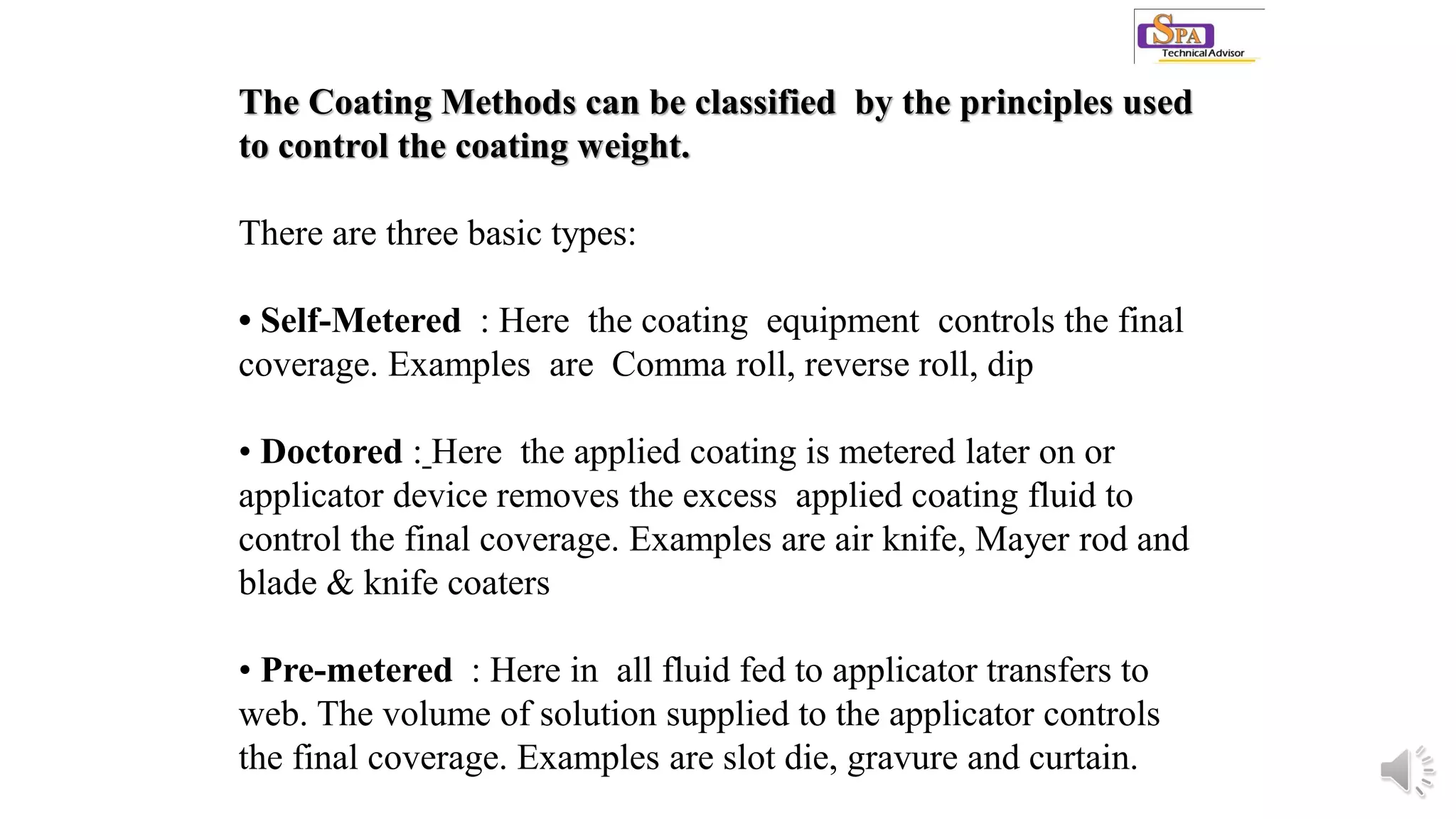
Classification of coating methods based on self-metered, doctored, and pre-metered principles.
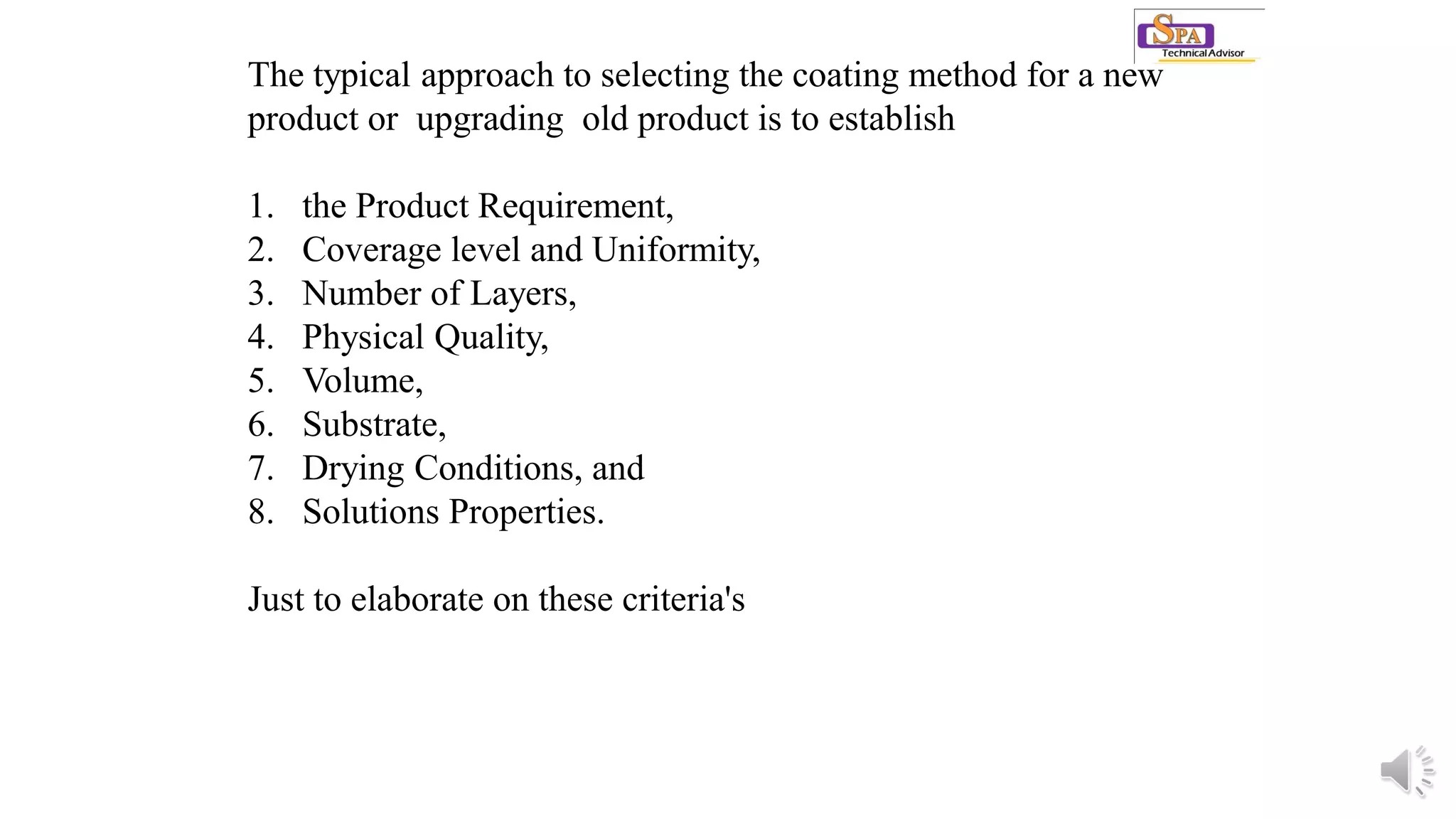
A deep dive into criteria like product requirements, uniformity, layers, physical quality, volume, substrate, drying conditions, and solution properties.
Insight on overlooked criteria in coating selection including cost, technical effort, and balancing concerns.
Introduction to coating methods animations available for visual understanding.
Recent survey data on commonly used web coating methods.
Description of coated rollers in the coating process, emphasizing precision in design and manufacturing.
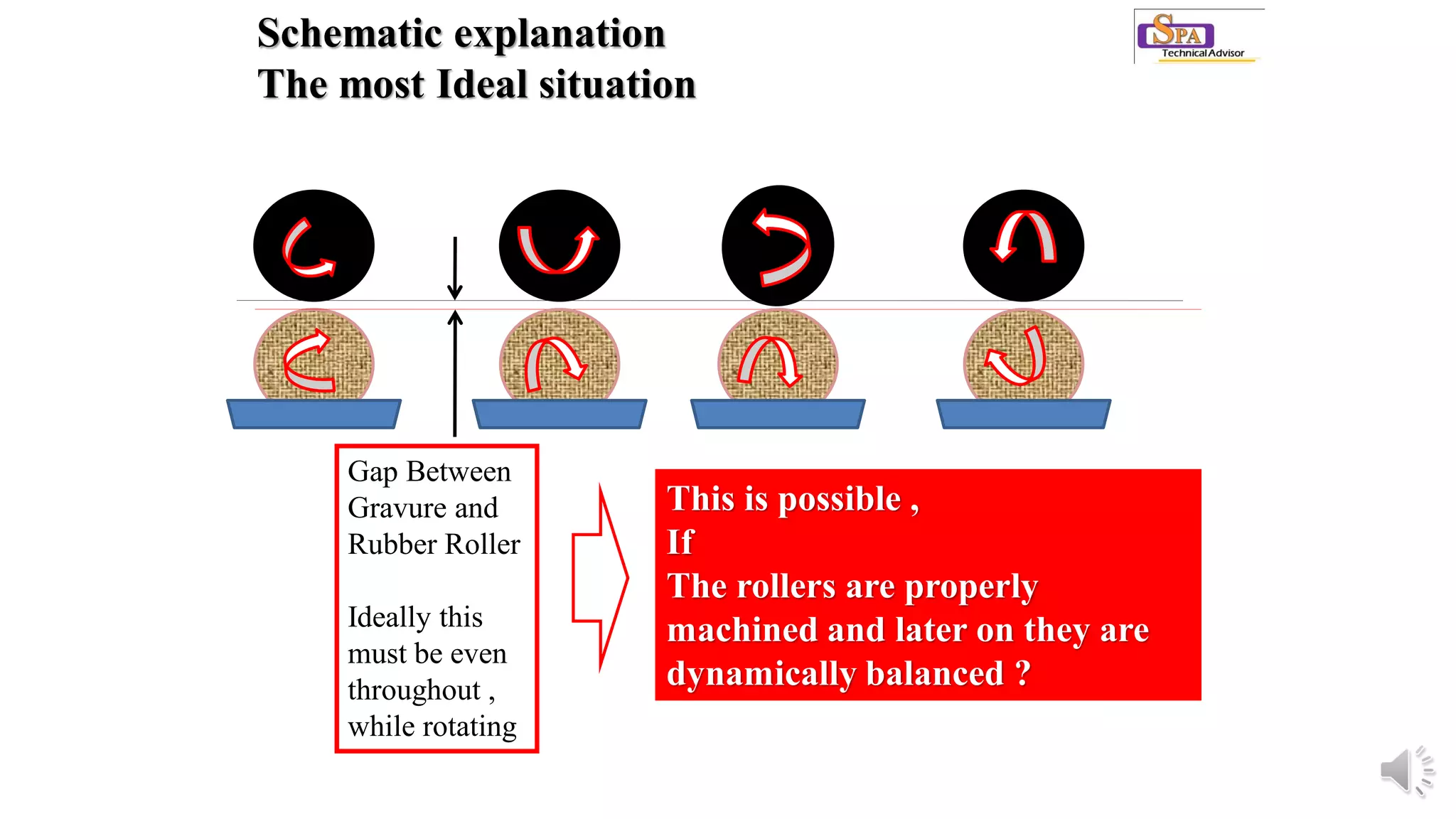
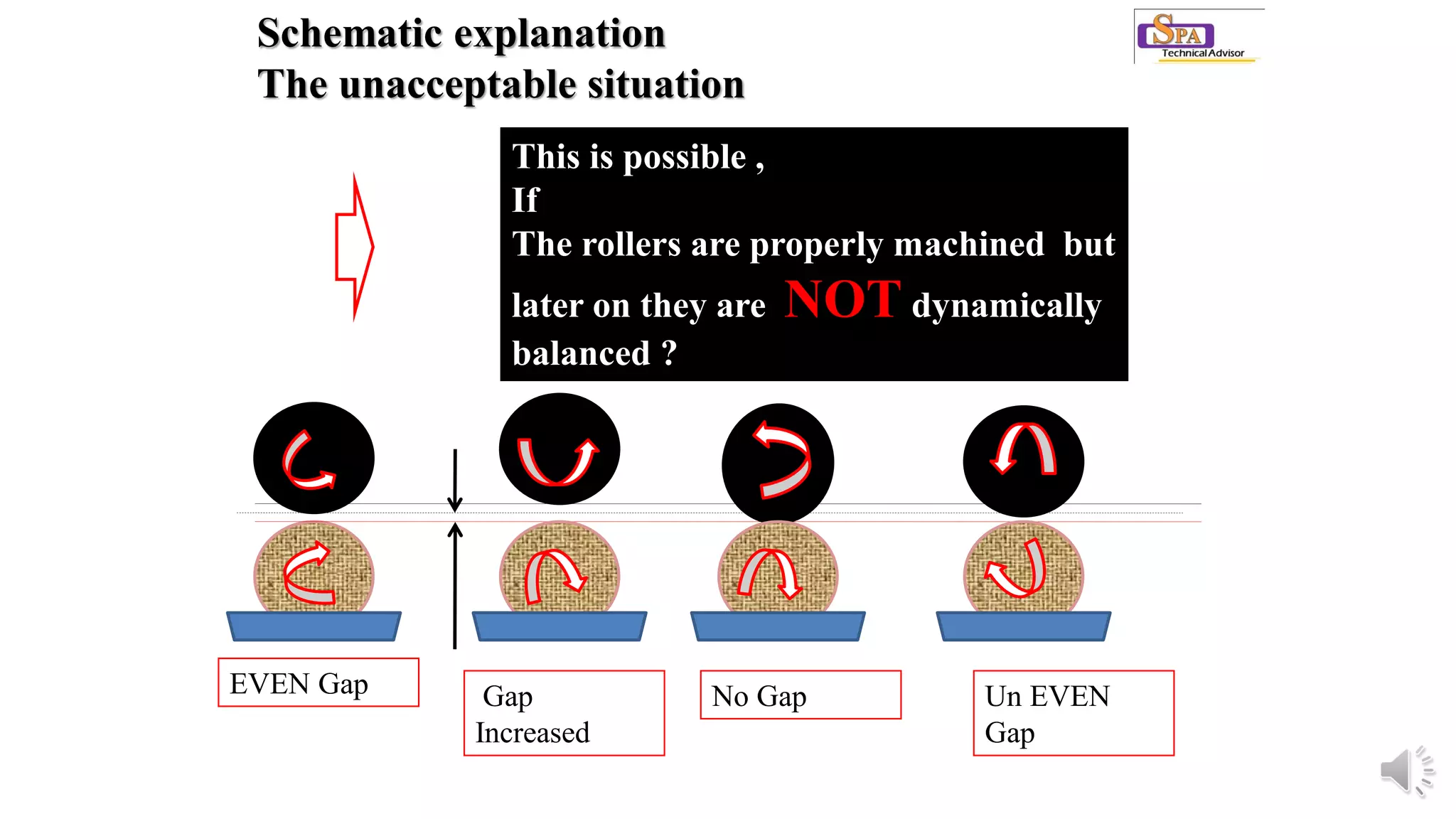
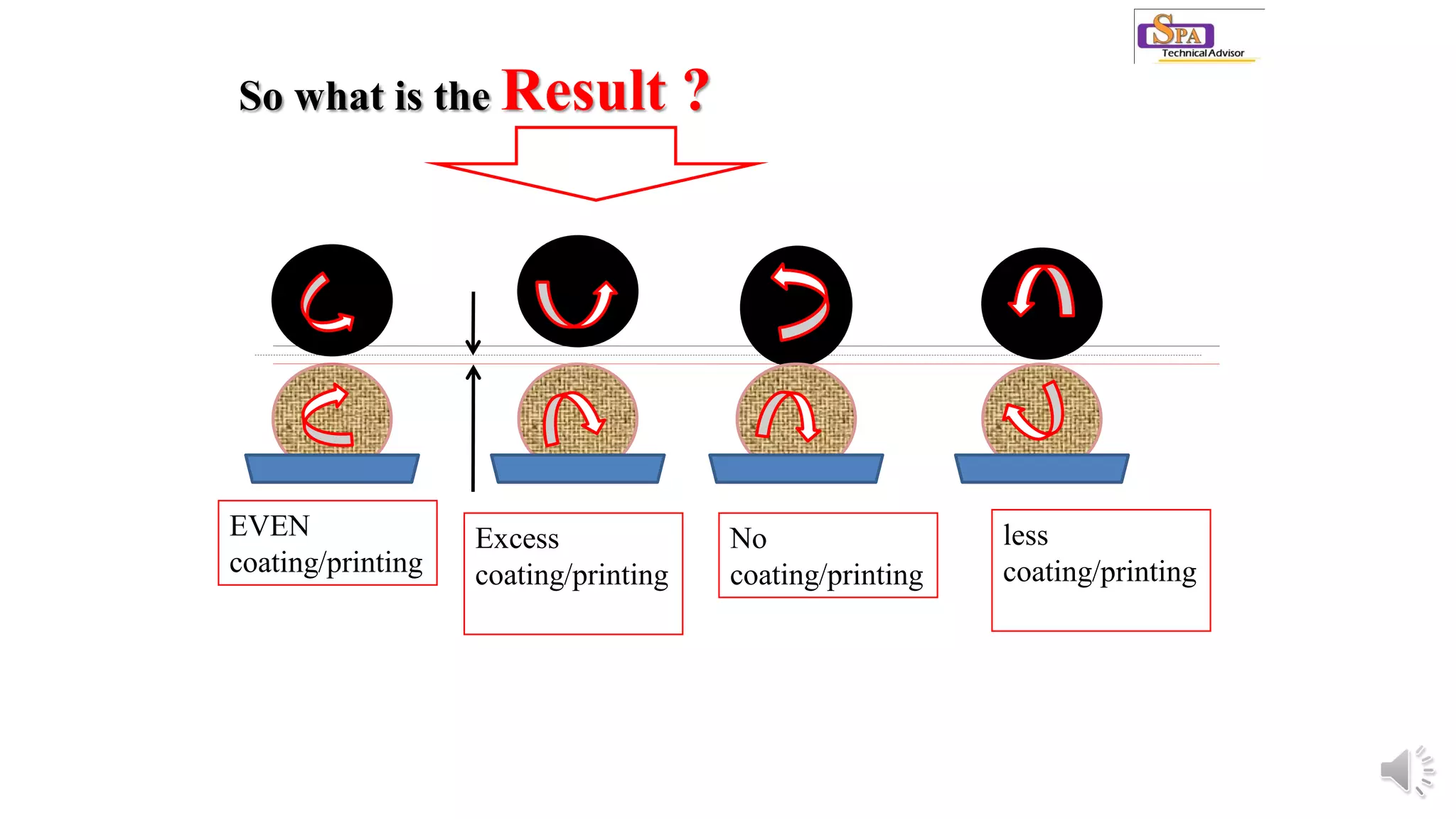
Illustrations of ideal and unacceptable gaps between rollers and the implications on coating quality.
Discussion on roller materials, design considerations, balancing requirements for effective coating.
How roll coaters operate, including thickness control mechanisms like metering blades.
Post application techniques to adjust coating thickness and achieve desired finishes on the substrate.Techniques and configurations for web coating, focusing on production efficiency and application methods.
Factors influencing roll coater selection including adhesive type, substrate thickness, and operational considerations.
Challenges in handling and coating process post-application, emphasizing operator interaction with coated products.
Coating Methods
Coating Process/Technology is in widespread use.
Coating is necessary for modification, or improvement or to make
it more suitable.
Several Industries
are based on coating technology.
3.
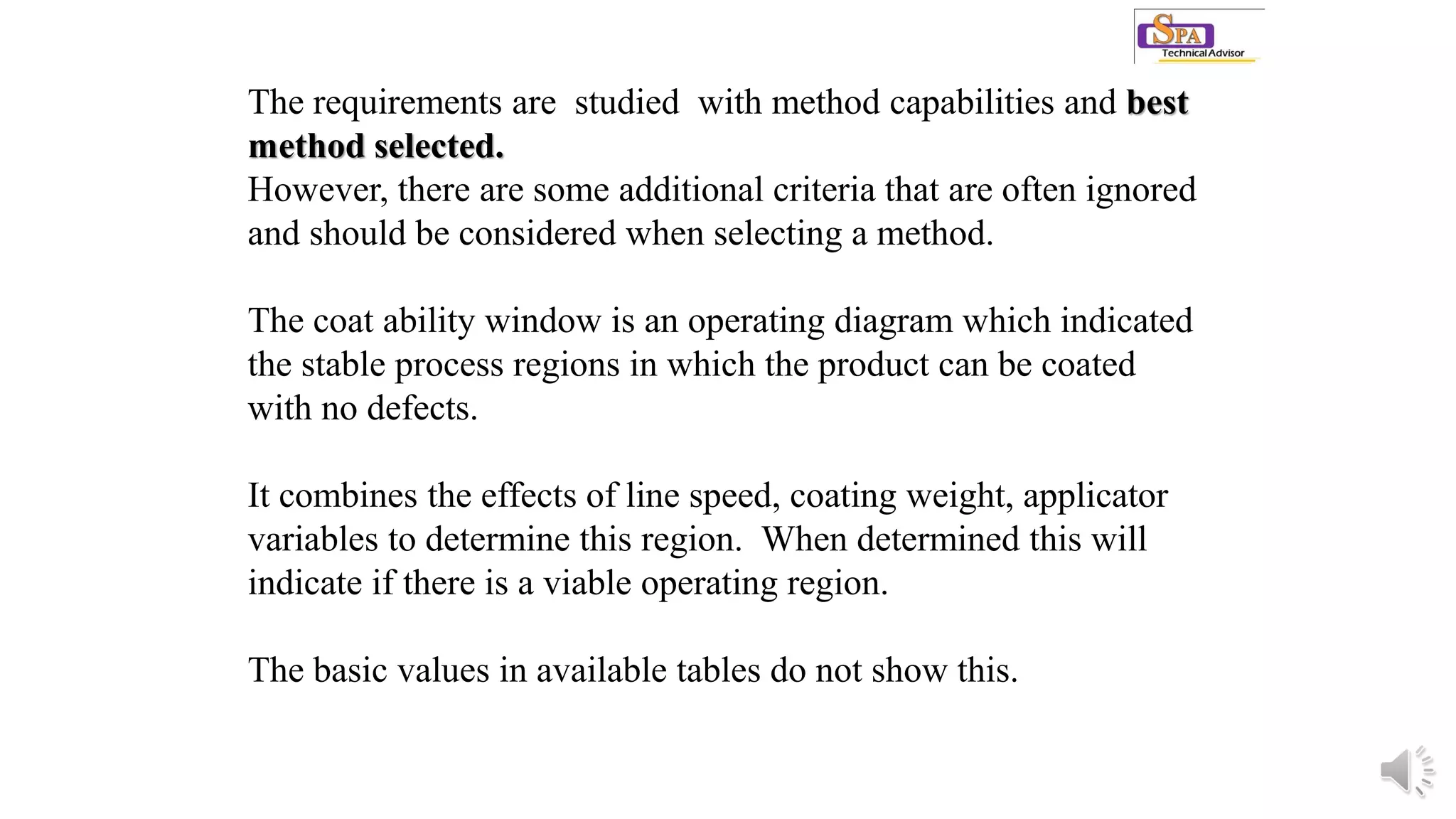
The basic steps
1.Preparing the coating solution
2. loading/ setting the Substrate on the Unwind
3. passing it through the coater / dryer
4. applying the coating from the coating solution
5. drying the coating
6. winding the final coated roll
7. Converting the coated substrate to final size
4.
Coating Methods
There arefew other operations
that are often used , such as,
a) surface treatment on the substrate to improve adhesion.
b) cleaning the substrate prior to coating , to reduce contamination
c) lamination with other substrate
Different types of coatings methods are used depending upon
the substrate as well as the end product requirement.
5.
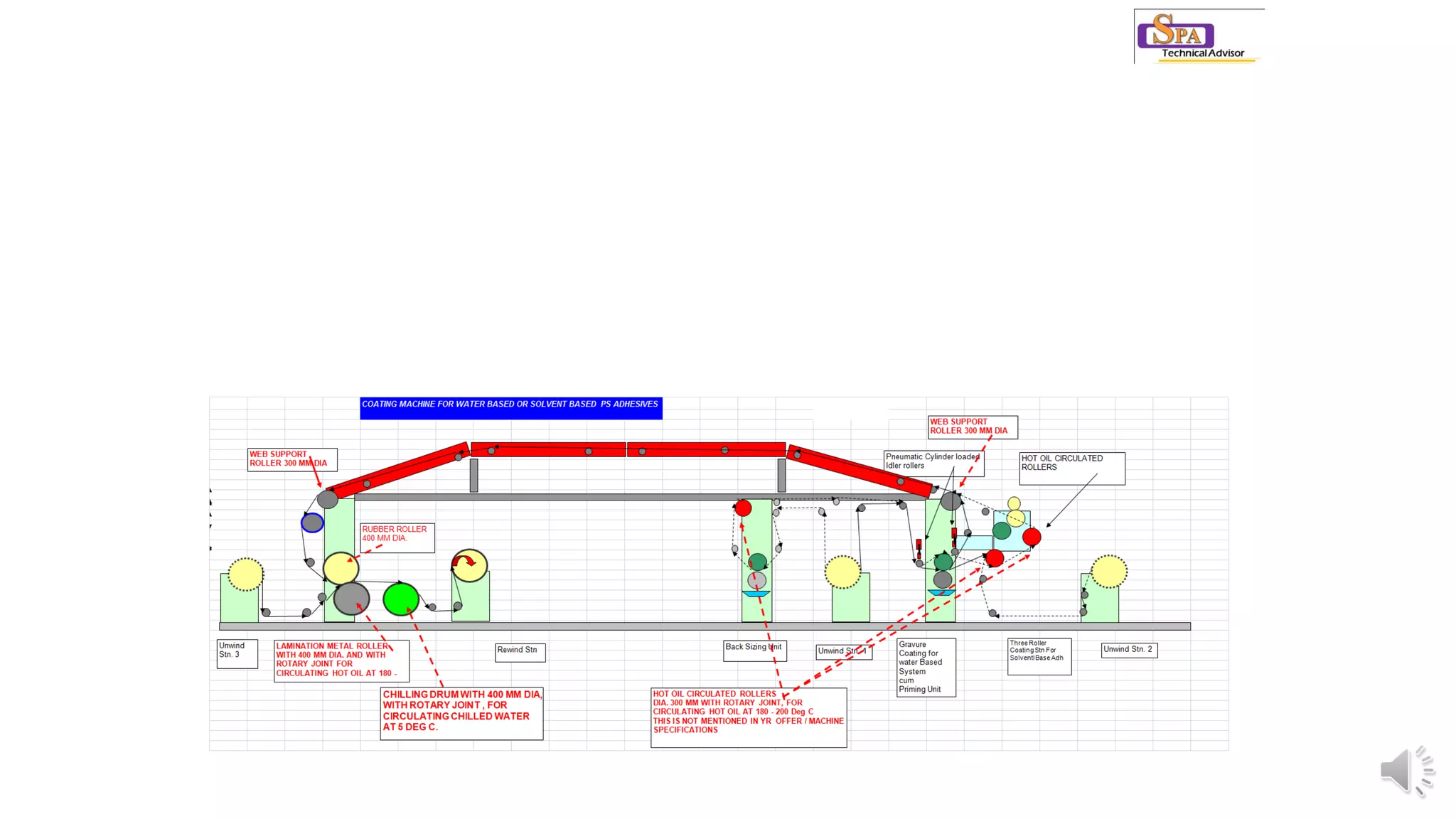
The coating machineis available in various sizes ,
from pilot coater using narrow webs , 150-600 mm wide and
running at low speeds , 5-10 mtrs / min ,
to production scale machines using wide web , over 1500 mm
wide and coating at 50-200 mtrs / min.
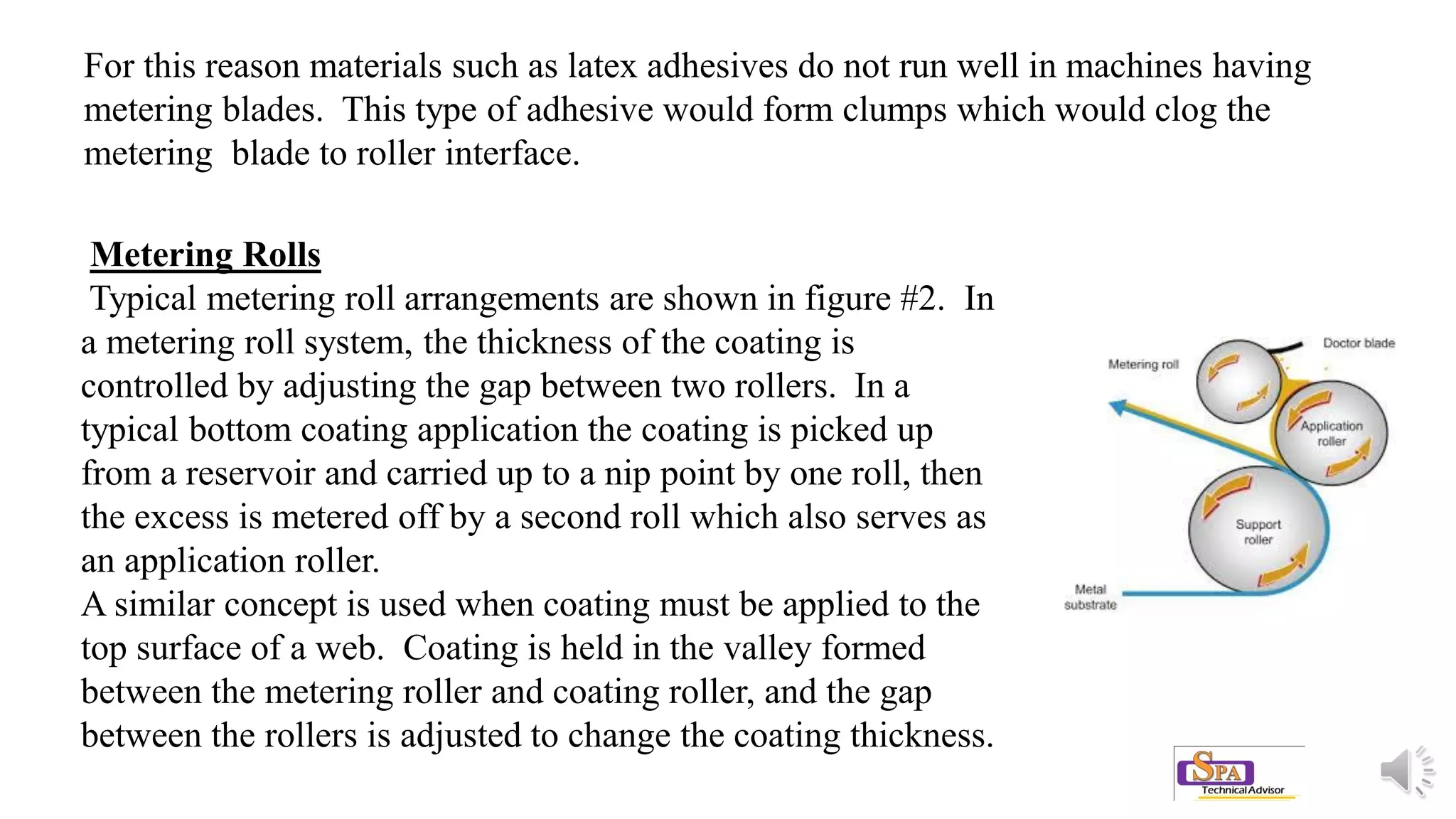
A typical coating machine is shown in the next slide.
7.
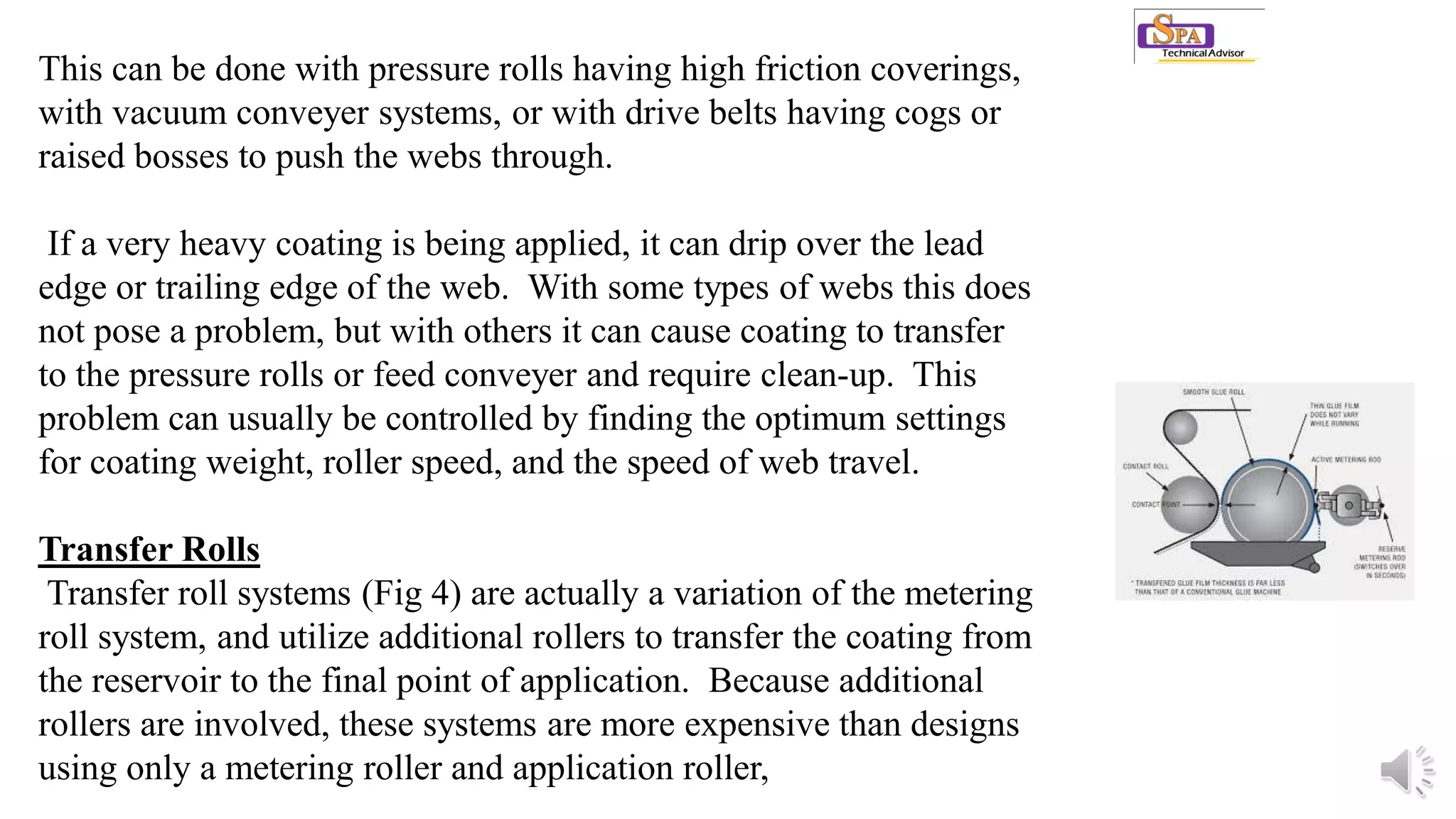
Coating Process
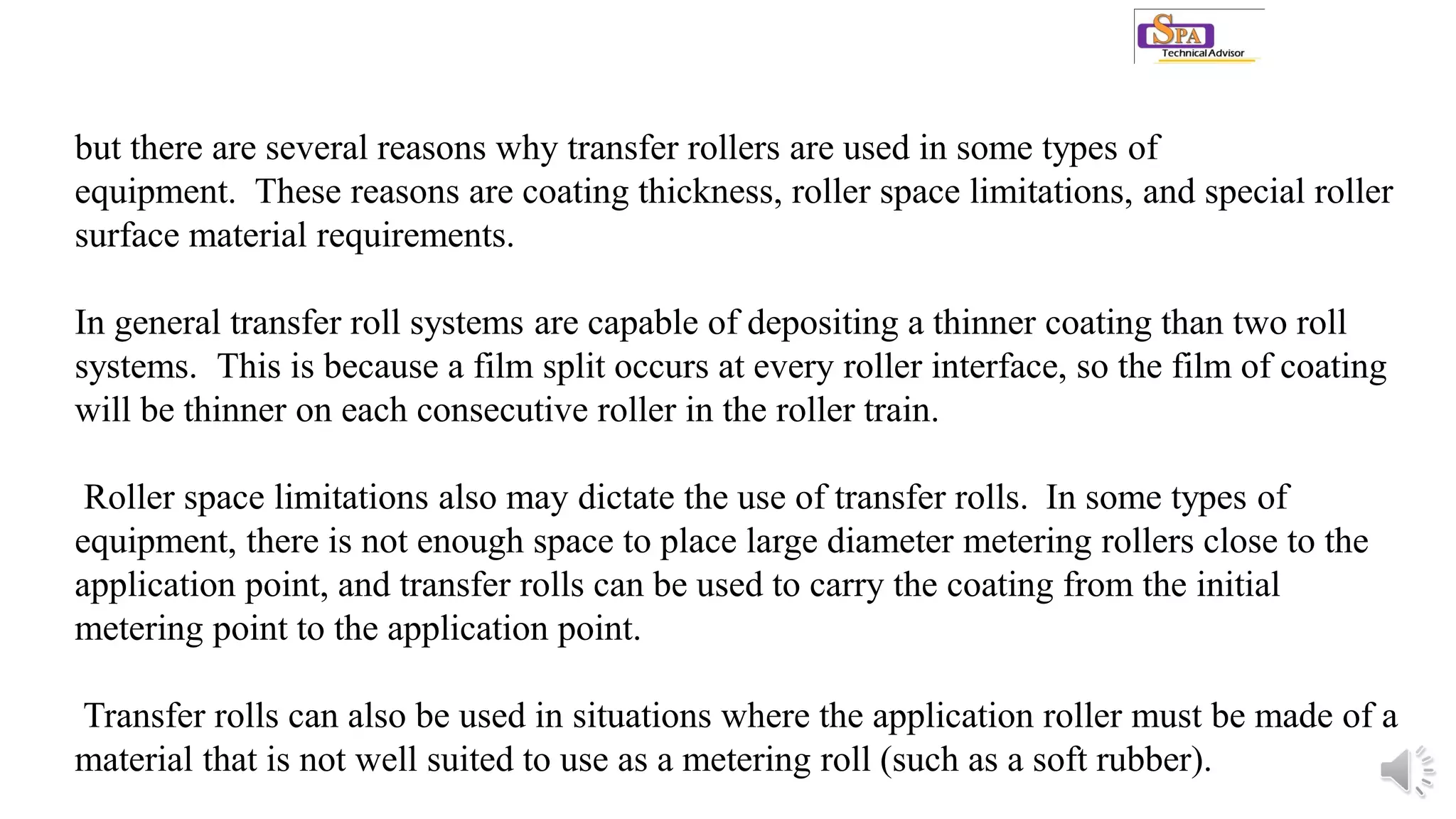
The applicationof liquid to the web / substrate is done by one of
the many coating methods.
Widely used coating methods are
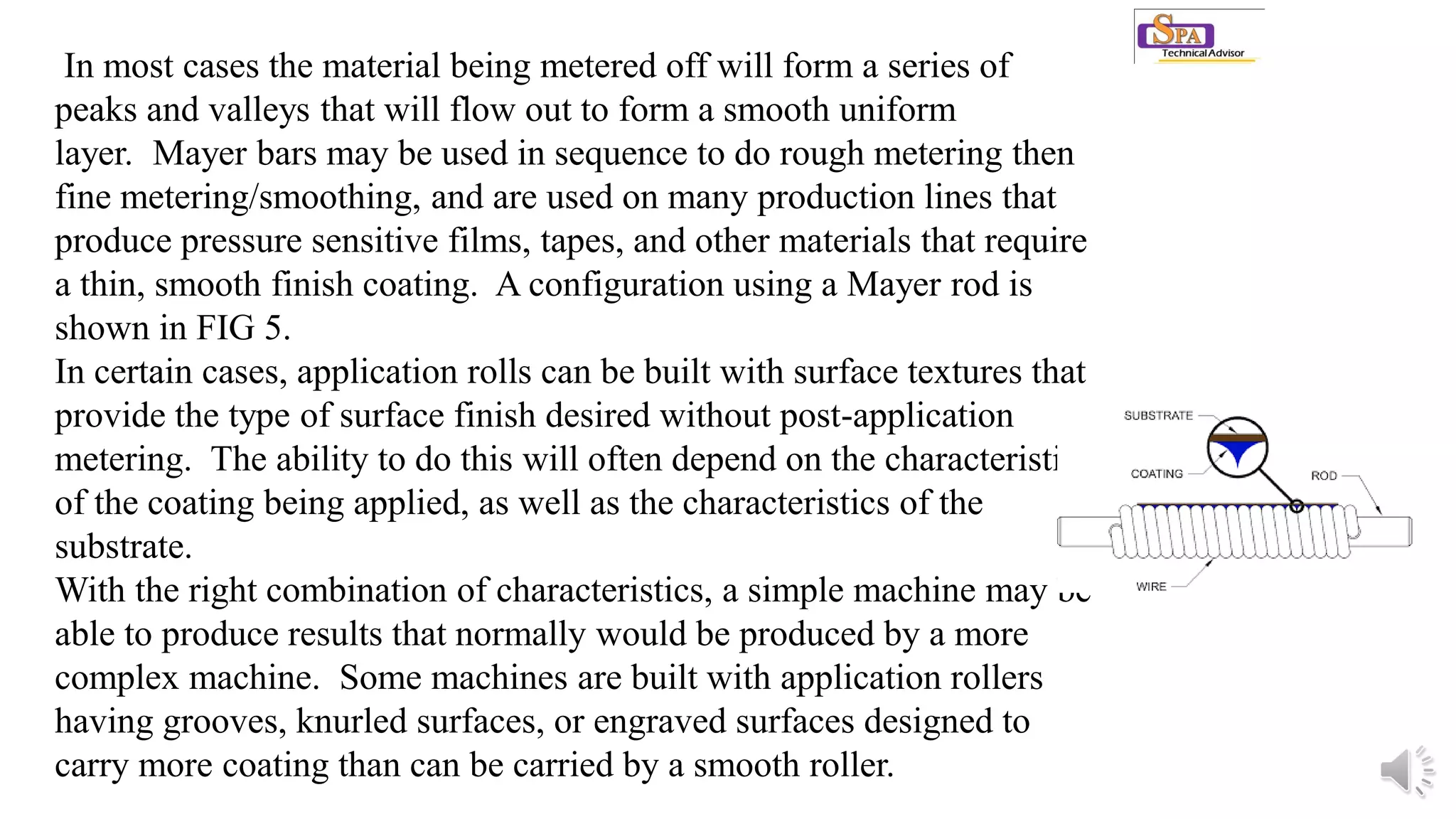
Reverse Roll,
wire wound or myer rod/bar,
direct and offset gravure ,
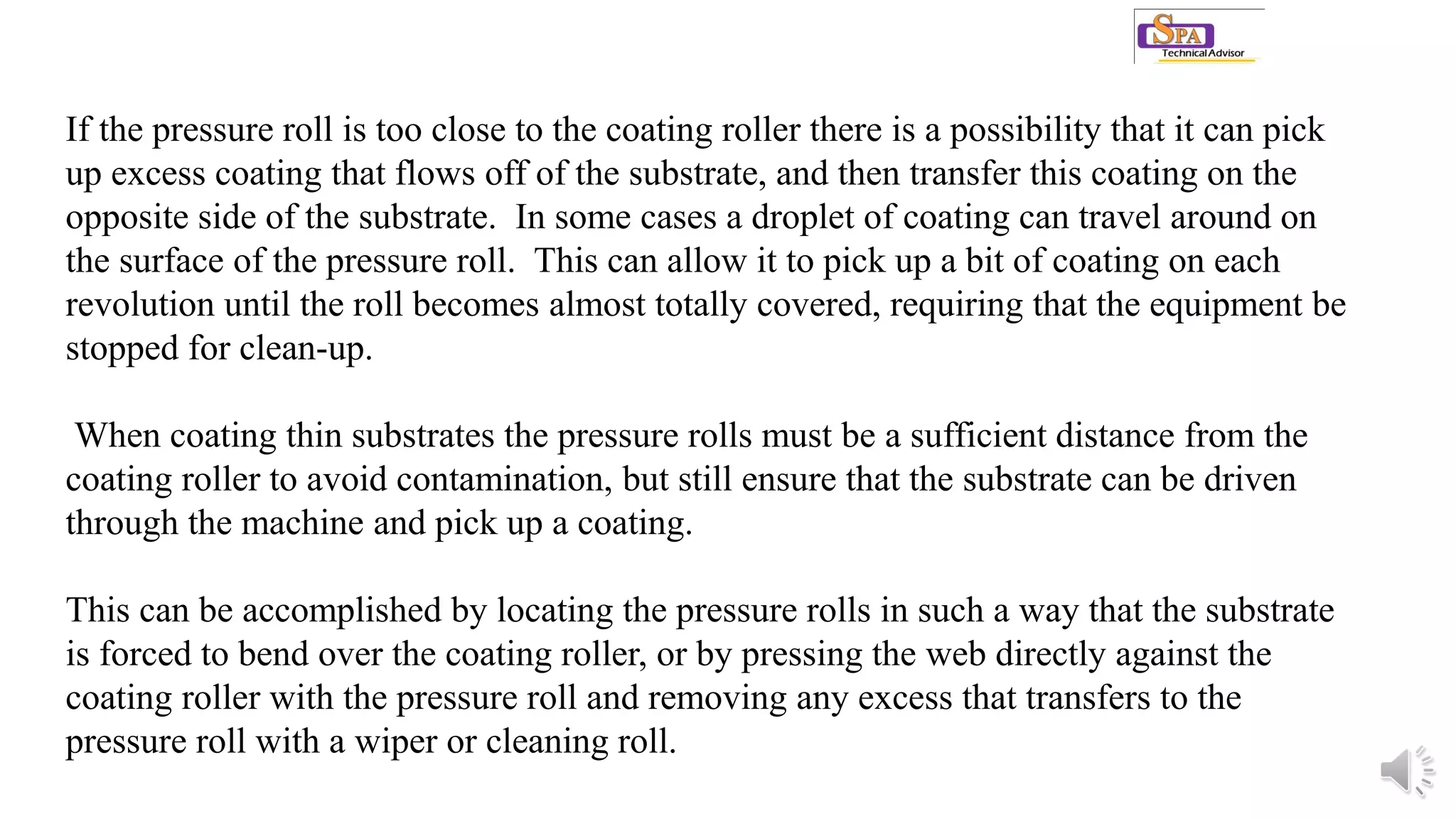
slot die,
blade,
knife over roll ,
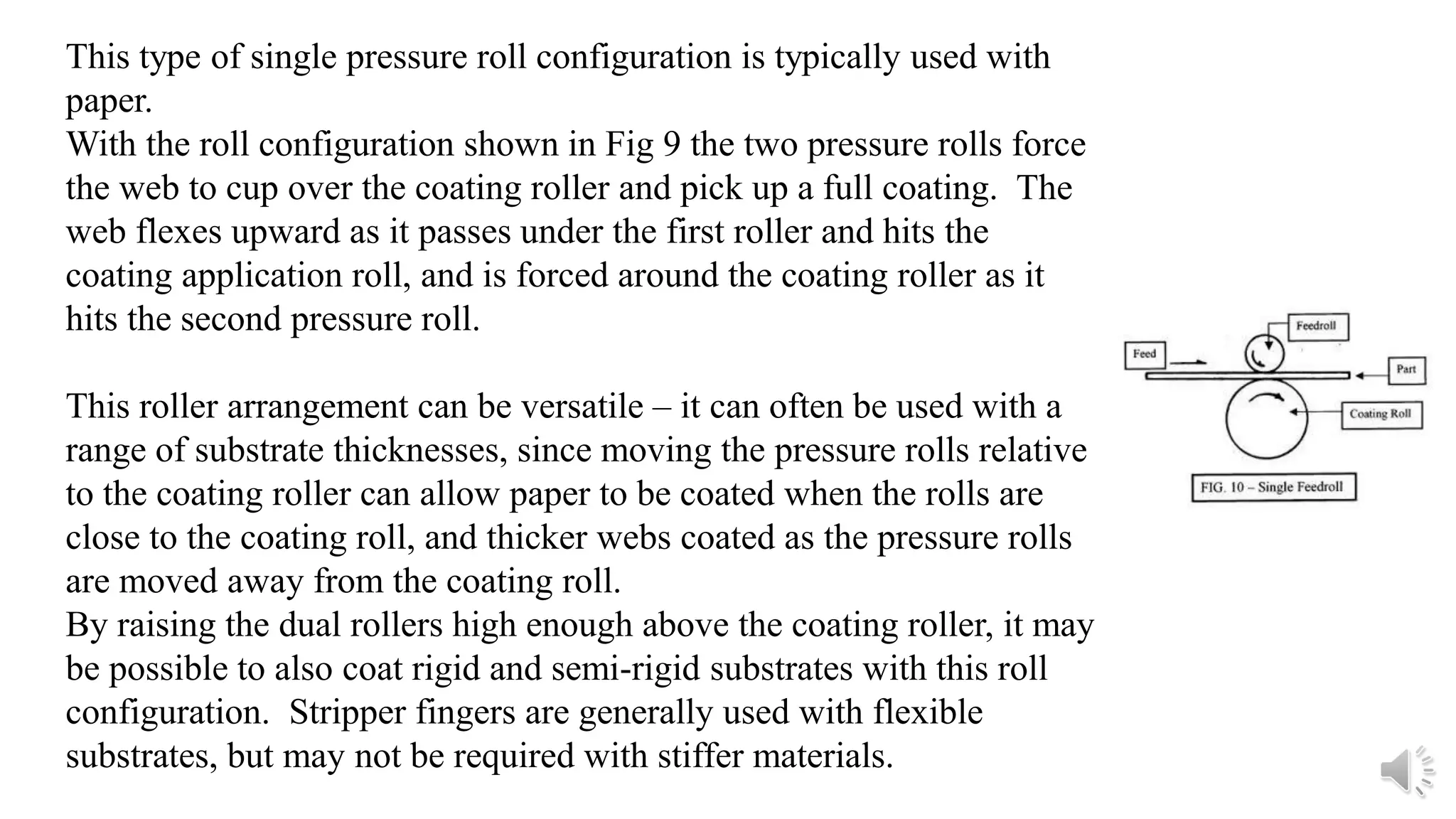
air knife ,
comma etc.
8.
Coating Process
The choiceof the method depends on
the nature of the web/ substrate ,
the rheology of the coating fluid ,
the solvent the wet coating weight desired,
the desired coating width and speed,
the no of layers or coating to be applied simultaneously ,
cost considerations,
environmental considerations .
9.
Coating Process
The coatingmethod
The choice should be
based on the specific requirement.
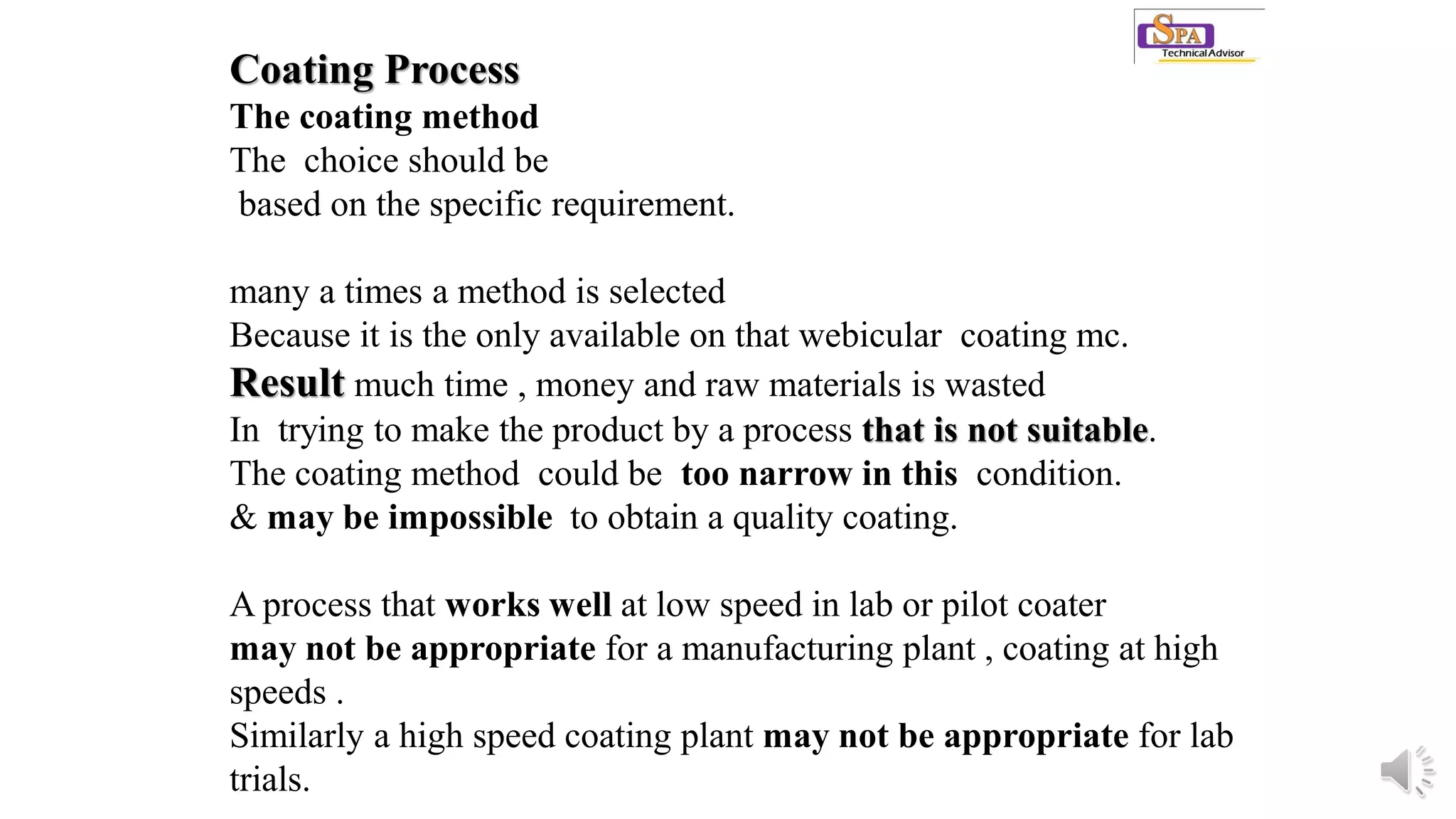
many a times a method is selected
Because it is the only available on that webicular coating mc.
Result much time , money and raw materials is wasted
In trying to make the product by a process that is not suitable.
The coating method could be too narrow in this condition.
& may be impossible to obtain a quality coating.
A process that works well at low speed in lab or pilot coater
may not be appropriate for a manufacturing plant , coating at high
speeds .
Similarly a high speed coating plant may not be appropriate for lab
trials.
10.
Coating is avery Important
process involved in the Manufacture
of Adhesive Coated / Printed /
Laminated
Products
11.
The selection ofthe best roll coating method for any webicular
type of work depends on a number of factors. The key factors
that need to be considered are as follows:
1. Type of adhesive
2. Thickness of adhesive coating
3. Thickness of substrate
4. Width of substrate
5. Full coat or web / pattern coat
6. Handling after coating
7. Cleanup
12.
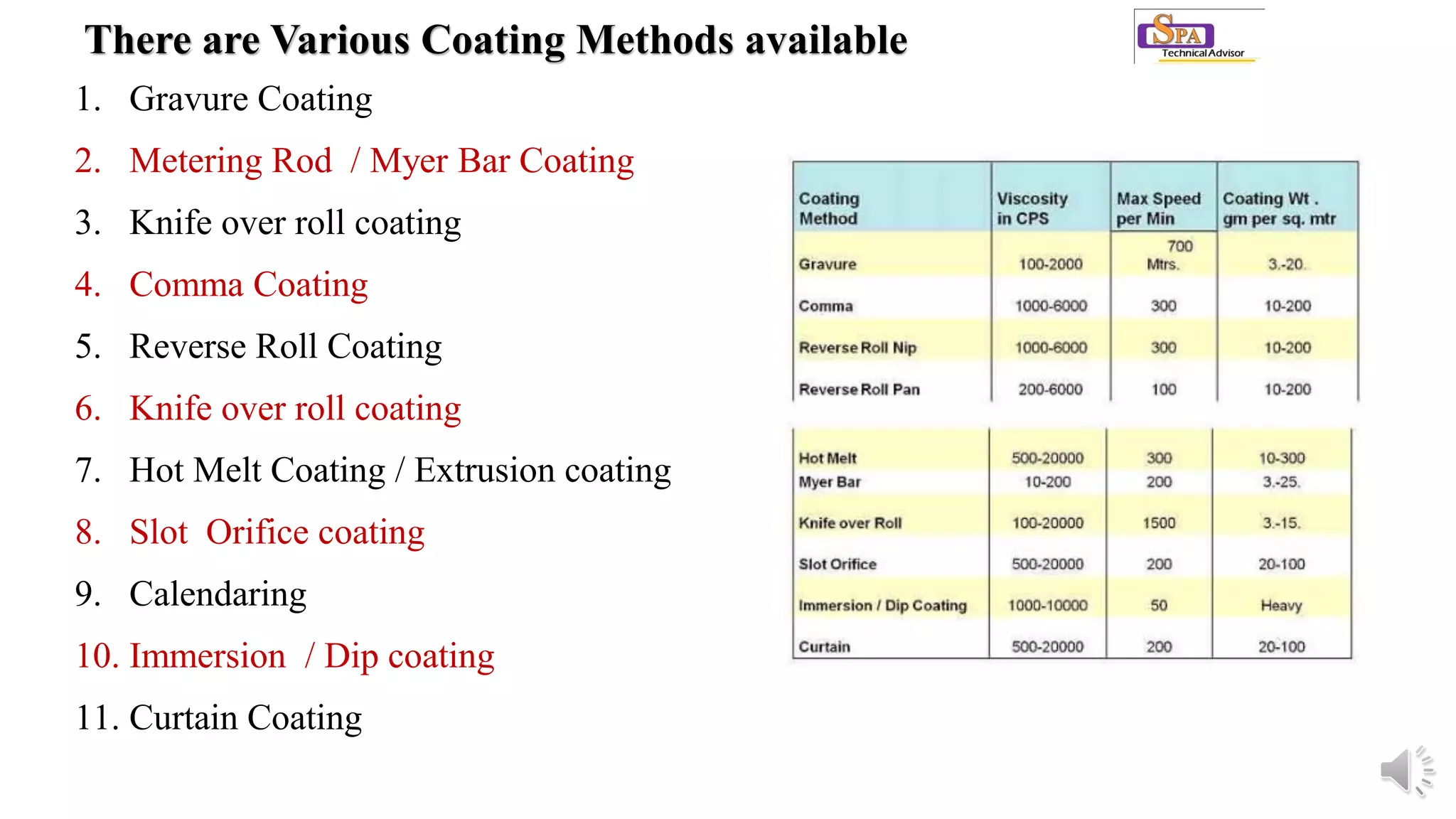
1. Gravure Coating
2.Metering Rod / Myer Bar Coating
3. Knife over roll coating
4. Comma Coating
5. Reverse Roll Coating
6. Knife over roll coating
7. Hot Melt Coating / Extrusion coating
8. Slot Orifice coating
9. Calendaring
10. Immersion / Dip coating
11. Curtain Coating
There are Various Coating Methods available
13.
The Coating Methodscan be classified by the principles used
to control the coating weight.
There are three basic types:
• Self-Metered : Here the coating equipment controls the final
coverage. Examples are Comma roll, reverse roll, dip
• Doctored : Here the applied coating is metered later on or
applicator device removes the excess applied coating fluid to
control the final coverage. Examples are air knife, Mayer rod and
blade & knife coaters
• Pre-metered : Here in all fluid fed to applicator transfers to
web. The volume of solution supplied to the applicator controls
the final coverage. Examples are slot die, gravure and curtain.
14.
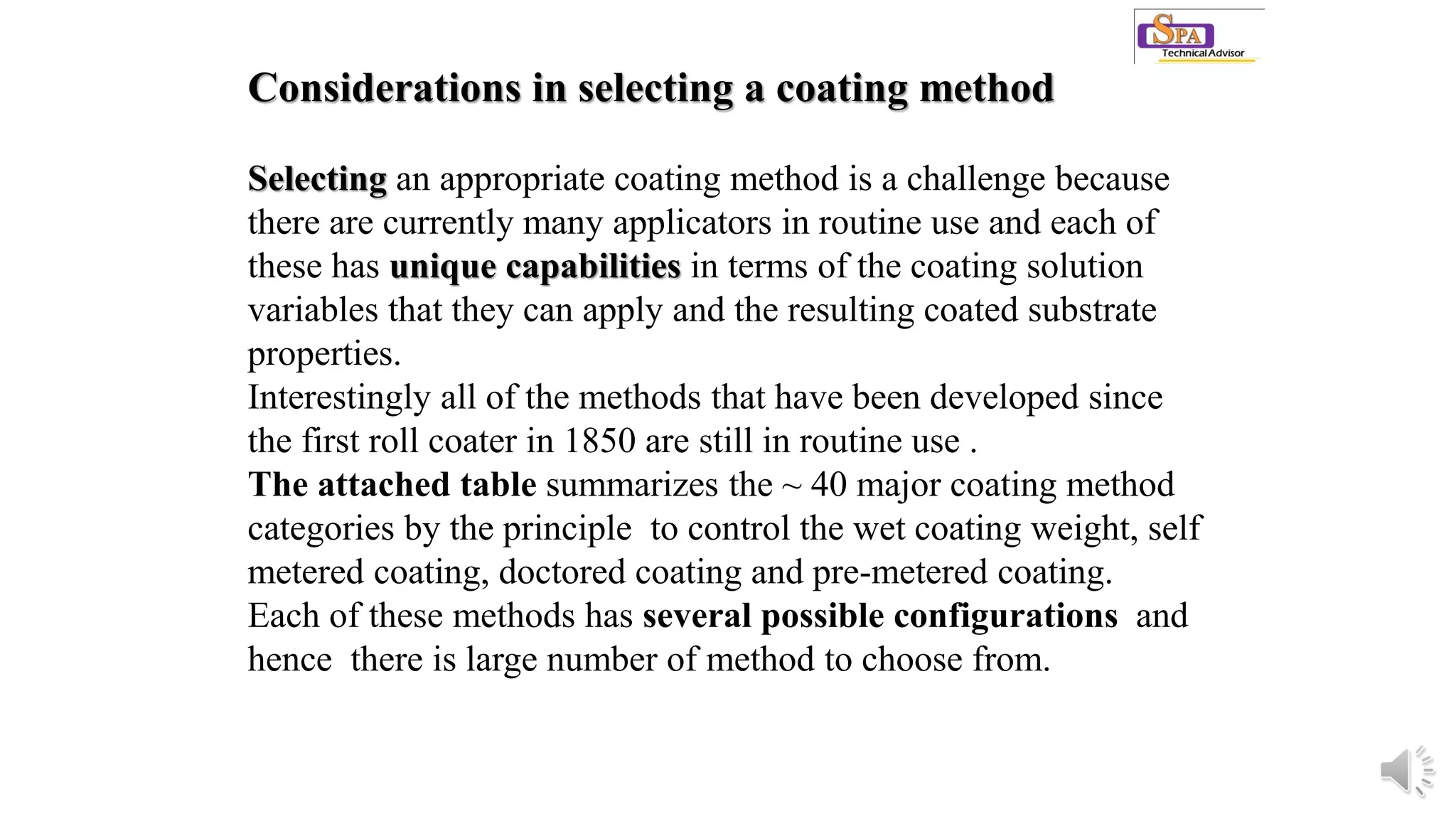
Considerations in selectinga coating method
Selecting an appropriate coating method is a challenge because
there are currently many applicators in routine use and each of
these has unique capabilities in terms of the coating solution
variables that they can apply and the resulting coated substrate
properties.
Interestingly all of the methods that have been developed since
the first roll coater in 1850 are still in routine use .
The attached table summarizes the ~ 40 major coating method
categories by the principle to control the wet coating weight, self
metered coating, doctored coating and pre-metered coating.
Each of these methods has several possible configurations and
hence there is large number of method to choose from.
15.
The typical approachto selecting the coating method for a new
product or upgrading old product is to establish
1. the Product Requirement,
2. Coverage level and Uniformity,
3. Number of Layers,
4. Physical Quality,
5. Volume,
6. Substrate,
7. Drying Conditions, and
8. Solutions Properties.
Just to elaborate on these criteria's
16.
The typical approachto selecting the coating method for a new
product or upgrading old product is to establish
Just to elaborate on these criteria's
17.
The typical approachto selecting the coating method for a new
product or upgrading old product is to establish
1. The Product Requirement,
The required product exact product specifications , are a must.
Before developing a New Product or upgrading
Specifications , of the same is a MUST
18.
The typical approachto selecting the coating method for a new
product or upgrading old product is to establish
2. Coverage level and Uniformity,
Check the specifications and study what is required ?
Coverage level
Or > the dry Thickness > the anchorage >
and
Uniformity,
Continuous or pattern ?
19.
The typical approachto selecting the coating method for a new
product or upgrading old product is to establish
3. Number of Layers,
In some products there could be a requirement of
Primer > actual coating > backside coating if any
Or in case of Tamper evident coating , there could be a
requirement of 7 to 8 coatings at a time
20.
The typical approachto selecting the coating method for a new
product or upgrading old product is to establish
4. Physical Quality,
Again check the specific requirements / specifications ?
Some time ,
A very good anchorage is required
There could be a requirement of complete transfer of coating , at
a later stage
21.
The typical approachto selecting the coating method for a new
product or upgrading old product is to establish
5. Volume,
While product development , one has to take into account what is
the quantity required ?
For example , for smaller quantities , narrow widths
Which method would be the most appropriative ?
For large quantities ?
For smaller quantities ?
There are options available
Choosing a wrong method could result into huge wastage of ?
Yes
Raw Material, Manpower, electricity, fuel , rent/ bank interest
22.
The typical approachto selecting the coating method for a new
product or upgrading old product is to establish
6. Substrate,
The coating / printing / lamination methods will certainly depend
on the type of substrate
Processing paper , film , fabric, foil , is entirely different.
The tension setting , coating method, drying conditions are totally
Different.
The substrate strength, the absorbency , the wet strength,
elasticity , ability to withstand the drying temp are some of the
important criteria's , which play a important role.
23.
The typical approachto selecting the coating method for a new
product or upgrading old product is to establish
7. Drying Conditions,
They depend on the substrate to be processed.
The drying temp, air velocity , the kind of drying process/
equipment , curing of the coating etc are the variables and , the
R&D team has to study this in details.
24.
The typical approachto selecting the coating method for a new
product or upgrading old product is to establish
8. Solutions Properties.
The solution properties play a very vital role. HOW ?
What are the variables ?
1. Viscosity
2. Solids content
3. Flow
4. Wet ability
5. coat ability
25.
The requirements arestudied with method capabilities and best
method selected.
However, there are some additional criteria that are often ignored
and should be considered when selecting a method.
The coat ability window is an operating diagram which indicated
the stable process regions in which the product can be coated
with no defects.
It combines the effects of line speed, coating weight, applicator
variables to determine this region. When determined this will
indicate if there is a viable operating region.
The basic values in available tables do not show this.
26.
Some other Considerationsin selecting a coating
method
Continued
The cost and technical effort to install and develop the coating
applicator should be considered.
The older established method, gravure reverse roll, Mayer Rod
are inexpensive and can easily be installed with the availability of
cartridge. There is also a large technical base for these methods
and they can be relatively easy to operate.
27.
Some other Considerationsin selecting a coating
method
Continued
Slot die coater is expensive and is technically sophisticated.
Considerably more technical effort is needed to run this process.
Often the simpler method is the best choice.
High line speed appears attractive but they may not be suitable
for all methods. With low volume products the start-up time and
initial losses until quality is established can adversely affect costs.
28.
Some other Considerationsin selecting a coating method
Continued
This loss is minimal for a high volume long coating campaigns.
However, it can be significant for a small volume product.
Therefore, for low volume product a lower line speed which is
easy to start and maintain may be preferred.
29.
Doctored Mode Self-meteredPre-metered
Air knife metering
mode
Comma
direct/indirect
Curtain Precision
Dip & scrape Dip Extrusion
Dip & Squeeze Direct Roll Flexo
Doctor Blade Direct roll hot melt Gravure direct
Floating knife Reverse Roll Gravure offset
Kiss coater gravure reverse
Knife over roll Hot Melt
Mayer rod Slot Die
Metering Bar
More on these methods ?
You will find some animations at the end of this presentation
30.
After monitoring thecoating methods being industrially used in
order to determine the most widely used web coating methods.
The results of the most recent survey are as follows:
This information is very useful to select a method most
appropriate
32.
Covered Rollers
A discussionof rollers for the coating sector would not be complete
without a mention of coating rolls.
Regardless of the adhesive/ ink application method, some type of
coating roll is usually used to spread and evenly distribute the
adhesive/ ink.
Coating rollers may seem casual , but their makeup and design must
be finely tuned.
Specified tolerances as tight as “half-a-thou” total indicated run out
(TIR) are common.
That’s one-half of one thousandth of an inch;
perfect concentricity is a must.
This Attribute to the needs for a very thin, very even layer of
adhesive / ink / release coat . If the coating roll is out of round,
adhesive/ ink/ release coat application will be uneven.
33.
Schematic explanation
The mostIdeal situation
Gap Between
Gravure and
Rubber Roller
Ideally this
must be even
throughout ,
while rotating
This is possible ,
If
The rollers are properly
machined and later on they are
dynamically balanced ?
34.
Schematic explanation
The unacceptablesituation
This is possible ,
If
The rollers are properly machined but
later on they are NOT dynamically
balanced ?
EVEN Gap Gap
Increased
No Gap Un EVEN
Gap
35.
Schematic explanation
The unacceptablesituation
This is possible ,
If
The rollers are properly machined but later on they
are NOT dynamically balanced ?
NOW
Can any one of you could quote a practical example ? ,
what happens if balancing is not done ?
How many of you use 2/4 wheeler ?
What we do after buying a new Vehicle ?
Why we do it ?
36.
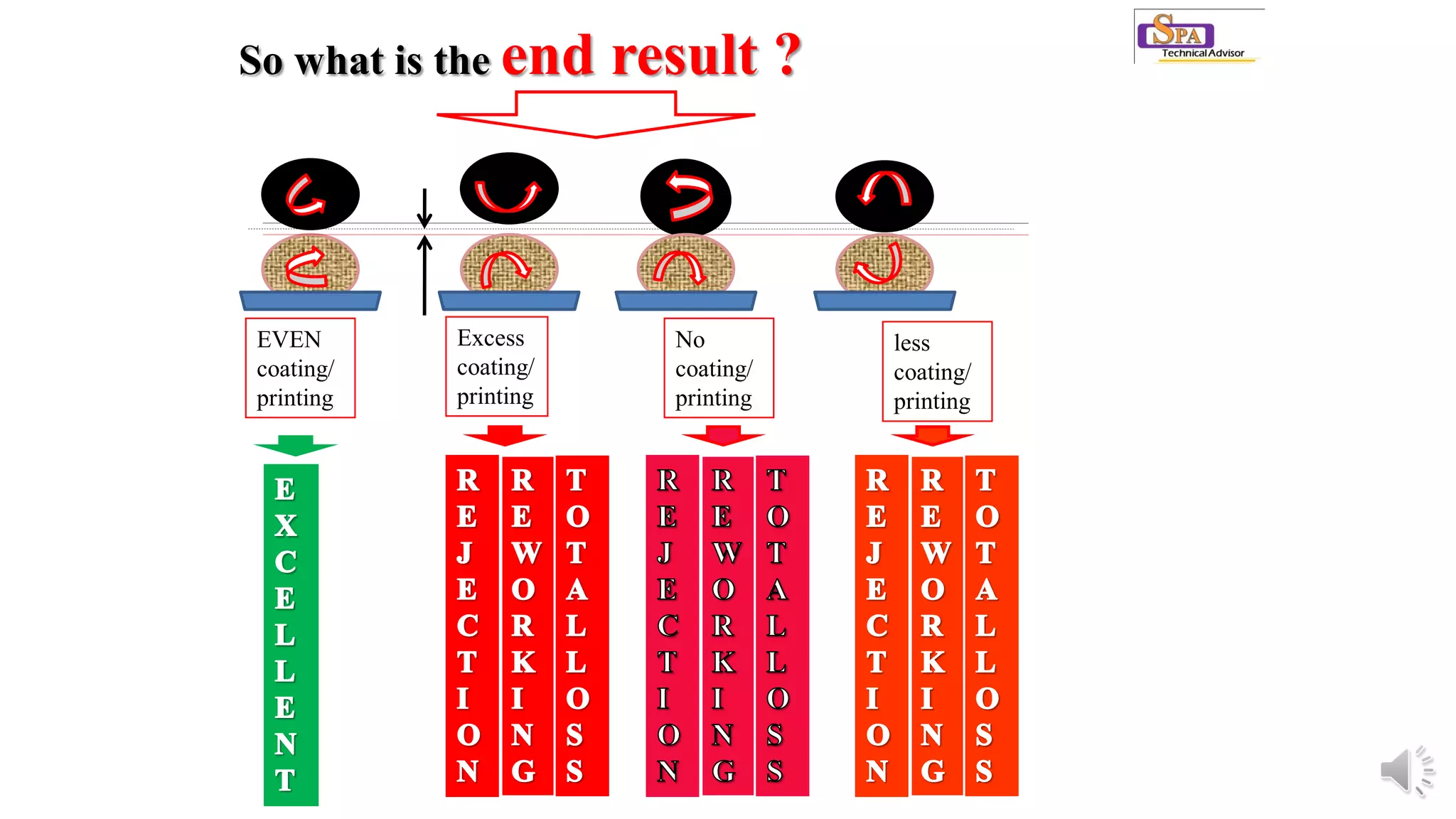
So what isthe Result ?
EVEN
coating/printing
Excess
coating/printing
No
coating/printing
less
coating/printing
37.
So what isthe end result ?
EVEN
coating/
printing
Excess
coating/
printing
No
coating/
printing
less
coating/
printing
38.
Covered Rollers (Continued )
Coating rolls are virtually always covered (seldom just bare steel), and the choice
of this is very important.
Many manufacturers say they have a “rubber-covered roller,” but few roll covers
are actually natural rubber.
Nitrile is one of the most common roll cover compounds for coating rolls.
Nitrile wears well and supports the most common durometer range for coating
rolls: 55-90 hardness (Shore A). The higher the hardness value, the harder the
rubber.
Where allowable, some engineers order an extra-thick nitrile coat (0.75-1.00 in.)
and then occasionally order a regrind of the roll face (using a “kiss grind” to
remove the top layer of uneven -up roll cover, usually just a few hundredths of an
inch).
39.
Covered Rollers (Continued )
This saves money vs. completely recovering the roller every time it becomes worn,
and it is possible to achieve 2-4 regrinds out of a thick coat.
Nitrile is also available in an FDA-approved version, which is required in the food
and pharmaceutical industries. For FDA-critical applications, it is also preferable to
have the roller core fabricated from stainless steel rather than the standard carbon
steel.
Ethylene propylene diene monomer (EPDM) is another popular coating roll
compound. This synthetic rubber features good heat and chemical resistance, with
fairly good release. It can also be applied thick and reground.
40.
Covered Rollers (Continued )
High-release silicone is another popular option for coating rolls, given its high
release and heat resistance traits. It lacks the durability of EPDM or nitrile, but there
is no substitute for the release offered by silicone. It is used extensively in plastic
film and paper applications. However, in addition to its higher up-front cost, silicone
does not regrind well, so rolls must be completely recovered when worn.
Coating rollers are usually finished in one of two ways: either very flat and smooth
(“micro polish” finish) or with very tightly spaced serrations or spirals (16-32 radial
serrations per inch). While every plant employs its own proprietary processes,
chemicals and techniques to optimize performance, making it difficult to develop
hard and fast rules about what works best, these are very common options.
41.
Covered Rollers (Continued )
Additional Considerations
High-tech elastomers and thermal transfer coefficients have added complexity to
roller technology, but they should not be intimidating. With the right knowledge,
you can make them work wonders for your plant. For plant managers wishing to
increase overall output, one easy method is to increase web/stock width. This means
increasing the width of all rollers, which is not as difficult as one might think.
Existing rollers can be reverse-engineered, and new rolls can be fabricated with the
old diameter and bearing fittings, but with a wider width. This is a great way to
expand capacity without purchasing entirely new machines.
42.
Covered Rollers (Continued )
The final item all engineers should note is balance. Whether you’re using coating rolls,
wiper rolls or chill rolls, they need to be balanced for the specific line speed. Rolls
should undergo static and dynamic balancing procedures. Static balancing eliminates
loping (which is what happens when the roller stops and still wants to roll over due to a
heavy spot). Dynamic balancing eliminates operational vibration. The roller maker will
use special balancing machines to set the roll in full rotation at the designated speed.
Special sensors help detect areas of imbalance, so technicians can then adjust the weight
distribution to achieve perfect rotational harmony. Unbalanced rollers result in damage
to bearings, wasted stock and poor processing results.
43.
Covered Rollers (Continued )
Don’t underestimate the importance of your plant’s rollers. They are bound to touch
your products at multiple points along the line—not just at the adhesive application
station. Keep your rollers clean and balanced, and don’t be afraid to renew the covers.
These expenditures will pay you back with reduced waste, higher line speeds, and
better finished products.
44.
About Roll Coaters
-How roll coaters work
- Coating thickness control
- Feed roller configurations
- Selecting a roll coater
How Roll Coaters Work
Roll coating machines are commonly used for the application of a liquid to the surface
of a web. Roll coaters can be used to apply liquid adhesives, paints, oils, and coatings
such as varnish or clear finish coats. Roll coaters can take many forms, from simple
paint rollers to sophisticated coating machines with multiple rollers. A roll coating
machine works by transferring a layer of coating from the surface of a roller to the
surface of a web. When this happens, a phenomenon know as “film splitting”
occurs. The layer of coating on the surface of the roll splits – web of it stays on the
roller, and web sticks to the surface of the web. The percentage of coating that sticks to
the web (the substrate) depends on the surface
45.
Characteristics Of BothThe Roller And The Substrate.
Coating Thickness Control
With most roll coaters, there is some means of controlling the thickness of the coating
on the surface of the roller before it contacts the substrate. The three most common
approaches to controlling the coating thickness are metering blade, metering roller, and
transfer from another
roll.
Metering Blade
A typical arrangement for a metering blade is shown in Figure #1. Coating is picked up
from a reservoir by the application roller. As the coating clings to the roller and is
carried up by the rotation of the roller, only a certain amount can pass through the gap
between the metering blade and the roll surface. The excess flows back to the
tank. Metering blades are usually made with some means of adjustment, so coating
thickness changes are made by moving the blade to open or close the gap.
46.
In some casesthe metering blade may be moved forward and back on its mount plate, It
can also be rotated to change the gap between the metering blade and the roller. The
advantages of a metering blade over other means of coating thickness control are low
cost, simplicity of design, and the fact that the metering blade system does not require
much space.
Two disadvantages are the potential for clogging and potential for roller
damage. Clogging can occur if debris or foreign matter in the liquid gets caught in the
gap between the coating roller and the metering blade. This can block a portion of the
coating from passing through the gap, which can cause streaks or inconsistent coating
results.
In cases where the debris is abrasive, it can cause damage to the surface of the roller.
Some types of coatings also tend to congeal or clump if subjected to situations where
there are shear forces on the liquid. This situation occurs between a metering blade and a
coating roller.
47.
In some casesthe metering blade may be moved forward and back on its mount plate, It
can also be rotated to change the gap between the metering blade and the roller. The
advantages of a metering blade over other means of coating thickness control are low
cost, simplicity of design, and the fact that the metering blade system does not require
much space.
Two disadvantages are the potential for clogging and potential for roller
damage. Clogging can occur if debris or foreign matter in the liquid gets caught in the
gap between the coating roller and the metering blade. This can block a portion of the
coating from passing through the gap, which can cause streaks or inconsistent coating
results.
In cases where the debris is abrasive, it can cause damage to the surface of the roller.
Some types of coatings also tend to congeal or clump if subjected to situations where
there are shear forces on the liquid. This situation occurs between a metering blade and a
coating roller.
48.
Metering Rolls
Typical meteringroll arrangements are shown in figure #2. In
a metering roll system, the thickness of the coating is
controlled by adjusting the gap between two rollers. In a
typical bottom coating application the coating is picked up
from a reservoir and carried up to a nip point by one roll, then
the excess is metered off by a second roll which also serves as
an application roller.
A similar concept is used when coating must be applied to the
top surface of a web. Coating is held in the valley formed
between the metering roller and coating roller, and the gap
between the rollers is adjusted to change the coating thickness.
For this reason materials such as latex adhesives do not run well in machines having
metering blades. This type of adhesive would form clumps which would clog the
metering blade to roller interface.
49.
Metering roller systemsare more expensive to build than metering blade systems,but
have several advantages. They are more tolerant of debris or foreign matter in the
liquid, since it can often pass through the gap between the rolls and go back into
circulation.
If the coating roll and metering roll are run at similar surface speeds, shear sensitive
materials such as latex can be applied without problems. In some situations, the coating
roll and pickup roll are run at different surface speeds. This can be done to minimize
the formation of foam in the tank, or to help smooth out the layer of coating on the
coating roller.
Reverse Roll Coating
In reverse roll coating, the surface of the web is fed across the coating roller in the
opposite direction to the surface travel of the coating roller. This causes the coating roll
to serve both as an application roller and a wiper roller.
50.
A small puddleof coating can form at the interface of roller and
substrate, and this flows onto the web as it passes under the coating
roll. A reverse roll coating arrangement is shown in Fig 3.
Reverse roll coating is used to apply heavier coatings than might be
possible with forward roll coating. It is also possible to apply a very
smooth coating by using the reverse roll technique. Since the
coating is heavier, it tends to flow out better, and the flow from the
puddle at the roller to web interface tends to smooth out the
coating. The result of these two effects working together can
provide coatings that are very flat and smooth.
The difficulties in reverse roll coating are in driving the web and in
dealing with any coating build-up on the leading or trailing edges of
the web. In order to travel in the opposite direction from the coating
roller, the web must be driven in a positive manner so that it does not
slip.
51.
This can bedone with pressure rolls having high friction coverings,
with vacuum conveyer systems, or with drive belts having cogs or
raised bosses to push the webs through.
If a very heavy coating is being applied, it can drip over the lead
edge or trailing edge of the web. With some types of webs this does
not pose a problem, but with others it can cause coating to transfer
to the pressure rolls or feed conveyer and require clean-up. This
problem can usually be controlled by finding the optimum settings
for coating weight, roller speed, and the speed of web travel.
Transfer Rolls
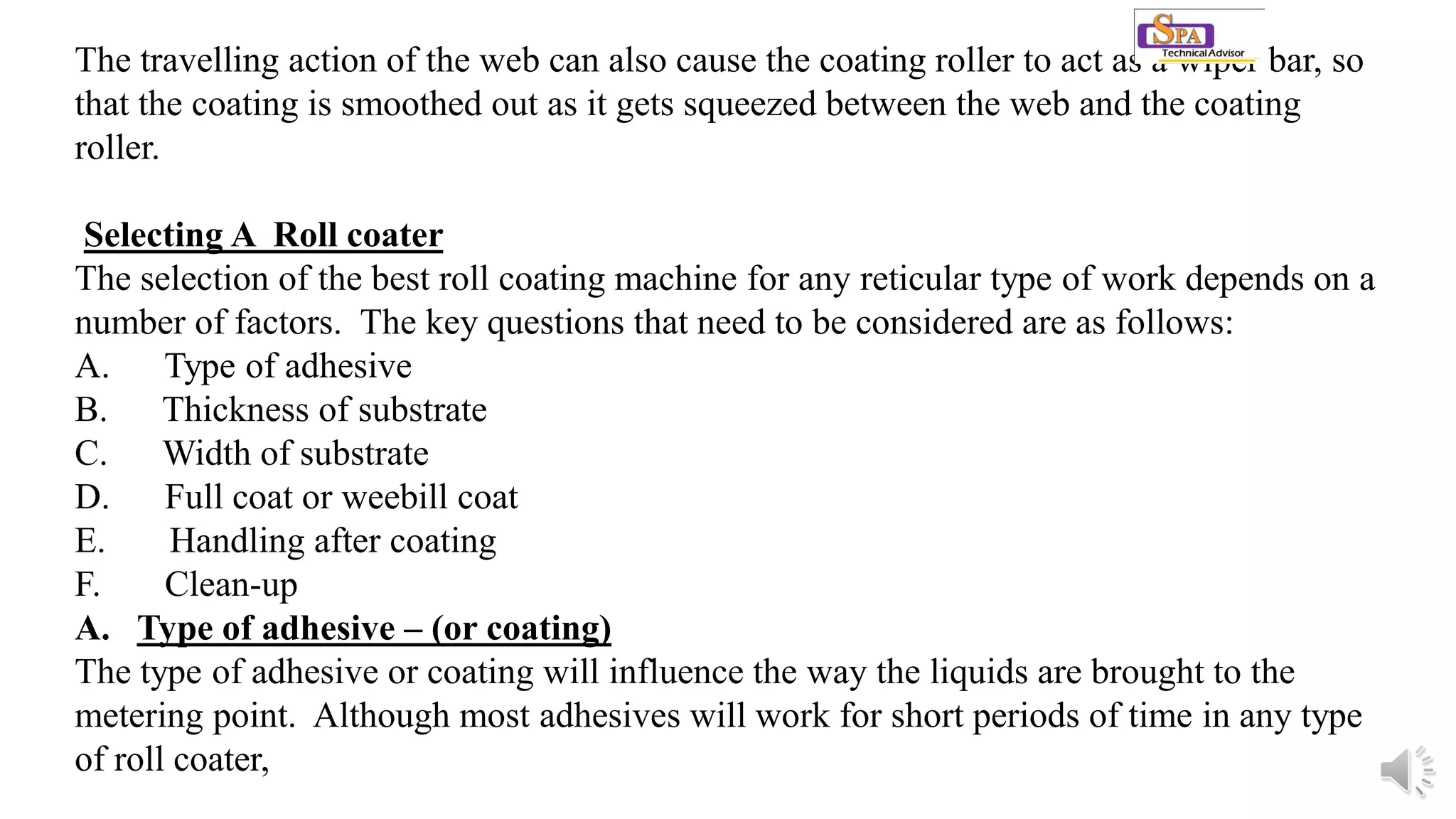
Transfer roll systems (Fig 4) are actually a variation of the metering
roll system, and utilize additional rollers to transfer the coating from
the reservoir to the final point of application. Because additional
rollers are involved, these systems are more expensive than designs
using only a metering roller and application roller,
52.
but there areseveral reasons why transfer rollers are used in some types of
equipment. These reasons are coating thickness, roller space limitations, and special roller
surface material requirements.
In general transfer roll systems are capable of depositing a thinner coating than two roll
systems. This is because a film split occurs at every roller interface, so the film of coating
will be thinner on each consecutive roller in the roller train.
Roller space limitations also may dictate the use of transfer rolls. In some types of
equipment, there is not enough space to place large diameter metering rollers close to the
application point, and transfer rolls can be used to carry the coating from the initial
metering point to the application point.
Transfer rolls can also be used in situations where the application roller must be made of a
material that is not well suited to use as a metering roll (such as a soft rubber).
53.
In these cases,metering of the coating is done with metal rolls or hard surfaced rolls, and
the coating is transferred to the application roll. This configuration can also be useful in
situations where rolls are used to transfer a pattern, such as certain types of printing
presses.
The coating is metered out to the surface of one roller, and the application roll picks up the
coating on a printing plate wrapped around the application roll. The plate transfers the
coating to the web.
Besides cost, one disadvantage of transfer roll systems is that they are more difficult to
adjust and calibrate than metering blade or two roll metering systems. In some situations
additional rolls or wiper blades must be added to prevent an accumulation of coating on
rolls when webs are not being coated.
Post Application Metering
In many applications roll coating machines are used to apply an adhesive or finish coating
to a web,
54.
Post Application Metering
Inmany applications roll coating machines are used to apply an
adhesive or finish coating to a web, but the thickness or finish of
the layer being applied does not meet the requirements of the end
product. In these cases a secondary metering method can be used
after the coating is applied to either thin out the coating, smooth it,
or texture it to meet the final requirements.
Almost all post application-metering situations are used when the
material being coated is in the form of a continuous web. One
method that is very popular is the use of a Mayer rod or Mayer
bar.
This is a rod wound with a layer of round wire. This device can be
used to both meter and smooth out a layer of coating. The bar is
used as a scraper bar to wipe off excess coating, and the spaces
that exist between the round wires serve to meter out a uniform
layer of coating.
55.
In most casesthe material being metered off will form a series of
peaks and valleys that will flow out to form a smooth uniform
layer. Mayer bars may be used in sequence to do rough metering then
fine metering/smoothing, and are used on many production lines that
produce pressure sensitive films, tapes, and other materials that require
a thin, smooth finish coating. A configuration using a Mayer rod is
shown in FIG 5.
In certain cases, application rolls can be built with surface textures that
provide the type of surface finish desired without post-application
metering. The ability to do this will often depend on the characteristics
of the coating being applied, as well as the characteristics of the
substrate.
With the right combination of characteristics, a simple machine may be
able to produce results that normally would be produced by a more
complex machine. Some machines are built with application rollers
having grooves, knurled surfaces, or engraved surfaces designed to
carry more coating than can be carried by a smooth roller.
56.
The surface texturecan be used as a method of controlling the amount of coating
deposited by a roller.
Web Coating
The majority of coating applications are ones where a continuous strip (web) of material
is coated, then dried (or chilled), and rewound into a roll. Web coating lends itself to high
production rates,and can be used with almost all types of adhesives and coatings. Many
web coating applications utilize roll coaters to apply the adhesive or coating, and most
utilize some form of post-application metering.
In general, web coating is done at much higher speeds than sheet coating, and considerable
attention must be given to factors such as proper web tracking, web tension control, web
flutter, and stretching. Since the web is a continuous strip, it can pass over a number of
rollers as it is being coated or treated, and some web coating configurations can be very
complex.
57.
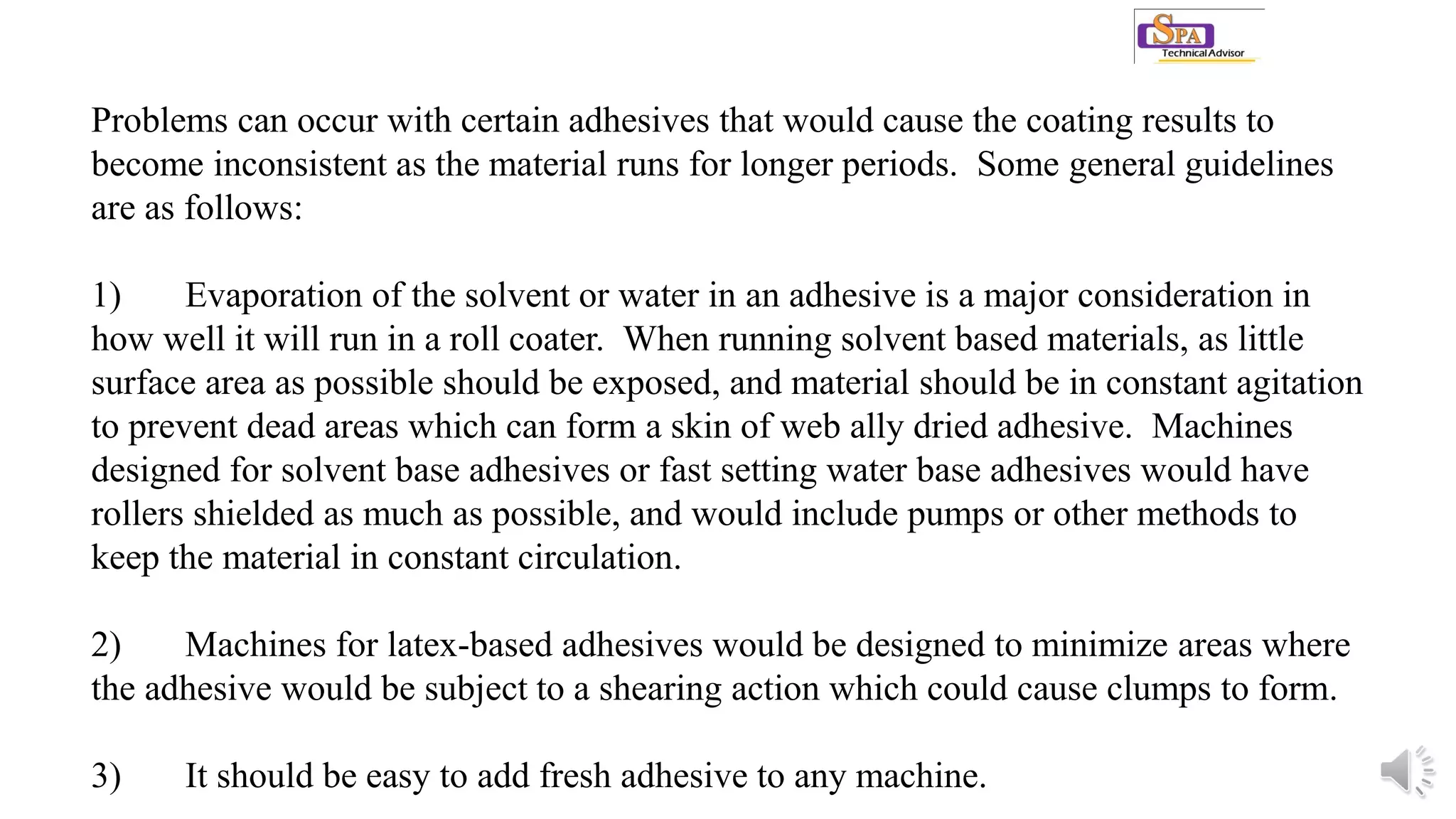
An engraved roller(gravure roll) is used in many web-coating
applications. This is used to transfer a very precise amount of
adhesive to the web. Two typical web coating configurations are
shown in Fig 6, both of them utilizing a gravure roller.
Pressure Roll Configurations
With any roll coater, the substrate to be coated must be brought into
contact with the application roller to pick up coating. In some
situations the web can be directly pressed against the coating roller
by a pressure roll, and in others the substrate must be guided over
the surface of the coating roller so that it just kisses the roller with
enough contact to pick up the liquid. Pressure rolls are sometimes
called feed rolls, backup rolls, or guide rolls.
The configuration of the pressure roll relative to the coating
application roll is usually determined by the thickness and
flexibility of the substrate to be coated.
58.
If the pressureroll is too close to the coating roller there is a possibility that it can pick
up excess coating that flows off of the substrate, and then transfer this coating on the
opposite side of the substrate. In some cases a droplet of coating can travel around on
the surface of the pressure roll. This can allow it to pick up a bit of coating on each
revolution until the roll becomes almost totally covered, requiring that the equipment be
stopped for clean-up.
When coating thin substrates the pressure rolls must be a sufficient distance from the
coating roller to avoid contamination, but still ensure that the substrate can be driven
through the machine and pick up a coating.
This can be accomplished by locating the pressure rolls in such a way that the substrate
is forced to bend over the coating roller, or by pressing the web directly against the
coating roller with the pressure roll and removing any excess that transfers to the
pressure roll with a wiper or cleaning roll.
59.
A third techniqueis to coat only a portion of the substrate and leave the edges uncoated to
avoid any transfer of coating.
If the substrate to be coated is sufficiently thick there is less chance of coating transfer and
the pressure roll can be located so that it presses the web directly against the coating roller.
Different configurations of pressure rolls relative to coating rolls have been used for
various types of equipment. Some typical configurations are shown here: In the
configuration shown in Fig 8 the substrate must flex as it hits the coating roll, and the
deflection creates a slight pressure of the substrate to the roll. Once the substrate is in
contact with the roll, the surface tension of the adhesive will tend to cause it to stick to the
roll and be pulled through the machine.
The stripper points indicated are small knife like fingers designed to break the leading edge
of a flexible substrate free of the coating roller and allow the web to feed through without
wrapping around the coating roller.
60.
This type ofsingle pressure roll configuration is typically used with
paper.
With the roll configuration shown in Fig 9 the two pressure rolls force
the web to cup over the coating roller and pick up a full coating. The
web flexes upward as it passes under the first roller and hits the
coating application roll, and is forced around the coating roller as it
hits the second pressure roll.
This roller arrangement can be versatile – it can often be used with a
range of substrate thicknesses, since moving the pressure rolls relative
to the coating roller can allow paper to be coated when the rolls are
close to the coating roll, and thicker webs coated as the pressure rolls
are moved away from the coating roll.
By raising the dual rollers high enough above the coating roller, it may
be possible to also coat rigid and semi-rigid substrates with this roll
configuration. Stripper fingers are generally used with flexible
substrates, but may not be required with stiffer materials.
61.
In Figure 10the web is pressed directly against the coating roll
by the pressure roll. If the web has sufficient thickness, stripper
fingers are not needed since the web will not cling to the coating
roll. Pressure rolls may or may not be driven, depending on the
type of material being coated and the type of adhesive, since
some types of adhesive generate sufficient driving force to pull
the web through the machine.
The configuration shown in Fig 11 is designed to force a
travelling strip of material to come in contact with the coating
roller and pick up coating. Web guide rolls do not need to be
driven, since the web is generally pulled by a rewind or take-up
roll, and the tension on the web creates the pressure of the
substrate against the coating roller.
In web coating, it is possible to pull the substrate over the
coating roller at a different speed than the surface of the
roller. This technique is often used to deposit a thinner layer of
coating than would be deposited by the roller running at the
same speed as the web.
62.
The travelling actionof the web can also cause the coating roller to act as a wiper bar, so
that the coating is smoothed out as it gets squeezed between the web and the coating
roller.
Selecting A Roll coater
The selection of the best roll coating machine for any reticular type of work depends on a
number of factors. The key questions that need to be considered are as follows:
A. Type of adhesive
B. Thickness of substrate
C. Width of substrate
D. Full coat or weebill coat
E. Handling after coating
F. Clean-up
A. Type of adhesive – (or coating)
The type of adhesive or coating will influence the way the liquids are brought to the
metering point. Although most adhesives will work for short periods of time in any type
of roll coater,
63.
Problems can occurwith certain adhesives that would cause the coating results to
become inconsistent as the material runs for longer periods. Some general guidelines
are as follows:
1) Evaporation of the solvent or water in an adhesive is a major consideration in
how well it will run in a roll coater. When running solvent based materials, as little
surface area as possible should be exposed, and material should be in constant agitation
to prevent dead areas which can form a skin of web ally dried adhesive. Machines
designed for solvent base adhesives or fast setting water base adhesives would have
rollers shielded as much as possible, and would include pumps or other methods to
keep the material in constant circulation.
2) Machines for latex-based adhesives would be designed to minimize areas where
the adhesive would be subject to a shearing action which could cause clumps to form.
3) It should be easy to add fresh adhesive to any machine.
64.
The design ofthe tank should be a compromise between the capacity and the exposed
surface area. Too large a tank may cause too much surface area to be exposed to
evaporation, but too small a tank may require constant refilling. Automatic refill
systems can be fitted to some machines to alleviate the need to refill constantly.
4) Some types of materials do not flow well, and need to be pumped to the metering
point. In some cases these materials can be carried up by a pickup roll that rotates
slowly enough to be wetted by then adhesive, but in other cases pumping systems are
required. This is especially true with certain high viscosity materials such as epoxies,
solvent cements and urethane adhesives.
5) Certain types of adhesives and coatings have special characteristics that must be
taken into account when selecting or designing a roll coater to handle them. An example
of this are Ultraviolet cured coatings (UV cure).
65.
Machines that areused to apply these coatings must have shielding or guarding in place to
keep the coating shielded from light as much as possible, since light exposure can cause
UV cure coatings to catalyse earlier than desired or can degrade the characteristics of the
coating.
The type of adhesive will affect the choice of materials for the rollers and reservoir, the
approach to coating thickness control, the method of machine clean-up, and the way that
coating gets delivered to the metering point. Certain types of adhesives (such as hotmelts,
waxes and certain high viscosity materials) require that the machine or the rollers be
heated to melt the material or lower the viscosity to a point where it can be applied.
Some adhesives or coatings will react with certain metals or other materials, and this can
degrade the adhesive as the machine runs, or cause damage to the coater. Examples of
this are the reactions of copper containing alloys with latex cements and U.V. cured
adhesives.
66.
Other examples ofincompatible materials would be aluminum components used with
highly acidic adhesives (such as hot animal glue). In this case the metal components
would be attacked and damaged by the glue.
Some adhesives are sensitive to a shearing action which occurs with a scraper blade, and
can tend to congeal when subjected to this type of force. These adhesives and coatings
must be run in machines having metering rollers.
For adhesives and coatings that must be heated either the rollers must be heated directly
or the tank which holds the material must be heated, and the heat from the tank and
material transferred to the application roller. The need for heating can limit the choice of
materials for the roller, since any material selected must be capable of maintaining critical
dimensions when heated to the operating temperature.
With any type of coating machine the type of adhesive or coating will affect the clean-up
method.
67.
Some types ofmaterials can be easily cleaned – others require extensive washing with
solvents or water to remove any residue. Most machines used for the application of
hotmelts do not require clean-up. The adhesive is simply allowed to cool and hardens
up in the machine. One exception to this are the “reactive” hotmelts or “moisture cure”
hotmelts which must be purged from the equipment before it is shut down.
B. Thickness of substrate
The thickness of the substrate determines the type of feed roll configuration that will
give the best results in coating the web. The web must be able to come into full contact
with the coating roller to pick up a consistent coating, but should not cause the coating
to transfer to the feed roller (or feed rolls).
Thin flexible substrates (such as paper), are usually best coated by using an offset
pressure roller or dual feed roller arrangement, and coating of individual sheets will
require the use of stripper fingers.
68.
Extremely flexible substratessuch as fabrics, thin foam, non-woven fabric, thin rubber
etc, can be very difficult to coat since they will tend to bunch up and fold over
themselves as they exit the coating point. In some cases, these types of material can only
be coated using a backing board of sufficient stiffness, coating them in a web form, or by
leaving a portion at the leading edge uncoated, and using this web to pull the substrate
through the coating point.
This can be done by loading the web into the coating machine with the feed roller open,
then bringing the feed roller into a position where it can drive the web while there is
some tension on the web to keep it from going slack and bunching up.
Thicker or stiffer substrates can be driven with a dual feed roll or single feed roll
arrangement. In some cases, stiff substrates such as plywood or fiber board can present
problems, since they may have high and low spots that will bridge over the coating roll
and create voids in the coating.
69.
C . Widthof Substrate
In general, the width of a roll coating machine should be at least 2 inches wider than
the widest web to be coated. With this extra width, if the web is loaded into the
machine slightly crooked, the full surface will still get coated.
D. Full coat or weebill coat
Roll coating machines are available that can apply coating to only a portion of a sheet
or the full surface. There are also pattern coaters available that can apply stripes or
other types of patterns in the same manner as a printing press (see transfer roll
systems). In selecting a coating machine, it is important to define the area to be
coated. Is it full surface, a pattern, or a stripe along one edge?
70.
E. Handling aftercoating
Once a web is coated with adhesive, it can become much more difficult to handle than
a dry web, so it is important to think about how the web will be handled once it is
coated.
The simplest and least inexpensive roll coaters coat the bottom surface of the
web. This means that the web must be handled immediately as it exits the machine,
and must be handled by the coated surface. With many types of webs this does not
present a problem, but potential problems with wet glue getting on operators fingers
need to be addressed. If the operators are able to handle and locate webs without
contaminating the clean surfaces there will be no problem, but in some cases the
operators will need to use special tools to handle the webs, or wipe their fingers clean
of glue at some point in the gluing and assembly operation.
With machines designed to apply adhesive or coatings to the top surface of the webs
the issue of glue contamination is drastically reduced.