COATING AND
LAMINATING ON
PAPER IN FILM'S AND
ITS TYPE NEEDS AND
METHOD
INTRODUCTION
• Coating and laminating are two of the most widely used processes
for transforming flexible films and sheets into products
• Coating is the process of applying one or more layers of a fluid or
melt to the surface of a material, while laminating is the bonding of
two or more webs.
• A laminate is defined as any combination of distinctly different
plastic film materials or plastic plus non plastic materials (typically
paper and aluminium foil), where each major web is generally
thicker than 6 μm.
• There is no upper limit to the possible number of webs, but two is
the obvious minimum and one of these must be thermoplastic.
COATING PROCESSES:
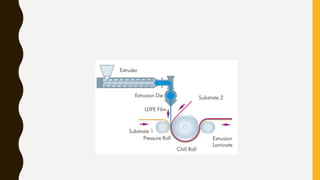
• Extrusion coating (sometimes called extrusion lamination) was first
practiced on a commercial scale in the production of LDPE-coated
paperboard for milk cartons as a replacement for wax-coated stock.
• Compared to wax, LDPE is superior with greater strength, seal
integrity and resistance to cracking and flaking off.
• It also provides greater resistance to moisture.
• Currently, almost all applications for wax coated paperboard have
been replaced by polyolefin-coated paper and board.
• Extrusion coating with polyethylene has several advantages
over adhesive lamination of a pre fabricated polyethylene
film to paper.
• First, thin films of polyethylene are difficult to handle and
maintain flat and handling them requires very low tensions,
which are difficult to control at high speeds.
• Secondly, extrusion coating temperatures are sufficiently
high so that good mechanical bonds are obtained by resin
penetration into the porous paper substrate.
LAMINATING PROCESSES:
• Methods that combine two or more webs by bonding them
together are called laminating processes.
• Bonding is usually accomplished by thermal or chemical
means with adhesives and curing systems.
• After the adhesive is adequately dried or cured, the coated
web is combined with an uncoated web through the
application of heat or pressure in a nip.
THERMAL LAMINATING
• Thermal laminating is the joining of two webs with an adhesive that
is first applied to land cooled and dried on one of the webs.
• The webs are heated before pressing them together in the nip of two
rollers, which provide the force needed to establish the intimate
contact required for the bond.
• The adhesives most commonly used are polyolefins such as EVA,
and the webs most commonly laminated this way include plastic
films, and aluminum foil joined with heat seal coated film or paper.
WET BOND LAMINATING
• Wet bond laminating uses solvent or aqueous based adhesives and
can only be used when one or more of the webs are permeable to the
water or other solvent used, thus allowing it to escape.
• Wet bonding is not generally successful with plastic films, even
when laminating them to paper.
• Usually aqueous adhesives such as casein, sodium silicate, starch,
PVA latex, rubber latex or dextrin are used.
DRY BONDING
• Dry bonding is considerably more versatile.
• In that process, any two materials can be laminated once an adhesive
system has been developed.
• Either aqueous or organic solvent based adhesives are used, and they
are dried or cured if necessary by the application of heat, prior to
laminating.
• The use of organic solvent base adhesives has been largely phased
out because of legislation limiting the release of VOCs (Volatile
Organic Compounds) into the atmosphere
SOLVENTLESS LAMINATING
• Solventless laminating consists of bonding together two webs by
curing in the absence of solvents.
• It has now become the dominant laminating method in commercial
use because of legislation limiting the release of VOCs.
• Single component urethanes are the most widely used; polyester
isocyanates are also used.
EXTRUSION LAMINATING
• Extrusion laminating is a specialized use of extrusion coating,
where a hot extruded film is trapped between two other webs and
cooled.
• This process is used mainly for producing a triple laminate of such
materials as paper, aluminium foil, RCF and PET with LSPE, where
the latter material is extruded and acts as the bonding agent between
the two substrates.
• As in the case of extrusion coating, this process is applicable to any
thermoplastic material, but the technology has been highly
developed mainly for polyethylene and associated copolymers,
including isomers.
• The conditions and time scale of coating materials with the dry surface treatment
(DST) differ significantly from the ones applied in conventional extrusion, solvent-
based and dispersion coating.
• In DST, the coating and surface finishing are combined in steps of applying layers of
dry coating particles onto a substrate, thereafter densifying and smoothening the
surface layer during a thermomechanical fixing phase.
• First, an electric field is used to direct charged coating particles onto the surface,
where the deposited layer attaches mainly electrostatically.
• Secondly, during the heating and compression phase, the polymer layer should
exhibit sufficient flow ability, deformability and affinity to the substrate surface in
order to provide an adequate and homogeneous coating.
• The dwell time in the heated roll nip can be adjusted to give the polymeric particles
sufficient time to sinter and homogenize throughout the layer by diffusion
mechanisms
• The layering, softening and immobilization of the coating should be
accomplished within milliseconds, where governing factors for
example are particle size, thermal conductivity within the layer, and
other polymer characteristics such as softening temperature and
rheological behavior.
• At low coat weights, a crucial requirement for obtaining a uniform and smooth
coating with a sufficient covering ability is an even distribution of particles of a fine
particle size, since large particles require longer time to flow sufficiently and level
out.
• The heat treatment is ideally used for controlling the rheological behaviour of the
polymer in order to achieve an adequate film formation and allow polymer
penetration into the porous surface of the paper and thereby anchor the coating layer
mechanically to the substrate and seal it.
• We studied the effects of the thermomechanical properties of the polymer and
fixation conditions on the formed structure and performance of the coatings prepared
in a laboratory scale dry surface treatment unit.
• The results of these experiments are presented and discussed. A main conclusion from
the work is that DST appears to be a promising technique for producing coated
structures.
Coating and Lamination

Coating and Lamination

  • 1.
    COATING AND LAMINATING ON PAPERIN FILM'S AND ITS TYPE NEEDS AND METHOD
  • 2.
    INTRODUCTION • Coating andlaminating are two of the most widely used processes for transforming flexible films and sheets into products • Coating is the process of applying one or more layers of a fluid or melt to the surface of a material, while laminating is the bonding of two or more webs. • A laminate is defined as any combination of distinctly different plastic film materials or plastic plus non plastic materials (typically paper and aluminium foil), where each major web is generally thicker than 6 μm. • There is no upper limit to the possible number of webs, but two is the obvious minimum and one of these must be thermoplastic.
  • 3.
    COATING PROCESSES: • Extrusioncoating (sometimes called extrusion lamination) was first practiced on a commercial scale in the production of LDPE-coated paperboard for milk cartons as a replacement for wax-coated stock. • Compared to wax, LDPE is superior with greater strength, seal integrity and resistance to cracking and flaking off. • It also provides greater resistance to moisture. • Currently, almost all applications for wax coated paperboard have been replaced by polyolefin-coated paper and board.
  • 4.
    • Extrusion coatingwith polyethylene has several advantages over adhesive lamination of a pre fabricated polyethylene film to paper. • First, thin films of polyethylene are difficult to handle and maintain flat and handling them requires very low tensions, which are difficult to control at high speeds. • Secondly, extrusion coating temperatures are sufficiently high so that good mechanical bonds are obtained by resin penetration into the porous paper substrate.
  • 6.
    LAMINATING PROCESSES: • Methodsthat combine two or more webs by bonding them together are called laminating processes. • Bonding is usually accomplished by thermal or chemical means with adhesives and curing systems. • After the adhesive is adequately dried or cured, the coated web is combined with an uncoated web through the application of heat or pressure in a nip.
  • 7.
    THERMAL LAMINATING • Thermallaminating is the joining of two webs with an adhesive that is first applied to land cooled and dried on one of the webs. • The webs are heated before pressing them together in the nip of two rollers, which provide the force needed to establish the intimate contact required for the bond. • The adhesives most commonly used are polyolefins such as EVA, and the webs most commonly laminated this way include plastic films, and aluminum foil joined with heat seal coated film or paper.
  • 8.
    WET BOND LAMINATING •Wet bond laminating uses solvent or aqueous based adhesives and can only be used when one or more of the webs are permeable to the water or other solvent used, thus allowing it to escape. • Wet bonding is not generally successful with plastic films, even when laminating them to paper. • Usually aqueous adhesives such as casein, sodium silicate, starch, PVA latex, rubber latex or dextrin are used.
  • 9.
    DRY BONDING • Drybonding is considerably more versatile. • In that process, any two materials can be laminated once an adhesive system has been developed. • Either aqueous or organic solvent based adhesives are used, and they are dried or cured if necessary by the application of heat, prior to laminating. • The use of organic solvent base adhesives has been largely phased out because of legislation limiting the release of VOCs (Volatile Organic Compounds) into the atmosphere
  • 10.
    SOLVENTLESS LAMINATING • Solventlesslaminating consists of bonding together two webs by curing in the absence of solvents. • It has now become the dominant laminating method in commercial use because of legislation limiting the release of VOCs. • Single component urethanes are the most widely used; polyester isocyanates are also used.
  • 11.
    EXTRUSION LAMINATING • Extrusionlaminating is a specialized use of extrusion coating, where a hot extruded film is trapped between two other webs and cooled. • This process is used mainly for producing a triple laminate of such materials as paper, aluminium foil, RCF and PET with LSPE, where the latter material is extruded and acts as the bonding agent between the two substrates. • As in the case of extrusion coating, this process is applicable to any thermoplastic material, but the technology has been highly developed mainly for polyethylene and associated copolymers, including isomers.
  • 12.
    • The conditionsand time scale of coating materials with the dry surface treatment (DST) differ significantly from the ones applied in conventional extrusion, solvent- based and dispersion coating. • In DST, the coating and surface finishing are combined in steps of applying layers of dry coating particles onto a substrate, thereafter densifying and smoothening the surface layer during a thermomechanical fixing phase. • First, an electric field is used to direct charged coating particles onto the surface, where the deposited layer attaches mainly electrostatically. • Secondly, during the heating and compression phase, the polymer layer should exhibit sufficient flow ability, deformability and affinity to the substrate surface in order to provide an adequate and homogeneous coating. • The dwell time in the heated roll nip can be adjusted to give the polymeric particles sufficient time to sinter and homogenize throughout the layer by diffusion mechanisms
  • 13.
    • The layering,softening and immobilization of the coating should be accomplished within milliseconds, where governing factors for example are particle size, thermal conductivity within the layer, and other polymer characteristics such as softening temperature and rheological behavior.
  • 14.
    • At lowcoat weights, a crucial requirement for obtaining a uniform and smooth coating with a sufficient covering ability is an even distribution of particles of a fine particle size, since large particles require longer time to flow sufficiently and level out. • The heat treatment is ideally used for controlling the rheological behaviour of the polymer in order to achieve an adequate film formation and allow polymer penetration into the porous surface of the paper and thereby anchor the coating layer mechanically to the substrate and seal it. • We studied the effects of the thermomechanical properties of the polymer and fixation conditions on the formed structure and performance of the coatings prepared in a laboratory scale dry surface treatment unit. • The results of these experiments are presented and discussed. A main conclusion from the work is that DST appears to be a promising technique for producing coated structures.

Editor's Notes

  • #3 Lamination is the technique of manufacturing a material in multiple layer, that composite material achives strength,stablilty, appearance Laminate is a permently assembles object by heat, pressure Standard thermal laminating flims, L temp laminating flims, heat set, pressure sensitive flims, liquid laminates