Researching Partners
PA-01: Siddharth Malewar
PA-02: Nikith Lalwani
PA-03: Jash Pandhi
PA-04: Jaya Verma
PA-05: Rohit Jagtap
PA-06: Yash Latthe
What is biaxial
stretching?
 Biaxial stretching of films is the process of forming hot plastic films in cross
machine directions, resulting in a stronger film.
 The biaxial stretching process is performed in two directions within the film.
Machine direction and transverse direction.
 Films can be biaxially oriented in two ways, sequentially and simultaneously.
 Biaxial orientation is a process whereby a plastic film or sheet is stretched in
such a way that the polymeric chains are oriented parallel to the plane of the
film.
What is biaxial oriented poly -
propylene (BOPP)?
 Film which is produced from PP in the biaxial orientation process is usually
designated BOPP (biaxially oriented propylene).
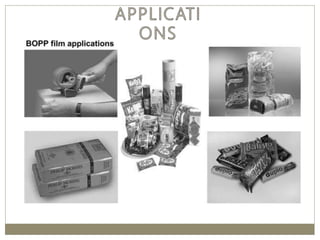
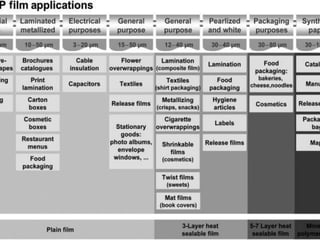
 BOPP films are used in food packaging, package overwrap, labels, adhesive
tapes and a variety of other applications.
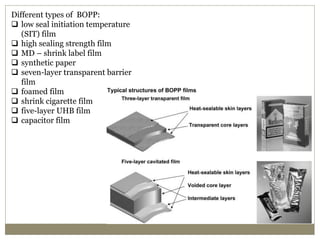
Different types of BOPP:
 low seal initiation temperature
(SIT) film
 high sealing strength film
 MD – shrink label film
 synthetic paper
 seven-layer transparent barrier
film
 foamed film
 shrink cigarette film
 five-layer UHB film
 capacitor film
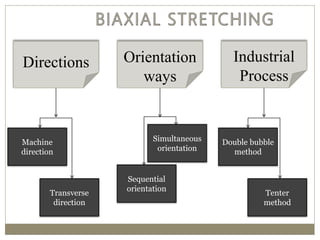
Directions Orientation
ways
Industrial
Process
Machine
direction
Transverse
direction
Sequential
orientation
Simultaneous
orientation
Double bubble
method
Tenter
method
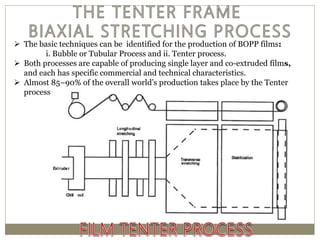
 The basic techniques can be identified for the production of BOPP films:
i. Bubble or Tubular Process and ii. Tenter process.
 Both processes are capable of producing single layer and co-extruded films,
and each has specific commercial and technical characteristics.
 Almost 85–90% of the overall world’s production takes place by the Tenter
process
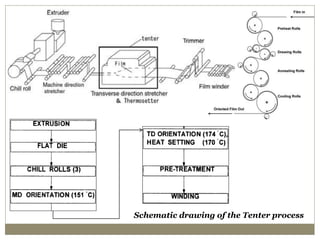
Schematic drawing of the Tenter process
 Different stretch or orientation ratios are possible in the
double bubble process through the control of the inflation air
pressure.
 Typically, polypropylene, one of the most common polymers
for biaxial stretching, is oriented at least seven times in both
the machine and transverse directions using the double
bubble process.
 The measured mechanical properties, particularly strength and
modulus, are directly related to the level of orientation in the
final film and increase with an increase in the orientation level.
 Films which are produced by the double bubble process have
certain definite advantages over films produced by other
processes.
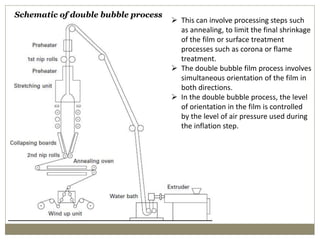
Schematic of double bubble process
 This can involve processing steps such
as annealing, to limit the final shrinkage
of the film or surface treatment
processes such as corona or flame
treatment.
 The double bubble film process involves
simultaneous orientation of the film in
both directions.
 In the double bubble process, the level
of orientation in the film is controlled
by the level of air pressure used during
the inflation step.
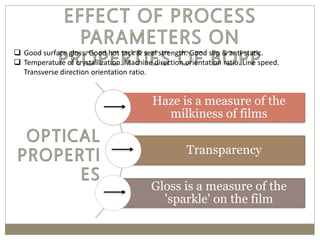
Haze is a measure of the
milkiness of films
Transparency
Gloss is a measure of the
'sparkle' on the film
 Good surface gloss. Good hot tack & seal strength. Good slip & anti-static.
 Temperature of crystallization. Machine direction orientation ratio. Line speed.
Transverse direction orientation ratio.
How do we get clear films?
Both transparent and opaque films can be produced by the biaxial stretching
process.
 If the quenching rate is high % crystallinity will be low and crystal size
will be low hence will be transparent and if it is quenched slowly it will
have high %crystallinity higher crystal size and hence it will be
translucent.
 In the case of opaque films, on the other hand, specific materials are
included in the formulation which contribute to the opacity or whiteness of
the final film stretched product. Those additives can be either organic or
inorganic in nature. During the film stretching process, there is a
debonding process which occurs at the interface between the stretched
polymer and the filler particle. This occurs primarily because of the lack of
adhesion between the two materials being stretched. The debonding
produces voids in the films. The scattering of light from these voids is
what produces the opacity or whiteness in the film.
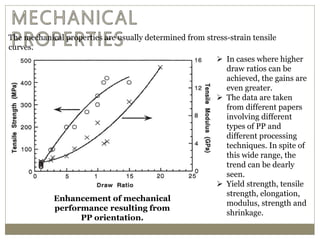
The mechanical properties are usually determined from stress-strain tensile
curves.
Enhancement of mechanical
performance resulting from
PP orientation.
 In cases where higher
draw ratios can be
achieved, the gains are
even greater.
 The data are taken
from different papers
involving different
types of PP and
different processing
techniques. In spite of
this wide range, the
trend can be dearly
seen.
 Yield strength, tensile
strength, elongation,
modulus, strength and
shrinkage.
Process parameters
• Increasing machine direction orientation leads to a higher level of
crystallinity, so the modulus, yield stress and tensile strength increased
in both the directions.
• When the crystallization temperature was increased, the degree of
crystallinity became higher and the film haze increased slightly.
 Permeability
Permeability of oriented films to different gases is significantly
reduced compared to unoriented films. The effects of relative humidity (RH)
and temperature on the barrier properties of biaxially-oriented polypropylene
(BOPP) films are studied. The water vapor transmission rate (WVTR) and the
oxygen transmission rate (OTR) are used to calculate the water vapor
permeability (WVP) and the oxygen permeability (OP) of packaging materials
which affects the shelf life and quality of the product.
 Dielectric properties
The dielectric properties of BOPP capacitor films, most notably the
dielectric loss, electrical conduction and breakdown, have been studied by
several authors and related with various compositional and morphological
features of BOPP.
 Heat sealing strength
The heat-sealing strength of the plastic layers is the same or different
materials fills the heat-bonded together at a certain temperature and
pressure, and then the peel strength is reached.
The effects of the material and processing parameters such as the
nucleating agent, the temperature of crystallization, and the degree of
MD orientation on the mechanical, optical, and thermal properties of
the BOPP films were investigated.
 The effect of the Nucleating Agent on the Properties of the BOPP Film
Nucleating agents are used to form β crystal structure in isotactic
polypropylene.
In order to observe the effects of nucleating agent on the optical and
mechanical properties of BOPP films, a nucleating agent was used in some of the
BOPP films produced by Polinas.
 Temperature of crystallization
 Degree of MD orientation
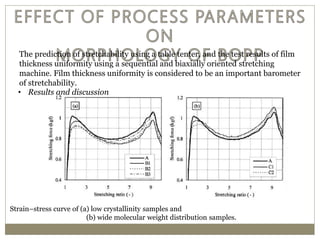
The prediction of stretchability using a table tenter, and the test results of film
thickness uniformity using a sequential and biaxially oriented stretching
machine. Film thickness uniformity is considered to be an important barometer
of stretchability.
• Results and discussion
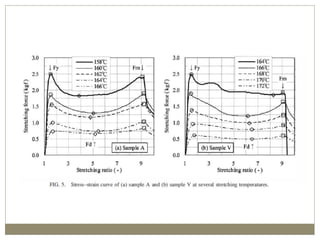
Strain–stress curve of (a) low crystallinity samples and
(b) wide molecular weight distribution samples.
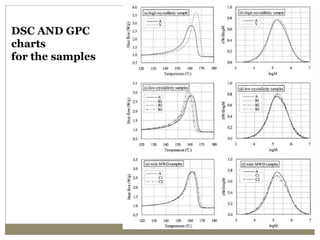
DSC AND GPC
charts
for the samples
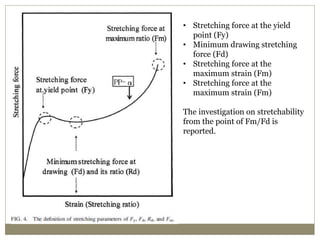
• Stretching force at the yield
point (Fy)
• Minimum drawing stretching
force (Fd)
• Stretching force at the
maximum strain (Fm)
• Stretching force at the
maximum strain (Fm)
The investigation on stretchability
from the point of Fm/Fd is
reported.
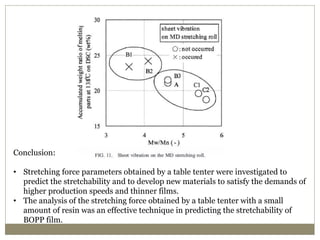
Conclusion:
• Stretching force parameters obtained by a table tenter were investigated to
predict the stretchability and to develop new materials to satisfy the demands of
higher production speeds and thinner films.
• The analysis of the stretching force obtained by a table tenter with a small
amount of resin was an effective technique in predicting the stretchability of
BOPP film.
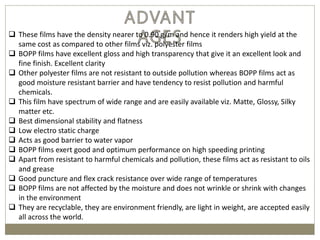
 These films have the density nearer to 0.90 g/m and hence it renders high yield at the
same cost as compared to other films viz. polyester films
 BOPP films have excellent gloss and high transparency that give it an excellent look and
fine finish. Excellent clarity
 Other polyester films are not resistant to outside pollution whereas BOPP films act as
good moisture resistant barrier and have tendency to resist pollution and harmful
chemicals.
 This film have spectrum of wide range and are easily available viz. Matte, Glossy, Silky
matter etc.
 Best dimensional stability and flatness
 Low electro static charge
 Acts as good barrier to water vapor
 BOPP films exert good and optimum performance on high speeding printing
 Apart from resistant to harmful chemicals and pollution, these films act as resistant to oils
and grease
 Good puncture and flex crack resistance over wide range of temperatures
 BOPP films are not affected by the moisture and does not wrinkle or shrink with changes
in the environment
 They are recyclable, they are environment friendly, are light in weight, are accepted easily
all across the world.
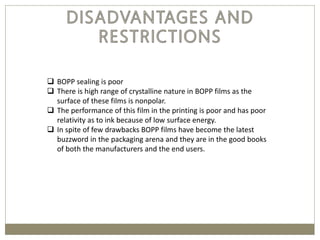
 BOPP sealing is poor
 There is high range of crystalline nature in BOPP films as the
surface of these films is nonpolar.
 The performance of this film in the printing is poor and has poor
relativity as to ink because of low surface energy.
 In spite of few drawbacks BOPP films have become the latest
buzzword in the packaging arena and they are in the good books
of both the manufacturers and the end users.
• Effects of Nucleating Agent and Processing Conditions on the
Mechanical, Thermal, and Optical Properties of Biaxially Oriented
Polypropylene Films. Chemical Engineering Department Middle East
Technical University Ankara, lbrkey. Slide 15
• Equipment design and requirements of biaxially stretched films M.T.
DeMeuse, Independent Consultant, USA.
• Factors Affecting The Haze Of BOPP Thermal Lamination Film China
thermal film.
• Research on the Performances of Heat-Sealing BOPP.
• Biaxially oriented polypropylene (BOPP) processes Abdellah Ajji and
Michel M. Dumoulin
• Effects of Temperature and Humidity on the Barrier Properties of
Biaxially-oriented Polypropylene and Polyvinyl Alcohol Films
• Research on the Performances of Heat-Sealing BOPP Film
• Effect of Processing Parameters on Polypropylene Film Properties
• The Effect of Molecular Structure of Polypropylene on Stretchability for
Biaxially Oriented Film

Bi-axially oriented Poly polypropylene films

  • 1.
    Researching Partners PA-01: SiddharthMalewar PA-02: Nikith Lalwani PA-03: Jash Pandhi PA-04: Jaya Verma PA-05: Rohit Jagtap PA-06: Yash Latthe
  • 2.
    What is biaxial stretching? Biaxial stretching of films is the process of forming hot plastic films in cross machine directions, resulting in a stronger film.  The biaxial stretching process is performed in two directions within the film. Machine direction and transverse direction.  Films can be biaxially oriented in two ways, sequentially and simultaneously.  Biaxial orientation is a process whereby a plastic film or sheet is stretched in such a way that the polymeric chains are oriented parallel to the plane of the film. What is biaxial oriented poly - propylene (BOPP)?  Film which is produced from PP in the biaxial orientation process is usually designated BOPP (biaxially oriented propylene).  BOPP films are used in food packaging, package overwrap, labels, adhesive tapes and a variety of other applications.
  • 3.
    Different types ofBOPP:  low seal initiation temperature (SIT) film  high sealing strength film  MD – shrink label film  synthetic paper  seven-layer transparent barrier film  foamed film  shrink cigarette film  five-layer UHB film  capacitor film
  • 4.
  • 6.
     The basictechniques can be identified for the production of BOPP films: i. Bubble or Tubular Process and ii. Tenter process.  Both processes are capable of producing single layer and co-extruded films, and each has specific commercial and technical characteristics.  Almost 85–90% of the overall world’s production takes place by the Tenter process
  • 7.
    Schematic drawing ofthe Tenter process
  • 8.
     Different stretchor orientation ratios are possible in the double bubble process through the control of the inflation air pressure.  Typically, polypropylene, one of the most common polymers for biaxial stretching, is oriented at least seven times in both the machine and transverse directions using the double bubble process.  The measured mechanical properties, particularly strength and modulus, are directly related to the level of orientation in the final film and increase with an increase in the orientation level.  Films which are produced by the double bubble process have certain definite advantages over films produced by other processes.
  • 9.
    Schematic of doublebubble process  This can involve processing steps such as annealing, to limit the final shrinkage of the film or surface treatment processes such as corona or flame treatment.  The double bubble film process involves simultaneous orientation of the film in both directions.  In the double bubble process, the level of orientation in the film is controlled by the level of air pressure used during the inflation step.
  • 10.
    Haze is ameasure of the milkiness of films Transparency Gloss is a measure of the 'sparkle' on the film  Good surface gloss. Good hot tack & seal strength. Good slip & anti-static.  Temperature of crystallization. Machine direction orientation ratio. Line speed. Transverse direction orientation ratio.
  • 11.
    How do weget clear films? Both transparent and opaque films can be produced by the biaxial stretching process.  If the quenching rate is high % crystallinity will be low and crystal size will be low hence will be transparent and if it is quenched slowly it will have high %crystallinity higher crystal size and hence it will be translucent.  In the case of opaque films, on the other hand, specific materials are included in the formulation which contribute to the opacity or whiteness of the final film stretched product. Those additives can be either organic or inorganic in nature. During the film stretching process, there is a debonding process which occurs at the interface between the stretched polymer and the filler particle. This occurs primarily because of the lack of adhesion between the two materials being stretched. The debonding produces voids in the films. The scattering of light from these voids is what produces the opacity or whiteness in the film.
  • 12.
    The mechanical propertiesare usually determined from stress-strain tensile curves. Enhancement of mechanical performance resulting from PP orientation.  In cases where higher draw ratios can be achieved, the gains are even greater.  The data are taken from different papers involving different types of PP and different processing techniques. In spite of this wide range, the trend can be dearly seen.  Yield strength, tensile strength, elongation, modulus, strength and shrinkage.
  • 13.
    Process parameters • Increasingmachine direction orientation leads to a higher level of crystallinity, so the modulus, yield stress and tensile strength increased in both the directions. • When the crystallization temperature was increased, the degree of crystallinity became higher and the film haze increased slightly.
  • 14.
     Permeability Permeability oforiented films to different gases is significantly reduced compared to unoriented films. The effects of relative humidity (RH) and temperature on the barrier properties of biaxially-oriented polypropylene (BOPP) films are studied. The water vapor transmission rate (WVTR) and the oxygen transmission rate (OTR) are used to calculate the water vapor permeability (WVP) and the oxygen permeability (OP) of packaging materials which affects the shelf life and quality of the product.  Dielectric properties The dielectric properties of BOPP capacitor films, most notably the dielectric loss, electrical conduction and breakdown, have been studied by several authors and related with various compositional and morphological features of BOPP.  Heat sealing strength The heat-sealing strength of the plastic layers is the same or different materials fills the heat-bonded together at a certain temperature and pressure, and then the peel strength is reached.
  • 15.
    The effects ofthe material and processing parameters such as the nucleating agent, the temperature of crystallization, and the degree of MD orientation on the mechanical, optical, and thermal properties of the BOPP films were investigated.  The effect of the Nucleating Agent on the Properties of the BOPP Film Nucleating agents are used to form β crystal structure in isotactic polypropylene. In order to observe the effects of nucleating agent on the optical and mechanical properties of BOPP films, a nucleating agent was used in some of the BOPP films produced by Polinas.  Temperature of crystallization  Degree of MD orientation
  • 16.
    The prediction ofstretchability using a table tenter, and the test results of film thickness uniformity using a sequential and biaxially oriented stretching machine. Film thickness uniformity is considered to be an important barometer of stretchability. • Results and discussion Strain–stress curve of (a) low crystallinity samples and (b) wide molecular weight distribution samples.
  • 18.
  • 19.
    • Stretching forceat the yield point (Fy) • Minimum drawing stretching force (Fd) • Stretching force at the maximum strain (Fm) • Stretching force at the maximum strain (Fm) The investigation on stretchability from the point of Fm/Fd is reported.
  • 20.
    Conclusion: • Stretching forceparameters obtained by a table tenter were investigated to predict the stretchability and to develop new materials to satisfy the demands of higher production speeds and thinner films. • The analysis of the stretching force obtained by a table tenter with a small amount of resin was an effective technique in predicting the stretchability of BOPP film.
  • 23.
     These filmshave the density nearer to 0.90 g/m and hence it renders high yield at the same cost as compared to other films viz. polyester films  BOPP films have excellent gloss and high transparency that give it an excellent look and fine finish. Excellent clarity  Other polyester films are not resistant to outside pollution whereas BOPP films act as good moisture resistant barrier and have tendency to resist pollution and harmful chemicals.  This film have spectrum of wide range and are easily available viz. Matte, Glossy, Silky matter etc.  Best dimensional stability and flatness  Low electro static charge  Acts as good barrier to water vapor  BOPP films exert good and optimum performance on high speeding printing  Apart from resistant to harmful chemicals and pollution, these films act as resistant to oils and grease  Good puncture and flex crack resistance over wide range of temperatures  BOPP films are not affected by the moisture and does not wrinkle or shrink with changes in the environment  They are recyclable, they are environment friendly, are light in weight, are accepted easily all across the world.
  • 24.
     BOPP sealingis poor  There is high range of crystalline nature in BOPP films as the surface of these films is nonpolar.  The performance of this film in the printing is poor and has poor relativity as to ink because of low surface energy.  In spite of few drawbacks BOPP films have become the latest buzzword in the packaging arena and they are in the good books of both the manufacturers and the end users.
  • 25.
    • Effects ofNucleating Agent and Processing Conditions on the Mechanical, Thermal, and Optical Properties of Biaxially Oriented Polypropylene Films. Chemical Engineering Department Middle East Technical University Ankara, lbrkey. Slide 15 • Equipment design and requirements of biaxially stretched films M.T. DeMeuse, Independent Consultant, USA. • Factors Affecting The Haze Of BOPP Thermal Lamination Film China thermal film. • Research on the Performances of Heat-Sealing BOPP. • Biaxially oriented polypropylene (BOPP) processes Abdellah Ajji and Michel M. Dumoulin • Effects of Temperature and Humidity on the Barrier Properties of Biaxially-oriented Polypropylene and Polyvinyl Alcohol Films • Research on the Performances of Heat-Sealing BOPP Film • Effect of Processing Parameters on Polypropylene Film Properties • The Effect of Molecular Structure of Polypropylene on Stretchability for Biaxially Oriented Film