POLYESTER
 First condensation polymer studied by Carothers in 1930
 Mainly of 2 types
a) Saturated: used in synthetic fibers, films and molding application
b) Unsaturated: used as laminating resin and glass-reinforced plastic
product
 Special Polyesters
- Polyethylene terephthalate
- Polybutylene terephthalate
- Polyarylates
- Poly(Dihydroxymethylcyclohexyl terephthalate)
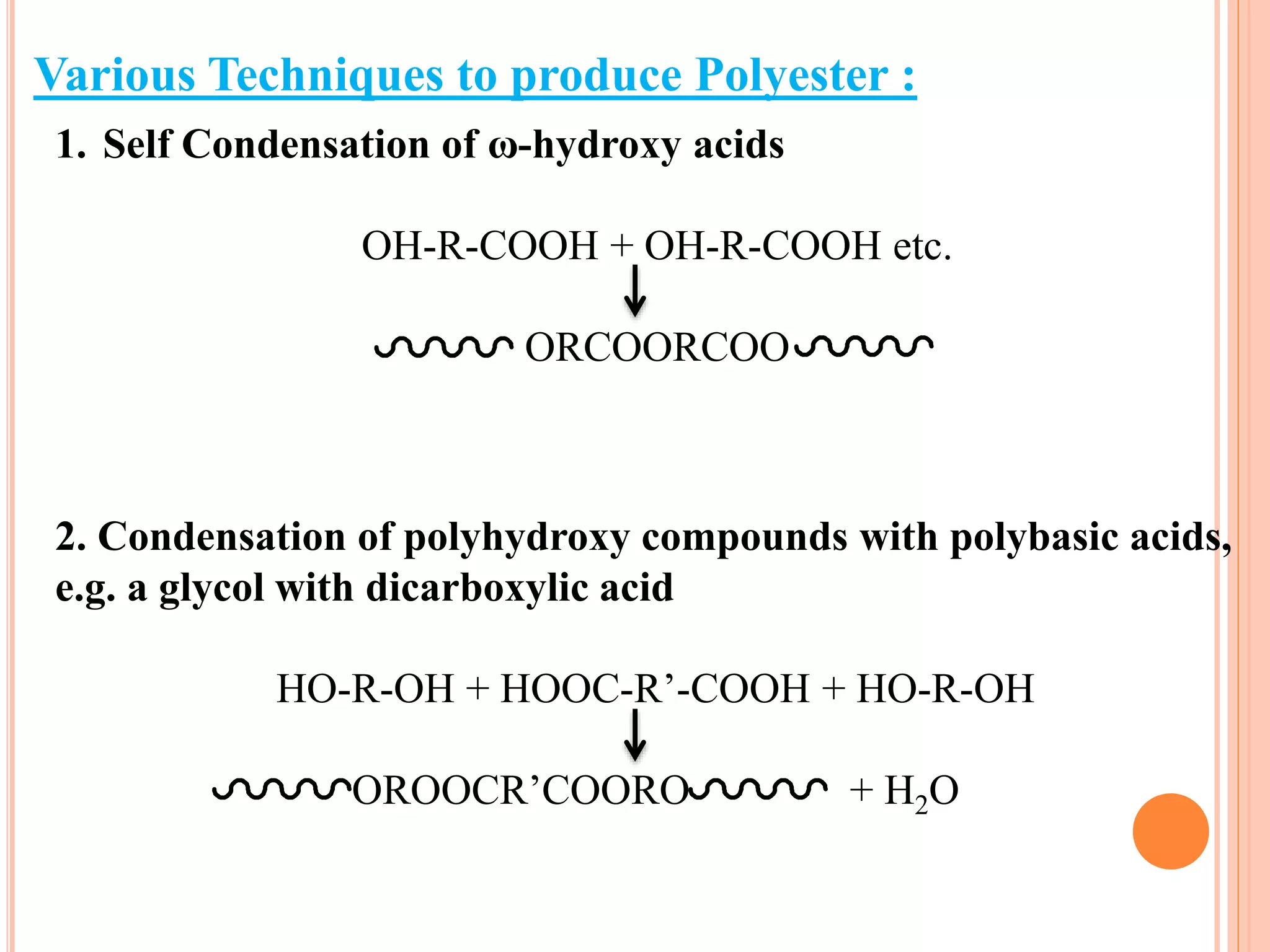
Various Techniques to produce Polyester :
1. Self Condensation of ω-hydroxy acids
OH-R-COOH + OH-R-COOH etc.
ORCOORCOO
2. Condensation of polyhydroxy compounds with polybasic acids,
e.g. a glycol with dicarboxylic acid
HO-R-OH + HOOC-R’-COOH + HO-R-OH
OROOCR’COORO + H2O
3. Ester Exchange:
R’OOC-R-COOR’ + HO-R”-OH
OOC-R’-COO-R”OO + R’OH
4. Ring Opening of Lactone e.g. ϵ-caprolactone with dihydroxy or
trihydroxy initiator
RCOO
R O
C
O
5. Alcoholysis of acid chloride of a di-carboxylic acid with
polyhydroxy alcohol:
ClOC-R-COCl + HO-R’-OH
OC-R-COOR’O + HCl
COMMON PROPERTIES IN POLYESTER
 Chemical Weakness: susceptible to hydrolysis, ammonolysis
and ester exchange leads to chain scission
 Electrical Insulation at high frequency: Polarity of ester
group adversely affect the high frequency electrical
insulation properties
 Proton acceptor ester group: allows interaction with other
grouping either an inter- or an intra molecular nature.
 Increases Flexibility and inter chain attraction
UNSATURATED POLYESTER LAMINATING
RESINS
 Polyester laminating resin are
a) Viscous
b) Pale yellow colored
c) Low degree of polymerization(~8 to 10)
d) Produced from a glycol and di acid
e) provide site of cross-linking
SELECTION OF RAW MATERIAL
C
HOOC
C
H H
COOH
C
HOOC
C
H COOH
H
HC CH
C C
O
O O
Maleic Acid
-used in conventional general
purpose resins
Fumaric Acid
-preferred b/s of less corrosiveness,
resins have greater heat resistance,
light coloured product
Maleic Anhydide
1. Di-acids:
2. Diols:
H3C
H
C CH2
OH OH
HO-CH2-CH2-O-CH2CH2-OH
1,2-Propylene Glycol
Diethylene Glycol
- Most important glycol
- Give resin with less crystallinity
- More compatible with styrene
- More use of glycols higher in homologous series
gives product with more flexibility and greater
water resistance
- They are sometime preferred when the
product with
i. greater water absorption
ii. inferior electrical properties
Are required.
3. Saturated Acid:
Function: to space out the double bond and thus reduces the cross link density
C
C
O
O
O
COOH
COOH
Phthalic Anhydride
Provides an inflexible link and maintains
rigidity
- low price, and cheaper resins formed
- Detrimental effect – reduces heat
resistance of laminates
- Cystalline solid and Tm=131ᵒC.
Isophthalic acid (Tm=347ᵒC)
 Provides higher H.D.T. , Flexural
moduli, and better craze resistance
 also useful in preparation of resilient
gel coats
 provides better water and alkali
resistance as compared to phthalic
anhydride.
HOOC-(CH2)4-COOH
Adipic Acid:
 When flexible resin is requires
 Used in gel coats
4. Diluents:
Styrene
 Low Price
 Compatibility
 Low viscosity
 Ease of use
 MMA is sometime use in conjunction with Styrene for translucent
sheeting
 Vinyl toluene and diallyl phthalate is occasionally employed
H2C CH
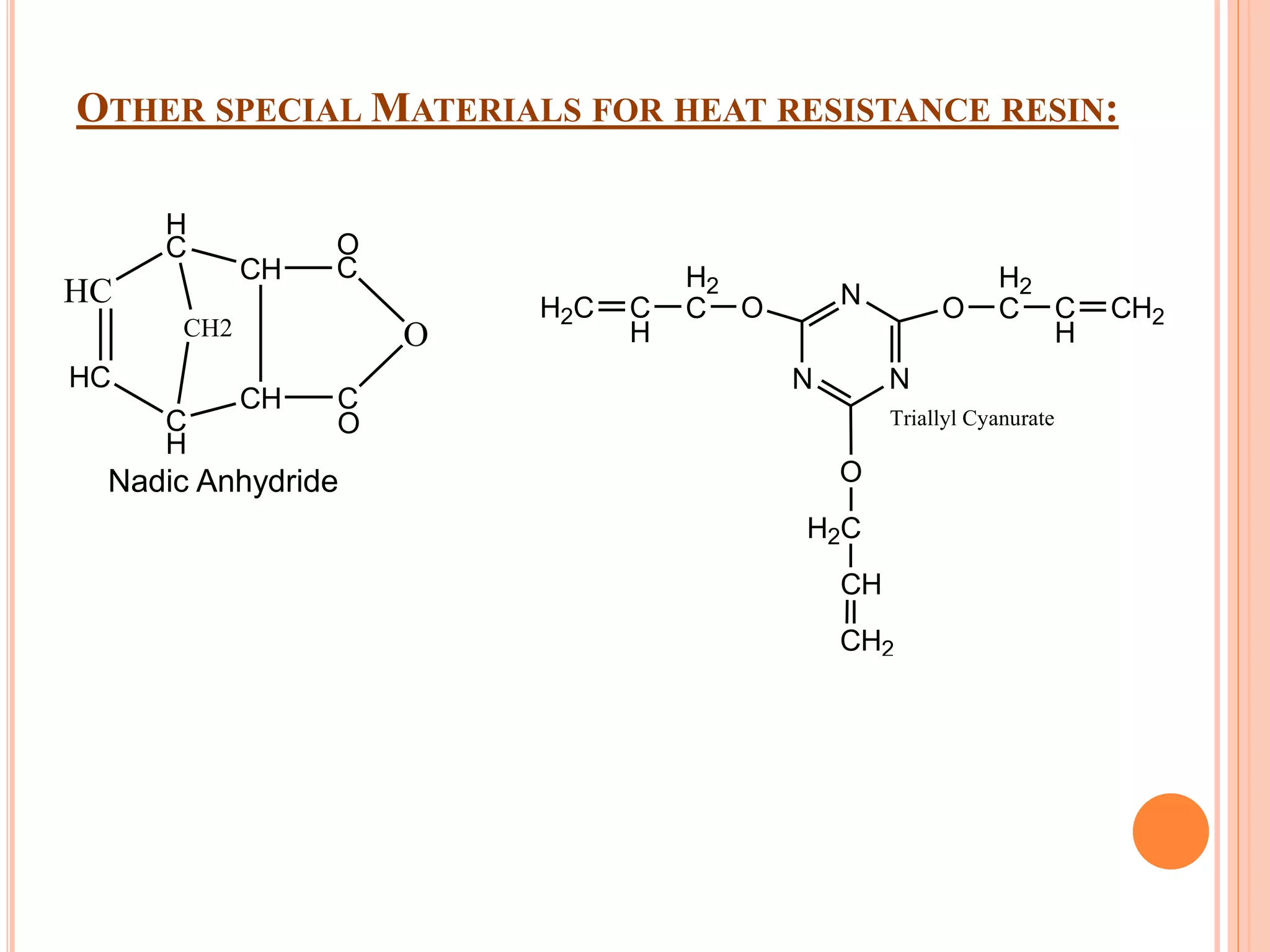
OTHER SPECIAL MATERIALS FOR HEAT RESISTANCE RESIN:
HC
HC
C
H
H
C
CH2
CH
CH
O
C
C
O
O
Nadic Anhydride
N N
N O
H2
C C
H
CH2O
H2
CC
H
H2C
O
H2C
CH
CH2
Triallyl Cyanurate
POLYMERIZATION
Glycol + Diacids+ Saturated Acid
e.g. Propylene Glycol + Maleic Anhydride + Phthalic Acid
150-200 ⁰C at 6-12 hrs.
N2 , Xylene,
HC
HC
O
C
C
O
O
Maleic Anhydride
+
H2
CHO C
H
CH3
OH
Propylene Glycol
HC
HC COOH
C
O
O
H2
C C
H
CH3
OH
Polymer Formation
E.g.
HC
HC COOH
C
O
O C
H
H2
C OH
HC
HC
C
O
O
C
O
O
Propylene Glycol
Phthalic Anhydride
O C
O
C
H
H
C C
O
O
CH3
C
H
H2
C OH
CH3
H
C
H2
C OH
CH3
CH
H2
C O
CH3
C
O
C
O
O CH
H2
C O
CH3
POLYESTER
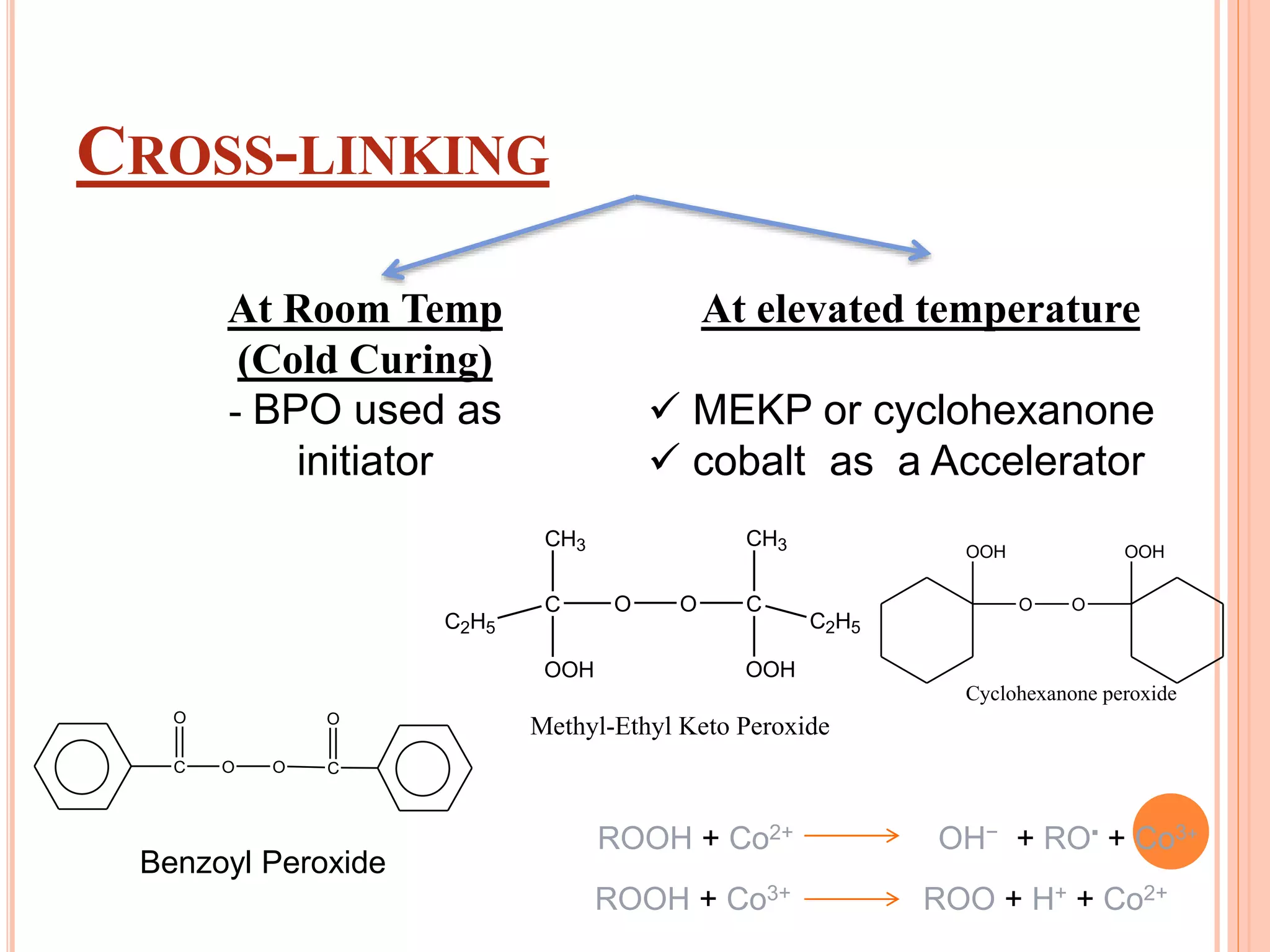
CROSS-LINKING
At Room Temp
(Cold Curing)
- BPO used as
initiator
At elevated temperature
 MEKP or cyclohexanone
 cobalt as a Accelerator
ROOH + Co2+ OH− + RO▪ + Co3+
ROOH + Co3+ ROO + H+ + Co2+
O O C
CH3
C2H5
OOH
C
CH3
C2H5
OOH
Methyl-Ethyl Keto Peroxide
O O
OOH OOH
Cyclohexanone peroxide
C
O
C
O
O O
Benzoyl Peroxide
Cross-linking by styrene and BPO as initiator
PROPERTIES
 High chemical resistance
 Good insulation properties (low frequency)
 Thermally stable(~200⁰C)
 UV resistance
 Flame retardant
POLYESTER-GLASS-
FIBER LAMINATES
APPLICATIONS
 Other applications include such
- diverse items as chemical storage vessels,
- chemical plant components,
- swimming pools,
- stacking chairs,
- trays,
- and sports equipment.
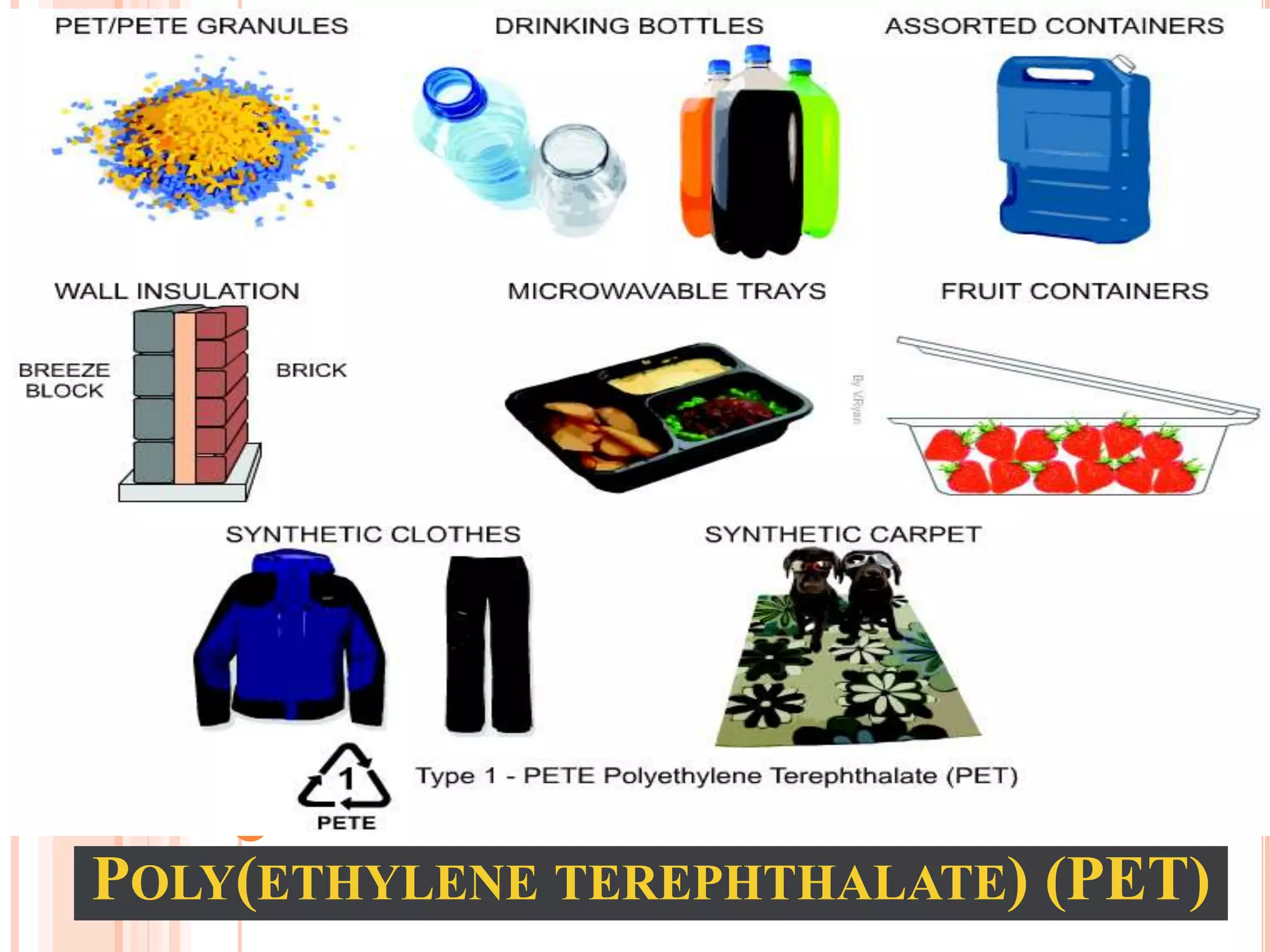
POLY(ETHYLENE TEREPHTHALATE) (PET)
PREPARATION
 Bulk condensation of monomers Terephthalic Acid or di-methyl
terephthalate, Ethylene glycol
HOOC COOH
Terephthalic Acid
H2
C
H2
C OHHO
Ethylene Gylcol
+
C
O
C
O
O
H2
C
H2
C O
n
- H₂O
COMMERCIAL ROUTES
 Dimethyl terephthalate (DMT) is reacted with excess ethylene
glycol (mole ratio 1:2.1–2.2) at 150ᵒC. The output of the process is
bis(hydroxyethyl) terephthalate (BHET).
 The pre-polymerization step (250–280ᵒC, 2–3 kPa) follows in which
BHET is polymerized to a degree of poymerization (DP) of up to 30.
 The next step is the polycondensation process where the DP is further
increased to 100 by heating under vacuum, the process conditions
being 280–290ᵒC and 50–100 Pa.
 Up to this stage, PET (poly ethylene terephthalate )is suitable for
applications that do not require high molecular weight or high intrinsic
viscosity [η], such as fibers and sheets.
 Solid-state polymerization is used to further increase the DP to 150.
The operating conditions are 200–240ᵒC at 100 kPa and 5–25 h.
Ester exchange and Polycondensation
PROPERTIES
 Virgin PET is produced at different specifications because
different applications require different properties.
 Examples of intrinsic viscosity [η] for different applications are
a) recording tape 0.60,
b) carbonated drink bottles 0.73–0.81, and
c) industrial tire cord 0.85 dl gˉ 1.
PET granules can be processed in many ways depending on
application and final product requirements.
SYNTHETIC FIBER
PET is widely used in synthetic fibers designed to simulate
wool cotton, or rayon, depending on the processing conditions.
- They have good wash-and-wear properties
- resistance to wrinkling. In the
Production of fiber: the molten polymer is extruded through spinnerets and rapidly cooled in air.
The filaments thus formed are, however, largely amorphous and weak. They are therefore drawn
at a temperature (80ᵒC) above Tg and finally heated at 190ᵒC under tension, whereby maximum
molecular orientation, crystallinity, and dimensional stability are achieved.
The melting point of highly crystalline PET is 271ᵒC.
 Crystalline PET has
- good resistance to water
- Resistance to dilute mineral acids but is degraded by concentrated nitric and sulfuric acids.
- It is soluble at normal temperatures only in proton donors which are capable of interaction
with the ester group, such as chlorinated and fluorinated acetic acids, phenols, and anhydrous
hydrofluoric acid.
FILM FORM
 PET is also used in film form (Melinex, Mylar) and as a molding material. The manufacture of PET film
closely resembles the manufacture of fiber.
 Production of film
a) The film is produced by quenching extruded sheet to the amorphous state and then reheating and stretching
the sheet approximately threefold in the axial and transverse directions at 80–100ᵒC. To stabilize the biaxially
oriented film, it is annealed under restraint at 180–210ᵒC.
b) This operation increases the crystallinity of PET film and reduces its tendency to shrink on heating. The
strength of PET in its oriented from is outstanding.
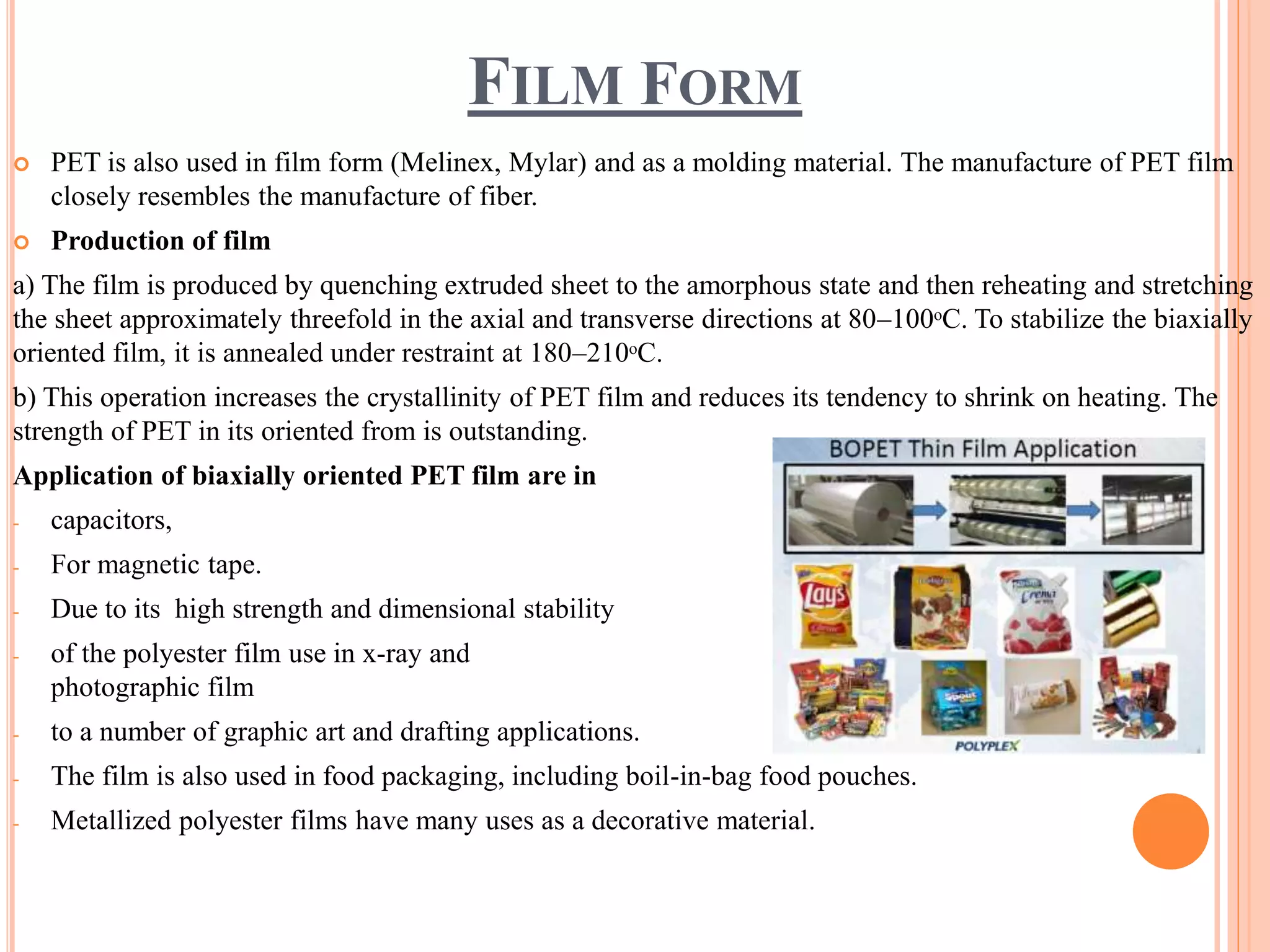
Application of biaxially oriented PET film are in
- capacitors,
- For magnetic tape.
- Due to its high strength and dimensional stability
- of the polyester film use in x-ray and
photographic film
- to a number of graphic art and drafting applications.
- The film is also used in food packaging, including boil-in-bag food pouches.
- Metallized polyester films have many uses as a decorative material.
BOTTLE MANUFACTURING
 In the late 1970s
a) Beverages bottles: Producing carbonated beverages PET bottles by
blow molding has gained prominence (particularly in the United States)
because PET has low permeability to carbon dioxide.
b) Bottles for various purposes: The process has been extended,
particularly in Europe, to produce bottles for other purposes, such as
fruit juice concentrates and sauces, wide-necked jars for coffee, and
other materials.
c) Material for microwave: Because of its excellent thermal stability,
PET is also used material for microwave and conventional ovens.
COPOLYMER OF PET
 PET copolymer, such as isphthalic acid modified PET, rather than homopolymer
PET.
 PET bottles are normally made from copolymer PET because of its
- lower crystallinity,
- improved ductitlity,
- better process ability, and
- better clarity.
POLY(BUTYLENE TEREPHTHALATE)
(PBT)
PREPARATION :
HO (CH2)4 OH
Butan-1,4-diol
H3COOC COOCH3
Dimethyl-terephthalate
+
C
O
C
O
O
H2
C O
4
PBT
- CH3OH
PROPERTIES
 Thermal Properties
- B/s of the longer sequence of methylene groups in polymeric chains leads to
both more flexibility and less polarity than PET.
- This leads to lower values for Tm (about 224ᵒC) and Tg (22–43ᵒC).
- The low Tg facilitates rapid crystallization when cooling in the mold, and
this allows short injection-molding cycles and high injection speeds.
 Other Properties
o dimensional stability,
o particularly in water, and its resistance to hydrocarbon oils without showing
stress cracking.
o high mechanical strength
o excellent electrical properties
o relatively low heat-deflection temperature 130ᵒF (54ᵒC) at 264 psi (1.8 MPa).
o The low water absorption of PBT—less than 0.1% after 24-h immersion—is
outstanding.
o Both dimensional stability and electrical properties are retained under
conditions of high humidity.
o The lubricity of the resin results in outstanding wear resistance.
APPLICATION
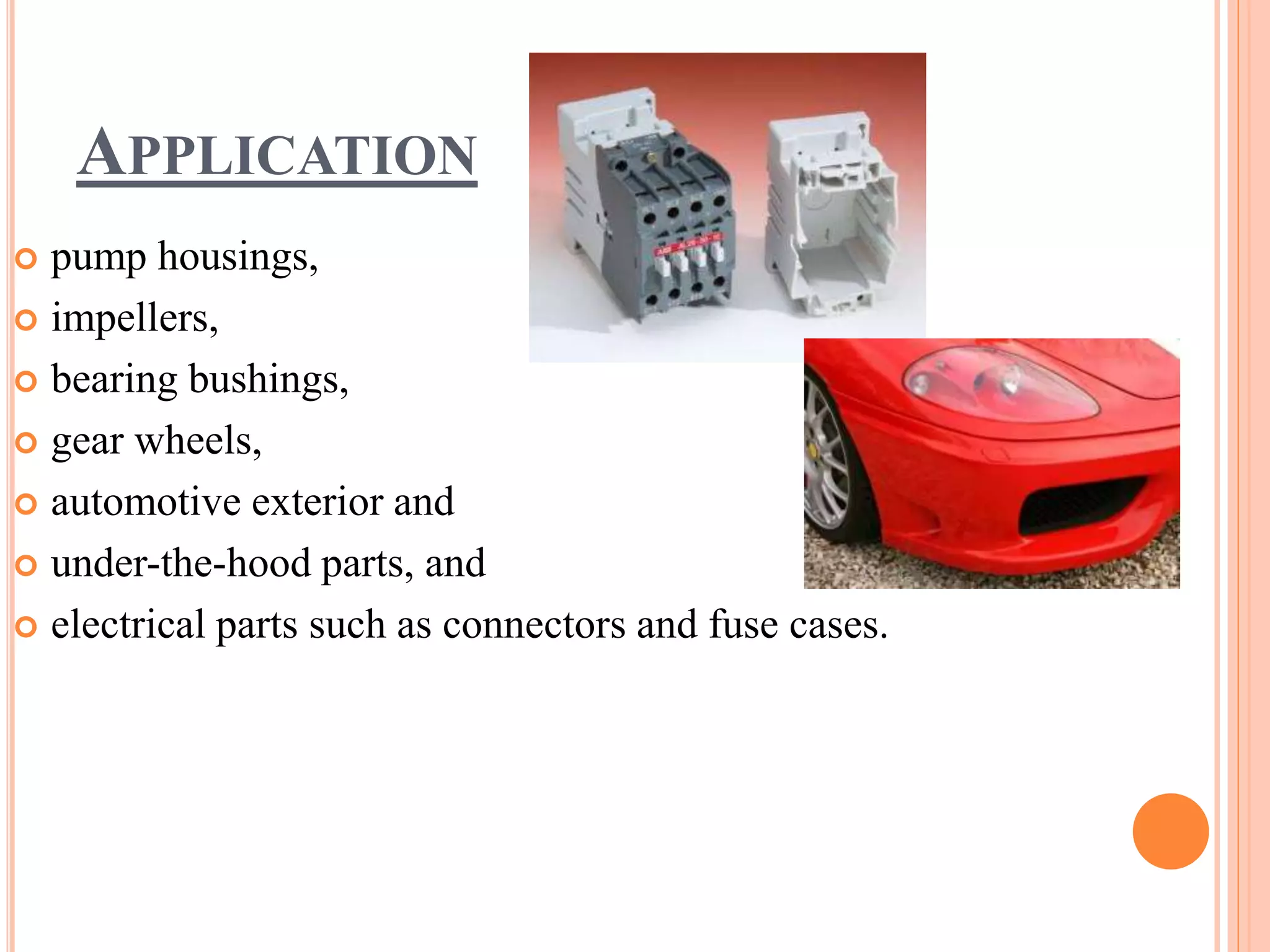
 pump housings,
 impellers,
 bearing bushings,
 gear wheels,
 automotive exterior and
 under-the-hood parts, and
 electrical parts such as connectors and fuse cases.
Aromatic Polyester
- Homopolymer
- Co-polyester
AROMATIC POLYESTER
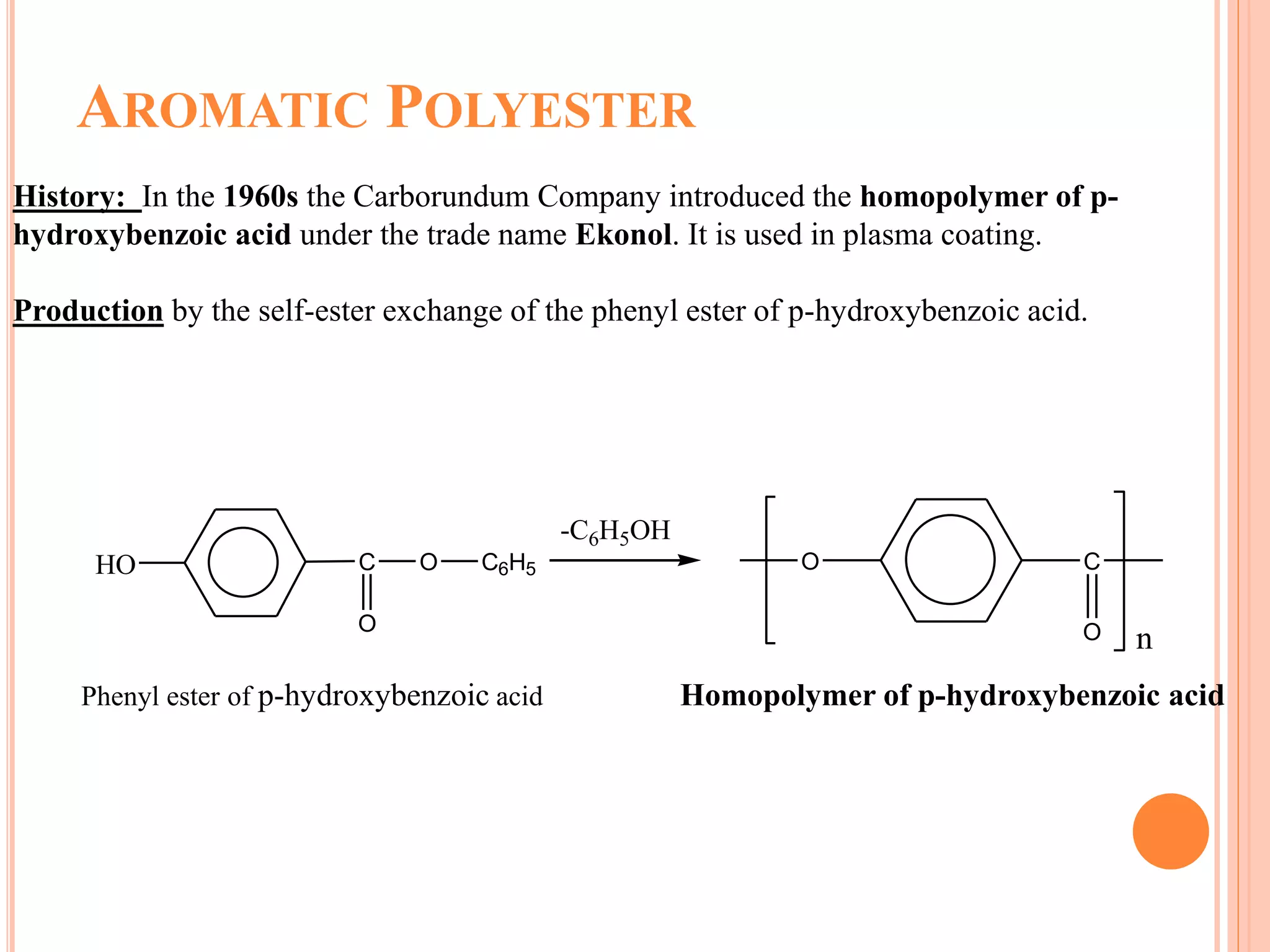
History: In the 1960s the Carborundum Company introduced the homopolymer of p-
hydroxybenzoic acid under the trade name Ekonol. It is used in plasma coating.
Production by the self-ester exchange of the phenyl ester of p-hydroxybenzoic acid.
HO C O C6H5
O
-C6H5OH
O C
O n
Phenyl ester of p-hydroxybenzoic acid Homopolymer of p-hydroxybenzoic acid
PROPERTIES:
 Average mol. wt. 8000–12,000 Da.
 insoluble in dilute acids and bases and all solvents up to their
boiling points.
 Tm=500ᵒC and is difficult to fabricate.
 It can be shaped only by hammering (like a metal), by impact
molding and by pressure sintering (420ᵒC at 35 MPa).
 The difficulty in fabrication has severely limited the wider
application of these polymers.
 Available as a finely divided powder in several grades, based
on particle size. The average particle size ranges from 35 to 80
μm.
BLEND WITH OTHER POWDERS
A. Blend with metals: metals, such as bronze, aluminum, and nickel-
chrome.
Applications:
- flame-spray compounds.
- Plasma sprayed coatings -thermally stable, self-lubricating, and wear
and corrosion resistant.
- abradable seals for jet aircraft engine parts.
B. Blended up to 25% with PTFE.
Such blends have good temperature and wear resistance and are self-
lubricating.
Applications include seals, bearings, and rotors.
COPOLYMERIC AROMATIC POLYESTERS
 E.g. Polyarylates, are copolyester of terephthalic acid,
isophthalic acid and bisphenol A in the ratio of 1:1:2.
COOHHOOC CHO OH
CH3
CH3
COOHHOOC
Terephthalic Acid
(1)
Isophthalic Acid
(1)
Bisphenol A
(2)
O C
CH3
CH3
O C
O
C
O
O C O C
O
C
O
CH3
CH3 n
Polyarylates
PROPERTIES
 Two isomeric acid (Isophthalic and Terephthalic acid) leads to an irregula
chain which inhibits crystallization.
 Due to this, it is processed at much lower temperatures than would be
possible with a crystalline homopolymer. Nevertheless the high aromatic
content of these polyesters ensures a high Tg (~90ᵒC).
 The polymer is self-extinguishing
- limiting oxygen index of 34
- a self-ignition temperature of 545ᵒC
- HDT under load (1.8 MPa) is about 175ᵒC
OPTICAL AND MECHANICAL PROPERTIES
 good optical properties
- luminous light transmission 84–88%
- 1–2% haze
- refractive index 1.61
 high impact strength between that PC and Psulfone
 exceptionally high level of recovery after deformation (important in
applications such as clips and snap fasteners)
 good toughness at both elevated and low temperatures
 with very little notch sensitivity, and high abrasion resistance which is
superior to that of polycarbonates.
WEATHERABILITY AND FLAMMABILITY
 Polyarylates weatherability and flammability (high oxygen index, low
flame spread) are inherent and are achieved without additives.
 The weatherability properties therefore do not deteriorate significantly
with time. (Tests show that over 5000 h of accelerated weathering
results in virtually no change in performance with respect to luminous
light transmittance, haze, gloss, yellowness, and impact.)
 Having no flame-retardant additives, the combustion products of
polyarylate are only carbon dioxide, carbonmonoxide, and water, with
no formation of toxic gas.
LIQUID CRYSTALLINE POLYMER
 Different approach: polymers with good melt processability coupled
with high softening point
 trade names Vectra (Celanese) and Xydar (Dartco Manufacturing)
 the retention of liquid crystalline order in the melt gives lower melt
viscosities than would otherwise be achieved.
 Heat distortion temperatures are also in the high range of 180–240ᵒC .
LCPs have thus heralded a new era of readily molded engineering and
electrical parts for high temperature use.
WHOLLY AROMATIC COPOLYESTER
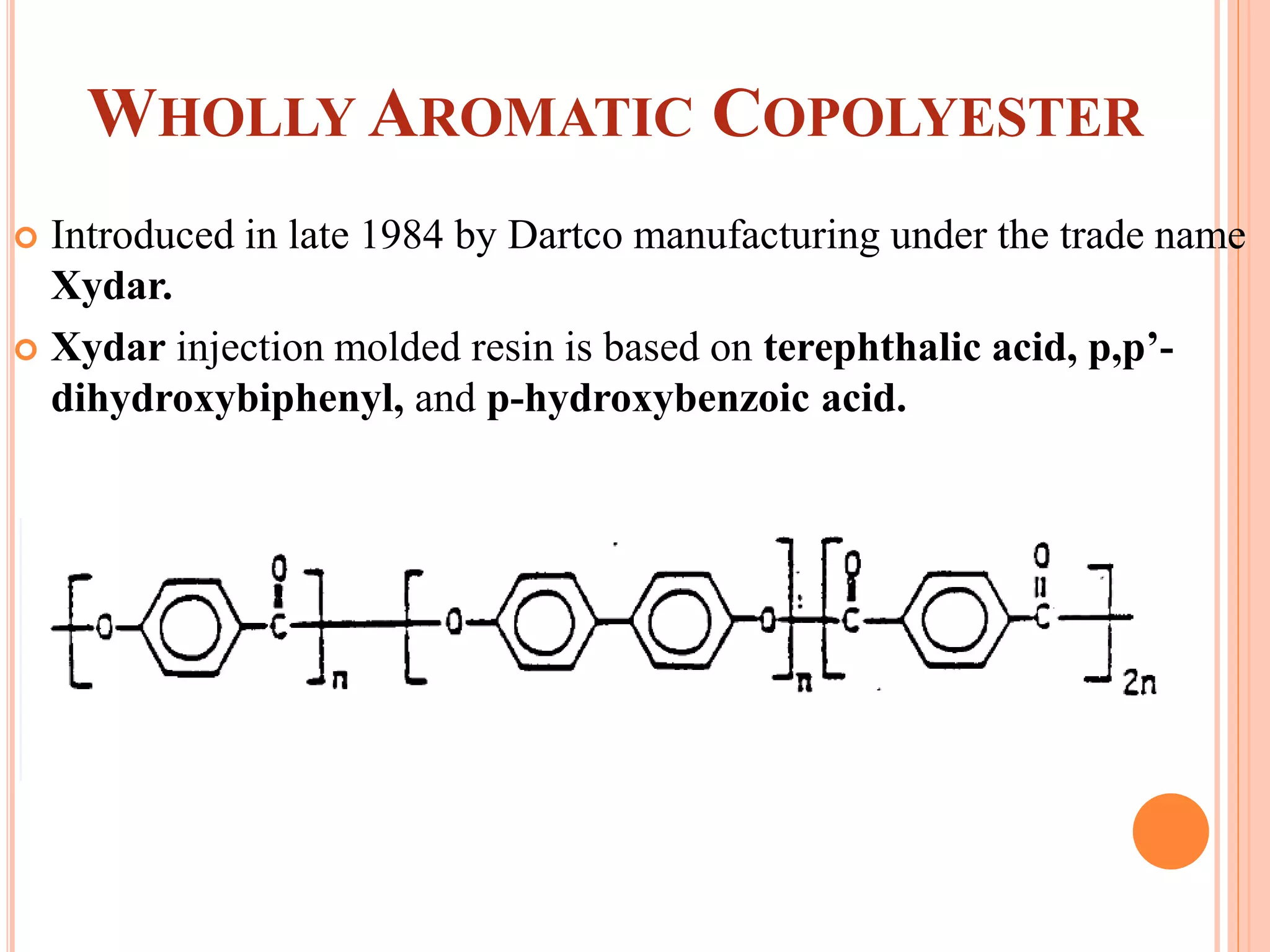
 Introduced in late 1984 by Dartco manufacturing under the trade name
Xydar.
 Xydar injection molded resin is based on terephthalic acid, p,p’-
dihydroxybiphenyl, and p-hydroxybenzoic acid.
PROPERTIES OF POLYESTER OF THIS CLASS
 Melt Viscosity
- Long rigid chains undergo parallel ordering in melt resulting in
a) low melt viscosity
b) good injection-molding characteristics at high Tm i.e. 400-430ᵒC.
 Mechanical Strength
- The melt solidifies to form highly packed fibrous chains in molded parts which gives
exceptionally physical properties
a) Tensile modulus = 2.4×10⁶ psi. (16500 MPa) at room temperature
= 1.2×10⁶ psi. (8300 MPa) at 300ᵒC.
b) Tensile strength = 138 MPa and Compressive strength = 41 MPa
 Thermal Properties:
- Thermal oxidative stability outstanding
- Decomposition temperature under N2 =560-570ᵒC.
- Inherently flame retardant
- Oxygen index= 42
- Smoke generation is extremely low
 Chemical Properties
- Extremely inert substance- i.e. resistance towards acids, solvents, boiling solvent and
hydrocarbon.
- but attacked by concentrated acids and boiling caustic
- Can withstand with high level of UV irradiation
- Transparent to microwave.

Polyester - A Speciality Polymer

  • 1.
    POLYESTER  First condensationpolymer studied by Carothers in 1930  Mainly of 2 types a) Saturated: used in synthetic fibers, films and molding application b) Unsaturated: used as laminating resin and glass-reinforced plastic product  Special Polyesters - Polyethylene terephthalate - Polybutylene terephthalate - Polyarylates - Poly(Dihydroxymethylcyclohexyl terephthalate)
  • 2.
    Various Techniques toproduce Polyester : 1. Self Condensation of ω-hydroxy acids OH-R-COOH + OH-R-COOH etc. ORCOORCOO 2. Condensation of polyhydroxy compounds with polybasic acids, e.g. a glycol with dicarboxylic acid HO-R-OH + HOOC-R’-COOH + HO-R-OH OROOCR’COORO + H2O
  • 3.
    3. Ester Exchange: R’OOC-R-COOR’+ HO-R”-OH OOC-R’-COO-R”OO + R’OH 4. Ring Opening of Lactone e.g. ϵ-caprolactone with dihydroxy or trihydroxy initiator RCOO R O C O
  • 4.
    5. Alcoholysis ofacid chloride of a di-carboxylic acid with polyhydroxy alcohol: ClOC-R-COCl + HO-R’-OH OC-R-COOR’O + HCl
  • 5.
    COMMON PROPERTIES INPOLYESTER  Chemical Weakness: susceptible to hydrolysis, ammonolysis and ester exchange leads to chain scission  Electrical Insulation at high frequency: Polarity of ester group adversely affect the high frequency electrical insulation properties  Proton acceptor ester group: allows interaction with other grouping either an inter- or an intra molecular nature.  Increases Flexibility and inter chain attraction
  • 6.
    UNSATURATED POLYESTER LAMINATING RESINS Polyester laminating resin are a) Viscous b) Pale yellow colored c) Low degree of polymerization(~8 to 10) d) Produced from a glycol and di acid e) provide site of cross-linking
  • 7.
    SELECTION OF RAWMATERIAL C HOOC C H H COOH C HOOC C H COOH H HC CH C C O O O Maleic Acid -used in conventional general purpose resins Fumaric Acid -preferred b/s of less corrosiveness, resins have greater heat resistance, light coloured product Maleic Anhydide 1. Di-acids:
  • 8.
    2. Diols: H3C H C CH2 OHOH HO-CH2-CH2-O-CH2CH2-OH 1,2-Propylene Glycol Diethylene Glycol - Most important glycol - Give resin with less crystallinity - More compatible with styrene - More use of glycols higher in homologous series gives product with more flexibility and greater water resistance - They are sometime preferred when the product with i. greater water absorption ii. inferior electrical properties Are required.
  • 9.
    3. Saturated Acid: Function:to space out the double bond and thus reduces the cross link density C C O O O COOH COOH Phthalic Anhydride Provides an inflexible link and maintains rigidity - low price, and cheaper resins formed - Detrimental effect – reduces heat resistance of laminates - Cystalline solid and Tm=131ᵒC. Isophthalic acid (Tm=347ᵒC)  Provides higher H.D.T. , Flexural moduli, and better craze resistance  also useful in preparation of resilient gel coats  provides better water and alkali resistance as compared to phthalic anhydride.
  • 10.
    HOOC-(CH2)4-COOH Adipic Acid:  Whenflexible resin is requires  Used in gel coats 4. Diluents: Styrene  Low Price  Compatibility  Low viscosity  Ease of use  MMA is sometime use in conjunction with Styrene for translucent sheeting  Vinyl toluene and diallyl phthalate is occasionally employed H2C CH
  • 11.
    OTHER SPECIAL MATERIALSFOR HEAT RESISTANCE RESIN: HC HC C H H C CH2 CH CH O C C O O Nadic Anhydride N N N O H2 C C H CH2O H2 CC H H2C O H2C CH CH2 Triallyl Cyanurate
  • 12.
    POLYMERIZATION Glycol + Diacids+Saturated Acid e.g. Propylene Glycol + Maleic Anhydride + Phthalic Acid 150-200 ⁰C at 6-12 hrs. N2 , Xylene, HC HC O C C O O Maleic Anhydride + H2 CHO C H CH3 OH Propylene Glycol HC HC COOH C O O H2 C C H CH3 OH Polymer Formation E.g.
  • 13.
    HC HC COOH C O O C H H2 COH HC HC C O O C O O Propylene Glycol Phthalic Anhydride O C O C H H C C O O CH3 C H H2 C OH CH3 H C H2 C OH CH3 CH H2 C O CH3 C O C O O CH H2 C O CH3 POLYESTER
  • 14.
    CROSS-LINKING At Room Temp (ColdCuring) - BPO used as initiator At elevated temperature  MEKP or cyclohexanone  cobalt as a Accelerator ROOH + Co2+ OH− + RO▪ + Co3+ ROOH + Co3+ ROO + H+ + Co2+ O O C CH3 C2H5 OOH C CH3 C2H5 OOH Methyl-Ethyl Keto Peroxide O O OOH OOH Cyclohexanone peroxide C O C O O O Benzoyl Peroxide
  • 15.
    Cross-linking by styreneand BPO as initiator
  • 16.
    PROPERTIES  High chemicalresistance  Good insulation properties (low frequency)  Thermally stable(~200⁰C)  UV resistance  Flame retardant
  • 17.
  • 18.
    APPLICATIONS  Other applicationsinclude such - diverse items as chemical storage vessels, - chemical plant components, - swimming pools, - stacking chairs, - trays, - and sports equipment.
  • 19.
  • 20.
    PREPARATION  Bulk condensationof monomers Terephthalic Acid or di-methyl terephthalate, Ethylene glycol HOOC COOH Terephthalic Acid H2 C H2 C OHHO Ethylene Gylcol + C O C O O H2 C H2 C O n - H₂O
  • 21.
    COMMERCIAL ROUTES  Dimethylterephthalate (DMT) is reacted with excess ethylene glycol (mole ratio 1:2.1–2.2) at 150ᵒC. The output of the process is bis(hydroxyethyl) terephthalate (BHET).  The pre-polymerization step (250–280ᵒC, 2–3 kPa) follows in which BHET is polymerized to a degree of poymerization (DP) of up to 30.  The next step is the polycondensation process where the DP is further increased to 100 by heating under vacuum, the process conditions being 280–290ᵒC and 50–100 Pa.  Up to this stage, PET (poly ethylene terephthalate )is suitable for applications that do not require high molecular weight or high intrinsic viscosity [η], such as fibers and sheets.  Solid-state polymerization is used to further increase the DP to 150. The operating conditions are 200–240ᵒC at 100 kPa and 5–25 h. Ester exchange and Polycondensation
  • 22.
    PROPERTIES  Virgin PETis produced at different specifications because different applications require different properties.  Examples of intrinsic viscosity [η] for different applications are a) recording tape 0.60, b) carbonated drink bottles 0.73–0.81, and c) industrial tire cord 0.85 dl gˉ 1. PET granules can be processed in many ways depending on application and final product requirements.
  • 23.
    SYNTHETIC FIBER PET iswidely used in synthetic fibers designed to simulate wool cotton, or rayon, depending on the processing conditions. - They have good wash-and-wear properties - resistance to wrinkling. In the Production of fiber: the molten polymer is extruded through spinnerets and rapidly cooled in air. The filaments thus formed are, however, largely amorphous and weak. They are therefore drawn at a temperature (80ᵒC) above Tg and finally heated at 190ᵒC under tension, whereby maximum molecular orientation, crystallinity, and dimensional stability are achieved. The melting point of highly crystalline PET is 271ᵒC.  Crystalline PET has - good resistance to water - Resistance to dilute mineral acids but is degraded by concentrated nitric and sulfuric acids. - It is soluble at normal temperatures only in proton donors which are capable of interaction with the ester group, such as chlorinated and fluorinated acetic acids, phenols, and anhydrous hydrofluoric acid.
  • 24.
    FILM FORM  PETis also used in film form (Melinex, Mylar) and as a molding material. The manufacture of PET film closely resembles the manufacture of fiber.  Production of film a) The film is produced by quenching extruded sheet to the amorphous state and then reheating and stretching the sheet approximately threefold in the axial and transverse directions at 80–100ᵒC. To stabilize the biaxially oriented film, it is annealed under restraint at 180–210ᵒC. b) This operation increases the crystallinity of PET film and reduces its tendency to shrink on heating. The strength of PET in its oriented from is outstanding. Application of biaxially oriented PET film are in - capacitors, - For magnetic tape. - Due to its high strength and dimensional stability - of the polyester film use in x-ray and photographic film - to a number of graphic art and drafting applications. - The film is also used in food packaging, including boil-in-bag food pouches. - Metallized polyester films have many uses as a decorative material.
  • 25.
    BOTTLE MANUFACTURING  Inthe late 1970s a) Beverages bottles: Producing carbonated beverages PET bottles by blow molding has gained prominence (particularly in the United States) because PET has low permeability to carbon dioxide. b) Bottles for various purposes: The process has been extended, particularly in Europe, to produce bottles for other purposes, such as fruit juice concentrates and sauces, wide-necked jars for coffee, and other materials. c) Material for microwave: Because of its excellent thermal stability, PET is also used material for microwave and conventional ovens.
  • 26.
    COPOLYMER OF PET PET copolymer, such as isphthalic acid modified PET, rather than homopolymer PET.  PET bottles are normally made from copolymer PET because of its - lower crystallinity, - improved ductitlity, - better process ability, and - better clarity.
  • 27.
  • 28.
    PREPARATION : HO (CH2)4OH Butan-1,4-diol H3COOC COOCH3 Dimethyl-terephthalate + C O C O O H2 C O 4 PBT - CH3OH
  • 29.
    PROPERTIES  Thermal Properties -B/s of the longer sequence of methylene groups in polymeric chains leads to both more flexibility and less polarity than PET. - This leads to lower values for Tm (about 224ᵒC) and Tg (22–43ᵒC). - The low Tg facilitates rapid crystallization when cooling in the mold, and this allows short injection-molding cycles and high injection speeds.  Other Properties o dimensional stability, o particularly in water, and its resistance to hydrocarbon oils without showing stress cracking. o high mechanical strength o excellent electrical properties o relatively low heat-deflection temperature 130ᵒF (54ᵒC) at 264 psi (1.8 MPa). o The low water absorption of PBT—less than 0.1% after 24-h immersion—is outstanding.
  • 30.
    o Both dimensionalstability and electrical properties are retained under conditions of high humidity. o The lubricity of the resin results in outstanding wear resistance.
  • 31.
    APPLICATION  pump housings, impellers,  bearing bushings,  gear wheels,  automotive exterior and  under-the-hood parts, and  electrical parts such as connectors and fuse cases.
  • 32.
  • 33.
    AROMATIC POLYESTER History: Inthe 1960s the Carborundum Company introduced the homopolymer of p- hydroxybenzoic acid under the trade name Ekonol. It is used in plasma coating. Production by the self-ester exchange of the phenyl ester of p-hydroxybenzoic acid. HO C O C6H5 O -C6H5OH O C O n Phenyl ester of p-hydroxybenzoic acid Homopolymer of p-hydroxybenzoic acid
  • 34.
    PROPERTIES:  Average mol.wt. 8000–12,000 Da.  insoluble in dilute acids and bases and all solvents up to their boiling points.  Tm=500ᵒC and is difficult to fabricate.  It can be shaped only by hammering (like a metal), by impact molding and by pressure sintering (420ᵒC at 35 MPa).  The difficulty in fabrication has severely limited the wider application of these polymers.  Available as a finely divided powder in several grades, based on particle size. The average particle size ranges from 35 to 80 μm.
  • 35.
    BLEND WITH OTHERPOWDERS A. Blend with metals: metals, such as bronze, aluminum, and nickel- chrome. Applications: - flame-spray compounds. - Plasma sprayed coatings -thermally stable, self-lubricating, and wear and corrosion resistant. - abradable seals for jet aircraft engine parts. B. Blended up to 25% with PTFE. Such blends have good temperature and wear resistance and are self- lubricating. Applications include seals, bearings, and rotors.
  • 36.
    COPOLYMERIC AROMATIC POLYESTERS E.g. Polyarylates, are copolyester of terephthalic acid, isophthalic acid and bisphenol A in the ratio of 1:1:2. COOHHOOC CHO OH CH3 CH3 COOHHOOC Terephthalic Acid (1) Isophthalic Acid (1) Bisphenol A (2) O C CH3 CH3 O C O C O O C O C O C O CH3 CH3 n Polyarylates
  • 37.
    PROPERTIES  Two isomericacid (Isophthalic and Terephthalic acid) leads to an irregula chain which inhibits crystallization.  Due to this, it is processed at much lower temperatures than would be possible with a crystalline homopolymer. Nevertheless the high aromatic content of these polyesters ensures a high Tg (~90ᵒC).  The polymer is self-extinguishing - limiting oxygen index of 34 - a self-ignition temperature of 545ᵒC - HDT under load (1.8 MPa) is about 175ᵒC
  • 38.
    OPTICAL AND MECHANICALPROPERTIES  good optical properties - luminous light transmission 84–88% - 1–2% haze - refractive index 1.61  high impact strength between that PC and Psulfone  exceptionally high level of recovery after deformation (important in applications such as clips and snap fasteners)  good toughness at both elevated and low temperatures  with very little notch sensitivity, and high abrasion resistance which is superior to that of polycarbonates.
  • 39.
    WEATHERABILITY AND FLAMMABILITY Polyarylates weatherability and flammability (high oxygen index, low flame spread) are inherent and are achieved without additives.  The weatherability properties therefore do not deteriorate significantly with time. (Tests show that over 5000 h of accelerated weathering results in virtually no change in performance with respect to luminous light transmittance, haze, gloss, yellowness, and impact.)  Having no flame-retardant additives, the combustion products of polyarylate are only carbon dioxide, carbonmonoxide, and water, with no formation of toxic gas.
  • 40.
    LIQUID CRYSTALLINE POLYMER Different approach: polymers with good melt processability coupled with high softening point  trade names Vectra (Celanese) and Xydar (Dartco Manufacturing)  the retention of liquid crystalline order in the melt gives lower melt viscosities than would otherwise be achieved.  Heat distortion temperatures are also in the high range of 180–240ᵒC . LCPs have thus heralded a new era of readily molded engineering and electrical parts for high temperature use.
  • 41.
    WHOLLY AROMATIC COPOLYESTER Introduced in late 1984 by Dartco manufacturing under the trade name Xydar.  Xydar injection molded resin is based on terephthalic acid, p,p’- dihydroxybiphenyl, and p-hydroxybenzoic acid.
  • 42.
    PROPERTIES OF POLYESTEROF THIS CLASS  Melt Viscosity - Long rigid chains undergo parallel ordering in melt resulting in a) low melt viscosity b) good injection-molding characteristics at high Tm i.e. 400-430ᵒC.  Mechanical Strength - The melt solidifies to form highly packed fibrous chains in molded parts which gives exceptionally physical properties a) Tensile modulus = 2.4×10⁶ psi. (16500 MPa) at room temperature = 1.2×10⁶ psi. (8300 MPa) at 300ᵒC. b) Tensile strength = 138 MPa and Compressive strength = 41 MPa
  • 43.
     Thermal Properties: -Thermal oxidative stability outstanding - Decomposition temperature under N2 =560-570ᵒC. - Inherently flame retardant - Oxygen index= 42 - Smoke generation is extremely low  Chemical Properties - Extremely inert substance- i.e. resistance towards acids, solvents, boiling solvent and hydrocarbon. - but attacked by concentrated acids and boiling caustic - Can withstand with high level of UV irradiation - Transparent to microwave.