
Marking and Coding By Shrikant Athavale For PG Students SIES 28-03-2011
Marking and coding product packaging may not be essential . . . until you get a project that uses new packaging materials or has new customer requirements:  the customer needs permanent codes; the packaging has changed from a paper box to a plastic bag;  the marks need to be highly readable.  Then it becomes crucial to know all your options before choosing the right technology.
Careful analysis can make the difference between a successful, efficient operation and one that experiences needless downtime, resulting in unhappy customers.  Key factors to consider include:
Types of materials or substrates you'll be marking Desired speed of application or throughput Print quality -- permanence and readability Up-front investment your company is willing to make Total cost of operation, including cost of service and consumables such as inks and ribbons Whether variable data, graphics, and bar codes are needed.
Once you know these factors, it will be easier to choose which marking and coding technology is best for your application.  Laser coding,  thermal transfer overprinting (TTO),  and continuous inkjet (CIJ) printing  are all options that have benefits for different applications.  Here is how each technology fits into the increasingly diverse industry of package marking and coding.
Industrial laser marking started in the early 1970s and since then has developed into a well-established technology. Today, laser marking/coding is used in thousands of production lines throughout the world. It can be used for marking numerical codes, 2D-matrix and bar codes, logos, and symbols onto labels, sleeves, glass and plastic bottles, cans, kegs, tubes, blisters, cardboards, tubular films, and caps.
Lasers do not require inks, stamps, or ribbons to generate a code. In modern sealed-off CO2 laser coders, such as Videojet's 3320 or 3120, the infrared laser light is generated via radio frequency discharge in a carbon dioxide gas mixture. The CO2 laser systems code thermally by changing the surface color (e.g. PVC packages), melting, foaming (e.g. PET bottles), or removing the material surface (e.g. printed labels, cardboards, cans, tubes).
The advantages of laser coding are numerous, including speed, versatility, code permanence, noncontact operation, clean and dry process, maintenance-free operation over thousands of hours, extremely low operating costs, and adaptability to a fully automated line. Lasers also offer unsurpassed reliability in "no code/no run" operations where mandatory package coding prior to distribution means that production will stop if a product is coded incorrectly. Halting production is a very expensive process, and most companies will do everything to avoid downtime. The unequaled uptime of a laser coder and its extreme productivity result in cost savings for a variety of applications.
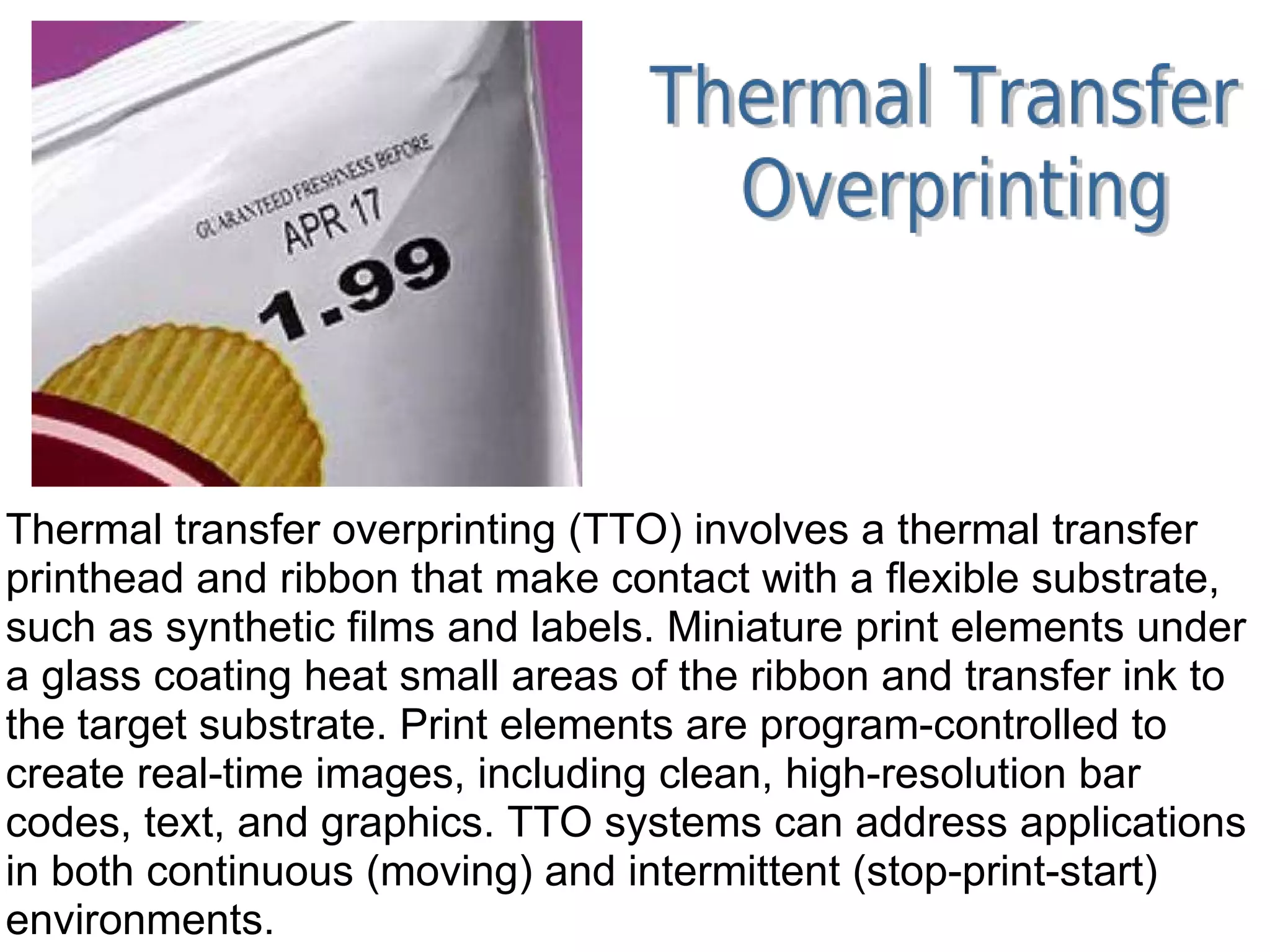
Thermal transfer overprinting (TTO) involves a thermal transfer printhead and ribbon that make contact with a flexible substrate, such as synthetic films and labels. Miniature print elements under a glass coating heat small areas of the ribbon and transfer ink to the target substrate. Print elements are program-controlled to create real-time images, including clean, high-resolution bar codes, text, and graphics. TTO systems can address applications in both continuous (moving) and intermittent (stop-print-start) environments.
Maximizing production uptime and ribbon utilization are the keys to success with TTO, and some methods of doing so are more effective than others. For example, the Videojet DataFlex Plus features a solid state, clutchless ribbon drive system that uses bidirectional stepper motors. The system continuously monitors ribbon tension to avoid ribbon-related faults, such as real or false ribbon breaks, which can interfere with production. This system also more precisely controls the ribbon, leaving only a millimeter of space between prints for better ribbon utilization. TTO systems that use clutch-based ribbon drives cannot as effectively accommodate fluctuations in ribbon tension on control spacing between prints. As a result, clutch-based systems use more ribbon and experience more ribbon-related faults, translating to increased downtime and higher operating costs.
Typical applications for TTO are within the snack, bakery, meats, and frozen food industries, where flexible packaging is common. There are also special applications, such as in the coffee and confectionery industries, where generic packaging is used across a wide product range and all product branding and specifications have been added using TTO. This saves companies substantial cost through reduced waste and inventory.
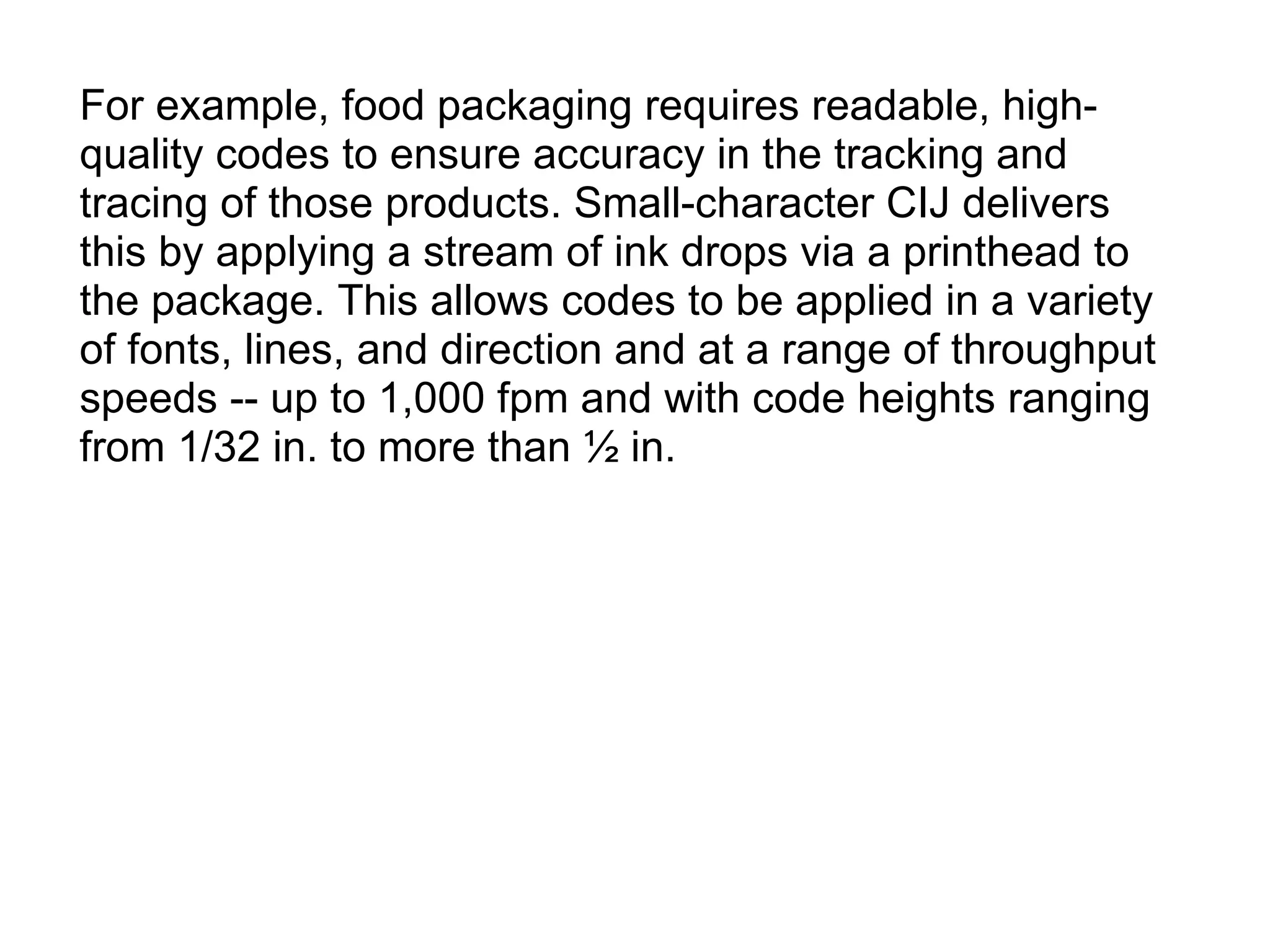
Perhaps the best known method of noncontact marking and coding is continuous ink jet (CIJ). CIJ has become one of the most versatile and durable options for food manufacturers. Small-character CIJ printers create lot codes, expiration dates, bar codes, and graphics on packaging, while large-character CIJ printers do the same for secondary packaging such as cartons and corrugated boxes.
For example, food packaging requires readable, high-quality codes to ensure accuracy in the tracking and tracing of those products. Small-character CIJ delivers this by applying a stream of ink drops via a printhead to the package. This allows codes to be applied in a variety of fonts, lines, and direction and at a range of throughput speeds -- up to 1,000 fpm and with code heights ranging from 1/32 in. to more than ½ in.
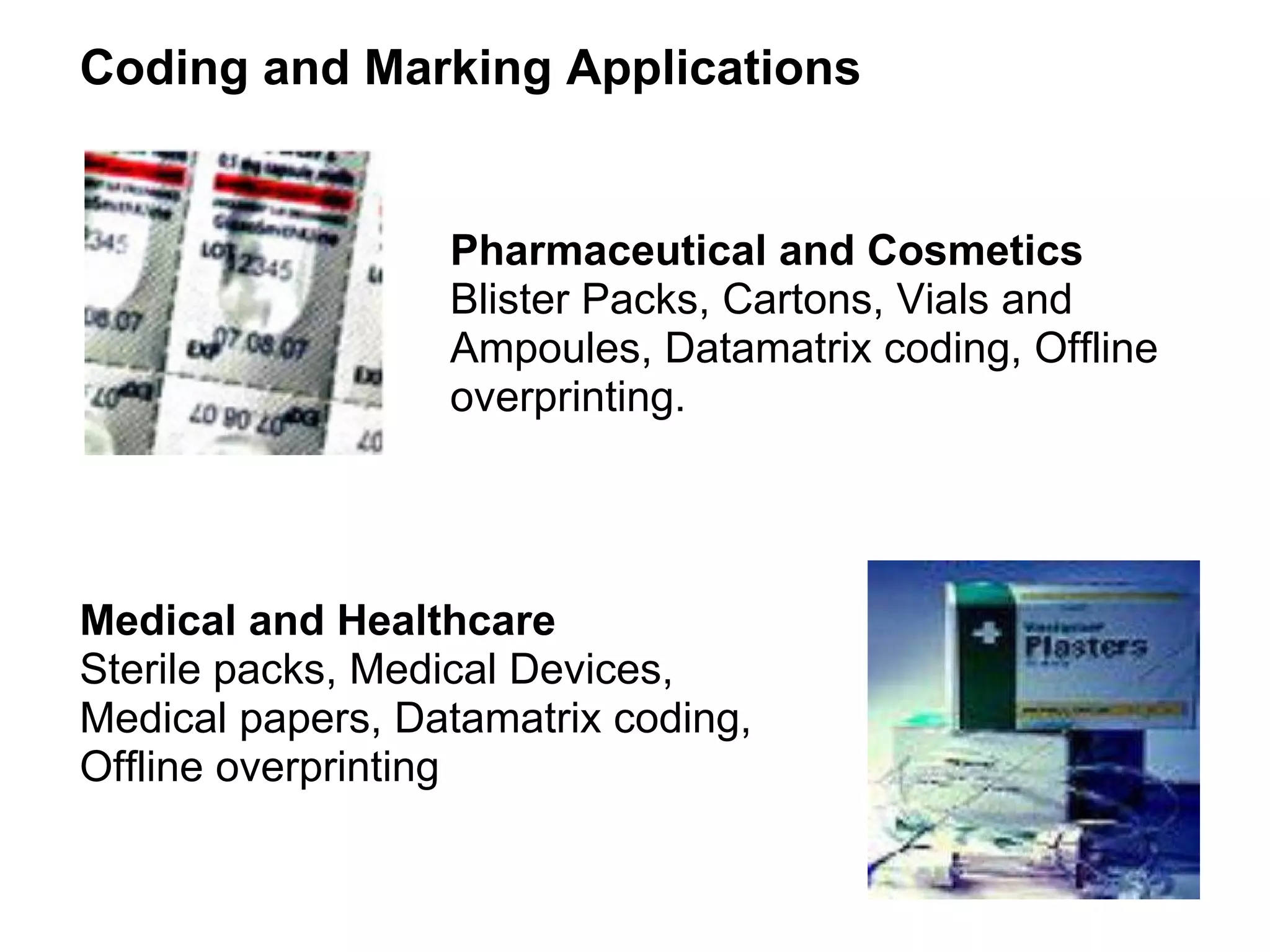
Coding and Marking Applications Pharmaceutical and Cosmetics Blister Packs, Cartons, Vials and Ampoules, Datamatrix coding, Offline overprinting.  Medical and Healthcare  Sterile packs, Medical Devices, Medical papers, Datamatrix coding, Offline overprinting
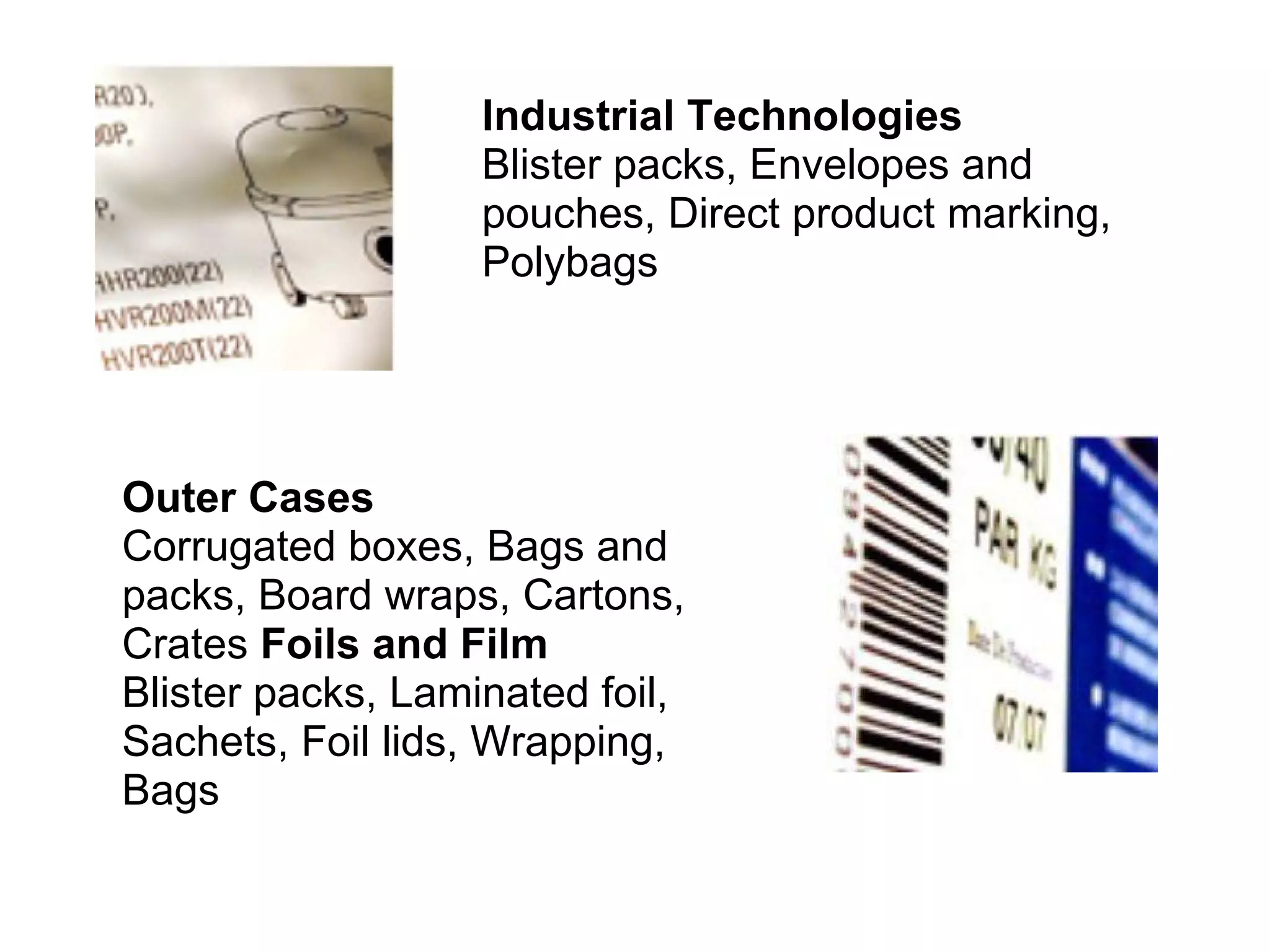
Industrial Technologies Blister packs, Envelopes and pouches, Direct product marking, Polybags  Outer Cases  Corrugated boxes, Bags and packs, Board wraps, Cartons, Crates  Foils and Film  Blister packs, Laminated foil, Sachets, Foil lids, Wrapping, Bags
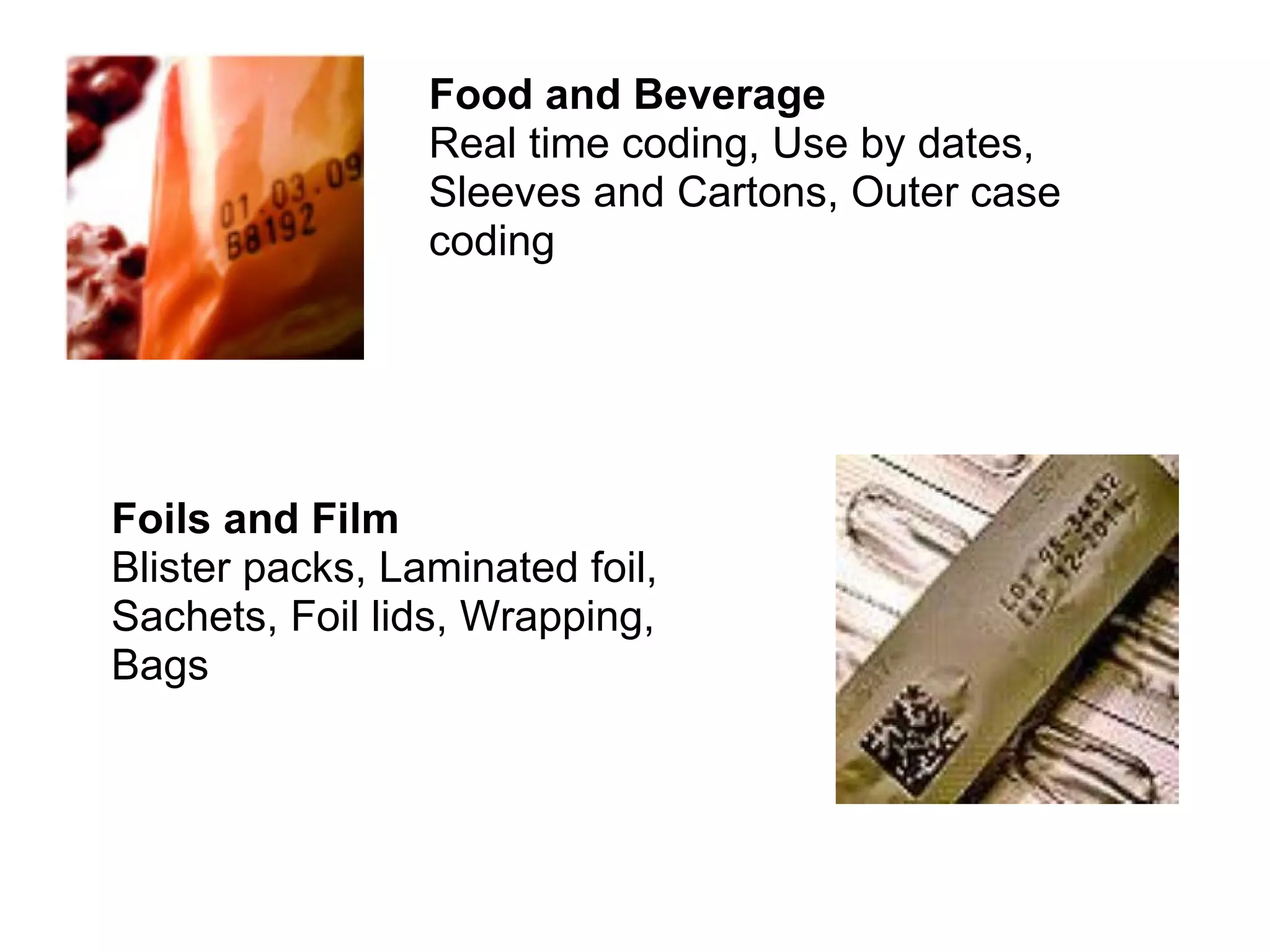
Food and Beverage  Real time coding, Use by dates, Sleeves and Cartons, Outer case coding  Foils and Film  Blister packs, Laminated foil, Sachets, Foil lids, Wrapping, Bags
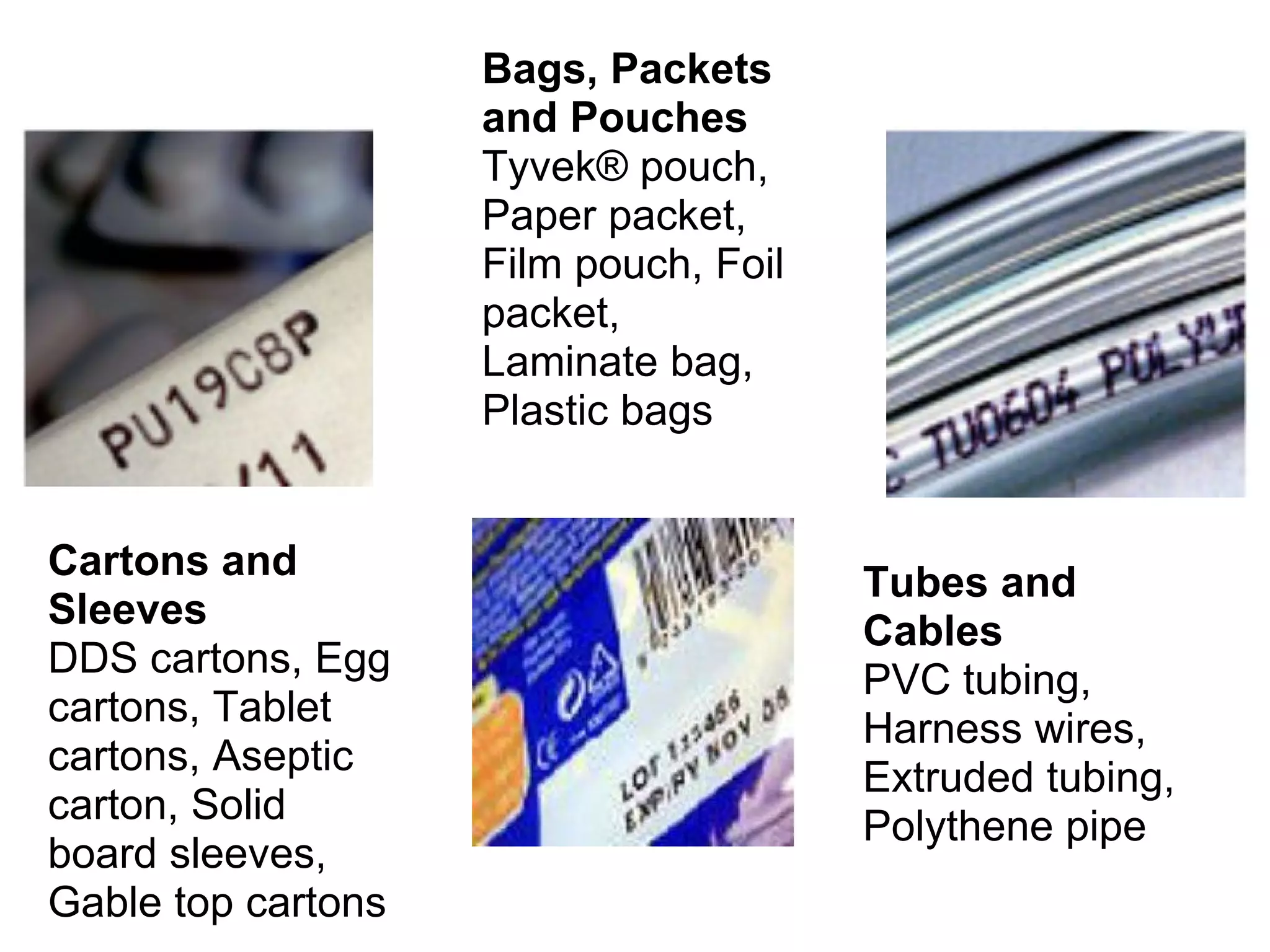
Cartons and Sleeves  DDS cartons, Egg cartons, Tablet cartons, Aseptic carton, Solid board sleeves, Gable top cartons  Bags, Packets and Pouches  Tyvek® pouch, Paper packet, Film pouch, Foil packet, Laminate bag, Plastic bags  Tubes and Cables  PVC tubing, Harness wires, Extruded tubing, Polythene pipe
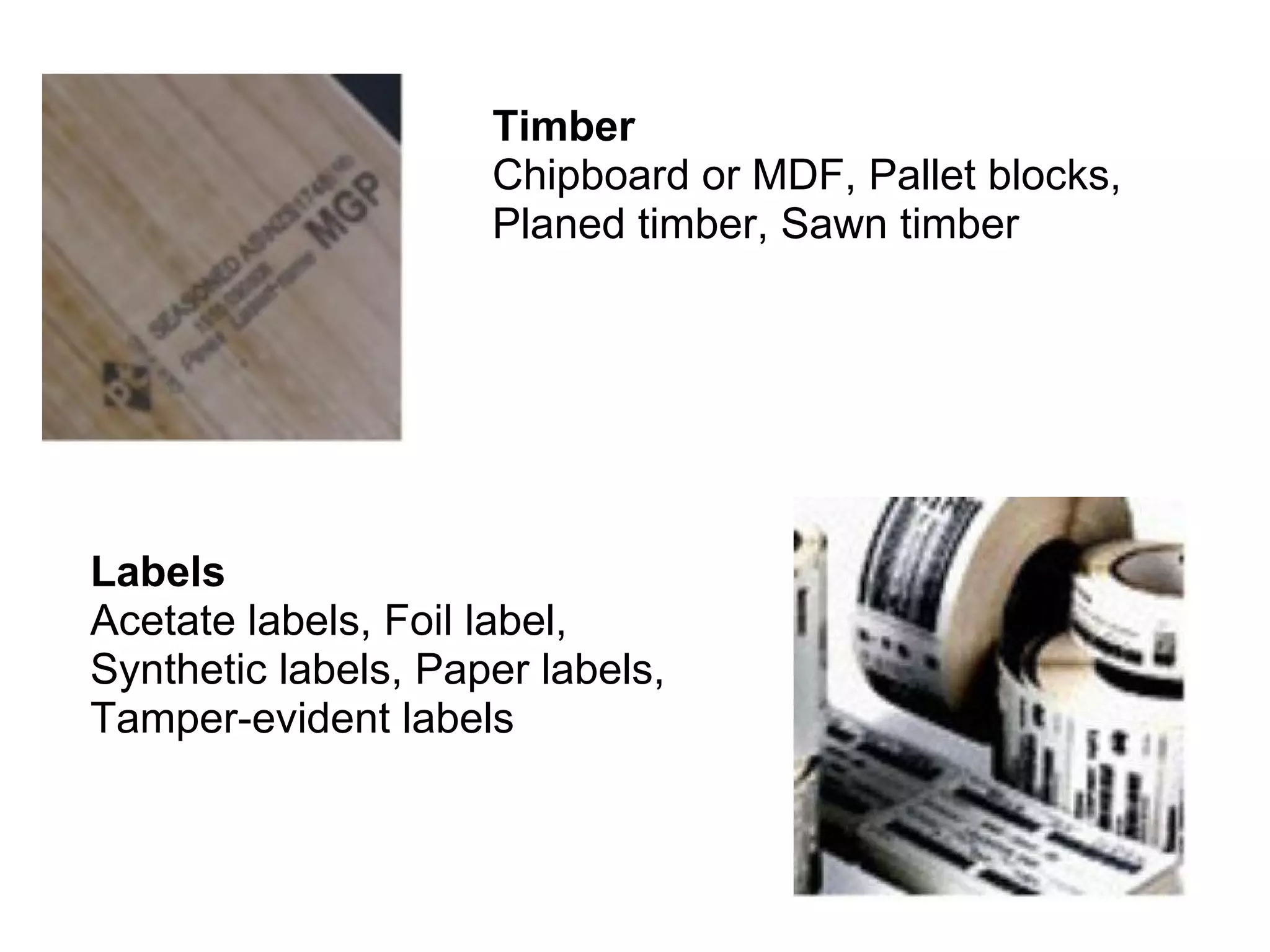
Timber  Chipboard or MDF, Pallet blocks, Planed timber, Sawn timber  Labels  Acetate labels, Foil label, Synthetic labels, Paper labels, Tamper-evident labels
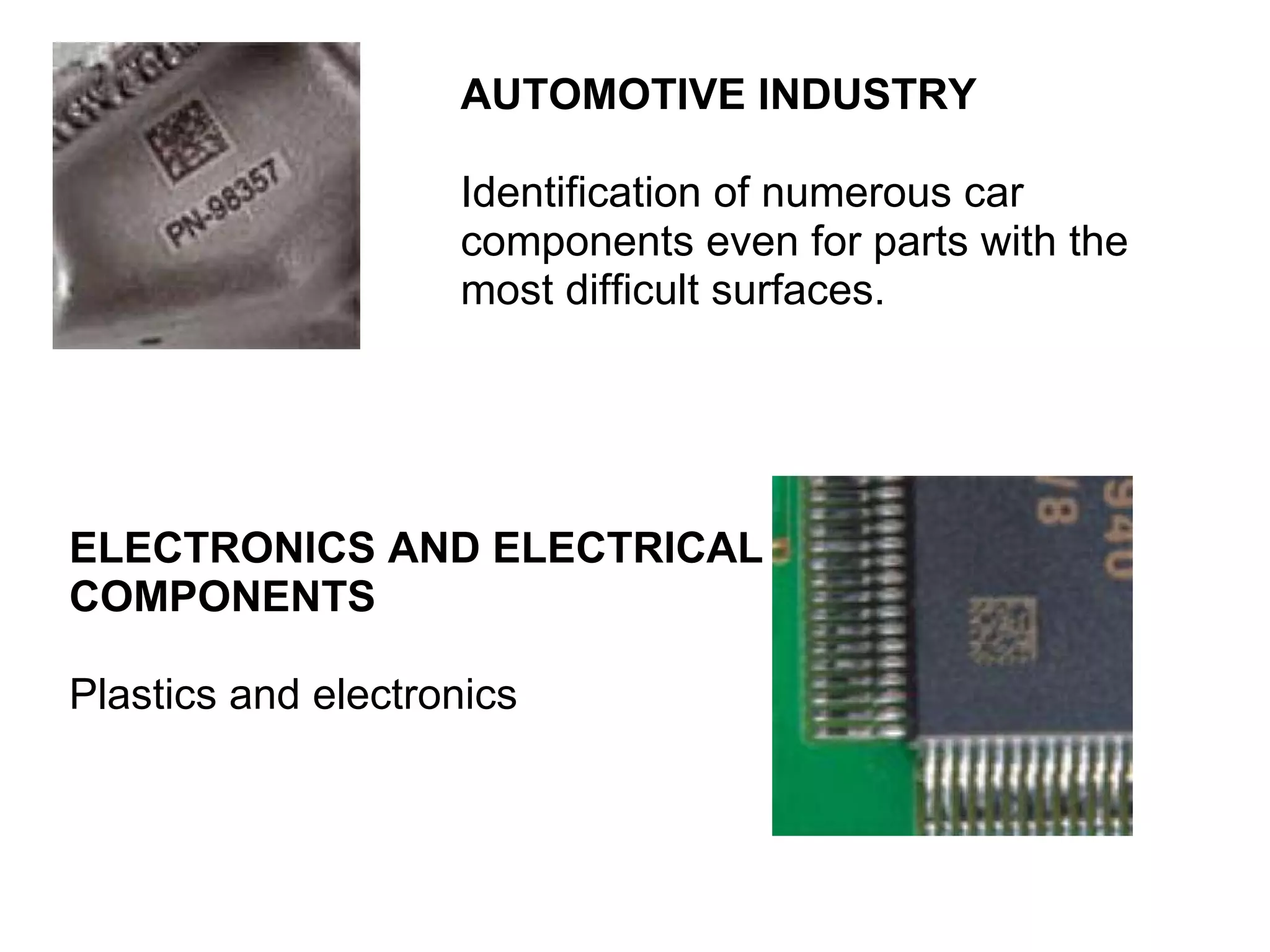
AUTOMOTIVE INDUSTRY Identification of numerous car components even for parts with the most difficult surfaces. ELECTRONICS AND ELECTRICAL COMPONENTS Plastics and electronics
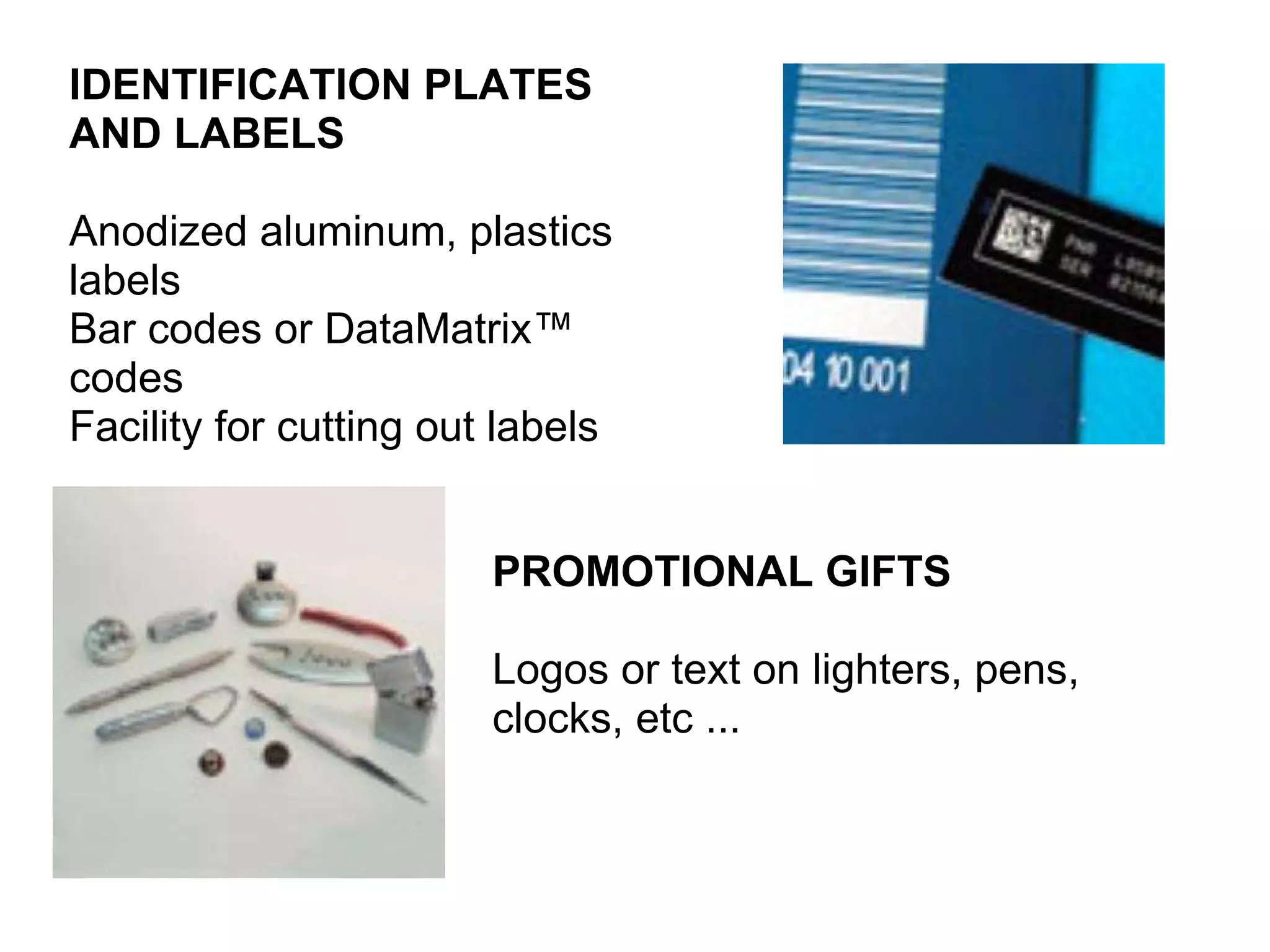
IDENTIFICATION PLATES AND LABELS Anodized aluminum, plastics labels Bar codes or DataMatrix™ codes Facility for cutting out labels PROMOTIONAL GIFTS Logos or text on lighters, pens, clocks, etc ...
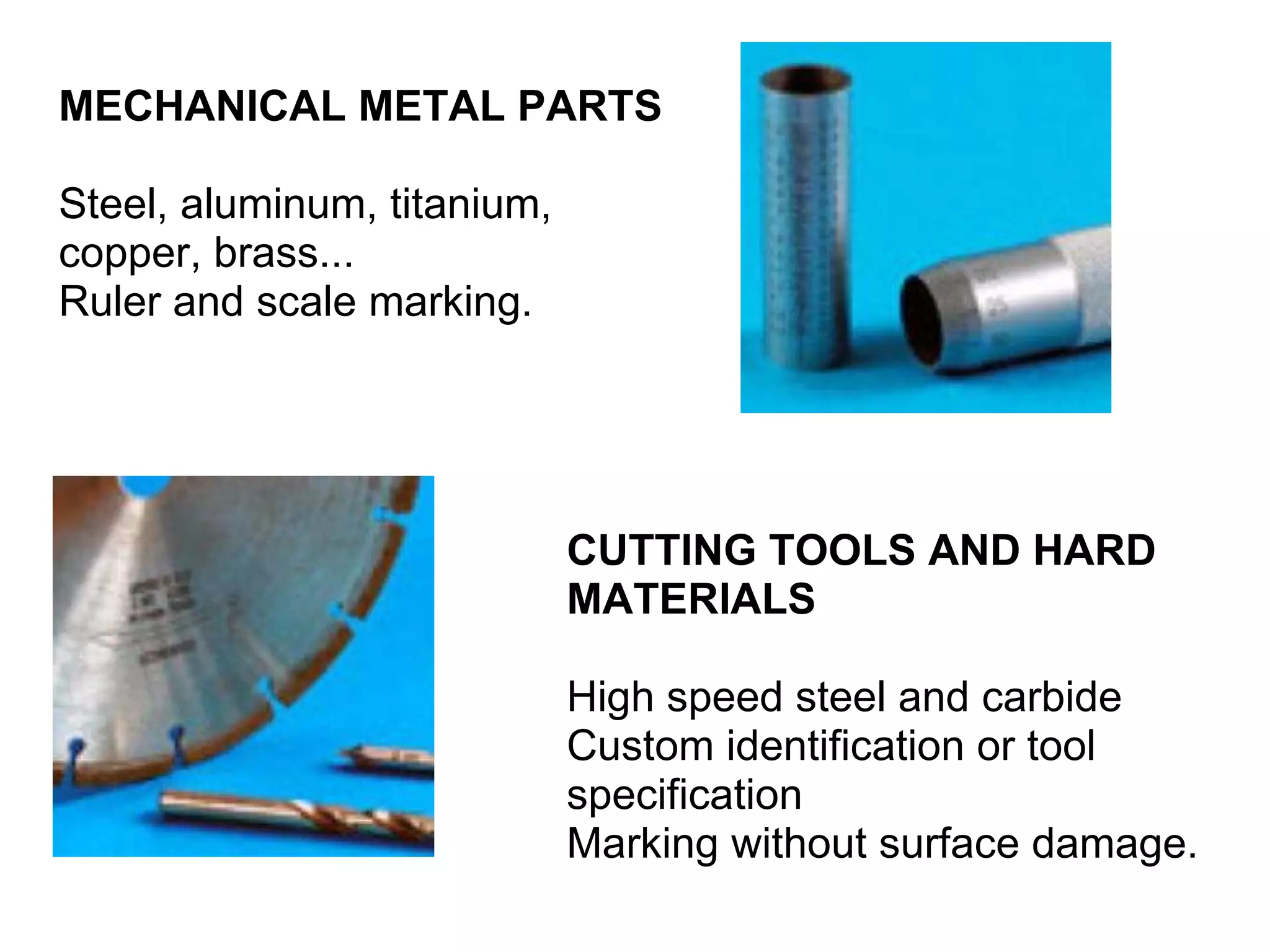
MECHANICAL METAL PARTS Steel, aluminum, titanium, copper, brass... Ruler and scale marking. CUTTING TOOLS AND HARD MATERIALS High speed steel and carbide Custom identification or tool specification Marking without surface damage.
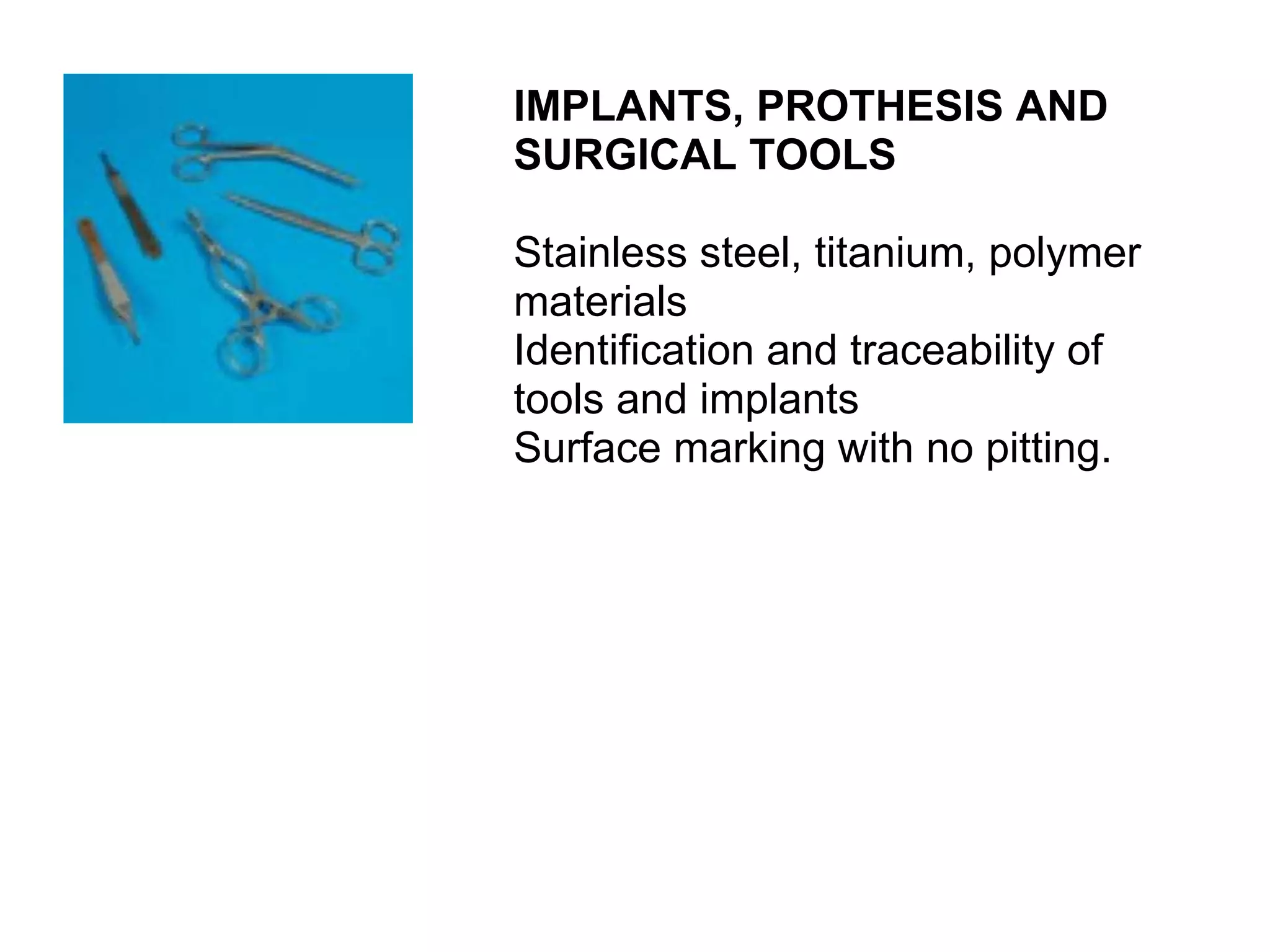
IMPLANTS, PROTHESIS AND SURGICAL TOOLS Stainless steel, titanium, polymer materials Identification and traceability of tools and implants Surface marking with no pitting.

Marking and coding 22 03 2011

  • 1.
    Marking and CodingBy Shrikant Athavale For PG Students SIES 28-03-2011
  • 2.
    Marking and codingproduct packaging may not be essential . . . until you get a project that uses new packaging materials or has new customer requirements: the customer needs permanent codes; the packaging has changed from a paper box to a plastic bag; the marks need to be highly readable. Then it becomes crucial to know all your options before choosing the right technology.
  • 3.
    Careful analysis canmake the difference between a successful, efficient operation and one that experiences needless downtime, resulting in unhappy customers. Key factors to consider include:
  • 4.
    Types of materialsor substrates you'll be marking Desired speed of application or throughput Print quality -- permanence and readability Up-front investment your company is willing to make Total cost of operation, including cost of service and consumables such as inks and ribbons Whether variable data, graphics, and bar codes are needed.
  • 5.
    Once you knowthese factors, it will be easier to choose which marking and coding technology is best for your application. Laser coding, thermal transfer overprinting (TTO), and continuous inkjet (CIJ) printing are all options that have benefits for different applications. Here is how each technology fits into the increasingly diverse industry of package marking and coding.
  • 6.
    Industrial laser markingstarted in the early 1970s and since then has developed into a well-established technology. Today, laser marking/coding is used in thousands of production lines throughout the world. It can be used for marking numerical codes, 2D-matrix and bar codes, logos, and symbols onto labels, sleeves, glass and plastic bottles, cans, kegs, tubes, blisters, cardboards, tubular films, and caps.
  • 7.
    Lasers do notrequire inks, stamps, or ribbons to generate a code. In modern sealed-off CO2 laser coders, such as Videojet's 3320 or 3120, the infrared laser light is generated via radio frequency discharge in a carbon dioxide gas mixture. The CO2 laser systems code thermally by changing the surface color (e.g. PVC packages), melting, foaming (e.g. PET bottles), or removing the material surface (e.g. printed labels, cardboards, cans, tubes).
  • 8.
    The advantages oflaser coding are numerous, including speed, versatility, code permanence, noncontact operation, clean and dry process, maintenance-free operation over thousands of hours, extremely low operating costs, and adaptability to a fully automated line. Lasers also offer unsurpassed reliability in "no code/no run" operations where mandatory package coding prior to distribution means that production will stop if a product is coded incorrectly. Halting production is a very expensive process, and most companies will do everything to avoid downtime. The unequaled uptime of a laser coder and its extreme productivity result in cost savings for a variety of applications.
  • 9.
    Thermal transfer overprinting(TTO) involves a thermal transfer printhead and ribbon that make contact with a flexible substrate, such as synthetic films and labels. Miniature print elements under a glass coating heat small areas of the ribbon and transfer ink to the target substrate. Print elements are program-controlled to create real-time images, including clean, high-resolution bar codes, text, and graphics. TTO systems can address applications in both continuous (moving) and intermittent (stop-print-start) environments.
  • 10.
    Maximizing production uptimeand ribbon utilization are the keys to success with TTO, and some methods of doing so are more effective than others. For example, the Videojet DataFlex Plus features a solid state, clutchless ribbon drive system that uses bidirectional stepper motors. The system continuously monitors ribbon tension to avoid ribbon-related faults, such as real or false ribbon breaks, which can interfere with production. This system also more precisely controls the ribbon, leaving only a millimeter of space between prints for better ribbon utilization. TTO systems that use clutch-based ribbon drives cannot as effectively accommodate fluctuations in ribbon tension on control spacing between prints. As a result, clutch-based systems use more ribbon and experience more ribbon-related faults, translating to increased downtime and higher operating costs.
  • 11.
    Typical applications forTTO are within the snack, bakery, meats, and frozen food industries, where flexible packaging is common. There are also special applications, such as in the coffee and confectionery industries, where generic packaging is used across a wide product range and all product branding and specifications have been added using TTO. This saves companies substantial cost through reduced waste and inventory.
  • 12.
    Perhaps the bestknown method of noncontact marking and coding is continuous ink jet (CIJ). CIJ has become one of the most versatile and durable options for food manufacturers. Small-character CIJ printers create lot codes, expiration dates, bar codes, and graphics on packaging, while large-character CIJ printers do the same for secondary packaging such as cartons and corrugated boxes.
  • 13.
    For example, foodpackaging requires readable, high-quality codes to ensure accuracy in the tracking and tracing of those products. Small-character CIJ delivers this by applying a stream of ink drops via a printhead to the package. This allows codes to be applied in a variety of fonts, lines, and direction and at a range of throughput speeds -- up to 1,000 fpm and with code heights ranging from 1/32 in. to more than ½ in.
  • 14.
    Coding and MarkingApplications Pharmaceutical and Cosmetics Blister Packs, Cartons, Vials and Ampoules, Datamatrix coding, Offline overprinting. Medical and Healthcare Sterile packs, Medical Devices, Medical papers, Datamatrix coding, Offline overprinting
  • 15.
    Industrial Technologies Blisterpacks, Envelopes and pouches, Direct product marking, Polybags Outer Cases Corrugated boxes, Bags and packs, Board wraps, Cartons, Crates Foils and Film Blister packs, Laminated foil, Sachets, Foil lids, Wrapping, Bags
  • 16.
    Food and Beverage Real time coding, Use by dates, Sleeves and Cartons, Outer case coding Foils and Film Blister packs, Laminated foil, Sachets, Foil lids, Wrapping, Bags
  • 17.
    Cartons and Sleeves DDS cartons, Egg cartons, Tablet cartons, Aseptic carton, Solid board sleeves, Gable top cartons Bags, Packets and Pouches Tyvek® pouch, Paper packet, Film pouch, Foil packet, Laminate bag, Plastic bags Tubes and Cables PVC tubing, Harness wires, Extruded tubing, Polythene pipe
  • 18.
    Timber Chipboardor MDF, Pallet blocks, Planed timber, Sawn timber Labels Acetate labels, Foil label, Synthetic labels, Paper labels, Tamper-evident labels
  • 19.
    AUTOMOTIVE INDUSTRY Identificationof numerous car components even for parts with the most difficult surfaces. ELECTRONICS AND ELECTRICAL COMPONENTS Plastics and electronics
  • 20.
    IDENTIFICATION PLATES ANDLABELS Anodized aluminum, plastics labels Bar codes or DataMatrix™ codes Facility for cutting out labels PROMOTIONAL GIFTS Logos or text on lighters, pens, clocks, etc ...
  • 21.
    MECHANICAL METAL PARTSSteel, aluminum, titanium, copper, brass... Ruler and scale marking. CUTTING TOOLS AND HARD MATERIALS High speed steel and carbide Custom identification or tool specification Marking without surface damage.
  • 22.
    IMPLANTS, PROTHESIS ANDSURGICAL TOOLS Stainless steel, titanium, polymer materials Identification and traceability of tools and implants Surface marking with no pitting.