
PROCESSED
MEAT
PACKAGING
Anas Ejaz Shaikh
13FET1006
Purpose of packaging
The basic purpose of packaging is to protect meat and meat
products from undesirable impacts on quality including microbiological
and physio-chemical alterations.
Packaging protects foodstuffs during processing, storage and
distribution from:
• contamination by dirt (by contact with surfaces and hands)
• contamination by micro-organisms (bacteria, moulds, yeasts)
• contamination by parasites (mainly insects)
• contamination by toxic substances (chemicals)
• influences affecting colour, smell and taste (off-odour, light, oxygen)
• loss or uptake of moisture (evaporation or water absorption)
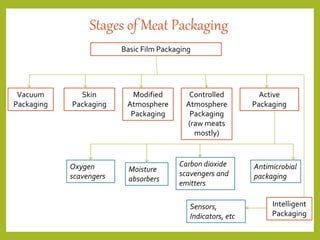
Stages of Meat Packaging
Basic Film Packaging
Vacuum
Packaging
Skin
Packaging
Modified
Atmosphere
Packaging
Controlled
Atmosphere
Packaging
(raw meats
mostly)
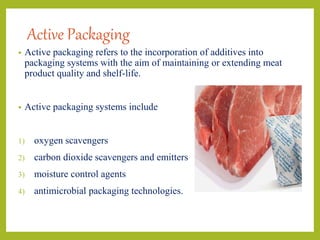
Active
Packaging
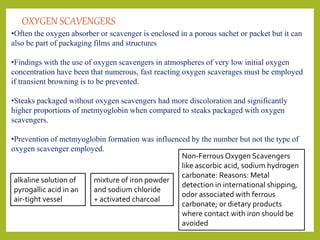
Oxygen
scavengers
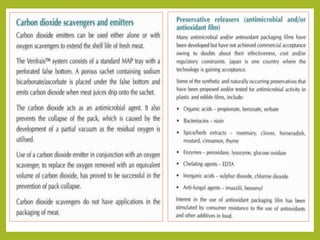
Carbon dioxide
scavengers and
emitters
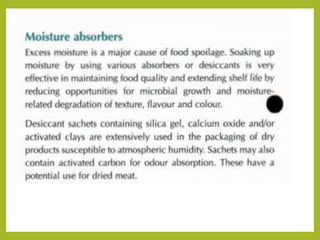
Moisture
absorbers
Antimicrobial
packaging
Sensors,
Indicators, etc
Intelligent
Packaging
Requirements for packaging materials
A range of synthetic materials suitable for meat packaging are available mainly in the form
of plastic films or foils.
Packaging films must be/have:
• flexible
• mechanical strength
• light weight
• odourless
• hygienic (clean and toxicologically harmless)
• easy recycling
• resistance to hot and cold temperatures
• resistance to oil and fats
• good barrier properties against gases
• sealing capability
• low-cost
Barrier against gases
Good barrier properties against oxygen and evaporation are the most
important features in order to ensure:
a) Exclusion of oxygen
• Oxygen changes the red meat colour to grey or green and causes oxidation
and rancidity of fats resulting in an undesirable off-flavour.
• The best protection will be achieved using oxygen-proof packaging films
together with vacuum packaging of the product .
• While oxygen is generally undesirable in packages of meat and meat products,
there is one exception where oxygen-permeable foils are desirable, namely
for fresh ready-to-sell meat portions to produce a desirable bright red meat
colour
b) Prevention of evaporation of product moisture
• Fresh meat or fresh sausages, cooked ham, etc. have a relatively high
moisture content and will suffer considerable weight and quality losses by
evaporation and drying during storage if such products remain unpacked. The
packaging material must therefore be sufficiently water-vapour-proof.
Barrier against light
• The prolonged exposure to daylight or artificial light
accelerates unattractive colour
changes, oxidation and rancidity.
• Transparent packaging films normally allow attractive
product presentation as the packaged product is
visible. However, no protection against light impact.
• For light sensitive products or products exposed to
strong light, coloured or opaque films should be used.
• Films laminated with aluminium foil are very
effective.
Sealing capability (Thermoplastic properties)
• The films must be heat sealable, i.e. under slight
pressure and with simultaneous high temperature
application, they will melt or seal together along the
heated area, resulting in hermetically closed plastic
pouches or bags.
Opaque and printed
films as light barrier
Aluminium foil bag
MATERIALS of packaging films
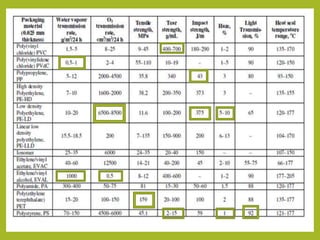
• Practically all films used for meat packaging derive from synthetic “plastic” materials.
• Cellulose in the form of transparent films is now no longer of great importance in meat
packaging.
• However, cellulose is still important for the manufacture of certain kinds of artificial
sausage casings
• The most common synthetic materials used for meat packaging are:
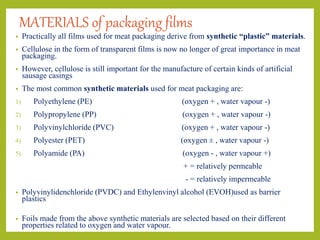
1) Polyethylene (PE) (oxygen + , water vapour -)
2) Polypropylene (PP) (oxygen + , water vapour -)
3) Polyvinylchloride (PVC) (oxygen + , water vapour -)
4) Polyester (PET) (oxygen ± , water vapour -)
5) Polyamide (PA) (oxygen - , water vapour +)
+ = relatively permeable
- = relatively impermeable
• Polyvinylidenchloride (PVDC) and Ethylenvinyl alcohol (EVOH)used as barrier
plastics
• Foils made from the above synthetic materials are selected based on their different
properties related to oxygen and water vapour.
TYPES OF PACKAGING FILMS
For the various purposes in the meat industry packaging films
can be divided into
• Single-layer films
• Multi-layer films
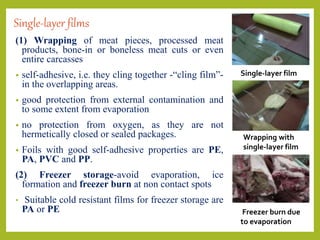
Single-layer films
(1) Wrapping of meat pieces, processed meat
products, bone-in or boneless meat cuts or even
entire carcasses
• self-adhesive, i.e. they cling together -“cling film”-
in the overlapping areas.
• good protection from external contamination and
to some extent from evaporation
• no protection from oxygen, as they are not
hermetically closed or sealed packages.
• Foils with good self-adhesive properties are PE,
PA, PVC and PP.
(2) Freezer storage-avoid evaporation, ice
formation and freezer burn at non contact spots
• Suitable cold resistant films for freezer storage are
PA or PE
Single-layer film
Wrapping with
single-layer film
Freezer burn due
to evaporation
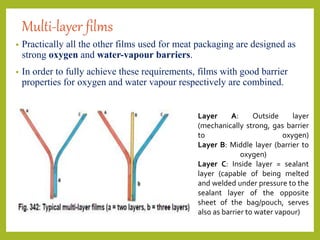
Multi-layer films
• Practically all the other films used for meat packaging are designed as
strong oxygen and water-vapour barriers.
• In order to fully achieve these requirements, films with good barrier
properties for oxygen and water vapour respectively are combined.
Layer A: Outside layer
(mechanically strong, gas barrier
to oxygen)
Layer B: Middle layer (barrier to
oxygen)
Layer C: Inside layer = sealant
layer (capable of being melted
and welded under pressure to the
sealant layer of the opposite
sheet of the bag/pouch, serves
also as barrier to water vapour)
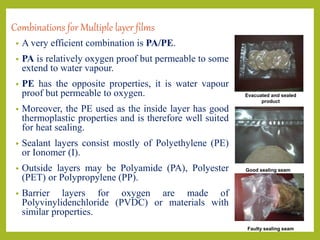
Combinations for Multiple layer films
• A very efficient combination is PA/PE.
• PA is relatively oxygen proof but permeable to some
extend to water vapour.
• PE has the opposite properties, it is water vapour
proof but permeable to oxygen.
• Moreover, the PE used as the inside layer has good
thermoplastic properties and is therefore well suited
for heat sealing.
• Sealant layers consist mostly of Polyethylene (PE)
or Ionomer (I).
• Outside layers may be Polyamide (PA), Polyester
(PET) or Polypropylene (PP).
• Barrier layers for oxygen are made of
Polyvinylidenchloride (PVDC) or materials with
similar properties.
Evacuated and sealed
product
Good sealing seam
Faulty sealing seam
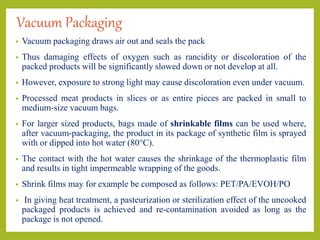
Vacuum Packaging
• Vacuum packaging draws air out and seals the pack
• Thus damaging effects of oxygen such as rancidity or discoloration of the
packed products will be significantly slowed down or not develop at all.
• However, exposure to strong light may cause discoloration even under vacuum.
• Processed meat products in slices or as entire pieces are packed in small to
medium-size vacuum bags.
• For larger sized products, bags made of shrinkable films can be used where,
after vacuum-packaging, the product in its package of synthetic film is sprayed
with or dipped into hot water (80°C).
• The contact with the hot water causes the shrinkage of the thermoplastic film
and results in tight impermeable wrapping of the goods.
• Shrink films may for example be composed as follows: PET/PA/EVOH/PO
• In giving heat treatment, a pasteurization or sterilization effect of the uncooked
packaged products is achieved and re-contamination avoided as long as the
package is not opened.
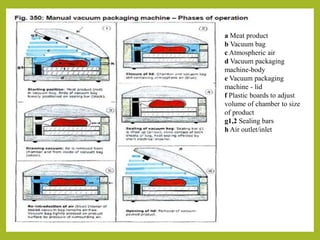
a Meat product
b Vacuum bag
c Atmospheric air
d Vacuum packaging
machine-body
e Vacuum packaging
machine - lid
f Plastic boards to adjust
volume of chamber to size
of product
g1,2 Sealing bars
h Air outlet/inlet
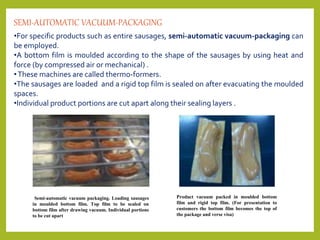
•For specific products such as entire sausages, semi-automatic vacuum-packaging can
be employed.
•A bottom film is moulded according to the shape of the sausages by using heat and
force (by compressed air or mechanical) .
•These machines are called thermo-formers.
•The sausages are loaded and a rigid top film is sealed on after evacuating the moulded
spaces.
•Individual product portions are cut apart along their sealing layers .
SEMI-AUTOMATIC VACUUM-PACKAGING
Semi-automatic vacuum packaging. Loading sausages
in moulded bottom film. Top film to be sealed on
bottom film after drawing vacuum. Individual portions
to be cut apart
Product vacuum packed in moulded bottom
film and rigid top film. (For presentation to
customers the bottom film becomes the top of
the package and verse visa)
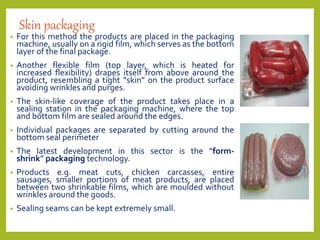
Skin packaging
• For this method the products are placed in the packaging
machine, usually on a rigid film, which serves as the bottom
layer of the final package.
• Another flexible film (top layer, which is heated for
increased flexibility) drapes itself from above around the
product, resembling a tight “skin” on the product surface
avoiding wrinkles and purges.
• The skin-like coverage of the product takes place in a
sealing station in the packaging machine, where the top
and bottom film are sealed around the edges.
• Individual packages are separated by cutting around the
bottom seal perimeter
• The latest development in this sector is the “form-
shrink” packaging technology.
• Products e.g. meat cuts, chicken carcasses, entire
sausages, smaller portions of meat products, are placed
between two shrinkable films, which are moulded without
wrinkles around the goods.
• Sealing seams can be kept extremely small.
Modified Atmosphere Packaging (MAP)
• The packaging materials used are gas-proof multi-layer films composed
for example of PE, PA and barrier layers.
• Rigid films may be used to mould cup or box shaped containers which
are filled. A flexible lid foil is then sealed on.
• MAP packaging can also be done for ordinary plastic bags/pouches.
• MAP packages are firstly subjected to a vacuum. A mixtures of gases is
the introduced into the air-free space before sealing.
• The gas mixture usually contains nitrogen (N2) and carbon dioxide
(CO2).
• N2 is inert, i.e. it does not react with meat product components such as
fat or myoglobin. Its function is to replace the atmospheric oxygen (O2)
and thus prevents O2 induced negative impacts.
• CO2, has a protective function, as it inhibits to some extend the growth
of bacteria and moulds.
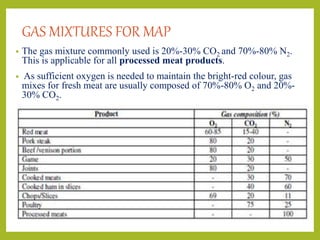
GAS MIXTURES FOR MAP
• The gas mixture commonly used is 20%-30% CO2 and 70%-80% N2.
This is applicable for all processed meat products.
• As sufficient oxygen is needed to maintain the bright-red colour, gas
mixes for fresh meat are usually composed of 70%-80% O2 and 20%-
30% CO2.
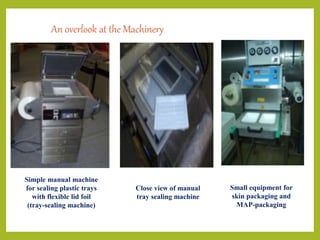
Simple manual machine
for sealing plastic trays
with flexible lid foil
(tray-sealing machine)
Close view of manual
tray sealing machine
Small equipment for
skin packaging and
MAP-packaging
An overlook at the Machinery
Active Packaging
• Active packaging refers to the incorporation of additives into
packaging systems with the aim of maintaining or extending meat
product quality and shelf-life.
• Active packaging systems include
1) oxygen scavengers
2) carbon dioxide scavengers and emitters
3) moisture control agents
4) antimicrobial packaging technologies.
•Often the oxygen absorber or scavenger is enclosed in a porous sachet or packet but it can
also be part of packaging films and structures
•Findings with the use of oxygen scavengers in atmospheres of very low initial oxygen
concentration have been that numerous, fast reacting oxygen scaverages must be employed
if transient browning is to be prevented.
•Steaks packaged without oxygen scavengers had more discoloration and significantly
higher proportions of metmyoglobin when compared to steaks packaged with oxygen
scavengers.
•Prevention of metmyoglobin formation was influenced by the number but not the type of
oxygen scavenger employed.
OXYGEN SCAVENGERS
alkaline solution of
pyrogallic acid in an
air-tight vessel
mixture of iron powder
and sodium chloride
+ activated charcoal
Non-Ferrous Oxygen Scavengers
like ascorbic acid, sodium hydrogen
carbonate: Reasons: Metal
detection in international shipping,
odor associated with ferrous
carbonate; or dietary products
where contact with iron should be
avoided
Intelligent Packaging
• Intelligent packaging systems are those that monitor the condition of
packaged foods to give information regarding the quality of the
packaged food during transport and storage.
The potential of
1) Sensor technologies
2) Indicators (including integrity,freshness and time-temperature (TTI)
indicators)
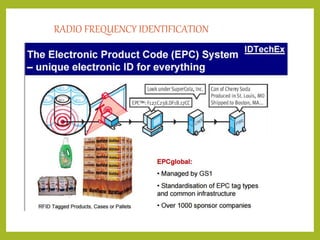
3) Radio Frequency IDentification (RFID)
are evaluated
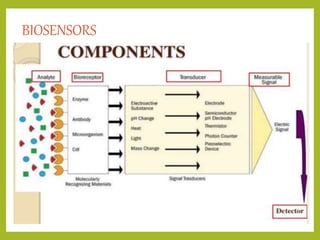
BIOSENSORS
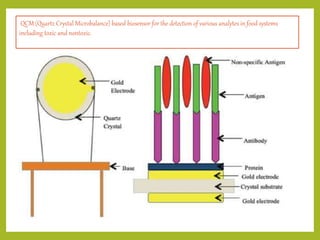
QCM (Quartz Crystal Microbalance) based biosensor for the detection of various analytes in food systems
including toxic and nontoxic.
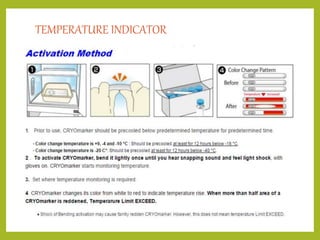
TEMPERATURE INDICATOR
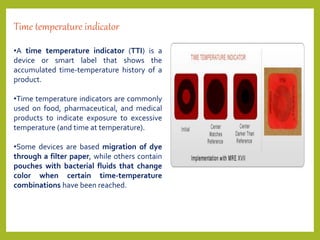
Time temperature indicator
•A time temperature indicator (TTI) is a
device or smart label that shows the
accumulated time-temperature history of a
product.
•Time temperature indicators are commonly
used on food, pharmaceutical, and medical
products to indicate exposure to excessive
temperature (and time at temperature).
•Some devices are based migration of dye
through a filter paper, while others contain
pouches with bacterial fluids that change
color when certain time-temperature
combinations have been reached.
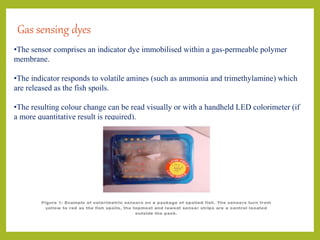
Gas sensing dyes
•The sensor comprises an indicator dye immobilised within a gas-permeable polymer
membrane.
•The indicator responds to volatile amines (such as ammonia and trimethylamine) which
are released as the fish spoils.
•The resulting colour change can be read visually or with a handheld LED colorimeter (if
a more quantitative result is required).
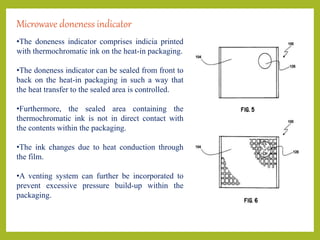
Microwave doneness indicator
•The doneness indicator comprises indicia printed
with thermochromatic ink on the heat-in packaging.
•The doneness indicator can be sealed from front to
back on the heat-in packaging in such a way that
the heat transfer to the sealed area is controlled.
•Furthermore, the sealed area containing the
thermochromatic ink is not in direct contact with
the contents within the packaging.
•The ink changes due to heat conduction through
the film.
•A venting system can further be incorporated to
prevent excessive pressure build-up within the
packaging.
RADIO FREQUENCY IDENTIFICATION
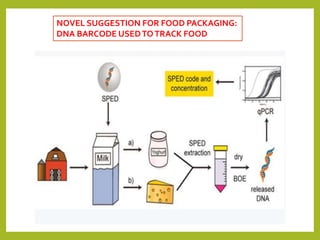
NOVEL SUGGESTION FOR FOOD PACKAGING:
DNA BARCODE USEDTOTRACK FOOD
Processed Meat Packaging - Anas Shaikh - 13FET1006

Processed Meat Packaging - Anas Shaikh - 13FET1006

  • 1.
  • 2.
    Purpose of packaging Thebasic purpose of packaging is to protect meat and meat products from undesirable impacts on quality including microbiological and physio-chemical alterations. Packaging protects foodstuffs during processing, storage and distribution from: • contamination by dirt (by contact with surfaces and hands) • contamination by micro-organisms (bacteria, moulds, yeasts) • contamination by parasites (mainly insects) • contamination by toxic substances (chemicals) • influences affecting colour, smell and taste (off-odour, light, oxygen) • loss or uptake of moisture (evaporation or water absorption)
  • 3.
    Stages of MeatPackaging Basic Film Packaging Vacuum Packaging Skin Packaging Modified Atmosphere Packaging Controlled Atmosphere Packaging (raw meats mostly) Active Packaging Oxygen scavengers Carbon dioxide scavengers and emitters Moisture absorbers Antimicrobial packaging Sensors, Indicators, etc Intelligent Packaging
  • 4.
    Requirements for packagingmaterials A range of synthetic materials suitable for meat packaging are available mainly in the form of plastic films or foils. Packaging films must be/have: • flexible • mechanical strength • light weight • odourless • hygienic (clean and toxicologically harmless) • easy recycling • resistance to hot and cold temperatures • resistance to oil and fats • good barrier properties against gases • sealing capability • low-cost
  • 5.
    Barrier against gases Goodbarrier properties against oxygen and evaporation are the most important features in order to ensure: a) Exclusion of oxygen • Oxygen changes the red meat colour to grey or green and causes oxidation and rancidity of fats resulting in an undesirable off-flavour. • The best protection will be achieved using oxygen-proof packaging films together with vacuum packaging of the product . • While oxygen is generally undesirable in packages of meat and meat products, there is one exception where oxygen-permeable foils are desirable, namely for fresh ready-to-sell meat portions to produce a desirable bright red meat colour b) Prevention of evaporation of product moisture • Fresh meat or fresh sausages, cooked ham, etc. have a relatively high moisture content and will suffer considerable weight and quality losses by evaporation and drying during storage if such products remain unpacked. The packaging material must therefore be sufficiently water-vapour-proof.
  • 6.
    Barrier against light •The prolonged exposure to daylight or artificial light accelerates unattractive colour changes, oxidation and rancidity. • Transparent packaging films normally allow attractive product presentation as the packaged product is visible. However, no protection against light impact. • For light sensitive products or products exposed to strong light, coloured or opaque films should be used. • Films laminated with aluminium foil are very effective. Sealing capability (Thermoplastic properties) • The films must be heat sealable, i.e. under slight pressure and with simultaneous high temperature application, they will melt or seal together along the heated area, resulting in hermetically closed plastic pouches or bags. Opaque and printed films as light barrier Aluminium foil bag
  • 7.
    MATERIALS of packagingfilms • Practically all films used for meat packaging derive from synthetic “plastic” materials. • Cellulose in the form of transparent films is now no longer of great importance in meat packaging. • However, cellulose is still important for the manufacture of certain kinds of artificial sausage casings • The most common synthetic materials used for meat packaging are: 1) Polyethylene (PE) (oxygen + , water vapour -) 2) Polypropylene (PP) (oxygen + , water vapour -) 3) Polyvinylchloride (PVC) (oxygen + , water vapour -) 4) Polyester (PET) (oxygen ± , water vapour -) 5) Polyamide (PA) (oxygen - , water vapour +) + = relatively permeable - = relatively impermeable • Polyvinylidenchloride (PVDC) and Ethylenvinyl alcohol (EVOH)used as barrier plastics • Foils made from the above synthetic materials are selected based on their different properties related to oxygen and water vapour.
  • 9.
    TYPES OF PACKAGINGFILMS For the various purposes in the meat industry packaging films can be divided into • Single-layer films • Multi-layer films
  • 10.
    Single-layer films (1) Wrappingof meat pieces, processed meat products, bone-in or boneless meat cuts or even entire carcasses • self-adhesive, i.e. they cling together -“cling film”- in the overlapping areas. • good protection from external contamination and to some extent from evaporation • no protection from oxygen, as they are not hermetically closed or sealed packages. • Foils with good self-adhesive properties are PE, PA, PVC and PP. (2) Freezer storage-avoid evaporation, ice formation and freezer burn at non contact spots • Suitable cold resistant films for freezer storage are PA or PE Single-layer film Wrapping with single-layer film Freezer burn due to evaporation
  • 11.
    Multi-layer films • Practicallyall the other films used for meat packaging are designed as strong oxygen and water-vapour barriers. • In order to fully achieve these requirements, films with good barrier properties for oxygen and water vapour respectively are combined. Layer A: Outside layer (mechanically strong, gas barrier to oxygen) Layer B: Middle layer (barrier to oxygen) Layer C: Inside layer = sealant layer (capable of being melted and welded under pressure to the sealant layer of the opposite sheet of the bag/pouch, serves also as barrier to water vapour)
  • 12.
    Combinations for Multiplelayer films • A very efficient combination is PA/PE. • PA is relatively oxygen proof but permeable to some extend to water vapour. • PE has the opposite properties, it is water vapour proof but permeable to oxygen. • Moreover, the PE used as the inside layer has good thermoplastic properties and is therefore well suited for heat sealing. • Sealant layers consist mostly of Polyethylene (PE) or Ionomer (I). • Outside layers may be Polyamide (PA), Polyester (PET) or Polypropylene (PP). • Barrier layers for oxygen are made of Polyvinylidenchloride (PVDC) or materials with similar properties. Evacuated and sealed product Good sealing seam Faulty sealing seam
  • 13.
    Vacuum Packaging • Vacuumpackaging draws air out and seals the pack • Thus damaging effects of oxygen such as rancidity or discoloration of the packed products will be significantly slowed down or not develop at all. • However, exposure to strong light may cause discoloration even under vacuum. • Processed meat products in slices or as entire pieces are packed in small to medium-size vacuum bags. • For larger sized products, bags made of shrinkable films can be used where, after vacuum-packaging, the product in its package of synthetic film is sprayed with or dipped into hot water (80°C). • The contact with the hot water causes the shrinkage of the thermoplastic film and results in tight impermeable wrapping of the goods. • Shrink films may for example be composed as follows: PET/PA/EVOH/PO • In giving heat treatment, a pasteurization or sterilization effect of the uncooked packaged products is achieved and re-contamination avoided as long as the package is not opened.
  • 14.
    a Meat product bVacuum bag c Atmospheric air d Vacuum packaging machine-body e Vacuum packaging machine - lid f Plastic boards to adjust volume of chamber to size of product g1,2 Sealing bars h Air outlet/inlet
  • 15.
    •For specific productssuch as entire sausages, semi-automatic vacuum-packaging can be employed. •A bottom film is moulded according to the shape of the sausages by using heat and force (by compressed air or mechanical) . •These machines are called thermo-formers. •The sausages are loaded and a rigid top film is sealed on after evacuating the moulded spaces. •Individual product portions are cut apart along their sealing layers . SEMI-AUTOMATIC VACUUM-PACKAGING Semi-automatic vacuum packaging. Loading sausages in moulded bottom film. Top film to be sealed on bottom film after drawing vacuum. Individual portions to be cut apart Product vacuum packed in moulded bottom film and rigid top film. (For presentation to customers the bottom film becomes the top of the package and verse visa)
  • 16.
    Skin packaging • Forthis method the products are placed in the packaging machine, usually on a rigid film, which serves as the bottom layer of the final package. • Another flexible film (top layer, which is heated for increased flexibility) drapes itself from above around the product, resembling a tight “skin” on the product surface avoiding wrinkles and purges. • The skin-like coverage of the product takes place in a sealing station in the packaging machine, where the top and bottom film are sealed around the edges. • Individual packages are separated by cutting around the bottom seal perimeter • The latest development in this sector is the “form- shrink” packaging technology. • Products e.g. meat cuts, chicken carcasses, entire sausages, smaller portions of meat products, are placed between two shrinkable films, which are moulded without wrinkles around the goods. • Sealing seams can be kept extremely small.
  • 17.
    Modified Atmosphere Packaging(MAP) • The packaging materials used are gas-proof multi-layer films composed for example of PE, PA and barrier layers. • Rigid films may be used to mould cup or box shaped containers which are filled. A flexible lid foil is then sealed on. • MAP packaging can also be done for ordinary plastic bags/pouches. • MAP packages are firstly subjected to a vacuum. A mixtures of gases is the introduced into the air-free space before sealing. • The gas mixture usually contains nitrogen (N2) and carbon dioxide (CO2). • N2 is inert, i.e. it does not react with meat product components such as fat or myoglobin. Its function is to replace the atmospheric oxygen (O2) and thus prevents O2 induced negative impacts. • CO2, has a protective function, as it inhibits to some extend the growth of bacteria and moulds.
  • 18.
    GAS MIXTURES FORMAP • The gas mixture commonly used is 20%-30% CO2 and 70%-80% N2. This is applicable for all processed meat products. • As sufficient oxygen is needed to maintain the bright-red colour, gas mixes for fresh meat are usually composed of 70%-80% O2 and 20%- 30% CO2.
  • 19.
    Simple manual machine forsealing plastic trays with flexible lid foil (tray-sealing machine) Close view of manual tray sealing machine Small equipment for skin packaging and MAP-packaging An overlook at the Machinery
  • 20.
    Active Packaging • Activepackaging refers to the incorporation of additives into packaging systems with the aim of maintaining or extending meat product quality and shelf-life. • Active packaging systems include 1) oxygen scavengers 2) carbon dioxide scavengers and emitters 3) moisture control agents 4) antimicrobial packaging technologies.
  • 21.
    •Often the oxygenabsorber or scavenger is enclosed in a porous sachet or packet but it can also be part of packaging films and structures •Findings with the use of oxygen scavengers in atmospheres of very low initial oxygen concentration have been that numerous, fast reacting oxygen scaverages must be employed if transient browning is to be prevented. •Steaks packaged without oxygen scavengers had more discoloration and significantly higher proportions of metmyoglobin when compared to steaks packaged with oxygen scavengers. •Prevention of metmyoglobin formation was influenced by the number but not the type of oxygen scavenger employed. OXYGEN SCAVENGERS alkaline solution of pyrogallic acid in an air-tight vessel mixture of iron powder and sodium chloride + activated charcoal Non-Ferrous Oxygen Scavengers like ascorbic acid, sodium hydrogen carbonate: Reasons: Metal detection in international shipping, odor associated with ferrous carbonate; or dietary products where contact with iron should be avoided
  • 24.
    Intelligent Packaging • Intelligentpackaging systems are those that monitor the condition of packaged foods to give information regarding the quality of the packaged food during transport and storage. The potential of 1) Sensor technologies 2) Indicators (including integrity,freshness and time-temperature (TTI) indicators) 3) Radio Frequency IDentification (RFID) are evaluated
  • 25.
  • 26.
    QCM (Quartz CrystalMicrobalance) based biosensor for the detection of various analytes in food systems including toxic and nontoxic.
  • 27.
  • 28.
    Time temperature indicator •Atime temperature indicator (TTI) is a device or smart label that shows the accumulated time-temperature history of a product. •Time temperature indicators are commonly used on food, pharmaceutical, and medical products to indicate exposure to excessive temperature (and time at temperature). •Some devices are based migration of dye through a filter paper, while others contain pouches with bacterial fluids that change color when certain time-temperature combinations have been reached.
  • 29.
    Gas sensing dyes •Thesensor comprises an indicator dye immobilised within a gas-permeable polymer membrane. •The indicator responds to volatile amines (such as ammonia and trimethylamine) which are released as the fish spoils. •The resulting colour change can be read visually or with a handheld LED colorimeter (if a more quantitative result is required).
  • 30.
    Microwave doneness indicator •Thedoneness indicator comprises indicia printed with thermochromatic ink on the heat-in packaging. •The doneness indicator can be sealed from front to back on the heat-in packaging in such a way that the heat transfer to the sealed area is controlled. •Furthermore, the sealed area containing the thermochromatic ink is not in direct contact with the contents within the packaging. •The ink changes due to heat conduction through the film. •A venting system can further be incorporated to prevent excessive pressure build-up within the packaging.
  • 31.
  • 32.
    NOVEL SUGGESTION FORFOOD PACKAGING: DNA BARCODE USEDTOTRACK FOOD