Cast versus blown film
Ted Brink
polyamide-based
Page  2
Contents
• film requirements
• polyamide characteristics
• blown versus cast film technology
• conclusions
cast versus blown film
Page  3
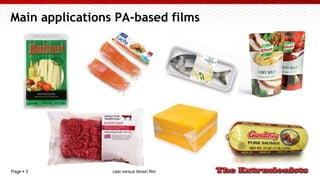
Main applications PA-based films
cast versus blown film
Page  4
Food packaging - film requirements
• oxygen barrier
• moisture barrier
• grease and fat resistant
• shrink performance
• puncture resistance
• sealability
• printability
• transparency
cast versus blown film
Page  5
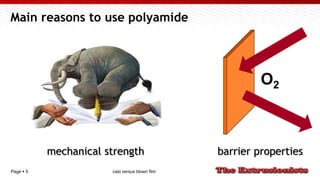
Main reasons to use polyamide
O2
mechanical strength barrier properties
cast versus blown film
Page  6
Polyamide properties
PA-type
Melting point
[°C]
H2O permeability
[cc/m2/atm/day]
O2 permeability
[cc/m2/atm/day]
PA66 255 8 12
PA6 220 15 12
PA6.12 215 5 45
PA6.66 195 16 14
PA11 190 4 120
PA12 180 5 190
cast versus blown film
Page  7
film production
cast versus blown film
Page  8
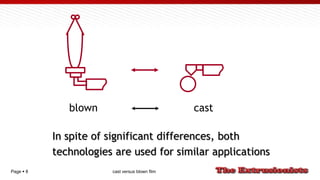
In spite of significant differences, both
technologies are used for similar applications
blown cast
cast versus blown film
Page  9
cast film
cast versus blown film
Page  10
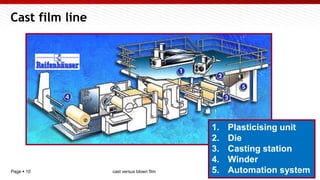
1. Plasticising unit
2. Die
3. Casting station
4. Winder
5. Automation system
Cast film line
cast versus blown film
Page  11
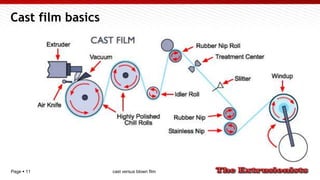
Cast film basics
cast versus blown film
Page  12
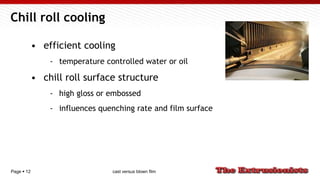
Chill roll cooling
• efficient cooling
- temperature controlled water or oil
• chill roll surface structure
- high gloss or embossed
- influences quenching rate and film surface
cast versus blown film
Page  13
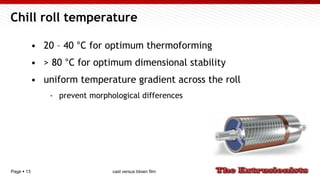
Chill roll temperature
• 20 – 40 °C for optimum thermoforming
• > 80 °C for optimum dimensional stability
• uniform temperature gradient across the roll
- prevent morphological differences
cast versus blown film
Page  14
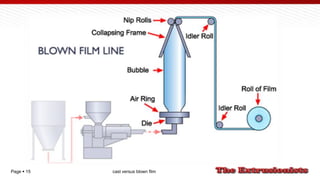
blown film
cast versus blown film
Page  15 cast versus blown film
Page  16
Bubble cooling
• cooling medium: air
• cooling technologies
- external bubble cooling
- internal bubble cooling
• cooling influences:
- output
- film morphology
ambient air or
chilled air
cast versus blown film
Page  17
External bubble cooling
cooling from the outside
• commonly ambient air
cast versus blown film
Page  18
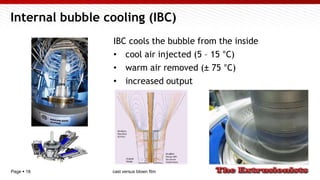
Internal bubble cooling (IBC)
IBC cools the bubble from the inside
• cool air injected (5 – 15 °C)
• warm air removed (± 75 °C)
• increased output
cast versus blown film
Page  19
cast ↔ blown
cast versus blown film
Page  20
Blown versus cast film – polymer viscosity
• blown film:
- requires melt strength → high viscosity
• cast film:
- less critical → medium to even low viscosity
cast versus blown film
Page  21
Blown versus cast film – cooling efficiency
• cooling medium blown film: air
- air not very efficient cooling medium
- outer bubble cooling
- inner bubble cooling
• cooling medium cast film: chill roll
- cooling by water or oil
- chill roll temperature between 25 and 125 °C
cooling efficiency
determines output
cast versus blown film
Page  22
Blown versus cast film – film morphology
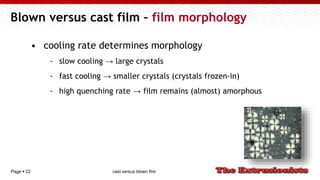
• cooling rate determines morphology
- slow cooling → large crystals
- fast cooling → smaller crystals (crystals frozen-in)
- high quenching rate → film remains (almost) amorphous
cast versus blown film
Page  23
Blown versus cast film – film transparency
• transparency related to morphology
- slow cooling → large crystals → more haze
- fast cooling → crystals less time to grow → higher transparency
- very fast cooling → low crystallinity → highest transparency
films with low crystallinity
may show postcrystallization
cast versus blown film
Page  24
Blown versus cast film – film stiffness
• stiffness related to morphology
- slow cooling → higher crystallinity → higher stiffness
- fast cooling → low crystallinity → lower stiffness
films with low crystallinity
may show postcrystallization
cast versus blown film
Page  25
Blown versus cast film – thermoforming
• cast films perform better than blown films
- lower crystallinity → easier drawing at lower stress
film morphology
determines thermoforming
cast versus blown film
Page  26
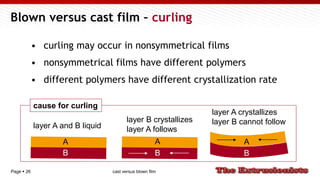
Blown versus cast film – curling
• curling may occur in nonsymmetrical films
• nonsymmetrical films have different polymers
• different polymers have different crystallization rate
A
layer A and B liquid
B
layer B crystallizes
layer A follows
A
B
layer A crystallizes
layer B cannot follow
B
A
cause for curling
cast versus blown film
Page  27
Blown versus cast film – orientation
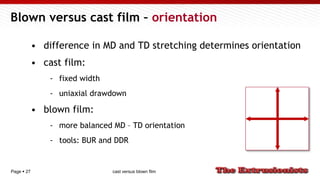
• difference in MD and TD stretching determines orientation
• cast film:
- fixed width
- uniaxial drawdown
• blown film:
- more balanced MD – TD orientation
- tools: BUR and DDR
cast versus blown film
Page  28
Blown versus cast film – process flexibility
• cast film:
- die has fixed width
- neck-in
- side trim
• blown film:
- adjustable bubble size
cast versus blown film
Page  29
Blown versus cast film – gauge uniformity
• cast film:
- ± 2 % independent on film thickness
• blown film:
- ± 10 % for thin films (< 20 µm)
- ± 5 % for thicker films (> 20 µm)
cast versus blown film
Page  30
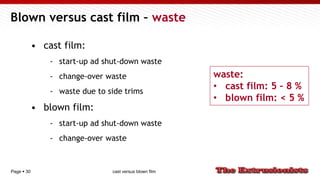
Blown versus cast film – waste
• cast film:
- start-up ad shut-down waste
- change-over waste
- waste due to side trims
• blown film:
- start-up ad shut-down waste
- change-over waste
waste:
• cast film: 5 – 8 %
• blown film: < 5 %
cast versus blown film
Page  31
Blown versus cast film – costs
• cast film:
- floor space needed
- higher investment costs
• blown film:
- height needed
- lower investment cost
cast film requires higher
investment than blown film
cast versus blown film
Page  32
Blown versus cast film – PA6 versus PA6.66
• cast film:
- only PA6 is used
• blown film:
- PA6.66 used more than PA6
- PA6.66 more transparent than PA6
- PA6.66 shows less curling than PA6
- PA6 blended with PA6I/6T
cast film: PA6
blown film: PA6.66
cast versus blown film
Page  33
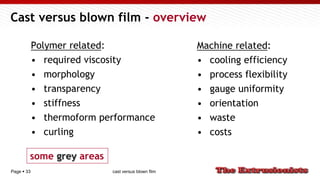
Cast versus blown film - overview
Polymer related:
• required viscosity
• morphology
• transparency
• stiffness
• thermoform performance
• curling
Machine related:
• cooling efficiency
• process flexibility
• gauge uniformity
• orientation
• waste
• costs
some grey areas
cast versus blown film
Page  34
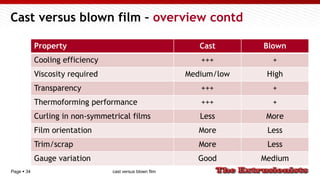
Cast versus blown film – overview contd
Property Cast Blown
Cooling efficiency +++ +
Viscosity required Medium/low High
Transparency +++ +
Thermoforming performance +++ +
Curling in non-symmetrical films Less More
Film orientation More Less
Trim/scrap More Less
Gauge variation Good Medium
cast versus blown film
Page  35
Cast versus blown film - summary
• process:
- cast film: higher output
- cast film: better gauge control
- blown film: less floor space and investment
• films:
- morphology difference
 film crystallinity
 crystal size
- optical properties
- thermoforming
due to cooling rate
cast versus blown film
Page  36
More information and contact
Ted Brink
Email: ted.brink@extrusionist.com
Internet: www.extrusionist.com
Tel.: +31 651109899
Skype: ted.brink
cast versus blown film

Cast versus blown film

  • 1.
    Cast versus blownfilm Ted Brink polyamide-based
  • 2.
    Page  2 Contents •film requirements • polyamide characteristics • blown versus cast film technology • conclusions cast versus blown film
  • 3.
    Page  3 Mainapplications PA-based films cast versus blown film
  • 4.
    Page  4 Foodpackaging - film requirements • oxygen barrier • moisture barrier • grease and fat resistant • shrink performance • puncture resistance • sealability • printability • transparency cast versus blown film
  • 5.
    Page  5 Mainreasons to use polyamide O2 mechanical strength barrier properties cast versus blown film
  • 6.
    Page  6 Polyamideproperties PA-type Melting point [°C] H2O permeability [cc/m2/atm/day] O2 permeability [cc/m2/atm/day] PA66 255 8 12 PA6 220 15 12 PA6.12 215 5 45 PA6.66 195 16 14 PA11 190 4 120 PA12 180 5 190 cast versus blown film
  • 7.
    Page  7 filmproduction cast versus blown film
  • 8.
    Page  8 Inspite of significant differences, both technologies are used for similar applications blown cast cast versus blown film
  • 9.
    Page  9 castfilm cast versus blown film
  • 10.
    Page  10 1.Plasticising unit 2. Die 3. Casting station 4. Winder 5. Automation system Cast film line cast versus blown film
  • 11.
    Page  11 Castfilm basics cast versus blown film
  • 12.
    Page  12 Chillroll cooling • efficient cooling - temperature controlled water or oil • chill roll surface structure - high gloss or embossed - influences quenching rate and film surface cast versus blown film
  • 13.
    Page  13 Chillroll temperature • 20 – 40 °C for optimum thermoforming • > 80 °C for optimum dimensional stability • uniform temperature gradient across the roll - prevent morphological differences cast versus blown film
  • 14.
    Page  14 blownfilm cast versus blown film
  • 15.
    Page  15cast versus blown film
  • 16.
    Page  16 Bubblecooling • cooling medium: air • cooling technologies - external bubble cooling - internal bubble cooling • cooling influences: - output - film morphology ambient air or chilled air cast versus blown film
  • 17.
    Page  17 Externalbubble cooling cooling from the outside • commonly ambient air cast versus blown film
  • 18.
    Page  18 Internalbubble cooling (IBC) IBC cools the bubble from the inside • cool air injected (5 – 15 °C) • warm air removed (± 75 °C) • increased output cast versus blown film
  • 19.
    Page  19 cast↔ blown cast versus blown film
  • 20.
    Page  20 Blownversus cast film – polymer viscosity • blown film: - requires melt strength → high viscosity • cast film: - less critical → medium to even low viscosity cast versus blown film
  • 21.
    Page  21 Blownversus cast film – cooling efficiency • cooling medium blown film: air - air not very efficient cooling medium - outer bubble cooling - inner bubble cooling • cooling medium cast film: chill roll - cooling by water or oil - chill roll temperature between 25 and 125 °C cooling efficiency determines output cast versus blown film
  • 22.
    Page  22 Blownversus cast film – film morphology • cooling rate determines morphology - slow cooling → large crystals - fast cooling → smaller crystals (crystals frozen-in) - high quenching rate → film remains (almost) amorphous cast versus blown film
  • 23.
    Page  23 Blownversus cast film – film transparency • transparency related to morphology - slow cooling → large crystals → more haze - fast cooling → crystals less time to grow → higher transparency - very fast cooling → low crystallinity → highest transparency films with low crystallinity may show postcrystallization cast versus blown film
  • 24.
    Page  24 Blownversus cast film – film stiffness • stiffness related to morphology - slow cooling → higher crystallinity → higher stiffness - fast cooling → low crystallinity → lower stiffness films with low crystallinity may show postcrystallization cast versus blown film
  • 25.
    Page  25 Blownversus cast film – thermoforming • cast films perform better than blown films - lower crystallinity → easier drawing at lower stress film morphology determines thermoforming cast versus blown film
  • 26.
    Page  26 Blownversus cast film – curling • curling may occur in nonsymmetrical films • nonsymmetrical films have different polymers • different polymers have different crystallization rate A layer A and B liquid B layer B crystallizes layer A follows A B layer A crystallizes layer B cannot follow B A cause for curling cast versus blown film
  • 27.
    Page  27 Blownversus cast film – orientation • difference in MD and TD stretching determines orientation • cast film: - fixed width - uniaxial drawdown • blown film: - more balanced MD – TD orientation - tools: BUR and DDR cast versus blown film
  • 28.
    Page  28 Blownversus cast film – process flexibility • cast film: - die has fixed width - neck-in - side trim • blown film: - adjustable bubble size cast versus blown film
  • 29.
    Page  29 Blownversus cast film – gauge uniformity • cast film: - ± 2 % independent on film thickness • blown film: - ± 10 % for thin films (< 20 µm) - ± 5 % for thicker films (> 20 µm) cast versus blown film
  • 30.
    Page  30 Blownversus cast film – waste • cast film: - start-up ad shut-down waste - change-over waste - waste due to side trims • blown film: - start-up ad shut-down waste - change-over waste waste: • cast film: 5 – 8 % • blown film: < 5 % cast versus blown film
  • 31.
    Page  31 Blownversus cast film – costs • cast film: - floor space needed - higher investment costs • blown film: - height needed - lower investment cost cast film requires higher investment than blown film cast versus blown film
  • 32.
    Page  32 Blownversus cast film – PA6 versus PA6.66 • cast film: - only PA6 is used • blown film: - PA6.66 used more than PA6 - PA6.66 more transparent than PA6 - PA6.66 shows less curling than PA6 - PA6 blended with PA6I/6T cast film: PA6 blown film: PA6.66 cast versus blown film
  • 33.
    Page  33 Castversus blown film - overview Polymer related: • required viscosity • morphology • transparency • stiffness • thermoform performance • curling Machine related: • cooling efficiency • process flexibility • gauge uniformity • orientation • waste • costs some grey areas cast versus blown film
  • 34.
    Page  34 Castversus blown film – overview contd Property Cast Blown Cooling efficiency +++ + Viscosity required Medium/low High Transparency +++ + Thermoforming performance +++ + Curling in non-symmetrical films Less More Film orientation More Less Trim/scrap More Less Gauge variation Good Medium cast versus blown film
  • 35.
    Page  35 Castversus blown film - summary • process: - cast film: higher output - cast film: better gauge control - blown film: less floor space and investment • films: - morphology difference  film crystallinity  crystal size - optical properties - thermoforming due to cooling rate cast versus blown film
  • 36.
    Page  36 Moreinformation and contact Ted Brink Email: ted.brink@extrusionist.com Internet: www.extrusionist.com Tel.: +31 651109899 Skype: ted.brink cast versus blown film

Editor's Notes