Major Techniques of Planned Change…


       © Ramakrishna Kongalla,
           Assistant Professor


                R'tist @ Tourism
• These are behavioral science techniques designed to
  plan and implement change in work settings.
• The major techniques of organizational development
  attempt to produce some kind of change in individual
  employees, work groups, and/or the entire
  organization.
• These change techniques can be divided into two
  categories:
  – Process; and
  – Structural


                       R'tist @ Tourism
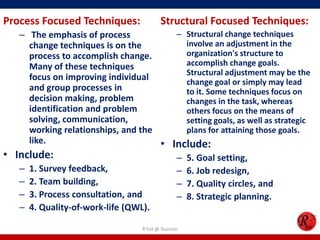
Process Focused Techniques:               Structural Focused Techniques:
   – The emphasis of process           – Structural change techniques
     change techniques is on the         involve an adjustment in the
     process to accomplish change.       organization's structure to
     Many of these techniques            accomplish change goals.
                                         Structural adjustment may be the
     focus on improving individual       change goal or simply may lead
     and group processes in              to it. Some techniques focus on
     decision making, problem            changes in the task, whereas
     identification and problem          others focus on the means of
     solving, communication,             setting goals, as well as strategic
     working relationships, and the      plans for attaining those goals.
     like.                          • Include:
• Include:                             – 5. Goal setting,
   – 1. Survey feedback,               – 6. Job redesign,
   – 2. Team building,                 – 7. Quality circles, and
   – 3. Process consultation, and      – 8. Strategic planning.
   – 4. Quality-of-work-life (QWL).

                                  R'tist @ Tourism
Survey Feedback
• Three basic steps are employed in survey feedback (Conlon & Short,
  1984).
   – First, a questionnaire is typically completed by all members of a work
     group or whole organization. It asks organization members for their
     perceptions and attitudes on a broad range of topics such as decision-
     making practices, communication effectiveness, coordination between
     units, job satisfaction, and the like. The leader of a work group or total
     organization receives a summary of the tabulated results from the survey.
     In some cases, a consultant (an internal or external change agent) meets
     with the leader to discuss the results.
   – In the second step, data are fed back to the organization members, usually
     during group meetings. The OD consultant, internal or external, often
     attends the meeting to explain any technical aspects of the data.
   – Finally, in the third step, specific plans for dealing with the problems
     identified by the survey are developed. Again, this usually takes place in
     group sessions where open discussion is encouraged.
                                  R'tist @ Tourism
• Survey feedback functions both as a change strategy and
  as a diagnostic process. Because of its value in
  organizational diagnosis, survey feedback is frequently
  used as part of large-scale, long-term change programs in
  conjunction with other strategies and techniques.
• It can be used to improve groups and teams, inter-group
  relations, and system-wide activities. The survey feedback
  technique is powerful because it provides organization
  members at all levels of the firm on results for their units
  and engages them in constructive discussions with their
  manager for making improvements.


                           R'tist @ Tourism
Team Building
• Organizations of all kinds are made up of people working together to
  achieve some common goal.
• Because people are frequently required to work in groups,
  considerable attention has been focused on team building in recent
  years (Dyer, 2008).
• Improving the team means better performance by the individuals and
  the group.
• Team building is a process of diagnosing and improving the
  effectiveness of group members with particular attention to
  performance and collaboration within the group, especially the role of
  the leader in relation to other group members (Cavanagh, 2011).
• Team-building strategies are typically directed toward goal setting,
  development of interpersonal relations, role analysis, and team
  process analysis (Kayser, 2012).

                                R'tist @ Tourism
• Team building may begin by having organization members
  define the goals of the work group or firm.
• Different perceptions of what the organization's purpose is may
  surface.
• Following this, group members can evaluate the organization's
  performance—how effectively they are achieving their goals.
• This may identify potential problem areas.
• Next, each team member's role can be identified and clarified.
• Previous ambiguities may be brought to the surface. And,
• finally, key processes that go on within the team are analyzed to
  identify how these processes might be improved, resulting in
  greater team effectiveness.
• This latter activity is similar to process consultation.

                             R'tist @ Tourism
Process Consultation
• A variation of the team building technique is process
  consultation. In process consultation, often an outside
  consultant helps the manager perceive, understand, and act
  on process events that occur in his or her work environment
  (Schein, 1999).
• These might include work flow, informal relationships
  among organization members, and formal communication
  channels.
• The consultant gives the manager insight into what is going
  on around him, within him, and between him and other
  people.
• The consultant is not there to solve the manager's problems.
• Instead, the consultant provides guidance to help the
  manager diagnose what processes need to be improved.
                            R'tist @ Tourism
• Process consultation usually addresses one or more of the
  following areas of concern: communication, leadership,
  decision making and problem solving, group norms and roles,
  and conflict resolution.
• Typical activities include gathering data about some
  organizational or group process, sharing this information with
  the group members involved, and planning actions designed to
  improve the process.
• Ideally, the work group intervention would be a combination of
  a team-building session followed by periodic process
  consultation to reinforce the improved work environment.


                           R'tist @ Tourism
Quality of Work Life
• In recent years, there has been a growing recognition of the importance
  of simultaneously improving both the value of employees’ psychological
  experiences at work and workers’ productivity.
• This philosophy is embodied in the quality-of-work-life (QWL) approach
  to change.
• Such programs are typically broad-based and lack the precise definition
  and focus of survey feedback and team building.
• Quality of work life can be defined as any activity undertaken by a work
  group or whole organization for the express purpose of improving one or
  more of the following conditions that affect a group member's
  experience with a work group or organization: adequate and fair
  compensation; safe and healthy working conditions; opportunity to use
  and develop personal capabilities; opportunity to grow and progress in a
  career; opportunity to participate in decisions; protection from arbitrary
  and unfair treatment; and opportunity to satisfy social needs (Pasmore,
  1985, 2011).


                                  R'tist @ Tourism
• Successful QWL programs are being used in such
  organizations as GM, Ford, Chrysler, AT&T, Motorola,
  IBM, Texas Instruments, Xerox, GE, and many other
  companies.
• Quality-of-work-life programs often encompass a
  wide variety of specific techniques such as team
  building, job restructuring, shared decision making,
  redesign of pay systems, Theory Z, and quality circles.
  Implementation of these techniques is expected to
  translate into improved worker performance.


                         R'tist @ Tourism
Goal Setting
• One of the major problems confronting large organizations is a lack
  of identification by the individual organization member with the
  goals of the organization.
• With specialization so highly developed in organizations, many
  group members are very much divorced from the direction and
  purpose of the larger system.
• Goal setting is a method of coordinating individual employees’
  efforts toward overall organization goals (Locke & Latham, 2012).
• Getting employees to work toward organization goals is not just a
  matter of informing them what the goals are.
• Rather, organization members' support for organization-wide goals
  is increased if they participate in the goal-setting process.
• When goal setting is a mutual management-follower influence
  process, group members are given some control over their work
  environment (Eikenberry, 2011; Senge, 2009).
                              R'tist @ Tourism
• A goal-setting program is organization-wide, in which a
  better fit between individual and organization goals is
  achieved.
• Top leaders (CEOs) set their operating goals, followed by
  meetings with the second level of administrators
  (managers) during which their goals are mutually set.
• These managers then meet with their department heads
  to help set their goals, and so on down the hierarchy to
  the lowest level in the organization.
• In this way, every level is linked with every other level.
• Short-run goals mesh with long-run goals; broad
  organization goals mesh with management goals, which
  in turn mesh with department and shop-floor objectives.
• This approach increases the chances that the
  organization will work as a coordinated unit, even in the
  face of change (Rothwell, 2010).
                          R'tist @ Tourism
Job Redesign
• The redesign of jobs has received increasing emphasis as
  a change strategy (Anderson, 2011).
• Job redesign can be defined as a deliberate, planned
  restructuring of the way tasks are performed with the
  purpose of improving performance.
• Job redesign includes a whole host of specific
  organizational change techniques, such as job
  enrichment, specialization, job engineering, job rotation,
  job enlargement, and autonomous task groups (Griffin &
  Woodman, 1985).
• These techniques are most successful when employed as
  a comprehensive organization change program that
  examines the fit among the task, technology, structure,
  and people within the organization (Senge, 2006).

                          R'tist @ Tourism
• Boredom on the job experienced by blue-collar workers in
  industry precipitated much of the emphasis on job redesign.
• However, repetitive tasks affect all kinds of employees from
  mass-production systems to management.
• Once workers' lower-level needs are satisfied, experienced
  employees begin to expect more out of their jobs.
• They want them to be more challenging, expressive, and
  fulfilling.
• Job redesign techniques are attempts to add variety and
  challenge to jobs—bringing them more in line with staff
  expectations. In effect, increasing employees' involvement in
  decision making is an example of job redesign (Chelst, 2012).
• In many cases, these improvements should lead to increased
  motivation, work performance, and organization learning
  (Herzberg, 2009).

                           R'tist @ Tourism
Quality Circles
• Widely used by Japanese firms, quality circles became
  popular in the United States in the 1980s (Katzan, 1989,
  McHugh & Dale, 1989).
• Like survey feedback, quality circles are designed to
  stimulate an upward communications flow, from first-line
  group members to managers and ultimately CEOs.
• Quality circles also fit well into comprehensive QWL
  programs. Companies such as Hewlett-Packard, General
  Electric, Xerox, Proctor & Gamble, IBM, Westinghouse,
  Eastman Kodak, Motorola, and American Airlines have
  used quality circles.
• Groups have dealt with issues such as how to reduce
  vandalism, how to create safer and more comfortable
  work environments, and how to improve product quality.

                         R'tist @ Tourism
• A quality circle is a voluntary group of five to ten
  members, typically from similar jobs or the same work
  group, who meet periodically to identify and solve work-
  related problems.
• Each quality circle usually has an appointed group leader,
  and members are trained in techniques of problem
  solving and group process by a facilitator, who may be an
  internal or external change consultant.
• Groups focus on departmental and organizational goals
  and submit proposals for change to management.
• Recently, managers have acted as facilitators of quality
  circles (Centre for Creative Leadership, 2011).
• A steering committee, consisting of people from all levels
  and areas of the organization, typically review proposals,
  accept or reject them, and allocate resources for
  implementation.
                          R'tist @ Tourism
Strategic Planning
• The process of strategic planning typically follows seven
  steps (Wootton, 2011).
• Although these steps are not always followed in the
  exact order specified, they do resemble the way most
  organizations go about planning strategically (Goodstein,
  2011).
   – Develop a mission.
      • A strategic plan must begin with a stated goal. Typically, goals involve
        a company’s outcomes (e.g., increased sales, product quality) and/or
        to improve its organizational culture (e.g., to make the work
        environment more pleasant). It is important to note that a company’s
        overall goals must be translated into corresponding goals to be
        achieved by various organizational units. In large firms, this would
        include the Sales Department, Marketing Department, Production
        Department, Advertising Department, Research and Development
        Department, and the like.
                                 R'tist @ Tourism
– Conduct a critical analysis of the internal environment.
   • By “internal environment,” we are referring to the nature of
     the organization itself, as identified by certain characteristics
     including the organization’s structure, culture, employee
     motivation,     leadership,    decision    making     practices,
     communication patterns, and receptivity to change, to name a
     few. For example, does the organizational structure stimulate
     or inhibit goal achievement? Does the culture of the company
     (or individual work units) encourage personnel to be innovative
     and to make positive changes, or does it encourage
     organization members to maintain the status quo? Are
     organization members motivated sufficiently to strive for the
     realization of organizational goals? Is there adequate and
     effective leadership to move the organization forward? Do
     decision making practices encourage goal accomplishment? Do
     people communicate with each other clearly enough to
     accomplish their goals? Are organization members willing to
     change in order to improve the organization’s performance?
                            R'tist @ Tourism
– Conduct a critical analysis of the external
  environment.
   • Organizations do not operate in a vacuum. Rather, they
     function within external environments that influence
     their capacity to function and grow as desired. The extent
     to which the environment either aids or hinders a
     company’s growth (or even its continued existence)
     depends on several key factors.
   • Specifically, a company has a competitive edge over
     others when
      – (a) there is a continued supply of resources to sustain
        production,
      – (b) resources cannot be easily duplicated by others, and
      – a(c) competitors do not have resources that are any better.

                          R'tist @ Tourism
– Prepare planning assumptions.
  • To clearly understand the nature of your strategic plan, it
    is important to highlight the assumptions underlying the
    plan:
     – (a) Is the planning process based on deliberate analyses and data
       or based on intuition and informal knowledge?
     – (b) Is the strategic plan based on the assumption that radical
       change is not only possible, but desirable; or instead, will the plan
       involve only minor incremental adjustments to the current ways
       of operating?
     – (c) The strategic plan will be made primarily in the interest of
       which stakeholder groups (stockholders, employees, clients,
       community)?
     – Furthermore, what resources does the company have available to
       plan and implement its strategy? The resources include financial,
       physical, and human resources. The assumptions underlying the
       strategic planning process are important to the ultimate success
       of the strategic plan.

                             R'tist @ Tourism
– Develop a strategy.
   • A strategy is the means by which a company
     achieves its goal.
   • Based on a careful assessment of the
     organization’s position on the aforementioned
     factors or characteristics (e.g., the company’s
     organizational structure, its culture, motivation of
     its members, leadership, decision making
     strategies, communications, inclination toward
     change, and available resources), a decision is
     made about how to go about achieving its goal.


                       R'tist @ Tourism
– Communicate the strategy.
  • The strategy must be communicated to stakeholders –
    individuals or groups in whose interest the organization is
    run.
  • These are individuals who have a stake in the organization.
  • The most important stakeholders include stockholders,
    employees, clients, and community members.
  • It is essential to communicate a company’s strategic plan
    to stakeholders very clearly, so they can contribute to its
    success, either directly (e.g., organization members who
    help achieve goals) or indirectly (e.g., stockholders, board
    of directors who set policy).
  • Unless stakeholders fully understand and accept a
    company’s strategic plan, it is unlikely to receive the full
    support it needs to meet its goals.
                         R'tist @ Tourism
– Develop evaluation procedures.
      – Evaluation procedures need to be developed prior to Evaluating
        the Results. These procedures will serve to guide the
        implementation of the strategy and evaluation of the outcome.
– Implement the strategy.
   • Once a strategy has been developed and communicated,
     the strategy is implemented. When this occurs, there may
     be some resistance. People tend to resist change. The
     company’s leaders need to apply various techniques to
     overcome resistance to change.
– Evaluate the results.
   • Finally, after a strategy has been implemented, it is
     important to determine if the goals have been achieved. If
     so, then new goals are developed. If not, then different
     goals may be defined, or different strategies for
     accomplishing the goals may be attempted.
                           R'tist @ Tourism
Thank You…!!!
©Ramakrishna Kongalla
e-mail: artist.ramakrishna@gmail.com


              R'tist @ Tourism

Techniques of Planned Change

  • 1.
    Major Techniques ofPlanned Change… © Ramakrishna Kongalla, Assistant Professor R'tist @ Tourism
  • 2.
    • These arebehavioral science techniques designed to plan and implement change in work settings. • The major techniques of organizational development attempt to produce some kind of change in individual employees, work groups, and/or the entire organization. • These change techniques can be divided into two categories: – Process; and – Structural R'tist @ Tourism
  • 3.
    Process Focused Techniques: Structural Focused Techniques: – The emphasis of process – Structural change techniques change techniques is on the involve an adjustment in the process to accomplish change. organization's structure to Many of these techniques accomplish change goals. Structural adjustment may be the focus on improving individual change goal or simply may lead and group processes in to it. Some techniques focus on decision making, problem changes in the task, whereas identification and problem others focus on the means of solving, communication, setting goals, as well as strategic working relationships, and the plans for attaining those goals. like. • Include: • Include: – 5. Goal setting, – 1. Survey feedback, – 6. Job redesign, – 2. Team building, – 7. Quality circles, and – 3. Process consultation, and – 8. Strategic planning. – 4. Quality-of-work-life (QWL). R'tist @ Tourism
  • 4.
    Survey Feedback • Threebasic steps are employed in survey feedback (Conlon & Short, 1984). – First, a questionnaire is typically completed by all members of a work group or whole organization. It asks organization members for their perceptions and attitudes on a broad range of topics such as decision- making practices, communication effectiveness, coordination between units, job satisfaction, and the like. The leader of a work group or total organization receives a summary of the tabulated results from the survey. In some cases, a consultant (an internal or external change agent) meets with the leader to discuss the results. – In the second step, data are fed back to the organization members, usually during group meetings. The OD consultant, internal or external, often attends the meeting to explain any technical aspects of the data. – Finally, in the third step, specific plans for dealing with the problems identified by the survey are developed. Again, this usually takes place in group sessions where open discussion is encouraged. R'tist @ Tourism
  • 5.
    • Survey feedbackfunctions both as a change strategy and as a diagnostic process. Because of its value in organizational diagnosis, survey feedback is frequently used as part of large-scale, long-term change programs in conjunction with other strategies and techniques. • It can be used to improve groups and teams, inter-group relations, and system-wide activities. The survey feedback technique is powerful because it provides organization members at all levels of the firm on results for their units and engages them in constructive discussions with their manager for making improvements. R'tist @ Tourism
  • 6.
    Team Building • Organizationsof all kinds are made up of people working together to achieve some common goal. • Because people are frequently required to work in groups, considerable attention has been focused on team building in recent years (Dyer, 2008). • Improving the team means better performance by the individuals and the group. • Team building is a process of diagnosing and improving the effectiveness of group members with particular attention to performance and collaboration within the group, especially the role of the leader in relation to other group members (Cavanagh, 2011). • Team-building strategies are typically directed toward goal setting, development of interpersonal relations, role analysis, and team process analysis (Kayser, 2012). R'tist @ Tourism
  • 7.
    • Team buildingmay begin by having organization members define the goals of the work group or firm. • Different perceptions of what the organization's purpose is may surface. • Following this, group members can evaluate the organization's performance—how effectively they are achieving their goals. • This may identify potential problem areas. • Next, each team member's role can be identified and clarified. • Previous ambiguities may be brought to the surface. And, • finally, key processes that go on within the team are analyzed to identify how these processes might be improved, resulting in greater team effectiveness. • This latter activity is similar to process consultation. R'tist @ Tourism
  • 8.
    Process Consultation • Avariation of the team building technique is process consultation. In process consultation, often an outside consultant helps the manager perceive, understand, and act on process events that occur in his or her work environment (Schein, 1999). • These might include work flow, informal relationships among organization members, and formal communication channels. • The consultant gives the manager insight into what is going on around him, within him, and between him and other people. • The consultant is not there to solve the manager's problems. • Instead, the consultant provides guidance to help the manager diagnose what processes need to be improved. R'tist @ Tourism
  • 9.
    • Process consultationusually addresses one or more of the following areas of concern: communication, leadership, decision making and problem solving, group norms and roles, and conflict resolution. • Typical activities include gathering data about some organizational or group process, sharing this information with the group members involved, and planning actions designed to improve the process. • Ideally, the work group intervention would be a combination of a team-building session followed by periodic process consultation to reinforce the improved work environment. R'tist @ Tourism
  • 10.
    Quality of WorkLife • In recent years, there has been a growing recognition of the importance of simultaneously improving both the value of employees’ psychological experiences at work and workers’ productivity. • This philosophy is embodied in the quality-of-work-life (QWL) approach to change. • Such programs are typically broad-based and lack the precise definition and focus of survey feedback and team building. • Quality of work life can be defined as any activity undertaken by a work group or whole organization for the express purpose of improving one or more of the following conditions that affect a group member's experience with a work group or organization: adequate and fair compensation; safe and healthy working conditions; opportunity to use and develop personal capabilities; opportunity to grow and progress in a career; opportunity to participate in decisions; protection from arbitrary and unfair treatment; and opportunity to satisfy social needs (Pasmore, 1985, 2011). R'tist @ Tourism
  • 11.
    • Successful QWLprograms are being used in such organizations as GM, Ford, Chrysler, AT&T, Motorola, IBM, Texas Instruments, Xerox, GE, and many other companies. • Quality-of-work-life programs often encompass a wide variety of specific techniques such as team building, job restructuring, shared decision making, redesign of pay systems, Theory Z, and quality circles. Implementation of these techniques is expected to translate into improved worker performance. R'tist @ Tourism
  • 12.
    Goal Setting • Oneof the major problems confronting large organizations is a lack of identification by the individual organization member with the goals of the organization. • With specialization so highly developed in organizations, many group members are very much divorced from the direction and purpose of the larger system. • Goal setting is a method of coordinating individual employees’ efforts toward overall organization goals (Locke & Latham, 2012). • Getting employees to work toward organization goals is not just a matter of informing them what the goals are. • Rather, organization members' support for organization-wide goals is increased if they participate in the goal-setting process. • When goal setting is a mutual management-follower influence process, group members are given some control over their work environment (Eikenberry, 2011; Senge, 2009). R'tist @ Tourism
  • 13.
    • A goal-settingprogram is organization-wide, in which a better fit between individual and organization goals is achieved. • Top leaders (CEOs) set their operating goals, followed by meetings with the second level of administrators (managers) during which their goals are mutually set. • These managers then meet with their department heads to help set their goals, and so on down the hierarchy to the lowest level in the organization. • In this way, every level is linked with every other level. • Short-run goals mesh with long-run goals; broad organization goals mesh with management goals, which in turn mesh with department and shop-floor objectives. • This approach increases the chances that the organization will work as a coordinated unit, even in the face of change (Rothwell, 2010). R'tist @ Tourism
  • 14.
    Job Redesign • Theredesign of jobs has received increasing emphasis as a change strategy (Anderson, 2011). • Job redesign can be defined as a deliberate, planned restructuring of the way tasks are performed with the purpose of improving performance. • Job redesign includes a whole host of specific organizational change techniques, such as job enrichment, specialization, job engineering, job rotation, job enlargement, and autonomous task groups (Griffin & Woodman, 1985). • These techniques are most successful when employed as a comprehensive organization change program that examines the fit among the task, technology, structure, and people within the organization (Senge, 2006). R'tist @ Tourism
  • 15.
    • Boredom onthe job experienced by blue-collar workers in industry precipitated much of the emphasis on job redesign. • However, repetitive tasks affect all kinds of employees from mass-production systems to management. • Once workers' lower-level needs are satisfied, experienced employees begin to expect more out of their jobs. • They want them to be more challenging, expressive, and fulfilling. • Job redesign techniques are attempts to add variety and challenge to jobs—bringing them more in line with staff expectations. In effect, increasing employees' involvement in decision making is an example of job redesign (Chelst, 2012). • In many cases, these improvements should lead to increased motivation, work performance, and organization learning (Herzberg, 2009). R'tist @ Tourism
  • 16.
    Quality Circles • Widelyused by Japanese firms, quality circles became popular in the United States in the 1980s (Katzan, 1989, McHugh & Dale, 1989). • Like survey feedback, quality circles are designed to stimulate an upward communications flow, from first-line group members to managers and ultimately CEOs. • Quality circles also fit well into comprehensive QWL programs. Companies such as Hewlett-Packard, General Electric, Xerox, Proctor & Gamble, IBM, Westinghouse, Eastman Kodak, Motorola, and American Airlines have used quality circles. • Groups have dealt with issues such as how to reduce vandalism, how to create safer and more comfortable work environments, and how to improve product quality. R'tist @ Tourism
  • 17.
    • A qualitycircle is a voluntary group of five to ten members, typically from similar jobs or the same work group, who meet periodically to identify and solve work- related problems. • Each quality circle usually has an appointed group leader, and members are trained in techniques of problem solving and group process by a facilitator, who may be an internal or external change consultant. • Groups focus on departmental and organizational goals and submit proposals for change to management. • Recently, managers have acted as facilitators of quality circles (Centre for Creative Leadership, 2011). • A steering committee, consisting of people from all levels and areas of the organization, typically review proposals, accept or reject them, and allocate resources for implementation. R'tist @ Tourism
  • 18.
    Strategic Planning • Theprocess of strategic planning typically follows seven steps (Wootton, 2011). • Although these steps are not always followed in the exact order specified, they do resemble the way most organizations go about planning strategically (Goodstein, 2011). – Develop a mission. • A strategic plan must begin with a stated goal. Typically, goals involve a company’s outcomes (e.g., increased sales, product quality) and/or to improve its organizational culture (e.g., to make the work environment more pleasant). It is important to note that a company’s overall goals must be translated into corresponding goals to be achieved by various organizational units. In large firms, this would include the Sales Department, Marketing Department, Production Department, Advertising Department, Research and Development Department, and the like. R'tist @ Tourism
  • 19.
    – Conduct acritical analysis of the internal environment. • By “internal environment,” we are referring to the nature of the organization itself, as identified by certain characteristics including the organization’s structure, culture, employee motivation, leadership, decision making practices, communication patterns, and receptivity to change, to name a few. For example, does the organizational structure stimulate or inhibit goal achievement? Does the culture of the company (or individual work units) encourage personnel to be innovative and to make positive changes, or does it encourage organization members to maintain the status quo? Are organization members motivated sufficiently to strive for the realization of organizational goals? Is there adequate and effective leadership to move the organization forward? Do decision making practices encourage goal accomplishment? Do people communicate with each other clearly enough to accomplish their goals? Are organization members willing to change in order to improve the organization’s performance? R'tist @ Tourism
  • 20.
    – Conduct acritical analysis of the external environment. • Organizations do not operate in a vacuum. Rather, they function within external environments that influence their capacity to function and grow as desired. The extent to which the environment either aids or hinders a company’s growth (or even its continued existence) depends on several key factors. • Specifically, a company has a competitive edge over others when – (a) there is a continued supply of resources to sustain production, – (b) resources cannot be easily duplicated by others, and – a(c) competitors do not have resources that are any better. R'tist @ Tourism
  • 21.
    – Prepare planningassumptions. • To clearly understand the nature of your strategic plan, it is important to highlight the assumptions underlying the plan: – (a) Is the planning process based on deliberate analyses and data or based on intuition and informal knowledge? – (b) Is the strategic plan based on the assumption that radical change is not only possible, but desirable; or instead, will the plan involve only minor incremental adjustments to the current ways of operating? – (c) The strategic plan will be made primarily in the interest of which stakeholder groups (stockholders, employees, clients, community)? – Furthermore, what resources does the company have available to plan and implement its strategy? The resources include financial, physical, and human resources. The assumptions underlying the strategic planning process are important to the ultimate success of the strategic plan. R'tist @ Tourism
  • 22.
    – Develop astrategy. • A strategy is the means by which a company achieves its goal. • Based on a careful assessment of the organization’s position on the aforementioned factors or characteristics (e.g., the company’s organizational structure, its culture, motivation of its members, leadership, decision making strategies, communications, inclination toward change, and available resources), a decision is made about how to go about achieving its goal. R'tist @ Tourism
  • 23.
    – Communicate thestrategy. • The strategy must be communicated to stakeholders – individuals or groups in whose interest the organization is run. • These are individuals who have a stake in the organization. • The most important stakeholders include stockholders, employees, clients, and community members. • It is essential to communicate a company’s strategic plan to stakeholders very clearly, so they can contribute to its success, either directly (e.g., organization members who help achieve goals) or indirectly (e.g., stockholders, board of directors who set policy). • Unless stakeholders fully understand and accept a company’s strategic plan, it is unlikely to receive the full support it needs to meet its goals. R'tist @ Tourism
  • 24.
    – Develop evaluationprocedures. – Evaluation procedures need to be developed prior to Evaluating the Results. These procedures will serve to guide the implementation of the strategy and evaluation of the outcome. – Implement the strategy. • Once a strategy has been developed and communicated, the strategy is implemented. When this occurs, there may be some resistance. People tend to resist change. The company’s leaders need to apply various techniques to overcome resistance to change. – Evaluate the results. • Finally, after a strategy has been implemented, it is important to determine if the goals have been achieved. If so, then new goals are developed. If not, then different goals may be defined, or different strategies for accomplishing the goals may be attempted. R'tist @ Tourism
  • 25.
    Thank You…!!! ©Ramakrishna Kongalla e-mail:artist.ramakrishna@gmail.com R'tist @ Tourism