14-1
Organizational Change

 Organizational change is the process by which
organization move from their present state to some
desired future state to increase effectiveness.

 When an organization system is disturbed by some
internal or external forces change frequently occur or any
alteration which occur in the overall work environment of
an organization.


                                                             14-2
CHARACTERSTICS OF O.C.
 Change happen for the pressure of both internal and
    external forces in the organization.
   Change in any part of the organization affect the whole
    organization.
   Change may affect people , structure, technology, and
    other element of the organization.
   Change also affect the rate of speed and degree of
    significance of the organization.
   Change may be reactive or proactive.


                                                          14-3
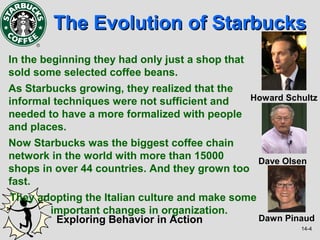
The Evolution of Starbucks
In the beginning they had only just a shop that
sold some selected coffee beans.
As Starbucks growing, they realized that the
informal techniques were not sufficient and  Howard Schultz
needed to have a more formalized with people
and places.
Now Starbucks was the biggest coffee chain
network in the world with more than 15000      Dave Olsen
shops in over 44 countries. And they grown too
fast.
They adopting the Italian culture and make some
       important changes in organization.
        Exploring Behavior in Action            Dawn Pinaud
                                                        14-4
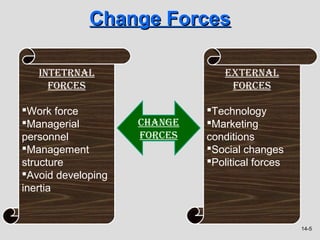
Change Forces

   INTETRNAL                     ExTERNAL
     FORCES                       FORCES

Work force                  Technology
Managerial         ChANgE   Marketing
personnel           FORCES   conditions
Management                  Social changes
structure                    Political forces
Avoid developing
inertia


                                                 14-5
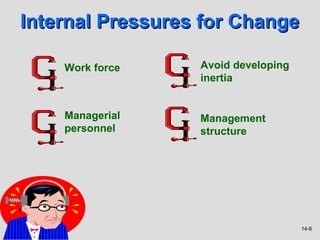
Internal Pressures for Change

    Work force    Avoid developing
                  inertia


    Managerial    Management
    personnel     structure


                                     14-6
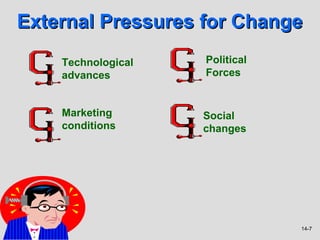
External Pressures for Change
    Technological   Political
    advances        Forces


    Marketing       Social
    conditions      changes


                                14-7
Companies’ Responses
Managerial
              to Pressures for “Green”
Advice
                Policies and Practices
     Taking as it positive way:
     It create a healthy image in customers.
     It help in cost cutting.
     Energy saving in the office.
     Help in reducing carbon in environment.


                                                14-8
Change Agents

• A Persons in organization responsible for
 managing change activities.


• Can be managers or non managers, current
 employees, newly hired employees or outside
 consultants.


                                               14-9
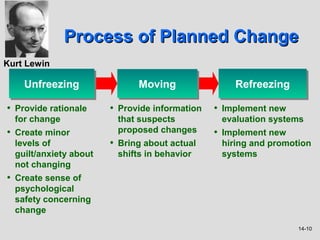
Process of Planned Change
Kurt Lewin

    Unfreezing                Moving                Refreezing

• Provide rationale     • Provide information   • Implement new
  for change             that suspects           evaluation systems
• Create minor           proposed changes       • Implement new
  levels of             • Bring about actual     hiring and promotion
  guilt/anxiety about    shifts in behavior      systems
  not changing
• Create sense of
  psychological
  safety concerning
  change
                                                                  14-10
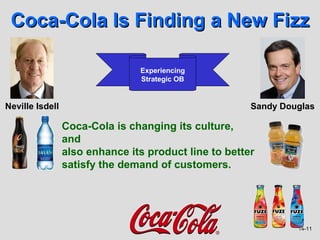
Coca-Cola Is Finding a New Fizz

                                Experiencing
                                Strategic OB


Neville Isdell                                         Sandy Douglas

                 Coca-Cola is changing its culture,
                 and
                 also enhance its product line to better
                 satisfy the demand of customers.


                                                                14-11
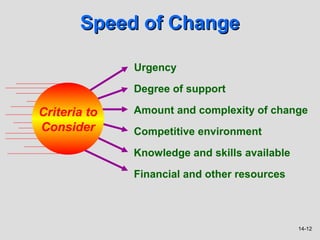
Speed of Change

              Urgency

              Degree of support

Criteria to   Amount and complexity of change
Consider      Competitive environment

              Knowledge and skills available

              Financial and other resources


                                               14-12
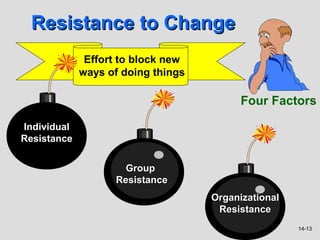
Resistance to Change
              Effort to block new
             ways of doing things

                                          Four Factors

Individual
Resistance


                     Group
                   Resistance
                                    Organizational
                                     Resistance
                                                     14-13
Individual Resistance

•Below are stated some reasons why people resists
changes. Some of these appear to be rational or
emotional. These reasons are:-

•Economic factors
•Habits
•Insecurity
•Lack of communication
•Extend of change
•Psychological factors
•Social factors

                                                    14-14
Group Resistance

  Most organizational changes have
   impact on formal groups in the
    organization the main reason
  why the groups resists change is
that they fear that their cohesiveness
   or existence is threatened by it.


                                         14-15
Organizational Resistance
  Organizational resistance means the change is
   resisted at the level of the organization itself.
Some organization are so designed that they resist
    new ideas, this is specifically true in case of
  organization which are conservative in nature.
Majority of the business firm are also resistance to
   changes. The major reason for organizational
                   resistance are:-
•Threat to power
•Group inertia
•Organizational structure
•Threat to specialization
•Resource constants
•Sunk costs                                          14-16
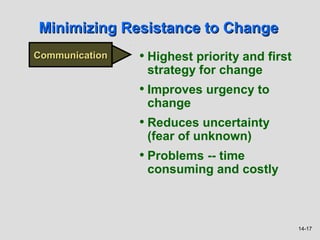
Minimizing Resistance to Change
Communication   • Highest priority and first
                 strategy for change
                • Improves urgency to
                 change
                • Reduces uncertainty
                 (fear of unknown)
                • Problems -- time
                 consuming and costly


                                               14-17
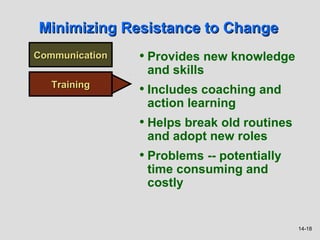
Minimizing Resistance to Change
Communication   • Provides new knowledge
                 and skills
   Training
                • Includes coaching and
                 action learning
                • Helps break old routines
                 and adopt new roles
                • Problems -- potentially
                 time consuming and
                 costly


                                             14-18
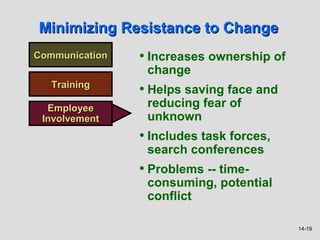
Minimizing Resistance to Change
Communication   • Increases ownership of
                 change
   Training
                • Helps saving face and
  Employee       reducing fear of
 Involvement     unknown
                • Includes task forces,
                 search conferences
                • Problems -- time-
                 consuming, potential
                 conflict

                                           14-19
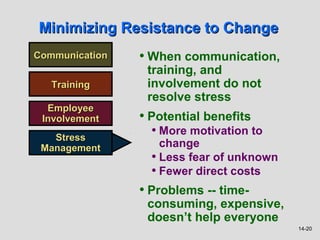
Minimizing Resistance to Change
Communication   • When communication,
                 training, and
   Training      involvement do not
                 resolve stress
  Employee
 Involvement    • Potential benefits
   Stress
                  • More motivation to
 Management         change
                  • Less fear of unknown
                  • Fewer direct costs
                • Problems -- time-
                 consuming, expensive,
                 doesn’t help everyone
                                           14-20
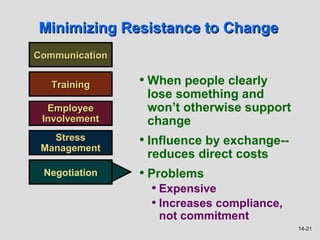
Minimizing Resistance to Change
Communication


   Training     • When people clearly
                 lose something and
  Employee       won’t otherwise support
 Involvement     change
   Stress
 Management
                • Influence by exchange--
                 reduces direct costs
 Negotiation    • Problems
                  • Expensive
                  • Increases compliance,
                   not commitment
                                            14-21
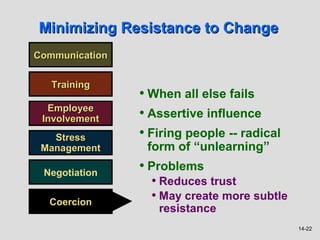
Minimizing Resistance to Change
Communication


   Training
                • When all else fails
  Employee
 Involvement    • Assertive influence
   Stress       • Firing people -- radical
 Management      form of “unlearning”

 Negotiation
                • Problems
                  • Reduces trust
  Coercion
                  • May create more subtle
                   resistance
                                             14-22
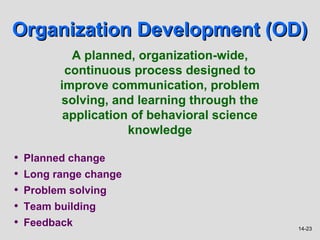
Organization Development (OD)
            A planned, organization-wide,
           continuous process designed to
          improve communication, problem
          solving, and learning through the
           application of behavioral science
                      knowledge

•   Planned change
•   Long range change
•   Problem solving
•   Team building
•   Feedback                                   14-23
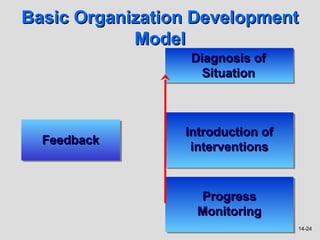
Basic Organization Development
            Model
                  Diagnosis of
                    Situation


                 Introduction of
  Feedback
                  interventions


                   Progress
                   Monitoring
                                   14-24
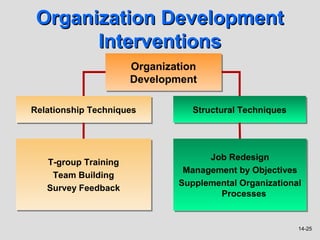
Organization Development
       Interventions
                      Organization
                      Development

Relationship Techniques          Structural Techniques


                                    Job Redesign
   T-group Training
                               Management by Objectives
    Team Building
                              Supplemental Organizational
   Survey Feedback
                                      Processes


                                                         14-25
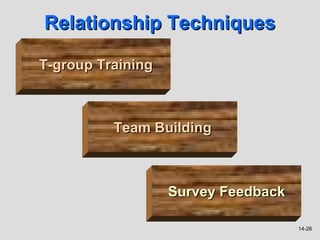
Relationship Techniques

T-group Training


          Team Building


                   Survey Feedback

                                     14-26
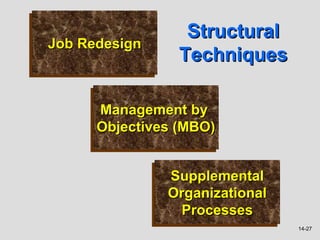
Structural
Job Redesign
Job Redesign
                 Techniques

       Management by
      Management by
      Objectives (MBO)
      Objectives (MBO)


               Supplemental
               Supplemental
               Organizational
               Organizational
                 Processes
                Processes
                                14-27
14-28
14-29

Organizational Change and Development

  • 1.
  • 2.
    Organizational Change  Organizationalchange is the process by which organization move from their present state to some desired future state to increase effectiveness.  When an organization system is disturbed by some internal or external forces change frequently occur or any alteration which occur in the overall work environment of an organization. 14-2
  • 3.
    CHARACTERSTICS OF O.C. Change happen for the pressure of both internal and external forces in the organization.  Change in any part of the organization affect the whole organization.  Change may affect people , structure, technology, and other element of the organization.  Change also affect the rate of speed and degree of significance of the organization.  Change may be reactive or proactive. 14-3
  • 4.
    The Evolution ofStarbucks In the beginning they had only just a shop that sold some selected coffee beans. As Starbucks growing, they realized that the informal techniques were not sufficient and Howard Schultz needed to have a more formalized with people and places. Now Starbucks was the biggest coffee chain network in the world with more than 15000 Dave Olsen shops in over 44 countries. And they grown too fast. They adopting the Italian culture and make some important changes in organization. Exploring Behavior in Action Dawn Pinaud 14-4
  • 5.
    Change Forces INTETRNAL ExTERNAL FORCES FORCES Work force Technology Managerial ChANgE Marketing personnel FORCES conditions Management Social changes structure Political forces Avoid developing inertia 14-5
  • 6.
    Internal Pressures forChange Work force Avoid developing inertia Managerial Management personnel structure 14-6
  • 7.
    External Pressures forChange Technological Political advances Forces Marketing Social conditions changes 14-7
  • 8.
    Companies’ Responses Managerial to Pressures for “Green” Advice Policies and Practices Taking as it positive way: It create a healthy image in customers. It help in cost cutting. Energy saving in the office. Help in reducing carbon in environment. 14-8
  • 9.
    Change Agents • APersons in organization responsible for managing change activities. • Can be managers or non managers, current employees, newly hired employees or outside consultants. 14-9
  • 10.
    Process of PlannedChange Kurt Lewin Unfreezing Moving Refreezing • Provide rationale • Provide information • Implement new for change that suspects evaluation systems • Create minor proposed changes • Implement new levels of • Bring about actual hiring and promotion guilt/anxiety about shifts in behavior systems not changing • Create sense of psychological safety concerning change 14-10
  • 11.
    Coca-Cola Is Findinga New Fizz Experiencing Strategic OB Neville Isdell Sandy Douglas Coca-Cola is changing its culture, and also enhance its product line to better satisfy the demand of customers. 14-11
  • 12.
    Speed of Change Urgency Degree of support Criteria to Amount and complexity of change Consider Competitive environment Knowledge and skills available Financial and other resources 14-12
  • 13.
    Resistance to Change Effort to block new ways of doing things Four Factors Individual Resistance Group Resistance Organizational Resistance 14-13
  • 14.
    Individual Resistance •Below arestated some reasons why people resists changes. Some of these appear to be rational or emotional. These reasons are:- •Economic factors •Habits •Insecurity •Lack of communication •Extend of change •Psychological factors •Social factors 14-14
  • 15.
    Group Resistance Most organizational changes have impact on formal groups in the organization the main reason why the groups resists change is that they fear that their cohesiveness or existence is threatened by it. 14-15
  • 16.
    Organizational Resistance Organizational resistance means the change is resisted at the level of the organization itself. Some organization are so designed that they resist new ideas, this is specifically true in case of organization which are conservative in nature. Majority of the business firm are also resistance to changes. The major reason for organizational resistance are:- •Threat to power •Group inertia •Organizational structure •Threat to specialization •Resource constants •Sunk costs 14-16
  • 17.
    Minimizing Resistance toChange Communication • Highest priority and first strategy for change • Improves urgency to change • Reduces uncertainty (fear of unknown) • Problems -- time consuming and costly 14-17
  • 18.
    Minimizing Resistance toChange Communication • Provides new knowledge and skills Training • Includes coaching and action learning • Helps break old routines and adopt new roles • Problems -- potentially time consuming and costly 14-18
  • 19.
    Minimizing Resistance toChange Communication • Increases ownership of change Training • Helps saving face and Employee reducing fear of Involvement unknown • Includes task forces, search conferences • Problems -- time- consuming, potential conflict 14-19
  • 20.
    Minimizing Resistance toChange Communication • When communication, training, and Training involvement do not resolve stress Employee Involvement • Potential benefits Stress • More motivation to Management change • Less fear of unknown • Fewer direct costs • Problems -- time- consuming, expensive, doesn’t help everyone 14-20
  • 21.
    Minimizing Resistance toChange Communication Training • When people clearly lose something and Employee won’t otherwise support Involvement change Stress Management • Influence by exchange-- reduces direct costs Negotiation • Problems • Expensive • Increases compliance, not commitment 14-21
  • 22.
    Minimizing Resistance toChange Communication Training • When all else fails Employee Involvement • Assertive influence Stress • Firing people -- radical Management form of “unlearning” Negotiation • Problems • Reduces trust Coercion • May create more subtle resistance 14-22
  • 23.
    Organization Development (OD) A planned, organization-wide, continuous process designed to improve communication, problem solving, and learning through the application of behavioral science knowledge • Planned change • Long range change • Problem solving • Team building • Feedback 14-23
  • 24.
    Basic Organization Development Model Diagnosis of Situation Introduction of Feedback interventions Progress Monitoring 14-24
  • 25.
    Organization Development Interventions Organization Development Relationship Techniques Structural Techniques Job Redesign T-group Training Management by Objectives Team Building Supplemental Organizational Survey Feedback Processes 14-25
  • 26.
    Relationship Techniques T-group Training Team Building Survey Feedback 14-26
  • 27.
    Structural Job Redesign Job Redesign Techniques Management by Management by Objectives (MBO) Objectives (MBO) Supplemental Supplemental Organizational Organizational Processes Processes 14-27
  • 28.
  • 29.

Editor's Notes

  • #7 Technological advances - Can lead to incremental or radical changes in how services and products are designed, produced, and delivered. Technology that is inconsistent with existing culture may cause resistance to change among managers and associates. Introduction and removal of government regulations - Firms in deregulated industries typically must adapt to a more competitive environment. Firms that prosper in a regulated environment may fail in one that is deregulated Changes in societal values - Changing values influence consumer purchases. Society’s values are evidenced in employee attitudes, behaviors, and expectations. Society’s values are represented in government regulations. Shifting political dynamics – political pressures – both national and international – can influence organizational operations. The political philosophy of those elected to office, interpretation of legislation, and government policies play a role. Changes in demographics - May cause alteration of internal practices to ensure fair treatment for people of all races and ages. Growing international interdependence – Reliance on imports, various treaties, and the impact of struggles and conflicts in other countries.
  • #8 Technological advances - Can lead to incremental or radical changes in how services and products are designed, produced, and delivered. Technology that is inconsistent with existing culture may cause resistance to change among managers and associates. Introduction and removal of government regulations - Firms in deregulated industries typically must adapt to a more competitive environment. Firms that prosper in a regulated environment may fail in one that is deregulated Changes in societal values - Changing values influence consumer purchases. Society’s values are evidenced in employee attitudes, behaviors, and expectations. Society’s values are represented in government regulations. Shifting political dynamics – political pressures – both national and international – can influence organizational operations. The political philosophy of those elected to office, interpretation of legislation, and government policies play a role. Changes in demographics - May cause alteration of internal practices to ensure fair treatment for people of all races and ages. Growing international interdependence – Reliance on imports, various treaties, and the impact of struggles and conflicts in other countries.
  • #11 “ Unfreezing” starts on mouse click followed by text after one second. Arrow starts on mouse click followed by “moving” and then text after one second each. Arrow starts on mouse click followed by “refreezing” and text after one second each. Unfreezing – A phase in the change process in which leaders help managers and associates move beyond the past by providing a rationale for change, by creating guilt and/or anxiety, and by creating a sense of psychological safety concerning the change. Tactics for unfreezing include: Reminding individuals that they have successfully changed in the past Communicating to individuals that managers and associates in other organizations in similar circumstances have successfully changed Letting individuals know that support and training will be available for the specific changes to be made Moving – A phase in the change process in which leaders help to implement new approaches by providing information that supports proposed changes and by providing resources and training to bring about actual shifts in behavior. Refreezing - A phase in the change process in which leaders lock in new approaches by implementing evaluation systems that track expected behaviors, by creating reward systems that reinforce expected behaviors, and by ensuring that hiring and promotion systems support the new demands.
  • #12 Coca Cola logo has a soda can fizz sound when it enters. The other graphics follow automatically. Text comes in on mouse clicks.
  • #13 Criteria to consider flies in from left with a whoosh sound. Arrows come in on mouse clicks followed automatically by the text after one second, Urgency – If the change is urgent, a faster pace is warranted. Degree of support – If the change is supported by a wide variety of people at the outset, a faster pace can be used. Amount and complexity of change – If the change is small and simple, a faster pace often can be used, but if the change is large, more time may be required. Competitive environment – If competitors are poised to take advantage of existing weaknesses, a faster pace should be considered. Knowledge and skills available – If the knowledge and skills required by the new approach exist in the firm or can be easily acquired, a faster pace can be used. Financial and other resources – If the resources required by the change are on hand or easily acquired, a faster pace can be considered.
  • #14 Banner stretches across on mouse click and hides on next mouse click. Man with four factors dissolves in on mouse click. Time bombs zoom in automatically at one second intervals. Resistance to change – Efforts to block the introduction of new approaches. Some of these efforts are passive in nature, involving such tactics as verbally supporting the change while continuing to work in the old ways; other efforts are active in nature, involving tactics such as organized protests and sabotage. Lack of understanding – Communicate clearly what the change entails. Different assessments – Include potential or actual resisters in the decision-making process. Self-interest – Reason with resistors, transfer or coerce them. Low tolerance for change – Offer or assure support for the resistors during the learning process.
  • #25 Diagnosis of Situation - Diagnostic devices for managers include interviews, surveys, group sociometric devices, process-oriented diagnosis, and accurate records (for example, performance records). Introduction of interventions - Organization development interventions include t-group training, team building, and job redesign. Progress Monitoring - Surveys and other techniques may be reused to determine what progress has been made toward solving the problem. The main criterion for evaluation is whether the original objective has been accomplished.
  • #27 Each one stretches across on mouse click. T-group training – Group exercises in which individuals focus on their actions, how others perceive their actions, and how others generally react to them; participants often learn about unintended negative consequences of certain types of behaviors. Team building - A process in which members of a team work together and with a facilitator to diagnose task, process, and interpersonal problems within the team and create solutions. Survey feedback - Data obtained from questionnaires; managers receive the data for their units and are expected to hold unit meetings to discuss problems.
  • #28 Each one zooms in on mouse click. Job redesign - Enlargement or enrichment of jobs; enrichment is the better method to enhance motivation for effective problem solving, communication, and learning. Management by objectives (MBO) - A management process in which individuals negotiate task objectives with their managers and then are held accountable for attainment of the objectives. Supplemental organizational processes - Processes in which associates and/or managers have ongoing meetings for the purpose of identifying and solving important problems.