Performance
-Linked Pay
Dhanush Patel L O
Dileep Kumar C V
Dileep Masankatti
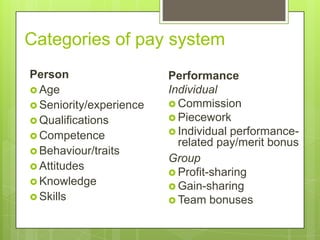
Categories of pay system
Person
 Age
 Seniority/experience
 Qualifications
 Competence
 Behaviour/traits
 Attitudes
 Knowledge
 Skills

Performance
Individual
 Commission
 Piecework
 Individual performancerelated pay/merit bonus
Group
 Profit-sharing
 Gain-sharing
 Team bonuses
Introduction






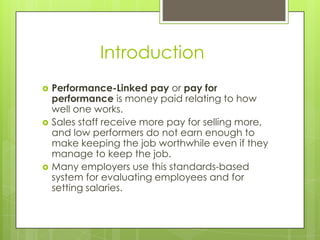
Performance-Linked pay or pay for
performance is money paid relating to how
well one works.
Sales staff receive more pay for selling more,
and low performers do not earn enough to
make keeping the job worthwhile even if they
manage to keep the job.
Many employers use this standards-based
system for evaluating employees and for
setting salaries.
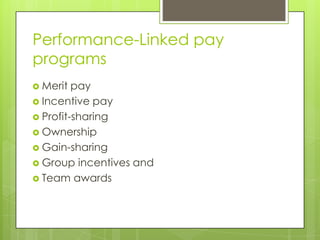
Performance-Linked pay
programs
 Merit

pay
 Incentive pay
 Profit-sharing
 Ownership
 Gain-sharing
 Group incentives and
 Team awards
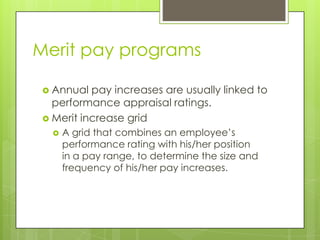
Merit pay programs
 Annual

pay increases are usually linked to
performance appraisal ratings.
 Merit increase grid


A grid that combines an employee’s
performance rating with his/her position
in a pay range, to determine the size and
frequency of his/her pay increases.
Criticisms of traditional merit
pay programs
 It

is unfair to rate individual performance.
 The individual focus of merit pay discourages
team work.
 Exclusive reliance on supervisor for
performance ratings may restrict accuracy.
 If merit increases are too small, they will not
motivate workers.
 Merit pay may lead to an ‘entitlement
mentality’.
Individual incentive programs
 Individual

incentives reward individual
performance, but differ from merit pay.



Incentives are not rolled into base pay.
They must be continuously earned.
Performance is usually measured as
physical output, rather than by subjective
ratings.
 Profit sharing
 A group compensation plan in which payments
are based on a measure of organization
performance (profits) and do not become part
of the employees’ base salary.
 Ownership
 Stock option. An employee ownership plan that
gives employees the opportunity to buy
the company’s stock at a previously fixed price.
 Employee stock ownership plan (ESOP). An
employee ownership plan that provides
employers certain tax and financial
advantages when stock is granted to
employees.
Gain-sharing, group incentives and
team awards
 Gain-sharing
 A form of group compensation based on group
or plant performance (rather than organizationwide profits) that does not become part of the
employee’s base salary.

 Group incentives
 Tend to measure performance in terms of
physical output.
 Team awards
 Use a broader range of performance measures
(e.g. cost savings, meeting deadlines).
Performance Measurement
Method
 Balanced


scorecard

A means of performance measurement
that gives managers a chance to look at
their company from the perspectives of
internal and external customers,
employees and shareholders.
PLP vs other financial remuneration


PLP vs salary




PLP vs bonus




Salary is paid for the efforts that one puts in and PLP is paid for the
results. Salary is paid in short, definitive cycles (e.g., weekly, monthly,
fortnightly etc.) while PLP is paid in a longer cycle of monthly, quarterly
or half-yearly, yearly.
Bonus is paid for the performance of the organization while PLI is paid
for the individual's performance. Bonus is normally paid yearly or halfyearly. This is normally paid as a percentage of one's salary, or as a
fixed amount, irrespective of the employee's individual performance.

PLP vs retention bonus


Some organizations give a retention bonus which is payable for the
period that an employee stays back in the organization. This is paid for
the value added by the employee by virtue of mere presence and not
necessary for the efforts or work output. Normally retention bonus is
paid yearly or half-yearly which will make the employee to stay back in
the organization.
The pros and cons of
performance pay
Arguments for:
 It

is right that those who perform better receive
higher rewards than those who perform less well.
 Linking pay to performance improves motivation
and hence performance.
 Performance-linked pay can send strong messages
about what behaviour is expected.
The pros and cons of
performance pay
Arguments against:
 Pay is not a motivator.
 It demotivates staff who

do not benefit.
 It ruptures relationships and team work.
 It represents a diversion from managing staff
performance properly.
 It discourages risk-taking.
 It undermines the intrinsic interest in the work.
Summary






Performance-Linked pay programs vary as to
whether they link pay to individual, group or
organization performance. A balance of
individual, group and organisation objectives may
be sought.
An effective pay strategy can have a substantial,
positive impact on an organization's success.
The importance of pay means that employees
care a great deal about the fairness of the pay
process. Pay programs must be explained and
administered in such a way that employees
understand their underlying rationale and believe it
is fair.
Bibliography
 http://en.wikipedia.org/wiki/Performance-

linked_incentives
 http://en.wikipedia.org/wiki/Performancerelated_pay
 De Cieri & Kramar, “Human Resource
Management in Australia: StrategyPeople-Performance”
7.performance linked pay

7.performance linked pay

  • 1.
    Performance -Linked Pay Dhanush PatelL O Dileep Kumar C V Dileep Masankatti
  • 2.
    Categories of paysystem Person  Age  Seniority/experience  Qualifications  Competence  Behaviour/traits  Attitudes  Knowledge  Skills Performance Individual  Commission  Piecework  Individual performancerelated pay/merit bonus Group  Profit-sharing  Gain-sharing  Team bonuses
  • 3.
    Introduction    Performance-Linked pay orpay for performance is money paid relating to how well one works. Sales staff receive more pay for selling more, and low performers do not earn enough to make keeping the job worthwhile even if they manage to keep the job. Many employers use this standards-based system for evaluating employees and for setting salaries.
  • 4.
    Performance-Linked pay programs  Merit pay Incentive pay  Profit-sharing  Ownership  Gain-sharing  Group incentives and  Team awards
  • 5.
    Merit pay programs Annual pay increases are usually linked to performance appraisal ratings.  Merit increase grid  A grid that combines an employee’s performance rating with his/her position in a pay range, to determine the size and frequency of his/her pay increases.
  • 6.
    Criticisms of traditionalmerit pay programs  It is unfair to rate individual performance.  The individual focus of merit pay discourages team work.  Exclusive reliance on supervisor for performance ratings may restrict accuracy.  If merit increases are too small, they will not motivate workers.  Merit pay may lead to an ‘entitlement mentality’.
  • 7.
    Individual incentive programs Individual incentives reward individual performance, but differ from merit pay.   Incentives are not rolled into base pay. They must be continuously earned. Performance is usually measured as physical output, rather than by subjective ratings.
  • 8.
     Profit sharing A group compensation plan in which payments are based on a measure of organization performance (profits) and do not become part of the employees’ base salary.  Ownership  Stock option. An employee ownership plan that gives employees the opportunity to buy the company’s stock at a previously fixed price.  Employee stock ownership plan (ESOP). An employee ownership plan that provides employers certain tax and financial advantages when stock is granted to employees.
  • 9.
    Gain-sharing, group incentivesand team awards  Gain-sharing  A form of group compensation based on group or plant performance (rather than organizationwide profits) that does not become part of the employee’s base salary.  Group incentives  Tend to measure performance in terms of physical output.  Team awards  Use a broader range of performance measures (e.g. cost savings, meeting deadlines).
  • 10.
    Performance Measurement Method  Balanced  scorecard Ameans of performance measurement that gives managers a chance to look at their company from the perspectives of internal and external customers, employees and shareholders.
  • 12.
    PLP vs otherfinancial remuneration  PLP vs salary   PLP vs bonus   Salary is paid for the efforts that one puts in and PLP is paid for the results. Salary is paid in short, definitive cycles (e.g., weekly, monthly, fortnightly etc.) while PLP is paid in a longer cycle of monthly, quarterly or half-yearly, yearly. Bonus is paid for the performance of the organization while PLI is paid for the individual's performance. Bonus is normally paid yearly or halfyearly. This is normally paid as a percentage of one's salary, or as a fixed amount, irrespective of the employee's individual performance. PLP vs retention bonus  Some organizations give a retention bonus which is payable for the period that an employee stays back in the organization. This is paid for the value added by the employee by virtue of mere presence and not necessary for the efforts or work output. Normally retention bonus is paid yearly or half-yearly which will make the employee to stay back in the organization.
  • 13.
    The pros andcons of performance pay Arguments for:  It is right that those who perform better receive higher rewards than those who perform less well.  Linking pay to performance improves motivation and hence performance.  Performance-linked pay can send strong messages about what behaviour is expected.
  • 14.
    The pros andcons of performance pay Arguments against:  Pay is not a motivator.  It demotivates staff who do not benefit.  It ruptures relationships and team work.  It represents a diversion from managing staff performance properly.  It discourages risk-taking.  It undermines the intrinsic interest in the work.
  • 15.
    Summary    Performance-Linked pay programsvary as to whether they link pay to individual, group or organization performance. A balance of individual, group and organisation objectives may be sought. An effective pay strategy can have a substantial, positive impact on an organization's success. The importance of pay means that employees care a great deal about the fairness of the pay process. Pay programs must be explained and administered in such a way that employees understand their underlying rationale and believe it is fair.
  • 16.
    Bibliography  http://en.wikipedia.org/wiki/Performance- linked_incentives  http://en.wikipedia.org/wiki/Performancerelated_pay De Cieri & Kramar, “Human Resource Management in Australia: StrategyPeople-Performance”