3.
5.
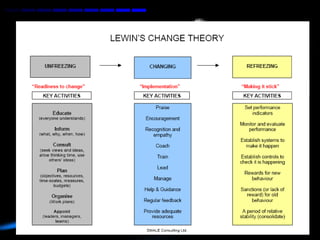
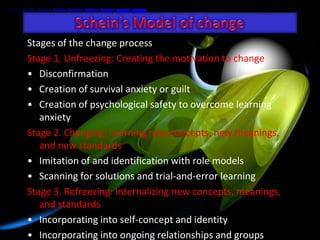
Stages of the change process
Stage 1. Unfreezing: Creating the motivation to change
• Disconfirmation
• Creation of survival anxiety or guilt
• Creation of psychological safety to overcome learning
   anxiety
Stage 2. Changing: Learning new concepts, new meanings,
   and new standards
• Imitation of and identification with role models
• Scanning for solutions and trial-and-error learning
Stage 3. Refreezing: Internalizing new concepts, meanings,
   and standards
• Incorporating into self-concept and identity
• Incorporating into ongoing relationships and groups
Unfreezing - The most difficult and important stage
(1) the present state is somehow disconfirmed;
(2) some anxiety or guilt is aroused because some goals will not be met or standards or ideals will not be maintained;
(3) enough ‘‘psychological safety’’ is provided to make it unnecessary for the target individuals or groups to psychologically
      defend themselves because the disconfirming information is too threatening or the anxiety or guilt is too high.
Cognitive Redefinition - By what means does a motivated learner learn something new when we are dealing with thought
      processes, feelings, values, and attitudes?
      It occurs by taking in new information that has one or more of the following impacts: 1) semantic redefintion--we learn
      that words can mean something different from what we had assumed; 2) cognitive broadening--we learn that a given
      concept can be much more broadly interpreted than what we had assumed 3) new standards of iudgment or
      evaluation--we learn that the anchors we used for judgment and comparison are not absolute, and if we use a
      different anchor our scale of judgment shifts.
Imitation and Positive or Defensive Identification with a Role Model
Cognitive re-definition occurs when the learner has become unfrozen,i.e. motivated to change, and has, therefore opened
      him or herself up to new information.
The next question to address, then, is how the new information comes to the learner. The most basic mechanism of
      acquiring new information that leads to cognitive restructuring is to discover in a conversational process that the
      interpretation that someone else puts on a concept is different from one's own. If one is motivated to change, i.e. if
      the factors described above have been operating, one may be able to "hear" or "see" something from a new
      perspective. The best examples come from what has colloquially been labeled brainwashing.
Scanning: Insight or Trial and Error Learning
A learner or change target can be highly motivated to learn something,yet have no role models nor initial feeling for where
      the answer or solution might lie. The learner then searches or scans by reading, traveling, talking to people, hiring
      consultants, entering therapy, going back to school, etc. to expose him or herself to a variety of new information that
      might reveal a solution to the problem.
Personal and Relational Refreezing
 The main point about refreezing is that new behavior must be to some degree congruent with the rest of the behavior and
      personality of the learner or it will simply set off new rounds of disconfirmation that often lead to unlearning the very
      thing one has learned.
7.
Bullock and Batten’s Integrative
         Model for Planned Change
Analyzed over 30 models of change management and arrived at their
own 4-phase model
The model progresses as follows:
Exploration phase - The organization has to make decision on the
need for change:
· Explore and decide on the need for change
· Identify what changes are required
· Identify resources required
Planning phase - Understanding the problem:
• Diagnosis of the problem
• Clarify goals and objectives
• Identify specific activities required to undertake change
• Agree changes with stakeholders
• Identify supports required to enable change to occur

Action phase-Changes identified,agreed& implemented:
• Support for change is explicit
• Changes are monitored and evaluated
• Results are communicated and acted upon
• Adjustments and refinements are made where necessary
Integration phase - Stabilising and embedding change:
• Changes supported and reinforced
• Results and outcomes from change communicated
   throughout the organization
• Continuous development of employees through training,
   education
• Ongoing monitoring and evaluation
Action Research Model
Assuming that planned change is a cyclical process,this model
proposes that organizations,in order to change,need to undertake
research initially so as to have adequate information that may guide
their future action.The results of the action are then assessed to
provide information to guide further action and this cycle is repeated
as an ongoing process.The eight steps elaborated by Cummings and
Huse(1989) under this model are:
Problem Identification:
At this stage,a key executive senses the existence of problems that
can be alleviated with the help of an organization development(OD)
Practitioner.
Consultant with An Expert:
Once the problem(s) has been sensed,it is understood that there is a
solution to such problem(s),the help of an OD expert is sought.
Data Gathering and Preliminary Diagnosis:
Using various tools such as
 interviews,questionnaires,organizational performance
 analysis,data is gathered by the OD consultant.The consultant
 works in collaboration with organizational members.
Feedback:
The gathered data is passed on to the key client /group to
 determine the strengths and weaknesses of the area under
 study,with the consultant providing the client all relevant and
 useful data.
Joint Diagnosis of the problem:
After discussing the feedback,the group focuses on additional
 relevant research that might be required.The results of this
 additional research are then summarized and submitted to the
 group again so that they are validated for further diagnoses and
 identification of problem(s).
Joint Action Planning:
The consultant and the management team jointly agree on problem-
 solving methods.Depending upon the cultural,technological and
 work environment,specific courses of action are taken in order to
 solve the problem(s).At this stage,the time and cost of the
 intervention is also taken into consideration.
Action:
This is the stage at which the actual change from its present state to
 its desired state takes place and may involve installation of new
 methos and procedures,reorganizing structures and work designs,or
 reinforcing new behavior.
Data Gathering After Action:
New data is gathered again so as to determine the amount of
 change that has taken place vis-à-vis the effects of the action.This
 affirms the cyclical nature of the process.Further feedback is sought
 and based onthis;situations are re-diagnosed and new action taken.
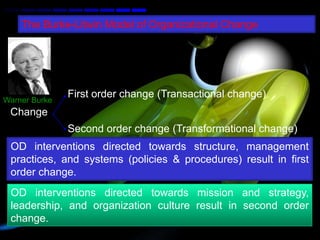
The Burke-Litwin Model of Organizational Change


               First order change (Transactional change)
Warner Burke
 Change
               Second order change (Transformational change)
 OD interventions directed towards structure, management
 practices, and systems (policies & procedures) result in first
 order change.
 OD interventions directed towards mission and strategy,
 leadership, and organization culture result in second order
 change.
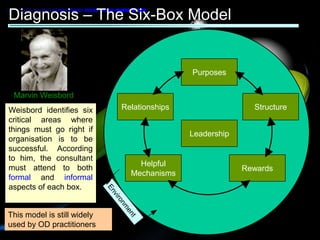
Diagnosis – The Six-Box Model


                                             Purposes

 Marvin Weisbord
Weisbord identifies six      Relationships                  Structure
critical areas where
things must go right if
                                             Leadership
organisation is to be
successful. According
to him, the consultant
                                 Helpful
must attend to both                                       Rewards
                               Mechanisms
formal and informal
aspects of each box.


This model is still widely
used by OD practitioners
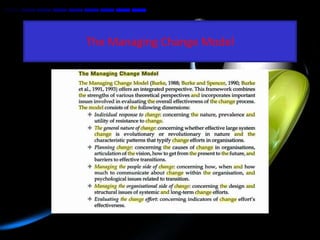
The Managing Change Model
Organizational change-model

Organizational change-model

  • 12.
  • 13.
  • 14.
    Stages of thechange process Stage 1. Unfreezing: Creating the motivation to change • Disconfirmation • Creation of survival anxiety or guilt • Creation of psychological safety to overcome learning anxiety Stage 2. Changing: Learning new concepts, new meanings, and new standards • Imitation of and identification with role models • Scanning for solutions and trial-and-error learning Stage 3. Refreezing: Internalizing new concepts, meanings, and standards • Incorporating into self-concept and identity • Incorporating into ongoing relationships and groups
  • 15.
    Unfreezing - Themost difficult and important stage (1) the present state is somehow disconfirmed; (2) some anxiety or guilt is aroused because some goals will not be met or standards or ideals will not be maintained; (3) enough ‘‘psychological safety’’ is provided to make it unnecessary for the target individuals or groups to psychologically defend themselves because the disconfirming information is too threatening or the anxiety or guilt is too high. Cognitive Redefinition - By what means does a motivated learner learn something new when we are dealing with thought processes, feelings, values, and attitudes? It occurs by taking in new information that has one or more of the following impacts: 1) semantic redefintion--we learn that words can mean something different from what we had assumed; 2) cognitive broadening--we learn that a given concept can be much more broadly interpreted than what we had assumed 3) new standards of iudgment or evaluation--we learn that the anchors we used for judgment and comparison are not absolute, and if we use a different anchor our scale of judgment shifts. Imitation and Positive or Defensive Identification with a Role Model Cognitive re-definition occurs when the learner has become unfrozen,i.e. motivated to change, and has, therefore opened him or herself up to new information. The next question to address, then, is how the new information comes to the learner. The most basic mechanism of acquiring new information that leads to cognitive restructuring is to discover in a conversational process that the interpretation that someone else puts on a concept is different from one's own. If one is motivated to change, i.e. if the factors described above have been operating, one may be able to "hear" or "see" something from a new perspective. The best examples come from what has colloquially been labeled brainwashing. Scanning: Insight or Trial and Error Learning A learner or change target can be highly motivated to learn something,yet have no role models nor initial feeling for where the answer or solution might lie. The learner then searches or scans by reading, traveling, talking to people, hiring consultants, entering therapy, going back to school, etc. to expose him or herself to a variety of new information that might reveal a solution to the problem. Personal and Relational Refreezing The main point about refreezing is that new behavior must be to some degree congruent with the rest of the behavior and personality of the learner or it will simply set off new rounds of disconfirmation that often lead to unlearning the very thing one has learned.
  • 18.
  • 20.
    Bullock and Batten’sIntegrative Model for Planned Change Analyzed over 30 models of change management and arrived at their own 4-phase model The model progresses as follows: Exploration phase - The organization has to make decision on the need for change: · Explore and decide on the need for change · Identify what changes are required · Identify resources required
  • 21.
    Planning phase -Understanding the problem: • Diagnosis of the problem • Clarify goals and objectives • Identify specific activities required to undertake change • Agree changes with stakeholders • Identify supports required to enable change to occur Action phase-Changes identified,agreed& implemented: • Support for change is explicit • Changes are monitored and evaluated • Results are communicated and acted upon • Adjustments and refinements are made where necessary
  • 22.
    Integration phase -Stabilising and embedding change: • Changes supported and reinforced • Results and outcomes from change communicated throughout the organization • Continuous development of employees through training, education • Ongoing monitoring and evaluation
  • 23.
    Action Research Model Assumingthat planned change is a cyclical process,this model proposes that organizations,in order to change,need to undertake research initially so as to have adequate information that may guide their future action.The results of the action are then assessed to provide information to guide further action and this cycle is repeated as an ongoing process.The eight steps elaborated by Cummings and Huse(1989) under this model are: Problem Identification: At this stage,a key executive senses the existence of problems that can be alleviated with the help of an organization development(OD) Practitioner. Consultant with An Expert: Once the problem(s) has been sensed,it is understood that there is a solution to such problem(s),the help of an OD expert is sought.
  • 24.
    Data Gathering andPreliminary Diagnosis: Using various tools such as interviews,questionnaires,organizational performance analysis,data is gathered by the OD consultant.The consultant works in collaboration with organizational members. Feedback: The gathered data is passed on to the key client /group to determine the strengths and weaknesses of the area under study,with the consultant providing the client all relevant and useful data. Joint Diagnosis of the problem: After discussing the feedback,the group focuses on additional relevant research that might be required.The results of this additional research are then summarized and submitted to the group again so that they are validated for further diagnoses and identification of problem(s).
  • 25.
    Joint Action Planning: Theconsultant and the management team jointly agree on problem- solving methods.Depending upon the cultural,technological and work environment,specific courses of action are taken in order to solve the problem(s).At this stage,the time and cost of the intervention is also taken into consideration. Action: This is the stage at which the actual change from its present state to its desired state takes place and may involve installation of new methos and procedures,reorganizing structures and work designs,or reinforcing new behavior. Data Gathering After Action: New data is gathered again so as to determine the amount of change that has taken place vis-à-vis the effects of the action.This affirms the cyclical nature of the process.Further feedback is sought and based onthis;situations are re-diagnosed and new action taken.
  • 26.
    The Burke-Litwin Modelof Organizational Change First order change (Transactional change) Warner Burke Change Second order change (Transformational change) OD interventions directed towards structure, management practices, and systems (policies & procedures) result in first order change. OD interventions directed towards mission and strategy, leadership, and organization culture result in second order change.
  • 27.
    Diagnosis – TheSix-Box Model Purposes Marvin Weisbord Weisbord identifies six Relationships Structure critical areas where things must go right if Leadership organisation is to be successful. According to him, the consultant Helpful must attend to both Rewards Mechanisms formal and informal aspects of each box. This model is still widely used by OD practitioners
  • 30.