HRD SYSTEMS,
PROCESSES, OUTCOMES
AND ORGANIZATIONAL
EFFECTIVENESS
Submitted to: Submitted by :
Dr. Rajendra Mishra Vidhu Arora [ 68-MBA-16 ]
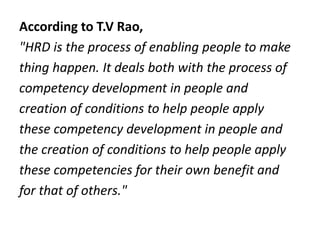
According to T.V Rao,
"HRD is the process of enabling people to make
thing happen. It deals both with the process of
competency development in people and
creation of conditions to help people apply
these competency development in people and
the creation of conditions to help people apply
these competencies for their own benefit and
for that of others."
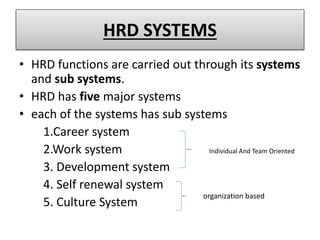
HRD SYSTEMS
• HRD functions are carried out through its systems
and sub systems.
• HRD has five major systems
• each of the systems has sub systems
1.Career system
2.Work system Individual And Team Oriented
3. Development system
4. Self renewal system
5. Culture System
organization based
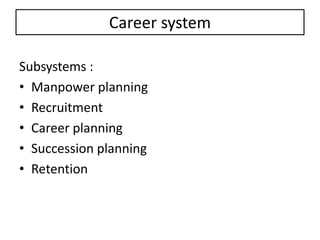
Career system
Subsystems :
• Manpower planning
• Recruitment
• Career planning
• Succession planning
• Retention
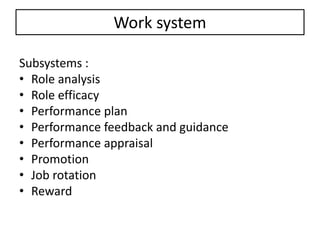
Work system
Subsystems :
• Role analysis
• Role efficacy
• Performance plan
• Performance feedback and guidance
• Performance appraisal
• Promotion
• Job rotation
• Reward
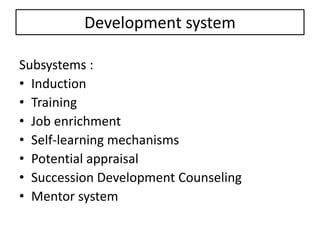
Development system
Subsystems :
• Induction
• Training
• Job enrichment
• Self-learning mechanisms
• Potential appraisal
• Succession Development Counseling
• Mentor system
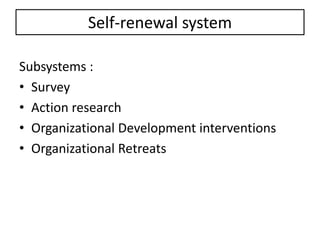
Self-renewal system
Subsystems :
• Survey
• Action research
• Organizational Development interventions
• Organizational Retreats
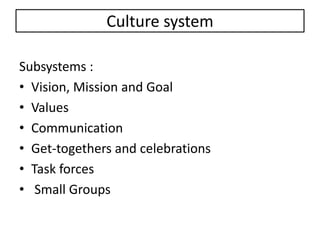
Culture system
Subsystems :
• Vision, Mission and Goal
• Values
• Communication
• Get-togethers and celebrations
• Task forces
• Small Groups
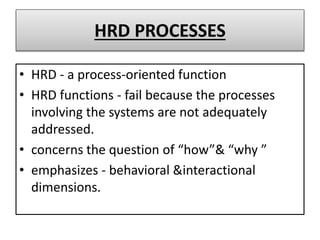
HRD PROCESSES
• HRD - a process-oriented function
• HRD functions - fail because the processes
involving the systems are not adequately
addressed.
• concerns the question of “how”& “why ”
• emphasizes - behavioral &interactional
dimensions.
• HRD processes centered around :
1. Employee
2. Role
3. Teams
4. Organization
1. Individual: Individual is the basic constituent
of an organization. All the behavioral pattern
and dynamisms emerge from individuals.
o Efficacy
o Effectiveness
o Styles
o Leadership
2. Role: Role is a dynamic entity which involves
the expectations of significant others and self
from the position of the role holder.
Role related HRD processes in organizations.
o Competencies for job performance
o Commitment
o Motivation
o Frustration
o Stress & Burnout
3. Teams: When individuals begin to work in
team, behavioral patterns and dynamisms
emerge.
o Communication
o Feedback
o Conflict resolution
o Collaboration
4. Organization: A large number of HRD processes
are organization related.
oOrganizational Climate
oCommunication
oLearning Organization
o Organizational Change
oOrganizational Development
HRD Outcomes
HRD outcomes provide the ground rules to build an
organization excelling in people, processes, products
and profits.
Outcomes :
• Training makes people more competent.
They develop new skills, knowledge and attitudes.
• There is greater clarity of norms and standards.
People become better aware of the skills required for
job performance.
• People become more committed to their jobs
because there comes greater objectivity in the
administration of reward.
• People develop greater trust and respect for each
other. They become more open in the behavior and the
new outcome like values are generated.
• There is great collaboration and team work which
produces synergy effect.
• There is greater readiness on the part of employees to
accept change. They find themselves better equipped
with problem solving capabilities.
• Lot of useful and objective data on employees are
generated which facilitate human resource planning.
• Participation develops in works a sense of
achievement and pride.
• HRD helps inducing multi skills to the employees.
Organizational Effectiveness
• Organizational effectiveness is the concept of
how effective an organization is in achieving
the outcomes the organization intends to
produce. The idea of organizational
effectiveness is especially important for
nonprofit organizations as most people who
donate money to nonprofit organizations and
charities
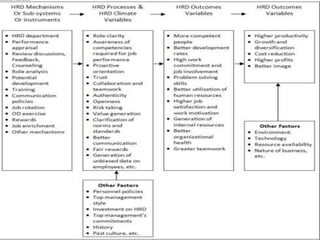
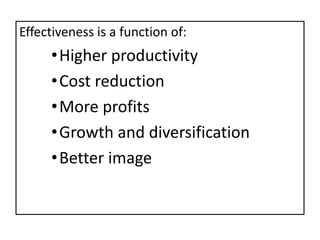
Effectiveness is a function of:
•Higher productivity
•Cost reduction
•More profits
•Growth and diversification
•Better image
hrd systems, processes, outcomes and organizational effectiveness

hrd systems, processes, outcomes and organizational effectiveness

  • 1.
    HRD SYSTEMS, PROCESSES, OUTCOMES ANDORGANIZATIONAL EFFECTIVENESS Submitted to: Submitted by : Dr. Rajendra Mishra Vidhu Arora [ 68-MBA-16 ]
  • 2.
    According to T.VRao, "HRD is the process of enabling people to make thing happen. It deals both with the process of competency development in people and creation of conditions to help people apply these competency development in people and the creation of conditions to help people apply these competencies for their own benefit and for that of others."
  • 3.
    HRD SYSTEMS • HRDfunctions are carried out through its systems and sub systems. • HRD has five major systems • each of the systems has sub systems 1.Career system 2.Work system Individual And Team Oriented 3. Development system 4. Self renewal system 5. Culture System organization based
  • 4.
    Career system Subsystems : •Manpower planning • Recruitment • Career planning • Succession planning • Retention
  • 5.
    Work system Subsystems : •Role analysis • Role efficacy • Performance plan • Performance feedback and guidance • Performance appraisal • Promotion • Job rotation • Reward
  • 6.
    Development system Subsystems : •Induction • Training • Job enrichment • Self-learning mechanisms • Potential appraisal • Succession Development Counseling • Mentor system
  • 7.
    Self-renewal system Subsystems : •Survey • Action research • Organizational Development interventions • Organizational Retreats
  • 8.
    Culture system Subsystems : •Vision, Mission and Goal • Values • Communication • Get-togethers and celebrations • Task forces • Small Groups
  • 9.
    HRD PROCESSES • HRD- a process-oriented function • HRD functions - fail because the processes involving the systems are not adequately addressed. • concerns the question of “how”& “why ” • emphasizes - behavioral &interactional dimensions.
  • 10.
    • HRD processescentered around : 1. Employee 2. Role 3. Teams 4. Organization
  • 11.
    1. Individual: Individualis the basic constituent of an organization. All the behavioral pattern and dynamisms emerge from individuals. o Efficacy o Effectiveness o Styles o Leadership
  • 12.
    2. Role: Roleis a dynamic entity which involves the expectations of significant others and self from the position of the role holder. Role related HRD processes in organizations. o Competencies for job performance o Commitment o Motivation o Frustration o Stress & Burnout
  • 13.
    3. Teams: Whenindividuals begin to work in team, behavioral patterns and dynamisms emerge. o Communication o Feedback o Conflict resolution o Collaboration
  • 14.
    4. Organization: Alarge number of HRD processes are organization related. oOrganizational Climate oCommunication oLearning Organization o Organizational Change oOrganizational Development
  • 15.
    HRD Outcomes HRD outcomesprovide the ground rules to build an organization excelling in people, processes, products and profits. Outcomes : • Training makes people more competent. They develop new skills, knowledge and attitudes. • There is greater clarity of norms and standards. People become better aware of the skills required for job performance. • People become more committed to their jobs because there comes greater objectivity in the administration of reward.
  • 16.
    • People developgreater trust and respect for each other. They become more open in the behavior and the new outcome like values are generated. • There is great collaboration and team work which produces synergy effect. • There is greater readiness on the part of employees to accept change. They find themselves better equipped with problem solving capabilities. • Lot of useful and objective data on employees are generated which facilitate human resource planning. • Participation develops in works a sense of achievement and pride. • HRD helps inducing multi skills to the employees.
  • 18.
    Organizational Effectiveness • Organizationaleffectiveness is the concept of how effective an organization is in achieving the outcomes the organization intends to produce. The idea of organizational effectiveness is especially important for nonprofit organizations as most people who donate money to nonprofit organizations and charities
  • 19.
    Effectiveness is afunction of: •Higher productivity •Cost reduction •More profits •Growth and diversification •Better image