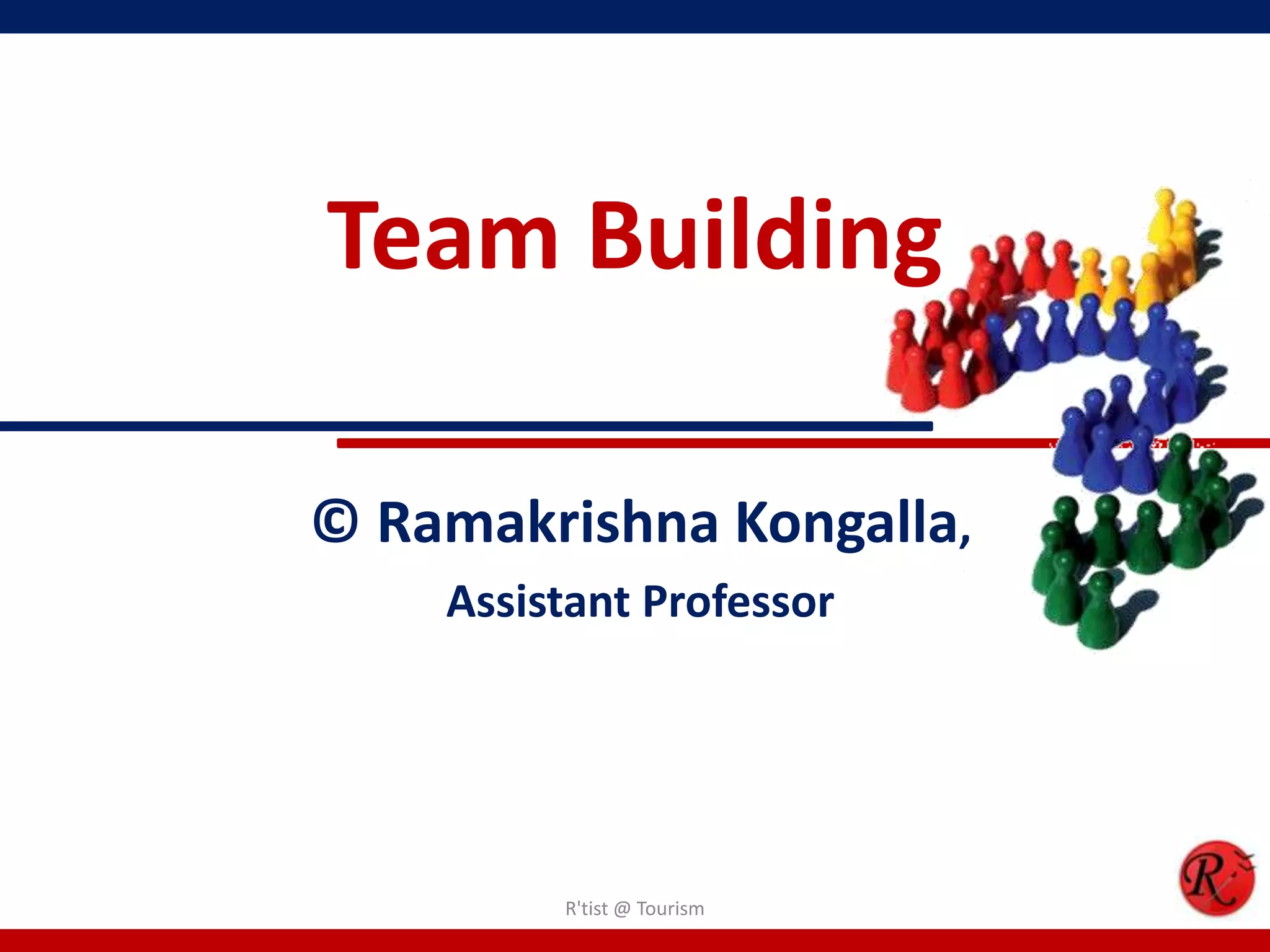
Team Building

© Ramakrishna Kongalla,
    Assistant Professor


         R'tist @ Tourism
• Today with the growing complexity of society
  and     the     continuing   development        of
  technological capability, more organisational life
  will revolve around group and team structures
• The contribution of teams and groups will find
  accrued importance in the decision making
  process


                      R'tist @ Tourism
Group Development
• Forming stage: is characterised by the development of
  interpersonal relationships, identification of goals and the
  establishment of behaviour norms among the members
• Storming stage: is characterised by intra-group conflict. e.g conflict
  over leadership, goals etc
• Norming stage: is where members of the group understand what is
  expected of them and where the leadership structure is clear
• Performing stage: This stage results in an effective well-integrated
  group that performs the required task effectively & efficiently
• Adjourning stage: When the task is completed, the group prepares
  for its winding up.

                               R'tist @ Tourism
Teams
• The team based structures approach is in line
  with the human aspect of management that
  has sought to encourage and sustain
  motivation and commitment of staff as a way
  of enhancing and advancing the cause of both
  productivity for the organisation and providing
  a satisfying environment for employees


                     R'tist @ Tourism
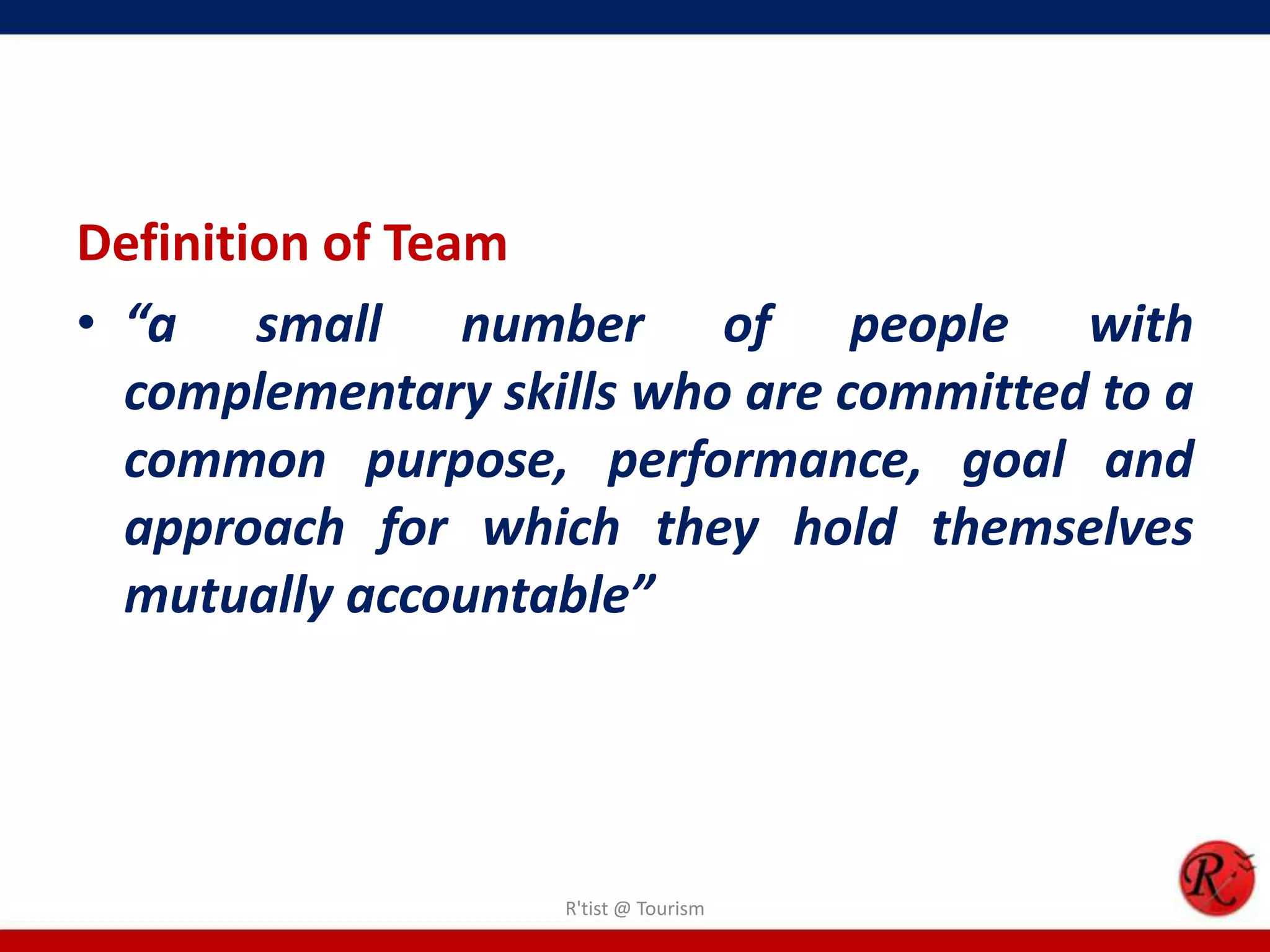
Definition of Team
• “a small number of people with
  complementary skills who are committed to a
  common purpose, performance, goal and
  approach for which they hold themselves
  mutually accountable”


                   R'tist @ Tourism
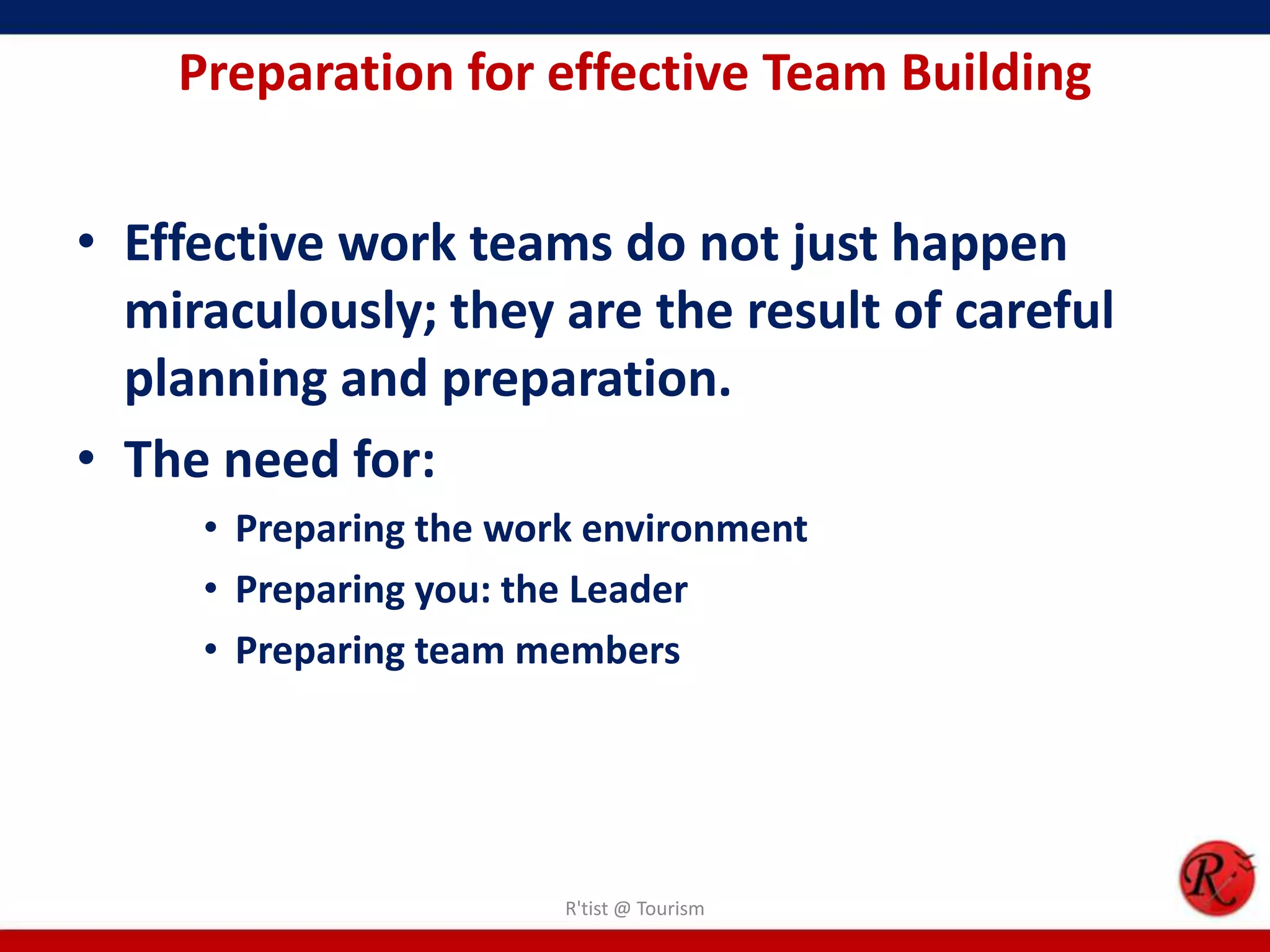
Preparation for effective Team Building


• Effective work teams do not just happen
  miraculously; they are the result of careful
  planning and preparation.
• The need for:
     • Preparing the work environment
     • Preparing you: the Leader
     • Preparing team members


                        R'tist @ Tourism
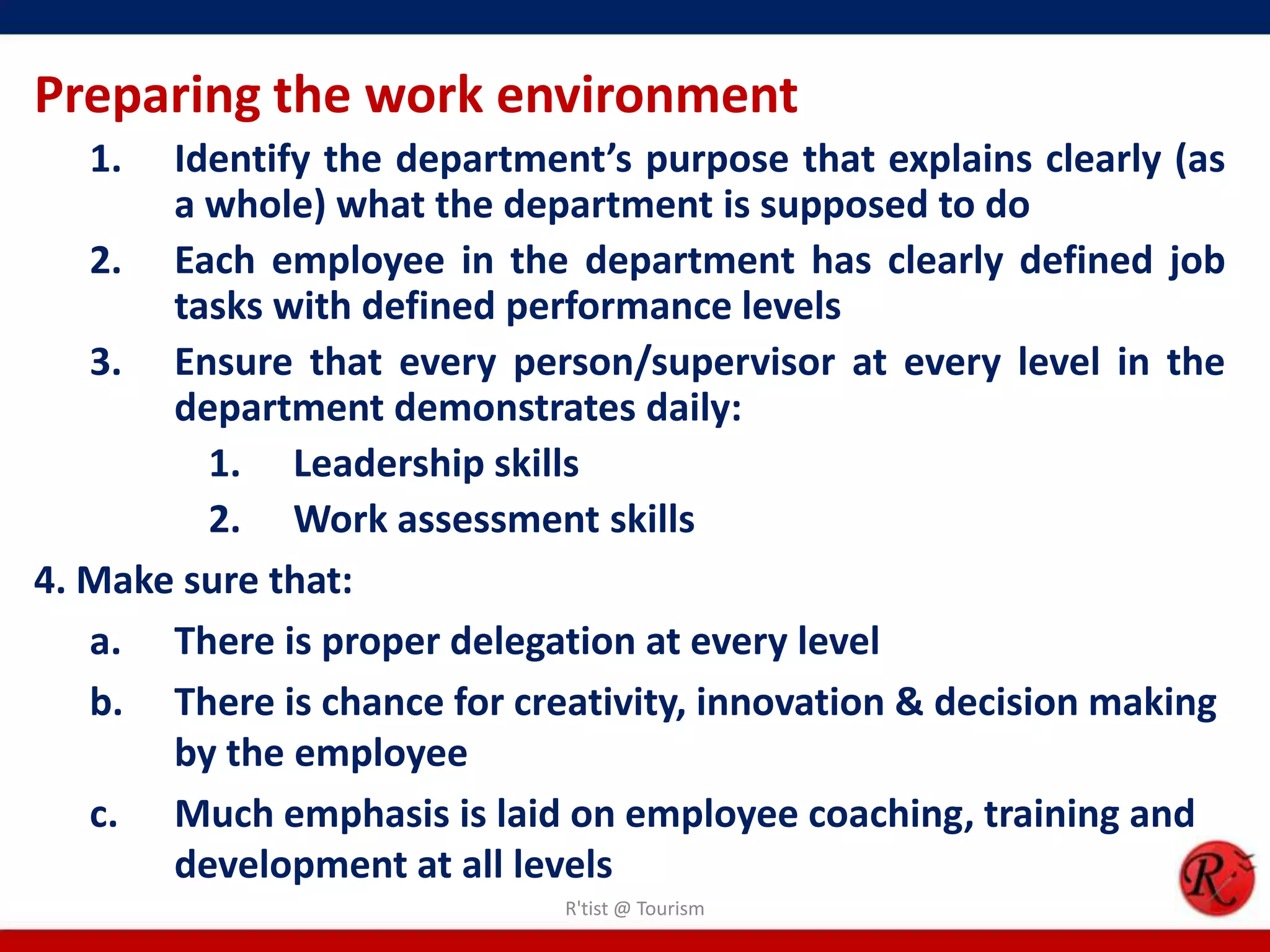
Preparing the work environment
   1.  Identify the department’s purpose that explains clearly (as
       a whole) what the department is supposed to do
   2. Each employee in the department has clearly defined job
       tasks with defined performance levels
   3. Ensure that every person/supervisor at every level in the
       department demonstrates daily:
         1. Leadership skills
         2. Work assessment skills
4. Make sure that:
   a. There is proper delegation at every level
   b. There is chance for creativity, innovation & decision making
       by the employee
   c. Much emphasis is laid on employee coaching, training and
       development at all levels
                             R'tist @ Tourism
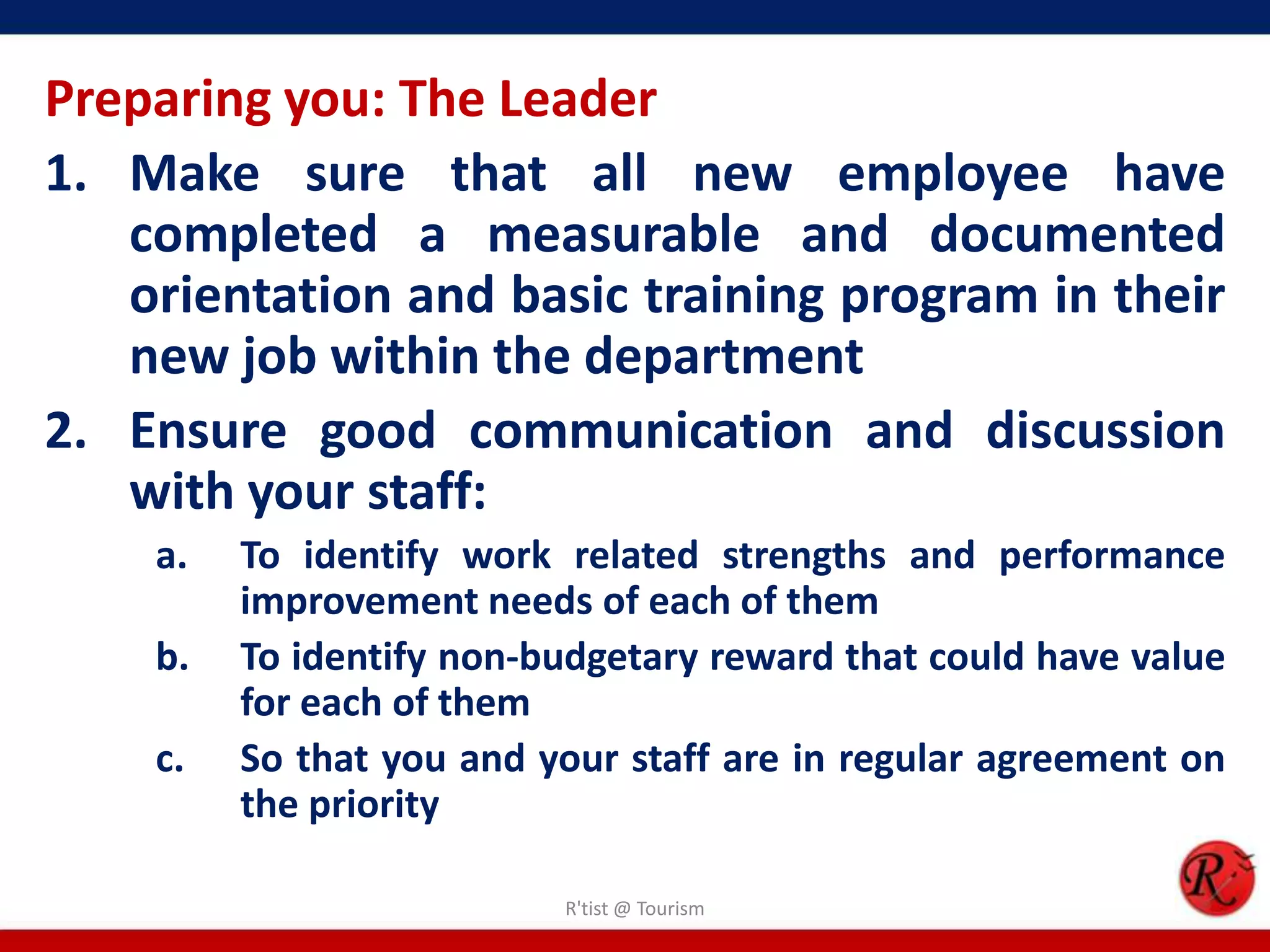
Preparing you: The Leader
1. Make sure that all new employee have
   completed a measurable and documented
   orientation and basic training program in their
   new job within the department
2. Ensure good communication and discussion
   with your staff:
    a.   To identify work related strengths and performance
         improvement needs of each of them
    b.   To identify non-budgetary reward that could have value
         for each of them
    c.   So that you and your staff are in regular agreement on
         the priority

                          R'tist @ Tourism
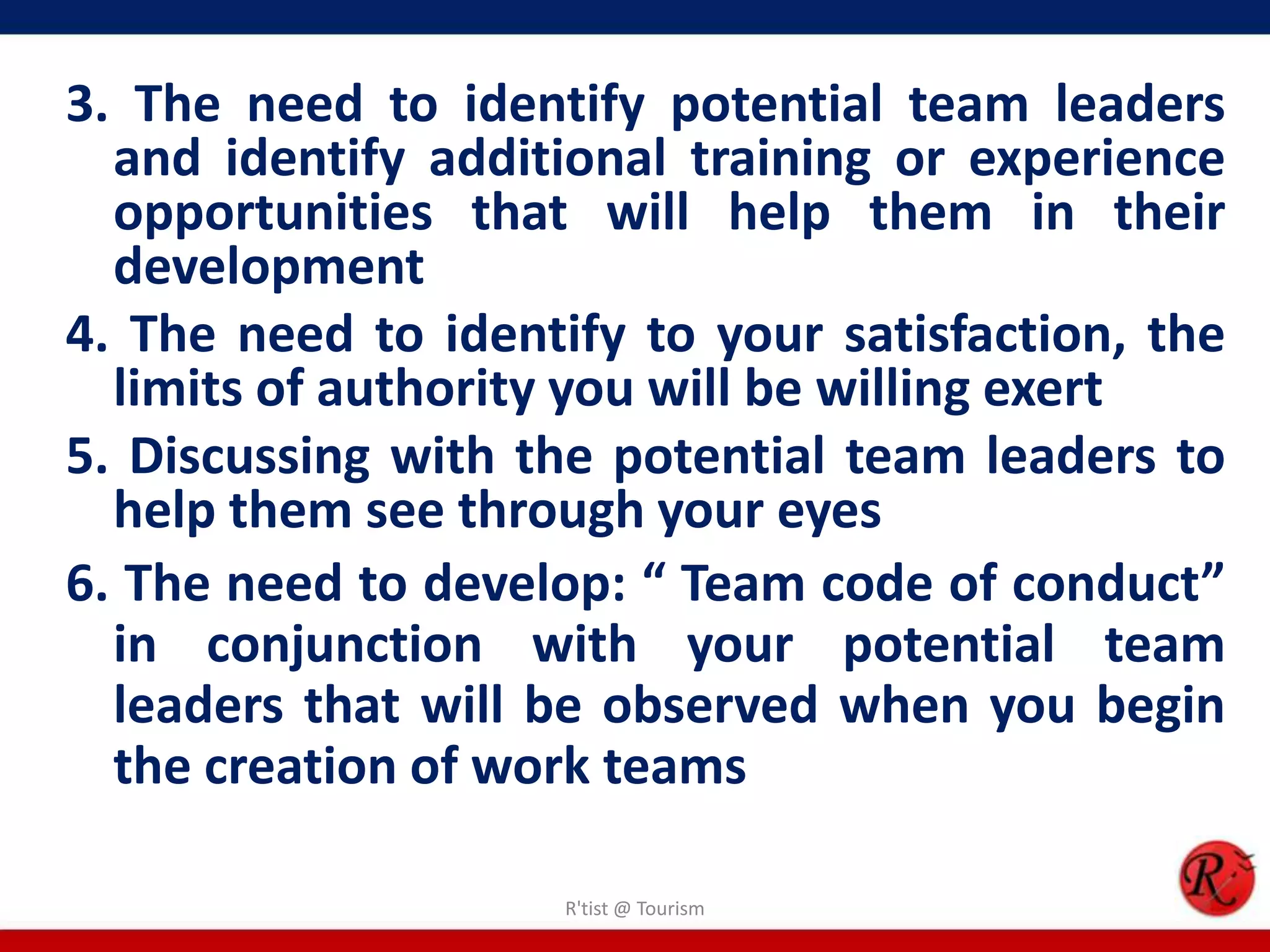
3. The need to identify potential team leaders
  and identify additional training or experience
  opportunities that will help them in their
  development
4. The need to identify to your satisfaction, the
  limits of authority you will be willing exert
5. Discussing with the potential team leaders to
  help them see through your eyes
6. The need to develop: “ Team code of conduct”
  in conjunction with your potential team
  leaders that will be observed when you begin
  the creation of work teams

                     R'tist @ Tourism
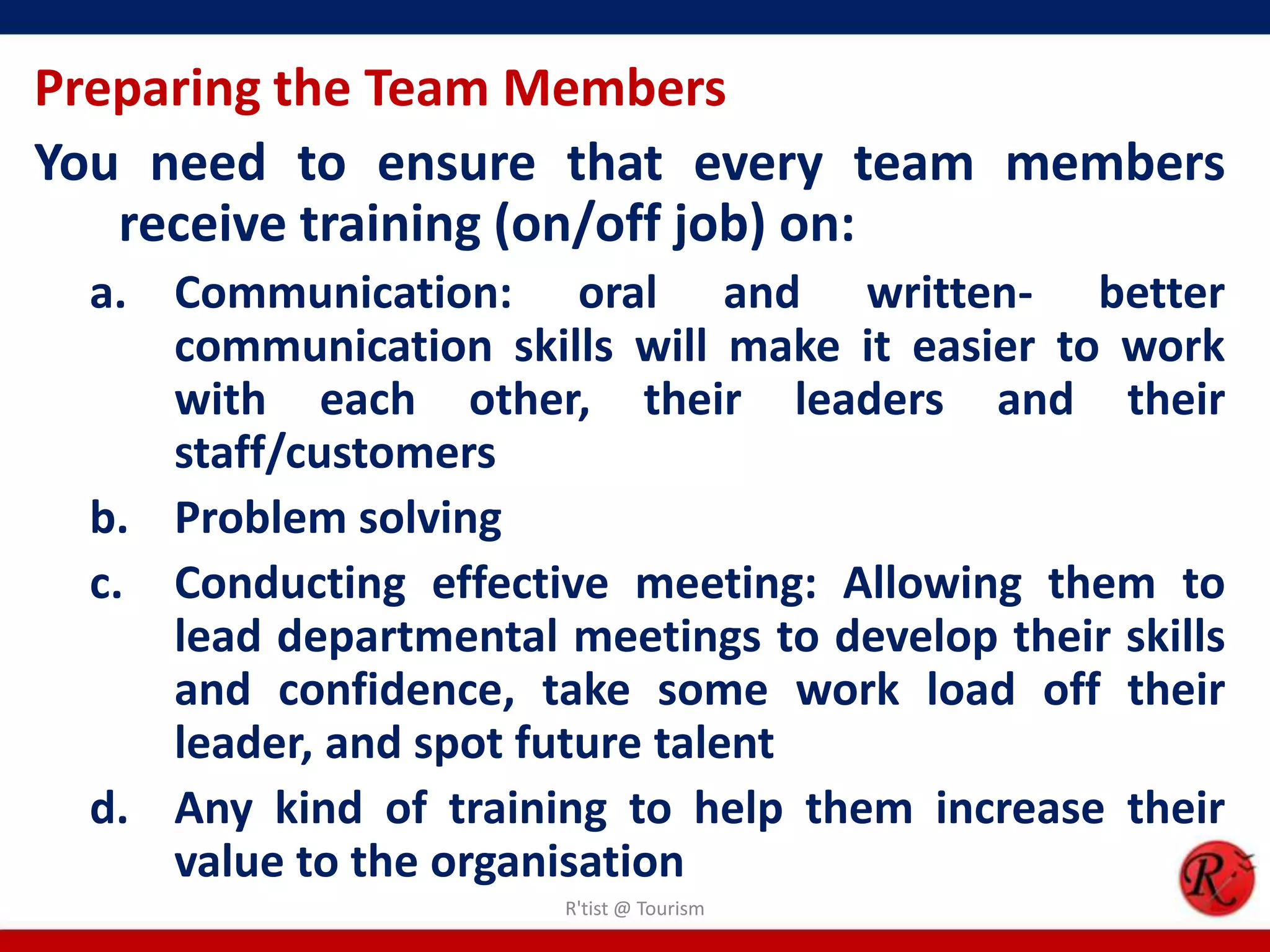
Preparing the Team Members
You need to ensure that every team members
   receive training (on/off job) on:
 a. Communication: oral and written- better
    communication skills will make it easier to work
    with each other, their leaders and their
    staff/customers
 b. Problem solving
 c. Conducting effective meeting: Allowing them to
    lead departmental meetings to develop their skills
    and confidence, take some work load off their
    leader, and spot future talent
 d. Any kind of training to help them increase their
    value to the organisation
                       R'tist @ Tourism
Leadership & Team building
• We have to bear in mind that Leadership &
  Team building cannot “function in isolation”,
  they are related to the behaviour of people in
  organisation
• Some VERY IMPORTANT ISSUES to consider:
  6 Issues in Organisation
     •   Communication
     •   Motivation
     •   Personality, perception & decision making
     •   Learning & learning organisation
     •   Values, attitude & job satisfaction
     •   Conflict management
                             R'tist @ Tourism
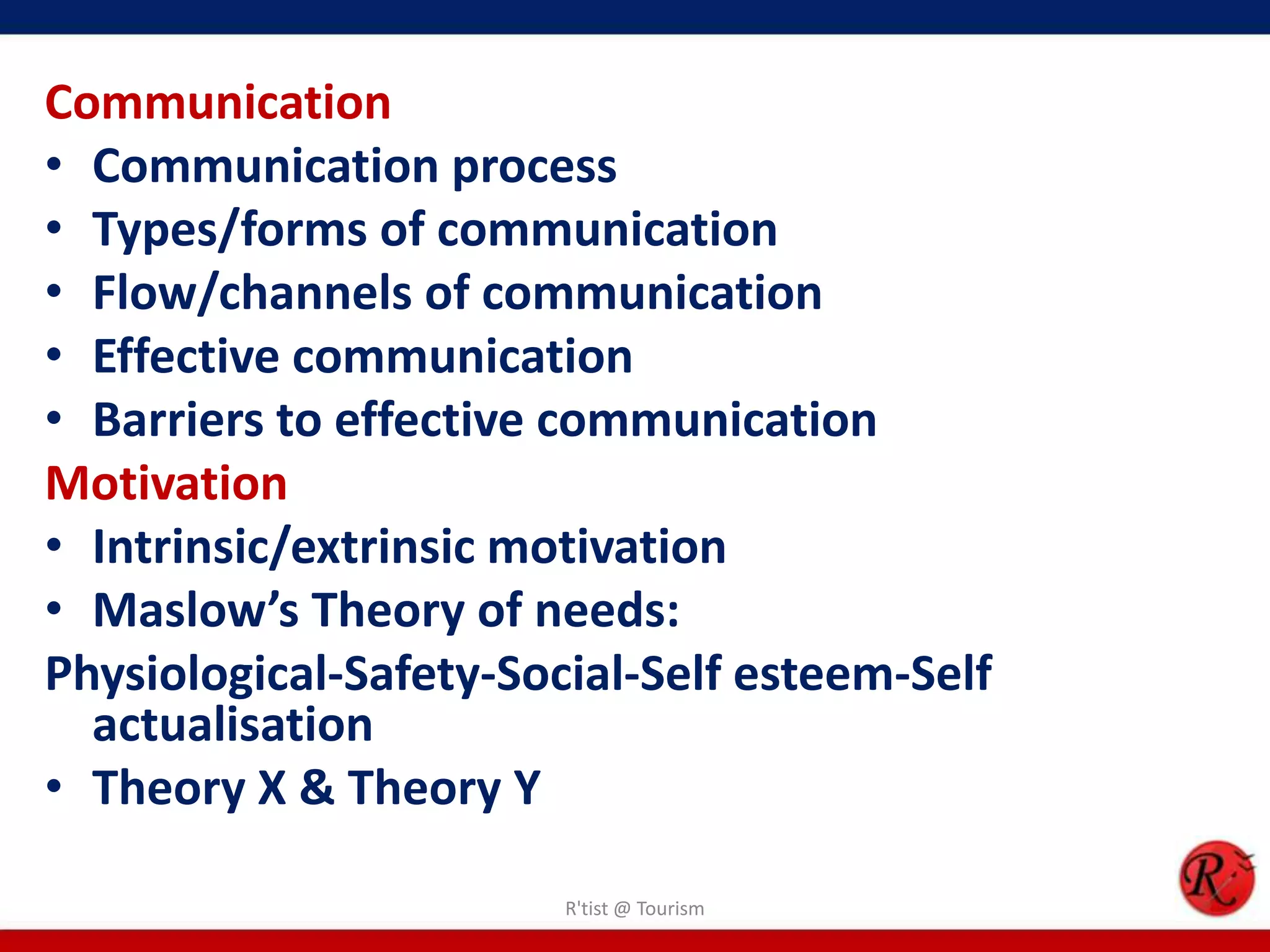
Communication
• Communication process
• Types/forms of communication
• Flow/channels of communication
• Effective communication
• Barriers to effective communication
Motivation
• Intrinsic/extrinsic motivation
• Maslow’s Theory of needs:
Physiological-Safety-Social-Self esteem-Self
  actualisation
• Theory X & Theory Y

                        R'tist @ Tourism
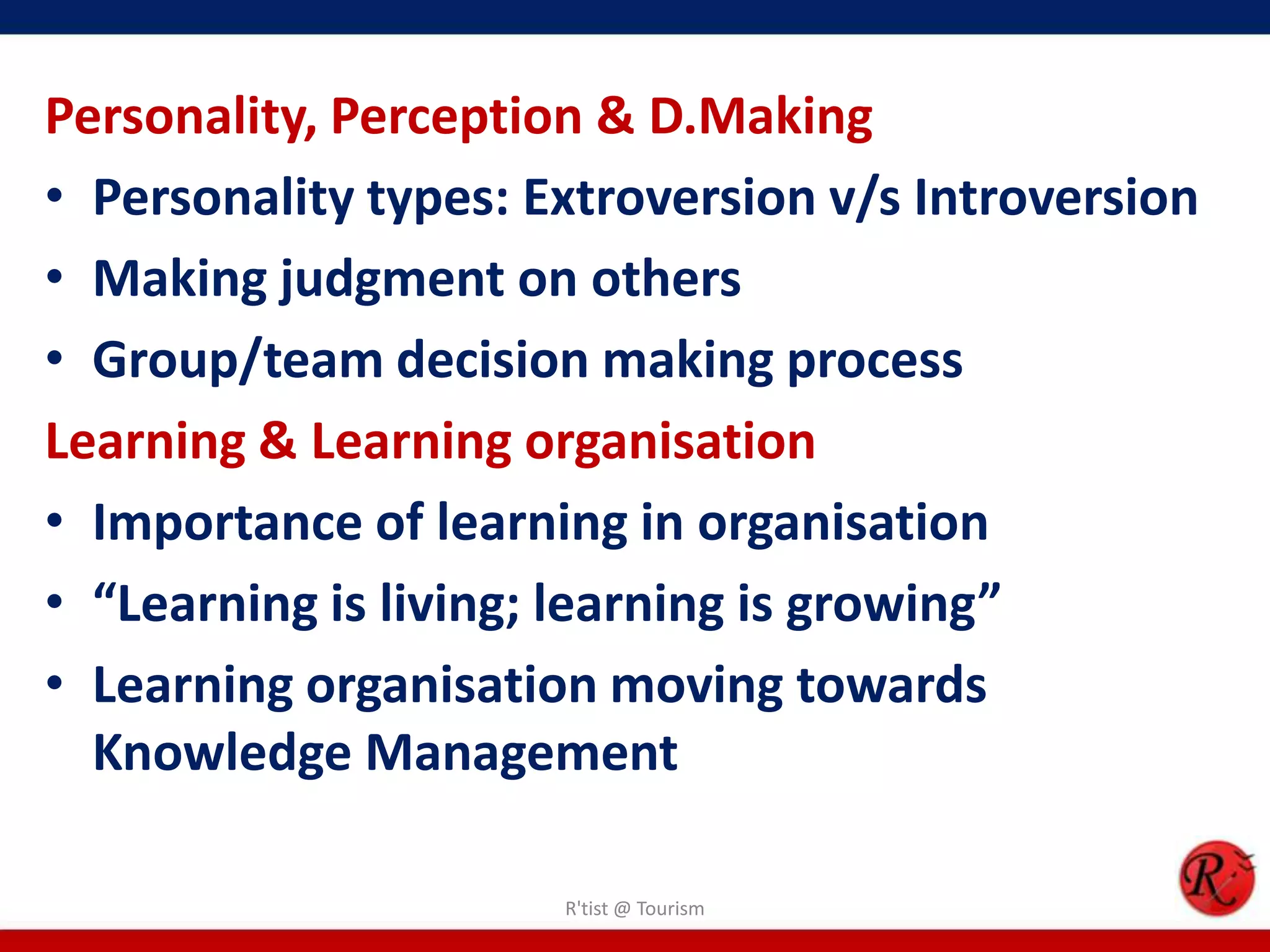
Personality, Perception & D.Making
• Personality types: Extroversion v/s Introversion
• Making judgment on others
• Group/team decision making process
Learning & Learning organisation
• Importance of learning in organisation
• “Learning is living; learning is growing”
• Learning organisation moving towards
  Knowledge Management

                      R'tist @ Tourism
Values, Attitude & J.Satisfaction
• Values: Importance
• Attitudes at work & towards work
• Factors leading to Job satisfaction: challenging
  work, rewards, work environment & work
  condition etc
Conflict Management
• Strategies for managing conflict:
  –   Communication
  –   Compromise
  –   Authoritative command
  –   Negotiation

                         R'tist @ Tourism
Thank You…!!!
©Ramakrishna Kongalla
e-mail: artist.ramakrishna@gmail.com


             R'tist @ Tourism

Team Building

  • 1.
    Team Building © RamakrishnaKongalla, Assistant Professor R'tist @ Tourism
  • 2.
    • Today withthe growing complexity of society and the continuing development of technological capability, more organisational life will revolve around group and team structures • The contribution of teams and groups will find accrued importance in the decision making process R'tist @ Tourism
  • 3.
    Group Development • Formingstage: is characterised by the development of interpersonal relationships, identification of goals and the establishment of behaviour norms among the members • Storming stage: is characterised by intra-group conflict. e.g conflict over leadership, goals etc • Norming stage: is where members of the group understand what is expected of them and where the leadership structure is clear • Performing stage: This stage results in an effective well-integrated group that performs the required task effectively & efficiently • Adjourning stage: When the task is completed, the group prepares for its winding up. R'tist @ Tourism
  • 4.
    Teams • The teambased structures approach is in line with the human aspect of management that has sought to encourage and sustain motivation and commitment of staff as a way of enhancing and advancing the cause of both productivity for the organisation and providing a satisfying environment for employees R'tist @ Tourism
  • 5.
    Definition of Team •“a small number of people with complementary skills who are committed to a common purpose, performance, goal and approach for which they hold themselves mutually accountable” R'tist @ Tourism
  • 6.
    Preparation for effectiveTeam Building • Effective work teams do not just happen miraculously; they are the result of careful planning and preparation. • The need for: • Preparing the work environment • Preparing you: the Leader • Preparing team members R'tist @ Tourism
  • 7.
    Preparing the workenvironment 1. Identify the department’s purpose that explains clearly (as a whole) what the department is supposed to do 2. Each employee in the department has clearly defined job tasks with defined performance levels 3. Ensure that every person/supervisor at every level in the department demonstrates daily: 1. Leadership skills 2. Work assessment skills 4. Make sure that: a. There is proper delegation at every level b. There is chance for creativity, innovation & decision making by the employee c. Much emphasis is laid on employee coaching, training and development at all levels R'tist @ Tourism
  • 8.
    Preparing you: TheLeader 1. Make sure that all new employee have completed a measurable and documented orientation and basic training program in their new job within the department 2. Ensure good communication and discussion with your staff: a. To identify work related strengths and performance improvement needs of each of them b. To identify non-budgetary reward that could have value for each of them c. So that you and your staff are in regular agreement on the priority R'tist @ Tourism
  • 9.
    3. The needto identify potential team leaders and identify additional training or experience opportunities that will help them in their development 4. The need to identify to your satisfaction, the limits of authority you will be willing exert 5. Discussing with the potential team leaders to help them see through your eyes 6. The need to develop: “ Team code of conduct” in conjunction with your potential team leaders that will be observed when you begin the creation of work teams R'tist @ Tourism
  • 10.
    Preparing the TeamMembers You need to ensure that every team members receive training (on/off job) on: a. Communication: oral and written- better communication skills will make it easier to work with each other, their leaders and their staff/customers b. Problem solving c. Conducting effective meeting: Allowing them to lead departmental meetings to develop their skills and confidence, take some work load off their leader, and spot future talent d. Any kind of training to help them increase their value to the organisation R'tist @ Tourism
  • 11.
    Leadership & Teambuilding • We have to bear in mind that Leadership & Team building cannot “function in isolation”, they are related to the behaviour of people in organisation • Some VERY IMPORTANT ISSUES to consider: 6 Issues in Organisation • Communication • Motivation • Personality, perception & decision making • Learning & learning organisation • Values, attitude & job satisfaction • Conflict management R'tist @ Tourism
  • 12.
    Communication • Communication process •Types/forms of communication • Flow/channels of communication • Effective communication • Barriers to effective communication Motivation • Intrinsic/extrinsic motivation • Maslow’s Theory of needs: Physiological-Safety-Social-Self esteem-Self actualisation • Theory X & Theory Y R'tist @ Tourism
  • 13.
    Personality, Perception &D.Making • Personality types: Extroversion v/s Introversion • Making judgment on others • Group/team decision making process Learning & Learning organisation • Importance of learning in organisation • “Learning is living; learning is growing” • Learning organisation moving towards Knowledge Management R'tist @ Tourism
  • 14.
    Values, Attitude &J.Satisfaction • Values: Importance • Attitudes at work & towards work • Factors leading to Job satisfaction: challenging work, rewards, work environment & work condition etc Conflict Management • Strategies for managing conflict: – Communication – Compromise – Authoritative command – Negotiation R'tist @ Tourism
  • 15.
    Thank You…!!! ©Ramakrishna Kongalla e-mail:artist.ramakrishna@gmail.com R'tist @ Tourism