Forces for change
Organizational Development
Prepared By
Kindly restrict the use of slides for personal purpose.
Please seek permission to reproduce the same in public forms and presentations.
Manu Melwin Joy
Assistant Professor
Ilahia School of Management Studies
Kerala, India.
Phone – 9744551114
Mail – manu_melwinjoy@yahoo.com
Forces for change
• Given a choice, most organizations
prefer stability to change because
the more predictable and routine
activities are, the higher the level
of efficiency that can be obtained.
Thus, the status quo is preferred in
many cases.
• But organizations are not static;
they are continuously changing in
response to a variety of forces
coming from both inside and
outside. For leaders, the challenge
is to anticipate and direct change
processes so that the performance
is improved.
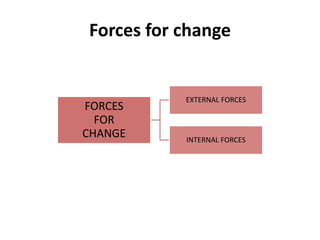
Forces for change
FORCES
FOR
CHANGE
EXTERNAL FORCES
INTERNAL FORCES
External forces
• The major external forces for
change are:-
– Nature of the workforce: Almost
every organization must adjust to
a multicultural environment,
demographic changes,
immigration and outsourcing.
– Technology is continually
changing jobs and organization.
Ex: faster, cheaper and more
mobile computers and handheld
devices.
– Economic shocks: rise and fall of
global housing market, financial
sector collapse, global recession.
External forces
• Competition is changing.
Competitors are as likely to come
from across the ocean as from
across town. Ex: increased
government regulation of
commerce.
• Social trends don’t remain static.
Companies must continually
adjust product and marketing
strategies to be sensitive to
changing social trends. The State
Bank of India did the same when
it started a zero-balance bank
account program for villagers.
Internal forces
• Declining effectiveness is a
pressure to change.
• A company that experiences its
third quarterly loss within a
fiscal year is undoubtedly
motivated to do something
about it.
• Some companies react by
instituting layoffs and massive
cost – cutting programs,
whereas others look at the
bigger picture, view the loss as
symptomatic of an underlying
problem, and seek the cause of
the problem.
Internal forces
• A crisis situation also may stimulate
change in an organization.
• Strikes or walkouts may lead
management to change the wage
structure.
• The resignation of a key decision-maker
is one crisis that causes the company to
rethink the composition of its
management team and its role in the
organization.
• A much-publicized crisis that led to
change with Exxon was the oil spill
accident with Exxon’s Valdez oil tanker.
The accident brought about many
changes in Exxon’s environmental
policies.
Internal forces
• Changes in the work climate at an
organization can also stimulate
change.
• A workforce that seems lethargic,
unmotivated, and dissatisfied is a
symptom that must be addressed.
• This symptom is common in
organizations that have experienced
layoffs.
• Workers who have escaped a layoff
may grieve for those who have lost
their jobs and may find it hard to
continue to be productive.
• They may fear that they will be laid off
as well, and many feel insecure in their
jobs.
Forces for change -  Organizational Change and Development - Manu Melwin Joy

Forces for change - Organizational Change and Development - Manu Melwin Joy

  • 1.
  • 2.
    Prepared By Kindly restrictthe use of slides for personal purpose. Please seek permission to reproduce the same in public forms and presentations. Manu Melwin Joy Assistant Professor Ilahia School of Management Studies Kerala, India. Phone – 9744551114 Mail – manu_melwinjoy@yahoo.com
  • 3.
    Forces for change •Given a choice, most organizations prefer stability to change because the more predictable and routine activities are, the higher the level of efficiency that can be obtained. Thus, the status quo is preferred in many cases. • But organizations are not static; they are continuously changing in response to a variety of forces coming from both inside and outside. For leaders, the challenge is to anticipate and direct change processes so that the performance is improved.
  • 4.
  • 5.
    External forces • Themajor external forces for change are:- – Nature of the workforce: Almost every organization must adjust to a multicultural environment, demographic changes, immigration and outsourcing. – Technology is continually changing jobs and organization. Ex: faster, cheaper and more mobile computers and handheld devices. – Economic shocks: rise and fall of global housing market, financial sector collapse, global recession.
  • 6.
    External forces • Competitionis changing. Competitors are as likely to come from across the ocean as from across town. Ex: increased government regulation of commerce. • Social trends don’t remain static. Companies must continually adjust product and marketing strategies to be sensitive to changing social trends. The State Bank of India did the same when it started a zero-balance bank account program for villagers.
  • 7.
    Internal forces • Decliningeffectiveness is a pressure to change. • A company that experiences its third quarterly loss within a fiscal year is undoubtedly motivated to do something about it. • Some companies react by instituting layoffs and massive cost – cutting programs, whereas others look at the bigger picture, view the loss as symptomatic of an underlying problem, and seek the cause of the problem.
  • 8.
    Internal forces • Acrisis situation also may stimulate change in an organization. • Strikes or walkouts may lead management to change the wage structure. • The resignation of a key decision-maker is one crisis that causes the company to rethink the composition of its management team and its role in the organization. • A much-publicized crisis that led to change with Exxon was the oil spill accident with Exxon’s Valdez oil tanker. The accident brought about many changes in Exxon’s environmental policies.
  • 9.
    Internal forces • Changesin the work climate at an organization can also stimulate change. • A workforce that seems lethargic, unmotivated, and dissatisfied is a symptom that must be addressed. • This symptom is common in organizations that have experienced layoffs. • Workers who have escaped a layoff may grieve for those who have lost their jobs and may find it hard to continue to be productive. • They may fear that they will be laid off as well, and many feel insecure in their jobs.