OD – Interventions
Contents
•   Definition
•   Characteristics of effective intervention
•   Design
•   Intervention overview
•   HR interventions
     –   Sensitivity training
     –   Grid training
     –   Process Consultation
     –   Team Building
     –   MBO
     –   Coaching
     –   Training and Development
     –   Organizational Confrontation Meeting
• Summary
Definition of Interventions
• An intervention is a set of sequenced and
  planned actions or events intended to help
  the organization increase its effectiveness.

• Interventions purposely disrupt the status
  quo.
Characteristics of
            Effective Interventions
• Is it relevant to the needs of the organization?
  – Valid information
  – Free and Informed Choice
  – Internal Commitment
• Does it transfer competence to manage
  change to organization members?
The Design of
               Effective Interventions
• Contingencies of Change Situation
  –    Readiness for Change
  –    Capability to Change
  –    Cultural Context
  –    Capabilities of the Change Agent
• Contingencies Related to the Target of Change
  –   Strategic Issues
  –   Technology and structure issues
  –   Human resources issues
  –   Human process issues
Intervention Overview
• Human Process Interventions
• Techno structural Interventions
• Human Resources Management
  Interventions
• Strategic Interventions
Human Process Interventions
•   Sensitivity training
•   Grid training
•   Process Consultation
•   Team Building
•   MBO
•   Coaching
•   Training and Development
•   Organizational Confrontation Meeting
Techno structural Interventions
• Structural Design
• Downsizing
• Reengineering
• Employee Involvement
• Work Design
Human Resources Management
             Interventions
• Goal Setting
• Performance Appraisal
• Reward Systems
• Career Planning and Development
• Managing Work Force Diversity
• Employee Stress and Wellness
Strategic Interventions
• Integrated Strategic Change
• Mergers and Acquisitions
• Alliances and Networks
• Culture Change
• Self-designing Organizations
• Organization Learning and Knowledge
  Management
Sensitivity Training – T groups
• Kurt Lewin & friends – 1946
• Development of “T group”
• Stranger lab – people from different
  organization.
• Cousin lab- same, but various departments
• Family lab – “Back home” people in situations
  and problem
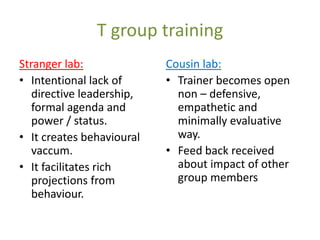
T group training
Stranger lab:              Cousin lab:
• Intentional lack of      • Trainer becomes open
   directive leadership,     non – defensive,
   formal agenda and         empathetic and
   power / status.           minimally evaluative
• It creates behavioural     way.
   vaccum.                 • Feed back received
• It facilitates rich        about impact of other
   projections from          group members
   behaviour.
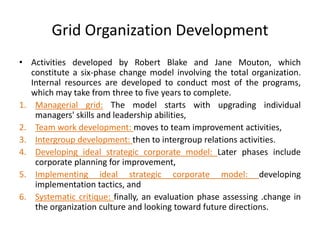
Grid Organization Development
• Activities developed by Robert Blake and Jane Mouton, which
   constitute a six-phase change model involving the total organization.
   Internal resources are developed to conduct most of the programs,
   which may take from three to five years to complete.
1. Managerial grid: The model starts with upgrading individual
    managers' skills and leadership abilities,
2. Team work development: moves to team improvement activities,
3. Intergroup development: then to intergroup relations activities.
4. Developing ideal strategic corporate model: Later phases include
    corporate planning for improvement,
5. Implementing ideal strategic corporate model: developing
    implementation tactics, and
6. Systematic critique: finally, an evaluation phase assessing .change in
    the organization culture and looking toward future directions.
Survey Feedback
• Activities that rely on questionnaire surveys to
  generate information that is then used to
  identify problems and opportunities. Groups
  analyze the data regarding; their performance
  and design action plans to correct problems.
  1. Data collection
  2. Feedback of information
  3. Follow up action
Process Consultation
• Activities       that     "help      the    client   to
  perceive, understand, and act upon process events which
  occur in the client's environment.'" .
• These activities perhaps more accurately describe an
  approach, a consulting mode in which the client gains
  insight into the human processes in organizations and
  learn skills in diagnosing and managing them.
• Primary emphasis is on processes such as
  communications, leader and member roles in
  groups, problem solving and decision making, group
  norms and group growth, leadership and authority, and
  intergroup cooperation and competition. '
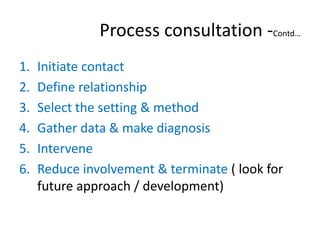
Process consultation -Contd…
1.   Initiate contact
2.   Define relationship
3.   Select the setting & method
4.   Gather data & make diagnosis
5.   Intervene
6.   Reduce involvement & terminate ( look for
     future approach / development)
Team-Building Activities
• Activities designed to enhance the effective operation of
  system teams.
• These activities focus on task issues such as the way
  things are done, the skills and resources needed to
  accomplish tasks, the quality of relationship among the
  team members or between members and the leader, and
  how well the team gets its job done.
• In addition, one must consider different kinds of teams,
  such as formal work teams, temporary tasks force teams,
  newly constituted teams, and cross-functional teams.
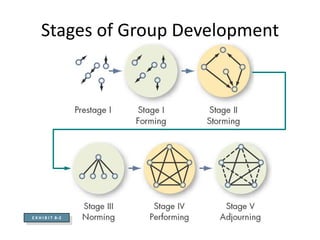
Life cycle of team
•   Forming
•   Storming
•   Norming
•   Performing
•   Adjourning
Stages of Group Development


E X H I B I T 8–2
Effective teams
•   Skills & Roll clarity
•   Supportive environment
•   Super – ordinate goals
•   Team rewards
Team building process
•   Problem sensing
•   Examining differences
•   Giving & receiving feedback
•   Developing interactive skills
    – Constructive behaviour
    – Negative behaviour
• Follow up action
MBO
• Peter Drucker coined in 1964.
• It is a comprehensive managerial system that
  integrates many managerial activities in a
  systematic manner, consciously towards
  effective and efficient achivement of
  organizational objectives”.
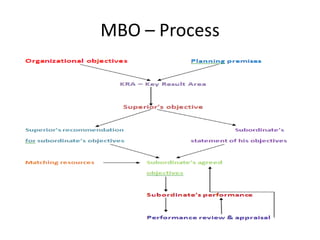
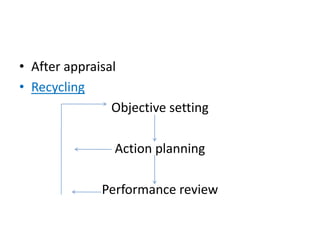
MBO – Process
• After appraisal
• Recycling
                Objective setting

                Action planning

              Performance review
Education and Training Activities.
• Activities designed to improve individuals' skills, abilities, and
  knowledge. Several activities are available and several approaches
  possible.
• For example, the individual can be educated in isolation from his or her
  own work group (say, in a T-group consisting of strangers), or one can
  be educated in relation to the work group (say, when a work team
  learns how better to manage interpersonal conflict). The activities may
  be directed toward technical skills required for performing tasks or
  may be directed toward improving interpersonal competence.
• The activities may be directed toward leadership issues,
  responsibilities and functions of group members, decision-making,
  problem solving, goal setting and planning, and so forth.
Coaching and Counseling
• Activities that entail the consultant or other organization
  members working with individuals to help
• (a) define learning goals,
• (b) learn how others see their behavior, and
• (c) learn new behaviors to help them better achieve their
  goals. A central feature of this activity is non evaluative
  feedback others give to an individual.
• A second feature is the second exploration of alternative
  behaviors.

Od unit 3 interventions

  • 1.
  • 2.
    Contents • Definition • Characteristics of effective intervention • Design • Intervention overview • HR interventions – Sensitivity training – Grid training – Process Consultation – Team Building – MBO – Coaching – Training and Development – Organizational Confrontation Meeting • Summary
  • 3.
    Definition of Interventions •An intervention is a set of sequenced and planned actions or events intended to help the organization increase its effectiveness. • Interventions purposely disrupt the status quo.
  • 4.
    Characteristics of Effective Interventions • Is it relevant to the needs of the organization? – Valid information – Free and Informed Choice – Internal Commitment • Does it transfer competence to manage change to organization members?
  • 5.
    The Design of Effective Interventions • Contingencies of Change Situation – Readiness for Change – Capability to Change – Cultural Context – Capabilities of the Change Agent • Contingencies Related to the Target of Change – Strategic Issues – Technology and structure issues – Human resources issues – Human process issues
  • 6.
    Intervention Overview • HumanProcess Interventions • Techno structural Interventions • Human Resources Management Interventions • Strategic Interventions
  • 7.
    Human Process Interventions • Sensitivity training • Grid training • Process Consultation • Team Building • MBO • Coaching • Training and Development • Organizational Confrontation Meeting
  • 8.
    Techno structural Interventions •Structural Design • Downsizing • Reengineering • Employee Involvement • Work Design
  • 9.
    Human Resources Management Interventions • Goal Setting • Performance Appraisal • Reward Systems • Career Planning and Development • Managing Work Force Diversity • Employee Stress and Wellness
  • 10.
    Strategic Interventions • IntegratedStrategic Change • Mergers and Acquisitions • Alliances and Networks • Culture Change • Self-designing Organizations • Organization Learning and Knowledge Management
  • 11.
    Sensitivity Training –T groups • Kurt Lewin & friends – 1946 • Development of “T group” • Stranger lab – people from different organization. • Cousin lab- same, but various departments • Family lab – “Back home” people in situations and problem
  • 12.
    T group training Strangerlab: Cousin lab: • Intentional lack of • Trainer becomes open directive leadership, non – defensive, formal agenda and empathetic and power / status. minimally evaluative • It creates behavioural way. vaccum. • Feed back received • It facilitates rich about impact of other projections from group members behaviour.
  • 13.
    Grid Organization Development •Activities developed by Robert Blake and Jane Mouton, which constitute a six-phase change model involving the total organization. Internal resources are developed to conduct most of the programs, which may take from three to five years to complete. 1. Managerial grid: The model starts with upgrading individual managers' skills and leadership abilities, 2. Team work development: moves to team improvement activities, 3. Intergroup development: then to intergroup relations activities. 4. Developing ideal strategic corporate model: Later phases include corporate planning for improvement, 5. Implementing ideal strategic corporate model: developing implementation tactics, and 6. Systematic critique: finally, an evaluation phase assessing .change in the organization culture and looking toward future directions.
  • 14.
    Survey Feedback • Activitiesthat rely on questionnaire surveys to generate information that is then used to identify problems and opportunities. Groups analyze the data regarding; their performance and design action plans to correct problems. 1. Data collection 2. Feedback of information 3. Follow up action
  • 15.
    Process Consultation • Activities that "help the client to perceive, understand, and act upon process events which occur in the client's environment.'" . • These activities perhaps more accurately describe an approach, a consulting mode in which the client gains insight into the human processes in organizations and learn skills in diagnosing and managing them. • Primary emphasis is on processes such as communications, leader and member roles in groups, problem solving and decision making, group norms and group growth, leadership and authority, and intergroup cooperation and competition. '
  • 16.
    Process consultation -Contd… 1. Initiate contact 2. Define relationship 3. Select the setting & method 4. Gather data & make diagnosis 5. Intervene 6. Reduce involvement & terminate ( look for future approach / development)
  • 17.
    Team-Building Activities • Activitiesdesigned to enhance the effective operation of system teams. • These activities focus on task issues such as the way things are done, the skills and resources needed to accomplish tasks, the quality of relationship among the team members or between members and the leader, and how well the team gets its job done. • In addition, one must consider different kinds of teams, such as formal work teams, temporary tasks force teams, newly constituted teams, and cross-functional teams.
  • 18.
    Life cycle ofteam • Forming • Storming • Norming • Performing • Adjourning
  • 19.
    Stages of GroupDevelopment E X H I B I T 8–2
  • 20.
    Effective teams • Skills & Roll clarity • Supportive environment • Super – ordinate goals • Team rewards
  • 21.
    Team building process • Problem sensing • Examining differences • Giving & receiving feedback • Developing interactive skills – Constructive behaviour – Negative behaviour • Follow up action
  • 22.
    MBO • Peter Druckercoined in 1964. • It is a comprehensive managerial system that integrates many managerial activities in a systematic manner, consciously towards effective and efficient achivement of organizational objectives”.
  • 23.
  • 24.
    • After appraisal •Recycling Objective setting Action planning Performance review
  • 25.
    Education and TrainingActivities. • Activities designed to improve individuals' skills, abilities, and knowledge. Several activities are available and several approaches possible. • For example, the individual can be educated in isolation from his or her own work group (say, in a T-group consisting of strangers), or one can be educated in relation to the work group (say, when a work team learns how better to manage interpersonal conflict). The activities may be directed toward technical skills required for performing tasks or may be directed toward improving interpersonal competence. • The activities may be directed toward leadership issues, responsibilities and functions of group members, decision-making, problem solving, goal setting and planning, and so forth.
  • 26.
    Coaching and Counseling •Activities that entail the consultant or other organization members working with individuals to help • (a) define learning goals, • (b) learn how others see their behavior, and • (c) learn new behaviors to help them better achieve their goals. A central feature of this activity is non evaluative feedback others give to an individual. • A second feature is the second exploration of alternative behaviors.