Action research
OD Process
Prepared By
Kindly restrict the use of slides for personal purpose.
Please seek permission to reproduce the same in public forms and presentations.
Manu Melwin Joy
Assistant Professor
Ilahia School of Management Studies
Kerala, India.
Phone – 9744551114
Mail – manu_melwinjoy@yahoo.com
Action Research
• Dual purpose of action
research:
– Making action more
effective.
– Building a body of scientific
knowledge around that
action.
• Action refers to: Programs
and interventions
designed to solve
problems and improve
conditions.
A Process and An Approach
• Action research is a process, an
ongoing series of events and
actions.
• Definition:
– Action research is the process of
systematically collecting research
data about an ongoing system
relative to some objective, goal, or
need of that system;
– feeding these data back into the
system;
– taking actions by altering selected
variables within the system based
both on the data and on hypotheses;
and
– evaluating the results of actions by
collecting more data.
Action research
• It was conceptualized by Kurt Lewin
and later elaborated and expanded
on by other behavioral scientists.
• Concerned with social change and,
more particularly, with effective,
permanent social change, Lewin
believed that the motivation to
change was strongly related to
action.
• If people are active in decisions
affecting them, they are more likely to
adopt new ways.
• "Rational social management", he
said, "proceeds in a spiral of steps,
each of which is composed of a circle
of planning, action, and fact-finding
about the result of action".
Kurt Lewin’s Action Research Model
• The process of change
involves three steps
– Unfreezing: Faced with a
dilemma or disconfirmation,
the individual or group
becomes aware of a need to
change.
– Changing: The situation is
diagnosed and new models of
behavior are explored and
tested.
– Refreezing: Application of
new behavior is evaluated,
and if reinforcing, adopted.
Action research
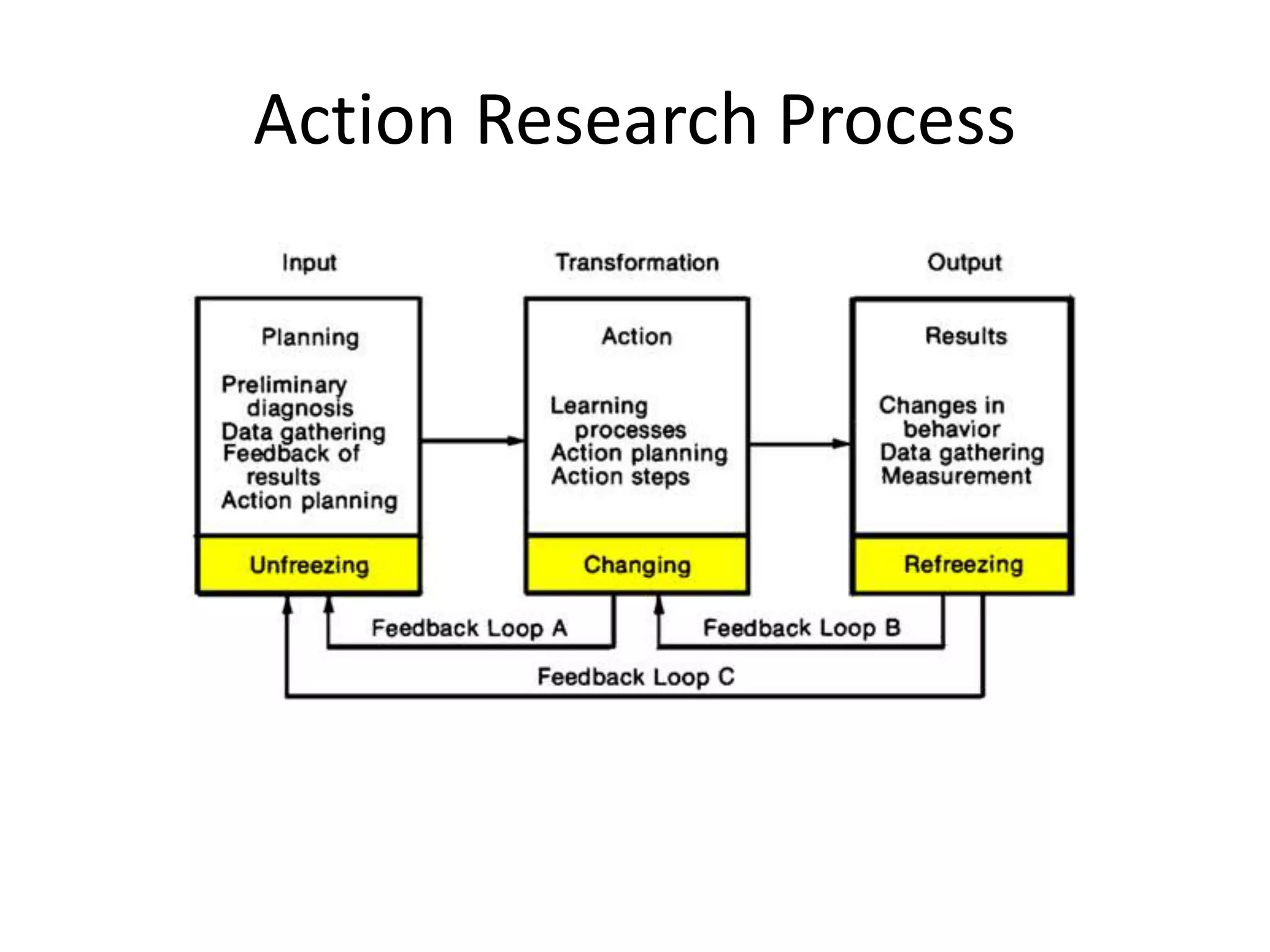
• Action research is depicted
as a cyclical process of
change.
• The cycle begins with a
series of planning actions
initiated by the client and
the change agent working
together.
• The principal elements of
this stage include a
preliminary diagnosis, data
gathering, feedback of
results, and joint action
planning.
Action research
• In the language of
systems theory, this is the
input phase, in which the
client system becomes
aware of problems as yet
unidentified, realizes it
may need outside help to
effect changes, and
shares with the
consultant the process of
problem diagnosis.
Action research
• The second stage of
action research is the
action, or transformation,
phase.
• This stage includes actions
relating to learning
processes (perhaps in the
form of role analysis) and
to planning and executing
behavioral changes in the
client organization.
Action research
• Included in this stage is
action-planning activity
carried out jointly by the
consultant and members
of the client system.
• Following the workshop or
learning sessions, these
action steps are carried
out on the job as part of
the transformation stage.
Action research
• The third stage of action
research is the output, or
results, phase.
• This stage includes actual
changes in behavior (if any)
resulting from corrective
action steps taken following
the second stage.
Action research
• Data are again gathered from
the client system so that
progress can be determined
and necessary adjustments in
learning activities can be
made.
• Minor adjustments of this
nature can be made in
learning activities via
Feedback Loop B.
• Major adjustments and
reevaluations would return
the OD project to the first, or
planning, stage for basic
changes in the program.
Action research
• Data are not simply returned
in the form of a written
report but instead are fed
back in open joint sessions,
and the client and the change
agent collaborate in
identifying and ranking
specific problems, in devising
methods for finding their real
causes, and in developing
plans for coping with them
realistically and practically.
Action research
• Scientific method in
the form of data
gathering, forming
hypotheses, testing
hypotheses, and
measuring results,
although not pursued
as rigorously as in the
laboratory, is
nevertheless an
integral part of the
process.
Action research
• Also sets in motion a
long-range, cyclical,
self-correcting
mechanism for
maintaining and
enhancing the
effectiveness of the
client's system by
leaving the system with
practical and useful
tools for self-analysis
and self-renewal.
Action Research Process
Action research  - OD process -  Organizational Change and Development - Manu Melwin Joy

Action research - OD process - Organizational Change and Development - Manu Melwin Joy

  • 1.
  • 2.
    Prepared By Kindly restrictthe use of slides for personal purpose. Please seek permission to reproduce the same in public forms and presentations. Manu Melwin Joy Assistant Professor Ilahia School of Management Studies Kerala, India. Phone – 9744551114 Mail – manu_melwinjoy@yahoo.com
  • 3.
    Action Research • Dualpurpose of action research: – Making action more effective. – Building a body of scientific knowledge around that action. • Action refers to: Programs and interventions designed to solve problems and improve conditions.
  • 4.
    A Process andAn Approach • Action research is a process, an ongoing series of events and actions. • Definition: – Action research is the process of systematically collecting research data about an ongoing system relative to some objective, goal, or need of that system; – feeding these data back into the system; – taking actions by altering selected variables within the system based both on the data and on hypotheses; and – evaluating the results of actions by collecting more data.
  • 5.
    Action research • Itwas conceptualized by Kurt Lewin and later elaborated and expanded on by other behavioral scientists. • Concerned with social change and, more particularly, with effective, permanent social change, Lewin believed that the motivation to change was strongly related to action. • If people are active in decisions affecting them, they are more likely to adopt new ways. • "Rational social management", he said, "proceeds in a spiral of steps, each of which is composed of a circle of planning, action, and fact-finding about the result of action".
  • 6.
    Kurt Lewin’s ActionResearch Model • The process of change involves three steps – Unfreezing: Faced with a dilemma or disconfirmation, the individual or group becomes aware of a need to change. – Changing: The situation is diagnosed and new models of behavior are explored and tested. – Refreezing: Application of new behavior is evaluated, and if reinforcing, adopted.
  • 7.
    Action research • Actionresearch is depicted as a cyclical process of change. • The cycle begins with a series of planning actions initiated by the client and the change agent working together. • The principal elements of this stage include a preliminary diagnosis, data gathering, feedback of results, and joint action planning.
  • 8.
    Action research • Inthe language of systems theory, this is the input phase, in which the client system becomes aware of problems as yet unidentified, realizes it may need outside help to effect changes, and shares with the consultant the process of problem diagnosis.
  • 9.
    Action research • Thesecond stage of action research is the action, or transformation, phase. • This stage includes actions relating to learning processes (perhaps in the form of role analysis) and to planning and executing behavioral changes in the client organization.
  • 10.
    Action research • Includedin this stage is action-planning activity carried out jointly by the consultant and members of the client system. • Following the workshop or learning sessions, these action steps are carried out on the job as part of the transformation stage.
  • 11.
    Action research • Thethird stage of action research is the output, or results, phase. • This stage includes actual changes in behavior (if any) resulting from corrective action steps taken following the second stage.
  • 12.
    Action research • Dataare again gathered from the client system so that progress can be determined and necessary adjustments in learning activities can be made. • Minor adjustments of this nature can be made in learning activities via Feedback Loop B. • Major adjustments and reevaluations would return the OD project to the first, or planning, stage for basic changes in the program.
  • 13.
    Action research • Dataare not simply returned in the form of a written report but instead are fed back in open joint sessions, and the client and the change agent collaborate in identifying and ranking specific problems, in devising methods for finding their real causes, and in developing plans for coping with them realistically and practically.
  • 14.
    Action research • Scientificmethod in the form of data gathering, forming hypotheses, testing hypotheses, and measuring results, although not pursued as rigorously as in the laboratory, is nevertheless an integral part of the process.
  • 15.
    Action research • Alsosets in motion a long-range, cyclical, self-correcting mechanism for maintaining and enhancing the effectiveness of the client's system by leaving the system with practical and useful tools for self-analysis and self-renewal.
  • 16.