Vernier Calipers
Chapter 5- Measurement
Introduction
 Vernier calipers are tools used in home,
small shop, and industrial settings.
 They are used to make precise length
measurements.
Introduction
 Some reasons for their popularity
include:
 Wide measuring range (usually 0 - 6”).
 English and metric scales are usually
found on the same instrument.
 Many different kinds of measurements
can be made with a caliper...
Introduction
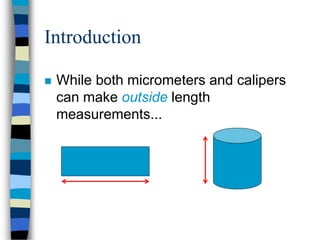
 While both micrometers and calipers
can make outside length
measurements...
Introduction
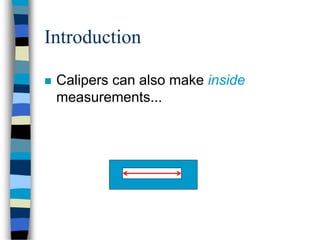
 Calipers can also make inside
measurements...
Introduction
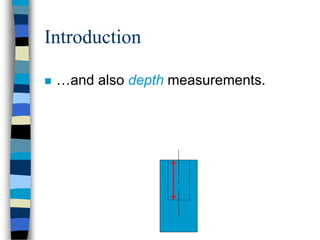
 …and also depth measurements.
Introduction
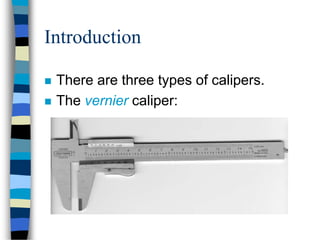
 There are three types of calipers.
 The vernier caliper:
Introduction
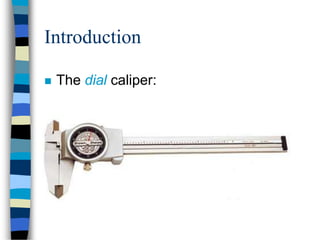
 The dial caliper:
Introduction
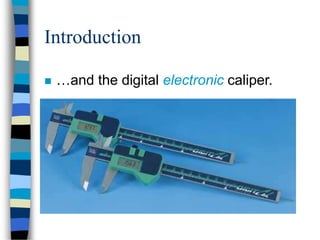
 …and the digital electronic caliper.
Introduction
 In this lesson, we will concentrate on
the vernier caliper since it takes the
most skill to read.
Introduction
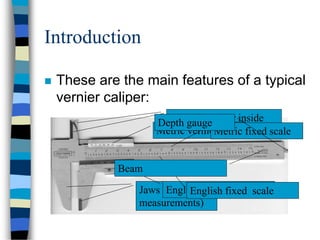
 These are the main features of a typical
vernier caliper:
Jaws (for outside
measurements)
Small jaws (for inside
measurements)Metric vernier scaleMetric fixed scale
English vernier scaleEnglish fixed scale
Beam
Depth gauge
Introduction
and
Example 1
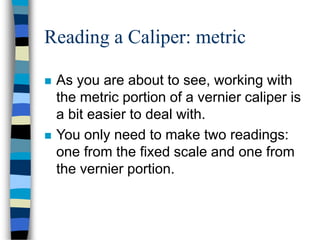
Reading a Caliper: metric
 As you are about to see, working with
the metric portion of a vernier caliper is
a bit easier to deal with.
 You only need to make two readings:
one from the fixed scale and one from
the vernier portion.
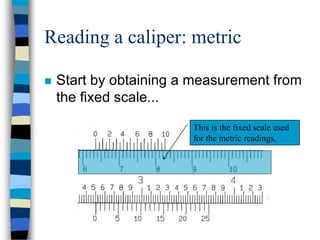
Reading a caliper: metric
 Start by obtaining a measurement from
the fixed scale...
This is the fixed scale used
for the metric readings.
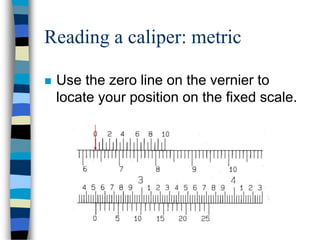
Reading a caliper: metric
 Use the zero line on the vernier to
locate your position on the fixed scale.
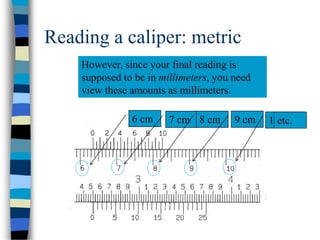
Reading a caliper: metric
Each number printed on the
metric scale represents centimeters.
6 cm
However, since your final reading is
supposed to be in millimeters, you need
view these amounts as millimeters.
7 cm 8 cm 9 cm 10 cmetc.
Reading a caliper: metric
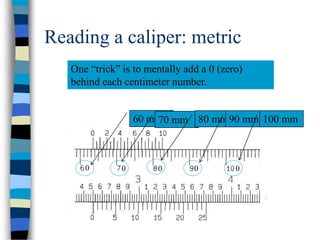
One “trick” is to mentally add a 0 (zero)
behind each centimeter number.
0
60 mm
0 0 0 0
70 mm 80 mm90 mm 100 mm
Reading a caliper: metric
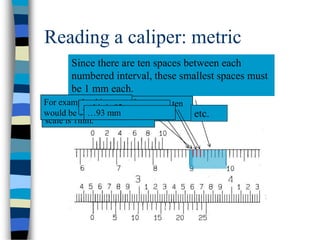
Since there are ten spaces between each
numbered interval, these smallest spaces must
be 1 mm each.
For example, note the ten
spaces in this interval.The smallest interval on this
scale is 1mm.
For example, this
would be 91 mm...
…this is 92 mm...
…93 mm etc.
Reading a caliper: metric
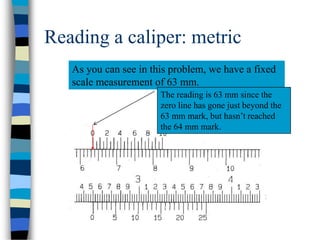
As you can see in this problem, we have a fixed
scale measurement of 63 mm.
The reading is 63 mm since the
zero line has gone just beyond the
63 mm mark, but hasn’t reached
the 64 mm mark.
Reading a caliper: metric
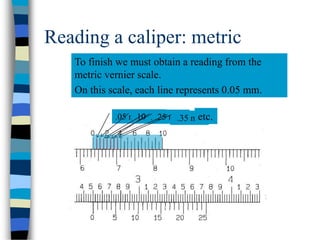
To finish we must obtain a reading from the
metric vernier scale.
On this scale, each line represents 0.05 mm.
.05 mm.10 mm.15 mm.20 mm.25 mm.30 mm.35 mmetc.
Reading a caliper: metric
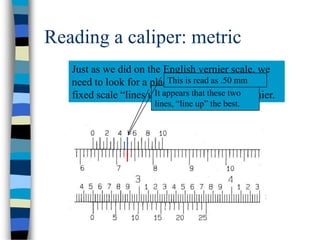
Just as we did on the English vernier scale, we
need to look for a place where a line from the
fixed scale “lines up” with a line on the vernier.It appears that these two
lines, “line up” the best.
This is read as .50 mm
Reading a caliper: metric
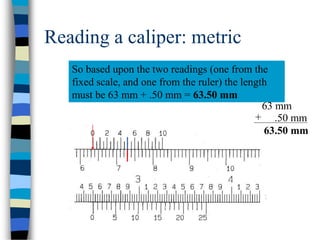
So based upon the two readings (one from the
fixed scale, and one from the ruler) the length
must be 63 mm + .50 mm = 63.50 mm
63 mm
.50 mm+
63.50 mm
Example 2
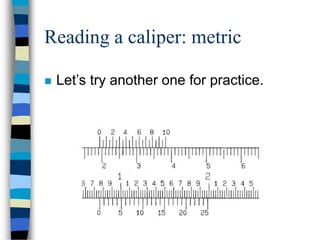
Reading a caliper: metric
 Let’s try another one for practice.
Reading a caliper: metric
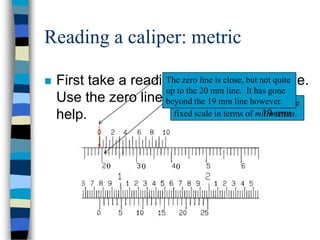
 First take a reading from the fixed scale.
Use the zero line from the vernier to
help.
Remember that we need to read the
fixed scale in terms of millimeters.
The zero line is close, but not quite
up to the 20 mm line. It has gone
beyond the 19 mm line however.
19 mm
0 0 0
19 mm
Reading a caliper: metric
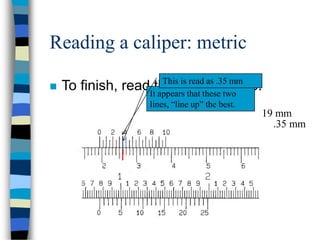
 To finish, read the vernier scale.It appears that these two
lines, “line up” the best.
This is read as .35 mm
.35 mm
19 mm
Reading a caliper: metric
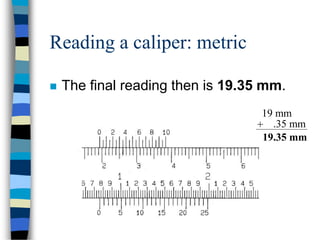
 The final reading then is 19.35 mm.
.35 mm+
19.35 mm
Reading a caliper: metric
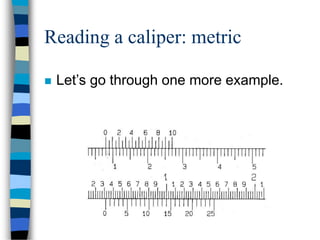
 Let’s go through one more example.
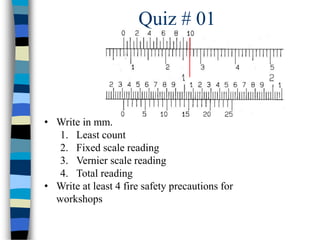
Quiz # 01
• Write in mm.
1. Least count
2. Fixed scale reading
3. Vernier scale reading
4. Total reading
• Write at least 4 fire safety precautions for
workshops

01b vernier caliper

  • 1.
  • 2.
    Introduction  Vernier calipersare tools used in home, small shop, and industrial settings.  They are used to make precise length measurements.
  • 3.
    Introduction  Some reasonsfor their popularity include:  Wide measuring range (usually 0 - 6”).  English and metric scales are usually found on the same instrument.  Many different kinds of measurements can be made with a caliper...
  • 4.
    Introduction  While bothmicrometers and calipers can make outside length measurements...
  • 5.
    Introduction  Calipers canalso make inside measurements...
  • 6.
    Introduction  …and alsodepth measurements.
  • 7.
    Introduction  There arethree types of calipers.  The vernier caliper:
  • 8.
  • 9.
    Introduction  …and thedigital electronic caliper.
  • 10.
    Introduction  In thislesson, we will concentrate on the vernier caliper since it takes the most skill to read.
  • 11.
    Introduction  These arethe main features of a typical vernier caliper: Jaws (for outside measurements) Small jaws (for inside measurements)Metric vernier scaleMetric fixed scale English vernier scaleEnglish fixed scale Beam Depth gauge
  • 12.
  • 13.
    Reading a Caliper:metric  As you are about to see, working with the metric portion of a vernier caliper is a bit easier to deal with.  You only need to make two readings: one from the fixed scale and one from the vernier portion.
  • 14.
    Reading a caliper:metric  Start by obtaining a measurement from the fixed scale... This is the fixed scale used for the metric readings.
  • 15.
    Reading a caliper:metric  Use the zero line on the vernier to locate your position on the fixed scale.
  • 16.
    Reading a caliper:metric Each number printed on the metric scale represents centimeters. 6 cm However, since your final reading is supposed to be in millimeters, you need view these amounts as millimeters. 7 cm 8 cm 9 cm 10 cmetc.
  • 17.
    Reading a caliper:metric One “trick” is to mentally add a 0 (zero) behind each centimeter number. 0 60 mm 0 0 0 0 70 mm 80 mm90 mm 100 mm
  • 18.
    Reading a caliper:metric Since there are ten spaces between each numbered interval, these smallest spaces must be 1 mm each. For example, note the ten spaces in this interval.The smallest interval on this scale is 1mm. For example, this would be 91 mm... …this is 92 mm... …93 mm etc.
  • 19.
    Reading a caliper:metric As you can see in this problem, we have a fixed scale measurement of 63 mm. The reading is 63 mm since the zero line has gone just beyond the 63 mm mark, but hasn’t reached the 64 mm mark.
  • 20.
    Reading a caliper:metric To finish we must obtain a reading from the metric vernier scale. On this scale, each line represents 0.05 mm. .05 mm.10 mm.15 mm.20 mm.25 mm.30 mm.35 mmetc.
  • 21.
    Reading a caliper:metric Just as we did on the English vernier scale, we need to look for a place where a line from the fixed scale “lines up” with a line on the vernier.It appears that these two lines, “line up” the best. This is read as .50 mm
  • 22.
    Reading a caliper:metric So based upon the two readings (one from the fixed scale, and one from the ruler) the length must be 63 mm + .50 mm = 63.50 mm 63 mm .50 mm+ 63.50 mm
  • 23.
  • 24.
    Reading a caliper:metric  Let’s try another one for practice.
  • 25.
    Reading a caliper:metric  First take a reading from the fixed scale. Use the zero line from the vernier to help. Remember that we need to read the fixed scale in terms of millimeters. The zero line is close, but not quite up to the 20 mm line. It has gone beyond the 19 mm line however. 19 mm 0 0 0
  • 26.
    19 mm Reading acaliper: metric  To finish, read the vernier scale.It appears that these two lines, “line up” the best. This is read as .35 mm .35 mm
  • 27.
    19 mm Reading acaliper: metric  The final reading then is 19.35 mm. .35 mm+ 19.35 mm
  • 28.
    Reading a caliper:metric  Let’s go through one more example.
  • 29.
    Quiz # 01 •Write in mm. 1. Least count 2. Fixed scale reading 3. Vernier scale reading 4. Total reading • Write at least 4 fire safety precautions for workshops