MEASUREMENT OF A TEST
SPECIMEN USING A VERNIER
CALLIPER GAUGE.
Experiment # 01
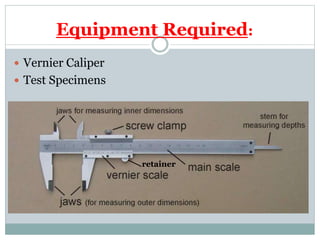
Equipment Required:
 Vernier Caliper
 Test Specimens
probe
retainer
Introduction of Vernier Calliper
 Invented by Pierre Vernier (1580-1637)a famous
french mathematician
 A Vernier caliper is an instrument that measures
internal or external dimensions and distances. This
device allows you to take more precise
measurements than you could with flat instruments,
such as rulers, and has a reading error of only 0.05
mm
Description of Vernier Calliper
parts and its uses
 For linear-dimensional measurement of parts or
components
 Precision of upto 0.05mm
 Outside and inside jaws
 Depth probe
 Main scale and Vernier scale
 Screw clamp
 Retainer
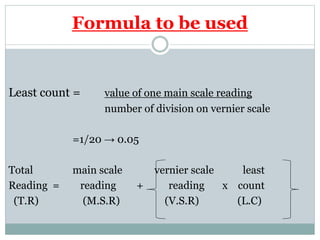
Formula to be used
Least count = value of one main scale reading
number of division on vernier scale
=1/20 → 0.05
Total main scale vernier scale least
Reading = reading + reading x count
(T.R) (M.S.R) (V.S.R) (L.C)
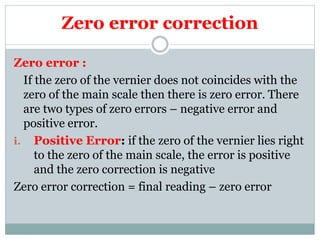
Zero error correction
Zero error :
If the zero of the vernier does not coincides with the
zero of the main scale then there is zero error. There
are two types of zero errors – negative error and
positive error.
i. Positive Error: if the zero of the vernier lies right
to the zero of the main scale, the error is positive
and the zero correction is negative
Zero error correction = final reading – zero error
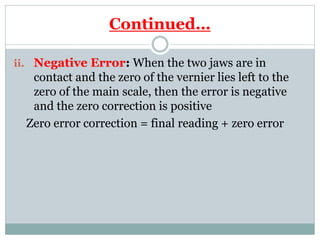
Continued…
ii. Negative Error: When the two jaws are in
contact and the zero of the vernier lies left to the
zero of the main scale, then the error is negative
and the zero correction is positive
Zero error correction = final reading + zero error
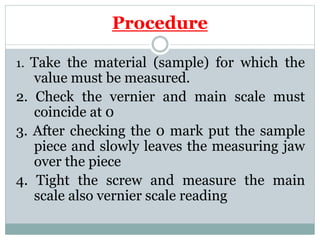
Procedure
1. Take the material (sample) for which the
value must be measured.
2. Check the vernier and main scale must
coincide at 0
3. After checking the 0 mark put the sample
piece and slowly leaves the measuring jaw
over the piece
4. Tight the screw and measure the main
scale also vernier scale reading
Continued…
5. Read the main scale where it lines up with the
sliding scale's zero
a) For example, if the 0 on the sliding scale lines
up with the 20mm mark, your measurement
is 2 inches. If it lines up past 20 mm by six
tenth-inch marks, your measurement is 26
mm.
b) If the result is between two lines, just use the
smaller value.
Continued…
6. Read the Vernier Scale Reading
a) Find the first mark on the Vernier scale that lines
up perfectly with any line on the main scale
b) Now multiply this division with the least count to
get the value of VSR
7. By adding MSR with VSR*L
i.e Total Reading = MSR + (VSR*L.C)
8. Take average to get the closest value.
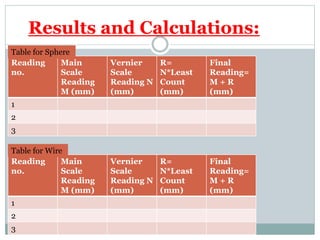
Results and Calculations:
Reading
no.
Main
Scale
Reading
M (mm)
Vernier
Scale
Reading N
(mm)
R=
N*Least
Count
(mm)
Final
Reading=
M + R
(mm)
1
2
3
Table for Sphere
Reading
no.
Main
Scale
Reading
M (mm)
Vernier
Scale
Reading N
(mm)
R=
N*Least
Count
(mm)
Final
Reading=
M + R
(mm)
1
2
3
Table for Wire
Sources of errors:
1. Zero error may not be removed
2. Least cout may not be calculated
3. Reading may not be taken correctly
4. Deformation of object due to extra
tightening the jaws.
Vernier calliper

Vernier calliper

  • 1.
    MEASUREMENT OF ATEST SPECIMEN USING A VERNIER CALLIPER GAUGE. Experiment # 01
  • 2.
    Equipment Required:  VernierCaliper  Test Specimens probe retainer
  • 3.
    Introduction of VernierCalliper  Invented by Pierre Vernier (1580-1637)a famous french mathematician  A Vernier caliper is an instrument that measures internal or external dimensions and distances. This device allows you to take more precise measurements than you could with flat instruments, such as rulers, and has a reading error of only 0.05 mm
  • 4.
    Description of VernierCalliper parts and its uses  For linear-dimensional measurement of parts or components  Precision of upto 0.05mm  Outside and inside jaws  Depth probe  Main scale and Vernier scale  Screw clamp  Retainer
  • 5.
    Formula to beused Least count = value of one main scale reading number of division on vernier scale =1/20 → 0.05 Total main scale vernier scale least Reading = reading + reading x count (T.R) (M.S.R) (V.S.R) (L.C)
  • 6.
    Zero error correction Zeroerror : If the zero of the vernier does not coincides with the zero of the main scale then there is zero error. There are two types of zero errors – negative error and positive error. i. Positive Error: if the zero of the vernier lies right to the zero of the main scale, the error is positive and the zero correction is negative Zero error correction = final reading – zero error
  • 7.
    Continued… ii. Negative Error:When the two jaws are in contact and the zero of the vernier lies left to the zero of the main scale, then the error is negative and the zero correction is positive Zero error correction = final reading + zero error
  • 8.
    Procedure 1. Take thematerial (sample) for which the value must be measured. 2. Check the vernier and main scale must coincide at 0 3. After checking the 0 mark put the sample piece and slowly leaves the measuring jaw over the piece 4. Tight the screw and measure the main scale also vernier scale reading
  • 9.
    Continued… 5. Read themain scale where it lines up with the sliding scale's zero a) For example, if the 0 on the sliding scale lines up with the 20mm mark, your measurement is 2 inches. If it lines up past 20 mm by six tenth-inch marks, your measurement is 26 mm. b) If the result is between two lines, just use the smaller value.
  • 10.
    Continued… 6. Read theVernier Scale Reading a) Find the first mark on the Vernier scale that lines up perfectly with any line on the main scale b) Now multiply this division with the least count to get the value of VSR 7. By adding MSR with VSR*L i.e Total Reading = MSR + (VSR*L.C) 8. Take average to get the closest value.
  • 11.
    Results and Calculations: Reading no. Main Scale Reading M(mm) Vernier Scale Reading N (mm) R= N*Least Count (mm) Final Reading= M + R (mm) 1 2 3 Table for Sphere Reading no. Main Scale Reading M (mm) Vernier Scale Reading N (mm) R= N*Least Count (mm) Final Reading= M + R (mm) 1 2 3 Table for Wire
  • 12.
    Sources of errors: 1.Zero error may not be removed 2. Least cout may not be calculated 3. Reading may not be taken correctly 4. Deformation of object due to extra tightening the jaws.