Measuring
Instruments
International Training Centre, Butibori
9001:2008
CERTIFIED INSTITUTE
By: Amol Khichade
Instruments
• Steel Rule
• Inside & Outside caliper
• Vernier Caliper
• Micrometer
• Height Gauge
• Gauge blocks
• Bevel Protractor
• Try Square
• Combination Square
• Dial Gauge
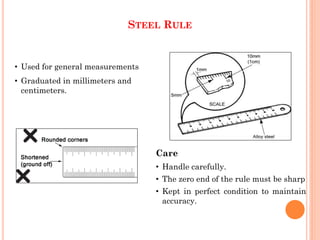
STEEL RULE
• Used for general measurements
• Graduated in millimeters and
centimeters.
Care
• Handle carefully.
• The zero end of the rule must be sharp
• Kept in perfect condition to maintain
accuracy.
MEASURING WITH A STEEL RULE
To measure length:
• Place the end of the ruler flush with start of
material.
• Look at exact place on rule where material ends.
• Read length on ruler scale.
• Generally measure to
an accuracy of 1 mm.
• Some measure to an
accuracy of 0.5mm.
INSIDE & OUTSIDE CALIPER
• Generally a spring caliper.
• Has no scale - cannot be used by itself.
• Commonly used for measure inside & outside diameter.
“Outside”
“Inside”
Common Uses of Vernier Calipers
VERNIER CALIPER
Depth
Measurement
Inside Diameter
Measurement
Outside Diameter
Measurement
VERNIER CALIPER MATERIAL
 There are a number of alloys which can be used to manufacture
vernier calipers but the material most widely used for the
manufacturing of vernier calipers is 440C grade Stainless steel.
 It is suitable because of its superior wear resistance, hardness
and a high ultimate tensile strength which makes it able to
withstand high stresses.
 In addition its ability to resist corrosion makes it a popular choice.
 The stainless steel is further strengthened by heat treatment
which improves its ability to resist permanent dents and lessens
the impact of wear compared to other stainless steel alloys.
 The treatment even improves the Ultimate tensile strength of the
material.
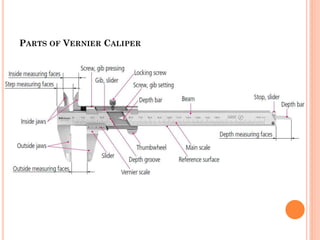
PARTS OF VERNIER CALIPER
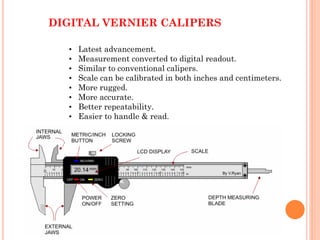
PARTS OF DIGITAL VERNIER CALIPER
MEASURING INTERNAL DIAMETER
Use the inside jaws of the caliper as shown in fig.
MEASURING EXTERNAL DIAMETER
Use the outside jaws of the caliper as shown
MEASURING DEPTH OF A OBJECT
Use the depth gauge of the
caliper as shown in fig.
LEAST COUNT
The "Least Count" of any measuring equipment is the smallest
quantity that can be measured accurately using that instrument.
Value of one main scale division
Least Count = -----------------------------------------------------
Total number of vernier scale division
TR = MSR + (VSR x LC)
TR:- Total Reading
MSR:- Main Scale Reading
VSR:- Vernier Scale Reading
LC:- Least Count
LEAST COUNT OF VERNIER CALIPER
Value of one main scale division
Least Count = -----------------------------------------------------
Total number of vernier scale division
1
Least Count = -------
50
Least Count = 0.02 mm
READING THE VERNIER SCALE
• Read the “0” position of the
vernier scale on the main scale
to get a rough reading.
• Main scale reading = 18mm
• Look along the vernier scale
until one of the vernier
division coincides with the
main scale
• Vernier scale reading= 23
• TR = MSR + (VSR x LC)
• TR = 18 + (23 x 0.02)
• TR = 18 + 0.46
• TR = 18.46 mm
EXERCISE
WORKING OF VERNIER CALIPER
MAIN SCALE
VERNIER SCALE
EXERCISE 1
Main scale reading =
Vernier scale reading=
TR = MSR + (VSR x LC)
EXERCISE 1
Main scale reading = 11mm
Vernier scale reading= 39
TR = MSR + (VSR x LC)
= 11 + (39 x 0.02)
= 11 + 0.78
TR = 11.78 mm
EXERCISE 2
Main scale reading =
Vernier scale reading=
TR = MSR + (VSR x LC)
EXERCISE 2
Main scale reading = 17mm
Vernier scale reading= 20
TR = MSR + (VSR x LC)
= 17 + (20 x 0.02)
= 17 + 0.40
TR = 17.40 mm
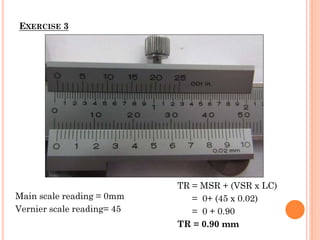
EXERCISE 3
Main scale reading =
Vernier scale reading=
TR = MSR + (VSR x LC)
EXERCISE 3
Main scale reading = 0mm
Vernier scale reading= 45
TR = MSR + (VSR x LC)
= 0+ (45 x 0.02)
= 0 + 0.90
TR = 0.90 mm
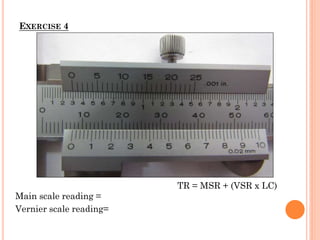
EXERCISE 4
Main scale reading =
Vernier scale reading=
TR = MSR + (VSR x LC)
EXERCISE 4
Main scale reading = 7mm
Vernier scale reading= 33
TR = MSR + (VSR x LC)
= 7 + (33 x 0.02)
= 7 + 0.66
TR = 7.66 mm
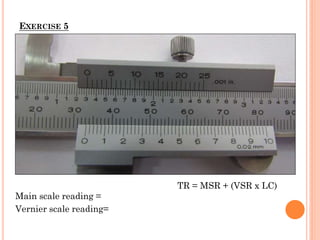
EXERCISE 5
Main scale reading =
Vernier scale reading=
TR = MSR + (VSR x LC)
EXERCISE 5
Main scale reading = 33mm
Vernier scale reading= 16
TR = MSR + (VSR x LC)
= 33 + (16 x 0.02)
= 33 + 0.32
TR = 33.32 mm
EXERCISE 6
Main scale reading =
Vernier scale reading=
TR = MSR + (VSR x LC)
EXERCISE 6
Main scale reading = 39mm
Vernier scale reading= 41
TR = MSR + (VSR x LC)
= 39 + (41 x 0.02)
= 39 + 0.82
TR = 39.82 mm
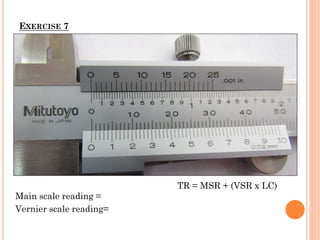
EXERCISE 7
Main scale reading =
Vernier scale reading=
TR = MSR + (VSR x LC)
EXERCISE 7
Main scale reading = 0mm
Vernier scale reading= 0
TR = MSR + (VSR x LC)
= 0 + (0 x 0.02)
= 0 + 0.0
TR = 0.00 mm
EXERCISE 8
Main scale reading =
Vernier scale reading=
TR = MSR + (VSR x LC)
EXERCISE 8
Main scale reading = 56mm
Vernier scale reading= 9
TR = MSR + (VSR x LC)
= 56 + (9 x 0.02)
= 56 + 0.18
TR = 56.18 mm
EXERCISE 9
Main scale reading =
Vernier scale reading=
TR = MSR + (VSR x LC)
EXERCISE 9
Main scale reading = 64mm
Vernier scale reading= 36
TR = MSR + (VSR x LC)
= 64 + (36 x 0.02)
= 64 + 0.72
TR = 64.72 mm
EXERCISE 10
Main scale reading =
Vernier scale reading=
TR = MSR + (VSR x LC)
EXERCISE 10
Main scale reading = 73mm
Vernier scale reading= 19
TR = MSR + (VSR x LC)
= 73 + (19 x 0.02)
= 73 + 0.38
TR = 73.38 mm
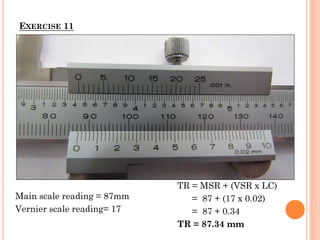
EXERCISE 11
Main scale reading =
Vernier scale reading=
TR = MSR + (VSR x LC)
EXERCISE 11
Main scale reading = 87mm
Vernier scale reading= 17
TR = MSR + (VSR x LC)
= 87 + (17 x 0.02)
= 87 + 0.34
TR = 87.34 mm
DIGITAL VERNIER CALIPERS
• Latest advancement.
• Measurement converted to digital readout.
• Similar to conventional calipers.
• Scale can be calibrated in both inches and centimeters.
• More rugged.
• More accurate.
• Better repeatability.
• Easier to handle & read.
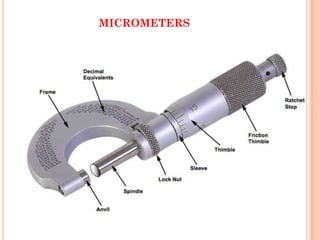
MICROMETERS
MATERIAL OF MICROMETER
 The micrometer is generally made of cast steel or malleable cast
iron
 Anvil & Spindle faces tipped with tungsten carbide for increase
hardness.
STANDARD OUTSIDE MICROMETER
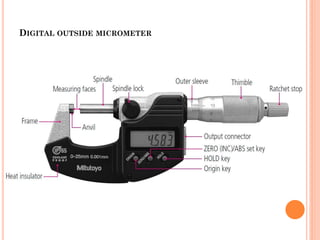
DIGITAL OUTSIDE MICROMETER
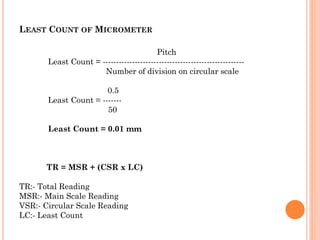
LEAST COUNT OF MICROMETER
Pitch
Least Count = -----------------------------------------------------
Number of division on circular scale
0.5
Least Count = -------
50
Least Count = 0.01 mm
TR = MSR + (CSR x LC)
TR:- Total Reading
MSR:- Main Scale Reading
VSR:- Circular Scale Reading
LC:- Least Count
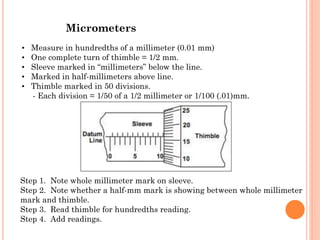
• Measure in hundredths of a millimeter (0.01 mm)
• One complete turn of thimble = 1/2 mm.
• Sleeve marked in “millimeters” below the line.
• Marked in half-millimeters above line.
• Thimble marked in 50 divisions.
- Each division = 1/50 of a 1/2 millimeter or 1/100 (.01)mm.
Micrometers
Step 1. Note whole millimeter mark on sleeve.
Step 2. Note whether a half-mm mark is showing between whole millimeter
mark and thimble.
Step 3. Read thimble for hundredths reading.
Step 4. Add readings.
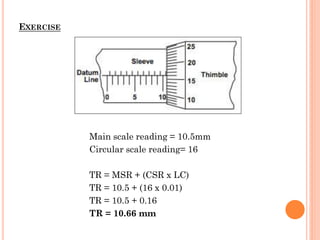
EXERCISE
Main scale reading = 10.5mm
Circular scale reading= 16
TR = MSR + (CSR x LC)
TR = 10.5 + (16 x 0.01)
TR = 10.5 + 0.16
TR = 10.66 mm
EXERCISE 1
TR = MSR + (CSR x LC)Main scale reading =
Circular scale reading =
EXERCISE 1
TR = MSR + (CSR x LC)
TR = 2 + (11 x 0.01)
TR = 2 + 0.11
TR = 2.11 mm
Main scale reading = 2 mm
Circular scale reading = 11
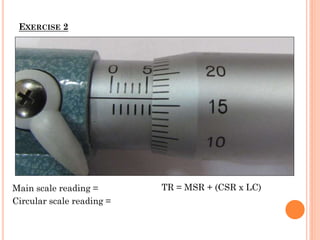
EXERCISE 2
TR = MSR + (CSR x LC)Main scale reading =
Circular scale reading =
EXERCISE 2
TR = MSR + (CSR x LC)
TR = 5.5 + (16 x 0.01)
TR = 5.5 + 0.16
TR = 5.66 mm
Main scale reading = 5.5 mm
Circular scale reading = 16
EXERCISE 3
TR = MSR + (CSR x LC)Main scale reading =
Circular scale reading =
EXERCISE 3
TR = MSR + (CSR x LC)
TR = 7.5 + (27 x 0.01)
TR = 7.5 + 0.27
TR = 7.77 mm
Main scale reading = 7.5 mm
Circular scale reading = 27
EXERCISE 4
TR = MSR + (CSR x LC)Main scale reading =
Circular scale reading =
EXERCISE 4
TR = MSR + (CSR x LC)
TR = 11 + (17 x 0.01)
TR = 11 + 0.17
TR = 11.17 mm
Main scale reading = 11 mm
Circular scale reading = 17
EXERCISE 5
TR = MSR + (CSR x LC)Main scale reading =
Circular scale reading =
EXERCISE 5
TR = MSR + (CSR x LC)
TR = 13 + (18 x 0.01)
TR = 13 + 0.18
TR = 13.18 mm
Main scale reading = 13 mm
Circular scale reading = 18
EXERCISE 6
TR = MSR + (CSR x LC)Main scale reading =
Circular scale reading =
EXERCISE 6
TR = MSR + (CSR x LC)
TR = 16.5 + (23 x 0.01)
TR = 16.5 + 0.23
TR = 16.73 mm
Main scale reading = 16.5 mm
Circular scale reading = 23
EXERCISE 7
TR = MSR + (CSR x LC)Main scale reading =
Circular scale reading =
EXERCISE 7
TR = MSR + (CSR x LC)
TR = 25 + (0 x 0.01)
TR = 25 + 0.00
TR = 25.00 mm
Main scale reading = 25 mm
Circular scale reading = 0
EXERCISE 8
TR = MSR + (CSR x LC)Main scale reading =
Circular scale reading =
EXERCISE 8
TR = MSR + (CSR x LC)
TR = 20.5 + (29 x 0.01)
TR = 20.5 + 0.29
TR = 20.79 mm
Main scale reading = 20.5 mm
Circular scale reading = 29
EXERCISE 9
TR = MSR + (CSR x LC)Main scale reading =
Circular scale reading =
EXERCISE 9
TR = MSR + (CSR x LC)
TR = 24 + (9 x 0.01)
TR = 24 + 0.09
TR = 24.09 mm
Main scale reading = 24 mm
Circular scale reading = 9
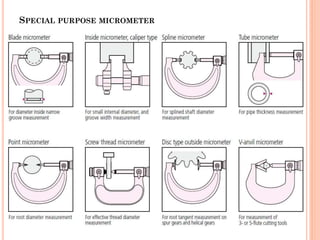
SPECIAL PURPOSE MICROMETER
• Removing Play
- Back off the thimble.
- Insert a C-spanner into slot or hole of adjusting nut.
- Turn adjusting nut clockwise until play between threads
is eliminated.
Micrometer Adjustments
• Adjusting Accuracy
- Clean measuring faces and check for damage.
- Closes faces.
- Turn sleeve until index line on sleeve matches zero (0)
line on thimble.
- Recheck accuracy by opening and closing faces. Rating
should be zero (0).
Micrometer Adjustments
• Close faces carefully to avoid damage.
• Keep micrometer clean. Wipe with oily cloth. Oil threads.
• Not too much pressure.
• Clean face of anvil and spindle before use.
• Check for accuracy. Close faces - should read zero (0).
• Don’t lay unit where it could fall.
• Don’t twirl micrometer to open or close a great distance.
• Clean and oil for long term storage. Place in box.
Care of the Micrometer
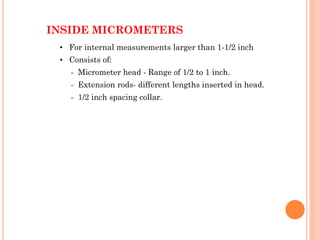
• For internal measurements larger than 1-1/2 inch
• Consists of:
- Micrometer head - Range of 1/2 to 1 inch.
- Extension rods- different lengths inserted in head.
- 1/2 inch spacing collar.
INSIDE MICROMETERS
Uses of Inside Micrometers
DIGITAL MICROMETERS
• Modern Version - Results Displayed Electronically
• Delicate instrument - handle with care.
How to Read Digital Micrometers
a. Before taking reading, do the following:
- Turn display on.
- Press button to activate desired scale.
- Slowly close micrometer until ratchet engages.
- Zero micrometer by pressing Origin or Set button.
b. For thickness reading:
- Open micrometer.
- Insert sample.
- Slowly close micrometer until ratchet engages.
- Read thickness on digital display.
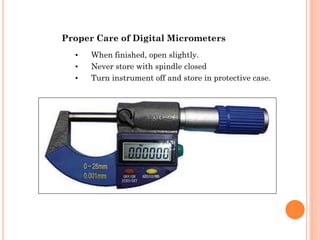
Proper Care of Digital Micrometers
• When finished, open slightly.
• Never store with spindle closed
• Turn instrument off and store in protective case.
HEIGHT GAUGE
 A height gauge is a measuring
device used either for
determining the height of
something, or for repetitious
marking of items to be worked on.
 It used in metalworking or
metrology to set or measure
vertical distances and also it
measures the height of an object.
 These are used to mark out lines
and widely used on surface plates
and on machine tables.
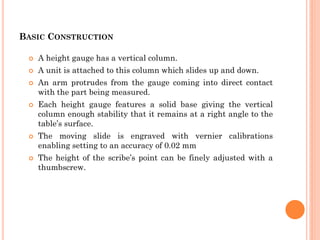
BASIC CONSTRUCTION
 A height gauge has a vertical column.
 A unit is attached to this column which slides up and down.
 An arm protrudes from the gauge coming into direct contact
with the part being measured.
 Each height gauge features a solid base giving the vertical
column enough stability that it remains at a right angle to the
table’s surface.
 The moving slide is engraved with vernier calibrations
enabling setting to an accuracy of 0.02 mm
 The height of the scribe’s point can be finely adjusted with a
thumbscrew.
VERNIER HEIGHT GAUGE
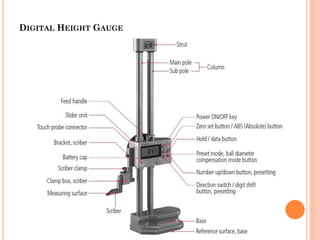
DIGITAL HEIGHT GAUGE
DIAL HEIGHT GAUGE
HEIGHT GAUGE MEASUREMENT EXAMPLE
GAUGE BLOCKS
• Rectangular blocks - hardened and ground alloy steel.
• Measuring surfaces lapped and polished - accurate to within a
few millionths of an inch.
• Size of block stamped one surface.
GAUGE BLOCK MATERIAL
 Gauge blocks are usually made either from alloy tool steels or
from cemented carbides.
 These are also available in carbon steel material.
 Steel blocks are hardened and tempered.
 The hardness is important because it slows down the gauge's rate
of wear during use.
 Blocks are kept very lightly oiled, and are stored and used in dry
climate-controlled conditions.
 Steel gauge blocks can last for decades without rusting.
Wringing Gauge Blocks Together
Gauge Blocks Set
Range(mm) Step(mm) Pieces
1.001 to 1.009 0.001 9
1.01 to 1.49 0.01 49
0.5 to 9.5 0.5 19
10 to 90 10 9
1.0005 --- 1
Total 87
Gauge Blocks Set includes following gauges.
Important notes on building of Slip Gauges:
 Always start with the last decimal place.
 Then take the subsequent decimal places.
 Minimum number of slip gauges should be used by
selecting the largest possible block in each step.
 If in case protector slips are used, first deduct their
thickness from the required dimension then proceed as per
above order.
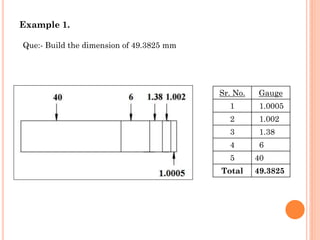
Example 1.
Que:- Build the dimension of 49.3825 mm
Sr. No. Gauge
1 1.0005
2 1.002
3 1.38
4 6
5 40
Total 49.3825
Example 2.
Que:- Build the dimension of 87.3215 mm
Sr. No. Gauge
1 1.0005
2 1.001
3 1.32
4 4
5 80
Total 87.3215
Example 3.
Que:- Build the dimension of 30.4875 mm
Sr. No. Gauge
1 1.0005
2 1.007
3 1.48
4 2
5 25
Total 30.4875
ANGULAR MEASUREMENT
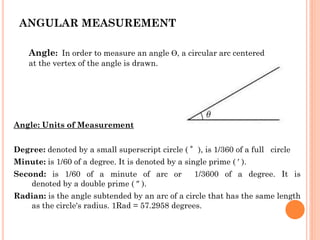
Angle: In order to measure an angle Ɵ, a circular arc centered
at the vertex of the angle is drawn.
Angle: Units of Measurement
Degree: denoted by a small superscript circle ( °), is 1/360 of a full circle
Minute: is 1/60 of a degree. It is denoted by a single prime ( ′ ).
Second: is 1/60 of a minute of arc or 1/3600 of a degree. It is
denoted by a double prime ( ″ ).
Radian: is the angle subtended by an arc of a circle that has the same length
as the circle's radius. 1Rad = 57.2958 degrees.
BEVEL PROTRACTOR
•The bevel protractor is a type of protractor that is circular and has a
pivoted arm used for measuring and marking of angles.
•The basic protractor is most commonly used in school geometry classes for
measuring angles up to 180 degrees.
•The bevel protractor is used when measuring angles up to 360 degrees.
•Bevel protractor has a full circular scale that is made up of 360 degrees.
•A bevel protractor has also a vernier scale. One vernier is equal to 1/12 of
a degree, which provides a more accurate measurement.
•The vernier scale is divided into 24 increments, with 12 spaces on either
side of the zero
BEVEL PROTRACTOR
APPLICATIONS OF BEVEL PROTECTOR
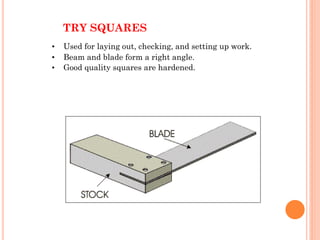
TRY SQUARES
• Used for laying out, checking, and setting up work.
• Beam and blade form a right angle.
• Good quality squares are hardened.
Using Solid Steel Squares.
• Remove all burrs from work surface. Wipe clean.
• Wipe square clean.
• Face source of light.
• Hold work with one hand. Grasp square with other.
• Place inside of square against finished surface.
• Lower blade to surface of work.
• All light should be excluded.
COMBINATION SQUARE
• Checking inside and outside squareness.
• Drawing lines parallel to edges of work piece.
• Measuring depth.
• Finding centers of round work pieces.
• Checking 450 angles.
Uses of Combination Squares.
• Has a face or dial marked in divisions of 0.01 mm (1/100 mm)
• Does not take a direct measurement - shows variations from the
original zero setting
• These variations are transferred from the spindle to the pointer.
DIAL INDICATOR GAUGE
Also called a dial gauge or dial indicator.
APPLICATIONS OF DIAL GAUGE
DIAL INDICATOR
• Used to measure:
- the bend or run-out in a shaft
- the clearance between two
parts
eg. between an engine valve
and its guide.
• Must be firmly mounted. A
magnetic stand or a stand with a
screw clamp is often used.
SETTING UP THE DIAL INDICATOR
1. Mount dial gauge firmly on its
stand
2. Mount stand securely, to
prevent damage from dropping
or excessive vibration
3. Keep spindle at right angles
(perpendicular) to the surface
being checked.
READING THE DIAL INDICATOR
1. Read the whole millimeters
from the inner scale (only
for absolute measurements)
3. Read the hundredths of
millimeters (small divisions on
outer scale).
2. Read the tenths of
millimeters (numbers on
outer scale)
READING THE DIAL INDICATOR
Step 1
Read the whole millimeters. The short
needle is between the 4 and the 5, so
the reading is 4.00 mm.
Step 2
Read the tenths. The long needle is
between the 0.20 and the 0.30 mm, so
the reading is 0.20 mm.
Step 3
The long needle is 6 small divisions
past the 2, so the reading is 0.06
mm.
Example
Step 1
Step 2
Step 3
READING THE DIAL INDICATOR
Step 4
To get the final
measurement - add up
the measurements from
Steps 1, 2, & 3.
Step 1 4.00 mm
Step 2 + 0.20 mm
Step 3 + 0.06 mm
Total = 4.26 mm
4.00 mm 0.20 mm
0.06 mm
CARE OF MEASURING INSTRUMENTS
1. Measuring a work piece (on a lathe) should be carried out only after the work piece
has stopped moving; otherwise, there could be wear on the measuring faces and the
accuracy of the tool may be compromised.
2. Wipe the measuring faces of a precision measuring tool and the to-be-measured
surface of the work piece to prevent the measuring accuracy from being negatively
affected by dirt or dust.
3. Never put precision measuring tools together with hand tools, such as cutting tools,
files, hammers and drills for the fear of damaging the precision measuring tools.
4. Never leave them on a lathe or other running machinery for fear of vibration causing
them to fall to the floor.
5. Precision measuring tools should not be used as substitutes for other tools. Don’t use
a caliper as a pry bar or screwdriver! Don’t use a micrometer for a hammer or C
clamp! You might be tempted but don’t do it!
6. Precision measuring tools should not be put under direct sunshine or any other heat
source because accurate measurements will not be achieved as the temperature
increases.
7. Precision measuring tools should never be put near any magnetic material such as a
magnetic worktable, to avoid being magnetized.
8. Tools should be cleaned after use.

Measuring instruments

  • 1.
    Measuring Instruments International Training Centre,Butibori 9001:2008 CERTIFIED INSTITUTE By: Amol Khichade
  • 2.
    Instruments • Steel Rule •Inside & Outside caliper • Vernier Caliper • Micrometer • Height Gauge • Gauge blocks • Bevel Protractor • Try Square • Combination Square • Dial Gauge
  • 3.
    STEEL RULE • Usedfor general measurements • Graduated in millimeters and centimeters. Care • Handle carefully. • The zero end of the rule must be sharp • Kept in perfect condition to maintain accuracy.
  • 4.
    MEASURING WITH ASTEEL RULE To measure length: • Place the end of the ruler flush with start of material. • Look at exact place on rule where material ends. • Read length on ruler scale. • Generally measure to an accuracy of 1 mm. • Some measure to an accuracy of 0.5mm.
  • 5.
    INSIDE & OUTSIDECALIPER • Generally a spring caliper. • Has no scale - cannot be used by itself. • Commonly used for measure inside & outside diameter. “Outside” “Inside”
  • 6.
    Common Uses ofVernier Calipers VERNIER CALIPER Depth Measurement Inside Diameter Measurement Outside Diameter Measurement
  • 7.
    VERNIER CALIPER MATERIAL There are a number of alloys which can be used to manufacture vernier calipers but the material most widely used for the manufacturing of vernier calipers is 440C grade Stainless steel.  It is suitable because of its superior wear resistance, hardness and a high ultimate tensile strength which makes it able to withstand high stresses.  In addition its ability to resist corrosion makes it a popular choice.  The stainless steel is further strengthened by heat treatment which improves its ability to resist permanent dents and lessens the impact of wear compared to other stainless steel alloys.  The treatment even improves the Ultimate tensile strength of the material.
  • 8.
  • 9.
    PARTS OF DIGITALVERNIER CALIPER
  • 10.
    MEASURING INTERNAL DIAMETER Usethe inside jaws of the caliper as shown in fig.
  • 11.
    MEASURING EXTERNAL DIAMETER Usethe outside jaws of the caliper as shown
  • 12.
    MEASURING DEPTH OFA OBJECT Use the depth gauge of the caliper as shown in fig.
  • 13.
    LEAST COUNT The "LeastCount" of any measuring equipment is the smallest quantity that can be measured accurately using that instrument. Value of one main scale division Least Count = ----------------------------------------------------- Total number of vernier scale division TR = MSR + (VSR x LC) TR:- Total Reading MSR:- Main Scale Reading VSR:- Vernier Scale Reading LC:- Least Count
  • 14.
    LEAST COUNT OFVERNIER CALIPER Value of one main scale division Least Count = ----------------------------------------------------- Total number of vernier scale division 1 Least Count = ------- 50 Least Count = 0.02 mm
  • 15.
    READING THE VERNIERSCALE • Read the “0” position of the vernier scale on the main scale to get a rough reading. • Main scale reading = 18mm • Look along the vernier scale until one of the vernier division coincides with the main scale • Vernier scale reading= 23 • TR = MSR + (VSR x LC) • TR = 18 + (23 x 0.02) • TR = 18 + 0.46 • TR = 18.46 mm EXERCISE
  • 16.
  • 17.
    WORKING OF VERNIERCALIPER MAIN SCALE VERNIER SCALE
  • 18.
    EXERCISE 1 Main scalereading = Vernier scale reading= TR = MSR + (VSR x LC)
  • 19.
    EXERCISE 1 Main scalereading = 11mm Vernier scale reading= 39 TR = MSR + (VSR x LC) = 11 + (39 x 0.02) = 11 + 0.78 TR = 11.78 mm
  • 20.
    EXERCISE 2 Main scalereading = Vernier scale reading= TR = MSR + (VSR x LC)
  • 21.
    EXERCISE 2 Main scalereading = 17mm Vernier scale reading= 20 TR = MSR + (VSR x LC) = 17 + (20 x 0.02) = 17 + 0.40 TR = 17.40 mm
  • 22.
    EXERCISE 3 Main scalereading = Vernier scale reading= TR = MSR + (VSR x LC)
  • 23.
    EXERCISE 3 Main scalereading = 0mm Vernier scale reading= 45 TR = MSR + (VSR x LC) = 0+ (45 x 0.02) = 0 + 0.90 TR = 0.90 mm
  • 24.
    EXERCISE 4 Main scalereading = Vernier scale reading= TR = MSR + (VSR x LC)
  • 25.
    EXERCISE 4 Main scalereading = 7mm Vernier scale reading= 33 TR = MSR + (VSR x LC) = 7 + (33 x 0.02) = 7 + 0.66 TR = 7.66 mm
  • 26.
    EXERCISE 5 Main scalereading = Vernier scale reading= TR = MSR + (VSR x LC)
  • 27.
    EXERCISE 5 Main scalereading = 33mm Vernier scale reading= 16 TR = MSR + (VSR x LC) = 33 + (16 x 0.02) = 33 + 0.32 TR = 33.32 mm
  • 28.
    EXERCISE 6 Main scalereading = Vernier scale reading= TR = MSR + (VSR x LC)
  • 29.
    EXERCISE 6 Main scalereading = 39mm Vernier scale reading= 41 TR = MSR + (VSR x LC) = 39 + (41 x 0.02) = 39 + 0.82 TR = 39.82 mm
  • 30.
    EXERCISE 7 Main scalereading = Vernier scale reading= TR = MSR + (VSR x LC)
  • 31.
    EXERCISE 7 Main scalereading = 0mm Vernier scale reading= 0 TR = MSR + (VSR x LC) = 0 + (0 x 0.02) = 0 + 0.0 TR = 0.00 mm
  • 32.
    EXERCISE 8 Main scalereading = Vernier scale reading= TR = MSR + (VSR x LC)
  • 33.
    EXERCISE 8 Main scalereading = 56mm Vernier scale reading= 9 TR = MSR + (VSR x LC) = 56 + (9 x 0.02) = 56 + 0.18 TR = 56.18 mm
  • 34.
    EXERCISE 9 Main scalereading = Vernier scale reading= TR = MSR + (VSR x LC)
  • 35.
    EXERCISE 9 Main scalereading = 64mm Vernier scale reading= 36 TR = MSR + (VSR x LC) = 64 + (36 x 0.02) = 64 + 0.72 TR = 64.72 mm
  • 36.
    EXERCISE 10 Main scalereading = Vernier scale reading= TR = MSR + (VSR x LC)
  • 37.
    EXERCISE 10 Main scalereading = 73mm Vernier scale reading= 19 TR = MSR + (VSR x LC) = 73 + (19 x 0.02) = 73 + 0.38 TR = 73.38 mm
  • 38.
    EXERCISE 11 Main scalereading = Vernier scale reading= TR = MSR + (VSR x LC)
  • 39.
    EXERCISE 11 Main scalereading = 87mm Vernier scale reading= 17 TR = MSR + (VSR x LC) = 87 + (17 x 0.02) = 87 + 0.34 TR = 87.34 mm
  • 40.
    DIGITAL VERNIER CALIPERS •Latest advancement. • Measurement converted to digital readout. • Similar to conventional calipers. • Scale can be calibrated in both inches and centimeters. • More rugged. • More accurate. • Better repeatability. • Easier to handle & read.
  • 41.
  • 42.
    MATERIAL OF MICROMETER The micrometer is generally made of cast steel or malleable cast iron  Anvil & Spindle faces tipped with tungsten carbide for increase hardness.
  • 43.
  • 44.
  • 45.
    LEAST COUNT OFMICROMETER Pitch Least Count = ----------------------------------------------------- Number of division on circular scale 0.5 Least Count = ------- 50 Least Count = 0.01 mm TR = MSR + (CSR x LC) TR:- Total Reading MSR:- Main Scale Reading VSR:- Circular Scale Reading LC:- Least Count
  • 46.
    • Measure inhundredths of a millimeter (0.01 mm) • One complete turn of thimble = 1/2 mm. • Sleeve marked in “millimeters” below the line. • Marked in half-millimeters above line. • Thimble marked in 50 divisions. - Each division = 1/50 of a 1/2 millimeter or 1/100 (.01)mm. Micrometers Step 1. Note whole millimeter mark on sleeve. Step 2. Note whether a half-mm mark is showing between whole millimeter mark and thimble. Step 3. Read thimble for hundredths reading. Step 4. Add readings.
  • 47.
    EXERCISE Main scale reading= 10.5mm Circular scale reading= 16 TR = MSR + (CSR x LC) TR = 10.5 + (16 x 0.01) TR = 10.5 + 0.16 TR = 10.66 mm
  • 48.
    EXERCISE 1 TR =MSR + (CSR x LC)Main scale reading = Circular scale reading =
  • 49.
    EXERCISE 1 TR =MSR + (CSR x LC) TR = 2 + (11 x 0.01) TR = 2 + 0.11 TR = 2.11 mm Main scale reading = 2 mm Circular scale reading = 11
  • 50.
    EXERCISE 2 TR =MSR + (CSR x LC)Main scale reading = Circular scale reading =
  • 51.
    EXERCISE 2 TR =MSR + (CSR x LC) TR = 5.5 + (16 x 0.01) TR = 5.5 + 0.16 TR = 5.66 mm Main scale reading = 5.5 mm Circular scale reading = 16
  • 52.
    EXERCISE 3 TR =MSR + (CSR x LC)Main scale reading = Circular scale reading =
  • 53.
    EXERCISE 3 TR =MSR + (CSR x LC) TR = 7.5 + (27 x 0.01) TR = 7.5 + 0.27 TR = 7.77 mm Main scale reading = 7.5 mm Circular scale reading = 27
  • 54.
    EXERCISE 4 TR =MSR + (CSR x LC)Main scale reading = Circular scale reading =
  • 55.
    EXERCISE 4 TR =MSR + (CSR x LC) TR = 11 + (17 x 0.01) TR = 11 + 0.17 TR = 11.17 mm Main scale reading = 11 mm Circular scale reading = 17
  • 56.
    EXERCISE 5 TR =MSR + (CSR x LC)Main scale reading = Circular scale reading =
  • 57.
    EXERCISE 5 TR =MSR + (CSR x LC) TR = 13 + (18 x 0.01) TR = 13 + 0.18 TR = 13.18 mm Main scale reading = 13 mm Circular scale reading = 18
  • 58.
    EXERCISE 6 TR =MSR + (CSR x LC)Main scale reading = Circular scale reading =
  • 59.
    EXERCISE 6 TR =MSR + (CSR x LC) TR = 16.5 + (23 x 0.01) TR = 16.5 + 0.23 TR = 16.73 mm Main scale reading = 16.5 mm Circular scale reading = 23
  • 60.
    EXERCISE 7 TR =MSR + (CSR x LC)Main scale reading = Circular scale reading =
  • 61.
    EXERCISE 7 TR =MSR + (CSR x LC) TR = 25 + (0 x 0.01) TR = 25 + 0.00 TR = 25.00 mm Main scale reading = 25 mm Circular scale reading = 0
  • 62.
    EXERCISE 8 TR =MSR + (CSR x LC)Main scale reading = Circular scale reading =
  • 63.
    EXERCISE 8 TR =MSR + (CSR x LC) TR = 20.5 + (29 x 0.01) TR = 20.5 + 0.29 TR = 20.79 mm Main scale reading = 20.5 mm Circular scale reading = 29
  • 64.
    EXERCISE 9 TR =MSR + (CSR x LC)Main scale reading = Circular scale reading =
  • 65.
    EXERCISE 9 TR =MSR + (CSR x LC) TR = 24 + (9 x 0.01) TR = 24 + 0.09 TR = 24.09 mm Main scale reading = 24 mm Circular scale reading = 9
  • 66.
  • 67.
    • Removing Play -Back off the thimble. - Insert a C-spanner into slot or hole of adjusting nut. - Turn adjusting nut clockwise until play between threads is eliminated. Micrometer Adjustments
  • 68.
    • Adjusting Accuracy -Clean measuring faces and check for damage. - Closes faces. - Turn sleeve until index line on sleeve matches zero (0) line on thimble. - Recheck accuracy by opening and closing faces. Rating should be zero (0). Micrometer Adjustments
  • 69.
    • Close facescarefully to avoid damage. • Keep micrometer clean. Wipe with oily cloth. Oil threads. • Not too much pressure. • Clean face of anvil and spindle before use. • Check for accuracy. Close faces - should read zero (0). • Don’t lay unit where it could fall. • Don’t twirl micrometer to open or close a great distance. • Clean and oil for long term storage. Place in box. Care of the Micrometer
  • 70.
    • For internalmeasurements larger than 1-1/2 inch • Consists of: - Micrometer head - Range of 1/2 to 1 inch. - Extension rods- different lengths inserted in head. - 1/2 inch spacing collar. INSIDE MICROMETERS
  • 71.
    Uses of InsideMicrometers
  • 72.
    DIGITAL MICROMETERS • ModernVersion - Results Displayed Electronically • Delicate instrument - handle with care. How to Read Digital Micrometers a. Before taking reading, do the following: - Turn display on. - Press button to activate desired scale. - Slowly close micrometer until ratchet engages. - Zero micrometer by pressing Origin or Set button. b. For thickness reading: - Open micrometer. - Insert sample. - Slowly close micrometer until ratchet engages. - Read thickness on digital display.
  • 73.
    Proper Care ofDigital Micrometers • When finished, open slightly. • Never store with spindle closed • Turn instrument off and store in protective case.
  • 74.
    HEIGHT GAUGE  Aheight gauge is a measuring device used either for determining the height of something, or for repetitious marking of items to be worked on.  It used in metalworking or metrology to set or measure vertical distances and also it measures the height of an object.  These are used to mark out lines and widely used on surface plates and on machine tables.
  • 75.
    BASIC CONSTRUCTION  Aheight gauge has a vertical column.  A unit is attached to this column which slides up and down.  An arm protrudes from the gauge coming into direct contact with the part being measured.  Each height gauge features a solid base giving the vertical column enough stability that it remains at a right angle to the table’s surface.  The moving slide is engraved with vernier calibrations enabling setting to an accuracy of 0.02 mm  The height of the scribe’s point can be finely adjusted with a thumbscrew.
  • 76.
  • 77.
  • 78.
  • 79.
  • 80.
  • 81.
  • 82.
  • 83.
  • 84.
    GAUGE BLOCKS • Rectangularblocks - hardened and ground alloy steel. • Measuring surfaces lapped and polished - accurate to within a few millionths of an inch. • Size of block stamped one surface.
  • 85.
    GAUGE BLOCK MATERIAL Gauge blocks are usually made either from alloy tool steels or from cemented carbides.  These are also available in carbon steel material.  Steel blocks are hardened and tempered.  The hardness is important because it slows down the gauge's rate of wear during use.  Blocks are kept very lightly oiled, and are stored and used in dry climate-controlled conditions.  Steel gauge blocks can last for decades without rusting.
  • 86.
  • 87.
    Gauge Blocks Set Range(mm)Step(mm) Pieces 1.001 to 1.009 0.001 9 1.01 to 1.49 0.01 49 0.5 to 9.5 0.5 19 10 to 90 10 9 1.0005 --- 1 Total 87 Gauge Blocks Set includes following gauges.
  • 88.
    Important notes onbuilding of Slip Gauges:  Always start with the last decimal place.  Then take the subsequent decimal places.  Minimum number of slip gauges should be used by selecting the largest possible block in each step.  If in case protector slips are used, first deduct their thickness from the required dimension then proceed as per above order.
  • 89.
    Example 1. Que:- Buildthe dimension of 49.3825 mm Sr. No. Gauge 1 1.0005 2 1.002 3 1.38 4 6 5 40 Total 49.3825
  • 90.
    Example 2. Que:- Buildthe dimension of 87.3215 mm Sr. No. Gauge 1 1.0005 2 1.001 3 1.32 4 4 5 80 Total 87.3215
  • 91.
    Example 3. Que:- Buildthe dimension of 30.4875 mm Sr. No. Gauge 1 1.0005 2 1.007 3 1.48 4 2 5 25 Total 30.4875
  • 92.
    ANGULAR MEASUREMENT Angle: Inorder to measure an angle Ɵ, a circular arc centered at the vertex of the angle is drawn. Angle: Units of Measurement Degree: denoted by a small superscript circle ( °), is 1/360 of a full circle Minute: is 1/60 of a degree. It is denoted by a single prime ( ′ ). Second: is 1/60 of a minute of arc or 1/3600 of a degree. It is denoted by a double prime ( ″ ). Radian: is the angle subtended by an arc of a circle that has the same length as the circle's radius. 1Rad = 57.2958 degrees.
  • 93.
  • 94.
    •The bevel protractoris a type of protractor that is circular and has a pivoted arm used for measuring and marking of angles. •The basic protractor is most commonly used in school geometry classes for measuring angles up to 180 degrees. •The bevel protractor is used when measuring angles up to 360 degrees. •Bevel protractor has a full circular scale that is made up of 360 degrees. •A bevel protractor has also a vernier scale. One vernier is equal to 1/12 of a degree, which provides a more accurate measurement. •The vernier scale is divided into 24 increments, with 12 spaces on either side of the zero BEVEL PROTRACTOR
  • 95.
  • 96.
    TRY SQUARES • Usedfor laying out, checking, and setting up work. • Beam and blade form a right angle. • Good quality squares are hardened.
  • 97.
    Using Solid SteelSquares. • Remove all burrs from work surface. Wipe clean. • Wipe square clean. • Face source of light. • Hold work with one hand. Grasp square with other. • Place inside of square against finished surface.
  • 98.
    • Lower bladeto surface of work. • All light should be excluded.
  • 99.
    COMBINATION SQUARE • Checkinginside and outside squareness. • Drawing lines parallel to edges of work piece. • Measuring depth. • Finding centers of round work pieces. • Checking 450 angles.
  • 100.
  • 101.
    • Has aface or dial marked in divisions of 0.01 mm (1/100 mm) • Does not take a direct measurement - shows variations from the original zero setting • These variations are transferred from the spindle to the pointer. DIAL INDICATOR GAUGE Also called a dial gauge or dial indicator.
  • 102.
  • 103.
  • 104.
    DIAL INDICATOR • Usedto measure: - the bend or run-out in a shaft - the clearance between two parts eg. between an engine valve and its guide. • Must be firmly mounted. A magnetic stand or a stand with a screw clamp is often used.
  • 105.
    SETTING UP THEDIAL INDICATOR 1. Mount dial gauge firmly on its stand 2. Mount stand securely, to prevent damage from dropping or excessive vibration 3. Keep spindle at right angles (perpendicular) to the surface being checked.
  • 106.
    READING THE DIALINDICATOR 1. Read the whole millimeters from the inner scale (only for absolute measurements) 3. Read the hundredths of millimeters (small divisions on outer scale). 2. Read the tenths of millimeters (numbers on outer scale)
  • 107.
    READING THE DIALINDICATOR Step 1 Read the whole millimeters. The short needle is between the 4 and the 5, so the reading is 4.00 mm. Step 2 Read the tenths. The long needle is between the 0.20 and the 0.30 mm, so the reading is 0.20 mm. Step 3 The long needle is 6 small divisions past the 2, so the reading is 0.06 mm. Example Step 1 Step 2 Step 3
  • 108.
    READING THE DIALINDICATOR Step 4 To get the final measurement - add up the measurements from Steps 1, 2, & 3. Step 1 4.00 mm Step 2 + 0.20 mm Step 3 + 0.06 mm Total = 4.26 mm 4.00 mm 0.20 mm 0.06 mm
  • 109.
    CARE OF MEASURINGINSTRUMENTS 1. Measuring a work piece (on a lathe) should be carried out only after the work piece has stopped moving; otherwise, there could be wear on the measuring faces and the accuracy of the tool may be compromised. 2. Wipe the measuring faces of a precision measuring tool and the to-be-measured surface of the work piece to prevent the measuring accuracy from being negatively affected by dirt or dust. 3. Never put precision measuring tools together with hand tools, such as cutting tools, files, hammers and drills for the fear of damaging the precision measuring tools. 4. Never leave them on a lathe or other running machinery for fear of vibration causing them to fall to the floor. 5. Precision measuring tools should not be used as substitutes for other tools. Don’t use a caliper as a pry bar or screwdriver! Don’t use a micrometer for a hammer or C clamp! You might be tempted but don’t do it! 6. Precision measuring tools should not be put under direct sunshine or any other heat source because accurate measurements will not be achieved as the temperature increases. 7. Precision measuring tools should never be put near any magnetic material such as a magnetic worktable, to avoid being magnetized. 8. Tools should be cleaned after use.