High Accuracy Measuring Devices A. Vernier CaliperB. Microcaliper
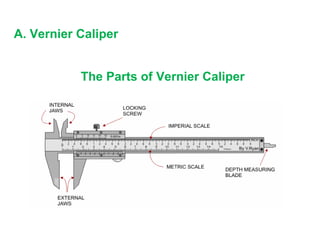
A. Vernier CaliperThe Parts of Vernier Caliper
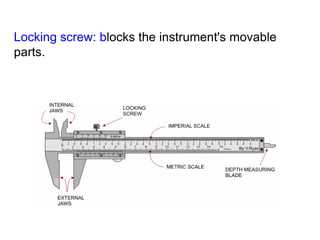
Inside jaws: Internal length (diameter) measurements are found by using this part.
Locking screw: blocks the instrument's movable parts.
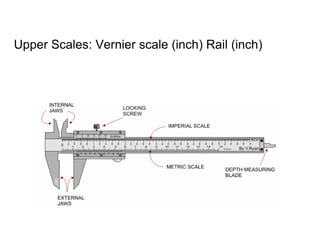
Upper Scales: Vernier scale (inch) Rail (inch)
Lower Scales: Vernier scale (mm) Rail (mm)
Depth probe: The part used in order to find depth measurements Front end of the rail
1. Inside jaws: Internal length measurements are found by using this part. 2. locking screw: This part blocks the instrument's movable parts in order to transfer between measurement methods easily.3. Vernier scale (inch)4. Rail (inch) 5. Depth probe: The part used in order to find depth measurements6. Front end of the rail7. Main scale (mm) 8. Vernier scale (mm) 9. Sliding Jaw10. Outside jaws: This part makes measuring external lengths possible.11. Fixed Jaw
Reading the Vernier Caliper
1) Read the cm mark on the fixed scale to the left of the 0-mark on the vernier scale. (1 cm or 10mm on the fixed caliper)
2. Find the mm mark on the fixed scale that is just to the left of the 0-mark on the vernier scale. (6mm or 0.6 cm on the fixed caliper)
3. Look along the 20 marks on the vernier scale and the mm marks on the fixed scale, until you find the two that most nearly line up. (0.25mm on the vernier scale)
4. To get the correct reading, simply add this found digit to your previous reading. (10mm + 6mm + 0.25mm= 16.25 mm)
23.7 mm or 2.37 cm
10.2 mm or 1.02 cm
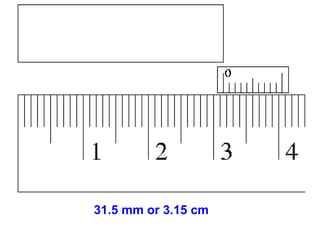
31.5 mm or 3.15 cm
9.1 mm or 0.91 cm
26.0 mm or 2.60 cm
756.5 mm  or75.65 cm
756.8 mm  or75.68 cm
Using the Micrometer Place the object whose length, diameter, or thickness is to be measured between the micrometer's measuring rods.
Using the Micrometer 2. Turn the thimbleuntil the spindlecontactsthe object to be measured. The rods should lightly touch the object between them but not clamp down on it.
Using the Micrometer 3. To apply a consistent pressure to the object, use the ratchet stop.
Using the Micrometer 4. Flip the locking lever to lock the measuring rods in place.
Using the Micrometer 5. Flip the locking lever to lock the measuring rods in place.
1. The mm marks are above the horizontal line and the half-mm marks are below it.
4.5 mm2. Read the value just exposed by the thimble on the central line of the cylinder. This value is in millimeters.
4.5 mm0.13 mm3. Read the mark on the thimble aligned with the horizontal line on the barrel. This mark is in hundredths of millimeters.
4.5 mm0.13 mm4. There are 50 such marks, each turn of the thimble corresponds to half a millimeter (the distance between the upward and downward marks on the cylinder central line).
4.5 mm0.13 mm5. Add these values together. This is the measurement of the object between the measuring rods.
4.5 mm0.13 mm4.5 mm + 0.13 mm = 4.63 mm
5.5 mm0.17 mm5.5 mm + 0.17 mm = 5.67 mm
3.5 mm0.17 mm3.5 mm + 0.17 mm = 3.67 mm
4.5 mm0.17 mm4.5 mm + 0.17 mm = 4.67 mm
18.5 mm + 0.40 mm = 18.90 mm
High Accuracy Tools

High Accuracy Tools

  • 1.
    High Accuracy MeasuringDevices A. Vernier CaliperB. Microcaliper
  • 2.
    A. Vernier CaliperTheParts of Vernier Caliper
  • 3.
    Inside jaws: Internallength (diameter) measurements are found by using this part.
  • 4.
    Locking screw: blocksthe instrument's movable parts.
  • 5.
    Upper Scales: Vernierscale (inch) Rail (inch)
  • 6.
    Lower Scales: Vernierscale (mm) Rail (mm)
  • 7.
    Depth probe: Thepart used in order to find depth measurements Front end of the rail
  • 8.
    Depth probe: Thepart used in order to find depth measurements Front end of the rail
  • 9.
    1. Inside jaws:Internal length measurements are found by using this part. 2. locking screw: This part blocks the instrument's movable parts in order to transfer between measurement methods easily.3. Vernier scale (inch)4. Rail (inch) 5. Depth probe: The part used in order to find depth measurements6. Front end of the rail7. Main scale (mm) 8. Vernier scale (mm) 9. Sliding Jaw10. Outside jaws: This part makes measuring external lengths possible.11. Fixed Jaw
  • 10.
  • 11.
    1) Read thecm mark on the fixed scale to the left of the 0-mark on the vernier scale. (1 cm or 10mm on the fixed caliper)
  • 12.
    2. Find themm mark on the fixed scale that is just to the left of the 0-mark on the vernier scale. (6mm or 0.6 cm on the fixed caliper)
  • 13.
    3. Look alongthe 20 marks on the vernier scale and the mm marks on the fixed scale, until you find the two that most nearly line up. (0.25mm on the vernier scale)
  • 14.
    4. To getthe correct reading, simply add this found digit to your previous reading. (10mm + 6mm + 0.25mm= 16.25 mm)
  • 16.
    23.7 mm or2.37 cm
  • 18.
    10.2 mm or1.02 cm
  • 20.
    31.5 mm or3.15 cm
  • 22.
    9.1 mm or0.91 cm
  • 24.
    26.0 mm or2.60 cm
  • 26.
    756.5 mm or75.65 cm
  • 28.
    756.8 mm or75.68 cm
  • 30.
    Using the MicrometerPlace the object whose length, diameter, or thickness is to be measured between the micrometer's measuring rods.
  • 31.
    Using the Micrometer2. Turn the thimbleuntil the spindlecontactsthe object to be measured. The rods should lightly touch the object between them but not clamp down on it.
  • 32.
    Using the Micrometer3. To apply a consistent pressure to the object, use the ratchet stop.
  • 33.
    Using the Micrometer4. Flip the locking lever to lock the measuring rods in place.
  • 34.
    Using the Micrometer5. Flip the locking lever to lock the measuring rods in place.
  • 35.
    1. The mmmarks are above the horizontal line and the half-mm marks are below it.
  • 36.
    4.5 mm2. Readthe value just exposed by the thimble on the central line of the cylinder. This value is in millimeters.
  • 37.
    4.5 mm0.13 mm3.Read the mark on the thimble aligned with the horizontal line on the barrel. This mark is in hundredths of millimeters.
  • 38.
    4.5 mm0.13 mm4.There are 50 such marks, each turn of the thimble corresponds to half a millimeter (the distance between the upward and downward marks on the cylinder central line).
  • 39.
    4.5 mm0.13 mm5.Add these values together. This is the measurement of the object between the measuring rods.
  • 40.
    4.5 mm0.13 mm4.5mm + 0.13 mm = 4.63 mm
  • 41.
    5.5 mm0.17 mm5.5mm + 0.17 mm = 5.67 mm
  • 42.
    3.5 mm0.17 mm3.5mm + 0.17 mm = 3.67 mm
  • 43.
    4.5 mm0.17 mm4.5mm + 0.17 mm = 4.67 mm
  • 44.
    18.5 mm +0.40 mm = 18.90 mm