LECTURE UNIT 006
 PROCESS
       is a change of state.
   A. Reversible process
            is one when a substance undergoes a change of state and can return back to its original state.

   B. Irreversible process
             is one when a substance undergoes a change of state and could no longer return to its original state due to (1) friction, (2)
                      difference in pressure between the system and surroundings and (3) difference in temperature between the system
   and                surroundings.
         For any ideal gas:
               1. General gas law equation (equation of state)
                           PV = mRT
               2. Gas constant
                       a.      R = Cp - Cv

                       b.                 R
                                    R=
                                          M
               3. Ratio of specific heat, k
                                      Cp
                                  k=        >1
                                      Cv

                                          hence Cp > Cv

1. CONSTANT PRESSURE or ISOBARIC PROCESS (P = c)
    A. CONSIDERING A CLOSED OR NON-FLOW SYSTEM
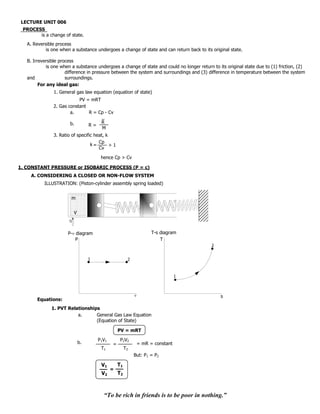
           ILLUSTRATION: (Piston-cylinder assembly spring loaded)


                        m


                           V
                       Q


                      P-v diagram                                       T-s diagram
                          P                                                 T
                                                                                            2


                                    1                     2


                                                                                    1


                                                              v                                  s
       Equations:
              1. PVT Relationships
                         a.      General Gas Law Equation
                                 (Equation of State)

                                                    PV = mRT
                                         P1V1        P2V2
                               b.               =                 = mR = constant
                                          T1             T2
                                                              But: P1 = P2

                                          V1        T1
                                                =
                                          V2        T2


                                           “To be rich in friends is to be poor in nothing.”
2. Work Non-Flow, WNF                            2

          General Formula:        WNF = P dV
                                                  1
                                                   2

                                          = PV
                                                   1

                                          = P (V2 - V1)           where: P1 = P2 = P

                                  WNF = (P2V2 - P1V1) =                PV

                                          = mRT2 - mRT1 = mR(               T)

                                  WNF = mR(T2 - T1) = mR(                   T)

  3. Heat Energy, Q
          Using NFEE;
                           Q=     U + WNF
                             = mCv        T + mR            T
                             = m (Cv + R)              T

                           Q = mCp           T=         H

  4. Change in Total Internal Energy,                  U

           U = mCv(T2 - T1) = mCv(                    T)

  5. Change in Total Enthalpy,               H

           H = mCp(T2 - T1) = mCp(                     T)

  6. Change in Total Entropy,            S
           From;      dQ = TdS
                             dQ
                      dS =
                       2
                              T      2
                                         dT
                      dS = mCp
                      1
                                     1   T

                   S2 - S2 = mCp (ln T2 - ln T1)

                                     T2          V2
                    S = mCp ln          = mCp ln
                                     T1          V1


B. CONSIDERING AN OPEN OR STEADY-FLOW SYSTEM
       ILLUSTRATION:                                        WSF


                    PE1                                                          PE2
                    KE1                            TS                            KE2
                     U1                          (P = C)                         U2
                    Wf1                                                          Wf2


                                                            Q

                                                 [ Ein = Eout]
                     PE1 + KE1 + U1 + Wf1 + Q = PE2 + KE2 + U2 + Wf2 + WSF
                     Q = (PE1 - PE2) + (KE2 - KE1) + (U2 - U1) + (Wf2 - Wf1) + WSF


           “Success in any area requires constantly readjusting your behavior as a result of feedback.”
Q=    PE +     KE +        U+    Wf + WSF

                       Recall:             H=    U+         Wf
                Q=    PE +    KE +         H + WSF
                       When:         PE ˜ 0          (z1 ˜ z2)
                                       ˜                ˜
                                   KE ˜ 0        (v1 ˜ v2)
                                                       ˜
                Q=    H + WSF
                       But: Q =         H

                WSF = 0

All ideal heat exchangers: (P=C)
         1. Steam generator
                   a. economizer
                   b. steam boiler
                   c. superheater
         2. Condenser
         3. Evaporators
         4. Air preheaters
         5. Any shell and tube heat exchangers (water or oiler heaters)
Various heat exchanger configurations


                  Parallel and counterflow
                                                                                                     Shell and tube


                          Cross-flow                                                             Direct-contact

 ILLUSTRATION: Steam Boiler
                             PE1
                             KE1      SL
                              U1
                             Wf1
                                                                                           PE2
                                      Flue gas                                             KE2
                                                                                D and SV
                                                                                           U2
                                                                                           Wf2
                                                            Water tube boiler

                                                             [Ein = Eout]
                                                        Hg1 + H1 = Hg2 + H2
                                      mgCpgTg1 + mwCpwT1 = mgCpgTg2 + msCpsT2
                                             mgCpg (Tg1 - Tg2) = msCpsT2 - mwCpwT1

                                           mgCpg (Tg1 - Tg2) = ms(h2 - h1)

                [Heat energy given off by the flue gas = Heat absorbed by the feed water]

                  “A good objective of leadership is to help those who are doing poorly to do well
                             and to help those who are doing well to do even better.”
ILLUSTRATION: Shell and Tube type heat exchanger

                                          1   mg
                         SL
                         mf

                           1


                          2

                          SL
                          mf
                                          2   mg


                     [Heat energy given off by the gas = Heat absorbed by the fluid]
                                      mgCpg(Tg1 - Tg2) = mfCpf(T2 - T1)

                                    mgCpg(Tg1 - Tg2) = mf(h2 - h1)


PROBLEM SET:
1.     A 2-kg mass of oxygen expands at a constant-pressure of 172 kPa in a piston-cylinder system from a temperature of 32oC
               to a final temperature of 182oC. Determine (a) the heat required, (b) the work, (c) the change in enthalpy, (d) the
change         in internal energy. [                                        ]

2.          Methane undergoes a constant pressure process from 6 Mpa and 600 K to 400 K. Determine the heat transfer and work
                    done per unit mass. [                          ]

3.       A fresh water heat exchanger is used to cool the oil in a marine engine. Water temperature into the exchanger is 15oC and
                  the water temperature out is 30oC. Oil temperature in is 150oC and the oil flow is 80 L/min. The oil has a relative
density of                0.9 and specific heat capacity of 1.8 kJ/kg-K. If the outlet oil temperature is 100oC. Determine the flow
rate of water in          liters per minute. [             ]

4.          A refrigerant flows through a water-cooled condenser at a rate of 25 kg/min. The specific enthalpy of the refrigerant
                      entering the condenser is 400 kJ/kg, and leaving, is 220 kJ/kg. Determine the mass flow of cooling water through
the                   condenser for a temperature increase of the water at 10oC, assuming no external heat exchanges. [                ]

5.          If 1 kg of air at 250 kPa pressure and 100oC where to be expanded at constant pressure in a closed process to twice the
                      original volume, determine:
                      a. the final state of air. [  ]
                      b. the amount of heat and work involved in the process. [                 ]
6.          An unknown ideal gas mixture is cooled at constant pressure from 300oC to 80oC. Assuming R=0.524 kJ/kg.K and k=1.39,
                    find (a) the change in entropy for 2.3 moles of this gas, (b) the final to initial volume ratio of this gas. [
        ]

 7.         An ideal gas with a molecular mass of 45 is heated at constant pressure from 135oC to 420oC. If the enthalpy change is
                     320 kJ/kg, determine (a) the change in internal energy, (b) the change in entropy. [                              ]

8.          An unknown gas mixture Cp = 0.7136 kJ/kg.K and k=1.35 initially occupies a volume of 435 L at atmospheric pressure and
                    30oC. Constant pressure heating causes the temperature of the gas to increase to 100oC. Determine (a) U, (b)
H (c)               WNF (d) V. [                               ]

 9.       Air is cooled at a constant pressure of 1 atm from an initial specific volume of 1.34 m3/kg to a final density of 1.205 kg/m3.
                    for the process and 2.5 kg of air, find (a) the change in internal energy (b) the change in enthalpy and (c) the
 change in                    entropy. [                                  ]
10.        8 kg of a gas, R = 280 J/kg.K and Cv = 0.78 kJ/kg.K undergo a reversible nonflow constant pressure process from V1 = 1.2
                    m3, P1 = 700 kPaa to a state where t2 = 480oC. Find (a) the change in internal energy, change in enthalpy, Q, WNF
(b) if the                   process had been reversible steady flow type with change in PE and KE are zero, find WSF. [
                                                              ]


                                “People perform better when leadership roles are defined.”
.
                       For moil,
                               .         .
                             moil = ρoil Voil
                                       From;
                                                   ρoil
                                            RD = ρw@4 C   o


                                                   ρoil
                                            0.9 =
                                                  1kg/L
                                                ρoil = 0.9 kg/L

                              .             kg
                              moil = ( 0.9     )( 80 L )
                                            L       min
                              .            kg
                              moil = 72
                                          min
      Then;
                  kg                                      .
              (72 min )(1.8 kgkJ K )(150 - 100)K = mw (4.187 kgkJ K )(30 - 15)K
                               -                                -

                            .             kg
                            mw = 103.1765
                                          min
                   And;
                                     .        .
                                     m w = ρw V w
                                   kg      kg .
                          103.1765 min = 1 L (Vw)
                                    .
                                    Vw = 103.1765 L/min

1.)

006 isobaric process

  • 1.
    LECTURE UNIT 006 PROCESS is a change of state. A. Reversible process is one when a substance undergoes a change of state and can return back to its original state. B. Irreversible process is one when a substance undergoes a change of state and could no longer return to its original state due to (1) friction, (2) difference in pressure between the system and surroundings and (3) difference in temperature between the system and surroundings. For any ideal gas: 1. General gas law equation (equation of state) PV = mRT 2. Gas constant a. R = Cp - Cv b. R R= M 3. Ratio of specific heat, k Cp k= >1 Cv hence Cp > Cv 1. CONSTANT PRESSURE or ISOBARIC PROCESS (P = c) A. CONSIDERING A CLOSED OR NON-FLOW SYSTEM ILLUSTRATION: (Piston-cylinder assembly spring loaded) m V Q P-v diagram T-s diagram P T 2 1 2 1 v s Equations: 1. PVT Relationships a. General Gas Law Equation (Equation of State) PV = mRT P1V1 P2V2 b. = = mR = constant T1 T2 But: P1 = P2 V1 T1 = V2 T2 “To be rich in friends is to be poor in nothing.”
  • 2.
    2. Work Non-Flow,WNF 2 General Formula: WNF = P dV 1 2 = PV 1 = P (V2 - V1) where: P1 = P2 = P WNF = (P2V2 - P1V1) = PV = mRT2 - mRT1 = mR( T) WNF = mR(T2 - T1) = mR( T) 3. Heat Energy, Q Using NFEE; Q= U + WNF = mCv T + mR T = m (Cv + R) T Q = mCp T= H 4. Change in Total Internal Energy, U U = mCv(T2 - T1) = mCv( T) 5. Change in Total Enthalpy, H H = mCp(T2 - T1) = mCp( T) 6. Change in Total Entropy, S From; dQ = TdS dQ dS = 2 T 2 dT dS = mCp 1 1 T S2 - S2 = mCp (ln T2 - ln T1) T2 V2 S = mCp ln = mCp ln T1 V1 B. CONSIDERING AN OPEN OR STEADY-FLOW SYSTEM ILLUSTRATION: WSF PE1 PE2 KE1 TS KE2 U1 (P = C) U2 Wf1 Wf2 Q [ Ein = Eout] PE1 + KE1 + U1 + Wf1 + Q = PE2 + KE2 + U2 + Wf2 + WSF Q = (PE1 - PE2) + (KE2 - KE1) + (U2 - U1) + (Wf2 - Wf1) + WSF “Success in any area requires constantly readjusting your behavior as a result of feedback.”
  • 3.
    Q= PE + KE + U+ Wf + WSF Recall: H= U+ Wf Q= PE + KE + H + WSF When: PE ˜ 0 (z1 ˜ z2) ˜ ˜ KE ˜ 0 (v1 ˜ v2) ˜ Q= H + WSF But: Q = H WSF = 0 All ideal heat exchangers: (P=C) 1. Steam generator a. economizer b. steam boiler c. superheater 2. Condenser 3. Evaporators 4. Air preheaters 5. Any shell and tube heat exchangers (water or oiler heaters) Various heat exchanger configurations Parallel and counterflow Shell and tube Cross-flow Direct-contact ILLUSTRATION: Steam Boiler PE1 KE1 SL U1 Wf1 PE2 Flue gas KE2 D and SV U2 Wf2 Water tube boiler [Ein = Eout] Hg1 + H1 = Hg2 + H2 mgCpgTg1 + mwCpwT1 = mgCpgTg2 + msCpsT2 mgCpg (Tg1 - Tg2) = msCpsT2 - mwCpwT1 mgCpg (Tg1 - Tg2) = ms(h2 - h1) [Heat energy given off by the flue gas = Heat absorbed by the feed water] “A good objective of leadership is to help those who are doing poorly to do well and to help those who are doing well to do even better.”
  • 4.
    ILLUSTRATION: Shell andTube type heat exchanger 1 mg SL mf 1 2 SL mf 2 mg [Heat energy given off by the gas = Heat absorbed by the fluid] mgCpg(Tg1 - Tg2) = mfCpf(T2 - T1) mgCpg(Tg1 - Tg2) = mf(h2 - h1) PROBLEM SET: 1. A 2-kg mass of oxygen expands at a constant-pressure of 172 kPa in a piston-cylinder system from a temperature of 32oC to a final temperature of 182oC. Determine (a) the heat required, (b) the work, (c) the change in enthalpy, (d) the change in internal energy. [ ] 2. Methane undergoes a constant pressure process from 6 Mpa and 600 K to 400 K. Determine the heat transfer and work done per unit mass. [ ] 3. A fresh water heat exchanger is used to cool the oil in a marine engine. Water temperature into the exchanger is 15oC and the water temperature out is 30oC. Oil temperature in is 150oC and the oil flow is 80 L/min. The oil has a relative density of 0.9 and specific heat capacity of 1.8 kJ/kg-K. If the outlet oil temperature is 100oC. Determine the flow rate of water in liters per minute. [ ] 4. A refrigerant flows through a water-cooled condenser at a rate of 25 kg/min. The specific enthalpy of the refrigerant entering the condenser is 400 kJ/kg, and leaving, is 220 kJ/kg. Determine the mass flow of cooling water through the condenser for a temperature increase of the water at 10oC, assuming no external heat exchanges. [ ] 5. If 1 kg of air at 250 kPa pressure and 100oC where to be expanded at constant pressure in a closed process to twice the original volume, determine: a. the final state of air. [ ] b. the amount of heat and work involved in the process. [ ] 6. An unknown ideal gas mixture is cooled at constant pressure from 300oC to 80oC. Assuming R=0.524 kJ/kg.K and k=1.39, find (a) the change in entropy for 2.3 moles of this gas, (b) the final to initial volume ratio of this gas. [ ] 7. An ideal gas with a molecular mass of 45 is heated at constant pressure from 135oC to 420oC. If the enthalpy change is 320 kJ/kg, determine (a) the change in internal energy, (b) the change in entropy. [ ] 8. An unknown gas mixture Cp = 0.7136 kJ/kg.K and k=1.35 initially occupies a volume of 435 L at atmospheric pressure and 30oC. Constant pressure heating causes the temperature of the gas to increase to 100oC. Determine (a) U, (b) H (c) WNF (d) V. [ ] 9. Air is cooled at a constant pressure of 1 atm from an initial specific volume of 1.34 m3/kg to a final density of 1.205 kg/m3. for the process and 2.5 kg of air, find (a) the change in internal energy (b) the change in enthalpy and (c) the change in entropy. [ ] 10. 8 kg of a gas, R = 280 J/kg.K and Cv = 0.78 kJ/kg.K undergo a reversible nonflow constant pressure process from V1 = 1.2 m3, P1 = 700 kPaa to a state where t2 = 480oC. Find (a) the change in internal energy, change in enthalpy, Q, WNF (b) if the process had been reversible steady flow type with change in PE and KE are zero, find WSF. [ ] “People perform better when leadership roles are defined.”
  • 5.
    . For moil, . . moil = ρoil Voil From; ρoil RD = ρw@4 C o ρoil 0.9 = 1kg/L ρoil = 0.9 kg/L . kg moil = ( 0.9 )( 80 L ) L min . kg moil = 72 min Then; kg . (72 min )(1.8 kgkJ K )(150 - 100)K = mw (4.187 kgkJ K )(30 - 15)K - - . kg mw = 103.1765 min And; . . m w = ρw V w kg kg . 103.1765 min = 1 L (Vw) . Vw = 103.1765 L/min 1.)