Irreversibility and Availability in
Transient Systems
S.Gunabalan
Associate Professor
Mechanical Engineering Department
Bharathiyar College of Engineering & Technology
Karaikal - 609 609.
e-Mail : gunabalans@yahoo.com
Part - 3
Available Energy is the maximum work output
obtainable from a certain heat input in a cyclic
heat engine.
Unavailable energy is the minimum energy that
has to be rejected to the sink by the second law
Dead state is defined as the system with zero
velocity and minimum potential energy.
Effectiveness is defined as the ratio of actual
useful work to the maximum useful work.
third law of thermodynamics states “When a
system is at zero absolute temperature, the
entropy of system is zero
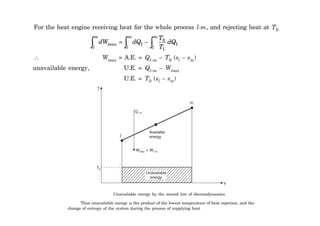
AVAILABLE ENERGY REFERRED TO A CYCLE
Q1 = A.E. + U.E.
Wmax = A.E. = Q1 – U.E.
the reversible efficiency,
For a given T1,
ηrev - increase with the decrease of T2.
The lowest practicable temperature of heat rejection
is the temperature of the surroundings, T0.
Availability in Transient flow
Transient flow is a flow where the velocity and
pressure changes over time.
Transient flows usually occur during the starting
or stopping of a pump, the opening or closing of
a tank, or simple changes in tank levels.
Transient flow usually refers to surge or water
hammer. The main reason transient flow can be
a problem is it can cause pressure that would
exceed the limits of pipes, fittings, etc.
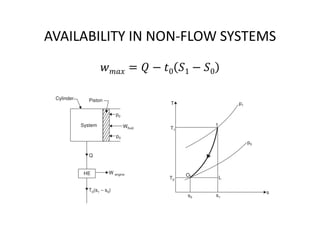
AVAILABILITY IN NON-FLOW SYSTEMS
= − 0 1 − 0
The heat supplied to the engine (Q)is equal to
the heat rejected by the fluid in the cylinder.
Wfluid = (u1-u0) – Q
Wfluid + = (u1−u0) – + − 0 1 − 0
Wfluid + = (u1−u0)	 − 0 1 − 0
Work done on atmosphere = p0 ( 0 – 1)
maximum work available Wmax
= (u1 – u0) – T0 (s1 – s0) – p0 ( 0 – 1)
Wmax = (u1 + p0 1 – T0s1) – (u0 + p0 0 – T0s0)
Wmax = (h1 – T0s1) – (h0 – T0s0)
AVAILABILITY IN STEADY FLOW
SYSTEMS
the function ‘b’ , ‘a’ is a composite property of a system and its environment ; this is
also known as Keenan function.
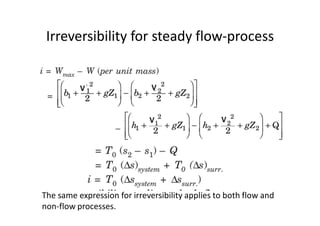
IRREVERSIBILITY
The actual work which a system does is always less
than the idealized reversible work, and
the difference between the two is called the
irreversibility of the process.
Irreversibility, I = Wmax – W
This is also referred as ‘degradation’ or ‘dissipation’.
For a non-flow process between the equilibrium
states, when the system exchanges heat
only with environment, irreversibility (per unit
mass)
Irreversibility for steady flow-process
The same expression for irreversibility applies to both flow and
non-flow processes.
Prob-1
A rigid tank of volume 2.5m3 contains air at
200kPa and 300K. The air is heated by supplying
heat from the reservoir at 600K until the
temperature reaches 500K. The surrounding
temperature is at 100kPa and 300K. Determine
the maximum useful work and the irreversibility
with the process.
volume = 2.5m3
P1 = 200kPa
T1 = 300K
T of reservoir = 600K
T2 = 500K.
Surrounding temperature
P0 = 100kPa
To = 300K.
Determine the maximum useful work and the irreversibility with the process.
Max work or reversible work or
availability of air at 1
	 . 1	 	1	 0 = 1 + 0 1 − 0 1 − ( 0 + 0 0 − 0 0)
	 . 1	 	1	 	0 = 1 − 0 + 0 1 − 0 − 0 1 − 0
To – is the surrounding
temperature
Max work or reversible work or
availability of air at 2
	 . 2	 	2	 	0 = 2 − 0 + 0 2 − 0 − 0 2 − 0
		 . 2	 	1 = 	 . 2	 	2	 	0 - 	 . 1	 	1	 	0
	 . 2	 	1
=
2 − 1 + 0 2 − 1 − 0 2 − 1
Prob-2
Two kg of air at 500 kPa,80℃ expands
adiabatically in a closed system until its volume
is doubled and its temperature is equal to that
of the surroundings which is at 100 kPa and 5℃.
For this process, determine the maximum work,
the change in availability and the irreversibility.
Assume for air cv = 0.718 kJ/kgK. And R = 287
J/kgK.
m = 2 kg
P1 = 500 kPa,
T1 = 80℃
expands adiabatically in a closed system
until its volume is doubled ie v2 = 2 v1
P2 = 100 kPa
T2 = 5℃.
Determine
1. the maximum work,
2. the change in availability and
3. The irreversibility.
Assume for air cv = 0.718 kJ/kgK. And R = 287 J/kgK.
Reference
• Rathakrishnan, E. 2005. Fundamentals of engineering thermodynamics.
Prentice Hall, New Delhi.
• Rajput, R. K. 2010. Engineering thermodynamics. Jones and Bartlett
Publishers, Sudbury, Mass.
• Nag, P. K. 2002. Basic and applied thermodynamics. Tata McGraw-Hill, New
Delhi.

03 part3 availability irreversibility

  • 1.
    Irreversibility and Availabilityin Transient Systems S.Gunabalan Associate Professor Mechanical Engineering Department Bharathiyar College of Engineering & Technology Karaikal - 609 609. e-Mail : gunabalans@yahoo.com Part - 3
  • 2.
    Available Energy isthe maximum work output obtainable from a certain heat input in a cyclic heat engine. Unavailable energy is the minimum energy that has to be rejected to the sink by the second law Dead state is defined as the system with zero velocity and minimum potential energy. Effectiveness is defined as the ratio of actual useful work to the maximum useful work. third law of thermodynamics states “When a system is at zero absolute temperature, the entropy of system is zero
  • 3.
    AVAILABLE ENERGY REFERREDTO A CYCLE Q1 = A.E. + U.E. Wmax = A.E. = Q1 – U.E. the reversible efficiency, For a given T1, ηrev - increase with the decrease of T2. The lowest practicable temperature of heat rejection is the temperature of the surroundings, T0.
  • 6.
    Availability in Transientflow Transient flow is a flow where the velocity and pressure changes over time. Transient flows usually occur during the starting or stopping of a pump, the opening or closing of a tank, or simple changes in tank levels. Transient flow usually refers to surge or water hammer. The main reason transient flow can be a problem is it can cause pressure that would exceed the limits of pipes, fittings, etc.
  • 7.
    AVAILABILITY IN NON-FLOWSYSTEMS = − 0 1 − 0
  • 8.
    The heat suppliedto the engine (Q)is equal to the heat rejected by the fluid in the cylinder. Wfluid = (u1-u0) – Q Wfluid + = (u1−u0) – + − 0 1 − 0 Wfluid + = (u1−u0) − 0 1 − 0 Work done on atmosphere = p0 ( 0 – 1) maximum work available Wmax = (u1 – u0) – T0 (s1 – s0) – p0 ( 0 – 1) Wmax = (u1 + p0 1 – T0s1) – (u0 + p0 0 – T0s0) Wmax = (h1 – T0s1) – (h0 – T0s0)
  • 9.
    AVAILABILITY IN STEADYFLOW SYSTEMS the function ‘b’ , ‘a’ is a composite property of a system and its environment ; this is also known as Keenan function.
  • 10.
    IRREVERSIBILITY The actual workwhich a system does is always less than the idealized reversible work, and the difference between the two is called the irreversibility of the process. Irreversibility, I = Wmax – W This is also referred as ‘degradation’ or ‘dissipation’.
  • 11.
    For a non-flowprocess between the equilibrium states, when the system exchanges heat only with environment, irreversibility (per unit mass)
  • 12.
    Irreversibility for steadyflow-process The same expression for irreversibility applies to both flow and non-flow processes.
  • 13.
    Prob-1 A rigid tankof volume 2.5m3 contains air at 200kPa and 300K. The air is heated by supplying heat from the reservoir at 600K until the temperature reaches 500K. The surrounding temperature is at 100kPa and 300K. Determine the maximum useful work and the irreversibility with the process.
  • 14.
    volume = 2.5m3 P1= 200kPa T1 = 300K T of reservoir = 600K T2 = 500K. Surrounding temperature P0 = 100kPa To = 300K. Determine the maximum useful work and the irreversibility with the process.
  • 15.
    Max work orreversible work or availability of air at 1 . 1 1 0 = 1 + 0 1 − 0 1 − ( 0 + 0 0 − 0 0) . 1 1 0 = 1 − 0 + 0 1 − 0 − 0 1 − 0 To – is the surrounding temperature
  • 16.
    Max work orreversible work or availability of air at 2 . 2 2 0 = 2 − 0 + 0 2 − 0 − 0 2 − 0 . 2 1 = . 2 2 0 - . 1 1 0 . 2 1 = 2 − 1 + 0 2 − 1 − 0 2 − 1
  • 19.
    Prob-2 Two kg ofair at 500 kPa,80℃ expands adiabatically in a closed system until its volume is doubled and its temperature is equal to that of the surroundings which is at 100 kPa and 5℃. For this process, determine the maximum work, the change in availability and the irreversibility. Assume for air cv = 0.718 kJ/kgK. And R = 287 J/kgK.
  • 20.
    m = 2kg P1 = 500 kPa, T1 = 80℃ expands adiabatically in a closed system until its volume is doubled ie v2 = 2 v1 P2 = 100 kPa T2 = 5℃. Determine 1. the maximum work, 2. the change in availability and 3. The irreversibility. Assume for air cv = 0.718 kJ/kgK. And R = 287 J/kgK.
  • 23.
    Reference • Rathakrishnan, E.2005. Fundamentals of engineering thermodynamics. Prentice Hall, New Delhi. • Rajput, R. K. 2010. Engineering thermodynamics. Jones and Bartlett Publishers, Sudbury, Mass. • Nag, P. K. 2002. Basic and applied thermodynamics. Tata McGraw-Hill, New Delhi.