4/3/2008


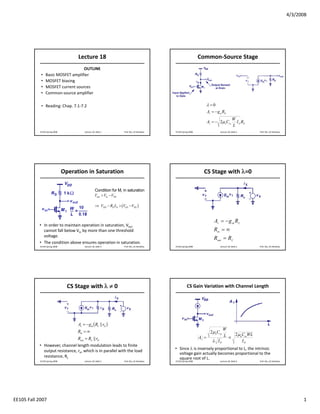
                                      Lecture 18                                                                   Common‐Source Stage
                                    OUTLINE
            •    Basic MOSFET amplifier
            •    MOSFET biasing
            •    MOSFET current sources
            •    Common‐source amplifier
                 Common source amplifier

            • Reading: Chap. 7.1‐7.2                                                                                      λ =0
                                                                                                                          Av = −g m RD
                                                                                                                                               W
                                                                                                                          Av = − 2μnCox          I D RD
                                                                                                                                               L
            EE105 Spring 2008             Lecture 18, Slide 1          Prof. Wu, UC Berkeley   EE105 Spring 2008                  Lecture 18, Slide 2     Prof. Wu, UC Berkeley


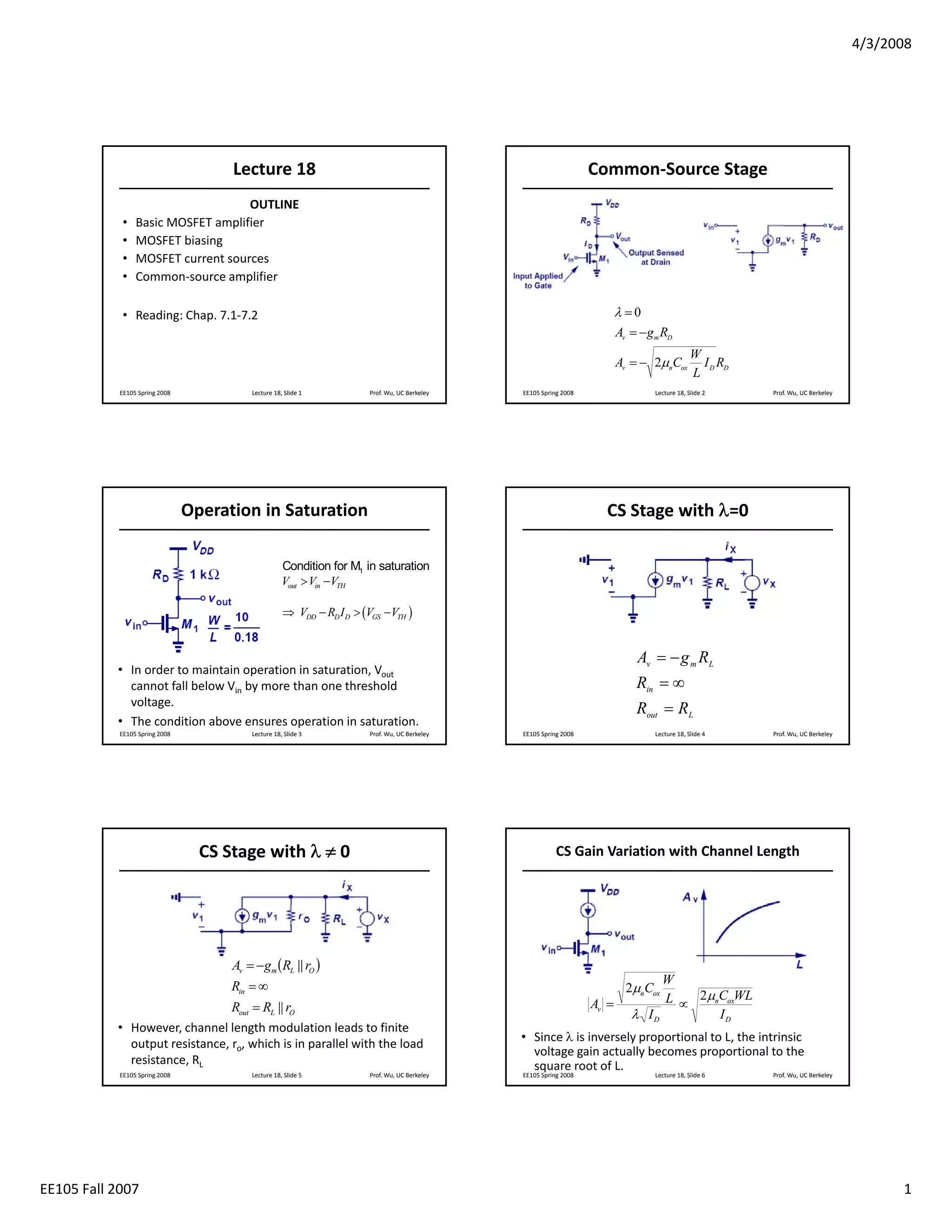
                                Operation in Saturation                                                              CS Stage with λ=0

                                                     Condition for M1 in saturation
                                                     Vout > Vin −VTH

                                                     ⇒ VDD − RD I D > (VGS −VTH )


                                                                                                                              Av = − g m RL
           • In order to maintain operation in saturation, Vout
             cannot fall below Vin by more than one threshold                                                                 Rin = ∞
             voltage.  
                                                                                                                              Rout = RL
           • The condition above ensures operation in saturation.  
            EE105 Spring 2008             Lecture 18, Slide 3          Prof. Wu, UC Berkeley   EE105 Spring 2008                  Lecture 18, Slide 4     Prof. Wu, UC Berkeley


                                  CS Stage with λ ≠ 0                                                     CS Gain Variation with Channel Length


                                      Av = −gm ( RL || rO )
                                      Rin = ∞                                                                                     W
                                                                                                                            2μnCox
                                                                                                                   Av =           L ∝ 2μnCoxWL
                                      Rout = RL || rO
                                                                                                                             λ ID        ID
           • However, channel length modulation leads to finite 
             output resistance, ro, which is in parallel with the load                         • Since λ is inversely proportional to L, the intrinsic 
                                                                                                 voltage gain actually becomes proportional to the 
             resistance, RL                                                                      square root of L.  
            EE105 Spring 2008             Lecture 18, Slide 5          Prof. Wu, UC Berkeley   EE105 Spring 2008                  Lecture 18, Slide 6     Prof. Wu, UC Berkeley


EE105 Fall 2007                                                                                                                                                                         1
4/3/2008


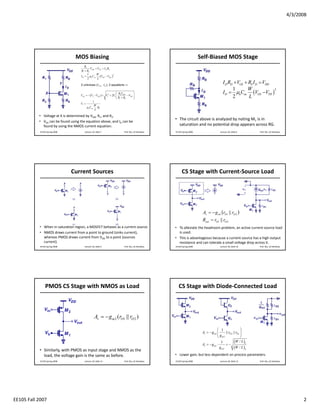
                                 MOS Biasing                                                                         Self‐Biased MOS Stage
                                         R1
                                              VDD = VGS + I D RS
                                     R1 + R2
                                            1      W
                                     I D = μnCox (VGS − VTH )
                                                                 2

                                            2       L

                                     2 unknows (VGS , I D ), 2 equations ⇒
                                                                                                                                       I D RD +VGS + RS I D = VDD
                                                                                                                                             1      W
                                                                                                                                       I D = μnCox (VGS −VTH )
                                                                                                                                                                  2
                                                                    ⎛ RV         ⎞
                                    VGS = − (V1 − VTH ) + V12 + 2V1 ⎜ 2 DD − VTH ⎟
                                                                    ⎝ R1 + R2    ⎠                                                           2       L
                                               1
                                    V1 =
                                                W
                                         μn Cox RS
                                                 L

           • Voltage at X is determined by VDD, R1, and R2.
                                                                                                 • The circuit above is analyzed by noting M1 is in 
           • VGS can be found using the equation above, and ID can be 
             found by using the NMOS current equation.                                             saturation and no potential drop appears across RG.
            EE105 Spring 2008           Lecture 18, Slide 7              Prof. Wu, UC Berkeley   EE105 Spring 2008                  Lecture 18, Slide 8      Prof. Wu, UC Berkeley


                                Current Sources                                                       CS Stage with Current‐Source Load


                                                                                                                      Av = − g m1 (rO1 || rO 2 )
                                                                                                                      Rout = rO1 || rO 2
           • When in saturation region, a MOSFET behaves as a current source.                    • To alleviate the headroom problem, an active current‐source load 
           • NMOS draws current from a point to ground (sinks current),                            is used.
             whereas PMOS draws current from VDD to a point (sources                             • This is advantageous because a current‐source has a high output 
             current).                                                                             resistance and can tolerate a small voltage drop across it.  
            EE105 Spring 2008           Lecture 18, Slide 9              Prof. Wu, UC Berkeley   EE105 Spring 2008                  Lecture 18, Slide 10     Prof. Wu, UC Berkeley


                PMOS CS Stage with NMOS as Load                                                    CS Stage with Diode‐Connected Load


                                                  Av = − g m 2 (rO1 || rO 2 )

                                                                                                                                  ⎛ 1                  ⎞
                                                                                                                      Av = − g m1 ⎜     || rO 2 || rO1 ⎟
                                                                                                                                  ⎝ gm2                ⎠
                                                                                                                                     1           (W / L )1
                                                                                                                      Av = − g m1 ⋅     =−
                                                                                                                                    gm2          (W / L )2
           • Similarly, with PMOS as input stage and NMOS as the 
             load, the voltage gain is the same as before.                                       • Lower gain, but less dependent on process parameters.
            EE105 Spring 2008           Lecture 18, Slide 11             Prof. Wu, UC Berkeley   EE105 Spring 2008                  Lecture 18, Slide 12     Prof. Wu, UC Berkeley


EE105 Fall 2007                                                                                                                                                                            2
4/3/2008


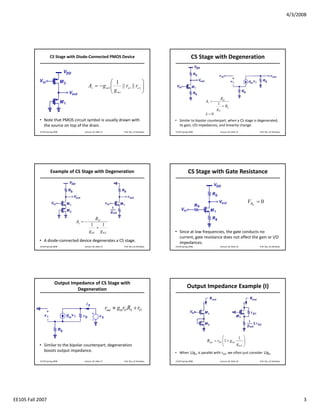
                     CS Stage with Diode‐Connected PMOS Device                                                 CS Stage with Degeneration


                                                         ⎛ 1                ⎞
                                            Av = − g m 2 ⎜
                                                         ⎜ g || ro1 || ro 2 ⎟
                                                                            ⎟
                                                         ⎝ m1               ⎠
                                                                                                                               RD
                                                                                                                    Av = −
                                                                                                                             1
                                                                                                                                + RS
                                                                                                                             gm
                                                                                                                    λ =0
           • Note that PMOS circuit symbol is usually drawn with                                • Similar to bipolar counterpart, when a CS stage is degenerated, 
             the source on top of the drain.                                                      its gain, I/O impedances, and linearity change.
            EE105 Spring 2008          Lecture 18, Slide 13             Prof. Wu, UC Berkeley   EE105 Spring 2008              Lecture 18, Slide 14        Prof. Wu, UC Berkeley


                      Example of CS Stage with Degeneration                                                 CS Stage with Gate Resistance


                                                                                                                                                      VRG = 0

                                                RD
                                   Av = −
                                             1     1
                                                +
                                            g m1 g m 2                                          • Since at low frequencies, the gate conducts no 
                                                                                                  current, gate resistance does not affect the gain or I/O 
           • A diode‐connected device degenerates a CS stage.                                     impedances.
            EE105 Spring 2008          Lecture 18, Slide 15             Prof. Wu, UC Berkeley   EE105 Spring 2008              Lecture 18, Slide 16        Prof. Wu, UC Berkeley


                          Output Impedance of CS Stage with 
                                   Degeneration
                                                                                                           Output Impedance Example (I)


                                                              rout ≈ gmrO RS + rO


                                                                                                                               ⎛          1 ⎞
                                                                                                                    Rout = rO1 ⎜1 + g m1     ⎟
           • Similar to the bipolar counterpart, degeneration                                                                  ⎝         gm2 ⎠
             boosts output impedance.                                                           • When 1/gm is parallel with rO2, we often just consider 1/gm

            EE105 Spring 2008          Lecture 18, Slide 17             Prof. Wu, UC Berkeley   EE105 Spring 2008              Lecture 18, Slide 18        Prof. Wu, UC Berkeley


EE105 Fall 2007                                                                                                                                                                          3
4/3/2008


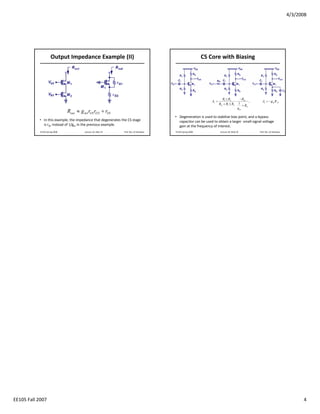
                      Output Impedance Example (II)                                                         CS Core with Biasing


                                                                                                                         R1 || R2      − RD
                                                                                                                Av =                ⋅         ,     Av = − g m R D
                                                                                                                       RG + R1 || R2 1 + R
                                                                                                                                            S
                                                                                                                                      gm
                                Rout ≈ g m1rO1rO 2 + rO1
                                                                                        • Degeneration is used to stabilize bias point, and a bypass 
           • In this example, the impedance that degenerates the CS stage                 capacitor can be used to obtain a larger  small‐signal voltage 
             is rO, instead of 1/gm in the previous example.                              gain at the frequency of interest. 
            EE105 Spring 2008            Lecture 18, Slide 19   Prof. Wu, UC Berkeley   EE105 Spring 2008               Lecture 18, Slide 20      Prof. Wu, UC Berkeley


EE105 Fall 2007                                                                                                                                                                 4

Cs with active load

  • 1.
    4/3/2008 Lecture 18 Common‐Source Stage OUTLINE • Basic MOSFET amplifier • MOSFET biasing • MOSFET current sources • Common‐source amplifier Common source amplifier • Reading: Chap. 7.1‐7.2 λ =0 Av = −g m RD W Av = − 2μnCox I D RD L EE105 Spring 2008 Lecture 18, Slide 1 Prof. Wu, UC Berkeley EE105 Spring 2008 Lecture 18, Slide 2 Prof. Wu, UC Berkeley Operation in Saturation CS Stage with λ=0 Condition for M1 in saturation Vout > Vin −VTH ⇒ VDD − RD I D > (VGS −VTH ) Av = − g m RL • In order to maintain operation in saturation, Vout cannot fall below Vin by more than one threshold  Rin = ∞ voltage.   Rout = RL • The condition above ensures operation in saturation.   EE105 Spring 2008 Lecture 18, Slide 3 Prof. Wu, UC Berkeley EE105 Spring 2008 Lecture 18, Slide 4 Prof. Wu, UC Berkeley CS Stage with λ ≠ 0 CS Gain Variation with Channel Length Av = −gm ( RL || rO ) Rin = ∞ W 2μnCox Av = L ∝ 2μnCoxWL Rout = RL || rO λ ID ID • However, channel length modulation leads to finite  output resistance, ro, which is in parallel with the load  • Since λ is inversely proportional to L, the intrinsic  voltage gain actually becomes proportional to the  resistance, RL square root of L.   EE105 Spring 2008 Lecture 18, Slide 5 Prof. Wu, UC Berkeley EE105 Spring 2008 Lecture 18, Slide 6 Prof. Wu, UC Berkeley EE105 Fall 2007 1
  • 2.
    4/3/2008 MOS Biasing Self‐Biased MOS Stage R1 VDD = VGS + I D RS R1 + R2 1 W I D = μnCox (VGS − VTH ) 2 2 L 2 unknows (VGS , I D ), 2 equations ⇒ I D RD +VGS + RS I D = VDD 1 W I D = μnCox (VGS −VTH ) 2 ⎛ RV ⎞ VGS = − (V1 − VTH ) + V12 + 2V1 ⎜ 2 DD − VTH ⎟ ⎝ R1 + R2 ⎠ 2 L 1 V1 = W μn Cox RS L • Voltage at X is determined by VDD, R1, and R2. • The circuit above is analyzed by noting M1 is in  • VGS can be found using the equation above, and ID can be  found by using the NMOS current equation. saturation and no potential drop appears across RG. EE105 Spring 2008 Lecture 18, Slide 7 Prof. Wu, UC Berkeley EE105 Spring 2008 Lecture 18, Slide 8 Prof. Wu, UC Berkeley Current Sources CS Stage with Current‐Source Load Av = − g m1 (rO1 || rO 2 ) Rout = rO1 || rO 2 • When in saturation region, a MOSFET behaves as a current source. • To alleviate the headroom problem, an active current‐source load  • NMOS draws current from a point to ground (sinks current),  is used. whereas PMOS draws current from VDD to a point (sources  • This is advantageous because a current‐source has a high output  current). resistance and can tolerate a small voltage drop across it.   EE105 Spring 2008 Lecture 18, Slide 9 Prof. Wu, UC Berkeley EE105 Spring 2008 Lecture 18, Slide 10 Prof. Wu, UC Berkeley PMOS CS Stage with NMOS as Load  CS Stage with Diode‐Connected Load Av = − g m 2 (rO1 || rO 2 ) ⎛ 1 ⎞ Av = − g m1 ⎜ || rO 2 || rO1 ⎟ ⎝ gm2 ⎠ 1 (W / L )1 Av = − g m1 ⋅ =− gm2 (W / L )2 • Similarly, with PMOS as input stage and NMOS as the  load, the voltage gain is the same as before. • Lower gain, but less dependent on process parameters. EE105 Spring 2008 Lecture 18, Slide 11 Prof. Wu, UC Berkeley EE105 Spring 2008 Lecture 18, Slide 12 Prof. Wu, UC Berkeley EE105 Fall 2007 2
  • 3.
    4/3/2008 CS Stage with Diode‐Connected PMOS Device CS Stage with Degeneration ⎛ 1 ⎞ Av = − g m 2 ⎜ ⎜ g || ro1 || ro 2 ⎟ ⎟ ⎝ m1 ⎠ RD Av = − 1 + RS gm λ =0 • Note that PMOS circuit symbol is usually drawn with  • Similar to bipolar counterpart, when a CS stage is degenerated,  the source on top of the drain. its gain, I/O impedances, and linearity change. EE105 Spring 2008 Lecture 18, Slide 13 Prof. Wu, UC Berkeley EE105 Spring 2008 Lecture 18, Slide 14 Prof. Wu, UC Berkeley Example of CS Stage with Degeneration CS Stage with Gate Resistance VRG = 0 RD Av = − 1 1 + g m1 g m 2 • Since at low frequencies, the gate conducts no  current, gate resistance does not affect the gain or I/O  • A diode‐connected device degenerates a CS stage. impedances. EE105 Spring 2008 Lecture 18, Slide 15 Prof. Wu, UC Berkeley EE105 Spring 2008 Lecture 18, Slide 16 Prof. Wu, UC Berkeley Output Impedance of CS Stage with  Degeneration Output Impedance Example (I) rout ≈ gmrO RS + rO ⎛ 1 ⎞ Rout = rO1 ⎜1 + g m1 ⎟ • Similar to the bipolar counterpart, degeneration  ⎝ gm2 ⎠ boosts output impedance. • When 1/gm is parallel with rO2, we often just consider 1/gm EE105 Spring 2008 Lecture 18, Slide 17 Prof. Wu, UC Berkeley EE105 Spring 2008 Lecture 18, Slide 18 Prof. Wu, UC Berkeley EE105 Fall 2007 3
  • 4.
    4/3/2008 Output Impedance Example (II) CS Core with Biasing R1 || R2 − RD Av = ⋅ , Av = − g m R D RG + R1 || R2 1 + R S gm Rout ≈ g m1rO1rO 2 + rO1 • Degeneration is used to stabilize bias point, and a bypass  • In this example, the impedance that degenerates the CS stage  capacitor can be used to obtain a larger  small‐signal voltage  is rO, instead of 1/gm in the previous example.   gain at the frequency of interest.  EE105 Spring 2008 Lecture 18, Slide 19 Prof. Wu, UC Berkeley EE105 Spring 2008 Lecture 18, Slide 20 Prof. Wu, UC Berkeley EE105 Fall 2007 4