EMG-bio feed back
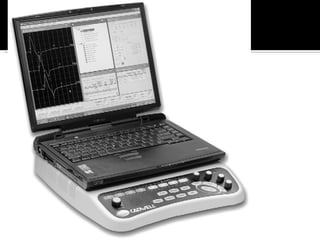
 An electromyography – is a clinical technique
  that involves recording of the electrical
  activity generated in a muscle (muscle AP) for
  diagnostic purposes
 An electromyogram - is a graphic
  representation of those electrical currents
  associated with muscle action
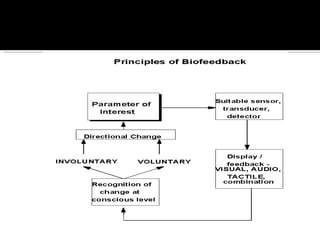
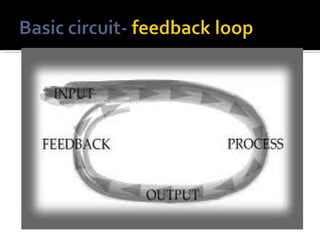
 It is a method of controlling a system by
  reinserting into it the results of its past
  performance.
                         -wiener1948
‘A technique which enables the individual to
    readily determine the activity levels of a
    particular physiological process, and with
    appropriate training, learn to manipulate the
    same process by an internalized mechanism.’
“Operant
 conditioning
 learning”
 Positive feed back
 Negative feed back
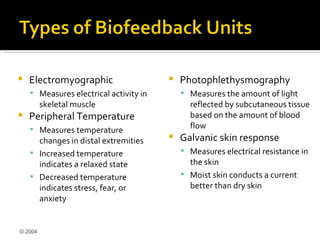
   Electromyographic                      Photophlethysmography
     Measures electrical activity in        Measures the amount of light
         skeletal muscle                      reflected by subcutaneous tissue
   Peripheral Temperature                    based on the amount of blood
     Measures temperature                    flow
      changes in distal extremities        Galvanic skin response
     Increased temperature                  Measures electrical resistance in
      indicates a relaxed state               the skin
     Decreased temperature                  Moist skin conducts a current
      indicates stress, fear, or              better than dry skin
      anxiety


© 2004
ADVANTAGES


 Chance to make appropriate small changes in
  performance
 Eventually larger changes or improvements
  in performance can be accomplished
 The goal is to train the patient to perceive
  these changes without the use of the
  measuring instrument so that he or she can
  practice independently
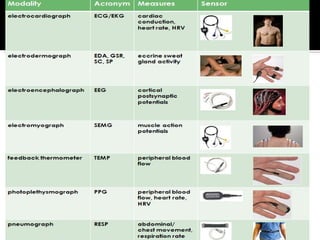
Biofeedback instruments may use
 the following
 signals/devices/sources
Eg: Temperature- thermometer-skin
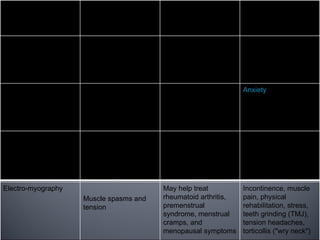
Type         What's Measured                Basic method               Used For


Brain waveEEG       Electrical activity in the   Sensors placed on       Alcohol and drug
                    brain                        scalp                   addition, brain
                                                                         damage, epilepsy,
                                                                         hyperactivity, insomnia


Breathing           Breath rate, rhythm,         Sensors around chest    Anxiety, asthma,
                    volume, and location         and abdomen or          hyperventilation
                                                 around mouth and
                                                 nose


Electro dermal      Sweat gland activity         Sensors placed on the   Anxiety, overactive
response                                         muscle group in         sweat glands
                                                 question


Electro-myography                                May help treat          Incontinence, muscle
                    Muscle spasms and            rheumatoid arthritis,   pain, physical
                    tension                      premenstrual            rehabilitation, stress,
                                                 syndrome, menstrual     teeth grinding (TMJ),
                                                 cramps, and             tension headaches,
                                                 menopausal symptoms     torticollis ("wry neck")
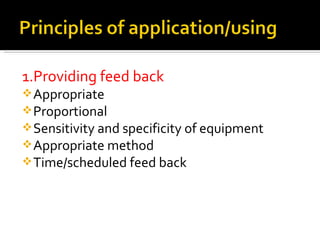
1.Providing feed back
 Appropriate
 Proportional
 Sensitivity and specificity of equipment
 Appropriate method
 Time/scheduled feed back
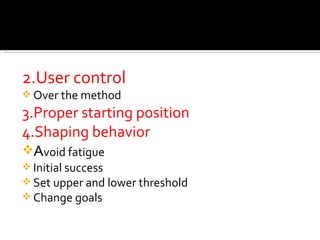
2.User control
 Over the method

3.Proper starting position
4.Shaping behavior
Avoid fatigue
 Initial success
 Set upper and lower threshold
 Change goals
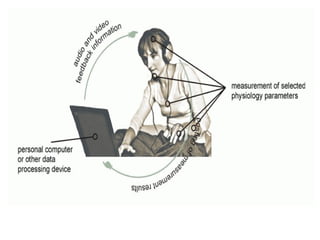
 It is a therapeutic procedure that uses
  electronic or electromechanical instruments
  to accurately measure, process, and feed
  back reinforcing information via auditory or
  visual signals.
 In clinical practice, it is used to help the
  patient develop greater voluntary control in
  terms of either neuromuscular relaxation or
  muscle reeducation following injury.
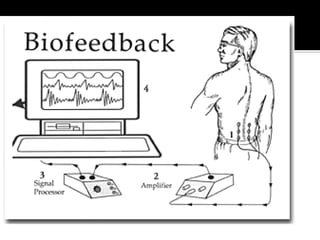
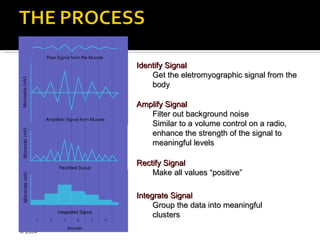
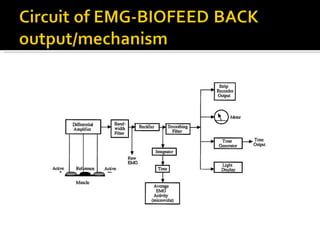
Identify Signal
             Get the eletromyographic signal from the
             body

         Amplify Signal
            Filter out background noise
            Similar to a volume control on a radio,
            enhance the strength of the signal to
            meaningful levels

         Rectify Signal
             Make all values “positive”

         Integrate Signal
              Group the data into meaningful
              clusters

© 2004
   Muscle reeducation
   Regaining neuromuscular control
   Increasing isometric and isotonic strength of
    a muscle
   Relaxation of muscle spasm
   Decreasing muscle guarding
   Pain reduction
   Psychologic relaxation
 Measuring muscle activity
 Separation / filteration
 Electrodes
 Displaying the feedback
 Biofeedback Measures electrical activity of
  muscle, not muscle contraction.
 Gives information about the quality of a
  muscle contraction
 Does not measure the strength of that
  muscle contraction specifically.
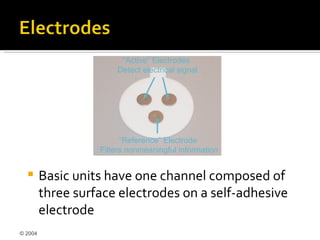
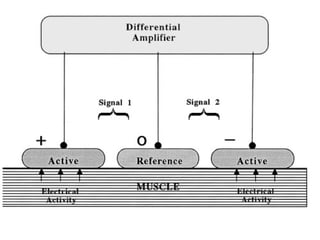
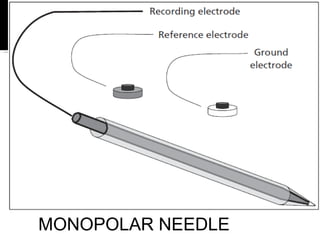
“Active” Electrodes
                       Detect electrical signal


                         “Reference” Electrode
                   Filters nonmeaningful information


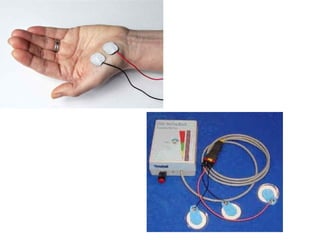
        Basic units have one channel composed of
         three surface electrodes on a self-adhesive
         electrode
© 2004
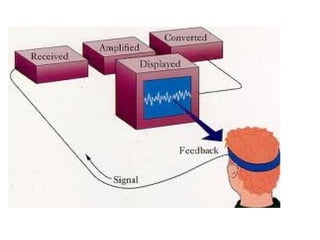
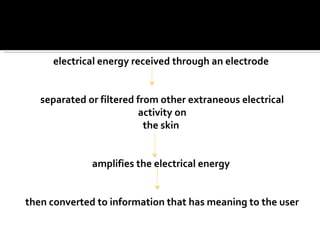
electrical energy received through an electrode


   separated or filtered from other extraneous electrical
                         activity on
                           the skin


              amplifies the electrical energy


then converted to information that has meaning to the user
• Noise must be eliminated
• Noise – by power lines , motor , lights , appliances.
• Accomplished by using 2 active electrodes and a
  single ground/reference electrode
   differential amplifier
   CMRR-common mode rejection ratio
• Filters are also used
• Use :
   Mask true electrical activity
   Decrease the reliability of the information being generated
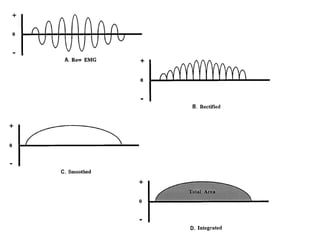
   After filtering, signal indicates true muscle
    activity – “raw” activity
   Raw activity – alternating voltage
   Biofeedback measures the overall increase
    and decrease in electrical activity
   To obtain this rectification is done
   Rectified signal can smoothed and
    integrated
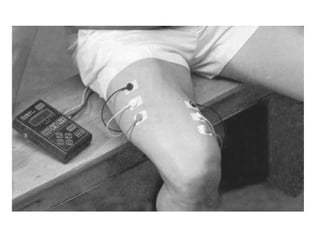
   Skin preparation
   Application of electrodes
   Selection of output modes
   Selection of sensitivity settings
   Comfortable positioning of the patient
   Begin with easy task
   Teach the patient how to use the unit
   Brief explanation
   Demonstration
   Skin preparation
     Reduce skin impedance
   Positioning of electrodes
     Placed as near to the muscle being monitored to
      minimize noise
     Parallel to the muscle fibers
   Spacing between electrodes
     More the distance between the electrodes – will
      include signal from nearby muscles
   Types
     Surface electrodes
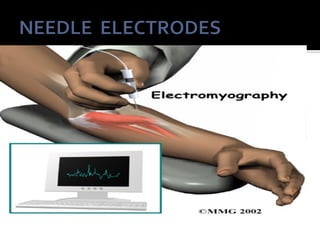
     Needle electrodes
   Made of stainless steel or nickel plated brass
    kept in a plastic holder
   Size : 4mm in diameter – small muscle
    activity
         12.5mm –for large muscle groups
   Increase in size will not increase the
    amplitude of the signal
   Conducting gel/paste/cream with high salt
    content is used
   Can be disposable and non-disposable
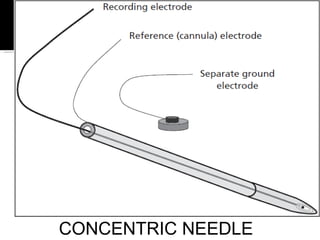
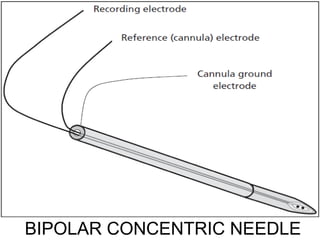
MONOPOLAR NEEDLE
CONCENTRIC NEEDLE
BIPOLAR CONCENTRIC NEEDLE
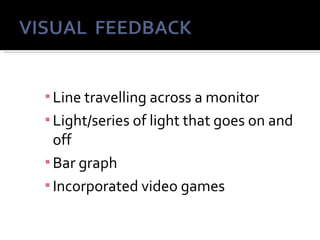
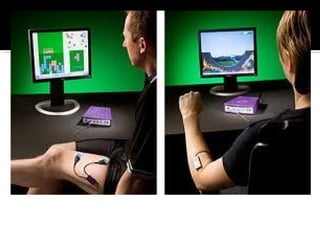
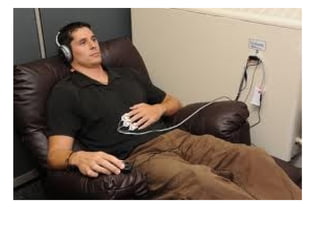
 Visual feedback
 Audio feedback
▪ Line travelling across a monitor
▪ Light/series of light that goes on and
  off
▪ Bar graph
▪ Incorporated video games
▪ Tone
▪ Buzzing
▪ Beeping
▪ Clicking
   An Increase  increased electrical
    activity  used to strengthen muscle
    contractions


   Decrease  decreased electrical activity
     used for relaxation
   Goal is to reestablish neuromuscular control
   Used to regain normal agonist/antagonist
    muscle action
   For postural control retraining
   Useful in patients who perform poorly on
    manual muscle tests
   Balance/mobility
   Muscle guarding
   Muscle guarding different from muscle
    spasticity
   Goal : to induce relaxation or to modulate
    pain by reducing electrical activity
   Patient attempts to reduce visual/auditory
    feedback to zero
   Positioning is important
   Verbal cues should be given to enhance
    relaxation
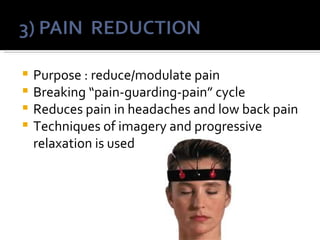
 Purpose : reduce/modulate pain
 Breaking “pain-guarding-pain” cycle
 Reduces pain in headaches and low back pain
 Techniques of imagery and progressive
  relaxation is used
   Hemiplegia
   Stroke
   Spinal cord injury
   Spasticity
   Cerebral palsy
   Facial paralysis
   Urinary and fecal incontinence
 HTN
 Stress
 Reynaud's disease
 Respiratory control
   severe psychosis
   depression
   psychopathic personalities
   diabetics and others with endocrine disorders
   Any musculoskeletal condition in which a
    muscular contraction might exaggerate that
    condition
Emg biofeedback

Emg biofeedback

  • 1.
  • 2.
     An electromyography– is a clinical technique that involves recording of the electrical activity generated in a muscle (muscle AP) for diagnostic purposes  An electromyogram - is a graphic representation of those electrical currents associated with muscle action
  • 4.
     It isa method of controlling a system by reinserting into it the results of its past performance. -wiener1948 ‘A technique which enables the individual to readily determine the activity levels of a particular physiological process, and with appropriate training, learn to manipulate the same process by an internalized mechanism.’
  • 5.
  • 10.
     Positive feedback  Negative feed back
  • 11.
    Electromyographic  Photophlethysmography  Measures electrical activity in  Measures the amount of light skeletal muscle reflected by subcutaneous tissue  Peripheral Temperature based on the amount of blood  Measures temperature flow changes in distal extremities  Galvanic skin response  Increased temperature  Measures electrical resistance in indicates a relaxed state the skin  Decreased temperature  Moist skin conducts a current indicates stress, fear, or better than dry skin anxiety © 2004
  • 12.
    ADVANTAGES  Chance tomake appropriate small changes in performance  Eventually larger changes or improvements in performance can be accomplished  The goal is to train the patient to perceive these changes without the use of the measuring instrument so that he or she can practice independently
  • 13.
    Biofeedback instruments mayuse the following signals/devices/sources Eg: Temperature- thermometer-skin
  • 14.
    Type What's Measured Basic method Used For Brain waveEEG Electrical activity in the Sensors placed on Alcohol and drug brain scalp addition, brain damage, epilepsy, hyperactivity, insomnia Breathing Breath rate, rhythm, Sensors around chest Anxiety, asthma, volume, and location and abdomen or hyperventilation around mouth and nose Electro dermal Sweat gland activity Sensors placed on the Anxiety, overactive response muscle group in sweat glands question Electro-myography May help treat Incontinence, muscle Muscle spasms and rheumatoid arthritis, pain, physical tension premenstrual rehabilitation, stress, syndrome, menstrual teeth grinding (TMJ), cramps, and tension headaches, menopausal symptoms torticollis ("wry neck")
  • 16.
    1.Providing feed back Appropriate  Proportional  Sensitivity and specificity of equipment  Appropriate method  Time/scheduled feed back
  • 17.
    2.User control  Overthe method 3.Proper starting position 4.Shaping behavior Avoid fatigue  Initial success  Set upper and lower threshold  Change goals
  • 18.
     It isa therapeutic procedure that uses electronic or electromechanical instruments to accurately measure, process, and feed back reinforcing information via auditory or visual signals.  In clinical practice, it is used to help the patient develop greater voluntary control in terms of either neuromuscular relaxation or muscle reeducation following injury.
  • 19.
    Identify Signal Get the eletromyographic signal from the body Amplify Signal Filter out background noise Similar to a volume control on a radio, enhance the strength of the signal to meaningful levels Rectify Signal Make all values “positive” Integrate Signal Group the data into meaningful clusters © 2004
  • 20.
    Muscle reeducation  Regaining neuromuscular control  Increasing isometric and isotonic strength of a muscle  Relaxation of muscle spasm  Decreasing muscle guarding  Pain reduction  Psychologic relaxation
  • 21.
     Measuring muscleactivity  Separation / filteration  Electrodes  Displaying the feedback
  • 22.
     Biofeedback Measureselectrical activity of muscle, not muscle contraction.  Gives information about the quality of a muscle contraction  Does not measure the strength of that muscle contraction specifically.
  • 23.
    “Active” Electrodes Detect electrical signal “Reference” Electrode Filters nonmeaningful information  Basic units have one channel composed of three surface electrodes on a self-adhesive electrode © 2004
  • 24.
    electrical energy receivedthrough an electrode separated or filtered from other extraneous electrical activity on the skin amplifies the electrical energy then converted to information that has meaning to the user
  • 26.
    • Noise mustbe eliminated • Noise – by power lines , motor , lights , appliances. • Accomplished by using 2 active electrodes and a single ground/reference electrode  differential amplifier  CMRR-common mode rejection ratio • Filters are also used • Use :  Mask true electrical activity  Decrease the reliability of the information being generated
  • 28.
    After filtering, signal indicates true muscle activity – “raw” activity  Raw activity – alternating voltage  Biofeedback measures the overall increase and decrease in electrical activity  To obtain this rectification is done  Rectified signal can smoothed and integrated
  • 30.
    Skin preparation  Application of electrodes  Selection of output modes  Selection of sensitivity settings  Comfortable positioning of the patient  Begin with easy task  Teach the patient how to use the unit  Brief explanation  Demonstration
  • 31.
    Skin preparation  Reduce skin impedance  Positioning of electrodes  Placed as near to the muscle being monitored to minimize noise  Parallel to the muscle fibers  Spacing between electrodes  More the distance between the electrodes – will include signal from nearby muscles  Types  Surface electrodes  Needle electrodes
  • 32.
    Made of stainless steel or nickel plated brass kept in a plastic holder  Size : 4mm in diameter – small muscle activity 12.5mm –for large muscle groups  Increase in size will not increase the amplitude of the signal  Conducting gel/paste/cream with high salt content is used  Can be disposable and non-disposable
  • 35.
  • 36.
  • 37.
  • 38.
  • 39.
    ▪ Line travellingacross a monitor ▪ Light/series of light that goes on and off ▪ Bar graph ▪ Incorporated video games
  • 41.
    ▪ Tone ▪ Buzzing ▪Beeping ▪ Clicking
  • 44.
    An Increase  increased electrical activity  used to strengthen muscle contractions  Decrease  decreased electrical activity  used for relaxation
  • 46.
    Goal is to reestablish neuromuscular control  Used to regain normal agonist/antagonist muscle action  For postural control retraining  Useful in patients who perform poorly on manual muscle tests  Balance/mobility
  • 47.
    Muscle guarding  Muscle guarding different from muscle spasticity  Goal : to induce relaxation or to modulate pain by reducing electrical activity  Patient attempts to reduce visual/auditory feedback to zero  Positioning is important  Verbal cues should be given to enhance relaxation
  • 48.
     Purpose :reduce/modulate pain  Breaking “pain-guarding-pain” cycle  Reduces pain in headaches and low back pain  Techniques of imagery and progressive relaxation is used
  • 49.
    Hemiplegia  Stroke  Spinal cord injury  Spasticity  Cerebral palsy  Facial paralysis  Urinary and fecal incontinence
  • 50.
     HTN  Stress Reynaud's disease  Respiratory control
  • 51.
    severe psychosis  depression  psychopathic personalities  diabetics and others with endocrine disorders  Any musculoskeletal condition in which a muscular contraction might exaggerate that condition

Editor's Notes

  • #20 Animated slide – 4 clicks
  • #24 Click for animation (two total on slide)