LOGOSreeraj S R
McKenzie Method
LOGOSreeraj S R
Introduction
 The McKenzie Method was developed by New Zealand
based physiotherapist, Robin McKenzie (1931–
2013).1,2
 The McKenzie method is a classification system and a
classification-based treatment for patients with pain.3
 A acronym for the McKenzie method is Mechanical
Diagnosis and Therapy (MDT).3
LOGOSreeraj S R
McKenzie Method?
 It is a philosophy of active patient involvement and education for back, neck and
extremity issues.
 It is grounded in finding a cause and effect relationship between the positions
the patient usually assumes while sitting, standing or moving, and the location of
pain as a result of those positions or activities.
 The therapeutic approach requires a patient to move through a series of
activities and test movements to gauge the patient’s pain response. The
approach then uses that information to develop an exercise program designed to
centralize or alleviate the pain
 The goal of McKenzie Method is to centralize the pain or move the pain from the
leg into the low back.
LOGOSreeraj S R
The aims
 The aims of the therapy are:
1. reducing pain,
2. centralization of symptoms (symptoms migrating into
the middle line of the body) and
3. the complete recovery of pain.
 The prevention step consists of educating and
encouraging the patient to exercise regularly and self-
care.
LOGOSreeraj S R
The three steps
The McKenzie method exists of 3 steps:3,4
1. Assessment
2. Treatment and
3. Prevention.
LOGOSreeraj S R
The Three Syndromes
 McKenzie described in 1981 the mechanical classification
in the McKenzie system.
 According to McKenzie, Pain of spinal origin can be
classified into 3 syndromes.
 Posture Syndrome
 Dysfunction Syndrome
 Derangement Syndrome3,5
LOGOSreeraj S R
The postural syndrome
 This is caused by mechanical deformation of soft tissues as a result of
postural stresses.
 Maintenance of certain postures or positions which place some soft
tissues under prolonged stress, will eventually be productive of pain.
 End range stress on normal structures
 Mechanical deformation due to prolonged stress eventually
produces pain
 The pain ceases only with a change of position or after postural
correction.5,6
LOGOSreeraj S R
The postural syndrome
The treatment includes:
• Patient education
• Correction of the posture = improving
posture by restoring lumbar lordosis
• Avoiding provocative postures = avoid
prolonged tensile stress on normal structure3
LOGOSreeraj S R
Dysfunction Syndrome
 This is caused by mechanical deformation of soft tissues affected by
adaptive shortening.
 This abnormal tissue may be the product of previous trauma, or
inflammatory or degenerative processes.
 These events cause contraction, scarring, adherence or adaptive
shortening.
 The pain is brought on as soon as shortened structures are stressed by
end positioning or end movement and ceases almost immediately
when the stress is released.
 Dysfunctions may be located in articular or contractile tissue 5,6
LOGOSreeraj S R
Dysfunction Syndrome
 The treatment includes:
• Mobilizing exercises in the direction of the dysfunction
or in the direction that reproduces the pain.
• The aim is to remodel that tissue, which limits the
movement, through exercises so that it becomes pain-
free over time.3
LOGOSreeraj S R
Derangement Syndrome
 This is caused by mechanical deformation of soft tissues as a result of
internal derangement.
 Alteration of the position of the fluid nucleus within the disc, and
possibly the surrounding annulus, causes a disturbance in the normal
resting position of the two vertebrae enclosing the disc involved.
 The structures’ increased mechanical deformation immediately or
eventually produce pain5,6
 This syndrome is classified in two groups:3
1.Irreducible derangement
2.Reducible derangement
LOGOSreeraj S R
Derangement Syndrome
The treatment includes:
• Examination of the patient’s symptomatic and
mechanical response to repeated movements
or sustained positions because the chosen
treatment depends on the clinically induced
directional preference.
LOGOSreeraj S R
Directional Preference
 It describes the situation when movements in one
direction will improve pain and the limitation of range,
whereas movements in the opposite direction cause
signs and symptoms to worsen.6,7,8
1. Centralization
2. Peripheralization
LOGOSreeraj S R
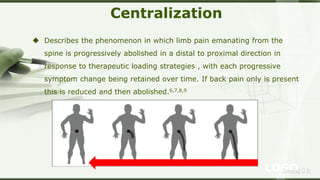
Centralization
 Describes the phenomenon in which limb pain emanating from the
spine is progressively abolished in a distal to proximal direction in
response to therapeutic loading strategies , with each progressive
symptom change being retained over time. If back pain only is present
this is reduced and then abolished.6,7,8,9
LOGOSreeraj S R
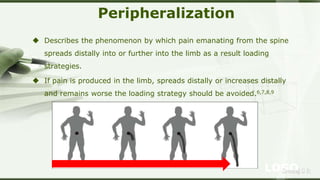
Peripheralization
 Describes the phenomenon by which pain emanating from the spine
spreads distally into or further into the limb as a result loading
strategies.
 If pain is produced in the limb, spreads distally or increases distally
and remains worse the loading strategy should be avoided.6,7,8,9
LOGOSreeraj S R
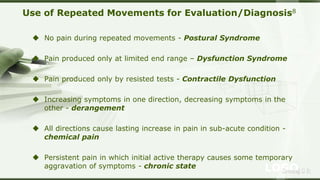
Use of Repeated Movements for Evaluation/Diagnosis8
 No pain during repeated movements - Postural Syndrome
 Pain produced only at limited end range – Dysfunction Syndrome
 Pain produced only by resisted tests - Contractile Dysfunction
 Increasing symptoms in one direction, decreasing symptoms in the
other - derangement
 All directions cause lasting increase in pain in sub-acute condition -
chemical pain
 Persistent pain in which initial active therapy causes some temporary
aggravation of symptoms - chronic state
LOGOSreeraj S R
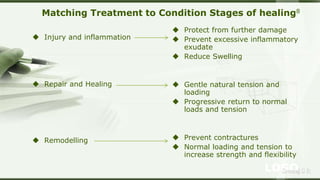
Matching Treatment to Condition Stages of healing8
 Injury and inflammation
 Repair and Healing
 Remodelling
 Protect from further damage
 Prevent excessive inflammatory
exudate
 Reduce Swelling
 Gentle natural tension and
loading
 Progressive return to normal
loads and tension
 Prevent contractures
 Normal loading and tension to
increase strength and flexibility
LOGOSreeraj S R
Tissue Status & Treatment Choice8
 Trauma /Inflammatory = rest
 Posture syndrome = education & Correction
 Articular dysfunction = remodel at end range
 Contractile dysfunction = remodel through range
 Articular Derangement = Reduce
 Chronic Pain = Recondition and Desensitize
 Healing = restorative exercises
LOGOSreeraj S R
Contra-indications5
 If in the examination no position or movement can be found
which reduces the presenting pain, the patient is unsuited for
mechanical therapy.
 Saddle anaesthesia and bladder weakness.
 Patients who exhibit signs of extreme pain.
 Developmental or acquired anomalies of bone structures which
may lead to weakness or instability of mechanical articulations.
 Architectural faults should be excluded from mechanical
therapy. E.g. spondylolisthesis
LOGOSreeraj S R
1. http://www.bspc.com.au/apacd/infosheet/d24.htm
2. http://en.wikipedia.org/wiki/McKenzie_method
3. http://www.physio-pedia.com/Mckenzie_Method
4. http://www.mckenziemdt.org/approach.cfm?section=int
5. McKenzie RA. The Lumbar Spine. Mechanical Diagnosis and Therapy. Chapter 5, Diagnosis.
Spinal Publications New Zealand Limited. 1981: pp24-26, 159
6. http://iwolfe.com/712/The%20McKenzie%20Method%20powerpoint_2008.ppt
7. Kilpikoski S. The McKenzie Method in Assessing, Classifying and Treating Non-Centralization
Phenomenon. Jyväskylä: University of Jyväskylä, 2010: p 22.
https://jyx.jyu.fi/dspace/handle/123456789/25634
8. www.hawkeyehealthcare.com/...8/McKenzie%20Extremity%20Talk.ppt
9. Ramos Sanchez SI. Case Report: Centralization in a Chronic Renal Insufficiency Patient with
Sciatica. The McKenzie Institute® International 2013; 2(1): 1-7
LOGOSreeraj S R
Thank You

Mc Kenzie Method (MDT)

  • 1.
  • 2.
    LOGOSreeraj S R Introduction The McKenzie Method was developed by New Zealand based physiotherapist, Robin McKenzie (1931– 2013).1,2  The McKenzie method is a classification system and a classification-based treatment for patients with pain.3  A acronym for the McKenzie method is Mechanical Diagnosis and Therapy (MDT).3
  • 3.
    LOGOSreeraj S R McKenzieMethod?  It is a philosophy of active patient involvement and education for back, neck and extremity issues.  It is grounded in finding a cause and effect relationship between the positions the patient usually assumes while sitting, standing or moving, and the location of pain as a result of those positions or activities.  The therapeutic approach requires a patient to move through a series of activities and test movements to gauge the patient’s pain response. The approach then uses that information to develop an exercise program designed to centralize or alleviate the pain  The goal of McKenzie Method is to centralize the pain or move the pain from the leg into the low back.
  • 4.
    LOGOSreeraj S R Theaims  The aims of the therapy are: 1. reducing pain, 2. centralization of symptoms (symptoms migrating into the middle line of the body) and 3. the complete recovery of pain.  The prevention step consists of educating and encouraging the patient to exercise regularly and self- care.
  • 5.
    LOGOSreeraj S R Thethree steps The McKenzie method exists of 3 steps:3,4 1. Assessment 2. Treatment and 3. Prevention.
  • 6.
    LOGOSreeraj S R TheThree Syndromes  McKenzie described in 1981 the mechanical classification in the McKenzie system.  According to McKenzie, Pain of spinal origin can be classified into 3 syndromes.  Posture Syndrome  Dysfunction Syndrome  Derangement Syndrome3,5
  • 7.
    LOGOSreeraj S R Thepostural syndrome  This is caused by mechanical deformation of soft tissues as a result of postural stresses.  Maintenance of certain postures or positions which place some soft tissues under prolonged stress, will eventually be productive of pain.  End range stress on normal structures  Mechanical deformation due to prolonged stress eventually produces pain  The pain ceases only with a change of position or after postural correction.5,6
  • 8.
    LOGOSreeraj S R Thepostural syndrome The treatment includes: • Patient education • Correction of the posture = improving posture by restoring lumbar lordosis • Avoiding provocative postures = avoid prolonged tensile stress on normal structure3
  • 9.
    LOGOSreeraj S R DysfunctionSyndrome  This is caused by mechanical deformation of soft tissues affected by adaptive shortening.  This abnormal tissue may be the product of previous trauma, or inflammatory or degenerative processes.  These events cause contraction, scarring, adherence or adaptive shortening.  The pain is brought on as soon as shortened structures are stressed by end positioning or end movement and ceases almost immediately when the stress is released.  Dysfunctions may be located in articular or contractile tissue 5,6
  • 10.
    LOGOSreeraj S R DysfunctionSyndrome  The treatment includes: • Mobilizing exercises in the direction of the dysfunction or in the direction that reproduces the pain. • The aim is to remodel that tissue, which limits the movement, through exercises so that it becomes pain- free over time.3
  • 11.
    LOGOSreeraj S R DerangementSyndrome  This is caused by mechanical deformation of soft tissues as a result of internal derangement.  Alteration of the position of the fluid nucleus within the disc, and possibly the surrounding annulus, causes a disturbance in the normal resting position of the two vertebrae enclosing the disc involved.  The structures’ increased mechanical deformation immediately or eventually produce pain5,6  This syndrome is classified in two groups:3 1.Irreducible derangement 2.Reducible derangement
  • 12.
    LOGOSreeraj S R DerangementSyndrome The treatment includes: • Examination of the patient’s symptomatic and mechanical response to repeated movements or sustained positions because the chosen treatment depends on the clinically induced directional preference.
  • 13.
    LOGOSreeraj S R DirectionalPreference  It describes the situation when movements in one direction will improve pain and the limitation of range, whereas movements in the opposite direction cause signs and symptoms to worsen.6,7,8 1. Centralization 2. Peripheralization
  • 14.
    LOGOSreeraj S R Centralization Describes the phenomenon in which limb pain emanating from the spine is progressively abolished in a distal to proximal direction in response to therapeutic loading strategies , with each progressive symptom change being retained over time. If back pain only is present this is reduced and then abolished.6,7,8,9
  • 15.
    LOGOSreeraj S R Peripheralization Describes the phenomenon by which pain emanating from the spine spreads distally into or further into the limb as a result loading strategies.  If pain is produced in the limb, spreads distally or increases distally and remains worse the loading strategy should be avoided.6,7,8,9
  • 16.
    LOGOSreeraj S R Useof Repeated Movements for Evaluation/Diagnosis8  No pain during repeated movements - Postural Syndrome  Pain produced only at limited end range – Dysfunction Syndrome  Pain produced only by resisted tests - Contractile Dysfunction  Increasing symptoms in one direction, decreasing symptoms in the other - derangement  All directions cause lasting increase in pain in sub-acute condition - chemical pain  Persistent pain in which initial active therapy causes some temporary aggravation of symptoms - chronic state
  • 17.
    LOGOSreeraj S R MatchingTreatment to Condition Stages of healing8  Injury and inflammation  Repair and Healing  Remodelling  Protect from further damage  Prevent excessive inflammatory exudate  Reduce Swelling  Gentle natural tension and loading  Progressive return to normal loads and tension  Prevent contractures  Normal loading and tension to increase strength and flexibility
  • 18.
    LOGOSreeraj S R TissueStatus & Treatment Choice8  Trauma /Inflammatory = rest  Posture syndrome = education & Correction  Articular dysfunction = remodel at end range  Contractile dysfunction = remodel through range  Articular Derangement = Reduce  Chronic Pain = Recondition and Desensitize  Healing = restorative exercises
  • 19.
    LOGOSreeraj S R Contra-indications5 If in the examination no position or movement can be found which reduces the presenting pain, the patient is unsuited for mechanical therapy.  Saddle anaesthesia and bladder weakness.  Patients who exhibit signs of extreme pain.  Developmental or acquired anomalies of bone structures which may lead to weakness or instability of mechanical articulations.  Architectural faults should be excluded from mechanical therapy. E.g. spondylolisthesis
  • 20.
    LOGOSreeraj S R 1.http://www.bspc.com.au/apacd/infosheet/d24.htm 2. http://en.wikipedia.org/wiki/McKenzie_method 3. http://www.physio-pedia.com/Mckenzie_Method 4. http://www.mckenziemdt.org/approach.cfm?section=int 5. McKenzie RA. The Lumbar Spine. Mechanical Diagnosis and Therapy. Chapter 5, Diagnosis. Spinal Publications New Zealand Limited. 1981: pp24-26, 159 6. http://iwolfe.com/712/The%20McKenzie%20Method%20powerpoint_2008.ppt 7. Kilpikoski S. The McKenzie Method in Assessing, Classifying and Treating Non-Centralization Phenomenon. Jyväskylä: University of Jyväskylä, 2010: p 22. https://jyx.jyu.fi/dspace/handle/123456789/25634 8. www.hawkeyehealthcare.com/...8/McKenzie%20Extremity%20Talk.ppt 9. Ramos Sanchez SI. Case Report: Centralization in a Chronic Renal Insufficiency Patient with Sciatica. The McKenzie Institute® International 2013; 2(1): 1-7
  • 21.