Def.: use of electricity in the ttt of musculoskeletal disorders. 
The choice of adequate modality is according to the structure to be 
treated, the pt. tolerance and the absence of contraindications. 
We can use more than one modality 
to treat the same condition ( multi 
modal ttt)
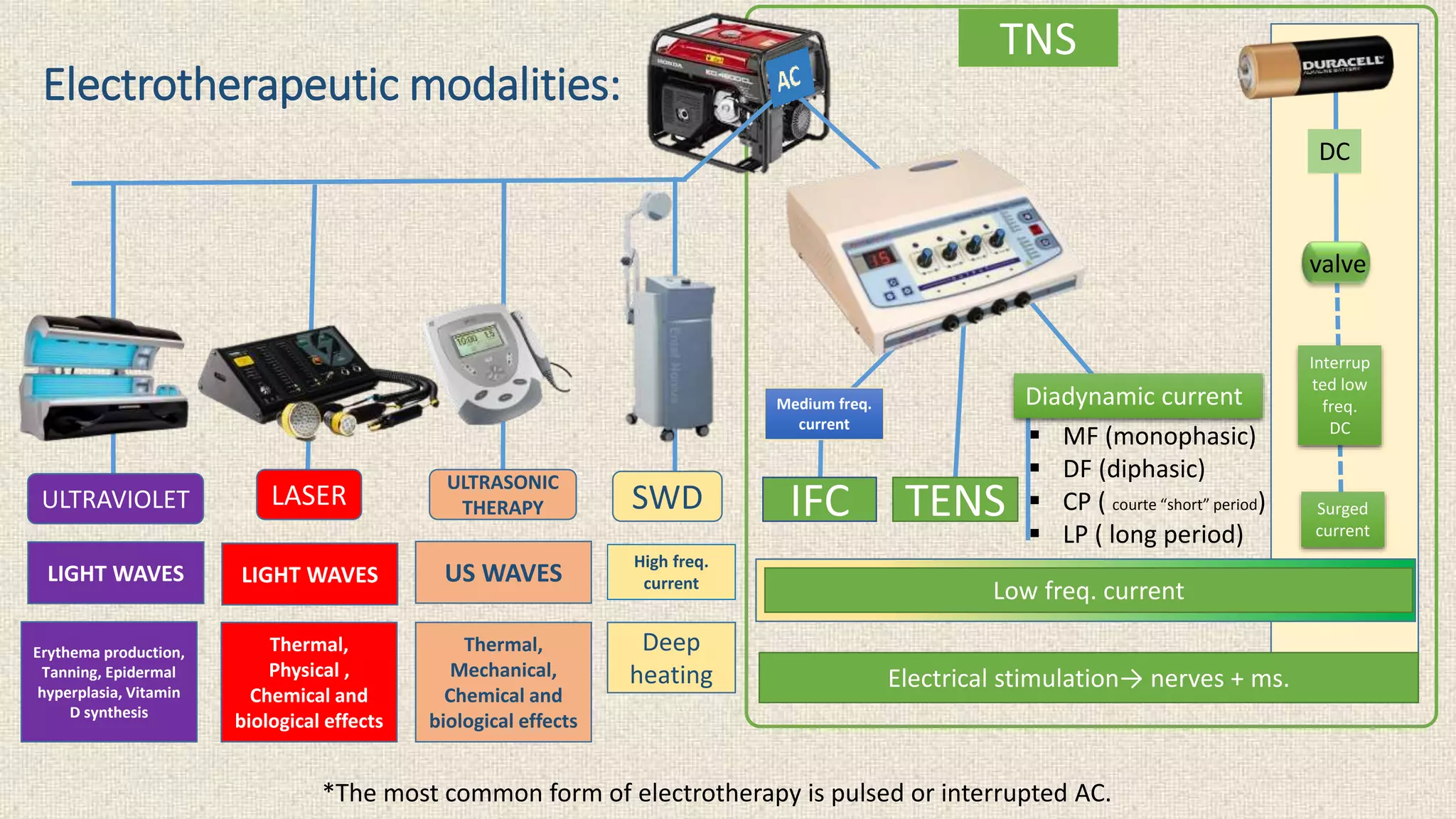
Electrotherapeutic modalities: 
DC 
valve 
Interrup 
ted low 
freq. 
DC 
Surged 
current 
Diadynamic current 
 MF (monophasic) 
 DF (diphasic) 
 CP ( courte “short” period) 
 LP ( long period) 
Medium freq. 
current 
SWD IFC TENS 
High freq. 
current 
Deep 
heating 
Low freq. current 
ULTRASONIC 
THERAPY ULTRAVIOLET LASER 
LIGHT WAVES LIGHT WAVES US WAVES 
Electrical stimulation→ nerves + ms. 
Thermal, 
Mechanical, 
Chemical and 
biological effects 
Thermal, 
Physical , 
Chemical and 
biological effects 
*The most common form of electrotherapy is pulsed or interrupted AC. 
Erythema production, 
Tanning, Epidermal 
hyperplasia, Vitamin 
D synthesis 
TNS
TNS 
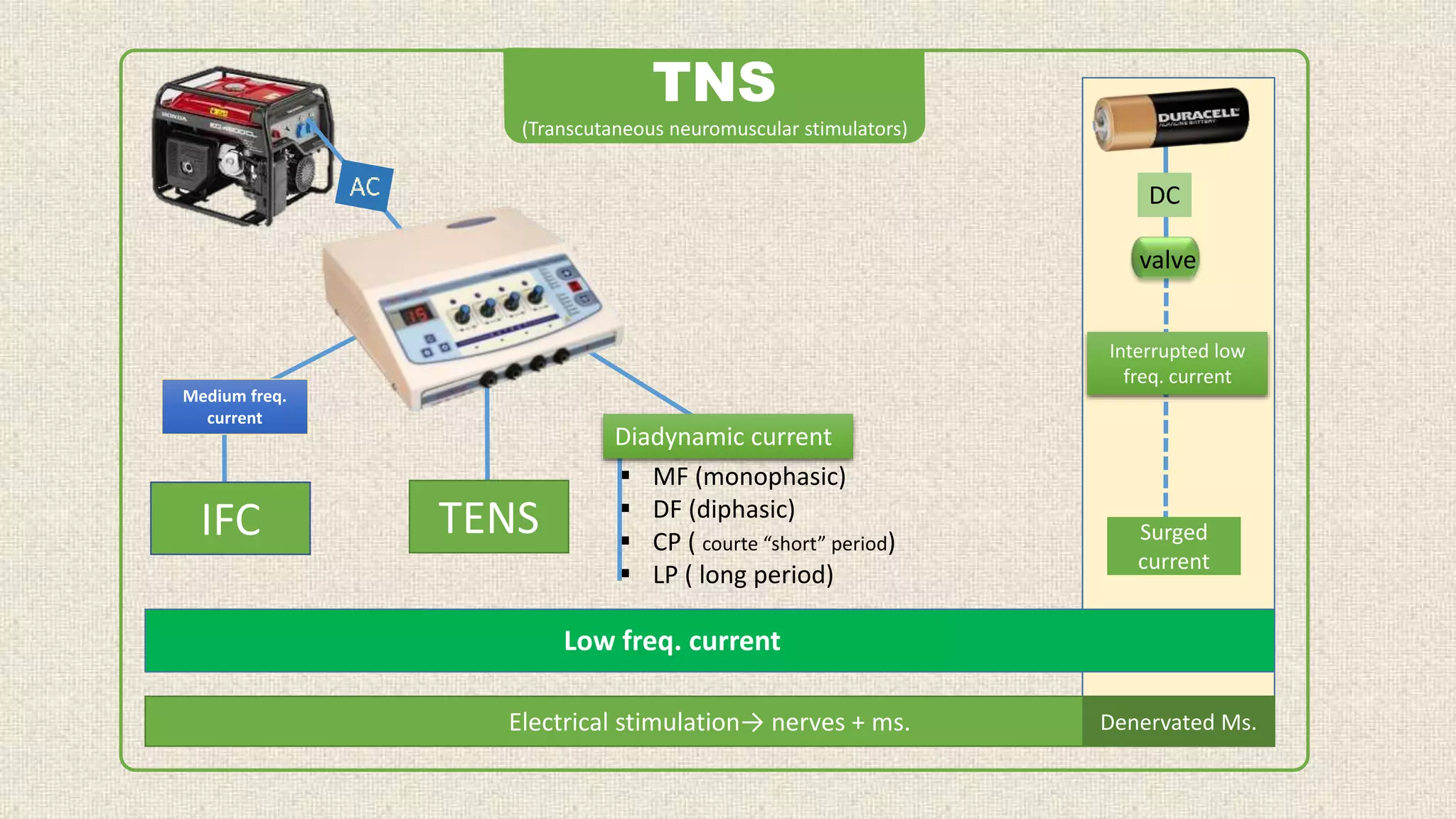
(Transcutaneous neuromuscular stimulators)
DC 
valve 
Interrupted low 
freq. current 
TNS 
(Transcutaneous neuromuscular stimulators) 
Diadynamic current 
 MF (monophasic) 
 DF (diphasic) 
 CP ( courte “short” period) 
 LP ( long period) 
IFC TENS 
Low freq. current 
Medium freq. 
current 
Electrical stimulation→ nerves + ms. 
Surged 
current 
Denervated Ms.
Galvanic (direct) 
current
Galvanic current 
It is a direct Current used to stimulate muscle directly, without 
activation of the peripheral nerve “ surged current”. 
- Direct muscle stimulation requires pulse of long durations of at least 
100 milliseconds, and more often uses even longer durations. 
appropriate electrical stimulation can cause a denervated muscle to 
contract 
•contraction of a denervated muscle may help limit edema and venous 
stasis within the muscle, and therefore delay muscle fiber degeneration 
and fibrosis 
•recovery time following denervation appears to be shortened with 
appropriate electrical stimulation
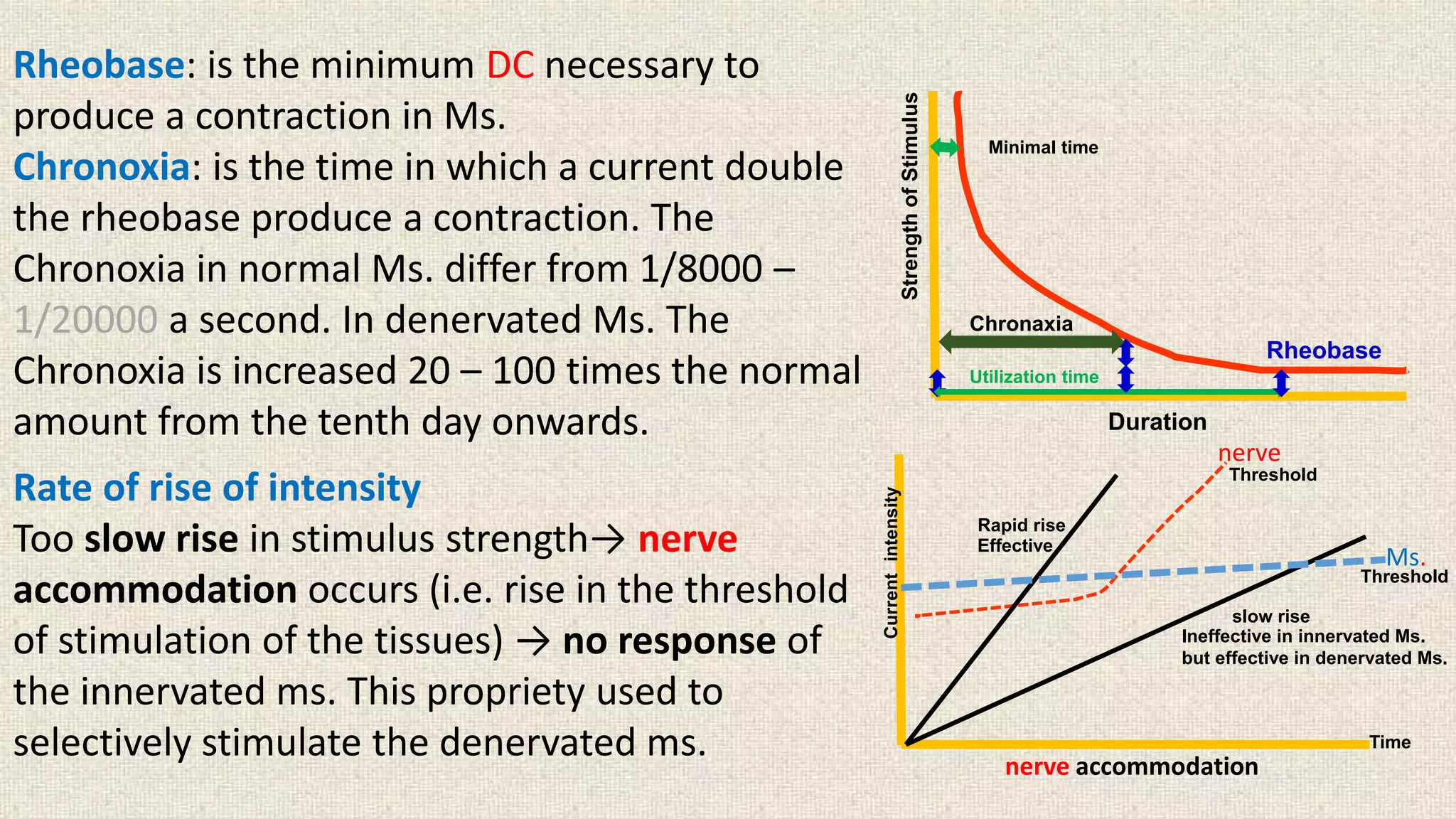
Rheobase: is the minimum DC necessary to 
produce a contraction in Ms. 
Chronoxia: is the time in which a current double 
the rheobase produce a contraction. The 
Chronoxia in normal Ms. differ from 1/8000 – 
1/20000 a second. In denervated Ms. The 
Chronoxia is increased 20 – 100 times the normal 
amount from the tenth day onwards. Duration 
Strength of Stimulus 
Minimal time 
Chronaxia 
Utilization time 
Rheobase 
Threshold 
Time 
Current intensity 
nerve 
Threshold 
Rapid rise 
Effective 
slow rise 
Ineffective in innervated Ms. 
but effective in denervated Ms. 
Rate of rise of intensity 
Too slow rise in stimulus strength→ nerve 
accommodation occurs (i.e. rise in the threshold 
of stimulation of the tissues) → no response of 
the innervated ms. This propriety used to 
selectively stimulate the denervated ms. 
nerve accommodation 
Ms.
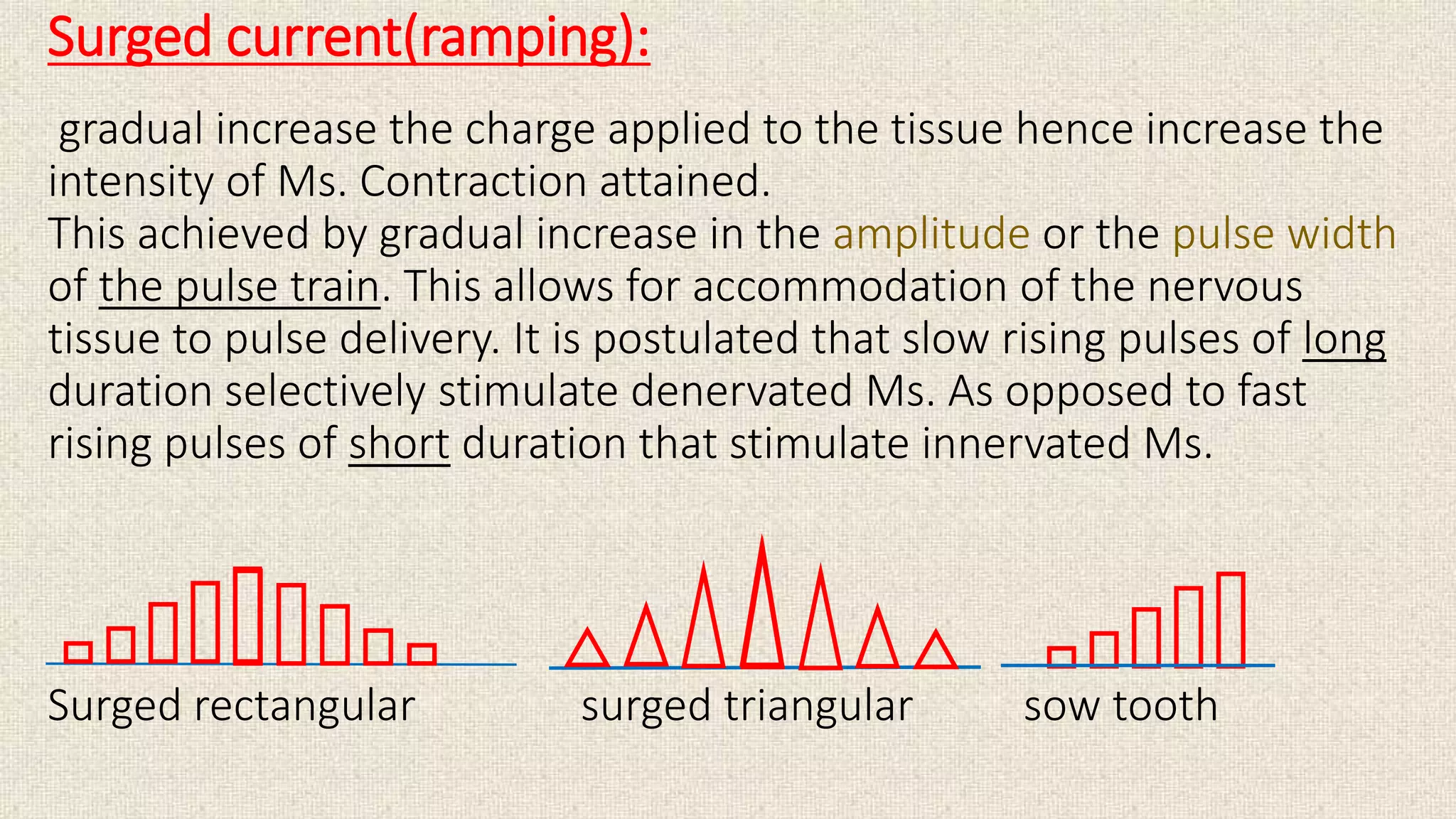
Surged current(ramping): 
gradual increase the charge applied to the tissue hence increase the 
intensity of Ms. Contraction attained. 
This achieved by gradual increase in the amplitude or the pulse width 
of the pulse train. This allows for accommodation of the nervous 
tissue to pulse delivery. It is postulated that slow rising pulses of long 
duration selectively stimulate denervated Ms. As opposed to fast 
rising pulses of short duration that stimulate innervated Ms. 
Surged rectangular surged triangular sow tooth
• Galvanic current indications: 
• Electro diagnostic 
• ++ of paralyzed Ms. Of LMNL. 
• Peripheral nerve injury. 
• Bell’s palsy. 
• Iontophoresis. 
• Hysterical conditions.
Diadynamic current
Diadynamic current: 
Def.: sinusoidal direct low frequency current (50-100 Hz). 
Type of Diadynamic current: 
1- monophasic (MF):50Hz impulse 
& interruption 10m.sec. 
Effect: muscles stimulation  ms. contraction. 
2- Diphasic (DF): freq. 100HZ & non interruption. 
Effect: affect autonomic nervous system 
by lowering the sympa. Tone. 
3-Short “courte” periodes current (CP): sudden 
alternation between monophasic and diphasic> 
Used for: long term pain relief. 
4-Long periods current (LP): MF mixed with 
a second modulated MF 
Use: analgesic effect 
pt. feels pleasant sensation than that produced by CP. 
5- Rhythmic Syncope (RS): This consists of 1.1 second MF followed by 0.9 second rest phase.
Therapeutic effects and mechanism of action: 
1- analgesic: may be due to blocking of a particular area of the reflex 
(through nerve fibers). 
DF  brief analgesic effect. 
CP  long term pain relief 
LP  reduce pain “with pleasant sensation”. 
2- hyperemic ( anti-edema): 
DF decrease sympathetic tone  V.D  increase blood supply  
increase metabolic rate in the tissues  rapid reabsorption of edema 
 decrease swelling  rapid recovery. 
3- muscles stimulator: MF is motor stimulator, also RS and modulated 
MF (L.P) produce muscles contraction.
Treatment strategy: 
- Current strength is gradually raised to the tolerance level (pt. remain comfortable) 
- Duration : 2-12 min .. Not exceed 15min. 
- Therapy : 6 application ( EOD or daily). Sever cases up to 3 time /day 
- The interval between sessions should not > 48hs. 
- Even if the pathological symp. Disappear afer 2-3 sessions add 2-3 sessions to stabilize 
the effect. 
- If after 6 sessions non improvement; interrupt for 1week and recontinue. 
Indication: 
• Sport inj.(rapid effect) Sprain, Contusions, Dislocation. ms. And joints pain. 
• MSk problems & soft tissues inj.( OA – RA – back pain – neck pain … etc.) 
• Neuralgia and neuritis.(trigeminal, brachial, sciatic, herpes zoster neuralgia…etc) 
N.B.: Diadynamic c. can be used alone or with other modalities like ultrasound and 
microwaves.
contraindications: 
Acute infection 
Various dermatological lesions. 
Metal implantation. 
Malignancies.
Interferential therapy
Interferential therapy: 
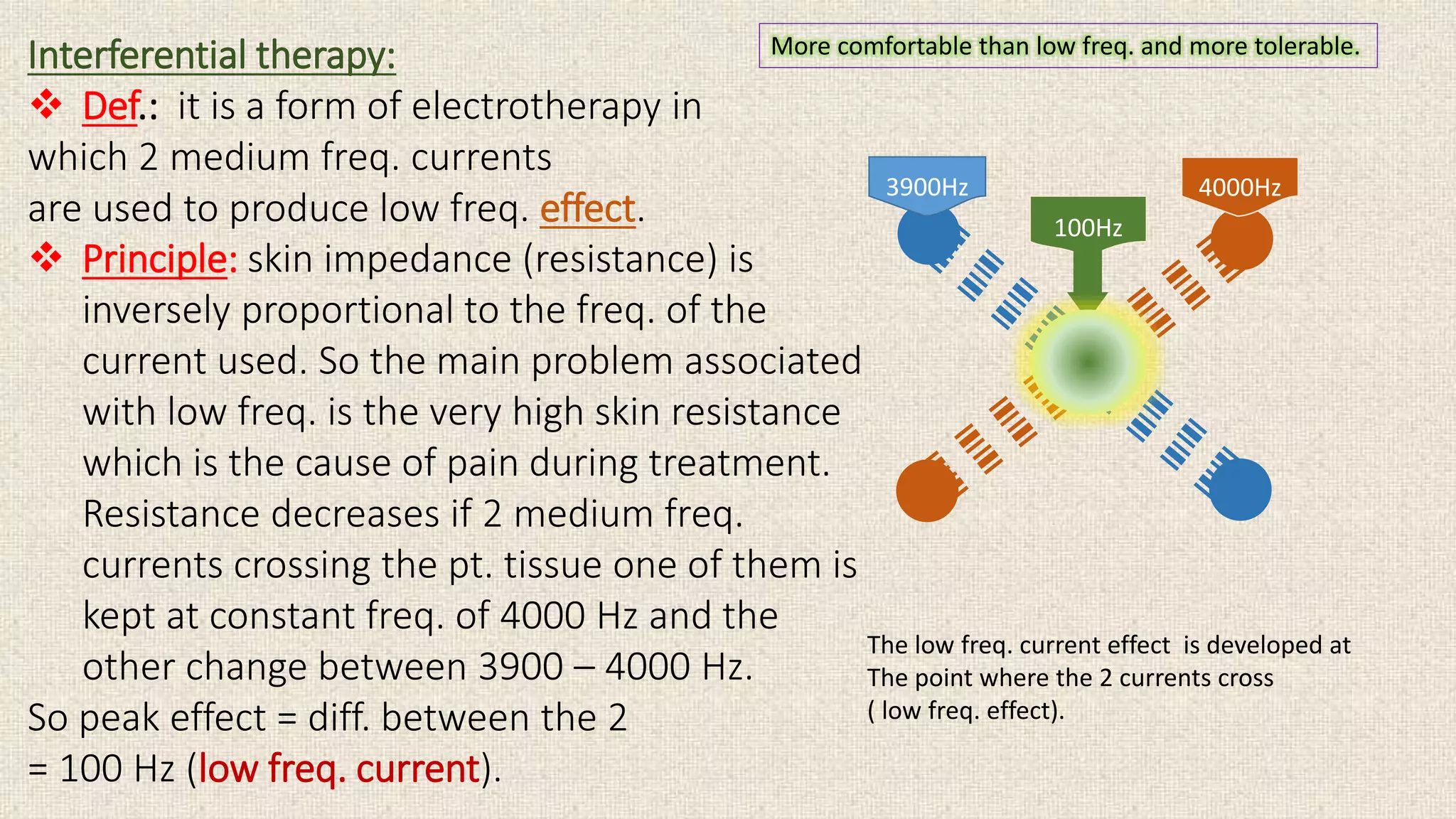
 Def.: it is a form of electrotherapy in 
which 2 medium freq. currents 
are used to produce low freq. effect. 
 Principle: skin impedance (resistance) is 
More comfortable than low freq. and more tolerable. 
inversely proportional to the freq. of the 
current used. So the main problem associated 
with low freq. is the very high skin resistance 
which is the cause of pain during treatment. 
Resistance decreases if 2 medium freq. 
currents crossing the pt. tissue one of them is 
kept at constant freq. of 4000 Hz and the 
other change between 3900 – 4000 Hz. 
So peak effect = diff. between the 2 
= 100 Hz (low freq. current). 
3900Hz 4000Hz 
100Hz 
The low freq. current effect is developed at 
The point where the 2 currents cross 
( low freq. effect).
physiological effect: and advantages 
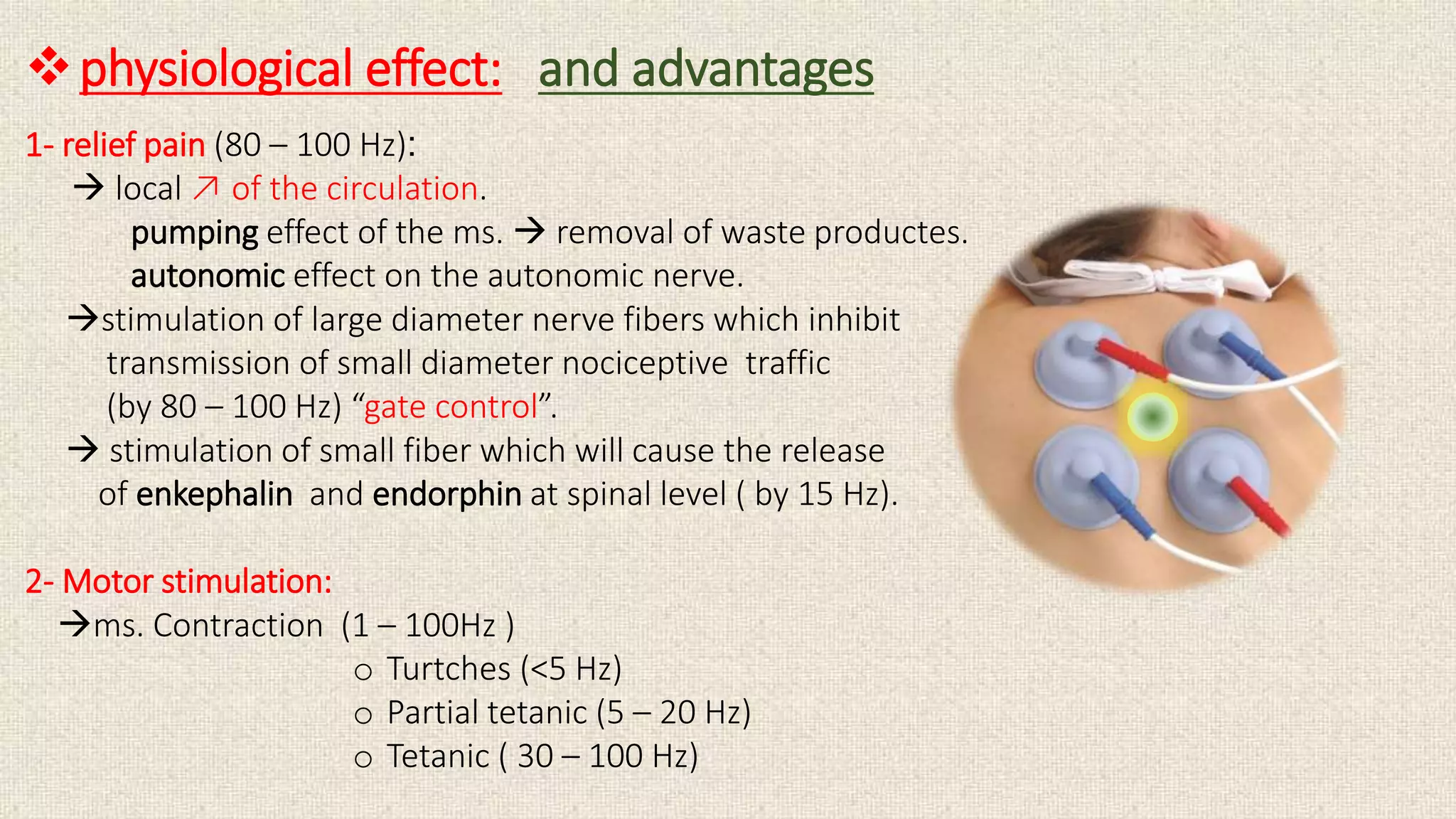
1- relief pain (80 – 100 Hz): 
 local ↗ of the circulation. 
pumping effect of the ms.  removal of waste productes. 
autonomic effect on the autonomic nerve. 
stimulation of large diameter nerve fibers which inhibit 
transmission of small diameter nociceptive traffic 
(by 80 – 100 Hz) “gate control”. 
 stimulation of small fiber which will cause the release 
of enkephalin and endorphin at spinal level ( by 15 Hz). 
2- Motor stimulation: 
ms. Contraction (1 – 100Hz ) 
o Turtches (<5 Hz) 
o Partial tetanic (5 – 20 Hz) 
o Tetanic ( 30 – 100 Hz)
Stimulation of both voluntary and smooth ms. (but faradic stimulation only voluntary ms.) 
with little sensory stimulation  more comfortable. 
contraction of deeply placed ms. E.g.: 
• Lower abdominal ms. 
• Pelvic floor ms. In stress incontinence. 
• ms. of inner side of the thigh. 
3 - Absorption of exudate ( 1 – 10 Hz) 
• Rhythmic ms. Contraction (pump) 
• and autonomic effect on the blood vessels 
 absorption of exudate  ↘ swelling. 
4 - ↗ healing (up to 100 Hz): ↗ tissue healing & resolution of acute and chro. 
Inflammation.
Factors affecting physiological effect of I.F.C 
I. Current intensity 
• Low  sensory response (fine tingling), used in acute pain, swelling and ↗ circulation. 
• Medium  strong tingling + ms. contraction. Used in ms. Srengthing & ms. Reeducation. 
• High  painful stimulation(↗tingling + contraction + pain), used in chro. Pain. 
II. Beat of frequency: 
• 1 – 10 Hz  ↘ swelling. 
• 5 – 20 Hz  motor stimulation. 
• 80 – 100 Hz  pain relief. 
III. Rhythmic or constant 
IV. Accuracy of electrode positioning.
Indication of IFC: 
o Reduce inflammation & oedema (by Increased local blood flow ). 
o Muscle stimulation (ms. Reeducation and strengthing) 
o Pain relief. 
Contra-indications: 
Acute inflammation or TB 
Malignancy. 
Metal implants. 
Pace makers 
Skin lesions. 
Intolerance 
Pregnancy, menses (excessive bleeding) for IFC of lower abdomen. 
Over thrombo-phelibitis (release of thrombi) 
Febrile conditions.
Dangers: 
Bare electrode touches the skin. 
Electrodes on the skin are too close allowing the short circuit. 
Technique of application: 
 Preparation of the pt. 
ᴥ comfortable ᴥ skin soaks with saline ᴥ skin lesions is insulated with pet. Jelly. 
 Preparation of the apparatus 
ᴥ electrodes connected to terminal ᴥ pads soaked with saline 
 Application of current: 
Positioning the electrodes so that the crossing points of the 2 currents is over or within the lesion. 
appropriate freq. to the indicated condition. 
current intensity is adjusted until the pt. feels mild tingling sensation. after few minutes 
accommodation may occurs and the intensity may be increased 
for about 15 minutes.
T E N S
TENS transcutaneous electrical nerve stimulation 
Def.: is the application of pulsed low freq. current of rectangular wave through 
surface electrode on the skin surface over afferent nerve endings for stimulating the 
sensory component of the peripheral nerves to decrease pain. 
Physical characters: 
o It is a sensory stimulator not ms. Contraction device 
o It is either monophasic or biphasic 
o It has different shapes: rectangular or spike 
o The most effective shape is still unknown. 
o It is formed of pulses which has 0.2m.sec ( as duration < 10m.sec stimulate 
sensory only not motor fibers. 
o Intensity 60 milli-ampears ( can be modified according to the propose response. 
( as intensity from 30 – 150 milli-ampears stimulate sensory only not motor fibers. 
o Freq.  low ( 10 – 100Hz)  conventional TENS.
 Mechanisme of TENS: ( physiological effect  just pain relief) 
a) According to gate control theory, pain which is transmitted by 
small unmylinated fiber my be inhibited by stimulating thick 
mylinated fiber. 
b) Electrical stimulation may ↗ release of endogenous morphine 
like substances: which has analgesic properties and so that the 
affect of TENS might be measurable by estimated of the level of 
opiate like substances as enkephalins & endorphins. 
c) It is suggested that it can ↗ pain threshold. 
d) psychological (placebo) effect. 
 Methods of application of TENS: 
 Transcutaneous method:stimulation of the peripheral nerves by 
application of the electrodes on the skin superficially. 
 Percutaneous method: used as diagnostic to assess the possible 
value of an implantable nervous system stimulator. 
 Implantation method: applied by using a cuff electrodes of 
various size which is placed around the affected peripheral nerve 
usually proximal to the area of injury.
INDICATIONS of TENS: 
o Acute pain: 
• Musculoskeletal system: 
Articular : arthritis 
non articular: strain of ligament muscles sprain. 
lumbar spondylosis. 
• Sport injuries: 
lig. Or ms. Sprain. 
shoulder contusion. 
• Neurological: 
Trigeminal neuralgia. Brachialgia 
sciatica post herpetic neuralgia 
• 1st stage of labour.
INDICATIONS of TENS: …cont 
o Chronic pain: 
• As rheumatoid arthritis, osteoarthritis. 
• LBP. Lumbar spondylosis. 
• Neuropathy or myofacial pain. 
o Post-operative pain: 
• Including dental extraction, post-laminectomy or 
abdominal injuries. 
o Cardiopulmonary problems: 
• ↗ pulmonary function test after thoracotomy. 
• ↘ pain of frozen shoulder.
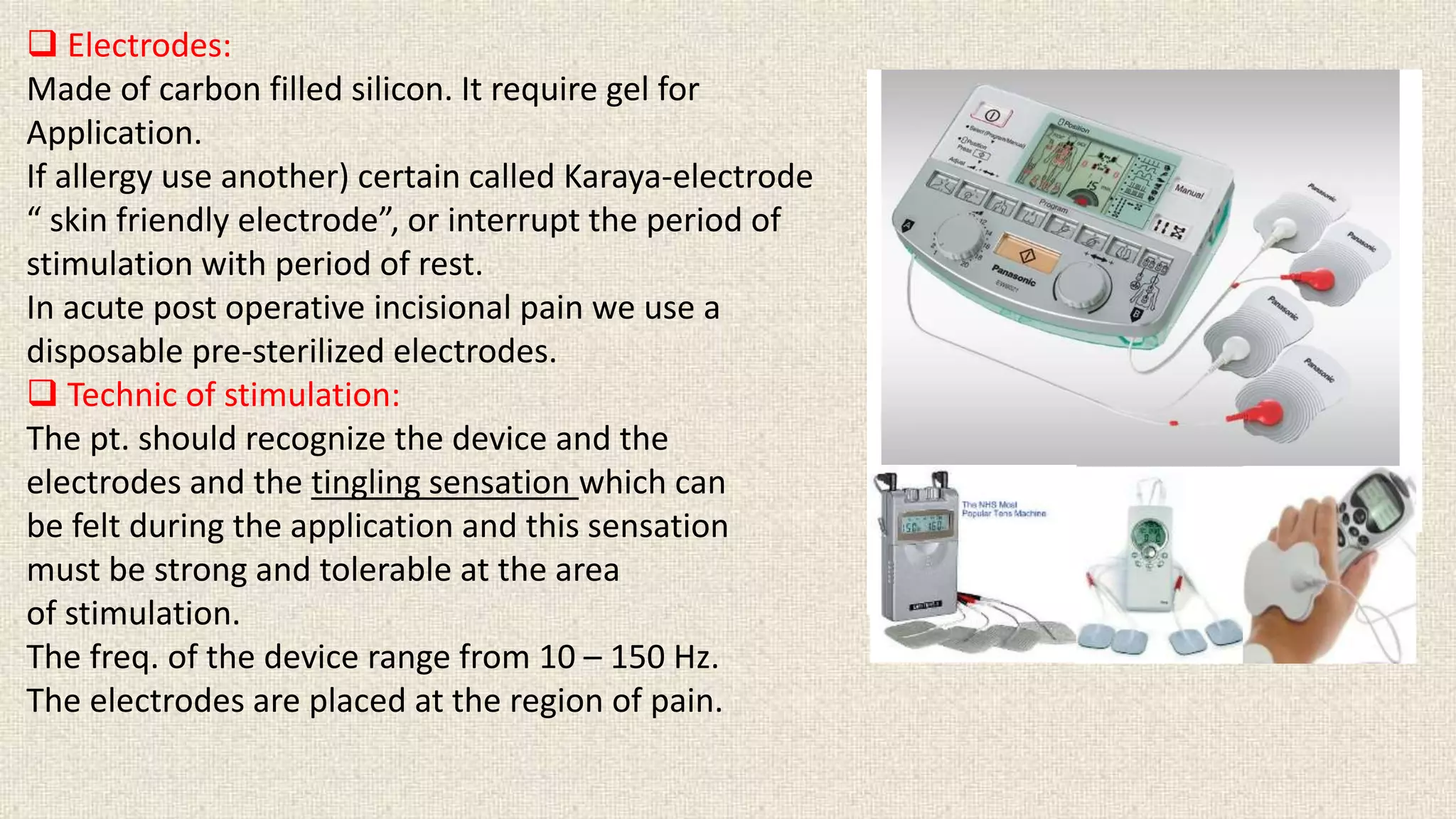
 Electrodes: 
Made of carbon filled silicon. It require gel for 
Application. 
If allergy use another) certain called Karaya-electrode 
“ skin friendly electrode”, or interrupt the period of 
stimulation with period of rest. 
In acute post operative incisional pain we use a 
disposable pre-sterilized electrodes. 
 Technic of stimulation: 
The pt. should recognize the device and the 
electrodes and the tingling sensation which can 
be felt during the application and this sensation 
must be strong and tolerable at the area 
of stimulation. 
The freq. of the device range from 10 – 150 Hz. 
The electrodes are placed at the region of pain.
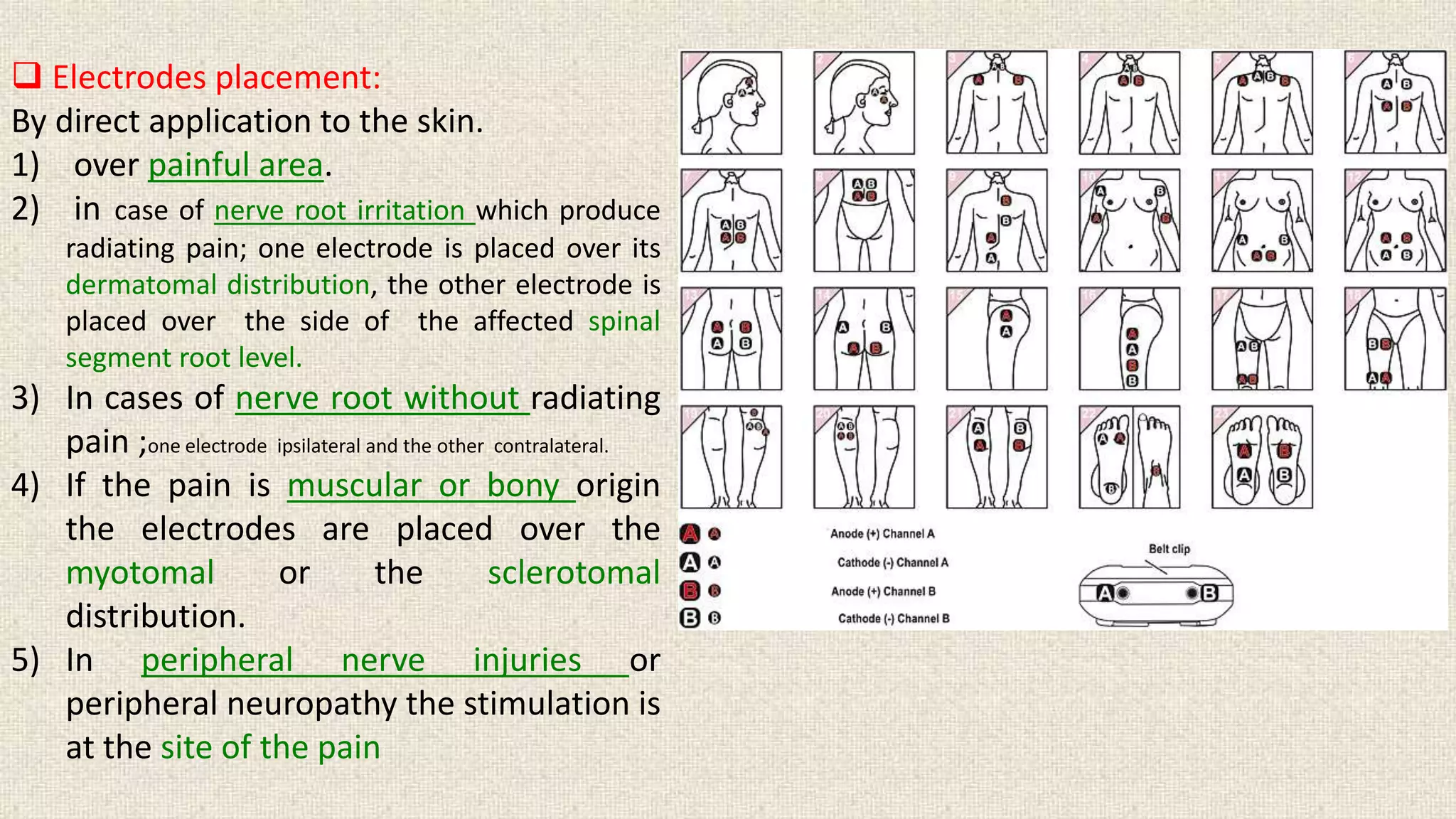
 Electrodes placement: 
By direct application to the skin. 
1) over painful area. 
2) in case of nerve root irritation which produce 
radiating pain; one electrode is placed over its 
dermatomal distribution, the other electrode is 
placed over the side of the affected spinal 
segment root level. 
3) In cases of nerve root without radiating 
pain ;one electrode ipsilateral and the other contralateral. 
4) If the pain is muscular or bony origin 
the electrodes are placed over the 
myotomal or the sclerotomal 
distribution. 
5) In peripheral nerve injuries or 
peripheral neuropathy the stimulation is 
at the site of the pain
 Electrodes placement: … cont 
6) In neurological injuries the loss of sensation in 
the painful area, contralateral stimulation can be 
done. 
7) In low back pain and cervical syndrome, bilateral 
stimulation of the painful area or the ipsilateral is 
effective. 
8) If there is localized pain and no trigger point are 
involved place one electrode on the painful area 
and the other over the dermatomal distribution 
either on the opposite side of the corresponding 
level or distally according to the pain radiation. 
9) During labour: 
↗freq.  120 Hz. 
proximal electrode over T8. 
distal electrode over S1 
2ed stage  anterior abdomen.
Duration and freq. of treatment: 
• The session of the pt. is 30 – 60 min 
about 2 – 4 times / day. 
• The periods of ttt must not be less 
than 30 days at least. 
• Rarely pt. use the device 24hs but it 
seems to be less effective. 
Side effect of TENS: 
o thalamic stimulation by TENS may 
lead to vertigo, nausea, shortness of 
breath or nystagmus. 
o Allergy to gel of electrode.
CONTRAINDICATIONS of TENS: 
• Over the carotid sinus. 
• Corticosteroids are avoided because it suppress the 
endogenous analgesic system. 
• In case of unknown pathology. For feer of mistaking pain  
harm to the pt. 
• Pt. with cardiac pacemaker as TENS may interfere with it 
• Acute illness. 
• Fever > 38 c 
• Over pregnant uterus. 
• In case of malignancies

electrotherapeutic modalities

  • 2.
    Def.: use ofelectricity in the ttt of musculoskeletal disorders. The choice of adequate modality is according to the structure to be treated, the pt. tolerance and the absence of contraindications. We can use more than one modality to treat the same condition ( multi modal ttt)
  • 3.
    Electrotherapeutic modalities: DC valve Interrup ted low freq. DC Surged current Diadynamic current  MF (monophasic)  DF (diphasic)  CP ( courte “short” period)  LP ( long period) Medium freq. current SWD IFC TENS High freq. current Deep heating Low freq. current ULTRASONIC THERAPY ULTRAVIOLET LASER LIGHT WAVES LIGHT WAVES US WAVES Electrical stimulation→ nerves + ms. Thermal, Mechanical, Chemical and biological effects Thermal, Physical , Chemical and biological effects *The most common form of electrotherapy is pulsed or interrupted AC. Erythema production, Tanning, Epidermal hyperplasia, Vitamin D synthesis TNS
  • 4.
  • 5.
    DC valve Interruptedlow freq. current TNS (Transcutaneous neuromuscular stimulators) Diadynamic current  MF (monophasic)  DF (diphasic)  CP ( courte “short” period)  LP ( long period) IFC TENS Low freq. current Medium freq. current Electrical stimulation→ nerves + ms. Surged current Denervated Ms.
  • 6.
  • 7.
    Galvanic current Itis a direct Current used to stimulate muscle directly, without activation of the peripheral nerve “ surged current”. - Direct muscle stimulation requires pulse of long durations of at least 100 milliseconds, and more often uses even longer durations. appropriate electrical stimulation can cause a denervated muscle to contract •contraction of a denervated muscle may help limit edema and venous stasis within the muscle, and therefore delay muscle fiber degeneration and fibrosis •recovery time following denervation appears to be shortened with appropriate electrical stimulation
  • 8.
    Rheobase: is theminimum DC necessary to produce a contraction in Ms. Chronoxia: is the time in which a current double the rheobase produce a contraction. The Chronoxia in normal Ms. differ from 1/8000 – 1/20000 a second. In denervated Ms. The Chronoxia is increased 20 – 100 times the normal amount from the tenth day onwards. Duration Strength of Stimulus Minimal time Chronaxia Utilization time Rheobase Threshold Time Current intensity nerve Threshold Rapid rise Effective slow rise Ineffective in innervated Ms. but effective in denervated Ms. Rate of rise of intensity Too slow rise in stimulus strength→ nerve accommodation occurs (i.e. rise in the threshold of stimulation of the tissues) → no response of the innervated ms. This propriety used to selectively stimulate the denervated ms. nerve accommodation Ms.
  • 9.
    Surged current(ramping): gradualincrease the charge applied to the tissue hence increase the intensity of Ms. Contraction attained. This achieved by gradual increase in the amplitude or the pulse width of the pulse train. This allows for accommodation of the nervous tissue to pulse delivery. It is postulated that slow rising pulses of long duration selectively stimulate denervated Ms. As opposed to fast rising pulses of short duration that stimulate innervated Ms. Surged rectangular surged triangular sow tooth
  • 10.
    • Galvanic currentindications: • Electro diagnostic • ++ of paralyzed Ms. Of LMNL. • Peripheral nerve injury. • Bell’s palsy. • Iontophoresis. • Hysterical conditions.
  • 11.
  • 12.
    Diadynamic current: Def.:sinusoidal direct low frequency current (50-100 Hz). Type of Diadynamic current: 1- monophasic (MF):50Hz impulse & interruption 10m.sec. Effect: muscles stimulation  ms. contraction. 2- Diphasic (DF): freq. 100HZ & non interruption. Effect: affect autonomic nervous system by lowering the sympa. Tone. 3-Short “courte” periodes current (CP): sudden alternation between monophasic and diphasic> Used for: long term pain relief. 4-Long periods current (LP): MF mixed with a second modulated MF Use: analgesic effect pt. feels pleasant sensation than that produced by CP. 5- Rhythmic Syncope (RS): This consists of 1.1 second MF followed by 0.9 second rest phase.
  • 13.
    Therapeutic effects andmechanism of action: 1- analgesic: may be due to blocking of a particular area of the reflex (through nerve fibers). DF  brief analgesic effect. CP  long term pain relief LP  reduce pain “with pleasant sensation”. 2- hyperemic ( anti-edema): DF decrease sympathetic tone  V.D  increase blood supply  increase metabolic rate in the tissues  rapid reabsorption of edema  decrease swelling  rapid recovery. 3- muscles stimulator: MF is motor stimulator, also RS and modulated MF (L.P) produce muscles contraction.
  • 14.
    Treatment strategy: -Current strength is gradually raised to the tolerance level (pt. remain comfortable) - Duration : 2-12 min .. Not exceed 15min. - Therapy : 6 application ( EOD or daily). Sever cases up to 3 time /day - The interval between sessions should not > 48hs. - Even if the pathological symp. Disappear afer 2-3 sessions add 2-3 sessions to stabilize the effect. - If after 6 sessions non improvement; interrupt for 1week and recontinue. Indication: • Sport inj.(rapid effect) Sprain, Contusions, Dislocation. ms. And joints pain. • MSk problems & soft tissues inj.( OA – RA – back pain – neck pain … etc.) • Neuralgia and neuritis.(trigeminal, brachial, sciatic, herpes zoster neuralgia…etc) N.B.: Diadynamic c. can be used alone or with other modalities like ultrasound and microwaves.
  • 15.
    contraindications: Acute infection Various dermatological lesions. Metal implantation. Malignancies.
  • 16.
  • 17.
    Interferential therapy: Def.: it is a form of electrotherapy in which 2 medium freq. currents are used to produce low freq. effect.  Principle: skin impedance (resistance) is More comfortable than low freq. and more tolerable. inversely proportional to the freq. of the current used. So the main problem associated with low freq. is the very high skin resistance which is the cause of pain during treatment. Resistance decreases if 2 medium freq. currents crossing the pt. tissue one of them is kept at constant freq. of 4000 Hz and the other change between 3900 – 4000 Hz. So peak effect = diff. between the 2 = 100 Hz (low freq. current). 3900Hz 4000Hz 100Hz The low freq. current effect is developed at The point where the 2 currents cross ( low freq. effect).
  • 18.
    physiological effect: andadvantages 1- relief pain (80 – 100 Hz):  local ↗ of the circulation. pumping effect of the ms.  removal of waste productes. autonomic effect on the autonomic nerve. stimulation of large diameter nerve fibers which inhibit transmission of small diameter nociceptive traffic (by 80 – 100 Hz) “gate control”.  stimulation of small fiber which will cause the release of enkephalin and endorphin at spinal level ( by 15 Hz). 2- Motor stimulation: ms. Contraction (1 – 100Hz ) o Turtches (<5 Hz) o Partial tetanic (5 – 20 Hz) o Tetanic ( 30 – 100 Hz)
  • 19.
    Stimulation of bothvoluntary and smooth ms. (but faradic stimulation only voluntary ms.) with little sensory stimulation  more comfortable. contraction of deeply placed ms. E.g.: • Lower abdominal ms. • Pelvic floor ms. In stress incontinence. • ms. of inner side of the thigh. 3 - Absorption of exudate ( 1 – 10 Hz) • Rhythmic ms. Contraction (pump) • and autonomic effect on the blood vessels  absorption of exudate  ↘ swelling. 4 - ↗ healing (up to 100 Hz): ↗ tissue healing & resolution of acute and chro. Inflammation.
  • 20.
    Factors affecting physiologicaleffect of I.F.C I. Current intensity • Low  sensory response (fine tingling), used in acute pain, swelling and ↗ circulation. • Medium  strong tingling + ms. contraction. Used in ms. Srengthing & ms. Reeducation. • High  painful stimulation(↗tingling + contraction + pain), used in chro. Pain. II. Beat of frequency: • 1 – 10 Hz  ↘ swelling. • 5 – 20 Hz  motor stimulation. • 80 – 100 Hz  pain relief. III. Rhythmic or constant IV. Accuracy of electrode positioning.
  • 21.
    Indication of IFC: o Reduce inflammation & oedema (by Increased local blood flow ). o Muscle stimulation (ms. Reeducation and strengthing) o Pain relief. Contra-indications: Acute inflammation or TB Malignancy. Metal implants. Pace makers Skin lesions. Intolerance Pregnancy, menses (excessive bleeding) for IFC of lower abdomen. Over thrombo-phelibitis (release of thrombi) Febrile conditions.
  • 22.
    Dangers: Bare electrodetouches the skin. Electrodes on the skin are too close allowing the short circuit. Technique of application:  Preparation of the pt. ᴥ comfortable ᴥ skin soaks with saline ᴥ skin lesions is insulated with pet. Jelly.  Preparation of the apparatus ᴥ electrodes connected to terminal ᴥ pads soaked with saline  Application of current: Positioning the electrodes so that the crossing points of the 2 currents is over or within the lesion. appropriate freq. to the indicated condition. current intensity is adjusted until the pt. feels mild tingling sensation. after few minutes accommodation may occurs and the intensity may be increased for about 15 minutes.
  • 23.
  • 24.
    TENS transcutaneous electricalnerve stimulation Def.: is the application of pulsed low freq. current of rectangular wave through surface electrode on the skin surface over afferent nerve endings for stimulating the sensory component of the peripheral nerves to decrease pain. Physical characters: o It is a sensory stimulator not ms. Contraction device o It is either monophasic or biphasic o It has different shapes: rectangular or spike o The most effective shape is still unknown. o It is formed of pulses which has 0.2m.sec ( as duration < 10m.sec stimulate sensory only not motor fibers. o Intensity 60 milli-ampears ( can be modified according to the propose response. ( as intensity from 30 – 150 milli-ampears stimulate sensory only not motor fibers. o Freq.  low ( 10 – 100Hz)  conventional TENS.
  • 25.
     Mechanisme ofTENS: ( physiological effect  just pain relief) a) According to gate control theory, pain which is transmitted by small unmylinated fiber my be inhibited by stimulating thick mylinated fiber. b) Electrical stimulation may ↗ release of endogenous morphine like substances: which has analgesic properties and so that the affect of TENS might be measurable by estimated of the level of opiate like substances as enkephalins & endorphins. c) It is suggested that it can ↗ pain threshold. d) psychological (placebo) effect.  Methods of application of TENS:  Transcutaneous method:stimulation of the peripheral nerves by application of the electrodes on the skin superficially.  Percutaneous method: used as diagnostic to assess the possible value of an implantable nervous system stimulator.  Implantation method: applied by using a cuff electrodes of various size which is placed around the affected peripheral nerve usually proximal to the area of injury.
  • 26.
    INDICATIONS of TENS: o Acute pain: • Musculoskeletal system: Articular : arthritis non articular: strain of ligament muscles sprain. lumbar spondylosis. • Sport injuries: lig. Or ms. Sprain. shoulder contusion. • Neurological: Trigeminal neuralgia. Brachialgia sciatica post herpetic neuralgia • 1st stage of labour.
  • 27.
    INDICATIONS of TENS:…cont o Chronic pain: • As rheumatoid arthritis, osteoarthritis. • LBP. Lumbar spondylosis. • Neuropathy or myofacial pain. o Post-operative pain: • Including dental extraction, post-laminectomy or abdominal injuries. o Cardiopulmonary problems: • ↗ pulmonary function test after thoracotomy. • ↘ pain of frozen shoulder.
  • 28.
     Electrodes: Madeof carbon filled silicon. It require gel for Application. If allergy use another) certain called Karaya-electrode “ skin friendly electrode”, or interrupt the period of stimulation with period of rest. In acute post operative incisional pain we use a disposable pre-sterilized electrodes.  Technic of stimulation: The pt. should recognize the device and the electrodes and the tingling sensation which can be felt during the application and this sensation must be strong and tolerable at the area of stimulation. The freq. of the device range from 10 – 150 Hz. The electrodes are placed at the region of pain.
  • 29.
     Electrodes placement: By direct application to the skin. 1) over painful area. 2) in case of nerve root irritation which produce radiating pain; one electrode is placed over its dermatomal distribution, the other electrode is placed over the side of the affected spinal segment root level. 3) In cases of nerve root without radiating pain ;one electrode ipsilateral and the other contralateral. 4) If the pain is muscular or bony origin the electrodes are placed over the myotomal or the sclerotomal distribution. 5) In peripheral nerve injuries or peripheral neuropathy the stimulation is at the site of the pain
  • 30.
     Electrodes placement:… cont 6) In neurological injuries the loss of sensation in the painful area, contralateral stimulation can be done. 7) In low back pain and cervical syndrome, bilateral stimulation of the painful area or the ipsilateral is effective. 8) If there is localized pain and no trigger point are involved place one electrode on the painful area and the other over the dermatomal distribution either on the opposite side of the corresponding level or distally according to the pain radiation. 9) During labour: ↗freq.  120 Hz. proximal electrode over T8. distal electrode over S1 2ed stage  anterior abdomen.
  • 31.
    Duration and freq.of treatment: • The session of the pt. is 30 – 60 min about 2 – 4 times / day. • The periods of ttt must not be less than 30 days at least. • Rarely pt. use the device 24hs but it seems to be less effective. Side effect of TENS: o thalamic stimulation by TENS may lead to vertigo, nausea, shortness of breath or nystagmus. o Allergy to gel of electrode.
  • 32.
    CONTRAINDICATIONS of TENS: • Over the carotid sinus. • Corticosteroids are avoided because it suppress the endogenous analgesic system. • In case of unknown pathology. For feer of mistaking pain  harm to the pt. • Pt. with cardiac pacemaker as TENS may interfere with it • Acute illness. • Fever > 38 c • Over pregnant uterus. • In case of malignancies