R A D HI K A C H IN T A M A N I
CRANIOSACRAL THERAPY
CONTENTS
Cranial structures and their mobility
Cranial rhythmic impulse
Origin and history of craniosacral therapy
Principles of CS therapy
Assessment
Techniques-palpation and treatment
Indications
Contraindications
Applications
Summary
References
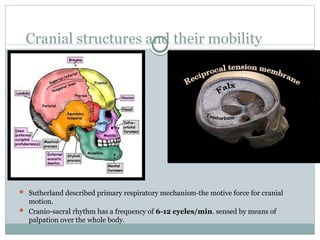
Cranial structures and their mobility
 Sutherland described primary respiratory mechanism-the motive force for cranial
motion.
 Cranio-sacral rhythm has a frequency of 6-12 cycles/min. sensed by means of
palpation over the whole body.
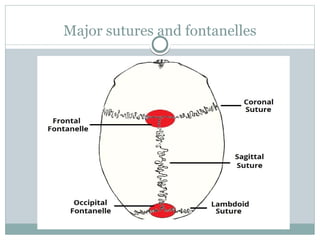
Major sutures and fontanelles
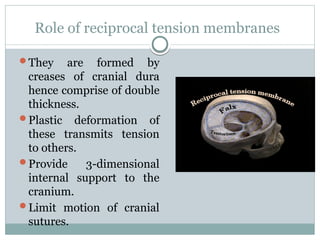
Role of reciprocal tension membranes
They are formed by
creases of cranial dura
hence comprise of double
thickness.
Plastic deformation of
these transmits tension
to others.
Provide 3-dimensional
internal support to the
cranium.
Limit motion of cranial
sutures.
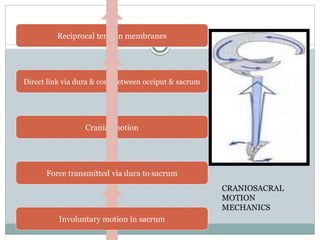
Reciprocal tension membranes
Direct link via dura & cord between occiput & sacrum
Cranial motion
Force transmitted via dura to sacrum
Involuntary motion in sacrum
CRANIOSACRAL
MOTION
MECHANICS
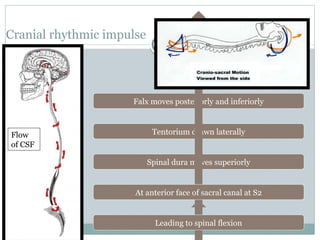
Cranial rhythmic impulse
Falx moves posteriorly and inferiorly
Tentorium drawn laterally
Spinal dura moves superiorly
At anterior face of sacral canal at S2
Leading to spinal flexion
Flow
of CSF
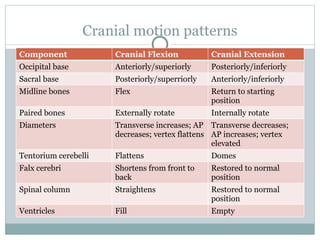
Cranial motion patterns
Component Cranial Flexion Cranial Extension
Occipital base Anteriorly/superiorly Posteriorly/inferiorly
Sacral base Posteriorly/superriorly Anteriorly/inferiorly
Midline bones Flex Return to starting
position
Paired bones Externally rotate Internally rotate
Diameters Transverse increases; AP
decreases; vertex flattens
Transverse decreases;
AP increases; vertex
elevated
Tentorium cerebelli Flattens Domes
Falx cerebri Shortens from front to
back
Restored to normal
position
Spinal column Straightens Restored to normal
position
Ventricles Fill Empty
Craniosacral therapy
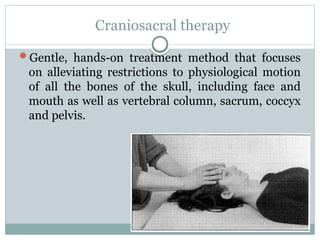
Gentle, hands-on treatment method that focuses
on alleviating restrictions to physiological motion
of all the bones of the skull, including face and
mouth as well as vertebral column, sacrum, coccyx
and pelvis.
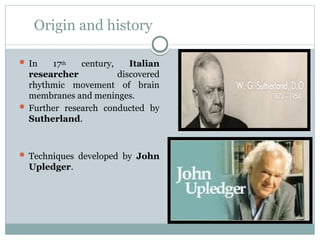
Origin and history
 In 17th century, Italian
researcher discovered
rhythmic movement of brain
membranes and meninges.
 Further research conducted by
Sutherland.
 Techniques developed by John
Upledger.
Principles of CS therapy
Body is a unity.
Person is a unity, made up of body, mind and spirit.
There is an interaction between structure and function
in which each influences other.
Body is able to :
1. Regulate itself (self-regulation)
2. Heal itself (self healing)
3. Maintain its state of health.
Assessment
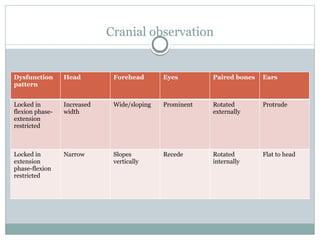
Cranial observation
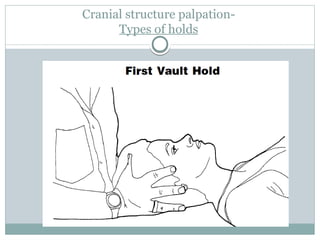
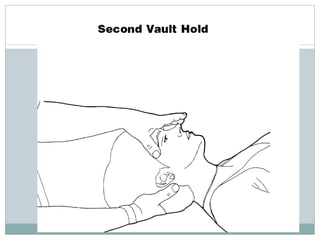
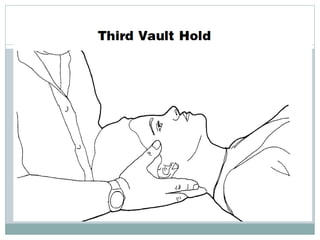
Cranial structure palpation
Associate with signs and symptoms.
Cranial observation
Dysfunction
pattern
Head Forehead Eyes Paired bones Ears
Locked in
flexion phase-
extension
restricted
Increased
width
Wide/sloping Prominent Rotated
externally
Protrude
Locked in
extension
phase-flexion
restricted
Narrow Slopes
vertically
Recede Rotated
internally
Flat to head
Cranial structure palpation-
Types of holds
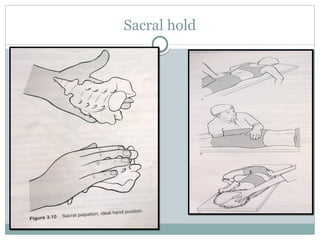
Sacral hold
Techniques-palpation and treatment
Types of techniques:
1. Direct techniques: engaging and moving the
bone/tissues directly towards the direction of
restriction.
2. Indirect techniques: moving the bones and
soft tissues towards direction of greatest ease.
3. Separation/disengagement techniques:
restricted articulation is separated using mild
force.
4. Moulding: done on infant skulls. External forces
are applied to alter contour of bone.
Meaning of release(signs)
Steady or stronger pulsation.
Greater warmth enters the area.
Definite change in palpated tone.
Lengthening or freeing up of tissues being held is
perceived.
Patient signs- flushing, change in skin color,
perspiration on lip or brow.
Treatment protocol
Between 6-10 of one hour sessions are usually
recommended.
Intervals between sessions- should be decided by the
practitioner and based on individual patient’s
condition and tolerance.
Still points
It is the point at which the Cranio-sacral rhythm stands
still.
Occurs as a part of dysfunction or can be induced
therapeutically.
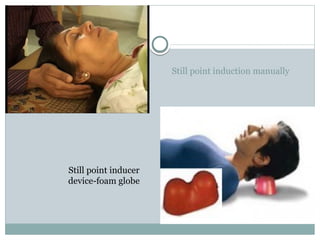
Induced by either resisting the flexion or the extension
phase.
Uses:
1. balancing technique for the craniosacral system.
2. to release accumulated stress.
3. improves fluid exchange between the various
physiological compartments of the body, as well as
improving blood flow by reducing sympathetic nervous
tone.
Still point induction manually
Still point inducer
device-foam globe
Indications
Allergies
Birth preparation
Relaxation
Hyperactivity
Headaches
Painful menstruation
Sleep disturbances
Back ache
Contraindications
Absolute contraindications:
1. Acute inflammation (meningitis)
2. Severe or open wounds
3. Skull fractures
4. Cardiac arrest (acute phase)
5. Stroke (acute phase)
6. Unclarified infection
Relative contraindications
Acute severe pain
Concussion
Whiplash injury
Multiple sclerosis
Epilepsy
Psychological illnesses
Osteoporosis
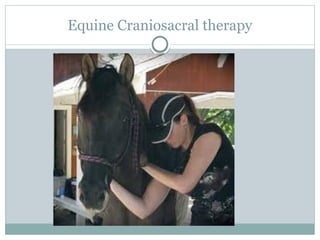
Equine Craniosacral therapy
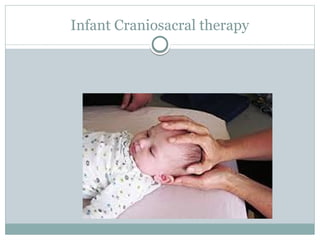
Infant Craniosacral therapy
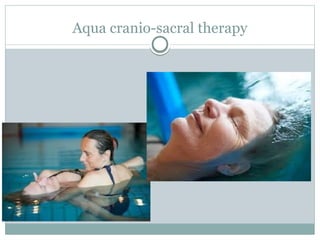
Aqua cranio-sacral therapy
References
Upledger JE. Your inner physician and you: CranioSacral
therapy and SomatoEmotional release. North Atlantic
Books; 1997.

Craniosacral therapy

  • 1.
    R A DHI K A C H IN T A M A N I CRANIOSACRAL THERAPY
  • 2.
    CONTENTS Cranial structures andtheir mobility Cranial rhythmic impulse Origin and history of craniosacral therapy Principles of CS therapy Assessment Techniques-palpation and treatment Indications Contraindications Applications Summary References
  • 3.
    Cranial structures andtheir mobility  Sutherland described primary respiratory mechanism-the motive force for cranial motion.  Cranio-sacral rhythm has a frequency of 6-12 cycles/min. sensed by means of palpation over the whole body.
  • 4.
    Major sutures andfontanelles
  • 5.
    Role of reciprocaltension membranes They are formed by creases of cranial dura hence comprise of double thickness. Plastic deformation of these transmits tension to others. Provide 3-dimensional internal support to the cranium. Limit motion of cranial sutures.
  • 6.
    Reciprocal tension membranes Directlink via dura & cord between occiput & sacrum Cranial motion Force transmitted via dura to sacrum Involuntary motion in sacrum CRANIOSACRAL MOTION MECHANICS
  • 7.
    Cranial rhythmic impulse Falxmoves posteriorly and inferiorly Tentorium drawn laterally Spinal dura moves superiorly At anterior face of sacral canal at S2 Leading to spinal flexion Flow of CSF
  • 8.
    Cranial motion patterns ComponentCranial Flexion Cranial Extension Occipital base Anteriorly/superiorly Posteriorly/inferiorly Sacral base Posteriorly/superriorly Anteriorly/inferiorly Midline bones Flex Return to starting position Paired bones Externally rotate Internally rotate Diameters Transverse increases; AP decreases; vertex flattens Transverse decreases; AP increases; vertex elevated Tentorium cerebelli Flattens Domes Falx cerebri Shortens from front to back Restored to normal position Spinal column Straightens Restored to normal position Ventricles Fill Empty
  • 9.
    Craniosacral therapy Gentle, hands-ontreatment method that focuses on alleviating restrictions to physiological motion of all the bones of the skull, including face and mouth as well as vertebral column, sacrum, coccyx and pelvis.
  • 10.
    Origin and history In 17th century, Italian researcher discovered rhythmic movement of brain membranes and meninges.  Further research conducted by Sutherland.  Techniques developed by John Upledger.
  • 11.
    Principles of CStherapy Body is a unity. Person is a unity, made up of body, mind and spirit. There is an interaction between structure and function in which each influences other. Body is able to : 1. Regulate itself (self-regulation) 2. Heal itself (self healing) 3. Maintain its state of health.
  • 12.
    Assessment Cranial observation Cranial structurepalpation Associate with signs and symptoms.
  • 13.
    Cranial observation Dysfunction pattern Head ForeheadEyes Paired bones Ears Locked in flexion phase- extension restricted Increased width Wide/sloping Prominent Rotated externally Protrude Locked in extension phase-flexion restricted Narrow Slopes vertically Recede Rotated internally Flat to head
  • 14.
  • 17.
  • 18.
    Techniques-palpation and treatment Typesof techniques: 1. Direct techniques: engaging and moving the bone/tissues directly towards the direction of restriction. 2. Indirect techniques: moving the bones and soft tissues towards direction of greatest ease. 3. Separation/disengagement techniques: restricted articulation is separated using mild force. 4. Moulding: done on infant skulls. External forces are applied to alter contour of bone.
  • 19.
    Meaning of release(signs) Steadyor stronger pulsation. Greater warmth enters the area. Definite change in palpated tone. Lengthening or freeing up of tissues being held is perceived. Patient signs- flushing, change in skin color, perspiration on lip or brow.
  • 20.
    Treatment protocol Between 6-10of one hour sessions are usually recommended. Intervals between sessions- should be decided by the practitioner and based on individual patient’s condition and tolerance.
  • 21.
    Still points It isthe point at which the Cranio-sacral rhythm stands still. Occurs as a part of dysfunction or can be induced therapeutically. Induced by either resisting the flexion or the extension phase. Uses: 1. balancing technique for the craniosacral system. 2. to release accumulated stress. 3. improves fluid exchange between the various physiological compartments of the body, as well as improving blood flow by reducing sympathetic nervous tone.
  • 22.
    Still point inductionmanually Still point inducer device-foam globe
  • 23.
  • 24.
    Contraindications Absolute contraindications: 1. Acuteinflammation (meningitis) 2. Severe or open wounds 3. Skull fractures 4. Cardiac arrest (acute phase) 5. Stroke (acute phase) 6. Unclarified infection
  • 25.
    Relative contraindications Acute severepain Concussion Whiplash injury Multiple sclerosis Epilepsy Psychological illnesses Osteoporosis
  • 26.
  • 27.
  • 28.
  • 29.
    References Upledger JE. Yourinner physician and you: CranioSacral therapy and SomatoEmotional release. North Atlantic Books; 1997.