ELECTRICAL STIMULATION
PRESENTER:DR N. BROJENDRO SINGH
MODERATOR: PROF N.ROMI SINGH
28/11/2015 at 2.00pm 1
ELECTRICAL STIMULATION
Application of suitably modified electric current to
stimulate excitable tissues like nerves and muscles to
produce therapeutic benefits
28/11/2015 at 2.00pm 2
ELECTRIC CURRENT
• Flow of electric charge
• Two types: direct current and alternating current
• Direct current (DC) : the unidirectional flow of electric
charge.
• Alternating current(AC) : flow of electric charge
periodically in reverses direction
28/11/2015 at 2.00pm 3
• Electric current can stimulate excitable tissue in body.
• Intermittent current are used
• Current duration range used:(0.01ms-3sec)
• Short duration less than 10 ms is faradic type-used for
stimulation of normal muscle
• Long duration more than10ms is called interrupted
galvanic type –used for stimulation of denervated muscles
28/11/2015 at 2.00pm 4
FARADIC CURRENT
• Interrupted direct current
• Pulse duration- (0.1 – 1 ms )
• Frequency (50 – 100 Hz)
• Surged form of current is used
28/11/2015 at 2.00pm 5
FORMS OF FARADIC TYPE CURRENT
28/11/2015 at 2.00pm 6
PHYSIOLOGICAL EFFECT OF FADADIC
CURRENT
• Sensory nerve stimulation
• Motor nerve stimulation
stimulation with 50 Hz frequency and 0.1 – 1ms with
surged current
• Effect on muscle contraction:
• Effect on denervated muscles
28/11/2015 at 2.00pm 7
CHEMICAL EFFECTS
• Produces chemical changes in electrodes
• Current flow in one direction for short periods
• No serious danger of burns
28/11/2015 at 2.00pm 8
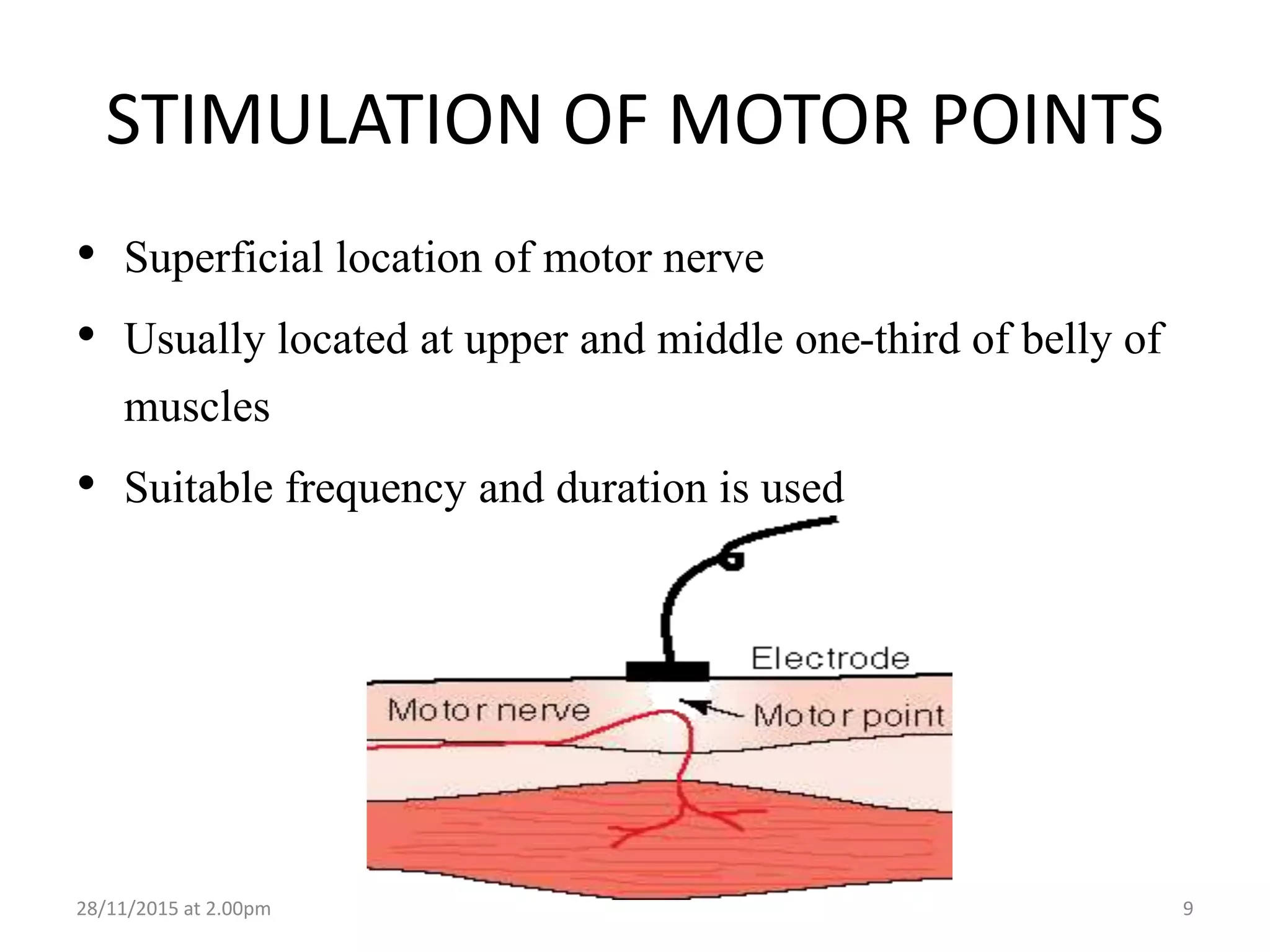
STIMULATION OF MOTOR POINTS
• Superficial location of motor nerve
• Usually located at upper and middle one-third of belly of
muscles
• Suitable frequency and duration is used
28/11/2015 at 2.00pm 9
INDICATIONS OF FARADIC CURRENT
• Facilitation of muscle contraction
• Re – education of muscle action
• Training of new muscle action
• Neuropraxia of a motor nerve
• Severed motor nerve
• Improved venous and lymphatic drainage
• Prevention and loosening of adhesions
28/11/2015 at 2.00pm 10
INTERRUPTED DIRECT CURRENT
• Frequency of 30 Hz
• Duration 100 ms
• Applied through a potentiometer
28/11/2015 at 2.00pm 11
TYPES OF INTERRUPTED DIRECT
CURRENT
28/11/2015 at 2.00pm 12
PHYSIOLOGICAL EFFECTS OF
INTERRUPTED DIRECT CURRENT
• Stimulation of denervated muscles
• Stimulation of sensory nerves
• Stimulation of motor nerves
28/11/2015 at 2.00pm 13
INDICATIONS
• To produce contractions of denervated muscles
• Re –education of muscles in early phase of
re-innervation
28/11/2015 at 2.00pm 14
PHYSIOLOGICAL RESPONSE TO
ELECTRICAL CURRENT
• As electricity moves through the body's conductive
medium, changes in the physiologic functioning can
occur at various levels
Cellular
Tissue
Segmental
Systematic
28/11/2015 at 2.00pm 15
EFFECTS AT CELLULAR LEVEL
• Excitation of nerve cells
• Changes in cell membrane permeability
• Stimulation of fibroblast, osteoblast
• Modification of microcirculation
28/11/2015 at 2.00pm 16
EFFECTS AT TISSUE LEVEL
• Skeletal muscle contraction
• Smooth muscle contraction
• Tissue regeneration
28/11/2015 at 2.00pm 17
EFFECTS AT SEGMENTAL LEVEL
• Modification of joint mobility
• Muscle pumping action to change circulation and
lymphatic activity
• Alteration of the microvascular system not associated
with muscle pumping
• Increased movement of charged proteins into the
lymphatic channels
28/11/2015 at 2.00pm 18
SYSTEMIC EFFECTS
• Analgesic effects as endogenous pain suppressors are
released and act at different levels to control pain
• Analgesic effects from the stimulation of certain
neurotransmitters to control neural activity in the presence
of pain stimuli
28/11/2015 at 2.00pm 19
ELECTRICAL STIMULATOR
28/11/2015 at 2.00pm 20
ELECTRODES
• Purpose
– Completes the circuit
– Interface between
electron and ion flow
– resistance to current
• Materials
– Metallic
– Carbon rubber
– Self-adhesive
28/11/2015 at 2.00pm 21
ELECTRODE PLACEMENT
• Electrodes spaced far apart penetrate more deeply with less
current density
• Larger the electrode the less density
• A multitude of placement techniques may be used to create
desire able clinical and physiological effects
28/11/2015 at 2.00pm 22
STIMULATION POINT
• Motor Points
– Superficial location of motor
nerve
• Trigger Points
– Localized, hypersensitive
muscle spasm
– Trigger referred pain
– Arise secondary to
pathology
• Acupuncture Points
– Areas of skin having
decreased electrical resistance
– May result in pain reduction
• Traumatized Areas
– Decreased electrical resistance
28/11/2015 at 2.00pm 23
TYPES
• Neuromuscular electrical stimulation(NMES)
• Functional electrical stimulation(FES)
• Transcutaneous electrical nerve stimulation(TENS)
• Interferential therapy unit
28/11/2015 at 2.00pm 24
NMES
NMES applies electrical impulses to the nervous system to
stimulate sensory and/or motor neurons
Common Uses
• Relaxation of muscle spasms
• Prevention or retardation of disuse atrophy
• Improvement of local blood circulation
• Re-education of the muscle
28/11/2015 at 2.00pm 25
FUNCTIONAL ELECTTRICAL
STIMULATION
• Technique that used electric currents to activate nerves
innervating extremities affected by paralysis and
neurological disabilities to restore normal functions
28/11/2015 at 2.00pm 26
MECHANISM OF FES
• Stimulate muscles in a programmed synergystic sequence
that allow patient to accomplish a specific functional
movement pattern
• Multichannel microprocessors
are pre-programmed to execute
variety of specific movement
28/11/2015 at 2.00pm 27
USES
• Prevent or correct diffuse atrophy
• Improve ROM in stiff joints and spasticity
• Re- education of new muscle action in muscle and
tendon transfers
• Supplementation or substitution of orthosis
28/11/2015 at 2.00pm 28
PARAMETER OF FES CURRENT
• Frequency-(12-100Hz)
• Intensity of current-(90-200)mA
• Pulse duration(20-300)msec
28/11/2015 at 2.00pm 29
STRENGHT- DURATION CURVE
28/11/2015 at 2.00pm 30
TENS
• Electrical stimulation which primarily aims to provide a
degree of symptomatic pain relief by exciting sensory
nerves
28/11/2015 at 2.00pm 31
MECHANISM OF TENS
• Gate Control Theory(Malzack and Wall)
• Activation of peripheral sensory Aβ fibers stimulates the
inhibitory interneuron in substansia gelatinosa in dorsal
horns of the spinal cord
• Activated interneurons produces inhibition of pain
carrying A-delta and C fibres and closes spinal pain gate
to prevent painful impulse to reach at sensory cortex
28/11/2015 at 2.00pm 32
DESCENDING PAIN CONTROL
• stimulation of smaller peripheral Aδ and C fibers through
the CNS causes a release of enkephalins blocking pain at
the spinal cord
28/11/2015 at 2.00pm 33
ENDOGENOUS OPIATE PAIN CONTROL
• Noxious stimulus causes release of β–endorphins and
dynorphin resulting in analgesia
28/11/2015 at 2.00pm 34
TYPES OF TENS
High TENS (Sensory Level)
o Duration (100-500 µsec)
o Frequency (100-150Hz)
o Sensory-level output
o Activates spinal gate
28/11/2015 at 2.00pm 35
LOW TENS
• Duration (100 to 150 µsec)
• Low pulse frequency (1 to 5 Hz)
• Motor-level output
• Modulation through release of β-endorphin
28/11/2015 at 2.00pm 36
CLINICAL APPLICATIONS
• Acute and chronic pain,
• Back and cervical muscular and disc syndromes,
• Arthritis
• Shoulder syndromes
• Neuropathies
• Many other painful conditions
28/11/2015 at 2.00pm 37
ELECTRODE PLACEMENT
 Negative electrode
• Spinal nerve roots
• Painful sites
•Dermatomes
• Myotomes
• Trigger points
• Acupuncture points
Positive electrodes
• Placed close to spinal
segment
28/11/2015 at 2.00pm 38
INTERFERENTIAL THERAPY
• Two medium frequency currents pass through the tissues
simultaneously
• Their paths cross; and interfere with each other
• Gives an interference or beat frequency which has low-
frequency stimulation
28/11/2015 at 2.00pm 39
MECHANISM OF INTERFERENTIAL
THERAPY
• Low frequency stimulation of muscle and nerve tissues at
sufficient depth without painful and side effects
• Medium frequency currents penetrate the tissues with little
resistance, but the resulting interference current allows
effective stimulation of the biological tissues
28/11/2015 at 2.00pm 40
ELECTRODE PLACEMENT
• When electrodes are arranged in a square and
interferential currents are passed through a homogeneous
medium - a pattern of interference will occur
28/11/2015 at 2.00pm 41
ELECTRODE PLACEMENT
• Ensure adequate coverage of the stimulated area
• Placement of the electrodes should be such that a
crossover effect is achieved in the desired area
28/11/2015 at 2.00pm 42
CONTRAINDICATIONS
• Undiagnosed pain
• Pacemakers
• Heart disease
• Epilepsy
• Pregnancy: first trimester-over the uterus
• Over the carotid sinus
• On broken skin
• On dysaesthetic skin
• Over the eyes, larynx, pharynx, over mucosal membranes
28/11/2015 at 2.00pm 43
THANK YOU
28/11/2015 at 2.00pm 44

Electrical stimulation

  • 1.
    ELECTRICAL STIMULATION PRESENTER:DR N.BROJENDRO SINGH MODERATOR: PROF N.ROMI SINGH 28/11/2015 at 2.00pm 1
  • 2.
    ELECTRICAL STIMULATION Application ofsuitably modified electric current to stimulate excitable tissues like nerves and muscles to produce therapeutic benefits 28/11/2015 at 2.00pm 2
  • 3.
    ELECTRIC CURRENT • Flowof electric charge • Two types: direct current and alternating current • Direct current (DC) : the unidirectional flow of electric charge. • Alternating current(AC) : flow of electric charge periodically in reverses direction 28/11/2015 at 2.00pm 3
  • 4.
    • Electric currentcan stimulate excitable tissue in body. • Intermittent current are used • Current duration range used:(0.01ms-3sec) • Short duration less than 10 ms is faradic type-used for stimulation of normal muscle • Long duration more than10ms is called interrupted galvanic type –used for stimulation of denervated muscles 28/11/2015 at 2.00pm 4
  • 5.
    FARADIC CURRENT • Interrupteddirect current • Pulse duration- (0.1 – 1 ms ) • Frequency (50 – 100 Hz) • Surged form of current is used 28/11/2015 at 2.00pm 5
  • 6.
    FORMS OF FARADICTYPE CURRENT 28/11/2015 at 2.00pm 6
  • 7.
    PHYSIOLOGICAL EFFECT OFFADADIC CURRENT • Sensory nerve stimulation • Motor nerve stimulation stimulation with 50 Hz frequency and 0.1 – 1ms with surged current • Effect on muscle contraction: • Effect on denervated muscles 28/11/2015 at 2.00pm 7
  • 8.
    CHEMICAL EFFECTS • Produceschemical changes in electrodes • Current flow in one direction for short periods • No serious danger of burns 28/11/2015 at 2.00pm 8
  • 9.
    STIMULATION OF MOTORPOINTS • Superficial location of motor nerve • Usually located at upper and middle one-third of belly of muscles • Suitable frequency and duration is used 28/11/2015 at 2.00pm 9
  • 10.
    INDICATIONS OF FARADICCURRENT • Facilitation of muscle contraction • Re – education of muscle action • Training of new muscle action • Neuropraxia of a motor nerve • Severed motor nerve • Improved venous and lymphatic drainage • Prevention and loosening of adhesions 28/11/2015 at 2.00pm 10
  • 11.
    INTERRUPTED DIRECT CURRENT •Frequency of 30 Hz • Duration 100 ms • Applied through a potentiometer 28/11/2015 at 2.00pm 11
  • 12.
    TYPES OF INTERRUPTEDDIRECT CURRENT 28/11/2015 at 2.00pm 12
  • 13.
    PHYSIOLOGICAL EFFECTS OF INTERRUPTEDDIRECT CURRENT • Stimulation of denervated muscles • Stimulation of sensory nerves • Stimulation of motor nerves 28/11/2015 at 2.00pm 13
  • 14.
    INDICATIONS • To producecontractions of denervated muscles • Re –education of muscles in early phase of re-innervation 28/11/2015 at 2.00pm 14
  • 15.
    PHYSIOLOGICAL RESPONSE TO ELECTRICALCURRENT • As electricity moves through the body's conductive medium, changes in the physiologic functioning can occur at various levels Cellular Tissue Segmental Systematic 28/11/2015 at 2.00pm 15
  • 16.
    EFFECTS AT CELLULARLEVEL • Excitation of nerve cells • Changes in cell membrane permeability • Stimulation of fibroblast, osteoblast • Modification of microcirculation 28/11/2015 at 2.00pm 16
  • 17.
    EFFECTS AT TISSUELEVEL • Skeletal muscle contraction • Smooth muscle contraction • Tissue regeneration 28/11/2015 at 2.00pm 17
  • 18.
    EFFECTS AT SEGMENTALLEVEL • Modification of joint mobility • Muscle pumping action to change circulation and lymphatic activity • Alteration of the microvascular system not associated with muscle pumping • Increased movement of charged proteins into the lymphatic channels 28/11/2015 at 2.00pm 18
  • 19.
    SYSTEMIC EFFECTS • Analgesiceffects as endogenous pain suppressors are released and act at different levels to control pain • Analgesic effects from the stimulation of certain neurotransmitters to control neural activity in the presence of pain stimuli 28/11/2015 at 2.00pm 19
  • 20.
  • 21.
    ELECTRODES • Purpose – Completesthe circuit – Interface between electron and ion flow – resistance to current • Materials – Metallic – Carbon rubber – Self-adhesive 28/11/2015 at 2.00pm 21
  • 22.
    ELECTRODE PLACEMENT • Electrodesspaced far apart penetrate more deeply with less current density • Larger the electrode the less density • A multitude of placement techniques may be used to create desire able clinical and physiological effects 28/11/2015 at 2.00pm 22
  • 23.
    STIMULATION POINT • MotorPoints – Superficial location of motor nerve • Trigger Points – Localized, hypersensitive muscle spasm – Trigger referred pain – Arise secondary to pathology • Acupuncture Points – Areas of skin having decreased electrical resistance – May result in pain reduction • Traumatized Areas – Decreased electrical resistance 28/11/2015 at 2.00pm 23
  • 24.
    TYPES • Neuromuscular electricalstimulation(NMES) • Functional electrical stimulation(FES) • Transcutaneous electrical nerve stimulation(TENS) • Interferential therapy unit 28/11/2015 at 2.00pm 24
  • 25.
    NMES NMES applies electricalimpulses to the nervous system to stimulate sensory and/or motor neurons Common Uses • Relaxation of muscle spasms • Prevention or retardation of disuse atrophy • Improvement of local blood circulation • Re-education of the muscle 28/11/2015 at 2.00pm 25
  • 26.
    FUNCTIONAL ELECTTRICAL STIMULATION • Techniquethat used electric currents to activate nerves innervating extremities affected by paralysis and neurological disabilities to restore normal functions 28/11/2015 at 2.00pm 26
  • 27.
    MECHANISM OF FES •Stimulate muscles in a programmed synergystic sequence that allow patient to accomplish a specific functional movement pattern • Multichannel microprocessors are pre-programmed to execute variety of specific movement 28/11/2015 at 2.00pm 27
  • 28.
    USES • Prevent orcorrect diffuse atrophy • Improve ROM in stiff joints and spasticity • Re- education of new muscle action in muscle and tendon transfers • Supplementation or substitution of orthosis 28/11/2015 at 2.00pm 28
  • 29.
    PARAMETER OF FESCURRENT • Frequency-(12-100Hz) • Intensity of current-(90-200)mA • Pulse duration(20-300)msec 28/11/2015 at 2.00pm 29
  • 30.
  • 31.
    TENS • Electrical stimulationwhich primarily aims to provide a degree of symptomatic pain relief by exciting sensory nerves 28/11/2015 at 2.00pm 31
  • 32.
    MECHANISM OF TENS •Gate Control Theory(Malzack and Wall) • Activation of peripheral sensory Aβ fibers stimulates the inhibitory interneuron in substansia gelatinosa in dorsal horns of the spinal cord • Activated interneurons produces inhibition of pain carrying A-delta and C fibres and closes spinal pain gate to prevent painful impulse to reach at sensory cortex 28/11/2015 at 2.00pm 32
  • 33.
    DESCENDING PAIN CONTROL •stimulation of smaller peripheral Aδ and C fibers through the CNS causes a release of enkephalins blocking pain at the spinal cord 28/11/2015 at 2.00pm 33
  • 34.
    ENDOGENOUS OPIATE PAINCONTROL • Noxious stimulus causes release of β–endorphins and dynorphin resulting in analgesia 28/11/2015 at 2.00pm 34
  • 35.
    TYPES OF TENS HighTENS (Sensory Level) o Duration (100-500 µsec) o Frequency (100-150Hz) o Sensory-level output o Activates spinal gate 28/11/2015 at 2.00pm 35
  • 36.
    LOW TENS • Duration(100 to 150 µsec) • Low pulse frequency (1 to 5 Hz) • Motor-level output • Modulation through release of β-endorphin 28/11/2015 at 2.00pm 36
  • 37.
    CLINICAL APPLICATIONS • Acuteand chronic pain, • Back and cervical muscular and disc syndromes, • Arthritis • Shoulder syndromes • Neuropathies • Many other painful conditions 28/11/2015 at 2.00pm 37
  • 38.
    ELECTRODE PLACEMENT  Negativeelectrode • Spinal nerve roots • Painful sites •Dermatomes • Myotomes • Trigger points • Acupuncture points Positive electrodes • Placed close to spinal segment 28/11/2015 at 2.00pm 38
  • 39.
    INTERFERENTIAL THERAPY • Twomedium frequency currents pass through the tissues simultaneously • Their paths cross; and interfere with each other • Gives an interference or beat frequency which has low- frequency stimulation 28/11/2015 at 2.00pm 39
  • 40.
    MECHANISM OF INTERFERENTIAL THERAPY •Low frequency stimulation of muscle and nerve tissues at sufficient depth without painful and side effects • Medium frequency currents penetrate the tissues with little resistance, but the resulting interference current allows effective stimulation of the biological tissues 28/11/2015 at 2.00pm 40
  • 41.
    ELECTRODE PLACEMENT • Whenelectrodes are arranged in a square and interferential currents are passed through a homogeneous medium - a pattern of interference will occur 28/11/2015 at 2.00pm 41
  • 42.
    ELECTRODE PLACEMENT • Ensureadequate coverage of the stimulated area • Placement of the electrodes should be such that a crossover effect is achieved in the desired area 28/11/2015 at 2.00pm 42
  • 43.
    CONTRAINDICATIONS • Undiagnosed pain •Pacemakers • Heart disease • Epilepsy • Pregnancy: first trimester-over the uterus • Over the carotid sinus • On broken skin • On dysaesthetic skin • Over the eyes, larynx, pharynx, over mucosal membranes 28/11/2015 at 2.00pm 43
  • 44.

Editor's Notes

  • #23 If a large “dispersive” pad is creating muscle contractions there may be areas of high current concentration and other areas relatively inactive, thus functionally reducing the total size of the electrode
  • #24 Predictably located Motor nerve charts
  • #28 FES utilizes multiple channel electrical stimulators controlled by a microprocessor to recruit muscles in a programmed synergystic sequence that will allow patient to accomplish a specific functional movement pattern
  • #41 The resistance (impedance) of the skin is inversely proportional to the frequency of the stimulating current