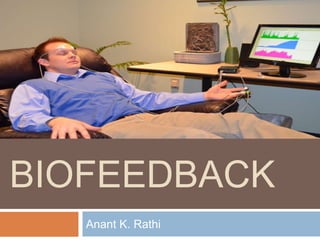
BIOFEEDBACK
Anant K. Rathi
Definitions
 "Bio" - life.
 "Feedback“ - returning knowledge to origin.
 Then "biofeedback" (BF) means returning the
biological knowledge created by the origin to
origin in order to make the origin understand
and control that knowledge.
 Biofeedback is a technique that measures
bodily functions and gives you information
about them in order to help train you to control
them.
Association for Applied Psychophysiology and Biofeedback
(AAPB), Biofeedback Certification International
alliance (BCIA), and the International Society for
Neurofeedback and Research (ISNR),
“is a process that enables an individual to learn how
to change physiological activity for the purposes
of improving health and performance. Precise
instruments measure physiological activity such
as brainwaves, heart function, breathing, muscle
activity, and skin temperature. These instruments
rapidly and accurately 'feed back' information to
the user. The presentation of this information—
often in conjunction with changes in thinking,
emotions, and behavior—supports desired
physiological changes. Over time, these changes
can endure without continued use of an
instrument.
Principle of BF
 The patient through the artificial proprioception
provided by the BF apparatus, is able to gain
conscious control over subliminal but
undamaged upper neuron pathways which are
in turn able to fix the missing function.
Purpose
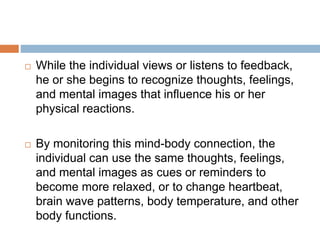
 To enhance an
individual's
awareness of physical
reactions to physical,
emotional, or
psychological stress ,
and their influence on
their own
physiological
responses.
 To develop self-
regulation skills that
play a role in
improving health and
well-being.
How biofeedback works
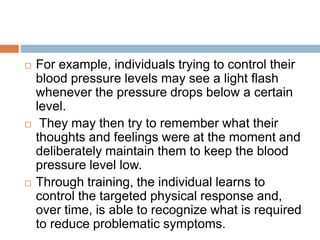
 Biofeedback utilizes electronic sensors, or
electrodes, attached to various parts of the
body to detect changes in physical responses.
 Signals then inform the individual of these
changes by means of visual or auditory signals
such as a light display or a series of beeps.
 While the individual views or listens to feedback,
he or she begins to recognize thoughts, feelings,
and mental images that influence his or her
physical reactions.
 By monitoring this mind-body connection, the
individual can use the same thoughts, feelings,
and mental images as cues or reminders to
become more relaxed, or to change heartbeat,
brain wave patterns, body temperature, and other
body functions.
 For example, individuals trying to control their
blood pressure levels may see a light flash
whenever the pressure drops below a certain
level.
 They may then try to remember what their
thoughts and feelings were at the moment and
deliberately maintain them to keep the blood
pressure level low.
 Through training, the individual learns to
control the targeted physical response and,
over time, is able to recognize what is required
to reduce problematic symptoms.
 Eventually, the external biofeedback becomes
unnecessary as the individual learns to
perceive internal physical responses and
make the desired changes. The individual then
has a powerful, portable, and self-
administered treatment tool to deal with
problematic symptoms.
Three stages of
biofeedback training
Types of sensory modalities
 Electromyograph (EMG)
 Galvanic skin response (GSR)
 Temperature or thermal sensors
 Heart rate sensors
 Capnometry (CAP)
 Photoplethysmograph
 Pneumograph
 Electroencephelograph
 Rheoencephalograph
 Hemoencephalograph
Electromyography
 The most frequently used biofeedback method
 for treating anxiety and worry, chronic pain,
essential hypertension, headache (migraine,
mixed headache, and tension type), low
backache, physical rehabilitation (cerebral
palsy, incomplete spinal cord lesions, and
stroke), temporomandibular joint disease
(TMD), torticollis, fecal & urinary incontinence
and pelvic pain.
Electromyography
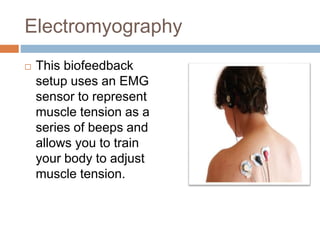
 This biofeedback
setup uses an EMG
sensor to represent
muscle tension as a
series of beeps and
allows you to train
your body to adjust
muscle tension.
Galvanic skin response ( skin
conductance)
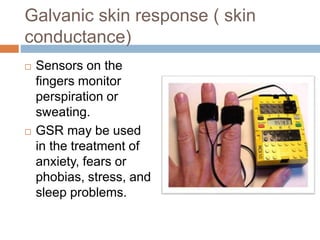
 Sensors on the
fingers monitor
perspiration or
sweating.
 GSR may be used
in the treatment of
anxiety, fears or
phobias, stress, and
sleep problems.
Galvanic skin response
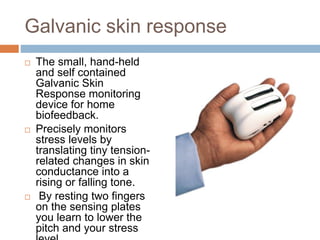
 The small, hand-held
and self contained
Galvanic Skin
Response monitoring
device for home
biofeedback.
 Precisely monitors
stress levels by
translating tiny tension-
related changes in skin
conductance into a
rising or falling tone.
 By resting two fingers
on the sensing plates
you learn to lower the
pitch and your stress
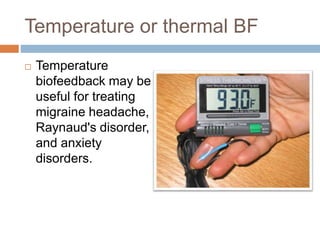
Temperature or thermal BF
 Sensors monitor body temperature and
changes in blood flow.
 Changes in hand temperature, for example,
can indicate relaxation when there is
increased blood flow to the skin.
Temperature or thermal BF
 Temperature
biofeedback may be
useful for treating
migraine headache,
Raynaud's disorder,
and anxiety
disorders.
Heart rate BF
 A pulse monitor placed on the fingertip
monitors pulse rate.
 Increases in heart rate are associated with
emotional arousal, such as being angry or
fearful.
 Decreases in heart rate are associated with
relaxation.
Capnometry/Respiratory rate
 Respiratory sensors monitor oxygen intake
and carbon dioxide output, rate of respiration.
 This differentiates correct breathing from
problematic breathing practices. Breath control
training may be used to treat panic attacks,
asthma, and a variety of stress-related
conditions.
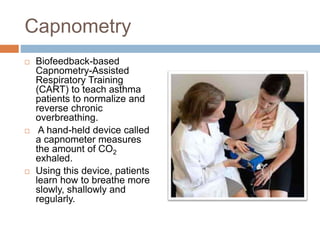
Capnometry
 Biofeedback-based
Capnometry-Assisted
Respiratory Training
(CART) to teach asthma
patients to normalize and
reverse chronic
overbreathing.
 A hand-held device called
a capnometer measures
the amount of CO2
exhaled.
 Using this device, patients
learn how to breathe more
slowly, shallowly and
regularly.
Electroencephalographs (EEG) or
neurofeedback
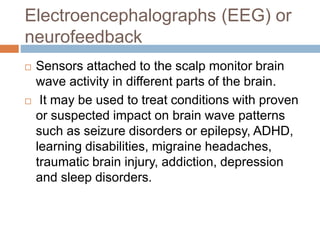
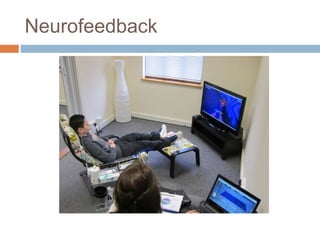
 Sensors attached to the scalp monitor brain
wave activity in different parts of the brain.
 It may be used to treat conditions with proven
or suspected impact on brain wave patterns
such as seizure disorders or epilepsy, ADHD,
learning disabilities, migraine headaches,
traumatic brain injury, addiction, depression
and sleep disorders.
Neurofeedback
Main Clinical
Applications of BF
Neuromuscular Rehabilitation
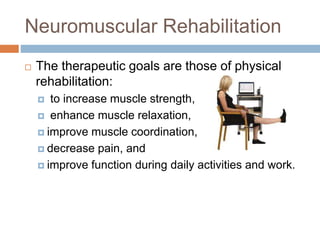
 The therapeutic goals are those of physical
rehabilitation:
 to increase muscle strength,
 enhance muscle relaxation,
 improve muscle coordination,
 decrease pain, and
 improve function during daily activities and work.
Chronic pain disorders
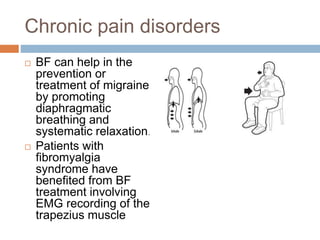
 BF can help in the
prevention or
treatment of migraine
by promoting
diaphragmatic
breathing and
systematic relaxation.
 Patients with
fibromyalgia
syndrome have
benefited from BF
treatment involving
EMG recording of the
trapezius muscle
Chronic pain disorders
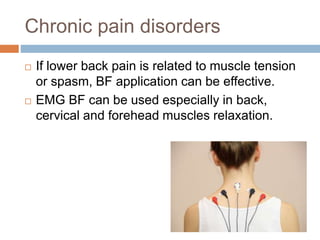
 If lower back pain is related to muscle tension
or spasm, BF application can be effective.
 EMG BF can be used especially in back,
cervical and forehead muscles relaxation.
Chronic pain disorders
 Biofeedback combined with cognitive
behavioral skills training prevented the
symptoms of patients at high risk for acute
temporomandibular (TMD)–related pain from
progressing to chronic TMD
 Thermal biofeedback may be useful for
treating phantom limb, which occurs in the
majority of patients who have amputations
Hypertension
 BF is particularly indicated in patients who are
hypersensitive to stress and who have
difficulty in tolerating or complying with
antihypertensive drug regimens.
Seizure disorders
 The treatment of epilepsy via conditioning of
the sensorimotor EEG dates back more than 3
decades.
 Such neurobiofeedback results in an
upregulation of excitation thresholds
associated with reduced susceptibility to
seizures, especially for patients whose
conditions are nonresponsive to standard
anticonvulsant medications.
Stroke
 Treatment of foot drop by relaxation of the
gastrocnemius and recruitment of the
dorsiflexors.
 Shoulder subluxation is a common
complication in flask hemiplegic patients.
 Strengthening of the upper trapezius and
anterior deltoid muscle fibers with EMG
BF not only reduces subluxation but also
improves the range of motion of the
shoulder joint
Spinal cord injury
 BF is used for muscle relaxation and/or
strengthening of the muscles
 In paraplegics relaxation of hip adductors and
gastrosoleus muscles is important.
 By adding BF treatment to the rehabilitation
programme, improvement is achieved in active
range of motion and function of the extremities
particularly in incomplete paraplegic and
tetraplegic patients.
Cerebral palsy
 BF is used for spasticity treatment, balance
training and strengthening of weak muscles.
 Dynamic equinus is a common deformity that
worsens the ambulatory ability of both diplegic
and hemiplegic conditions.
Post-Orthopedic Surgery
 Muscle weakness occurring after orthopedic
surgeries benefit from BF treatment. EMG BF
is found to be effective in improving
quadriceps muscle strength after
meniscectomy
Incontinence
 Pelvic floor muscle training (Kegel exercises),
alone or with BF is effective in stress
incontinence.
 BF enables the patient to improve pelvic
muscle strength and coordination through
muscle awareness.
 BF is advocated as first-line therapy for
patients whose symptoms of mild to moderate
fecal incontinence have not responded to
simple dietary advice or medication
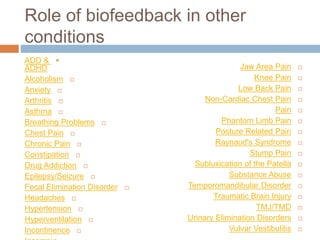
Role of biofeedback in other
conditions
ADD &
ADHD
Alcoholism
Anxiety
Arthritis
Asthma
Breathing Problems
Chest Pain
Chronic Pain
Constipation
Drug Addiction
Epilepsy/Seizure
Fecal Elimination Disorder
Headaches
Hypertension
Hyperventilation
Incontinence
Jaw Area Pain
Knee Pain
Low Back Pain
Non-Cardiac Chest Pain
Pain
Phantom Limb Pain
Posture Related Pain
Raynaud's Syndrome
Stump Pain
Subluxication of the Patella
Substance Abuse
Temporomandibular Disorder
Traumatic Brain Injury
TMJ/TMD
Urinary Elimination Disorders
Vulvar Vestibulitis
Conclusion
 biofeedback is a therapeutic technology that
empowers patients to be active participants in
their own health care by providing them with
immediate insight into the functioning of their
bodies
Reference
 Biofeedback applications:a survey of clinical
research, Sala Horowitz, Ph.D.
http://touroinstitute.com/biofeedback.pdf
 International encylopedia of rehabilitation
http://cirrie.buffalo.edu/encyclopedia/en/article/
23/
 http://www.encyclopedia.com/topic/biofeedbac
k.aspx
Thank you

Biofeedback and implications

  • 1.
  • 2.
    Definitions  "Bio" -life.  "Feedback“ - returning knowledge to origin.  Then "biofeedback" (BF) means returning the biological knowledge created by the origin to origin in order to make the origin understand and control that knowledge.  Biofeedback is a technique that measures bodily functions and gives you information about them in order to help train you to control them.
  • 3.
    Association for AppliedPsychophysiology and Biofeedback (AAPB), Biofeedback Certification International alliance (BCIA), and the International Society for Neurofeedback and Research (ISNR), “is a process that enables an individual to learn how to change physiological activity for the purposes of improving health and performance. Precise instruments measure physiological activity such as brainwaves, heart function, breathing, muscle activity, and skin temperature. These instruments rapidly and accurately 'feed back' information to the user. The presentation of this information— often in conjunction with changes in thinking, emotions, and behavior—supports desired physiological changes. Over time, these changes can endure without continued use of an instrument.
  • 4.
    Principle of BF The patient through the artificial proprioception provided by the BF apparatus, is able to gain conscious control over subliminal but undamaged upper neuron pathways which are in turn able to fix the missing function.
  • 5.
    Purpose  To enhancean individual's awareness of physical reactions to physical, emotional, or psychological stress , and their influence on their own physiological responses.  To develop self- regulation skills that play a role in improving health and well-being.
  • 6.
    How biofeedback works Biofeedback utilizes electronic sensors, or electrodes, attached to various parts of the body to detect changes in physical responses.  Signals then inform the individual of these changes by means of visual or auditory signals such as a light display or a series of beeps.
  • 7.
     While theindividual views or listens to feedback, he or she begins to recognize thoughts, feelings, and mental images that influence his or her physical reactions.  By monitoring this mind-body connection, the individual can use the same thoughts, feelings, and mental images as cues or reminders to become more relaxed, or to change heartbeat, brain wave patterns, body temperature, and other body functions.
  • 8.
     For example,individuals trying to control their blood pressure levels may see a light flash whenever the pressure drops below a certain level.  They may then try to remember what their thoughts and feelings were at the moment and deliberately maintain them to keep the blood pressure level low.  Through training, the individual learns to control the targeted physical response and, over time, is able to recognize what is required to reduce problematic symptoms.
  • 9.
     Eventually, theexternal biofeedback becomes unnecessary as the individual learns to perceive internal physical responses and make the desired changes. The individual then has a powerful, portable, and self- administered treatment tool to deal with problematic symptoms.
  • 10.
  • 11.
    Types of sensorymodalities  Electromyograph (EMG)  Galvanic skin response (GSR)  Temperature or thermal sensors  Heart rate sensors  Capnometry (CAP)  Photoplethysmograph  Pneumograph  Electroencephelograph  Rheoencephalograph  Hemoencephalograph
  • 12.
    Electromyography  The mostfrequently used biofeedback method  for treating anxiety and worry, chronic pain, essential hypertension, headache (migraine, mixed headache, and tension type), low backache, physical rehabilitation (cerebral palsy, incomplete spinal cord lesions, and stroke), temporomandibular joint disease (TMD), torticollis, fecal & urinary incontinence and pelvic pain.
  • 13.
    Electromyography  This biofeedback setupuses an EMG sensor to represent muscle tension as a series of beeps and allows you to train your body to adjust muscle tension.
  • 14.
    Galvanic skin response( skin conductance)  Sensors on the fingers monitor perspiration or sweating.  GSR may be used in the treatment of anxiety, fears or phobias, stress, and sleep problems.
  • 15.
    Galvanic skin response The small, hand-held and self contained Galvanic Skin Response monitoring device for home biofeedback.  Precisely monitors stress levels by translating tiny tension- related changes in skin conductance into a rising or falling tone.  By resting two fingers on the sensing plates you learn to lower the pitch and your stress
  • 16.
    Temperature or thermalBF  Sensors monitor body temperature and changes in blood flow.  Changes in hand temperature, for example, can indicate relaxation when there is increased blood flow to the skin.
  • 17.
    Temperature or thermalBF  Temperature biofeedback may be useful for treating migraine headache, Raynaud's disorder, and anxiety disorders.
  • 18.
    Heart rate BF A pulse monitor placed on the fingertip monitors pulse rate.  Increases in heart rate are associated with emotional arousal, such as being angry or fearful.  Decreases in heart rate are associated with relaxation.
  • 19.
    Capnometry/Respiratory rate  Respiratorysensors monitor oxygen intake and carbon dioxide output, rate of respiration.  This differentiates correct breathing from problematic breathing practices. Breath control training may be used to treat panic attacks, asthma, and a variety of stress-related conditions.
  • 20.
    Capnometry  Biofeedback-based Capnometry-Assisted Respiratory Training (CART)to teach asthma patients to normalize and reverse chronic overbreathing.  A hand-held device called a capnometer measures the amount of CO2 exhaled.  Using this device, patients learn how to breathe more slowly, shallowly and regularly.
  • 21.
    Electroencephalographs (EEG) or neurofeedback Sensors attached to the scalp monitor brain wave activity in different parts of the brain.  It may be used to treat conditions with proven or suspected impact on brain wave patterns such as seizure disorders or epilepsy, ADHD, learning disabilities, migraine headaches, traumatic brain injury, addiction, depression and sleep disorders.
  • 22.
  • 23.
  • 24.
    Neuromuscular Rehabilitation  Thetherapeutic goals are those of physical rehabilitation:  to increase muscle strength,  enhance muscle relaxation,  improve muscle coordination,  decrease pain, and  improve function during daily activities and work.
  • 25.
    Chronic pain disorders BF can help in the prevention or treatment of migraine by promoting diaphragmatic breathing and systematic relaxation.  Patients with fibromyalgia syndrome have benefited from BF treatment involving EMG recording of the trapezius muscle
  • 26.
    Chronic pain disorders If lower back pain is related to muscle tension or spasm, BF application can be effective.  EMG BF can be used especially in back, cervical and forehead muscles relaxation.
  • 27.
    Chronic pain disorders Biofeedback combined with cognitive behavioral skills training prevented the symptoms of patients at high risk for acute temporomandibular (TMD)–related pain from progressing to chronic TMD  Thermal biofeedback may be useful for treating phantom limb, which occurs in the majority of patients who have amputations
  • 28.
    Hypertension  BF isparticularly indicated in patients who are hypersensitive to stress and who have difficulty in tolerating or complying with antihypertensive drug regimens.
  • 29.
    Seizure disorders  Thetreatment of epilepsy via conditioning of the sensorimotor EEG dates back more than 3 decades.  Such neurobiofeedback results in an upregulation of excitation thresholds associated with reduced susceptibility to seizures, especially for patients whose conditions are nonresponsive to standard anticonvulsant medications.
  • 30.
    Stroke  Treatment offoot drop by relaxation of the gastrocnemius and recruitment of the dorsiflexors.  Shoulder subluxation is a common complication in flask hemiplegic patients.  Strengthening of the upper trapezius and anterior deltoid muscle fibers with EMG BF not only reduces subluxation but also improves the range of motion of the shoulder joint
  • 31.
    Spinal cord injury BF is used for muscle relaxation and/or strengthening of the muscles  In paraplegics relaxation of hip adductors and gastrosoleus muscles is important.  By adding BF treatment to the rehabilitation programme, improvement is achieved in active range of motion and function of the extremities particularly in incomplete paraplegic and tetraplegic patients.
  • 32.
    Cerebral palsy  BFis used for spasticity treatment, balance training and strengthening of weak muscles.  Dynamic equinus is a common deformity that worsens the ambulatory ability of both diplegic and hemiplegic conditions.
  • 33.
    Post-Orthopedic Surgery  Muscleweakness occurring after orthopedic surgeries benefit from BF treatment. EMG BF is found to be effective in improving quadriceps muscle strength after meniscectomy
  • 34.
    Incontinence  Pelvic floormuscle training (Kegel exercises), alone or with BF is effective in stress incontinence.  BF enables the patient to improve pelvic muscle strength and coordination through muscle awareness.  BF is advocated as first-line therapy for patients whose symptoms of mild to moderate fecal incontinence have not responded to simple dietary advice or medication
  • 35.
    Role of biofeedbackin other conditions ADD & ADHD Alcoholism Anxiety Arthritis Asthma Breathing Problems Chest Pain Chronic Pain Constipation Drug Addiction Epilepsy/Seizure Fecal Elimination Disorder Headaches Hypertension Hyperventilation Incontinence Jaw Area Pain Knee Pain Low Back Pain Non-Cardiac Chest Pain Pain Phantom Limb Pain Posture Related Pain Raynaud's Syndrome Stump Pain Subluxication of the Patella Substance Abuse Temporomandibular Disorder Traumatic Brain Injury TMJ/TMD Urinary Elimination Disorders Vulvar Vestibulitis
  • 36.
    Conclusion  biofeedback isa therapeutic technology that empowers patients to be active participants in their own health care by providing them with immediate insight into the functioning of their bodies
  • 37.
    Reference  Biofeedback applications:asurvey of clinical research, Sala Horowitz, Ph.D. http://touroinstitute.com/biofeedback.pdf  International encylopedia of rehabilitation http://cirrie.buffalo.edu/encyclopedia/en/article/ 23/  http://www.encyclopedia.com/topic/biofeedbac k.aspx
  • 38.

Editor's Notes

  • #7 (of a stimulus or mental process) below the threshold of sensation or consciousness; perceived by or affecting someone's mind without their being aware of it.
  • #10 a process whereby electronic monitoring of a normally automatic bodily function is used to train someone to acquire voluntary control of that function.
  • #18 Surface electrodes measure muscle electrode potential In addition to surface electrodes, clinicians may also insert wires or needles intramuscularly to record an EMG signal. While this is more painful and often costly, the signal is more reliable since surface electrodes pick up cross talk from nearby muscles. The use of surface electrodes is also limited to superficial muscles, making the intramuscular approach beneficial to access signals from deeper muscles. 
  • #19 One of the most sensitive markers for emotional arousal is galvanic skin response (GSR), also referred to as skin conductance (SC) or electro-dermal activity (EDA). EDA modulates the amount of sweat secretion from sweat glands. The amount of sweat glands varies across the human body, being highest in hand and foot regions (200–600 sweat glands per cm2). This change in skin conductance is generally termed Galvanic Skin Response (GSR).
  • #20  If the sympathetic branch of the autonomic nervous system is highly aroused, then sweat gland activity also increases, which in turn increases skin conductance. In this way, skin conductance can be a measure of emotional and sympathetic responses
  • #21 Skin temperature mainly reflects arteriole diameter. Hand-warming and hand-cooling are produced by separate mechanisms, and their regulation involves different skills.[22] Hand-warming involves arteriole vasodilation produced by a beta-2 adrenergic hormonal mechanism.[23] Hand-cooling involves arteriole vasoconstriction produced by the increased firing of sympathetic C-fibers.[24]
  • #26  Peniston Protocol. This approach employed independent auditory feedback of two slow brain wave frequencies, alpha (8–13 Hz) and theta (4–8 Hz) in an eyes closed condition to produce a hypnagogic state. The patient was taught prior to neurofeedback to use what amounts to success imagery (beingsober, refusing offers of alcohol, living confidently, and happy) as they drifted down into an alpha-theta state. Repeated sessions reportedly resulted in long-term abstinence and changes in personality  ADHD = This study protocol is designed to investigate the effect of slow cortical potential (SCP) feedback and a new form of neurofeedback using near-infrared spectroscopy (NIRS) on symptomatology and neurophysiological parameters in an adult ADHD using sensorimotor-rhythm neurofeedback indicated that training to increase 12-15 Hz sensorimotor rhythm over the sensorimotor cortex during wakefulness could reduce attention-deficit/hyperactivity disorder and epilepsy symptoms and even improve sleep quality by enhancing sleep spindle activity
  • #32 three types of biofeedback treatment: (1) surface electromyographic (SEMG) training of the masticatory muscles, (2) SEMG training combined with adjunctive cognitive-behavioral therapy (CBT) techniques, and (3) biofeedback-assisted relaxation training (BART). Studies have shown that burning / tingling descriptions of phantom pain are caused by too little blood flowing in the stump (residual limb) while cramping / twisting descriptions are caused by spasms in the major muscles of the stump. Numerous studies have shown that people can learn to increase blood flow to their limbs while others have shown that people can control spasms in the muscles of their limbs.  Muscle tension biofeedback to control cramping phantom pain usually takes between one and ten sessions. Temperature biofeedback to control burning phantom pain usually takes between ten and twenty sessions.
  • #34 Whereas Sensory Motor Rhytham biofeedback aims to modulate frequency components of the electroencephalography (EEG), slow cortical potential (SCP) biofeedback (which was introduced in the 1990s) focuses on the regulation of the amplitude of cortical potential changes (DC shift). In its application to epilepsy, biofeedback using galvanic skin response (GSR), an electrodermal measure of sympathetic activity,  People with seizures can learn to regulate and stabilize their brains through neurofeedback and achieve lasting results. Neurofeedback helps stabilize the timing in the brain.  biofeedback using Sensory Motor Rhythm (SMR), Slow Cortical Potentials (SCP), and GSR