BIOFEEDBACK
Amani M. Abdussalam
History and Philosophy
 Biofeedback is one of the earliest behavioral
medicine treatments and has been practiced in
clinical settings since the 1970’s.
 Biofeedback achieves its results through
psychophysiological (mind-body) self-regulation.
 Today, biofeedback is used widely by physicians,
nurses, psychologists, physical therapists, drug
rehabilitation counselors, dentists and other
professionals to treat an array of disorders.
History and Philosophy
 In biofeedback therapy, individuals are trained
on electronic monitors to exert control over
vital bodily processes, such as heart rate,
respiration, blood pressure, muscular tension,
and brain activity.
 By observing and monitoring shifts in bodily
functions or striate muscle activity, patients
learn to adapt and modify their mental and
emotional responses to alleviate symptoms
and help regulate specific health conditions.
Principle of BF
 The patient through the artificial proprioception
provided by the BF apparatus, is able to gain
conscious control over subliminal but
undamaged upper neuron pathways which are
in turn able to fix the missing function.
Purpose
 To enhance an
individual's awareness
of physical reactions to
physical, emotional, or
psychological stress ,
and their influence on
their own physiological
responses.
 To develop self-
regulation skills that
play a role in improving
health and well-being.
Definitions
 "Bio" means life. "Feedback" is returning
knowledge to origin. Then "biofeedback" (BF)
means returning the biological knowledge
created by the origin to origin in order to make
the origin understand and control that
knowledge
Definitions
 Biofeedback is a technique that measures
bodily functions and gives you information
about them in order to help train you to control
them.
“.a method of controlling a system
by reinserting into it the results of
ts past performance.”
How biofeedback works
 Biofeedback utilizes electronic sensors, or
electrodes, attached to various parts of the
body to detect changes in physical responses.
 Signals then inform the individual of these
changes by means of visual or auditory signals
such as a light display or a series of beeps.
 While the individual views or listens to
feedback, he or she begins to recognize
thoughts, feelings, and mental images that
influence his or her physical reactions.
 By monitoring this mind-body connection, the
individual can use the same thoughts, feelings,
and mental images as cues or reminders to
become more relaxed, or to change heartbeat,
brain wave patterns, body temperature, and
other body functions.
 The individual uses trial-and-error to change
the signals change in the desired direction.
 For example, individuals trying to control their
blood pressure levels may see a light flash
whenever the pressure drops below a certain
level.
 They may then try to remember what their
thoughts and feelings were at the moment and
deliberately maintain them to keep the blood
pressure level low.
 Through training, the individual learns to control
the targeted physical response and, over time, is
able to recognize what is required to reduce
problematic symptoms.
 Eventually, the external biofeedback becomes
unnecessary as the individual learns to
perceive internal physical responses and
make the desired changes. The individual then
has a powerful, portable, and self-
administered treatment tool to deal with
problematic symptoms.
Three stages of
biofeedback training
Types of biofeedback equipment
 Electromyograph (EMG)
 Galvanic skin response (GSR)
 Temperature or thermal sensors
 Heart rate sensors
 Capnometry (CAP)
Electromyography
 The most frequently used biofeedback method
 Used in the treatment of various neurologic
disorders such as stroke , cerebral palsy,
traumatic brain injury, and multiple sclerosis.
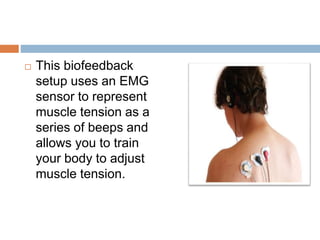
 This biofeedback
setup uses an EMG
sensor to represent
muscle tension as a
series of beeps and
allows you to train
your body to adjust
muscle tension.
Galvanic skin response ( skin
conductance)
 Sensors on the
fingers monitor
perspiration or
sweating.
 GSR may be used
in the treatment of
anxiety, fears or
phobias, stress, and
sleep problems.
Galvanic skin response
 The small, hand-held and
self contained Galvanic
Skin Response monitoring
device for home
biofeedback.
 Precisely monitors stress
levels by translating tiny
tension-related changes in
skin conductance into a
rising or falling tone.
 By resting two fingers on
the sensing plates you
learn to lower the pitch and
your stress level.
Temperature or thermal BF
 Sensors monitor body temperature and
changes in blood flow.
 Changes in hand temperature, for example,
can indicate relaxation when there is
increased blood flow to the skin.
Temperature or thermal BF
 Temperature
biofeedback may be
useful for treating
migraine headache,
Raynaud's disorder,
and anxiety
disorders.
Heart rate BF
 A pulse monitor placed on the fingertip
monitors pulse rate.
 Increases in heart rate are associated with
emotional arousal, such as being angry or
fearful.
 Decreases in heart rate are associated with
relaxation.
Capnometry
 Respiratory sensors monitor oxygen intake
and carbon dioxide output.
 This differentiates correct breathing from
problematic breathing practices. Breath control
training may be used to treat panic attacks,
asthma, and a variety of stress-related
conditions.
Capnometry
 Biofeedback-based
Capnometry-Assisted
Respiratory Training
(CART) to teach asthma
patients to normalize and
reverse chronic
overbreathing.
 A hand-held device called
a capnometer measures
the amount of CO2
exhaled.
 Using this device, patients
learn how to breathe more
slowly, shallowly and
regularly.
Electroencephalographs (EEG) or
neurofeedback
 Sensors attached to the scalp monitor brain
wave activity in different parts of the brain.
 It may be used to treat conditions with proven
or suspected impact on brain wave patterns
such as seizure disorders or epilepsy, ADHD,
learning disabilities, migraine headaches,
traumatic brain injury, and sleep disorders.
Neurofeedback
Main Clinical
Applications of BF
Neuromuscular Rehabilitation
 The therapeutic goals are those of physical
rehabilitation:
 to increase muscle strength,
 enhance muscle relaxation,
 improve muscle coordination,
 decrease pain, and
 improve function during daily activities and work.
Chronic pain disorders
 BF can help in the prevention or treatment of
migraine by promoting diaphragmatic
breathing and systematic relaxation.
 Patients with fibromyalgia syndrome have
benefited from BF treatment involving EMG
recording of the trapezius muscle
Chronic pain disorders
 If lower back pain is related to muscle tension
or spasm, BF application can be effective.
 Relaxation of the body muscles with BF is
useful in low back pain. EMG BF can be used
especially in back, cervical and forehead
muscles relaxation.
Chronic pain disorders
 Biofeedback combined with cognitive
behavioral skills training prevented the
symptoms of patients at high risk for acute
temporomandibular (TMD)–related pain from
progressing to chronic TMD
 thermal biofeedback may be useful for treating
phantom limb, which occurs in the majority of
patients who have amputations
Hypertension
 BF is particularly indicated in patients who are
hypersensitive to stress and who have
difficulty in tolerating or complying with
antihypertensive drug regimens.
Seizure disorders
 The treatment of epilepsy via conditioning of
the sensorimotor EEG dates back more than 3
decades.
 Such neurobiofeedback results in an
upregulation of excitation thresholds
associated with reduced susceptibility to
seizures, especially for patients whose
conditions are nonresponsive to standard
anticonvulsant medications.
Stroke
 Treatment of foot drop by relaxation of the
gastrocnemius and recruitment of the dorsiflexors.
 Shoulder subluxation is a common
complication in flask hemiplegic patients.
 Strengthening of the upper trapezius and
anterior deltoid muscle fibers with EMG BF
not only reduces subluxation but also
improves the range of motion of the shoulder
joint
Spinal cord injury
 BF is used for muscle relaxation and/or
strengthening of the muscles
 In paraplegics relaxation of hip adductors and
gastrosoleus muscles is important.
 By adding BF treatment to the rehabilitation
programme, improvement is achieved in active
range of motion and function of the extremities
particularly in incomplete paraplegic and
tetraplegic patients.
Cerebral palsy
 BF is used for spasticity treatment, balance
training and strengthening of weak muscles.
 Dynamic equinus is a common deformity that
worsens the ambulatory ability of both diplegic
and hemiplegic conditions.
Post-Orthopeadic Surgery
 Muscle weakness occuring after orthopeadic
surgeries benefit from BF treatment. EMG BF
is found to be effective in improving
quadriceps muscle strength after
meniscectomy
Incontinence
 Pelvic floor muscle training (Kegel exercises),
alone or with BF is effective in stress
incontinence.
 BF enables the patient to improve pelvic
muscle strength and coordination through
muscle awareness.
Incontinence
 BF is advocated as first-line therapy for
patients whose symptoms of mild to moderate
fecal incontinence have not responded to
simple dietary advice or medication
Conclusion
 biofeedback is a therapeutic technology that
empowers patients to be active participants in
their own health care by providing them with
immediate insight into the functioning of their
bodies
Reference
 Biofeedback applications:a survey of clinical
research, Sala Horowitz, Ph.D.
http://touroinstitute.com/biofeedback.pdf
 International encylopedia of rehabilitation
http://cirrie.buffalo.edu/encyclopedia/en/article/
23/
 http://www.encyclopedia.com/topic/biofeedbac
k.aspx

Biofeedback

  • 1.
  • 2.
    History and Philosophy Biofeedback is one of the earliest behavioral medicine treatments and has been practiced in clinical settings since the 1970’s.  Biofeedback achieves its results through psychophysiological (mind-body) self-regulation.  Today, biofeedback is used widely by physicians, nurses, psychologists, physical therapists, drug rehabilitation counselors, dentists and other professionals to treat an array of disorders.
  • 3.
    History and Philosophy In biofeedback therapy, individuals are trained on electronic monitors to exert control over vital bodily processes, such as heart rate, respiration, blood pressure, muscular tension, and brain activity.  By observing and monitoring shifts in bodily functions or striate muscle activity, patients learn to adapt and modify their mental and emotional responses to alleviate symptoms and help regulate specific health conditions.
  • 4.
    Principle of BF The patient through the artificial proprioception provided by the BF apparatus, is able to gain conscious control over subliminal but undamaged upper neuron pathways which are in turn able to fix the missing function.
  • 5.
    Purpose  To enhancean individual's awareness of physical reactions to physical, emotional, or psychological stress , and their influence on their own physiological responses.  To develop self- regulation skills that play a role in improving health and well-being.
  • 6.
    Definitions  "Bio" meanslife. "Feedback" is returning knowledge to origin. Then "biofeedback" (BF) means returning the biological knowledge created by the origin to origin in order to make the origin understand and control that knowledge
  • 7.
    Definitions  Biofeedback isa technique that measures bodily functions and gives you information about them in order to help train you to control them.
  • 8.
    “.a method ofcontrolling a system by reinserting into it the results of ts past performance.”
  • 9.
    How biofeedback works Biofeedback utilizes electronic sensors, or electrodes, attached to various parts of the body to detect changes in physical responses.  Signals then inform the individual of these changes by means of visual or auditory signals such as a light display or a series of beeps.
  • 10.
     While theindividual views or listens to feedback, he or she begins to recognize thoughts, feelings, and mental images that influence his or her physical reactions.  By monitoring this mind-body connection, the individual can use the same thoughts, feelings, and mental images as cues or reminders to become more relaxed, or to change heartbeat, brain wave patterns, body temperature, and other body functions.
  • 11.
     The individualuses trial-and-error to change the signals change in the desired direction.
  • 12.
     For example,individuals trying to control their blood pressure levels may see a light flash whenever the pressure drops below a certain level.  They may then try to remember what their thoughts and feelings were at the moment and deliberately maintain them to keep the blood pressure level low.  Through training, the individual learns to control the targeted physical response and, over time, is able to recognize what is required to reduce problematic symptoms.
  • 13.
     Eventually, theexternal biofeedback becomes unnecessary as the individual learns to perceive internal physical responses and make the desired changes. The individual then has a powerful, portable, and self- administered treatment tool to deal with problematic symptoms.
  • 14.
  • 15.
    Types of biofeedbackequipment  Electromyograph (EMG)  Galvanic skin response (GSR)  Temperature or thermal sensors  Heart rate sensors  Capnometry (CAP)
  • 16.
    Electromyography  The mostfrequently used biofeedback method  Used in the treatment of various neurologic disorders such as stroke , cerebral palsy, traumatic brain injury, and multiple sclerosis.
  • 17.
     This biofeedback setupuses an EMG sensor to represent muscle tension as a series of beeps and allows you to train your body to adjust muscle tension.
  • 18.
    Galvanic skin response( skin conductance)  Sensors on the fingers monitor perspiration or sweating.  GSR may be used in the treatment of anxiety, fears or phobias, stress, and sleep problems.
  • 19.
    Galvanic skin response The small, hand-held and self contained Galvanic Skin Response monitoring device for home biofeedback.  Precisely monitors stress levels by translating tiny tension-related changes in skin conductance into a rising or falling tone.  By resting two fingers on the sensing plates you learn to lower the pitch and your stress level.
  • 20.
    Temperature or thermalBF  Sensors monitor body temperature and changes in blood flow.  Changes in hand temperature, for example, can indicate relaxation when there is increased blood flow to the skin.
  • 21.
    Temperature or thermalBF  Temperature biofeedback may be useful for treating migraine headache, Raynaud's disorder, and anxiety disorders.
  • 22.
    Heart rate BF A pulse monitor placed on the fingertip monitors pulse rate.  Increases in heart rate are associated with emotional arousal, such as being angry or fearful.  Decreases in heart rate are associated with relaxation.
  • 23.
    Capnometry  Respiratory sensorsmonitor oxygen intake and carbon dioxide output.  This differentiates correct breathing from problematic breathing practices. Breath control training may be used to treat panic attacks, asthma, and a variety of stress-related conditions.
  • 24.
    Capnometry  Biofeedback-based Capnometry-Assisted Respiratory Training (CART)to teach asthma patients to normalize and reverse chronic overbreathing.  A hand-held device called a capnometer measures the amount of CO2 exhaled.  Using this device, patients learn how to breathe more slowly, shallowly and regularly.
  • 25.
    Electroencephalographs (EEG) or neurofeedback Sensors attached to the scalp monitor brain wave activity in different parts of the brain.  It may be used to treat conditions with proven or suspected impact on brain wave patterns such as seizure disorders or epilepsy, ADHD, learning disabilities, migraine headaches, traumatic brain injury, and sleep disorders.
  • 26.
  • 27.
  • 28.
    Neuromuscular Rehabilitation  Thetherapeutic goals are those of physical rehabilitation:  to increase muscle strength,  enhance muscle relaxation,  improve muscle coordination,  decrease pain, and  improve function during daily activities and work.
  • 29.
    Chronic pain disorders BF can help in the prevention or treatment of migraine by promoting diaphragmatic breathing and systematic relaxation.  Patients with fibromyalgia syndrome have benefited from BF treatment involving EMG recording of the trapezius muscle
  • 30.
    Chronic pain disorders If lower back pain is related to muscle tension or spasm, BF application can be effective.  Relaxation of the body muscles with BF is useful in low back pain. EMG BF can be used especially in back, cervical and forehead muscles relaxation.
  • 31.
    Chronic pain disorders Biofeedback combined with cognitive behavioral skills training prevented the symptoms of patients at high risk for acute temporomandibular (TMD)–related pain from progressing to chronic TMD  thermal biofeedback may be useful for treating phantom limb, which occurs in the majority of patients who have amputations
  • 32.
    Hypertension  BF isparticularly indicated in patients who are hypersensitive to stress and who have difficulty in tolerating or complying with antihypertensive drug regimens.
  • 33.
    Seizure disorders  Thetreatment of epilepsy via conditioning of the sensorimotor EEG dates back more than 3 decades.  Such neurobiofeedback results in an upregulation of excitation thresholds associated with reduced susceptibility to seizures, especially for patients whose conditions are nonresponsive to standard anticonvulsant medications.
  • 34.
    Stroke  Treatment offoot drop by relaxation of the gastrocnemius and recruitment of the dorsiflexors.  Shoulder subluxation is a common complication in flask hemiplegic patients.  Strengthening of the upper trapezius and anterior deltoid muscle fibers with EMG BF not only reduces subluxation but also improves the range of motion of the shoulder joint
  • 35.
    Spinal cord injury BF is used for muscle relaxation and/or strengthening of the muscles  In paraplegics relaxation of hip adductors and gastrosoleus muscles is important.  By adding BF treatment to the rehabilitation programme, improvement is achieved in active range of motion and function of the extremities particularly in incomplete paraplegic and tetraplegic patients.
  • 36.
    Cerebral palsy  BFis used for spasticity treatment, balance training and strengthening of weak muscles.  Dynamic equinus is a common deformity that worsens the ambulatory ability of both diplegic and hemiplegic conditions.
  • 37.
    Post-Orthopeadic Surgery  Muscleweakness occuring after orthopeadic surgeries benefit from BF treatment. EMG BF is found to be effective in improving quadriceps muscle strength after meniscectomy
  • 38.
    Incontinence  Pelvic floormuscle training (Kegel exercises), alone or with BF is effective in stress incontinence.  BF enables the patient to improve pelvic muscle strength and coordination through muscle awareness.
  • 39.
    Incontinence  BF isadvocated as first-line therapy for patients whose symptoms of mild to moderate fecal incontinence have not responded to simple dietary advice or medication
  • 40.
    Conclusion  biofeedback isa therapeutic technology that empowers patients to be active participants in their own health care by providing them with immediate insight into the functioning of their bodies
  • 41.
    Reference  Biofeedback applications:asurvey of clinical research, Sala Horowitz, Ph.D. http://touroinstitute.com/biofeedback.pdf  International encylopedia of rehabilitation http://cirrie.buffalo.edu/encyclopedia/en/article/ 23/  http://www.encyclopedia.com/topic/biofeedbac k.aspx