Modes of Mechanical Ventilation: The Essentials
Lluis Blanch MD, PhD
Senior Critical Care Department
Director Research and Innovation
Corporació Sanitaria Parc Tauli. Sabadell. Spain.
Universitat Autònoma de Barcelona. Spain.
22-23 January 2014 Cairo, Egypt
Objectives MV
• Safety
• Efficacy
– Oxygenation
– Ventilation
– Work of Breathing

• Comfort / Synchrony
– Surveillance of Flow & Pressure
Modes of Mechanical Ventilation:
Relationship between possible breath types and
inspiratory-phase variables

Phase variables that define inspiration:
trigger variable
limit variable: pressure, flow or volume
cycle variable that ends inspiration

Gas delivery:
pressure, volume, flow, time or dual control

Breath type:
mandatory or spontaneous
PCV & VCV Waveforms
PCV

Rectangular
Pressure
Waveform

VCV

VCV

VCV

Rectangular
Flow
Waveform

Ascending
Ramp Flow
Waveform

Descending
Ramp Flow
Waveform

VCV

Sinusoidal
Flow
Waveform
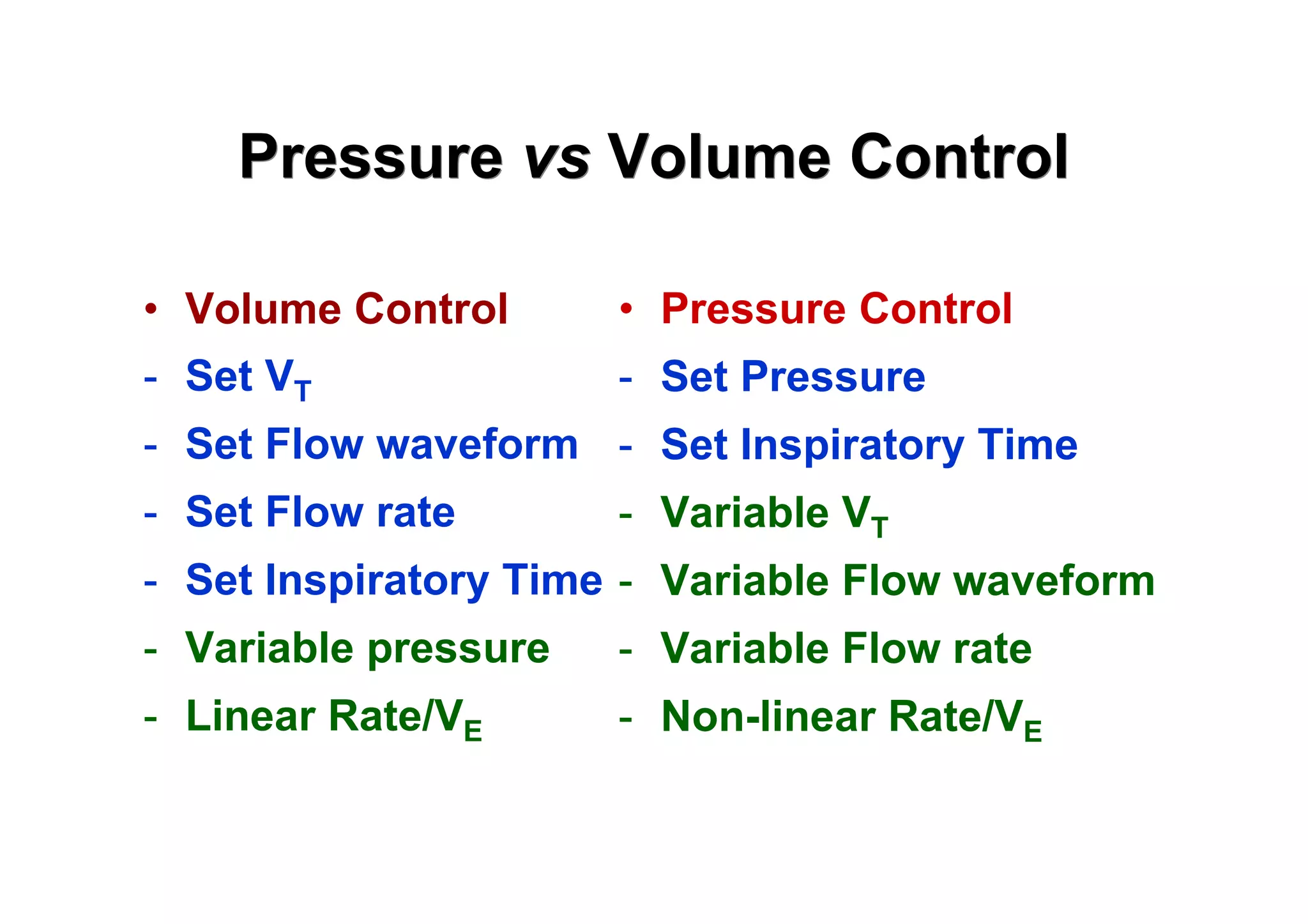
Pressure vs Volume Control
• Volume Control

• Pressure Control

- Set VT

- Set Pressure

- Set Flow waveform - Set Inspiratory Time
- Set Flow rate

- Variable VT

- Set Inspiratory Time - Variable Flow waveform
- Variable pressure

- Variable Flow rate

- Linear Rate/VE

- Non-linear Rate/VE
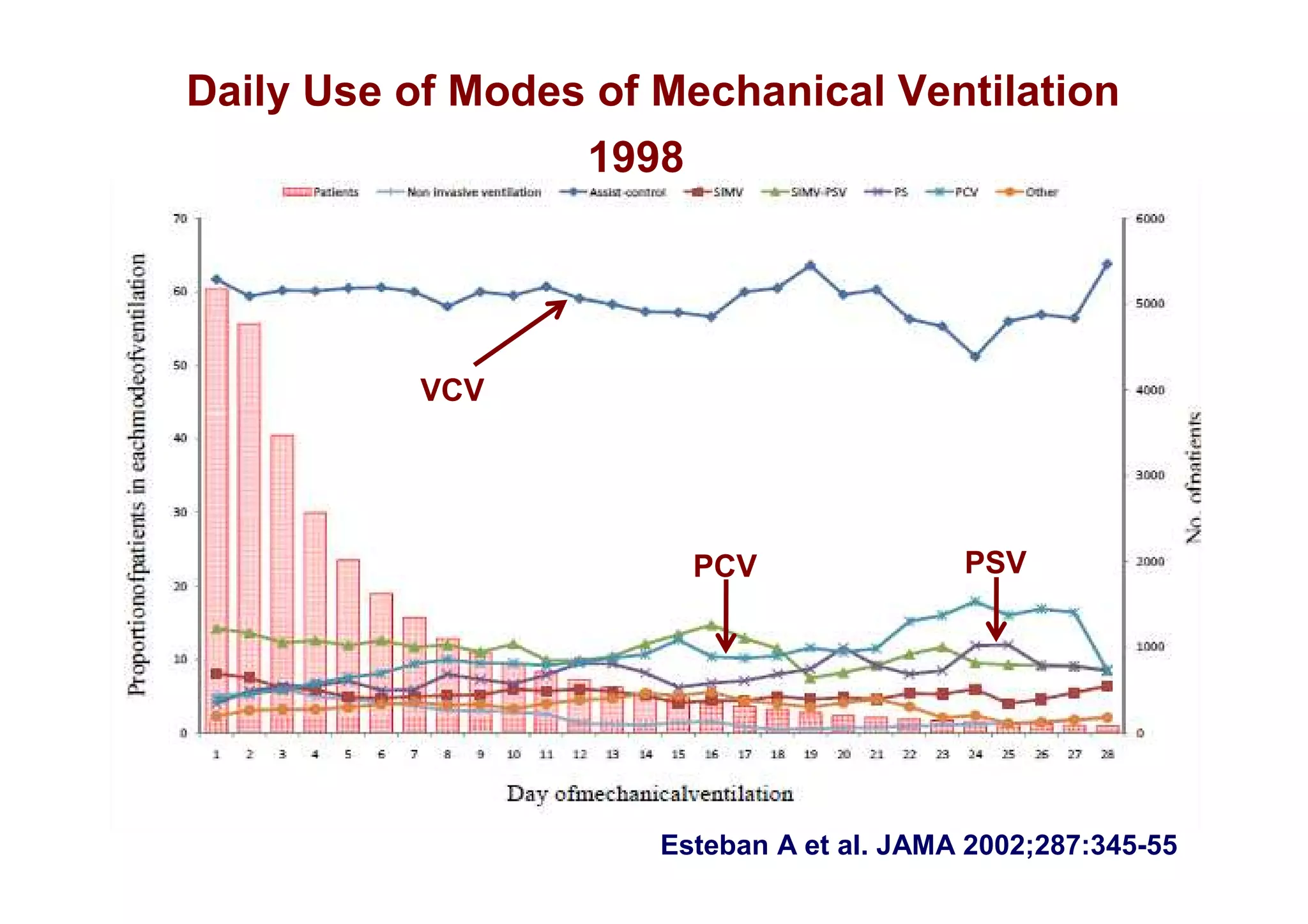
Daily Use of Modes of Mechanical Ventilation
1998

VCV

PCV

PSV

Esteban A et al. JAMA 2002;287:345-55
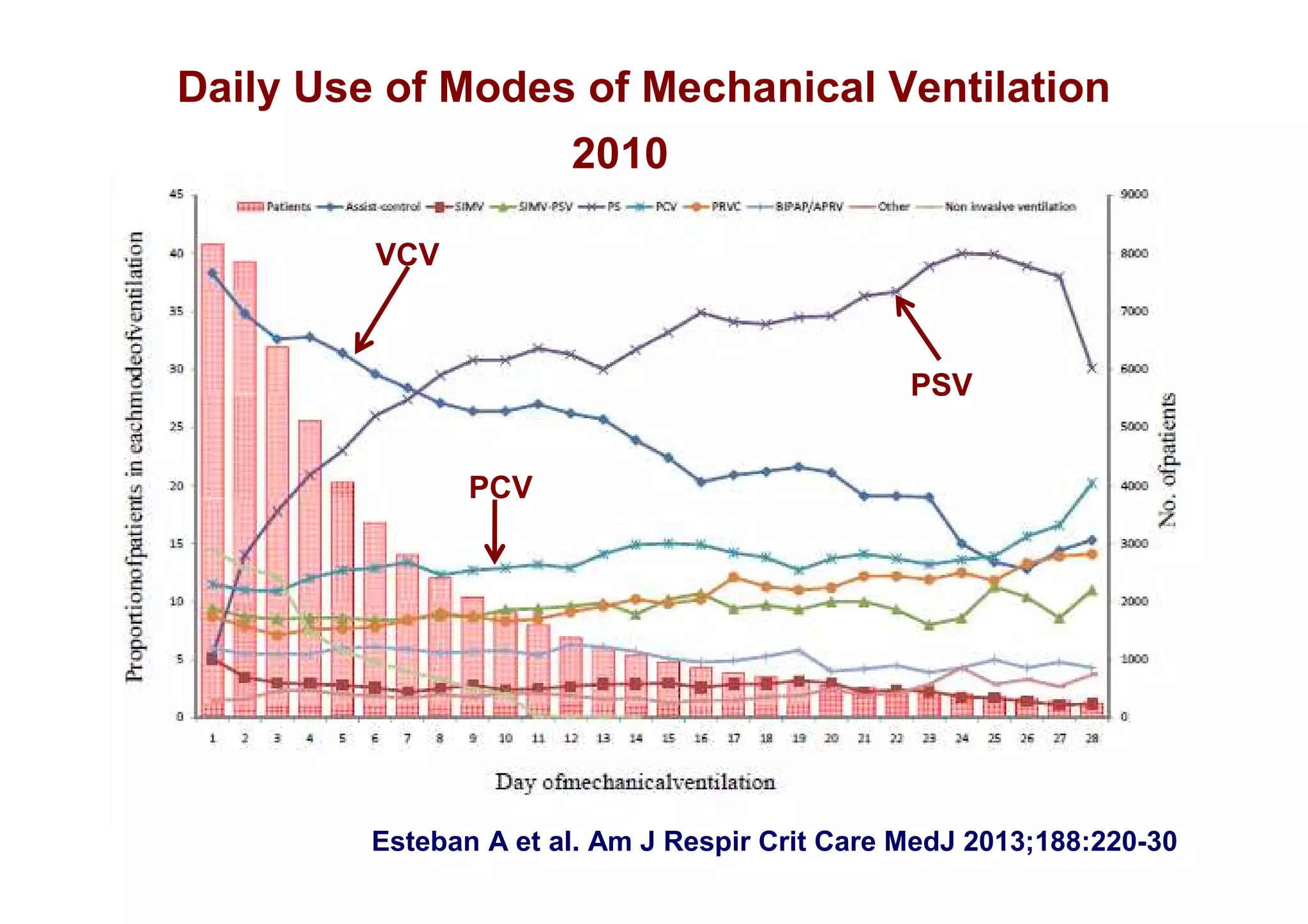
Daily Use of Modes of Mechanical Ventilation
2010
VCV

PSV
PCV

Esteban A et al. Am J Respir Crit Care MedJ 2013;188:220-30
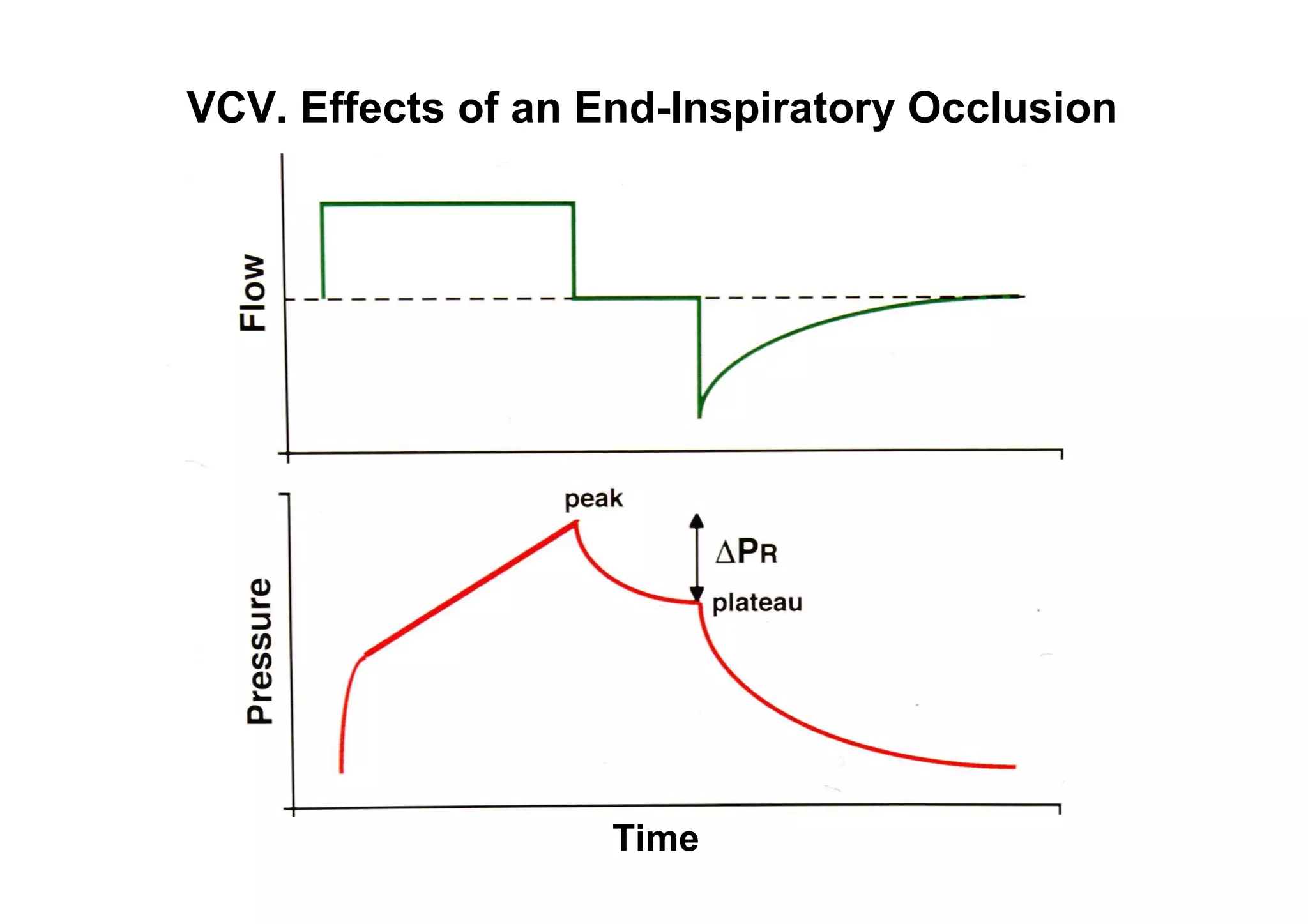
VCV. Effects of an End-Inspiratory Occlusion

Time
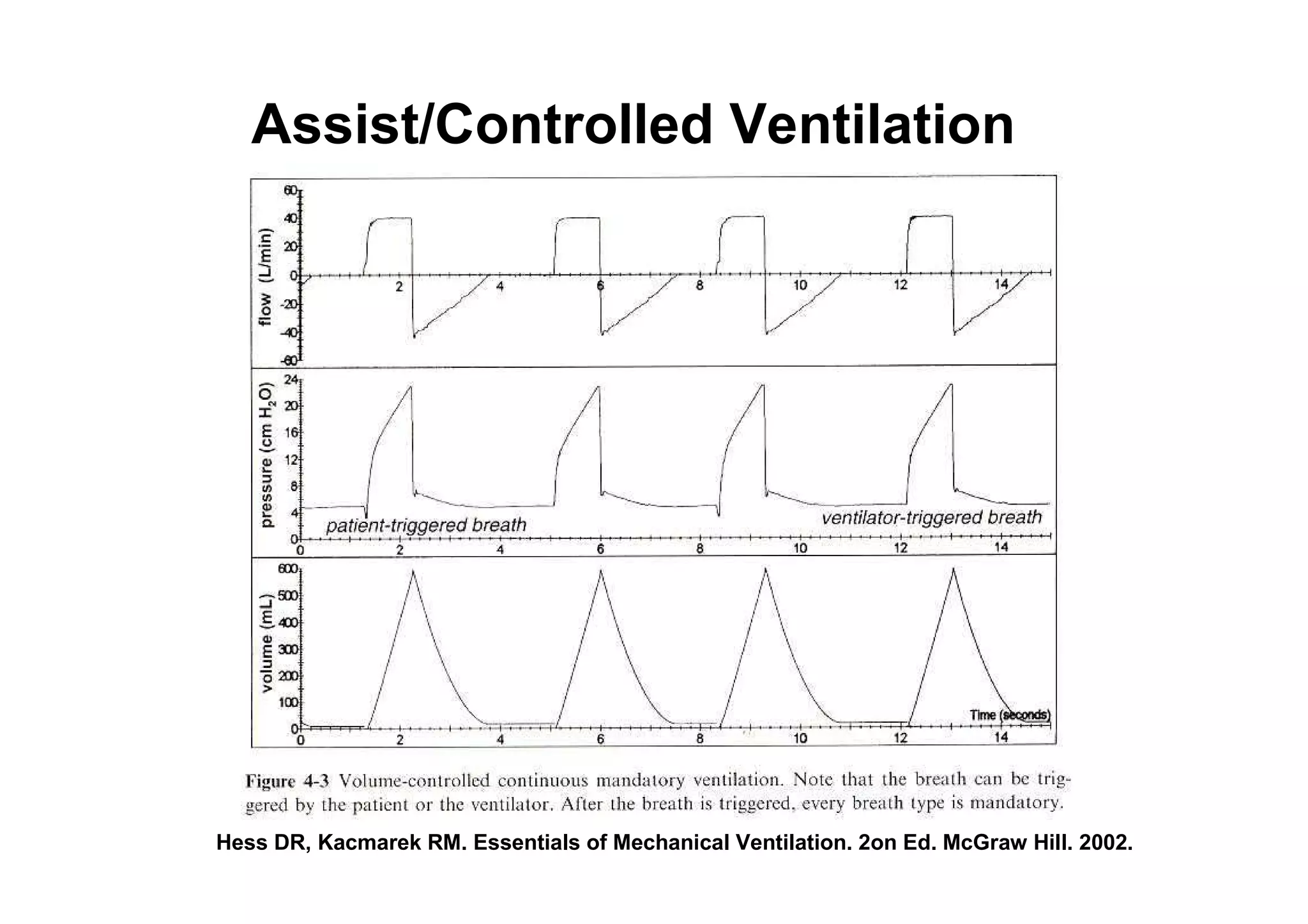
Assist/Controlled Ventilation

Hess DR, Kacmarek RM. Essentials of Mechanical Ventilation. 2on Ed. McGraw Hill. 2002.
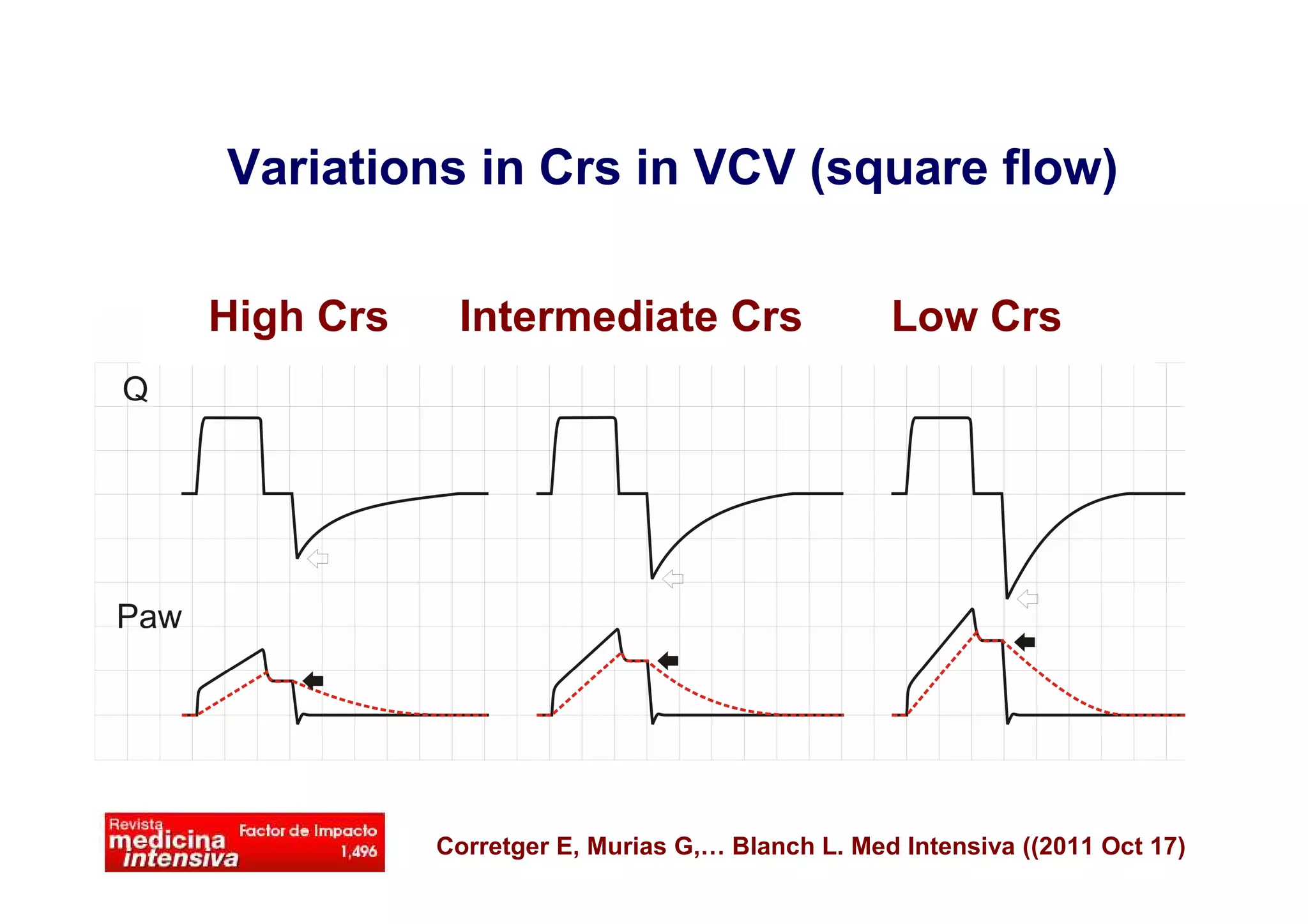
Variations in Crs in VCV (square flow)
High Crs

Intermediate Crs

Low Crs

Corretger E, Murias G,… Blanch L. Med Intensiva ((2011 Oct 17)
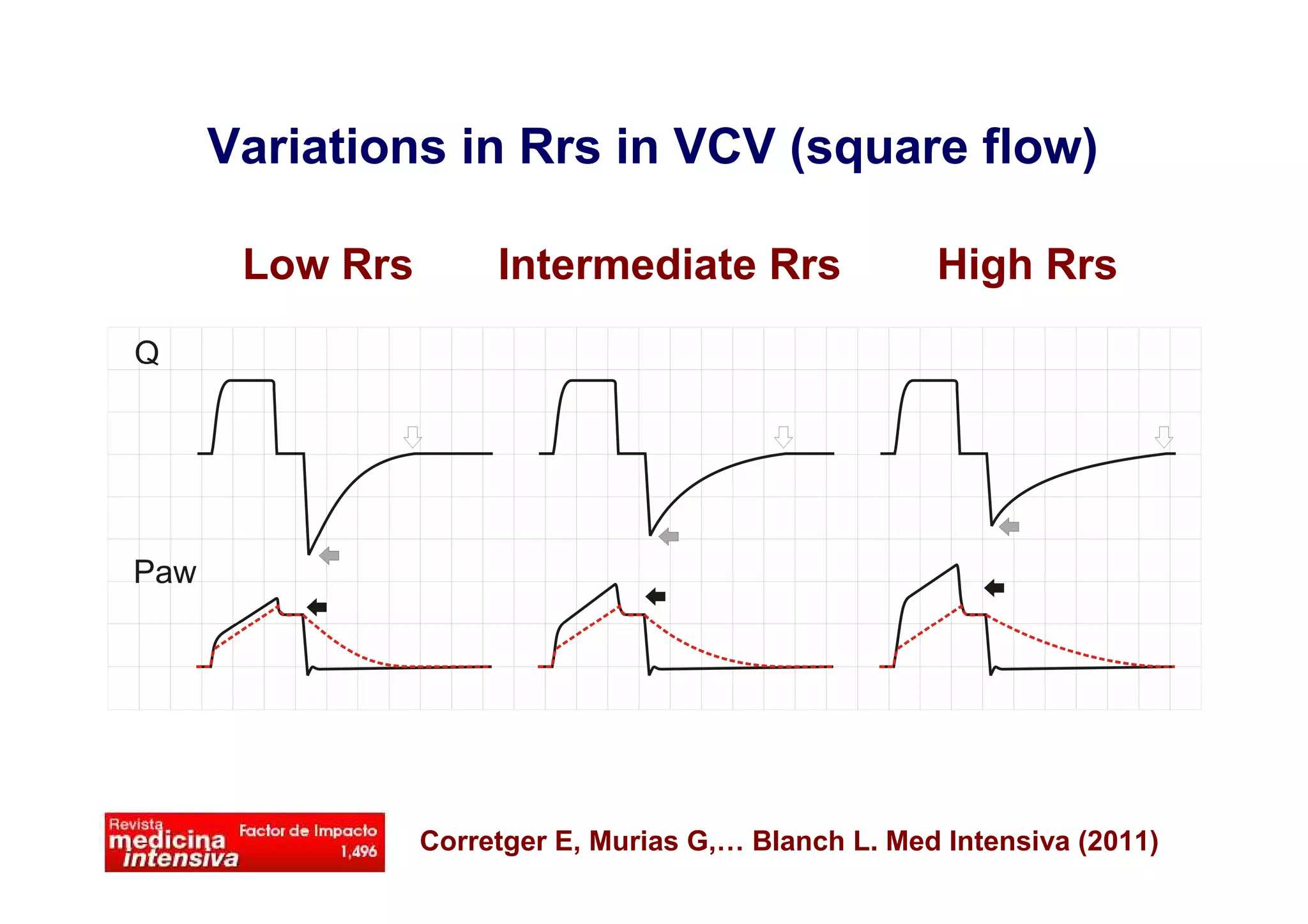
Variations in Rrs in VCV (square flow)
Low Rrs

Intermediate Rrs

High Rrs

Corretger E, Murias G,… Blanch L. Med Intensiva (2011)
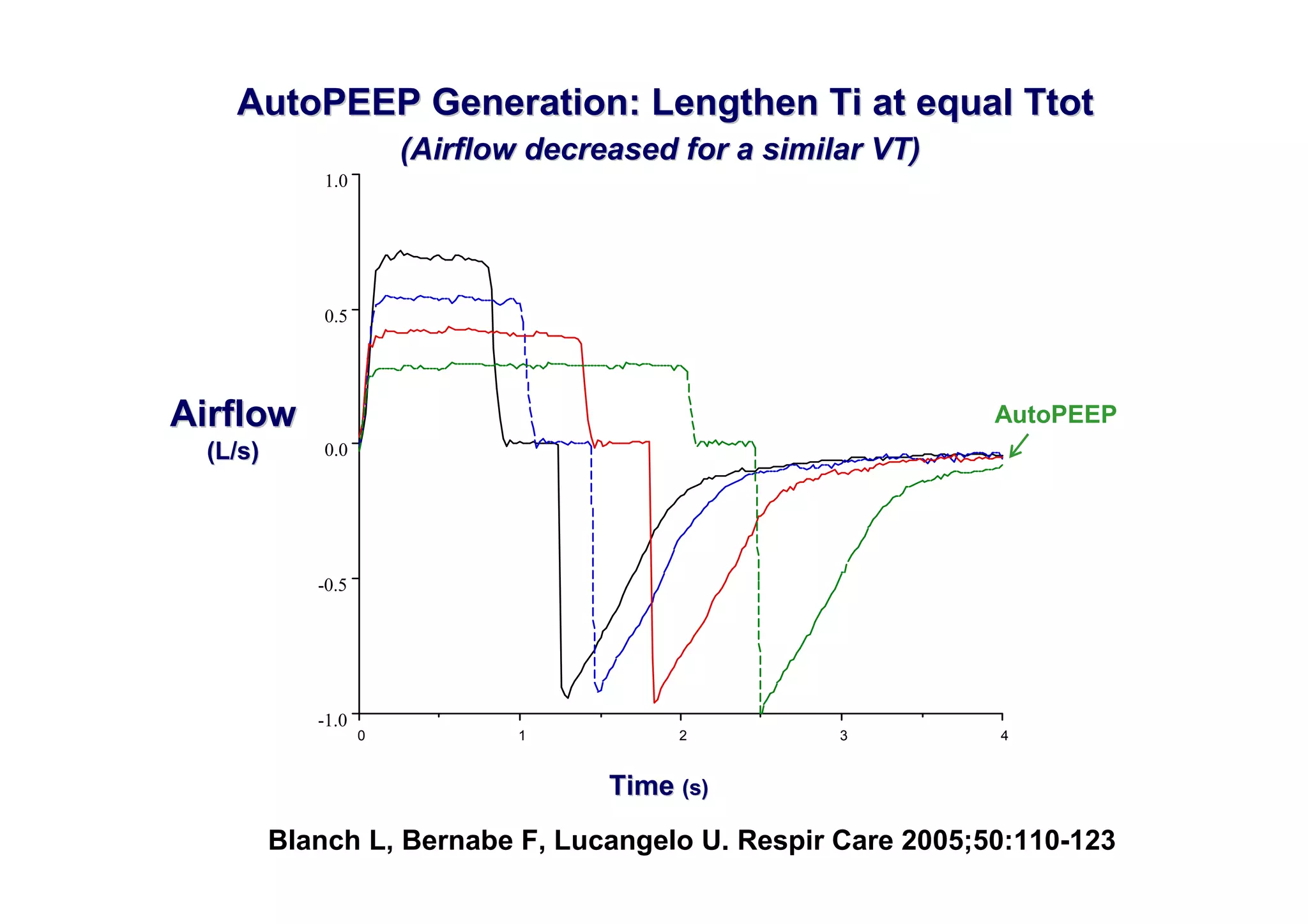
AutoPEEP Generation: Lengthen Ti at equal Ttot
(Airflow decreased for a similar VT)
1.0

0.5

Airflow
(L/s)

AutoPEEP
0.0

-0.5

-1.0

0

1

2

3

4

Time (s)
Blanch L, Bernabe F, Lucangelo U. Respir Care 2005;50:110-123
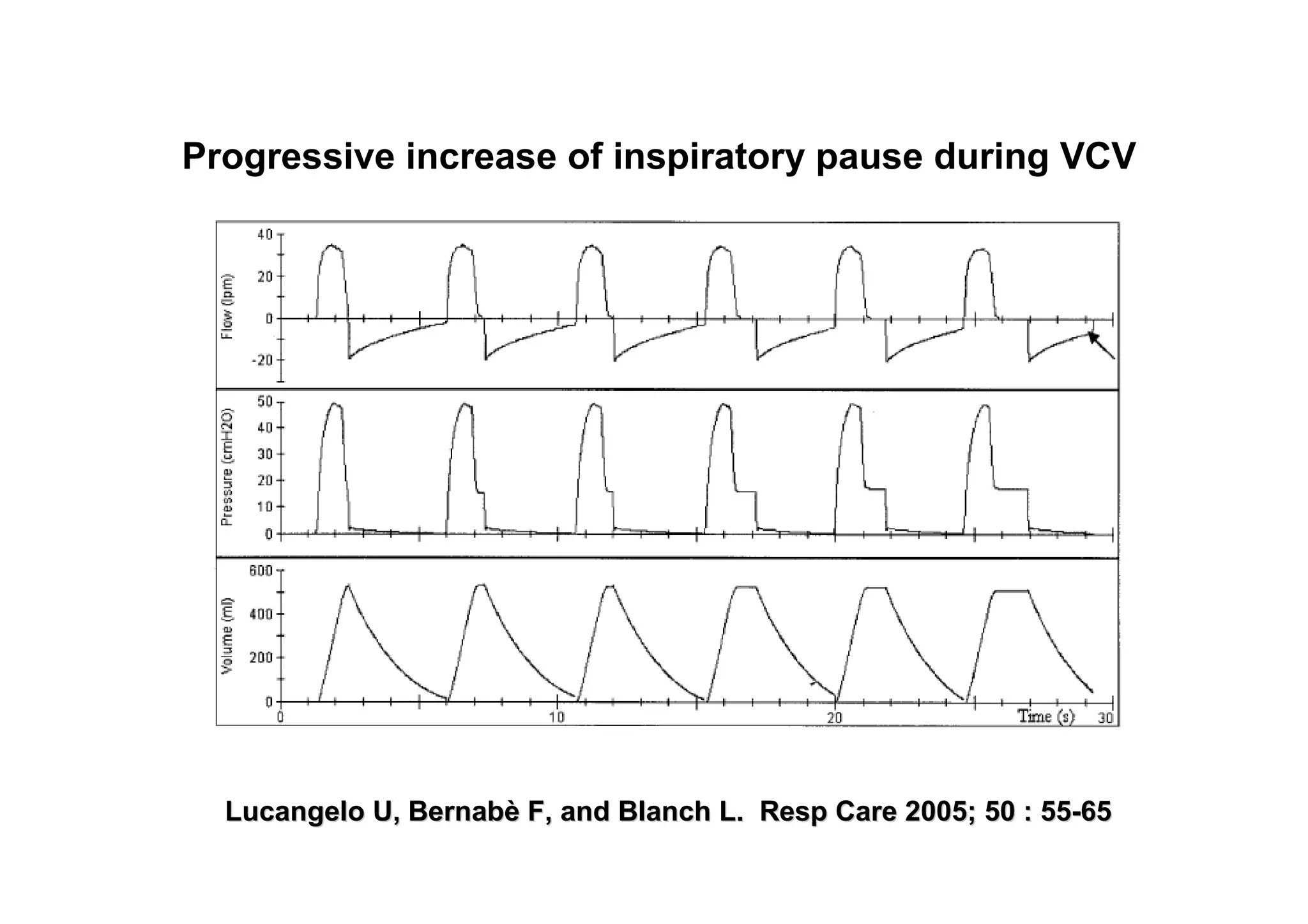
Progressive increase of inspiratory pause during VCV

Lucangelo U, Bernabè F, and Blanch L. Resp Care 2005; 50 : 55-65
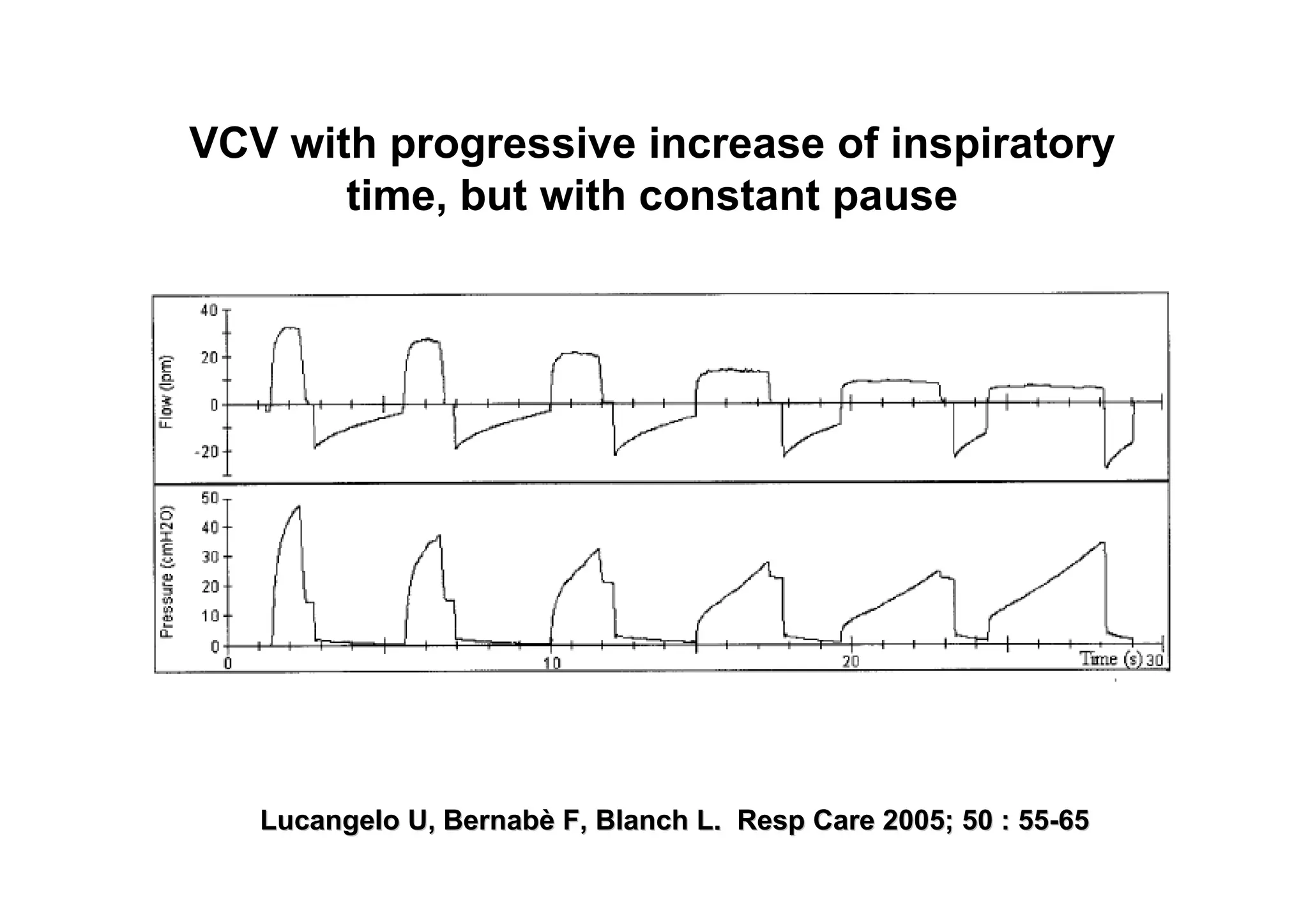
VCV with progressive increase of inspiratory
time, but with constant pause

Lucangelo U, Bernabè F, Blanch L. Resp Care 2005; 50 : 55-65
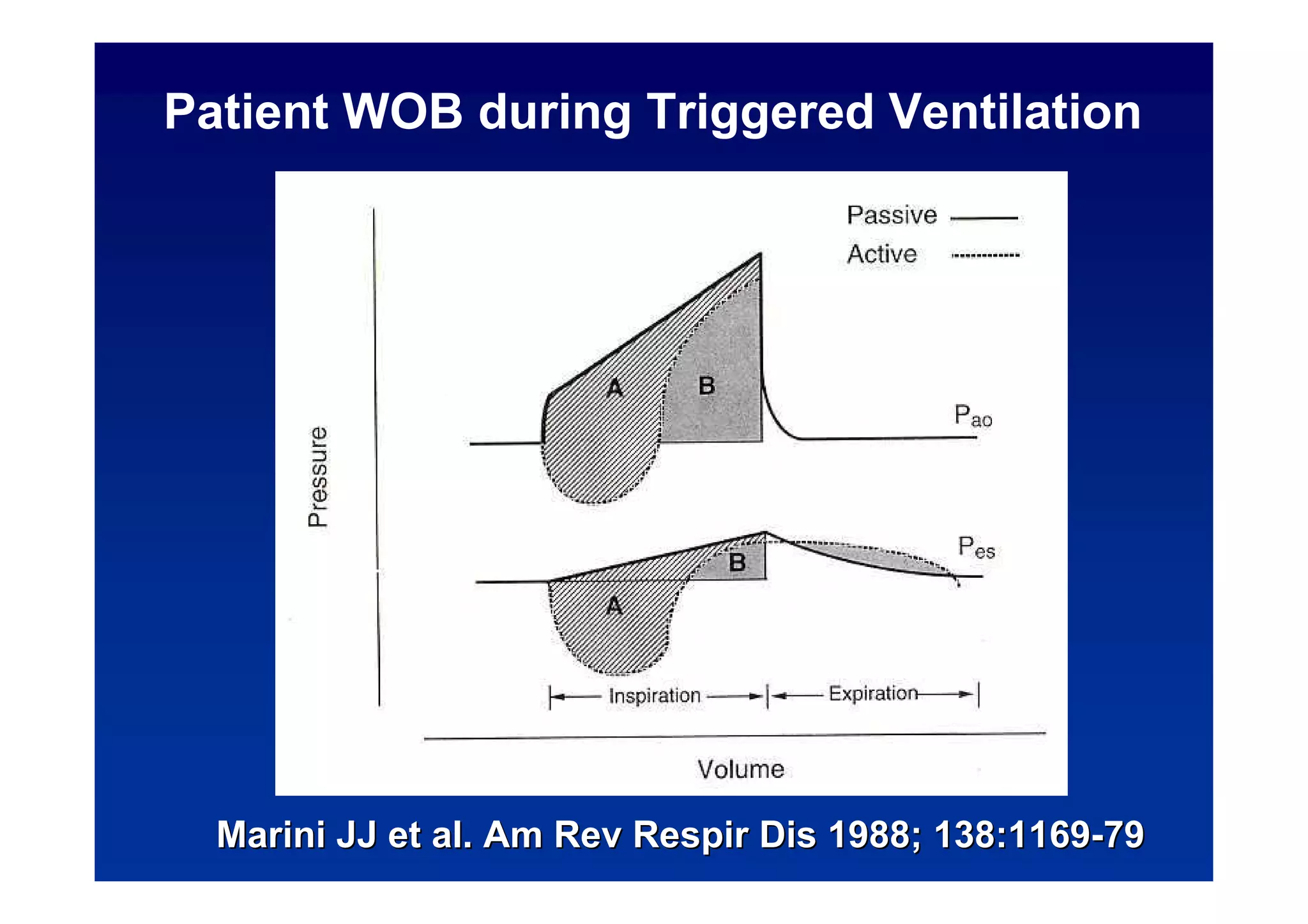
Patient WOB during Triggered Ventilation

Marini JJ et al. Am Rev Respir Dis 1988; 138:1169-79
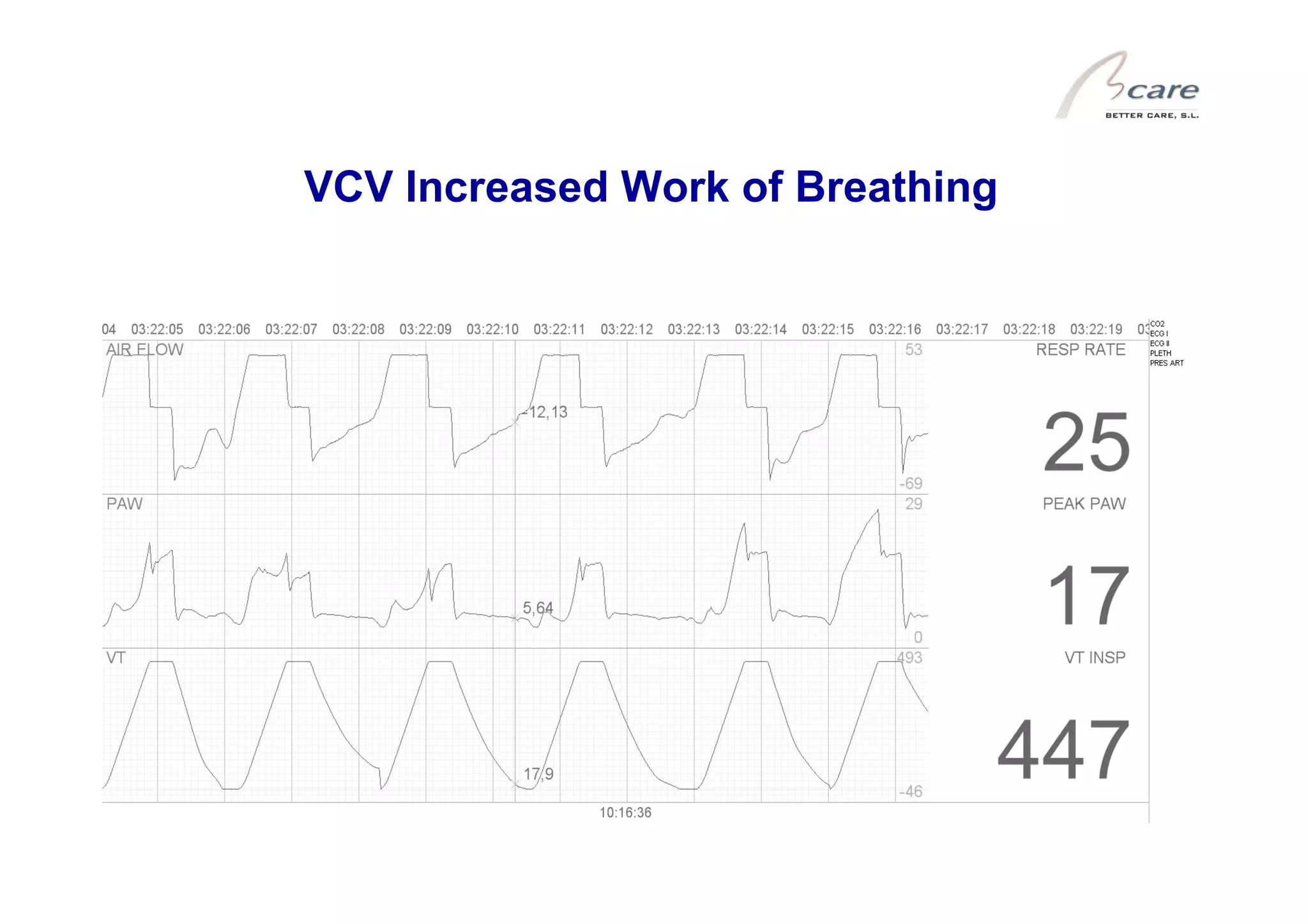
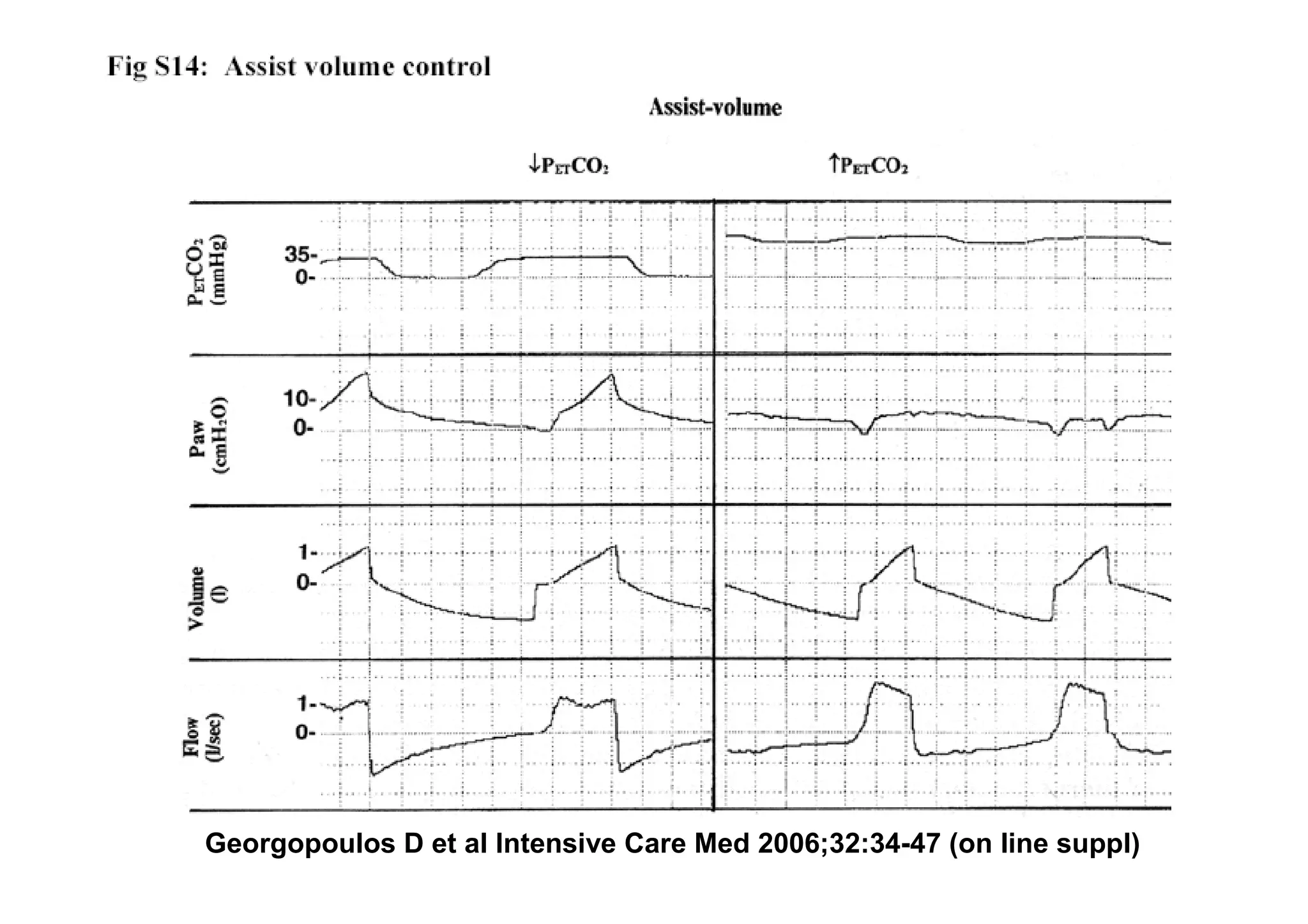
VCV Increased Work of Breathing
Georgopoulos D et al Intensive Care Med 2006;32:34-47 (on line suppl)
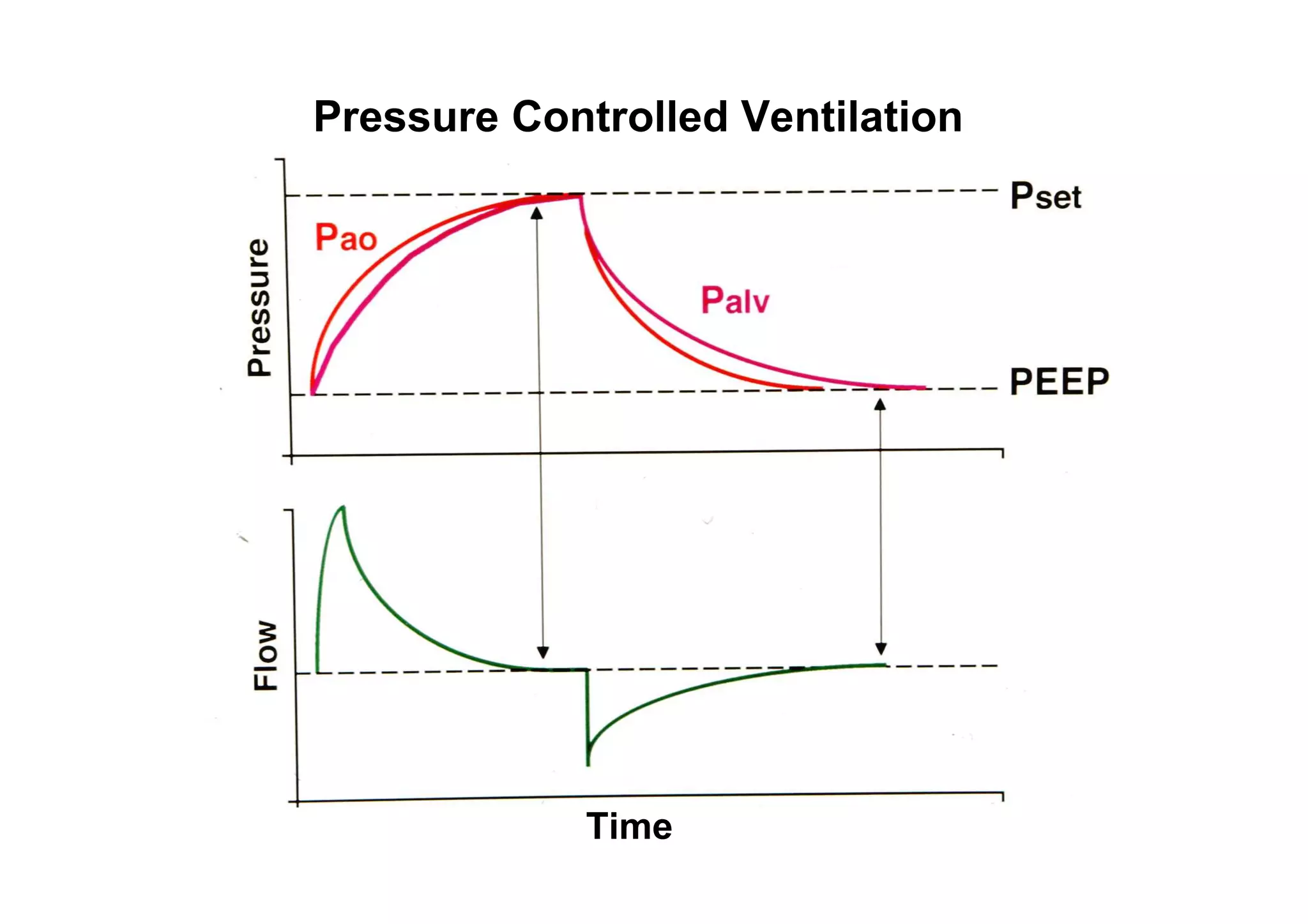
Pressure Controlled Ventilation

Time
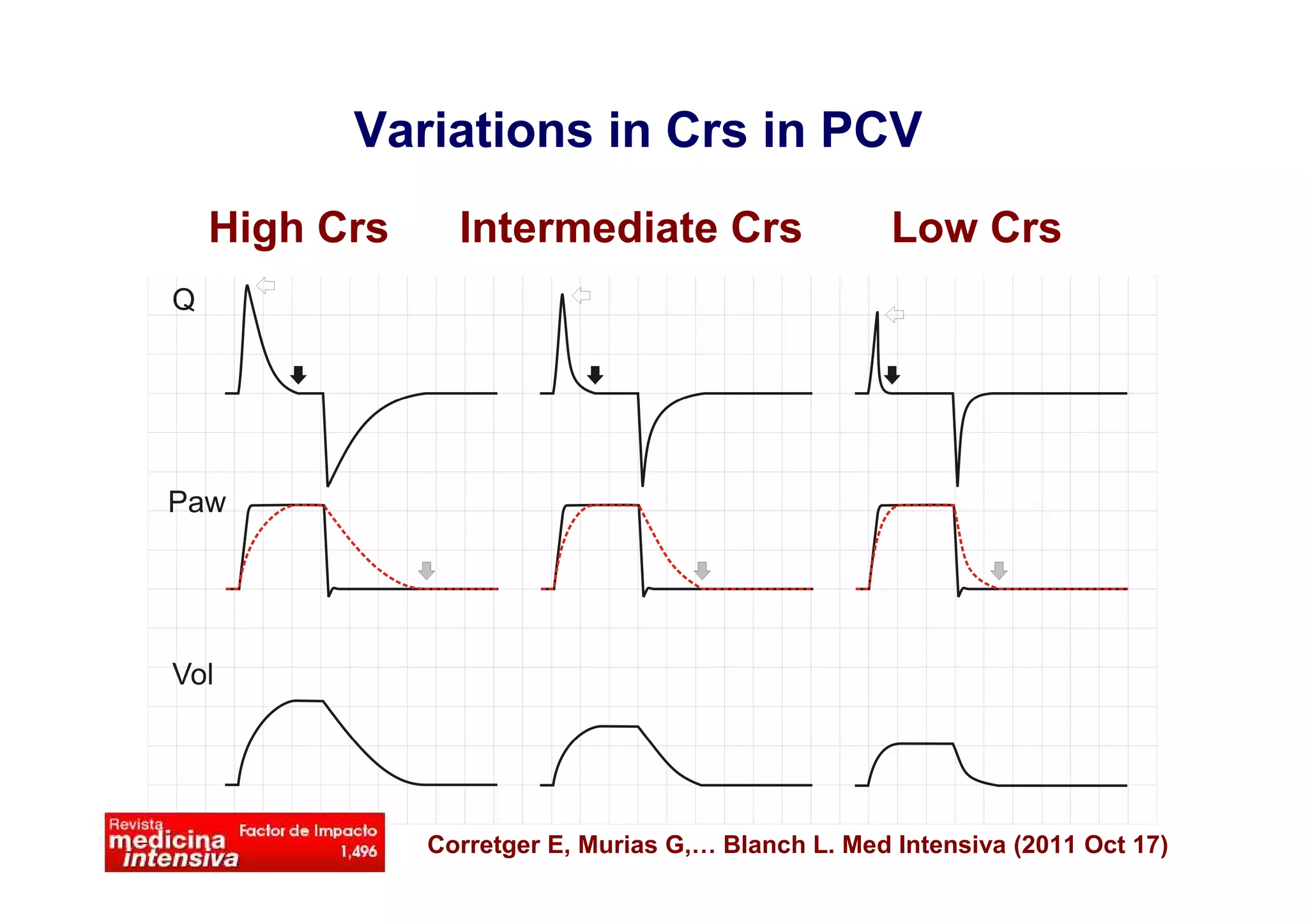
Variations in Crs in PCV
High Crs

Intermediate Crs

Low Crs

Corretger E, Murias G,… Blanch L. Med Intensiva (2011 Oct 17)
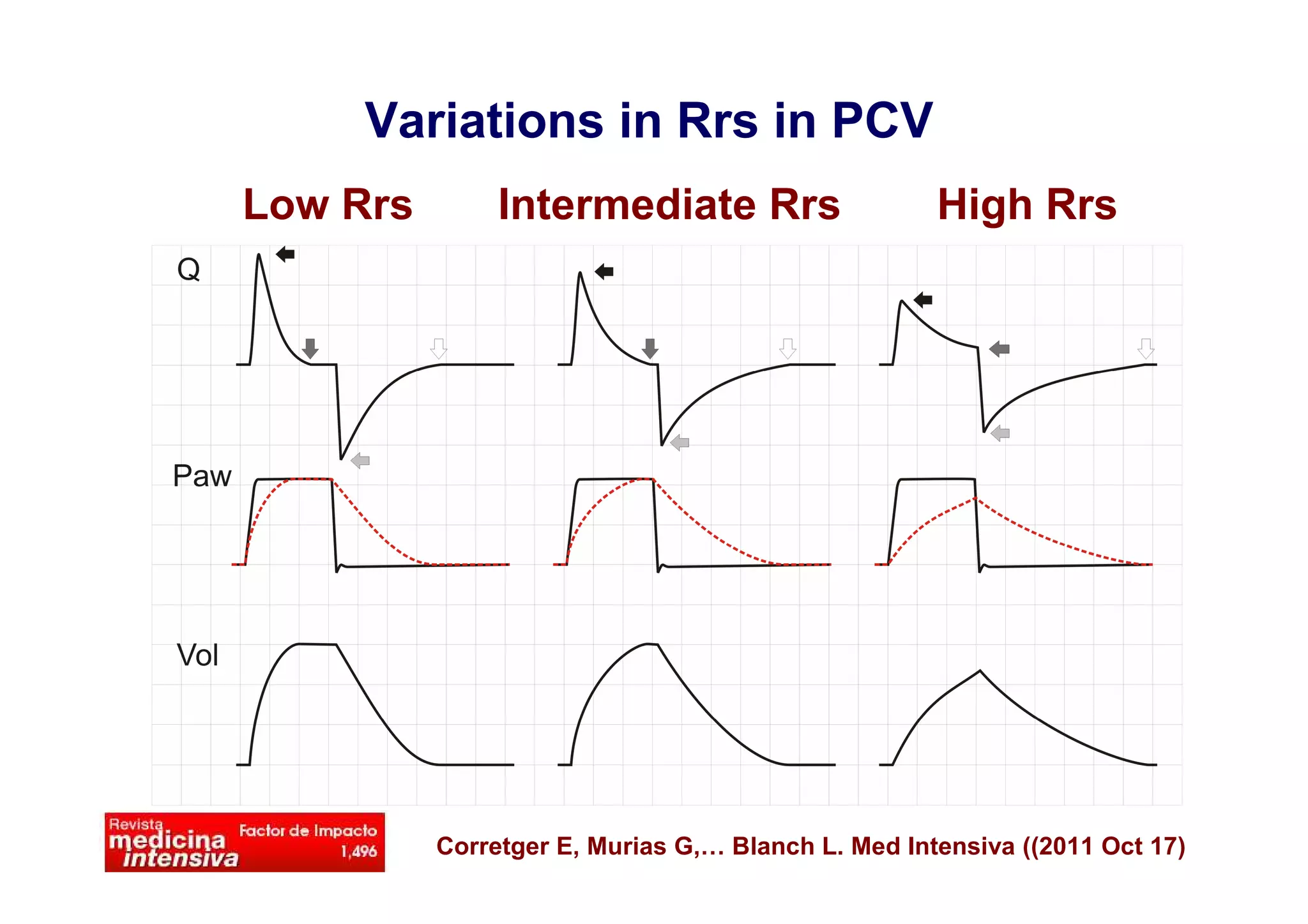
Variations in Rrs in PCV
Low Rrs

Intermediate Rrs

High Rrs

Corretger E, Murias G,… Blanch L. Med Intensiva ((2011 Oct 17)
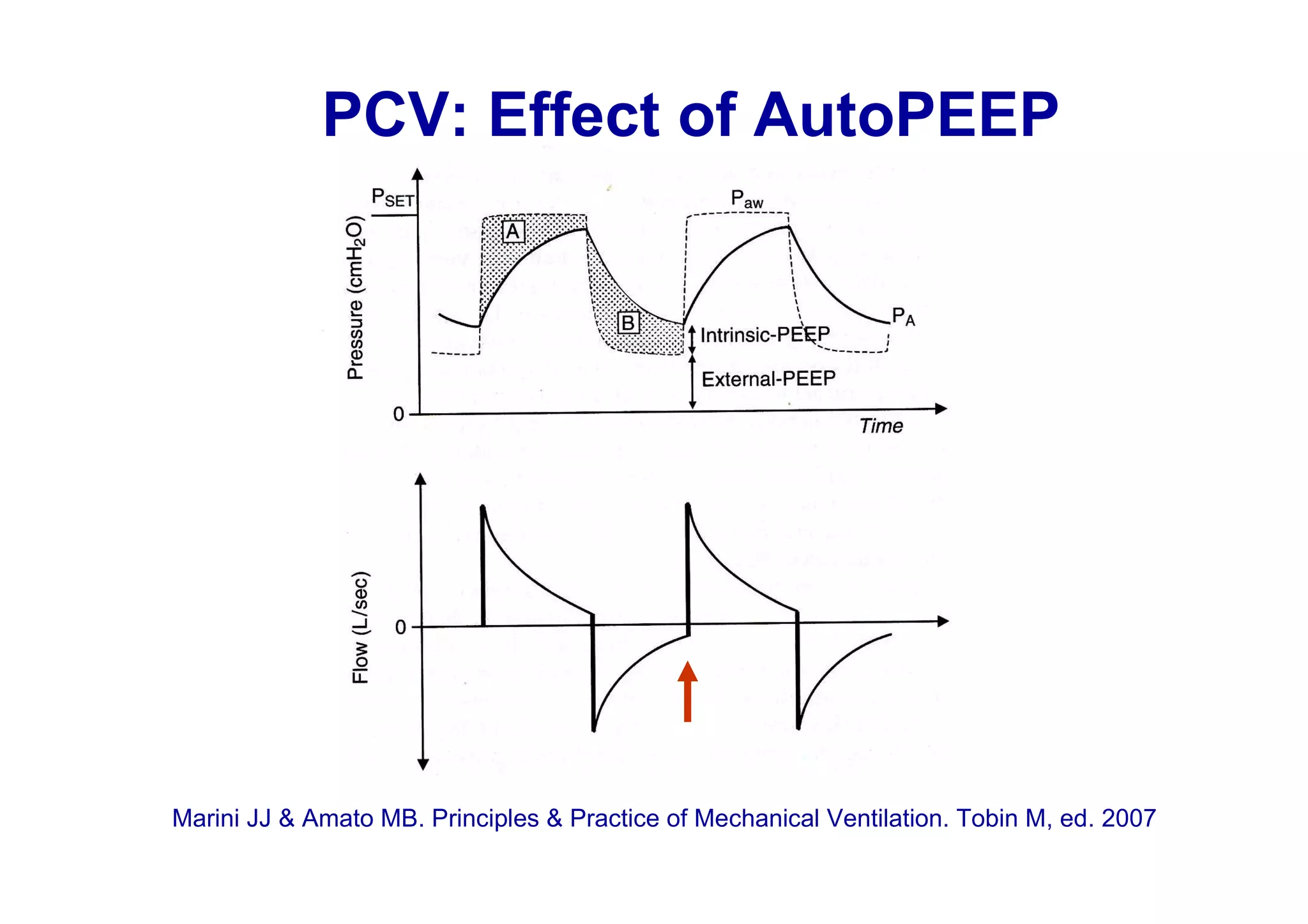
PCV: Effect of AutoPEEP

Marini JJ & Amato MB. Principles & Practice of Mechanical Ventilation. Tobin M, ed. 2007
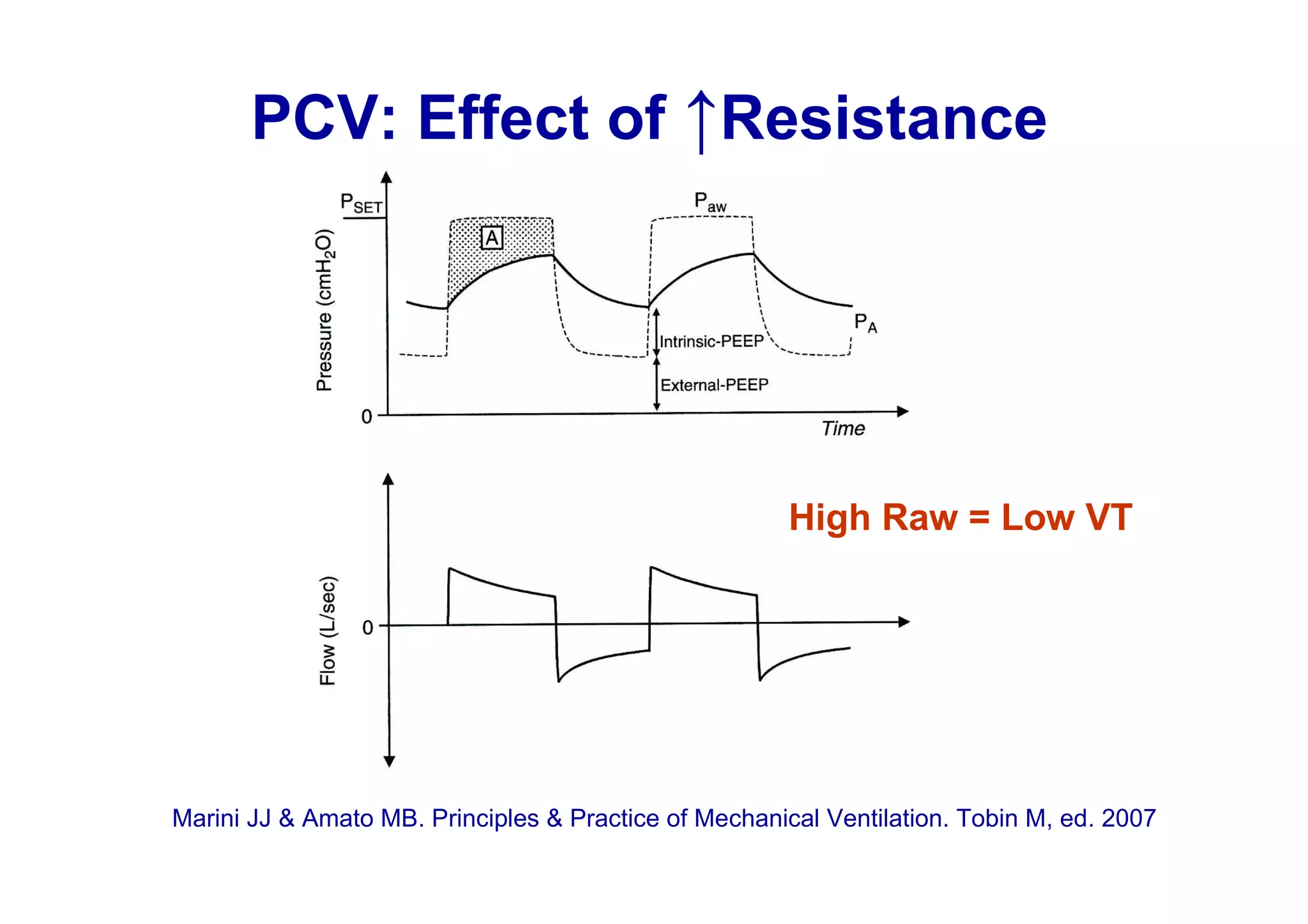
PCV: Effect of ↑Resistance

High Raw = Low VT

Marini JJ & Amato MB. Principles & Practice of Mechanical Ventilation. Tobin M, ed. 2007
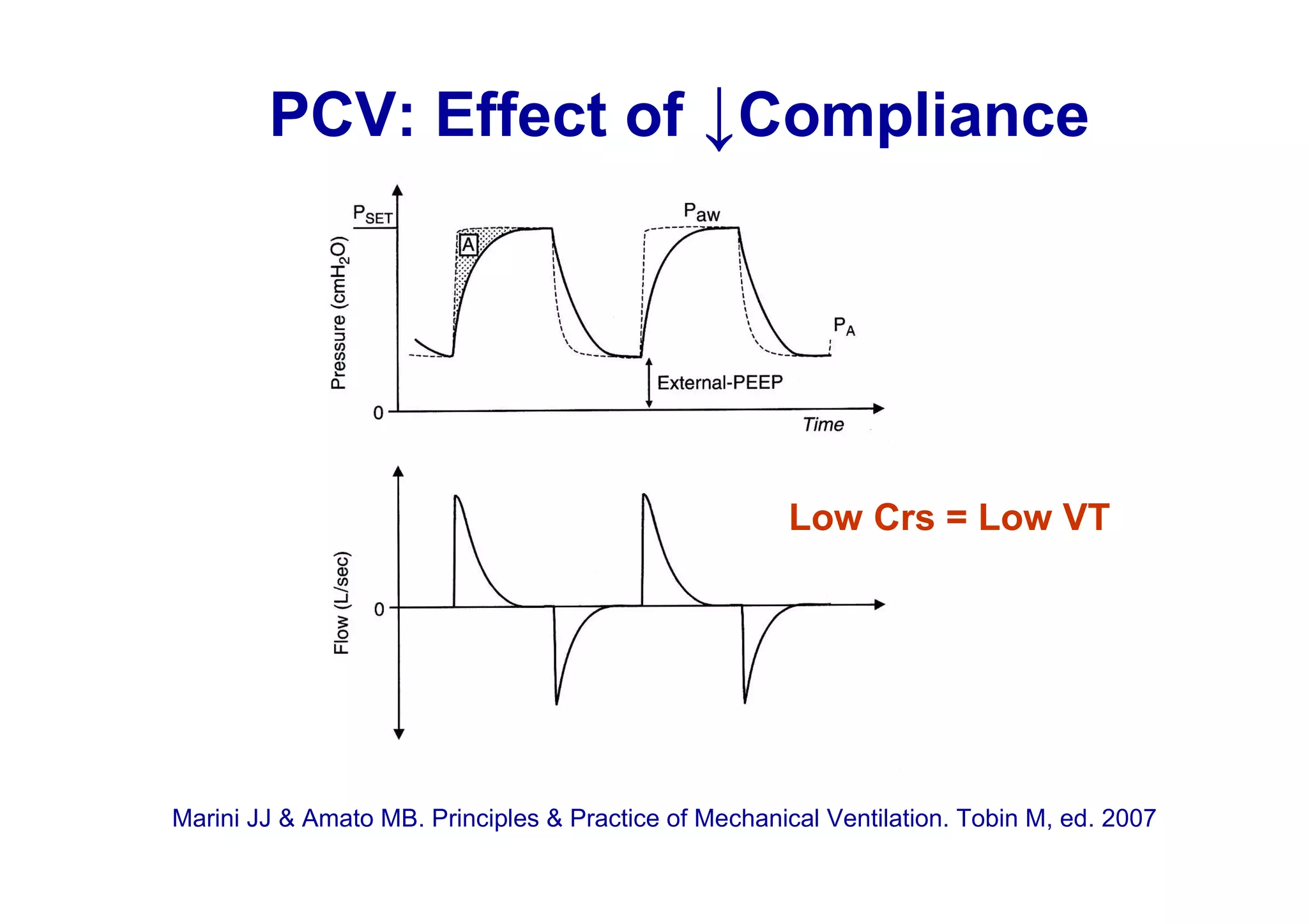
PCV: Effect of ↓Compliance

Low Crs = Low VT

Marini JJ & Amato MB. Principles & Practice of Mechanical Ventilation. Tobin M, ed. 2007
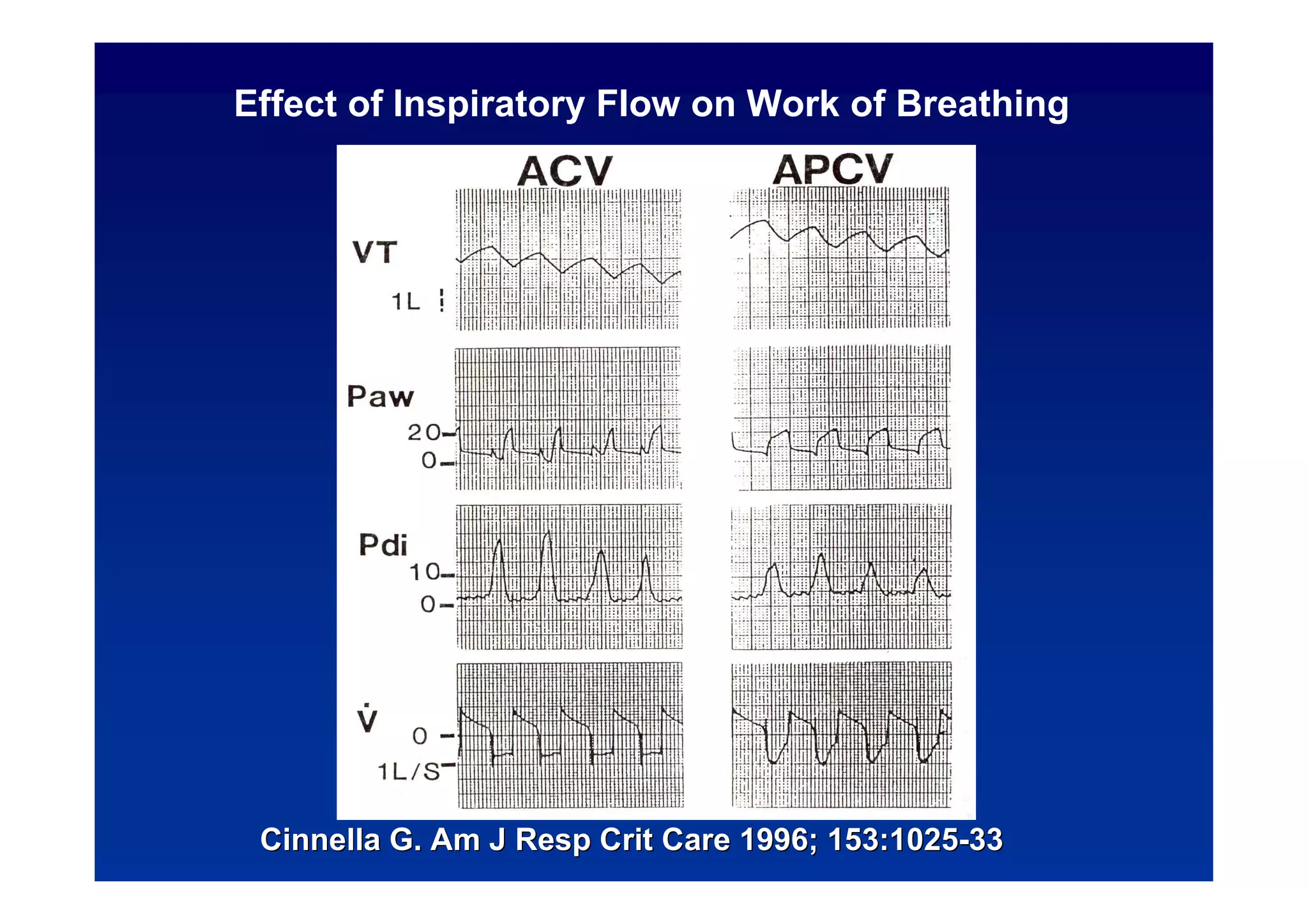
Effect of Inspiratory Flow on Work of Breathing

Cinnella G. Am J Resp Crit Care 1996; 153:1025-33
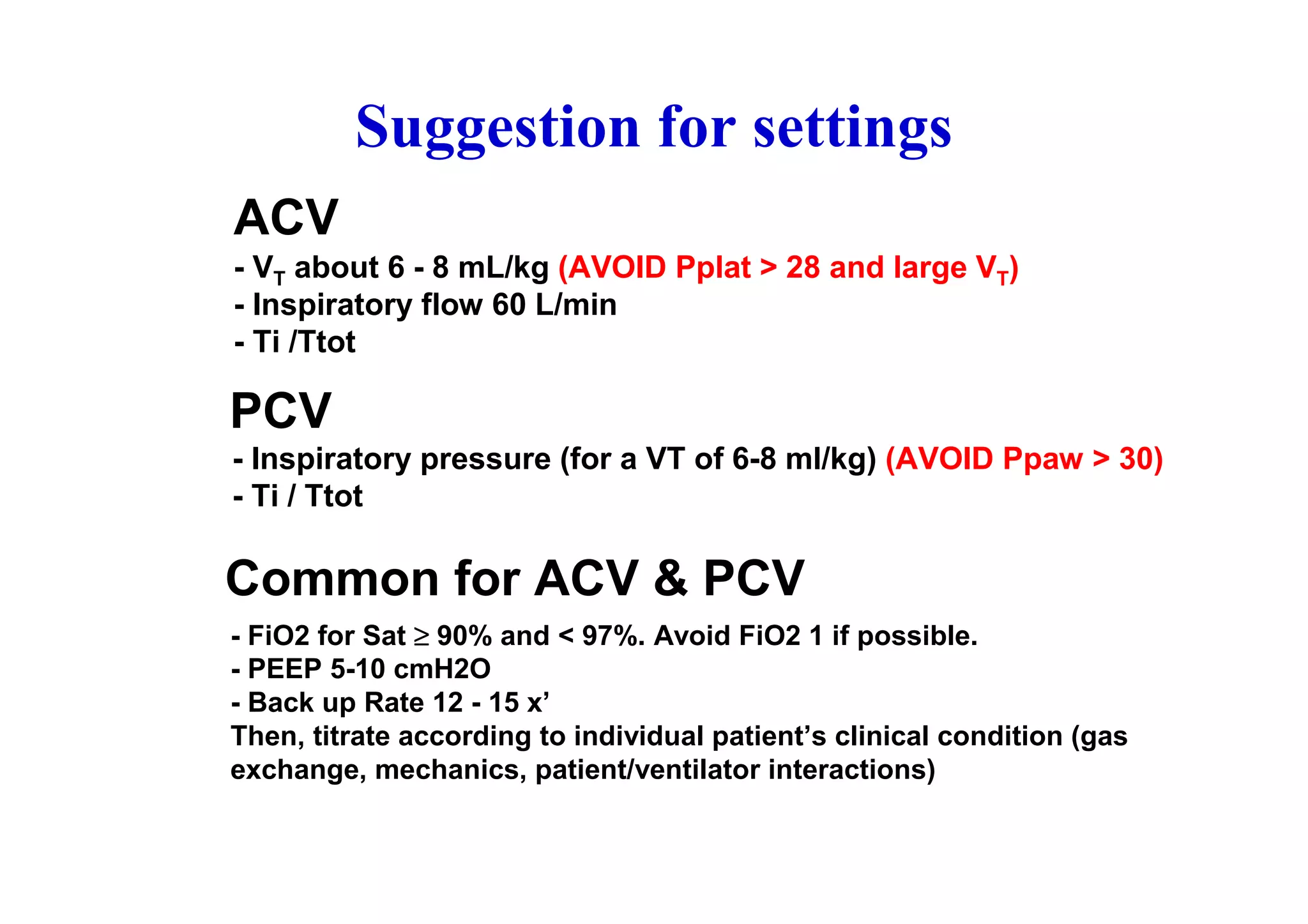
Suggestion for settings
ACV
- VT about 6 - 8 mL/kg (AVOID Pplat > 28 and large VT)
- Inspiratory flow 60 L/min
- Ti /Ttot

PCV
- Inspiratory pressure (for a VT of 6-8 ml/kg) (AVOID Ppaw > 30)
- Ti / Ttot

Common for ACV & PCV
- FiO2 for Sat ≥ 90% and < 97%. Avoid FiO2 1 if possible.
- PEEP 5-10 cmH2O
- Back up Rate 12 - 15 x’
Then, titrate according to individual patient’s clinical condition (gas
exchange, mechanics, patient/ventilator interactions)
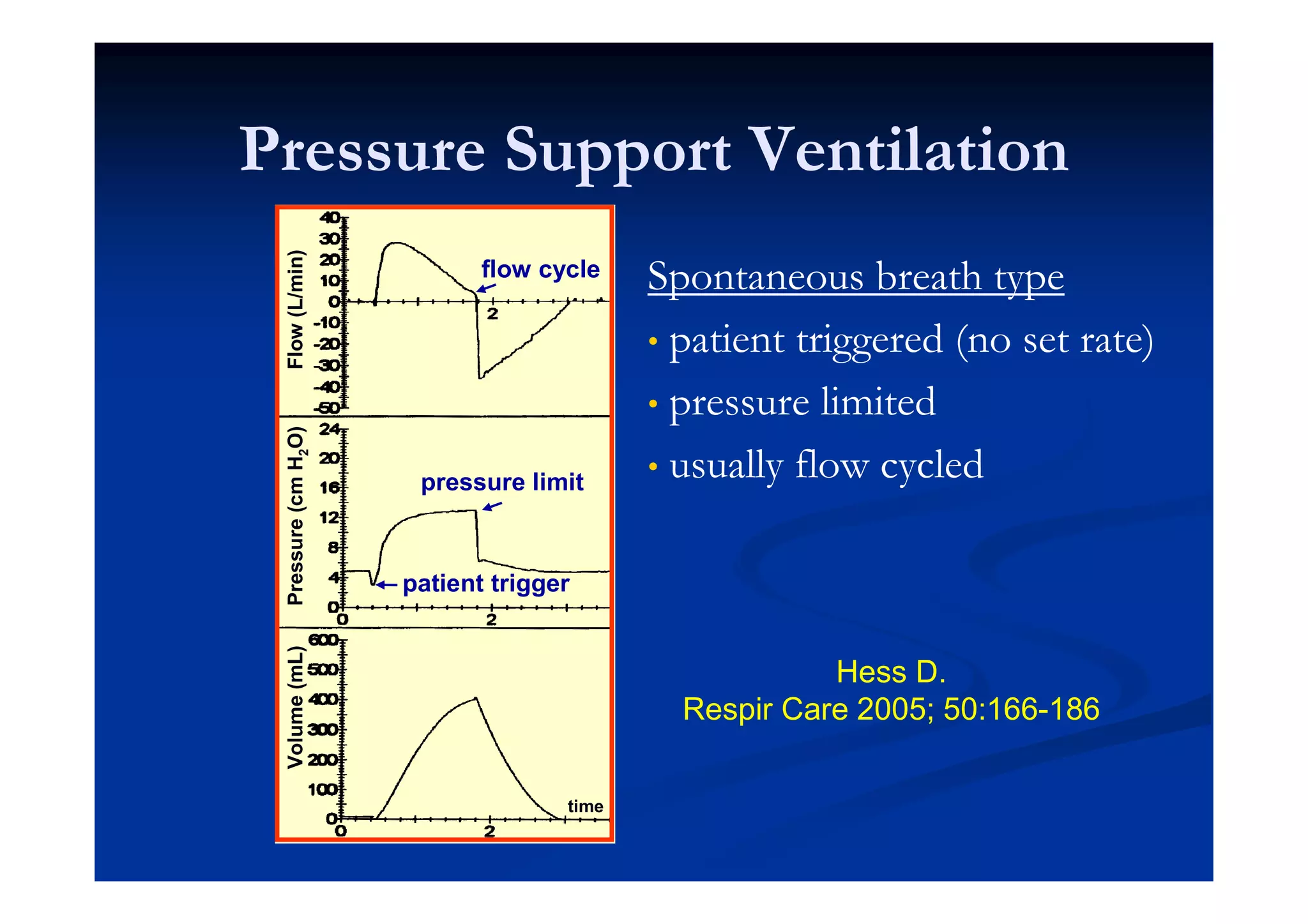
flow cycle

pressure limit

Spontaneous breath type
• patient triggered (no set rate)
• pressure limited
• usually flow cycled

patient trigger

Volume (mL)

Pressure (cm H2O)

Flow (L/min)

Pressure Support Ventilation

Hess D.
Respir Care 2005; 50:166-186
time
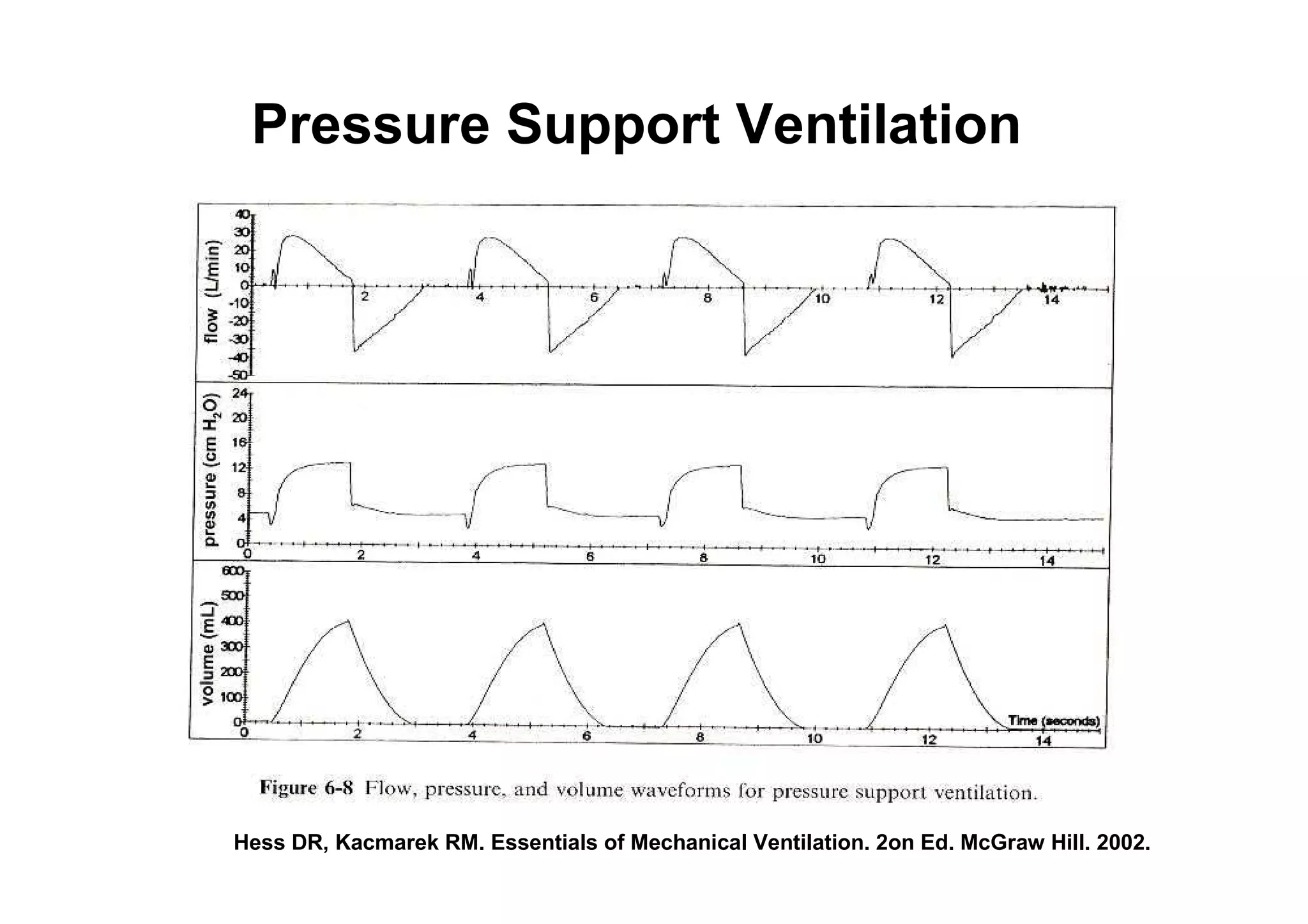
Pressure Support Ventilation

Hess DR, Kacmarek RM. Essentials of Mechanical Ventilation. 2on Ed. McGraw Hill. 2002.
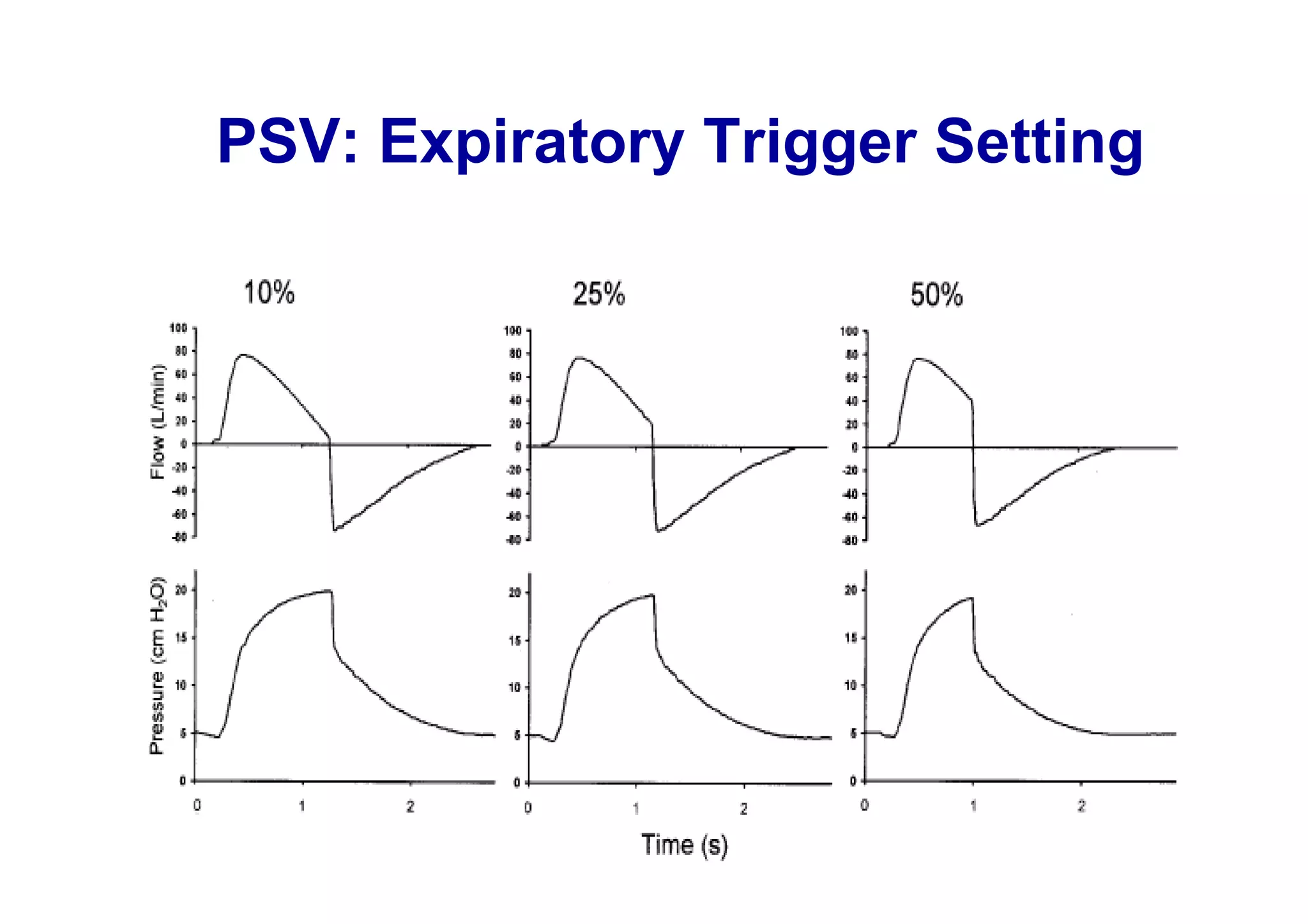
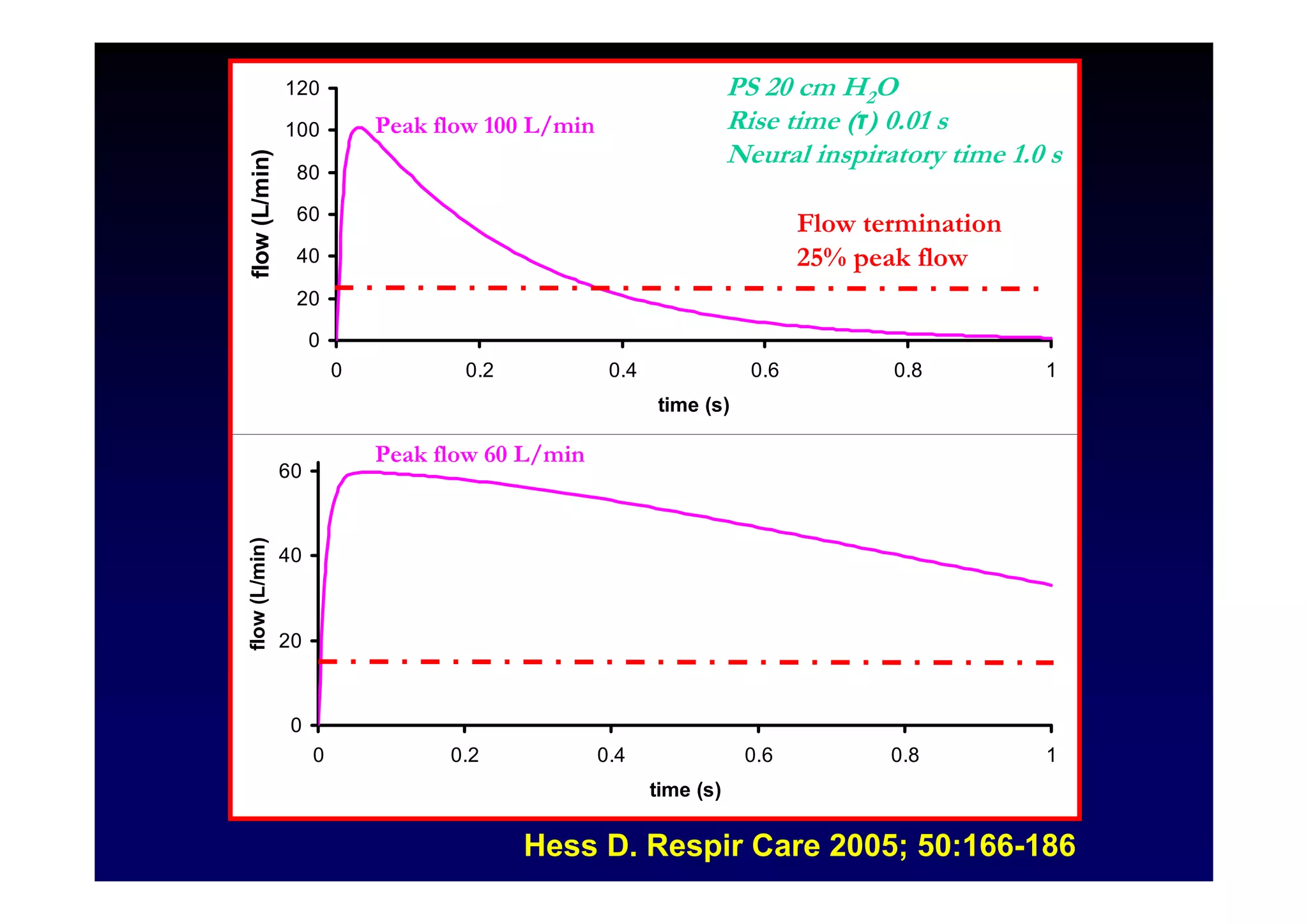
PSV: Expiratory Trigger Setting
PS 20 cm H2O
Rise time (τ) 0.01 s
Neural inspiratory time 1.0 s

120

Peak flow 100 L/min

flow (L/min)

100
80
60

Flow termination
25% peak flow

40
20

R 10 cm H2O/L/s, C 0.02 L/cm H2O

0
0

0.2

0.4

0.6

0.8

1

time (s)

Peak flow 60 L/min

flow (L/min)

60

40

R 20 cm H2O/L/s, C 0.05 L/cm H2O
20

0
0

0.2

0.4

0.6

0.8

1

time (s)

Hess D. Respir Care 2005; 50:166-186
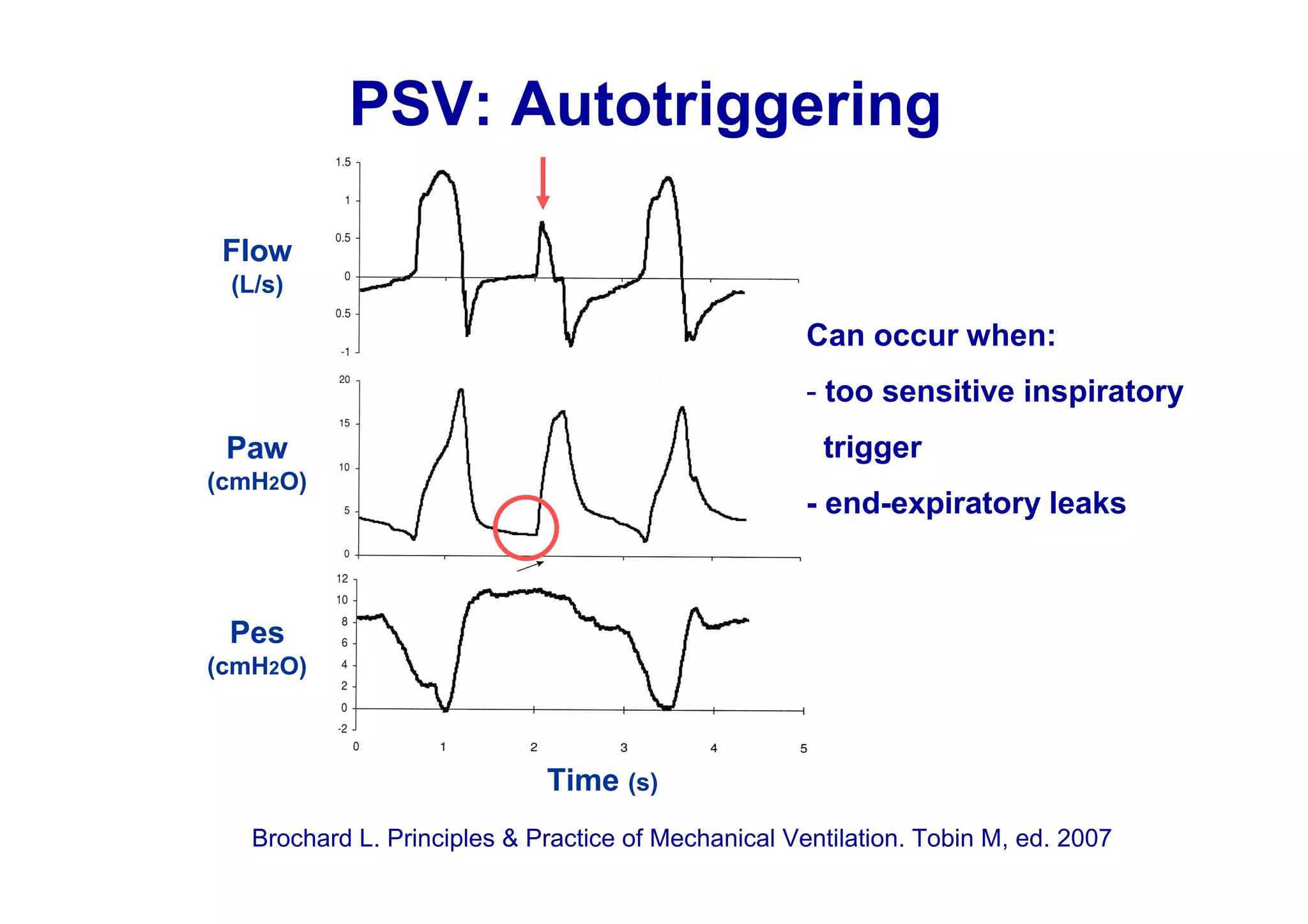
PSV: Autotriggering
Flow
(L/s)

Can occur when:
- too sensitive inspiratory
trigger

Paw
(cmH2O)

- end-expiratory leaks

Pes
(cmH2O)

Time (s)
Brochard L. Principles & Practice of Mechanical Ventilation. Tobin M, ed. 2007
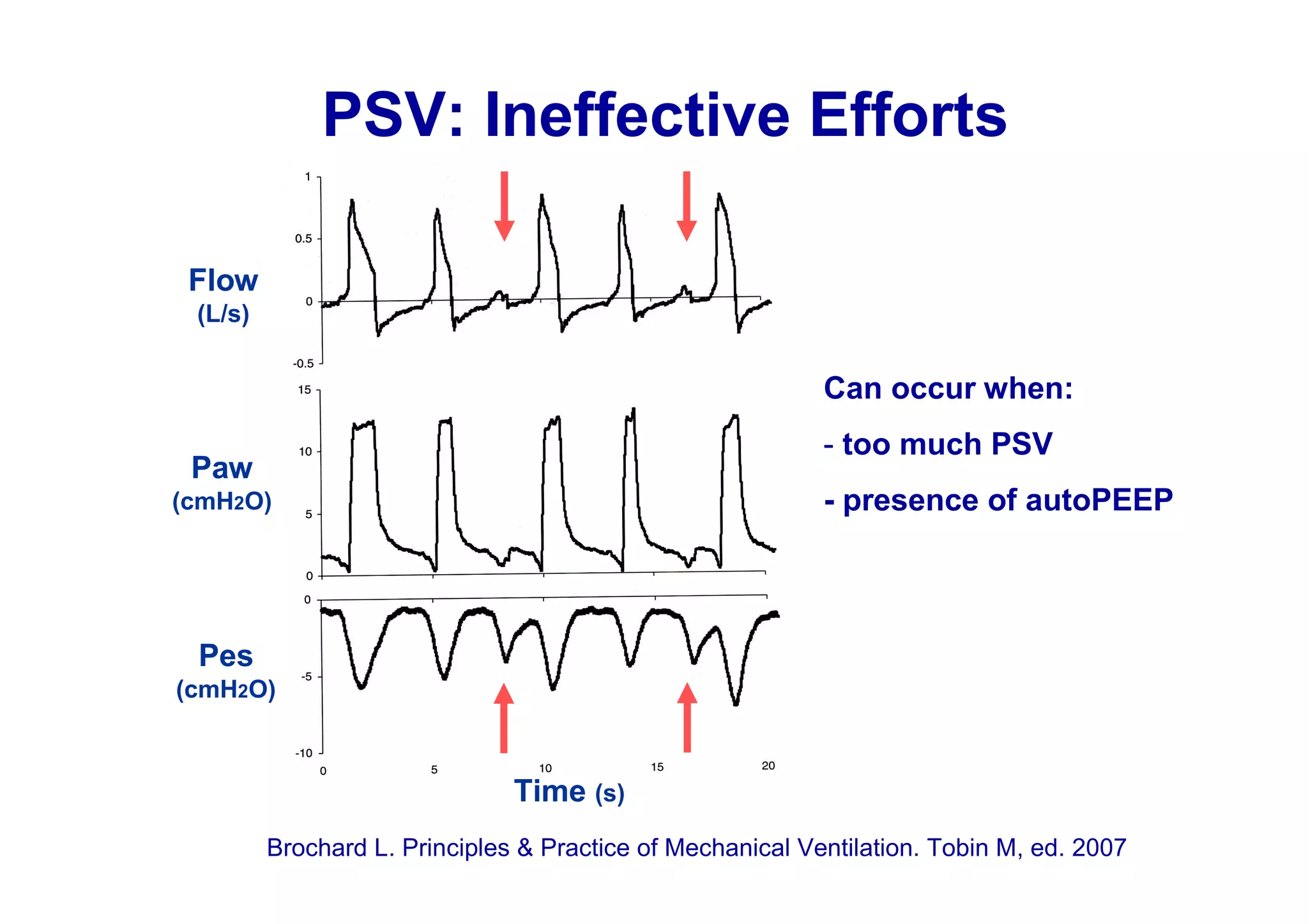
PSV: Ineffective Efforts
Flow
(L/s)

Can occur when:
- too much PSV

Paw

- presence of autoPEEP

(cmH2O)

Pes
(cmH2O)

Time (s)
Brochard L. Principles & Practice of Mechanical Ventilation. Tobin M, ed. 2007
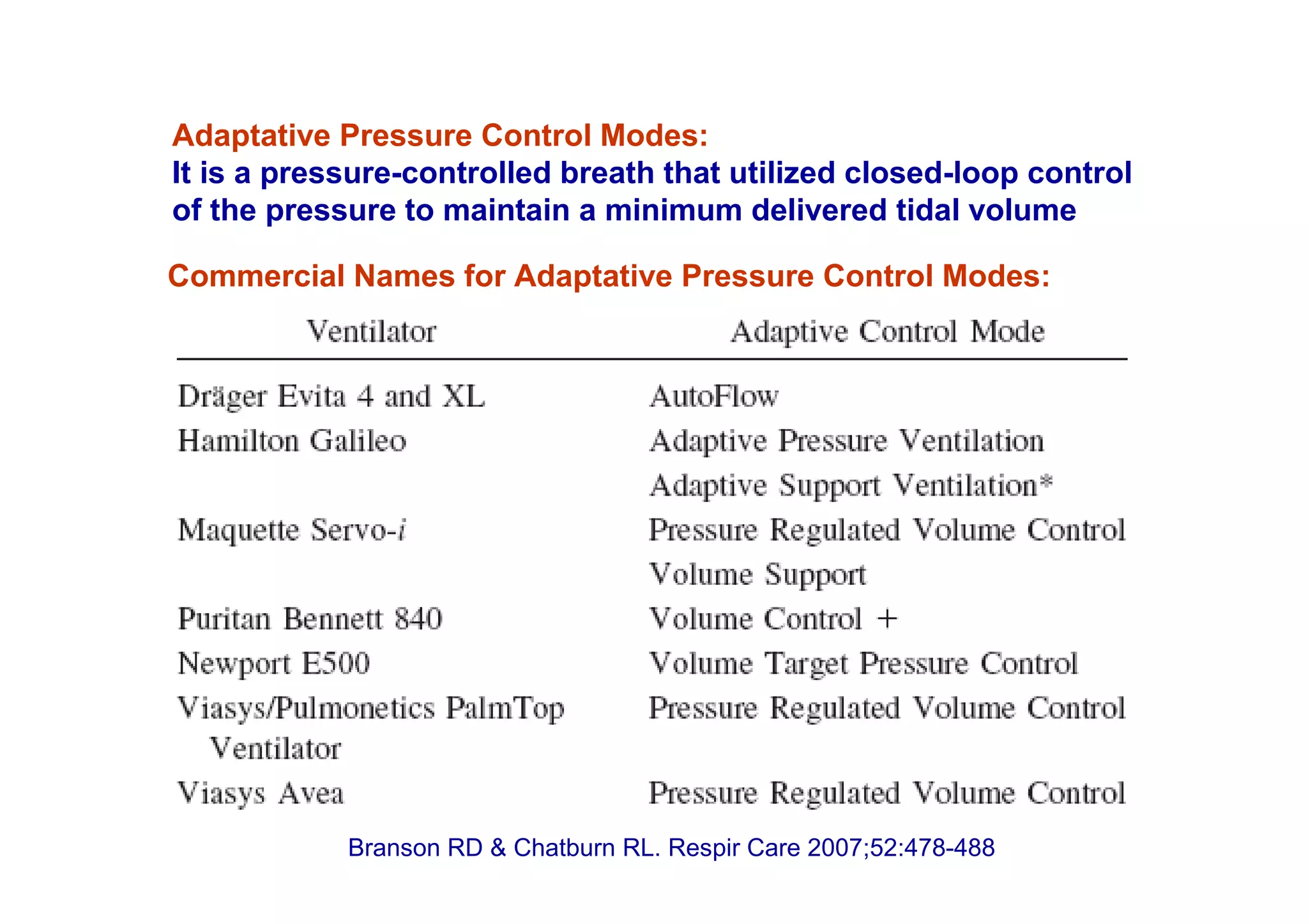
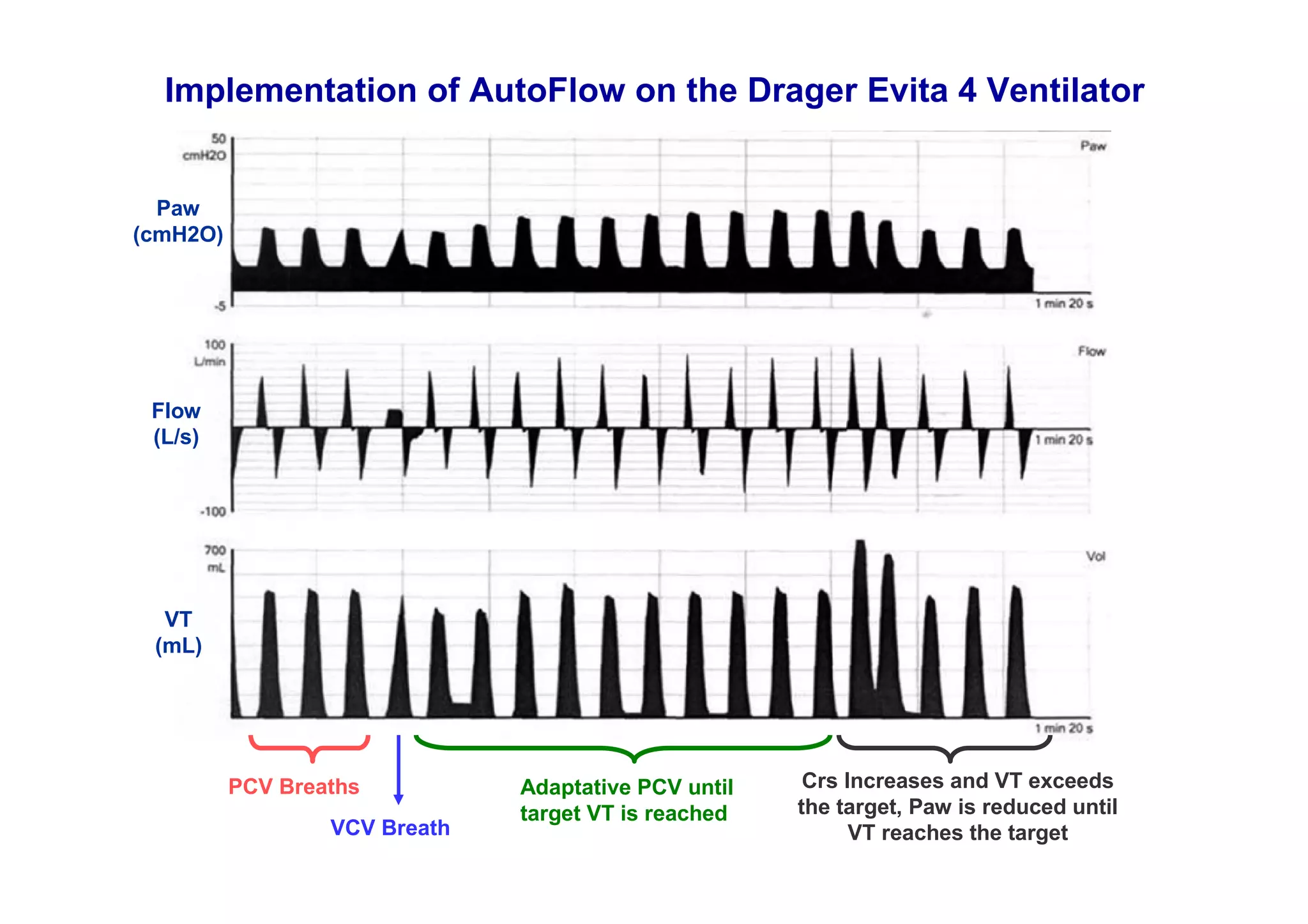
Adaptative Pressure Control Modes:
It is a pressure-controlled breath that utilized closed-loop control
of the pressure to maintain a minimum delivered tidal volume
Commercial Names for Adaptative Pressure Control Modes:

Branson RD & Chatburn RL. Respir Care 2007;52:478-488
Implementation of AutoFlow on the Drager Evita 4 Ventilator

Paw
(cmH2O)

Flow
(L/s)

VT
(mL)

PCV Breaths
VCV Breath

Adaptative PCV until
target VT is reached

Crs Increases and VT exceeds
the target, Paw is reduced until
VT reaches the target
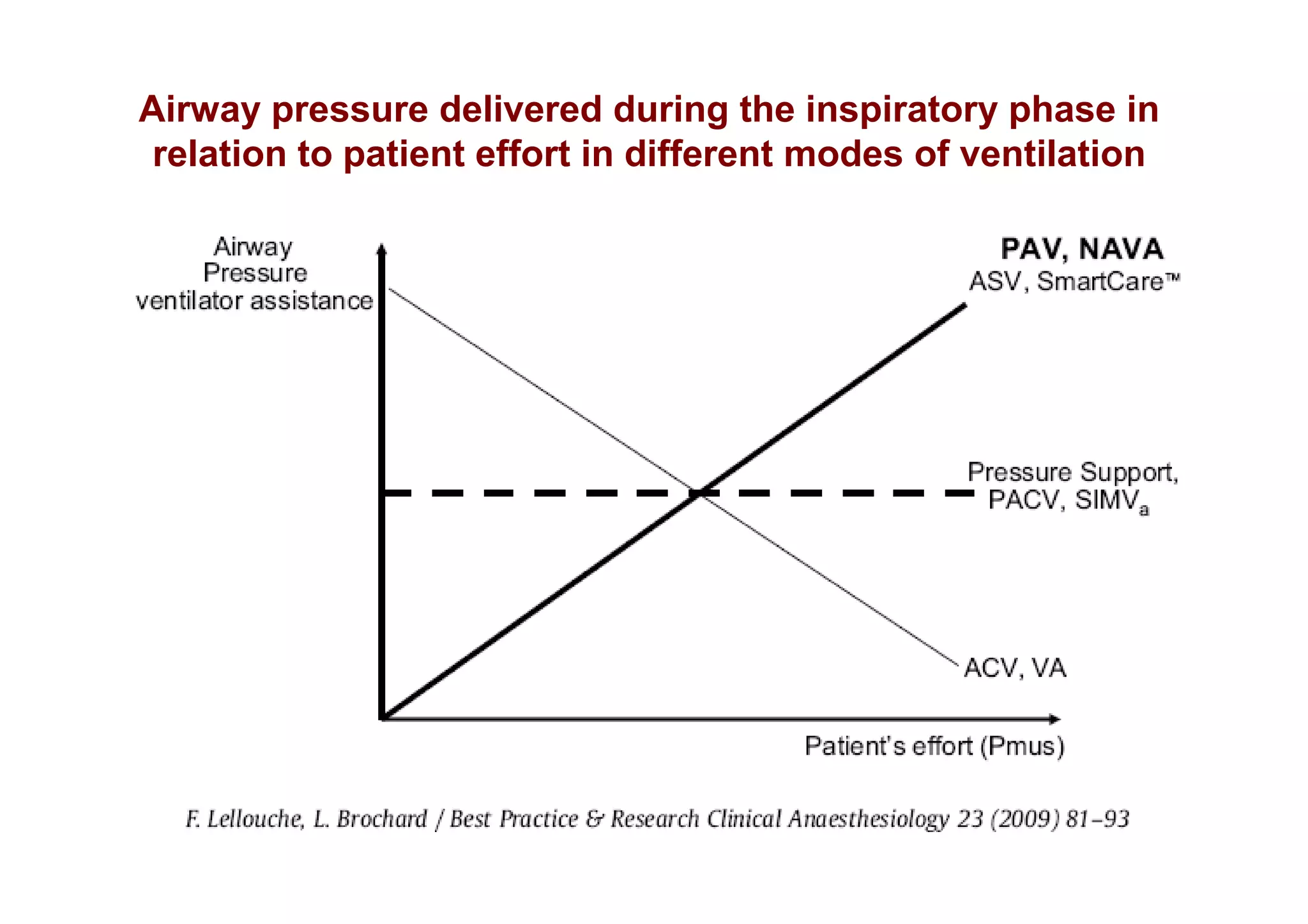
Airway pressure delivered during the inspiratory phase in
relation to patient effort in different modes of ventilation
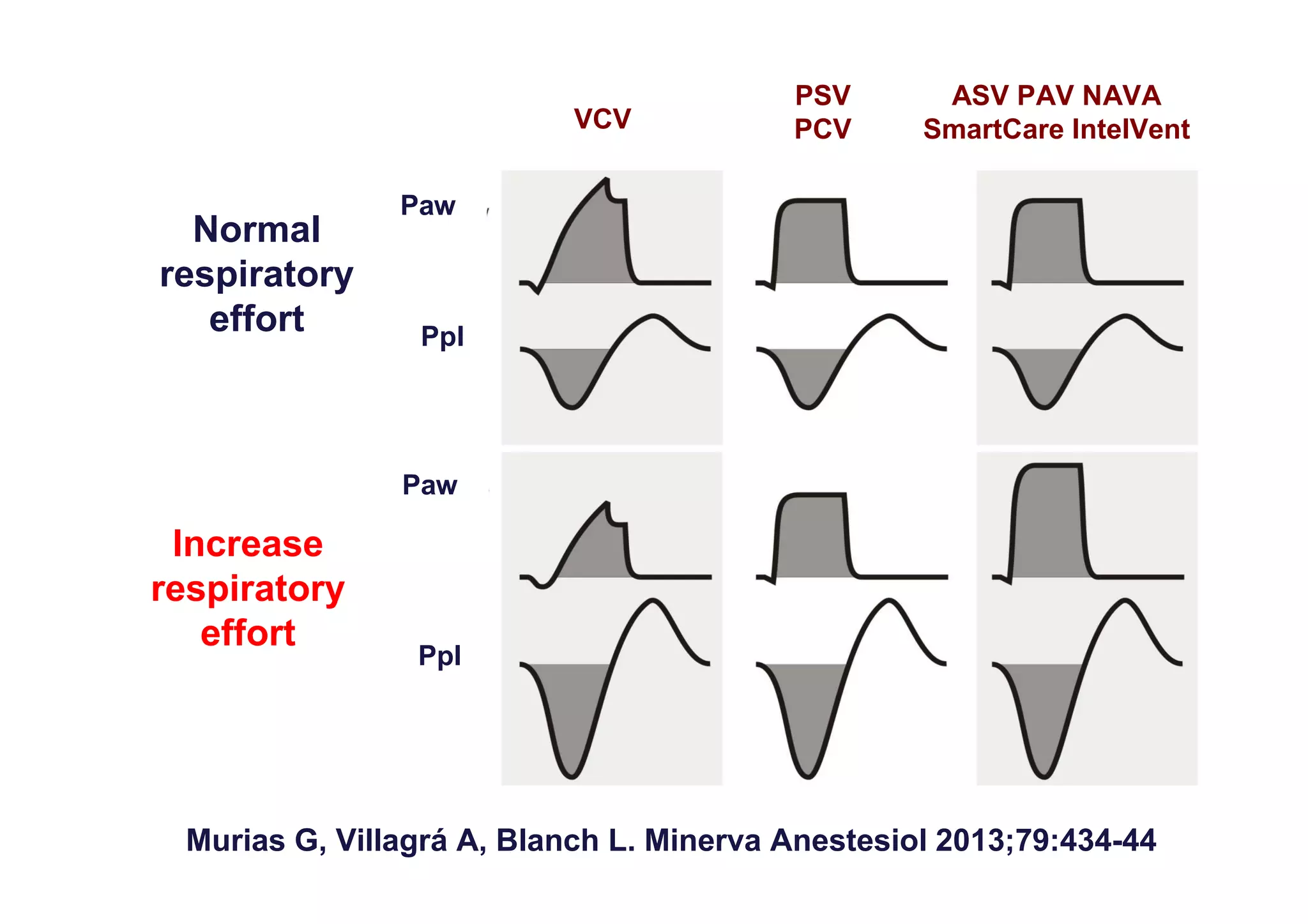
VCV

Normal
respiratory
effort

PSV
PCV

ASV PAV NAVA
SmartCare IntelVent

Paw

Ppl

Paw

Increase
respiratory
effort

Ppl

Murias G, Villagrá A, Blanch L. Minerva Anestesiol 2013;79:434-44
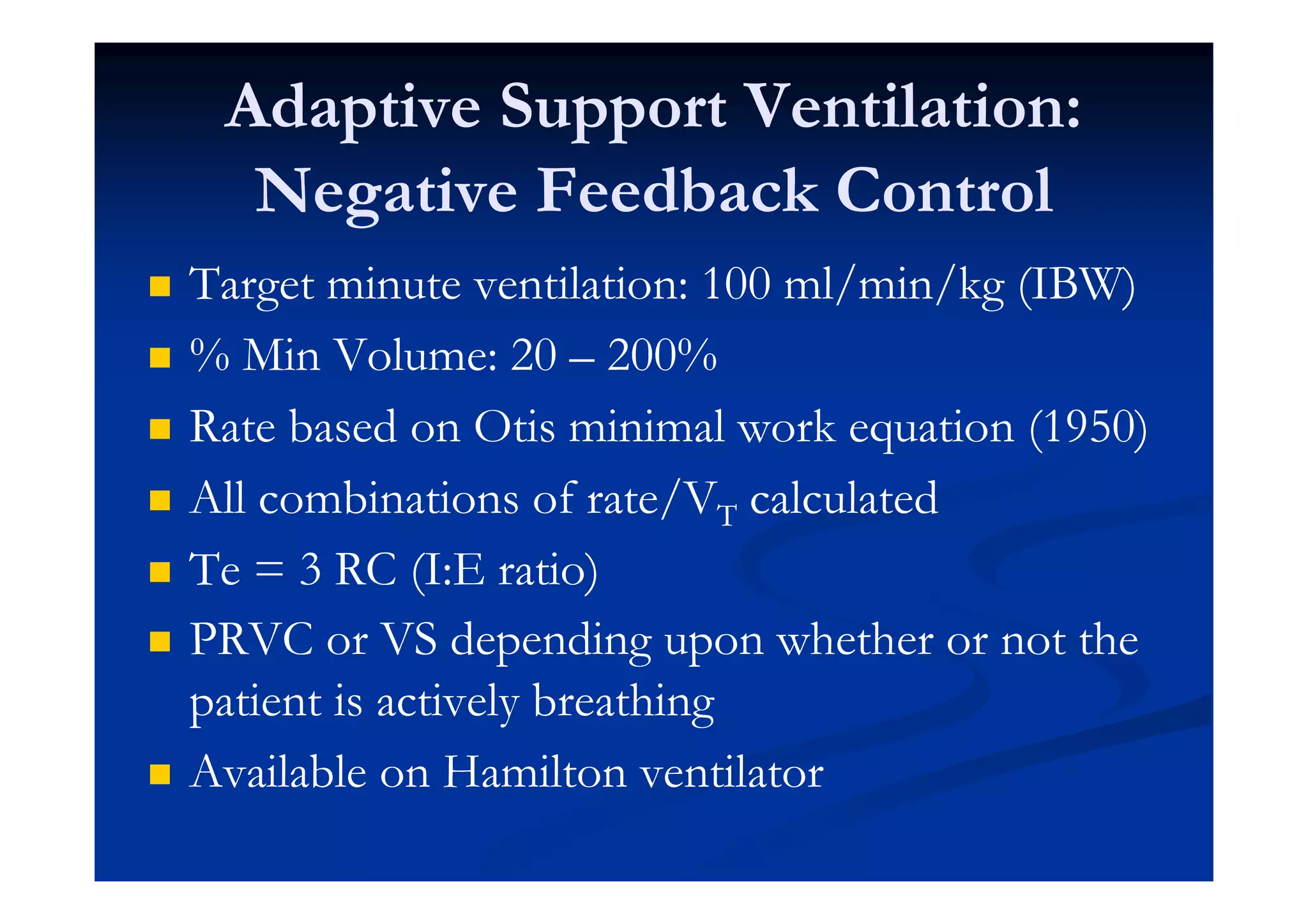
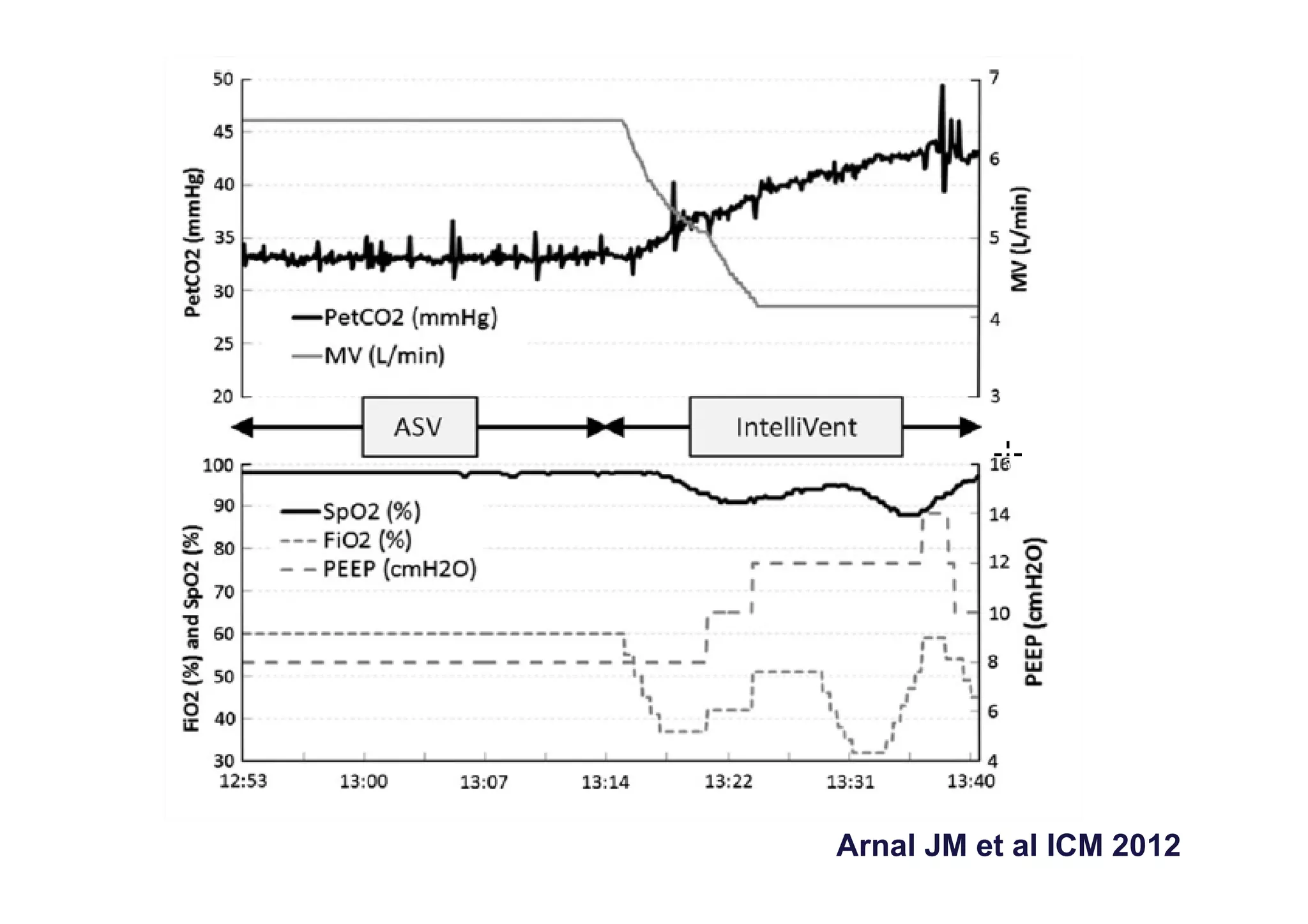
Adaptive Support Ventilation:
Negative Feedback Control
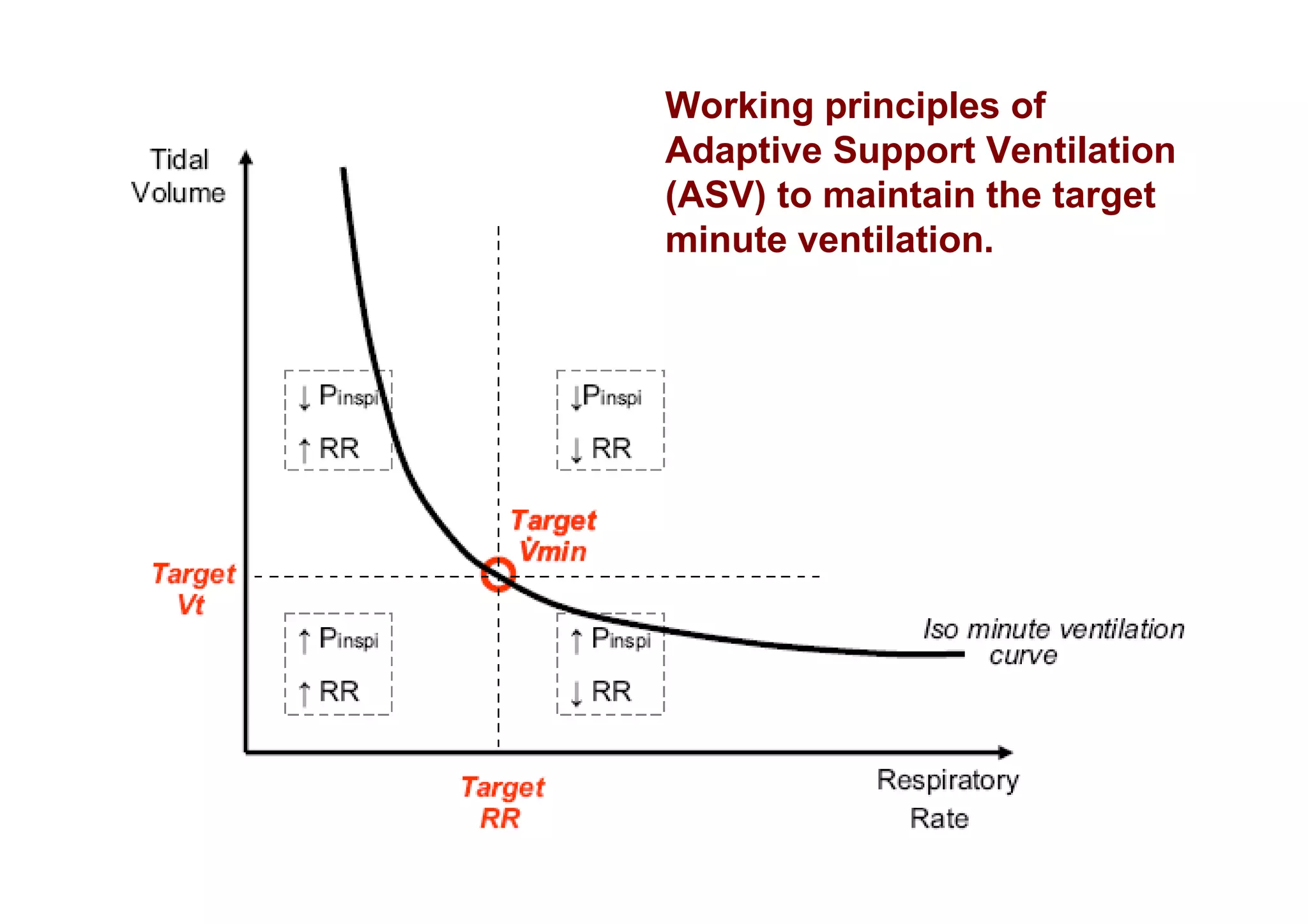
Target minute ventilation: 100 ml/min/kg (IBW)
% Min Volume: 20 – 200%
Rate based on Otis minimal work equation (1950)
All combinations of rate/VT calculated
Te = 3 RC (I:E ratio)
PRVC or VS depending upon whether or not the
patient is actively breathing
Available on Hamilton ventilator
Working principles of
Adaptive Support Ventilation
(ASV) to maintain the target
minute ventilation.
Arnal JM et al ICM 2012
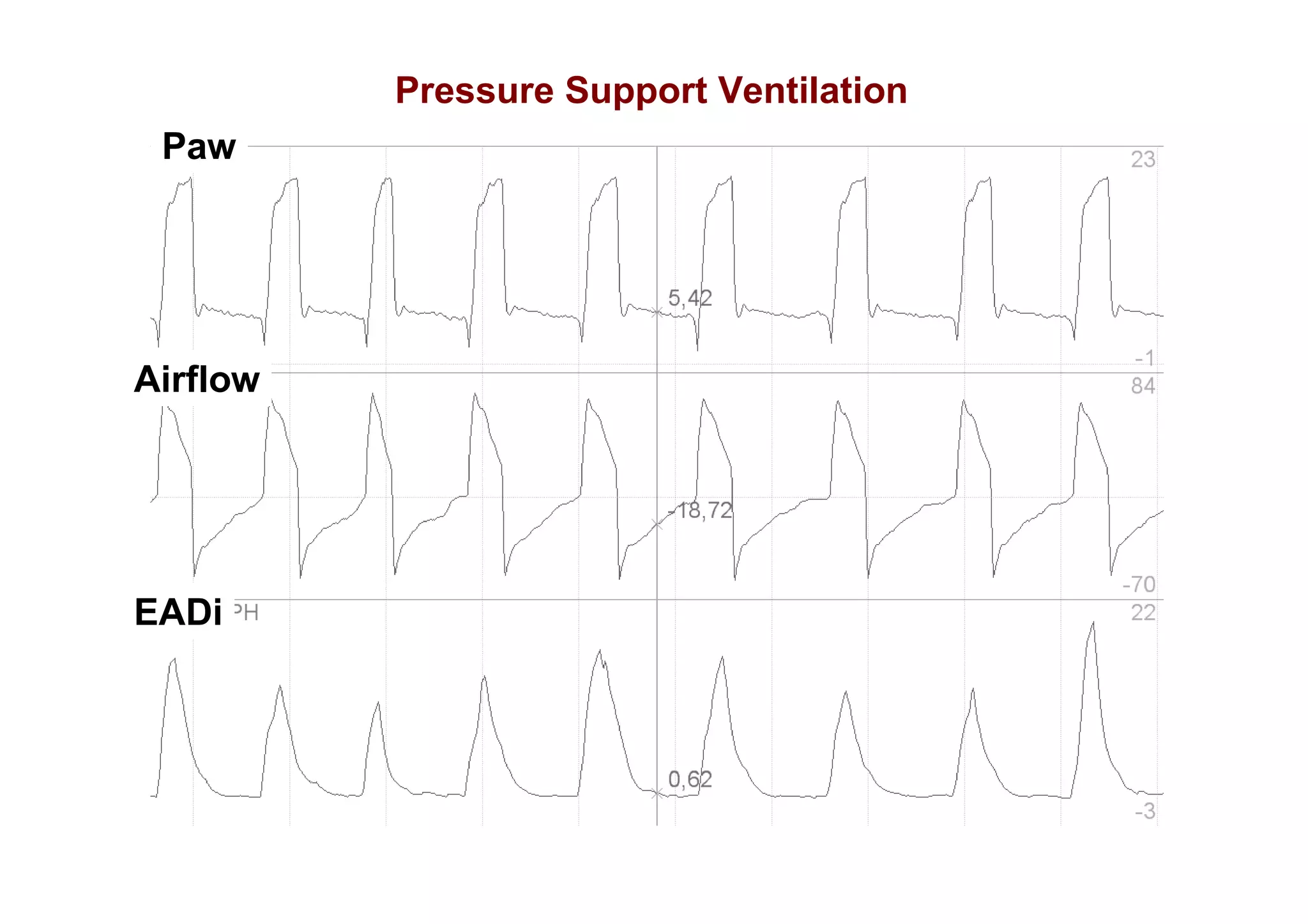
Pressure Support Ventilation
Paw

Airflow

EADi
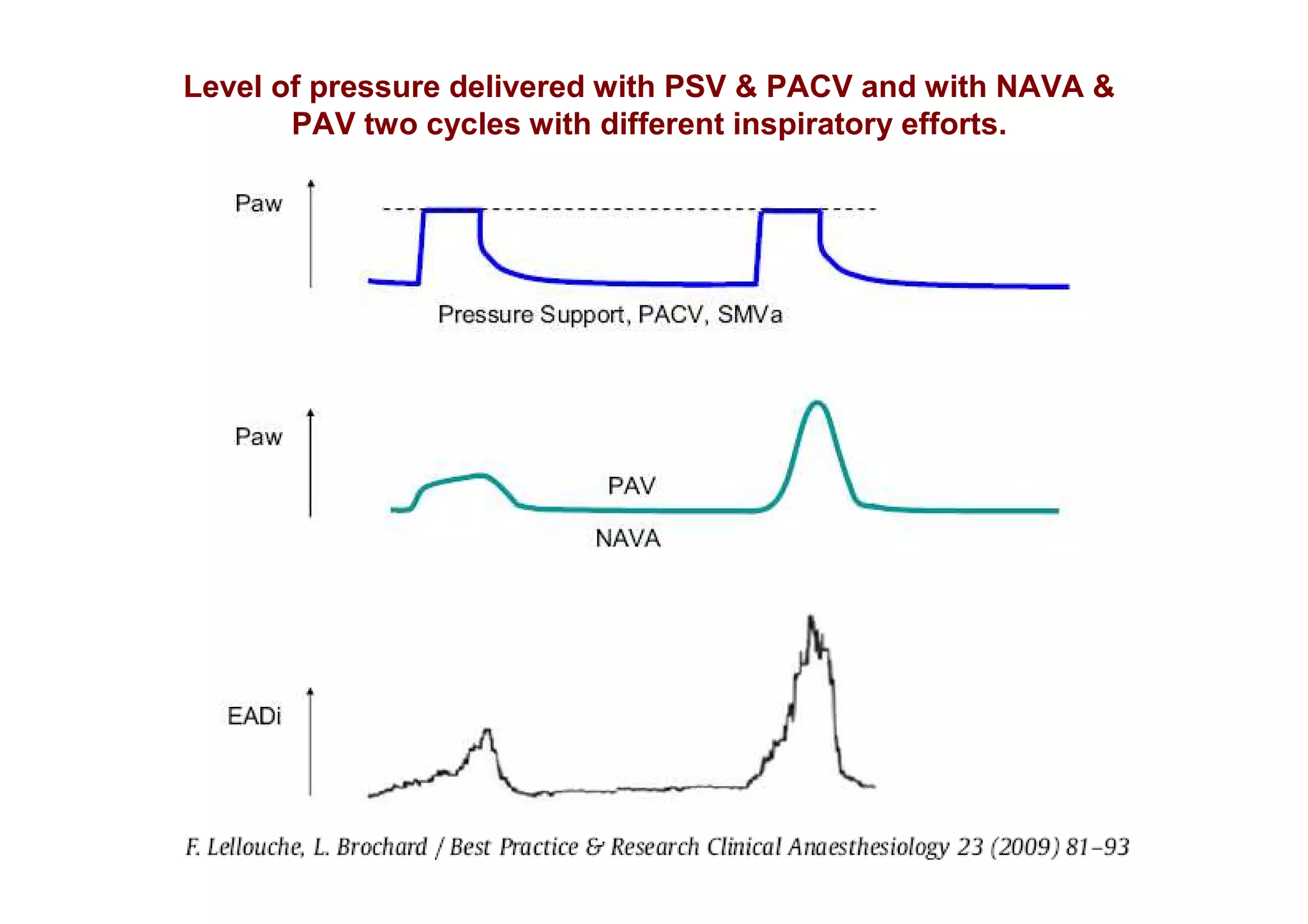
Level of pressure delivered with PSV & PACV and with NAVA &
PAV two cycles with different inspiratory efforts.
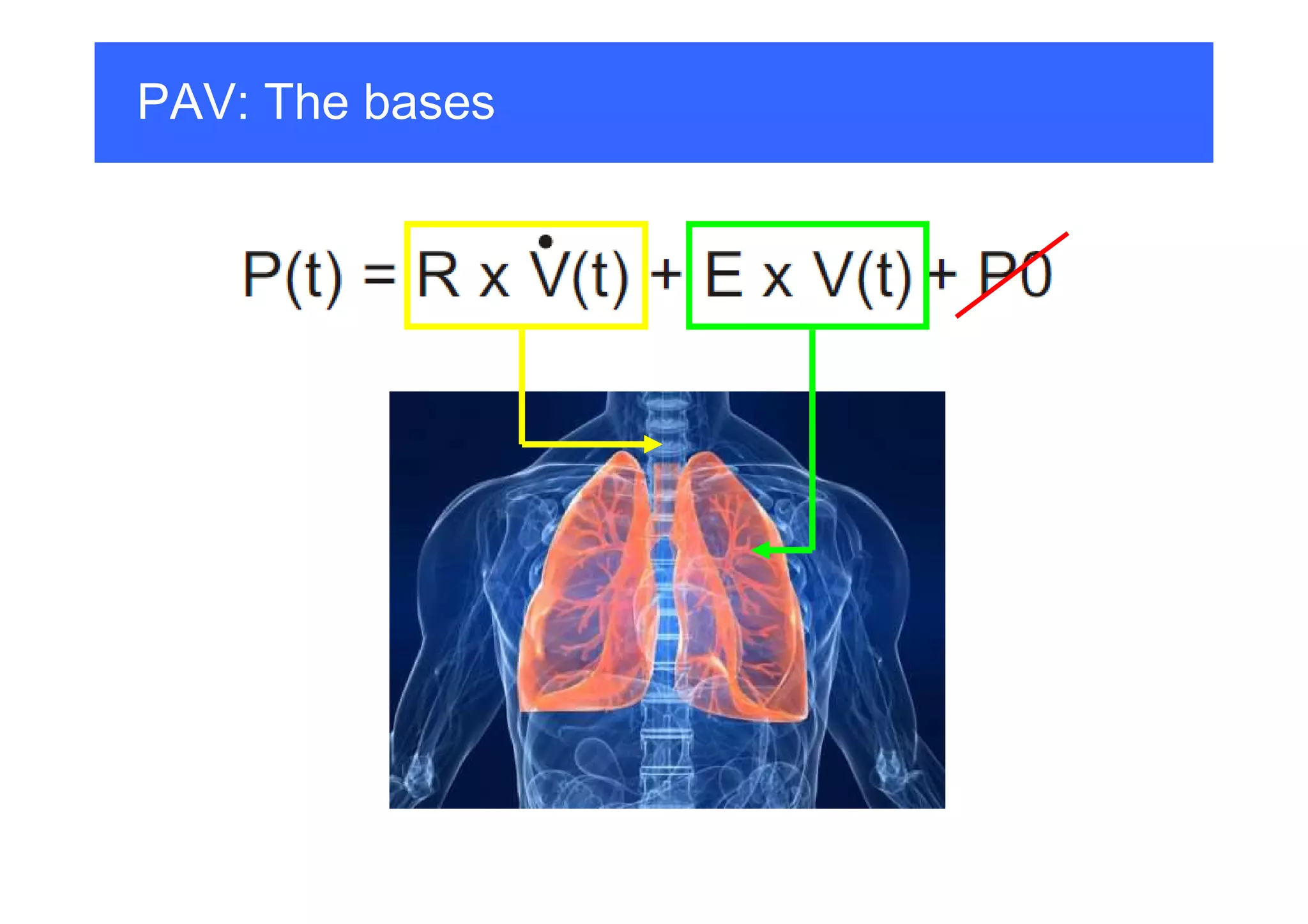
PAV: The bases
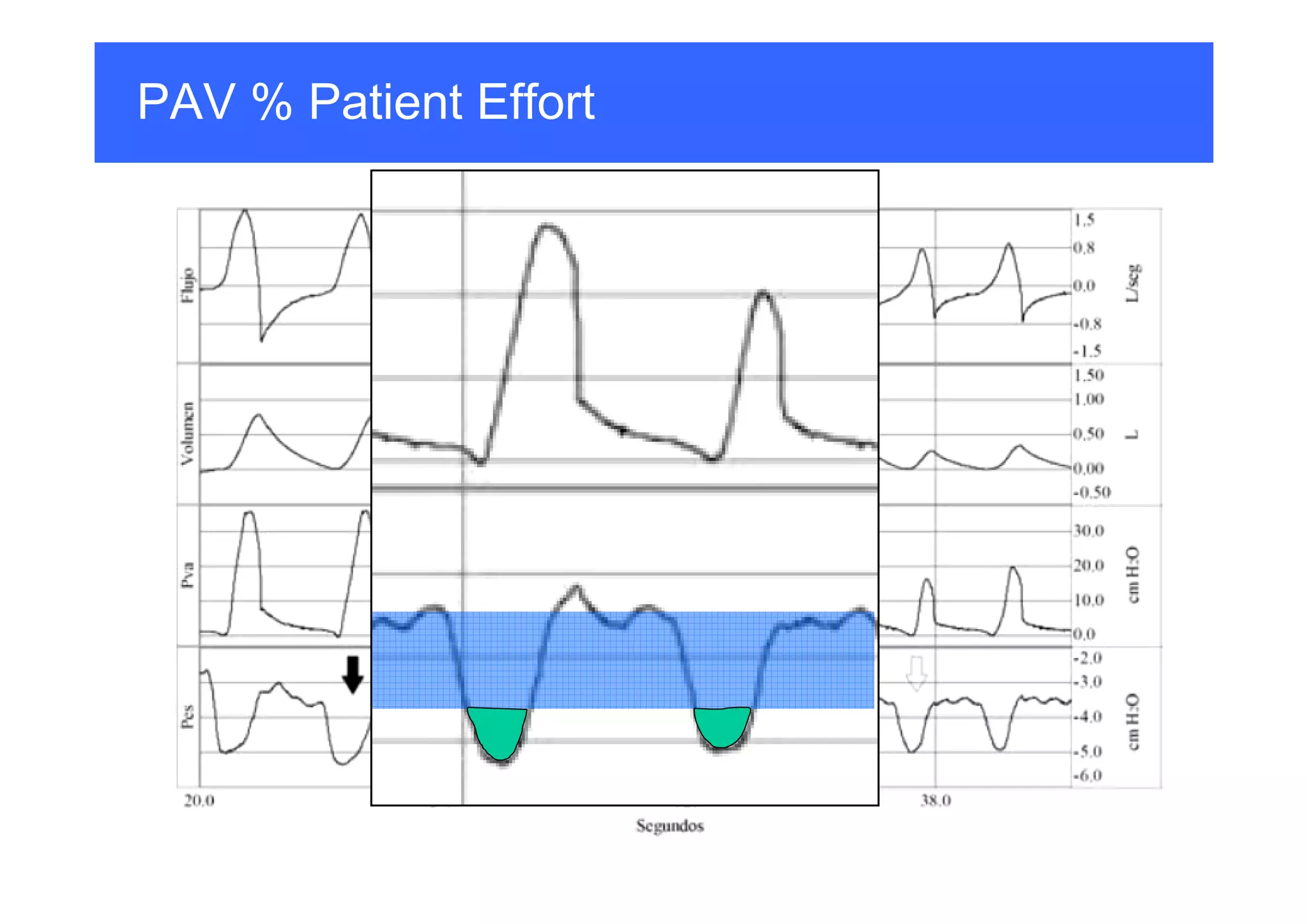
PAV % Patient Effort
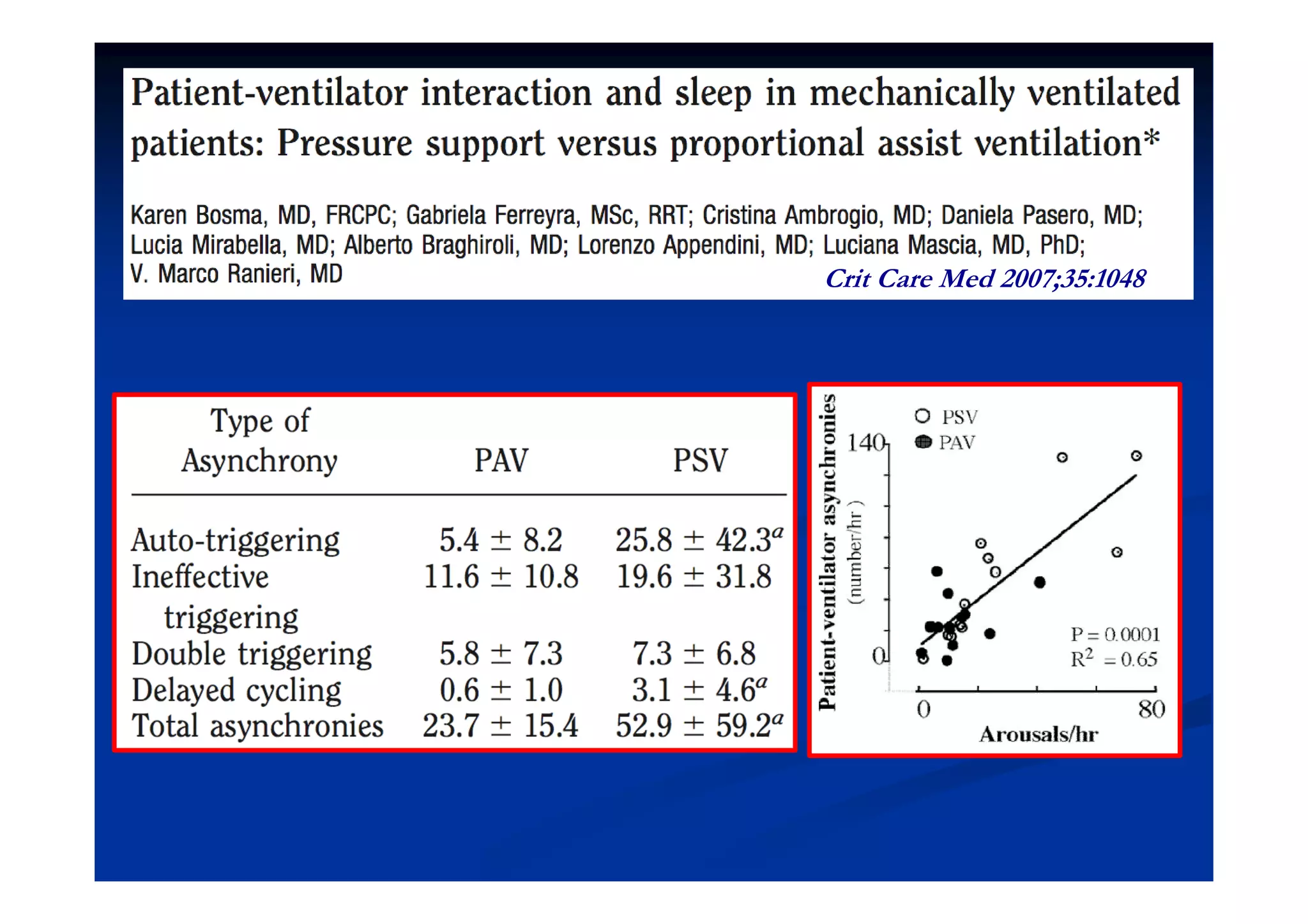
Crit Care Med 2007;35:1048
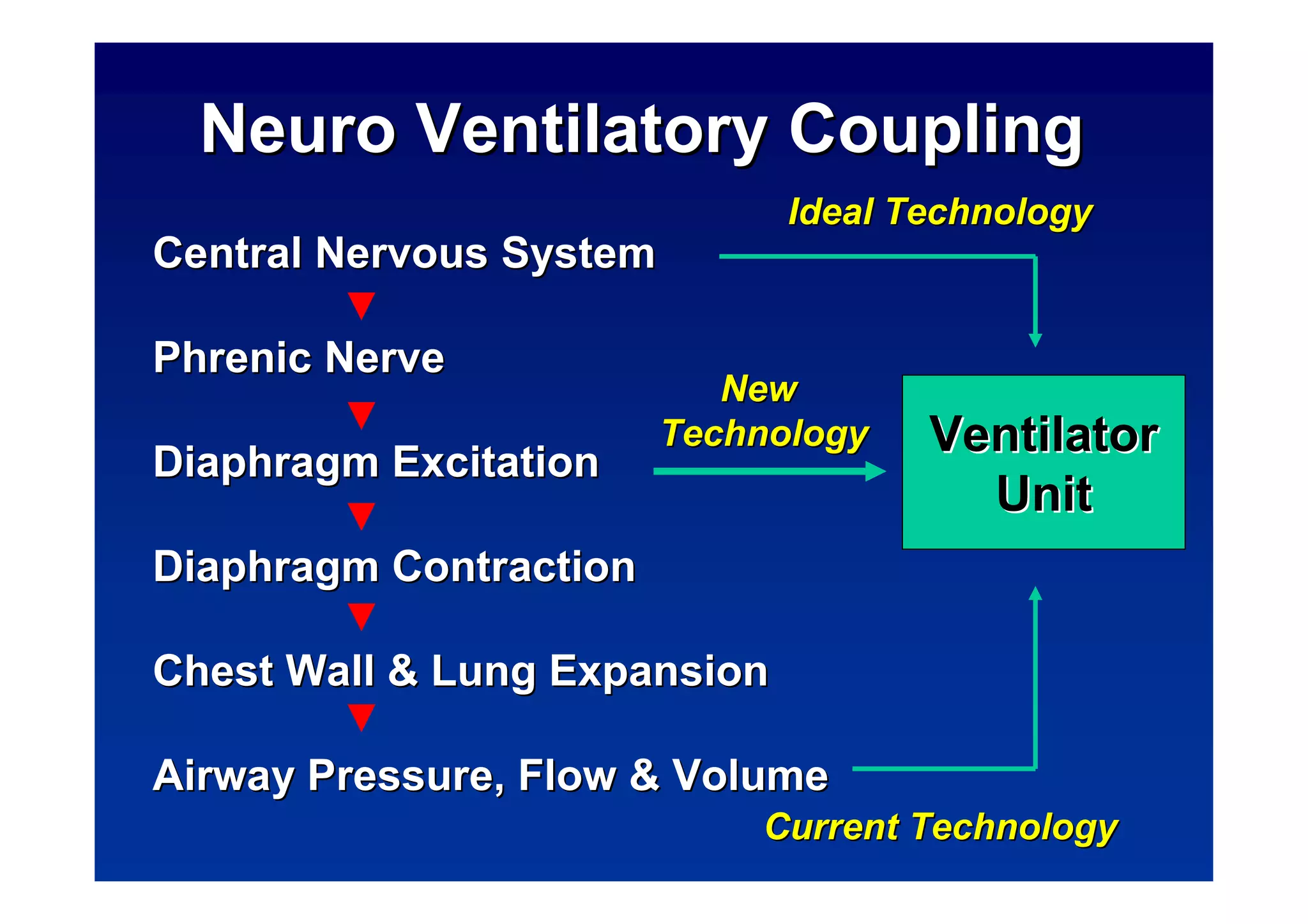
Neuro Ventilatory Coupling
Ideal Technology

Central Nervous System
Phrenic Nerve
Diaphragm Excitation

New
Technology

Ventilator
Unit

Diaphragm Contraction
Chest Wall & Lung Expansion
Airway Pressure, Flow & Volume
Current Technology
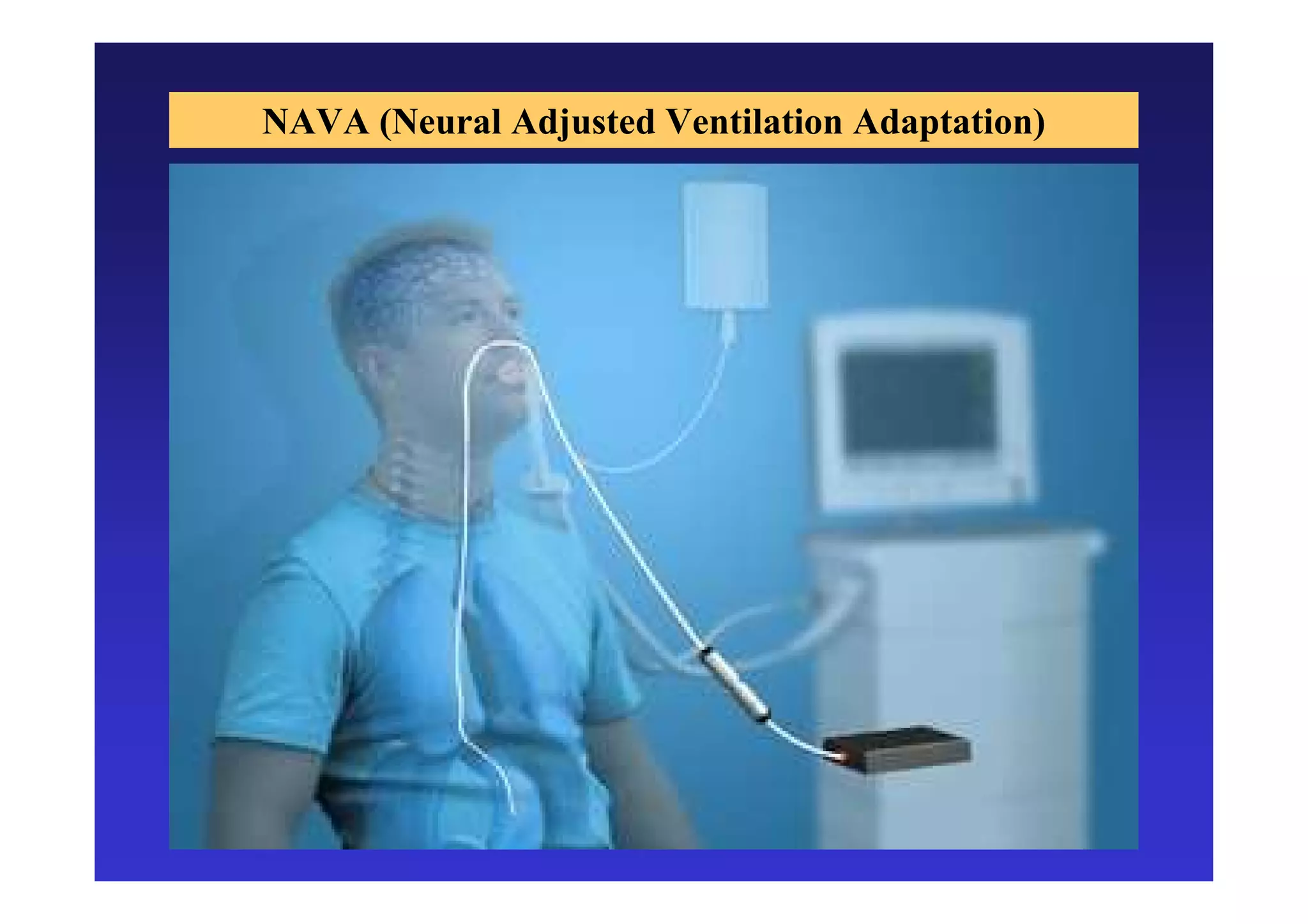
NAVA (Neural Adjusted Ventilation Adaptation)
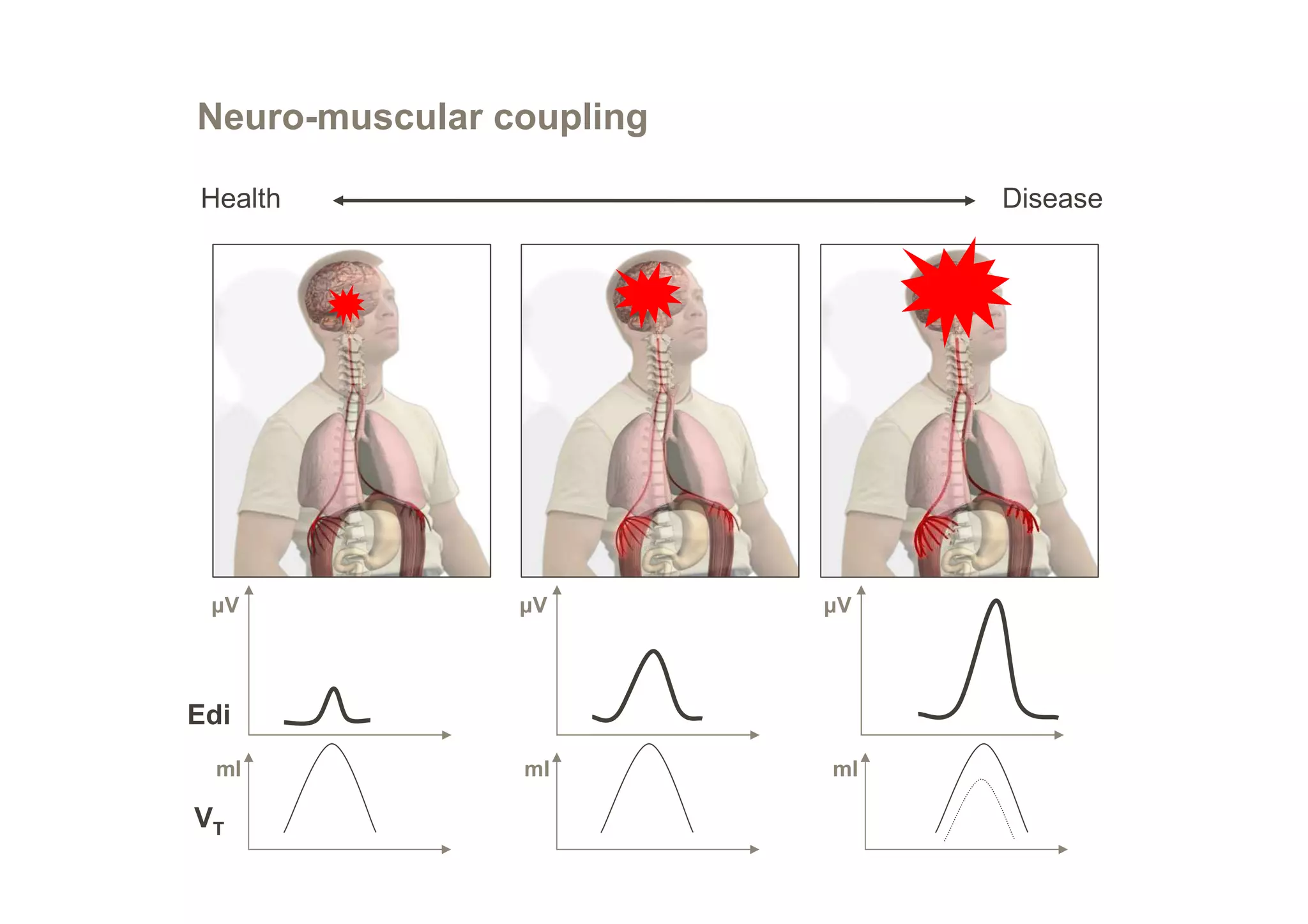
Neuro-muscular coupling
Health

µV

Disease

µV

µV

Edi
ml

VT

ml

ml
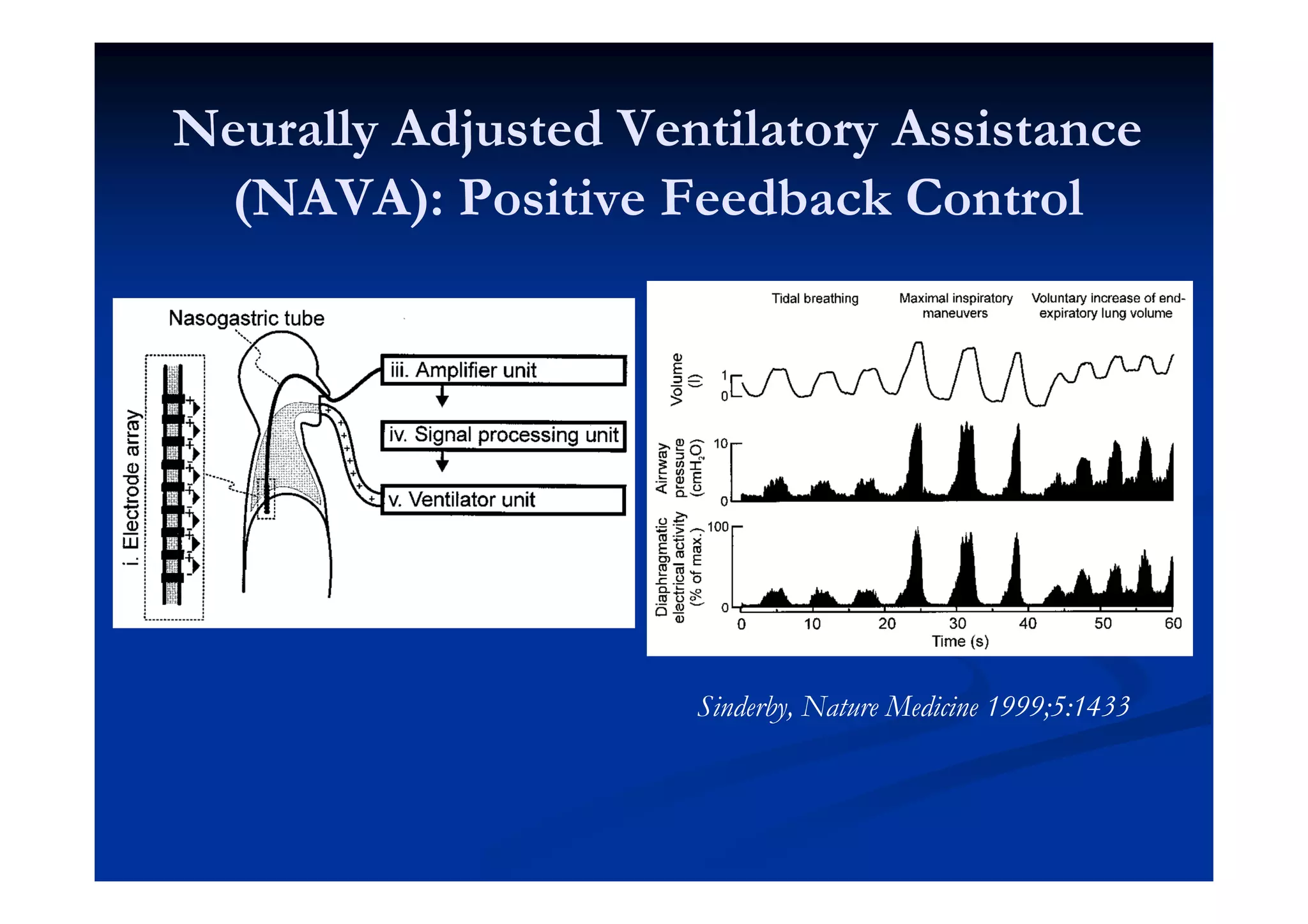
Neurally Adjusted Ventilatory Assistance
(NAVA): Positive Feedback Control

Sinderby, Nature Medicine 1999;5:1433
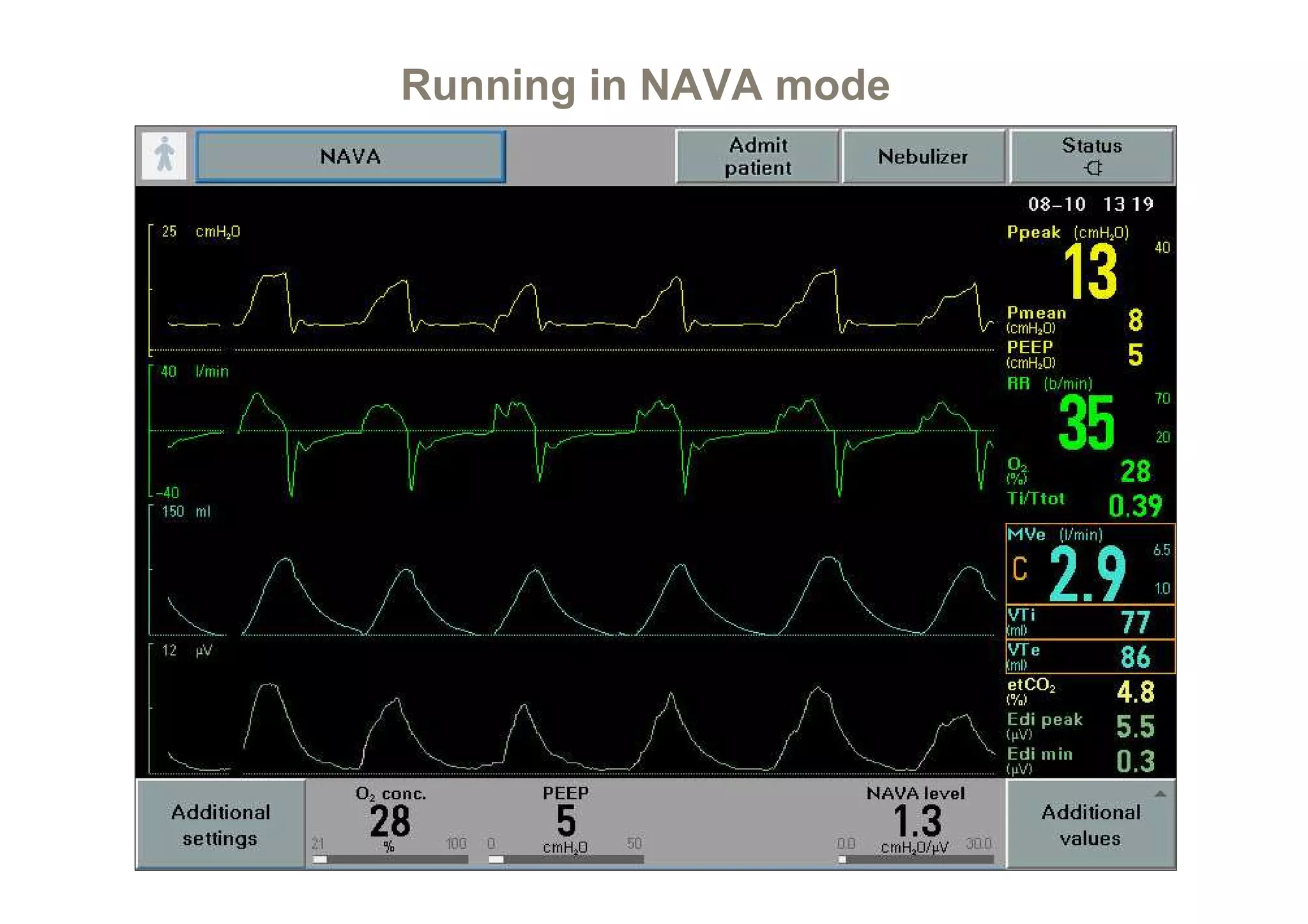
Running in NAVA mode
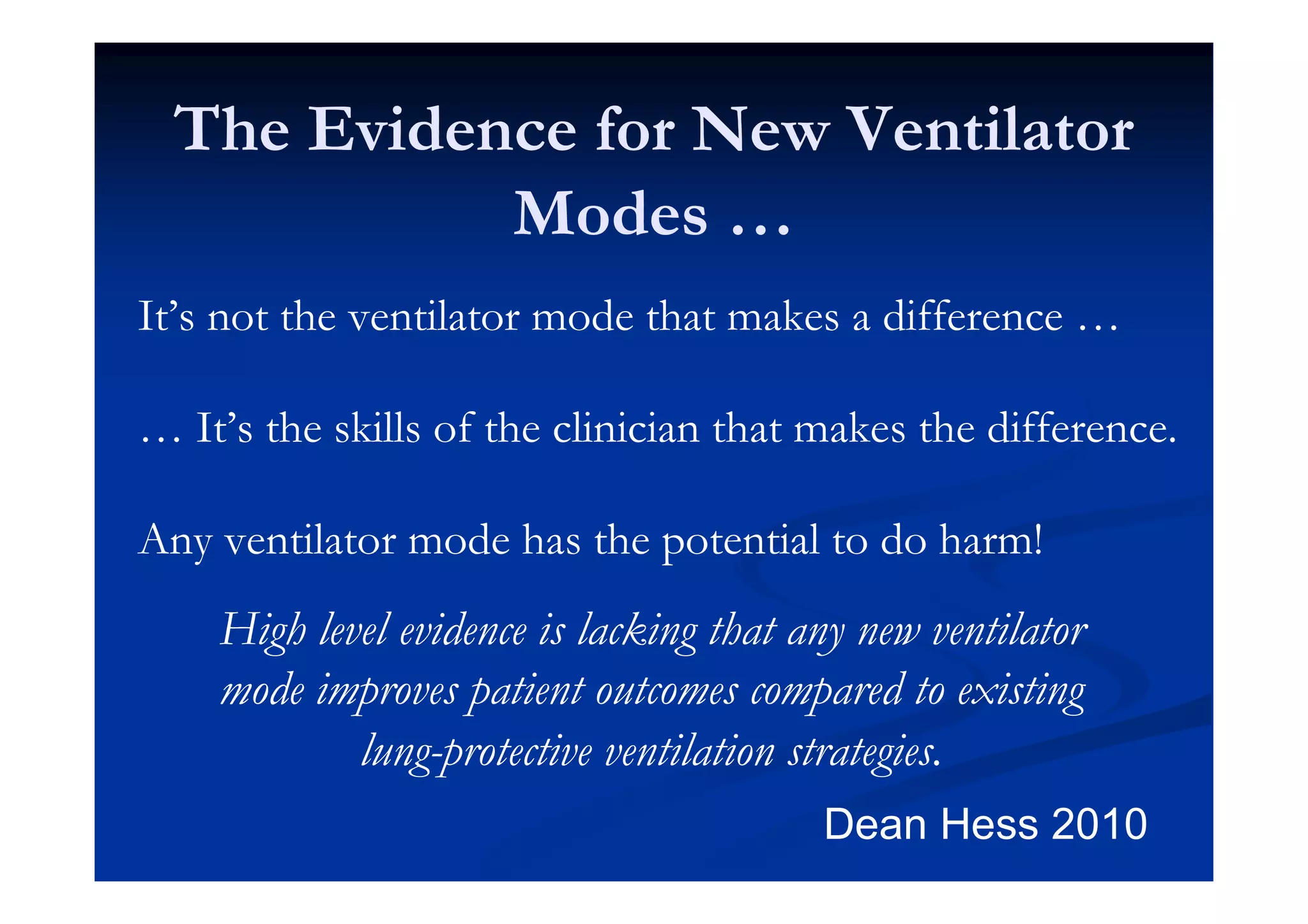
The Evidence for New Ventilator
Modes …
It’s not the ventilator mode that makes a difference …
… It’s the skills of the clinician that makes the difference.
Any ventilator mode has the potential to do harm!

High level evidence is lacking that any new ventilator
mode improves patient outcomes compared to existing
lung-protective ventilation strategies.
Dean Hess 2010

Modes of Mechanical Ventilation: The Essentials

  • 1.
    Modes of MechanicalVentilation: The Essentials Lluis Blanch MD, PhD Senior Critical Care Department Director Research and Innovation Corporació Sanitaria Parc Tauli. Sabadell. Spain. Universitat Autònoma de Barcelona. Spain. 22-23 January 2014 Cairo, Egypt
  • 2.
    Objectives MV • Safety •Efficacy – Oxygenation – Ventilation – Work of Breathing • Comfort / Synchrony – Surveillance of Flow & Pressure
  • 3.
    Modes of MechanicalVentilation: Relationship between possible breath types and inspiratory-phase variables Phase variables that define inspiration: trigger variable limit variable: pressure, flow or volume cycle variable that ends inspiration Gas delivery: pressure, volume, flow, time or dual control Breath type: mandatory or spontaneous
  • 4.
    PCV & VCVWaveforms PCV Rectangular Pressure Waveform VCV VCV VCV Rectangular Flow Waveform Ascending Ramp Flow Waveform Descending Ramp Flow Waveform VCV Sinusoidal Flow Waveform
  • 5.
    Pressure vs VolumeControl • Volume Control • Pressure Control - Set VT - Set Pressure - Set Flow waveform - Set Inspiratory Time - Set Flow rate - Variable VT - Set Inspiratory Time - Variable Flow waveform - Variable pressure - Variable Flow rate - Linear Rate/VE - Non-linear Rate/VE
  • 6.
    Daily Use ofModes of Mechanical Ventilation 1998 VCV PCV PSV Esteban A et al. JAMA 2002;287:345-55
  • 7.
    Daily Use ofModes of Mechanical Ventilation 2010 VCV PSV PCV Esteban A et al. Am J Respir Crit Care MedJ 2013;188:220-30
  • 8.
    VCV. Effects ofan End-Inspiratory Occlusion Time
  • 9.
    Assist/Controlled Ventilation Hess DR,Kacmarek RM. Essentials of Mechanical Ventilation. 2on Ed. McGraw Hill. 2002.
  • 10.
    Variations in Crsin VCV (square flow) High Crs Intermediate Crs Low Crs Corretger E, Murias G,… Blanch L. Med Intensiva ((2011 Oct 17)
  • 11.
    Variations in Rrsin VCV (square flow) Low Rrs Intermediate Rrs High Rrs Corretger E, Murias G,… Blanch L. Med Intensiva (2011)
  • 12.
    AutoPEEP Generation: LengthenTi at equal Ttot (Airflow decreased for a similar VT) 1.0 0.5 Airflow (L/s) AutoPEEP 0.0 -0.5 -1.0 0 1 2 3 4 Time (s) Blanch L, Bernabe F, Lucangelo U. Respir Care 2005;50:110-123
  • 13.
    Progressive increase ofinspiratory pause during VCV Lucangelo U, Bernabè F, and Blanch L. Resp Care 2005; 50 : 55-65
  • 14.
    VCV with progressiveincrease of inspiratory time, but with constant pause Lucangelo U, Bernabè F, Blanch L. Resp Care 2005; 50 : 55-65
  • 15.
    Patient WOB duringTriggered Ventilation Marini JJ et al. Am Rev Respir Dis 1988; 138:1169-79
  • 16.
    VCV Increased Workof Breathing
  • 17.
    Georgopoulos D etal Intensive Care Med 2006;32:34-47 (on line suppl)
  • 18.
  • 19.
    Variations in Crsin PCV High Crs Intermediate Crs Low Crs Corretger E, Murias G,… Blanch L. Med Intensiva (2011 Oct 17)
  • 20.
    Variations in Rrsin PCV Low Rrs Intermediate Rrs High Rrs Corretger E, Murias G,… Blanch L. Med Intensiva ((2011 Oct 17)
  • 21.
    PCV: Effect ofAutoPEEP Marini JJ & Amato MB. Principles & Practice of Mechanical Ventilation. Tobin M, ed. 2007
  • 22.
    PCV: Effect of↑Resistance High Raw = Low VT Marini JJ & Amato MB. Principles & Practice of Mechanical Ventilation. Tobin M, ed. 2007
  • 23.
    PCV: Effect of↓Compliance Low Crs = Low VT Marini JJ & Amato MB. Principles & Practice of Mechanical Ventilation. Tobin M, ed. 2007
  • 24.
    Effect of InspiratoryFlow on Work of Breathing Cinnella G. Am J Resp Crit Care 1996; 153:1025-33
  • 25.
    Suggestion for settings ACV -VT about 6 - 8 mL/kg (AVOID Pplat > 28 and large VT) - Inspiratory flow 60 L/min - Ti /Ttot PCV - Inspiratory pressure (for a VT of 6-8 ml/kg) (AVOID Ppaw > 30) - Ti / Ttot Common for ACV & PCV - FiO2 for Sat ≥ 90% and < 97%. Avoid FiO2 1 if possible. - PEEP 5-10 cmH2O - Back up Rate 12 - 15 x’ Then, titrate according to individual patient’s clinical condition (gas exchange, mechanics, patient/ventilator interactions)
  • 26.
    flow cycle pressure limit Spontaneousbreath type • patient triggered (no set rate) • pressure limited • usually flow cycled patient trigger Volume (mL) Pressure (cm H2O) Flow (L/min) Pressure Support Ventilation Hess D. Respir Care 2005; 50:166-186 time
  • 27.
    Pressure Support Ventilation HessDR, Kacmarek RM. Essentials of Mechanical Ventilation. 2on Ed. McGraw Hill. 2002.
  • 28.
  • 29.
    PS 20 cmH2O Rise time (τ) 0.01 s Neural inspiratory time 1.0 s 120 Peak flow 100 L/min flow (L/min) 100 80 60 Flow termination 25% peak flow 40 20 R 10 cm H2O/L/s, C 0.02 L/cm H2O 0 0 0.2 0.4 0.6 0.8 1 time (s) Peak flow 60 L/min flow (L/min) 60 40 R 20 cm H2O/L/s, C 0.05 L/cm H2O 20 0 0 0.2 0.4 0.6 0.8 1 time (s) Hess D. Respir Care 2005; 50:166-186
  • 30.
    PSV: Autotriggering Flow (L/s) Can occurwhen: - too sensitive inspiratory trigger Paw (cmH2O) - end-expiratory leaks Pes (cmH2O) Time (s) Brochard L. Principles & Practice of Mechanical Ventilation. Tobin M, ed. 2007
  • 31.
    PSV: Ineffective Efforts Flow (L/s) Canoccur when: - too much PSV Paw - presence of autoPEEP (cmH2O) Pes (cmH2O) Time (s) Brochard L. Principles & Practice of Mechanical Ventilation. Tobin M, ed. 2007
  • 32.
    Adaptative Pressure ControlModes: It is a pressure-controlled breath that utilized closed-loop control of the pressure to maintain a minimum delivered tidal volume Commercial Names for Adaptative Pressure Control Modes: Branson RD & Chatburn RL. Respir Care 2007;52:478-488
  • 33.
    Implementation of AutoFlowon the Drager Evita 4 Ventilator Paw (cmH2O) Flow (L/s) VT (mL) PCV Breaths VCV Breath Adaptative PCV until target VT is reached Crs Increases and VT exceeds the target, Paw is reduced until VT reaches the target
  • 34.
    Airway pressure deliveredduring the inspiratory phase in relation to patient effort in different modes of ventilation
  • 35.
    VCV Normal respiratory effort PSV PCV ASV PAV NAVA SmartCareIntelVent Paw Ppl Paw Increase respiratory effort Ppl Murias G, Villagrá A, Blanch L. Minerva Anestesiol 2013;79:434-44
  • 36.
    Adaptive Support Ventilation: NegativeFeedback Control Target minute ventilation: 100 ml/min/kg (IBW) % Min Volume: 20 – 200% Rate based on Otis minimal work equation (1950) All combinations of rate/VT calculated Te = 3 RC (I:E ratio) PRVC or VS depending upon whether or not the patient is actively breathing Available on Hamilton ventilator
  • 37.
    Working principles of AdaptiveSupport Ventilation (ASV) to maintain the target minute ventilation.
  • 38.
    Arnal JM etal ICM 2012
  • 39.
  • 40.
    Level of pressuredelivered with PSV & PACV and with NAVA & PAV two cycles with different inspiratory efforts.
  • 41.
  • 42.
  • 43.
    Crit Care Med2007;35:1048
  • 44.
    Neuro Ventilatory Coupling IdealTechnology Central Nervous System Phrenic Nerve Diaphragm Excitation New Technology Ventilator Unit Diaphragm Contraction Chest Wall & Lung Expansion Airway Pressure, Flow & Volume Current Technology
  • 45.
    NAVA (Neural AdjustedVentilation Adaptation)
  • 46.
  • 47.
    Neurally Adjusted VentilatoryAssistance (NAVA): Positive Feedback Control Sinderby, Nature Medicine 1999;5:1433
  • 48.
  • 50.
    The Evidence forNew Ventilator Modes … It’s not the ventilator mode that makes a difference … … It’s the skills of the clinician that makes the difference. Any ventilator mode has the potential to do harm! High level evidence is lacking that any new ventilator mode improves patient outcomes compared to existing lung-protective ventilation strategies. Dean Hess 2010