WHAT IS SCIENCE?

Ian Anderson
Saint Ignatius College Geelong
WHAT IS SCIENCE?
Some definitions.


“Science (from the Latin scientia, meaning „knowledge‟
or „knowing‟) is the effort to discover, and increase
human understanding of how the physical world works.”
(from Wikipedia)



“Any system of knowledge that is concerned with the
physical world and its phenomena and that entails
unbiased observations and systematic experimentation.”
(from Encyclopaedia Britannica)
WHAT IS SCIENCE?
Are these definitions confusing?
WHAT IS SCIENCE?
Want a simpler definition?
WHAT IS SCIENCE?
“Science is the knowledge gained from using
observations and experiments to describe and
explain the world around us.”
WHAT IS SCIENCE?
How does Science differ from other fields of study?
“Science is the knowledge gained from using
observations and experiments to describe and
explain the world around us.”
WHAT IS SCIENCE?
How does Science differ from other fields of study?
“Science is the knowledge gained from using
observations and experiments to describe and
explain the world around us.”
WHAT IS SCIENCE?
All scientists observe things, try to explain their
observations and then conduct experiments to test
their ideas.
This process is known as the

scientific method.
WHAT IS SCIENCE?
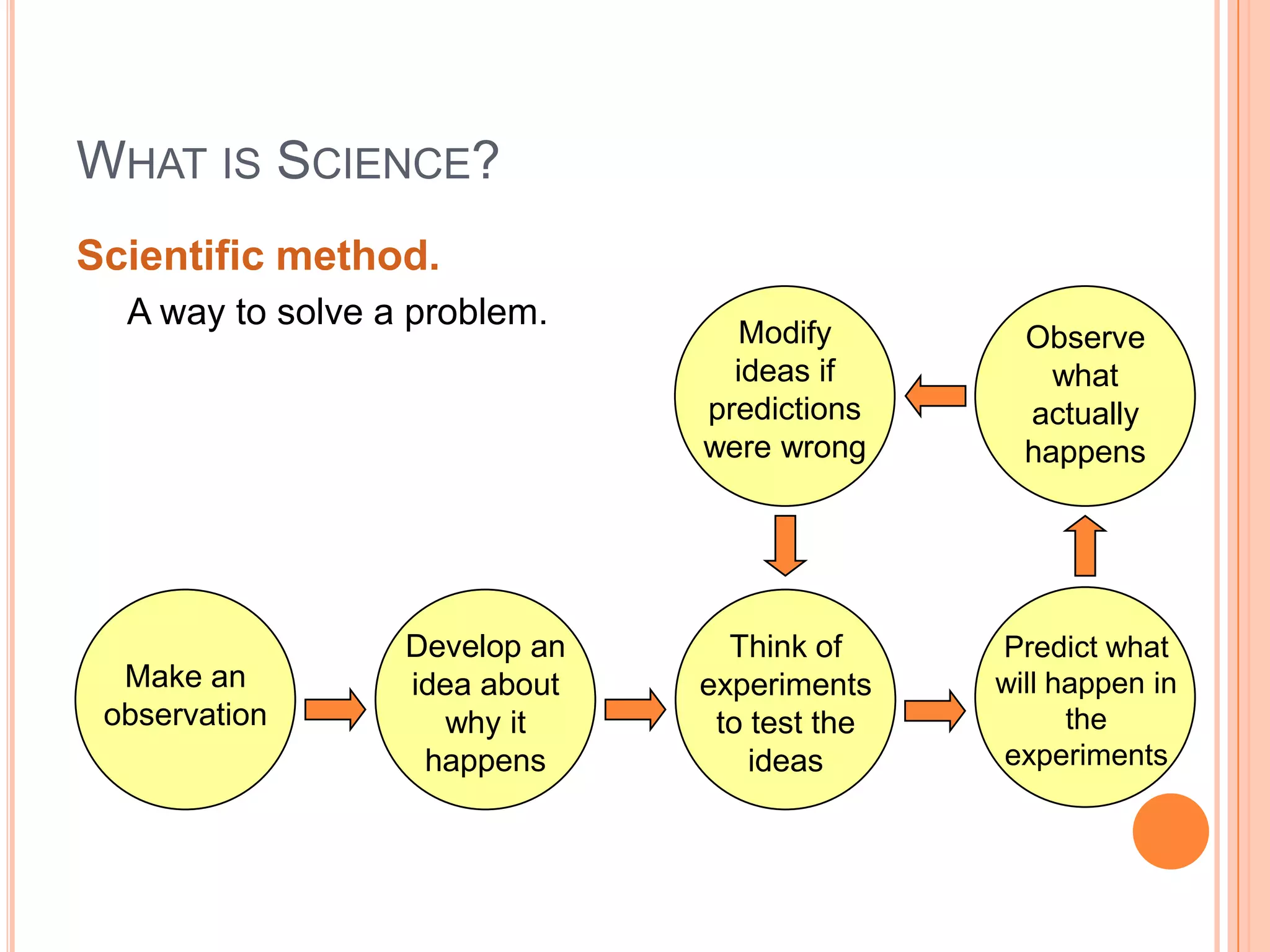
Scientific method.
A way to solve a problem.

Make an
observation

Develop an
idea about
why it
happens

Modify
ideas if
predictions
were wrong

Observe
what
actually
happens

Think of
experiments
to test the
ideas

Predict what
will happen in
the
experiments
OBSERVATION


Observation is one of the most important tools for a
scientist.
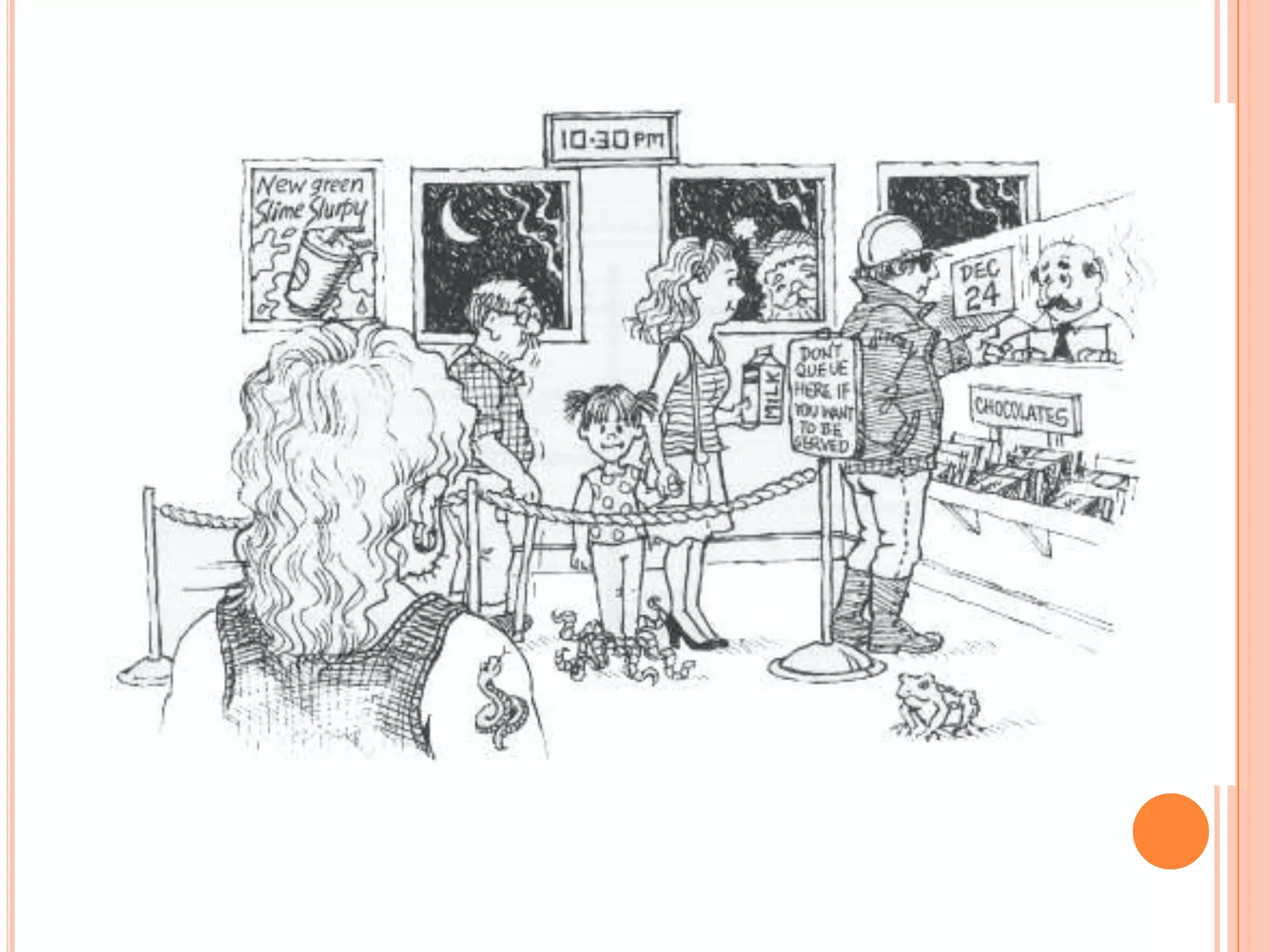
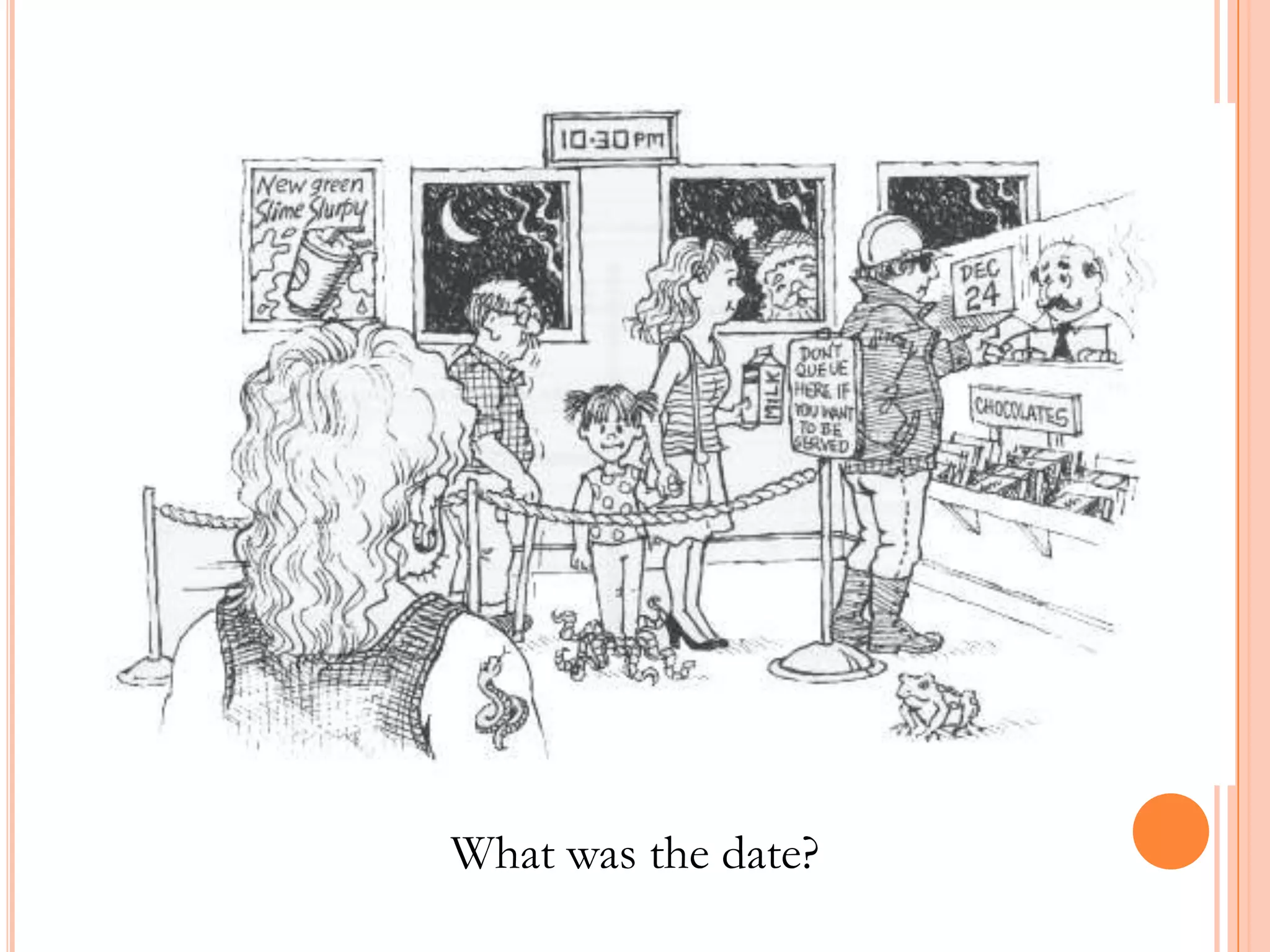
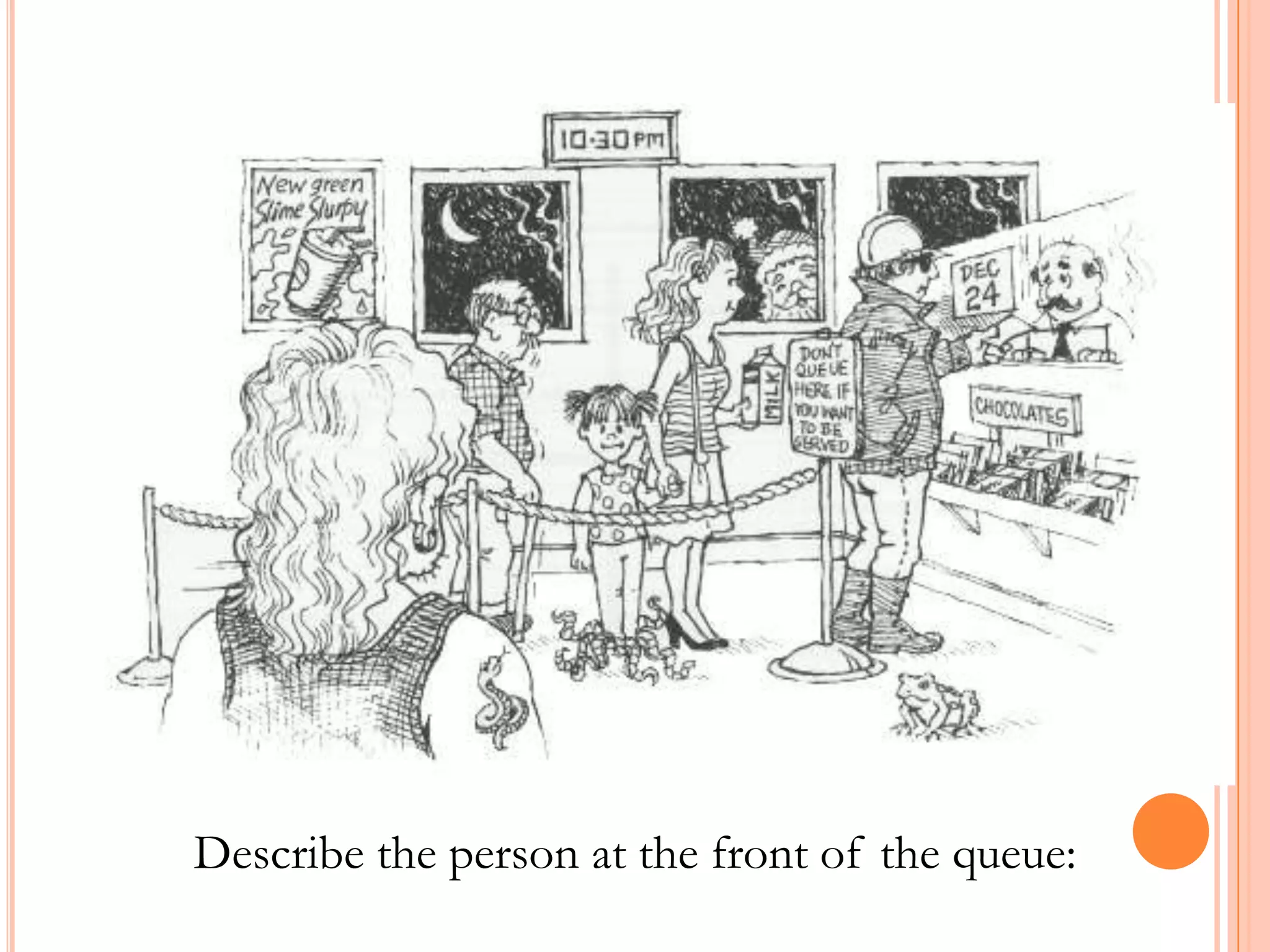
WHAT DID YOU OBSERVE?
1.
2.
3.

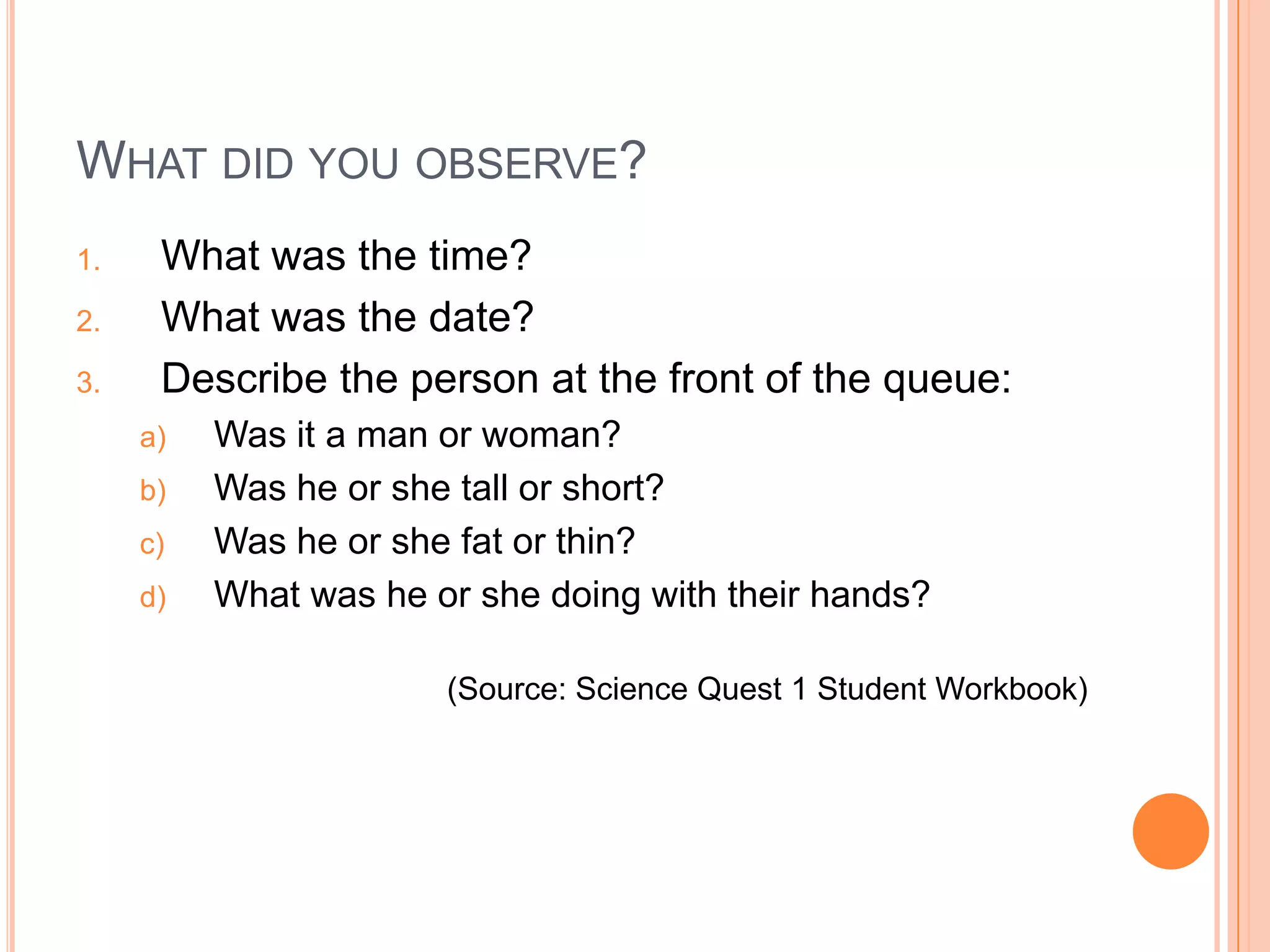
What was the time?
What was the date?
Describe the person at the front of the queue:
a)
b)

c)
d)

Was it a man or woman?
Was he or she tall or short?
Was he or she fat or thin?
What was he or she doing with their hands?
(Source: Science Quest 1 Student Workbook)
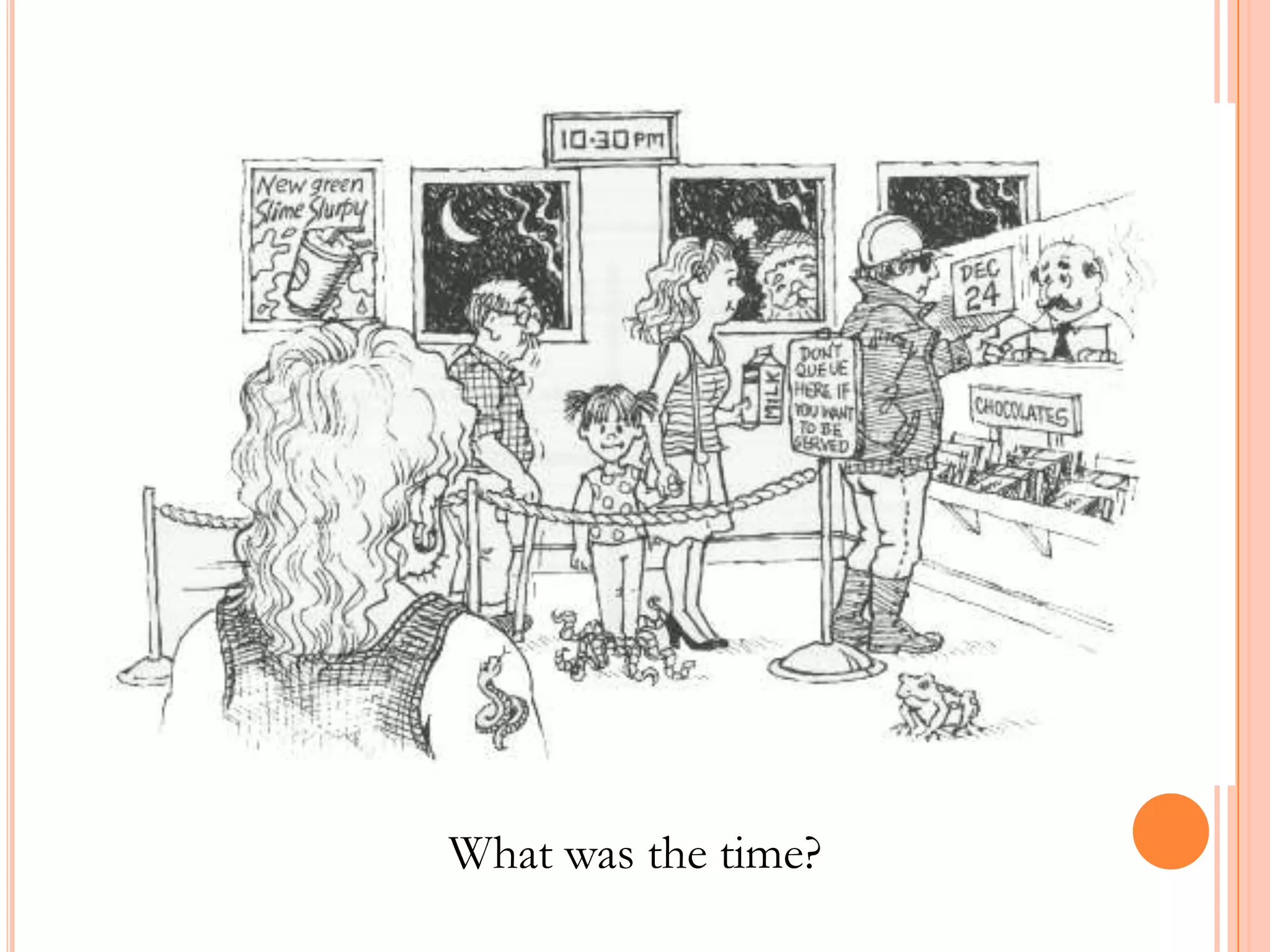
What was the time?
What was the date?
Describe the person at the front of the queue:
WHAT IS A SCIENTIST?
A scientist is a person who experiments in order to
learn.
WHERE DO SCIENTISTS WORK?
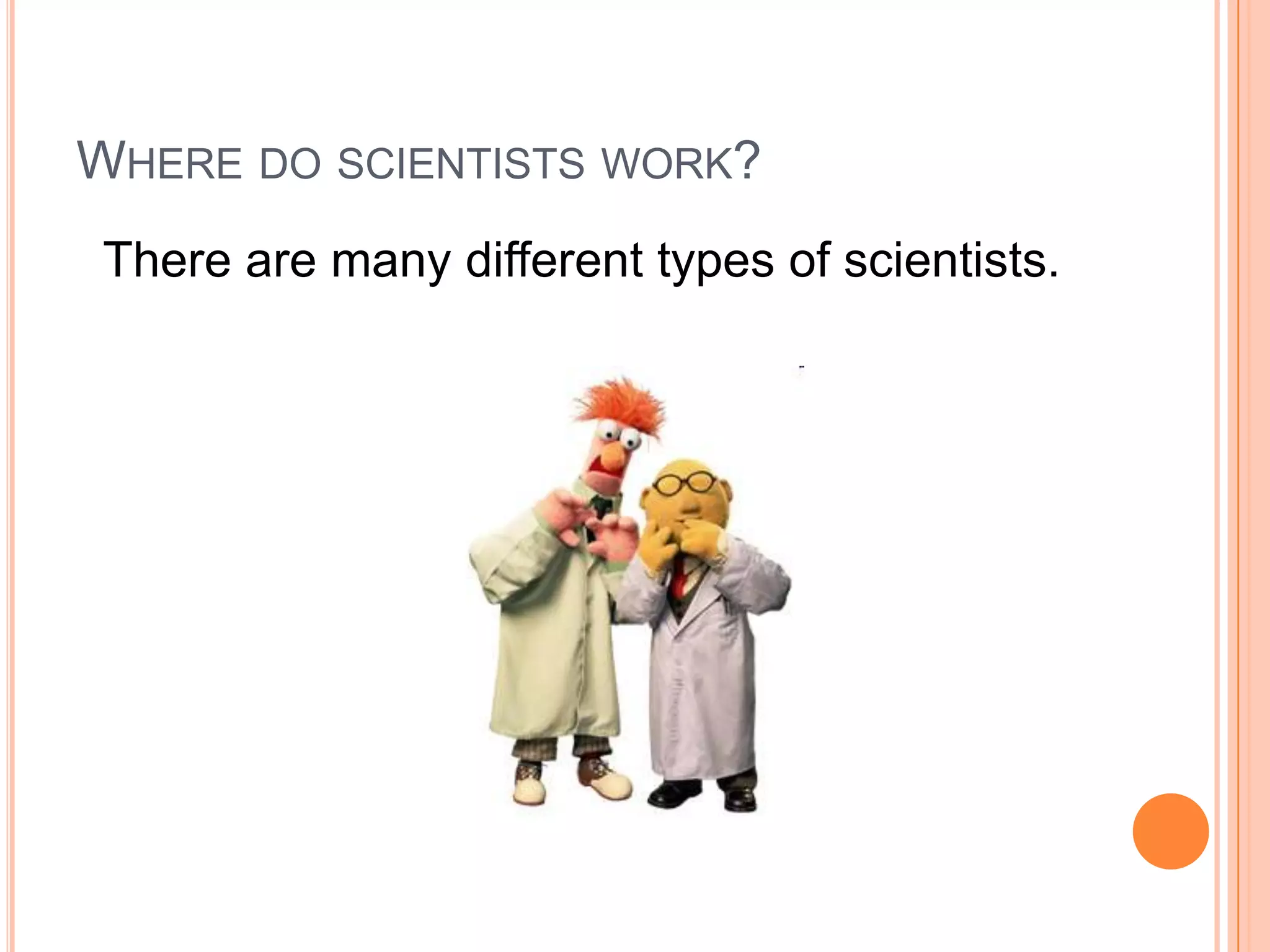
There are many different types of scientists.
WHERE DO SCIENTISTS WORK?
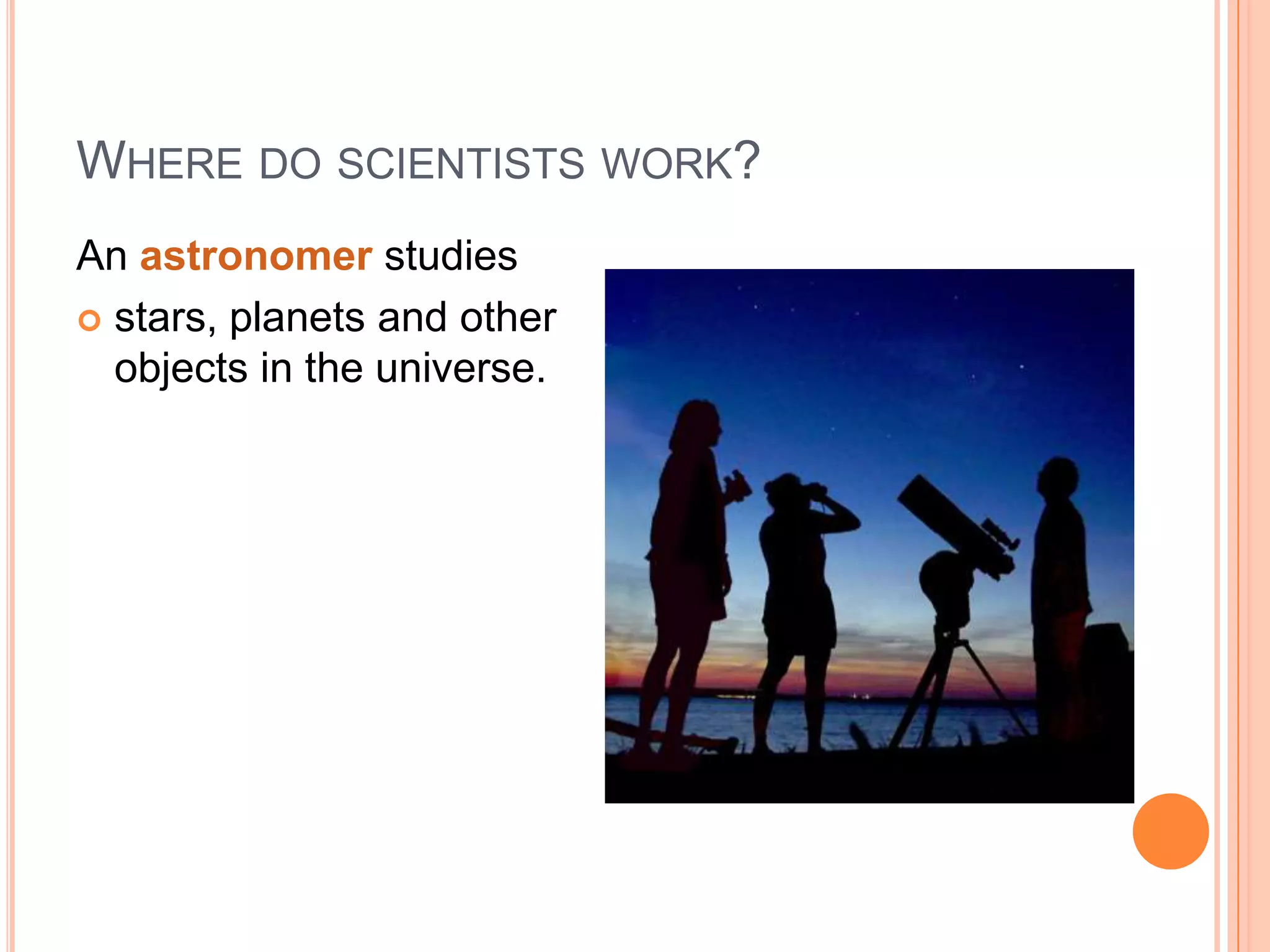
An astronomer studies
 stars, planets and other
objects in the universe.
WHERE DO SCIENTISTS WORK?
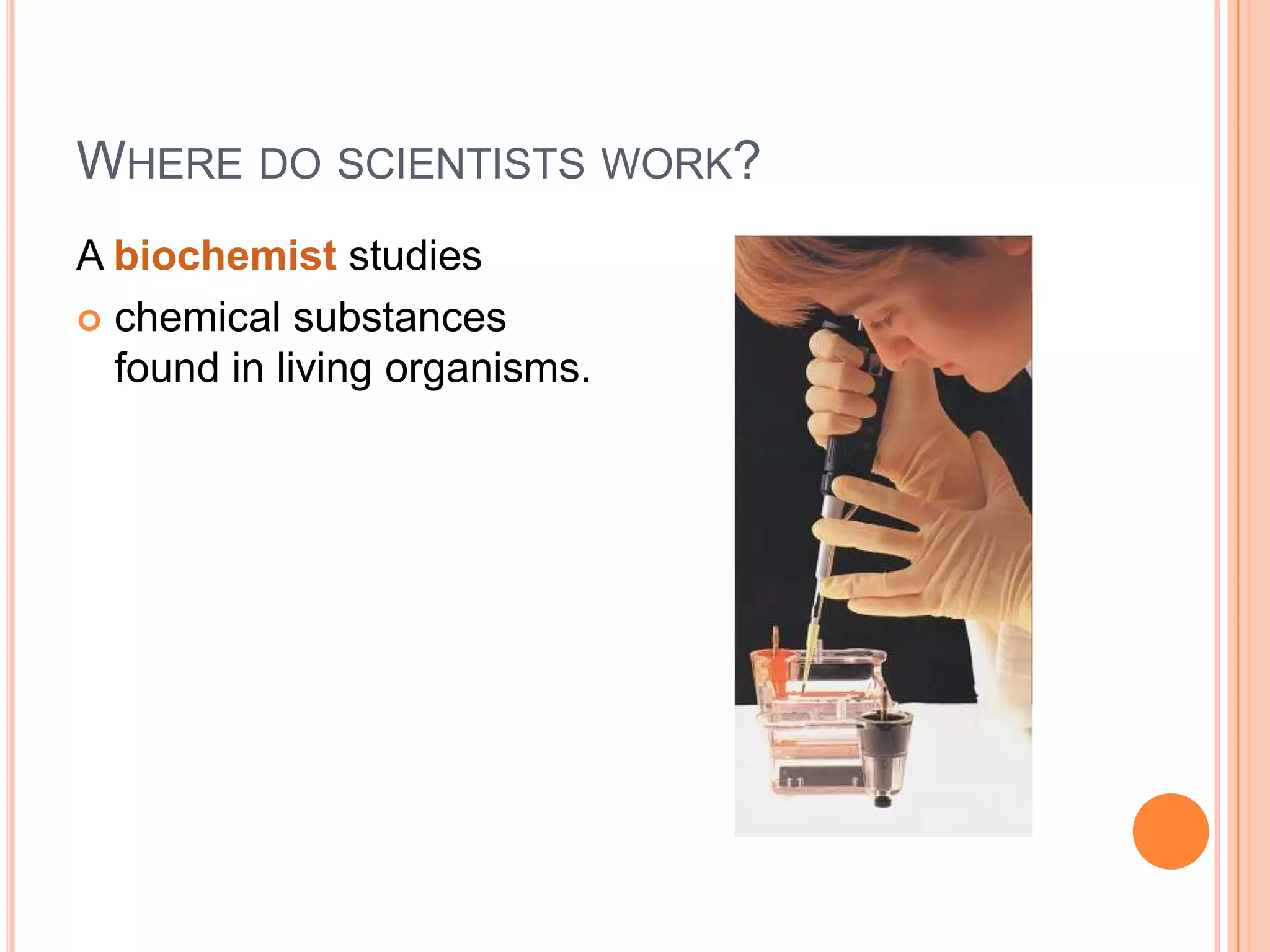
A biochemist studies
 chemical substances
found in living organisms.
WHERE DO SCIENTISTS WORK?
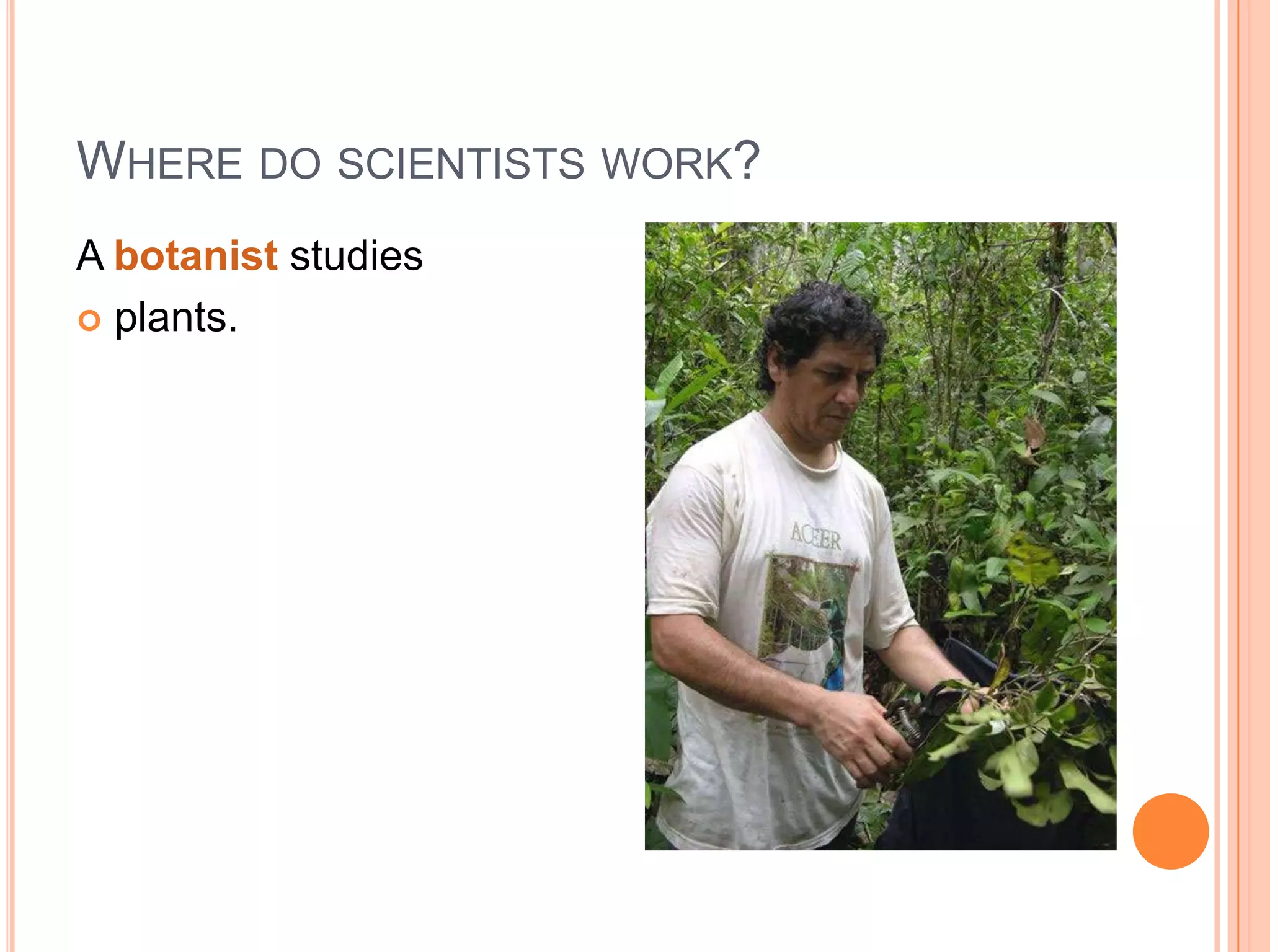
A botanist studies
 plants.
WHERE DO SCIENTISTS WORK?
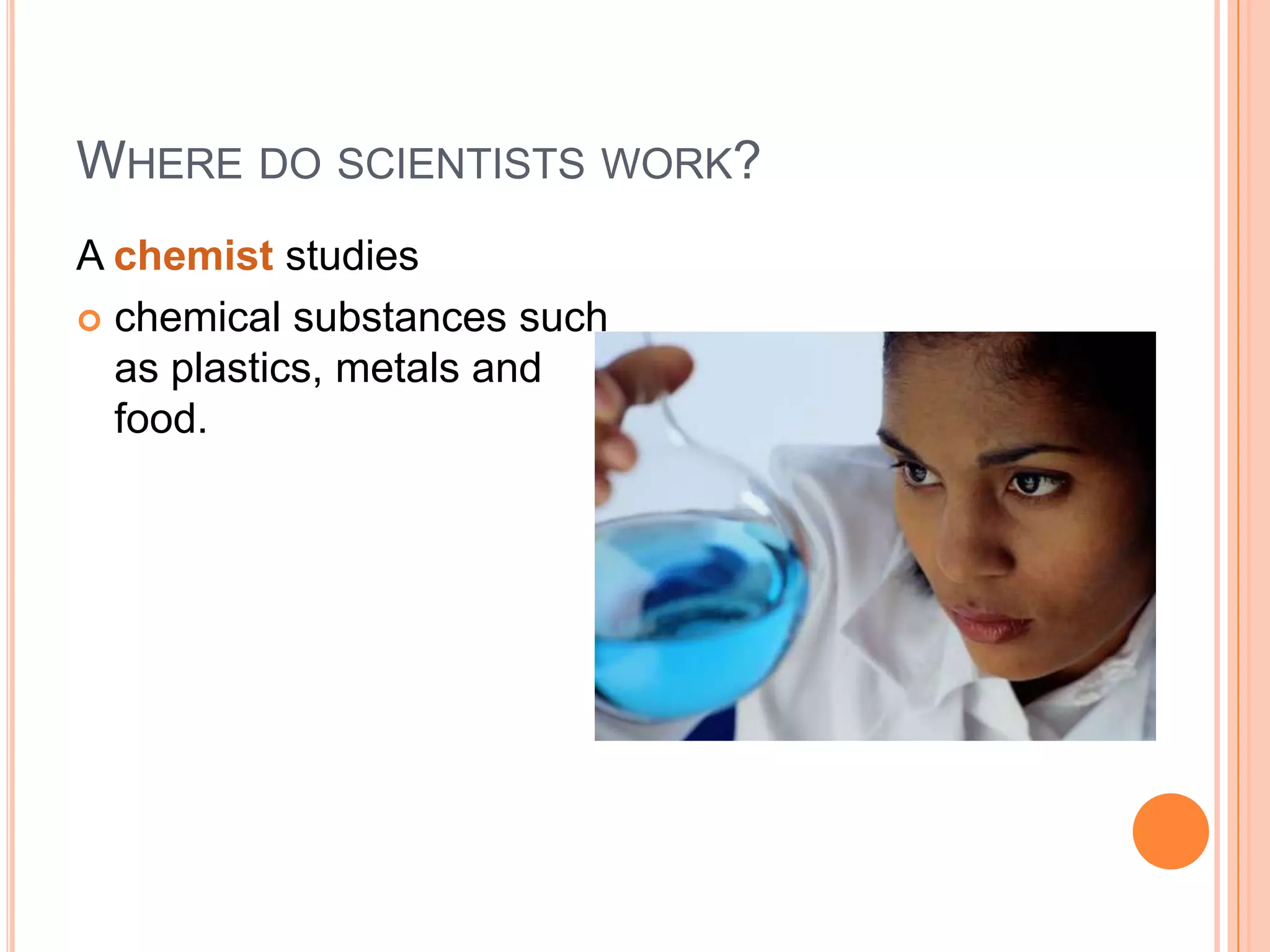
A chemist studies
 chemical substances such
as plastics, metals and
food.
WHERE DO SCIENTISTS WORK?
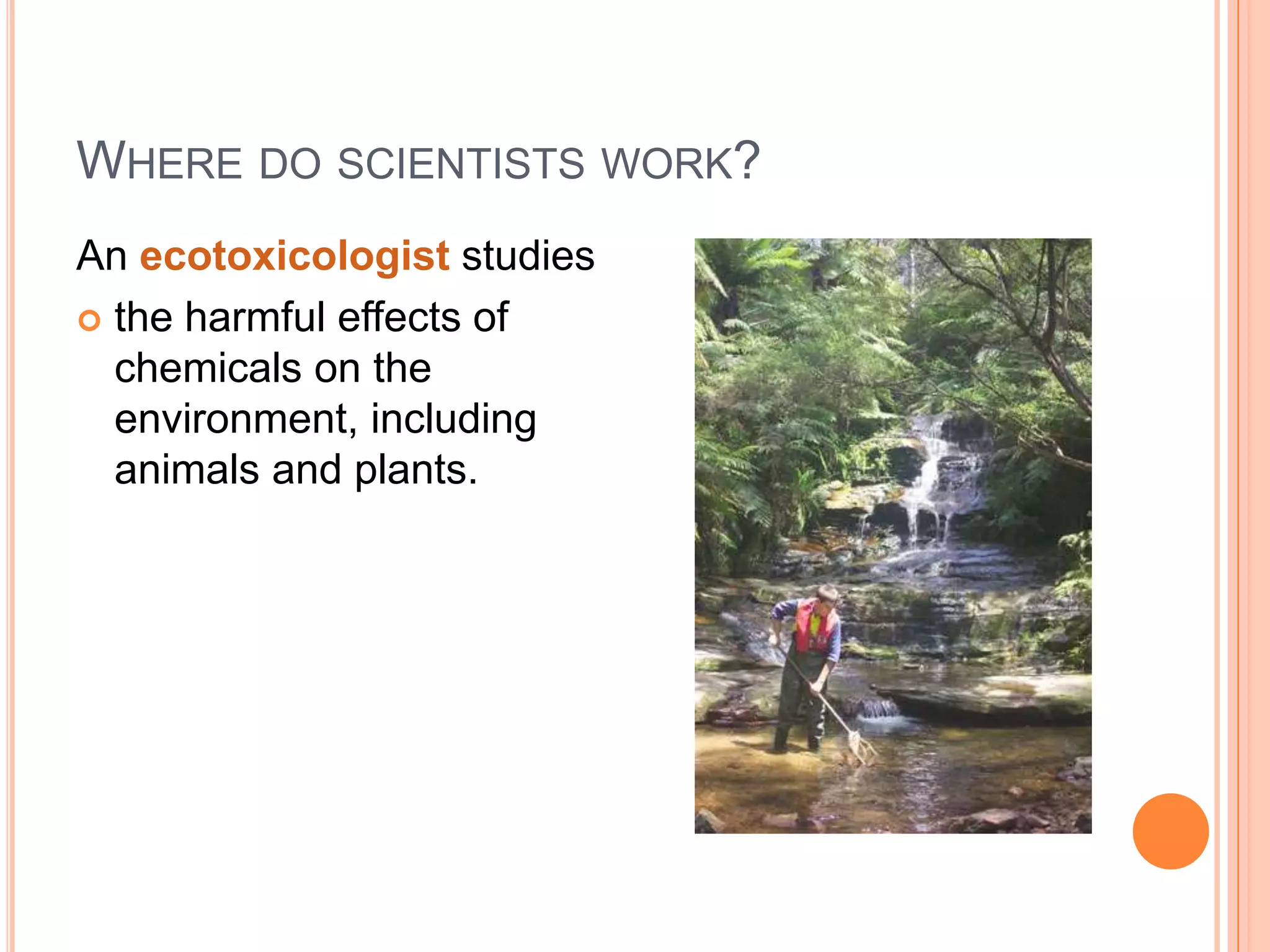
An ecotoxicologist studies
 the harmful effects of
chemicals on the
environment, including
animals and plants.
WHERE DO SCIENTISTS WORK?
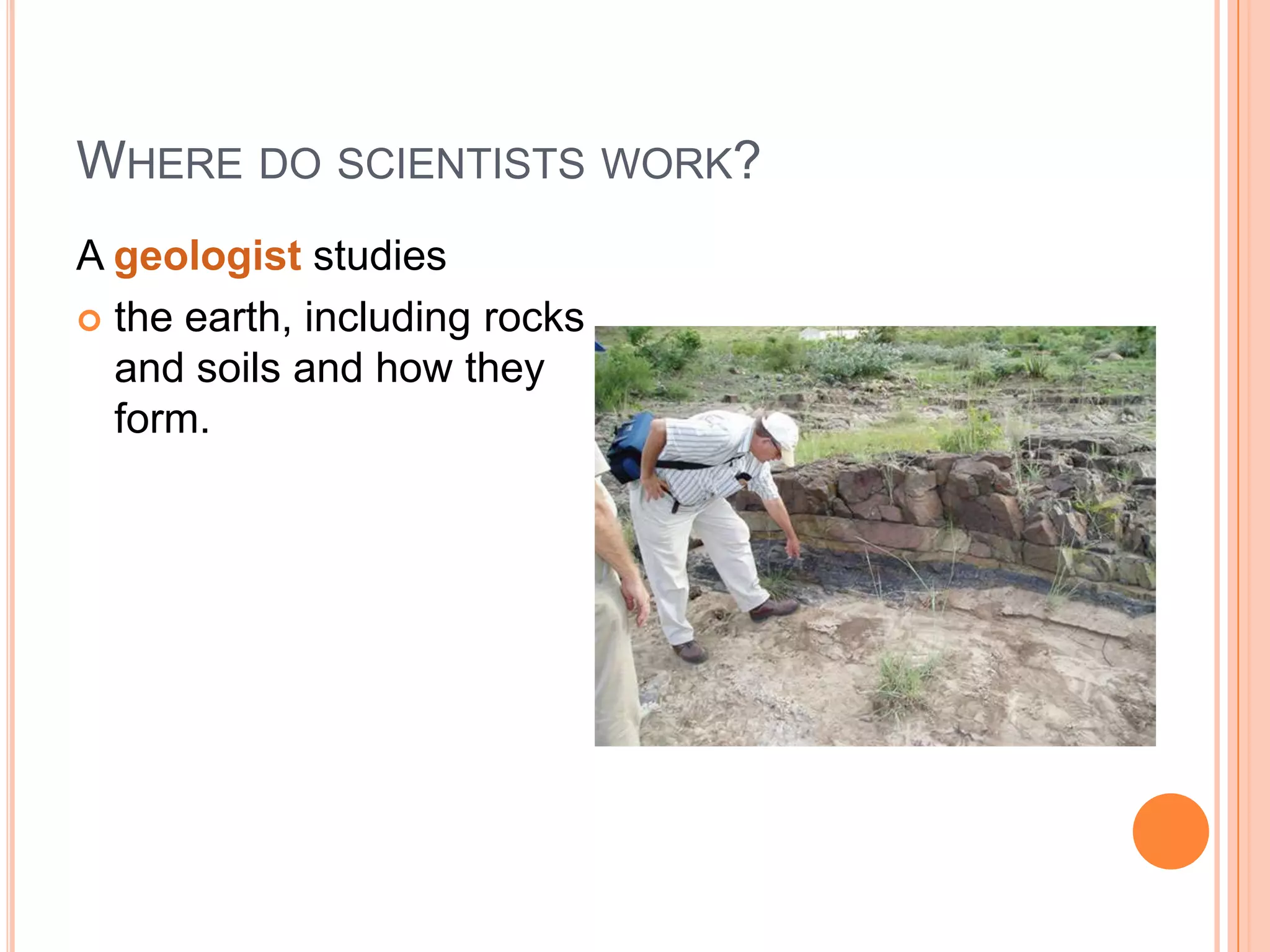
A geologist studies
 the earth, including rocks
and soils and how they
form.
WHERE DO SCIENTISTS WORK?
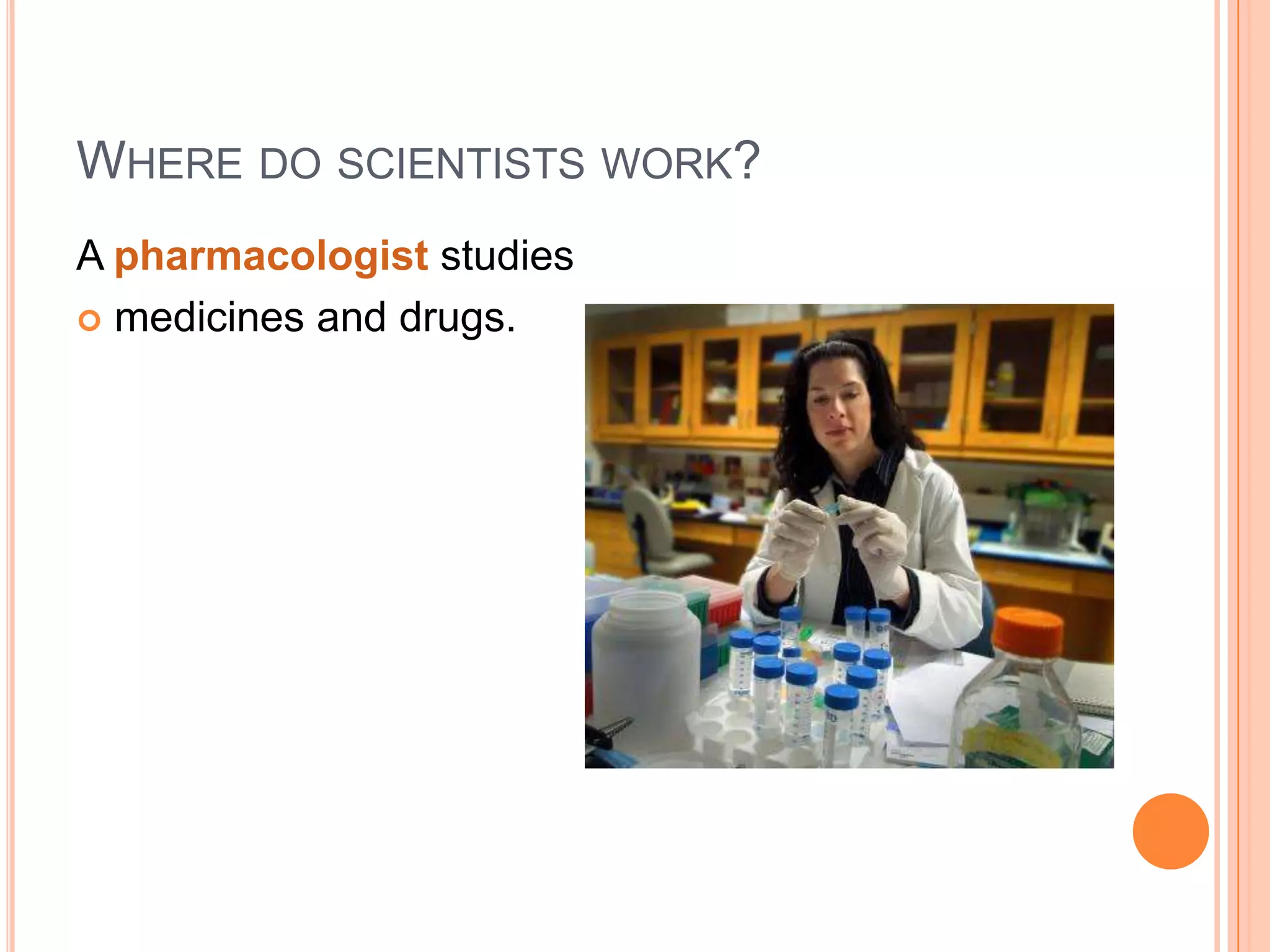
A pharmacologist studies
 medicines and drugs.
WHERE DO SCIENTISTS WORK?
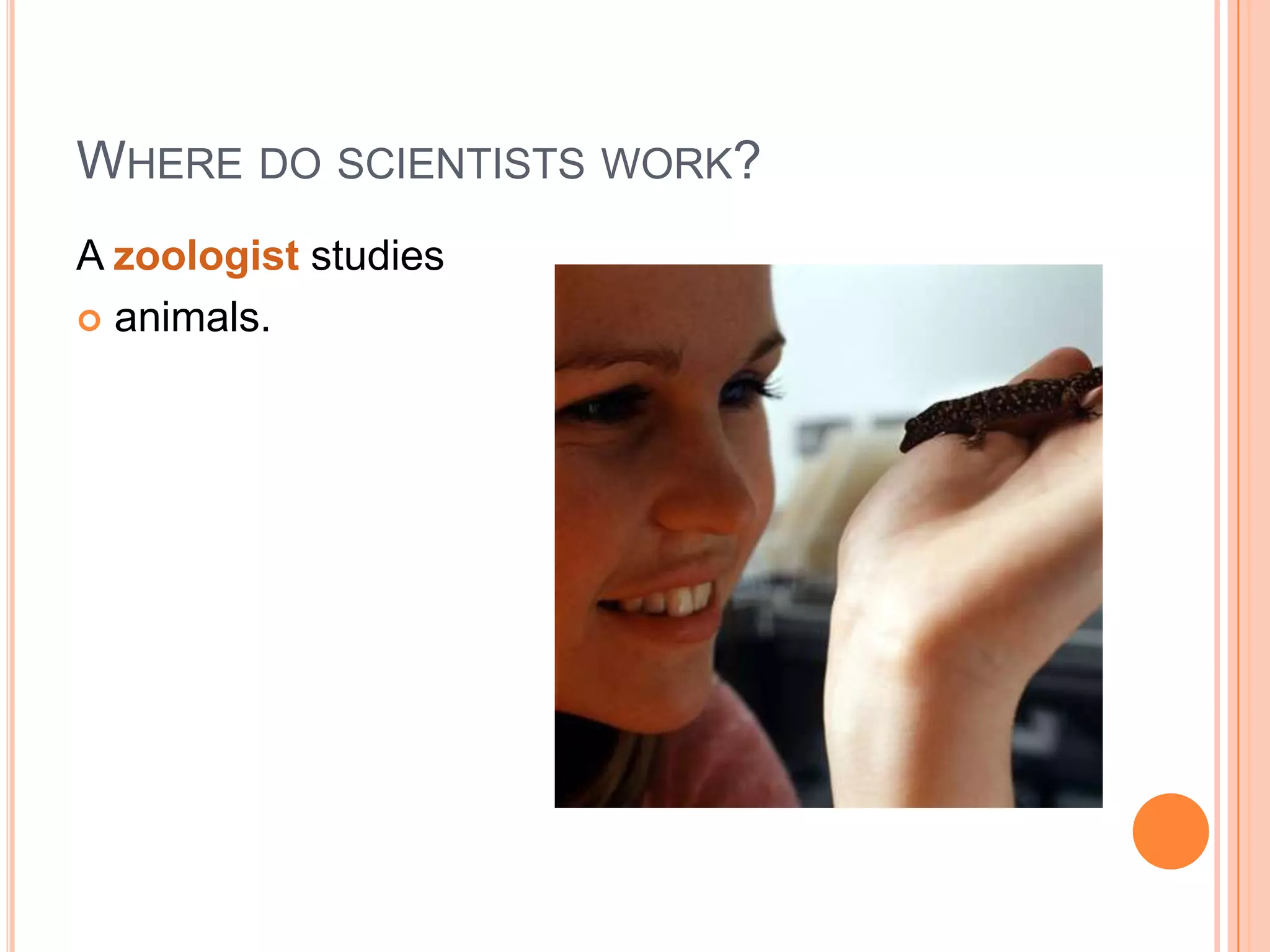
A zoologist studies
 animals.
WHAT IS NOT SCIENCE?
Studies that are not based on the scientific method (yet
are claimed to be scientific) are called pseudoscience.


i.e. they make claims that are not testable.

Pseudoscience is often seen in advertising.
WHAT IS SCIENCE?
Can students be scientists?

Yes we can!
http://sickscience7.wikispaces.com/

What is Science?

  • 1.
    WHAT IS SCIENCE? IanAnderson Saint Ignatius College Geelong
  • 2.
    WHAT IS SCIENCE? Somedefinitions.  “Science (from the Latin scientia, meaning „knowledge‟ or „knowing‟) is the effort to discover, and increase human understanding of how the physical world works.” (from Wikipedia)  “Any system of knowledge that is concerned with the physical world and its phenomena and that entails unbiased observations and systematic experimentation.” (from Encyclopaedia Britannica)
  • 3.
    WHAT IS SCIENCE? Arethese definitions confusing?
  • 4.
    WHAT IS SCIENCE? Wanta simpler definition?
  • 5.
    WHAT IS SCIENCE? “Scienceis the knowledge gained from using observations and experiments to describe and explain the world around us.”
  • 6.
    WHAT IS SCIENCE? Howdoes Science differ from other fields of study? “Science is the knowledge gained from using observations and experiments to describe and explain the world around us.”
  • 7.
    WHAT IS SCIENCE? Howdoes Science differ from other fields of study? “Science is the knowledge gained from using observations and experiments to describe and explain the world around us.”
  • 8.
    WHAT IS SCIENCE? Allscientists observe things, try to explain their observations and then conduct experiments to test their ideas. This process is known as the scientific method.
  • 9.
    WHAT IS SCIENCE? Scientificmethod. A way to solve a problem. Make an observation Develop an idea about why it happens Modify ideas if predictions were wrong Observe what actually happens Think of experiments to test the ideas Predict what will happen in the experiments
  • 10.
    OBSERVATION  Observation is oneof the most important tools for a scientist.
  • 12.
    WHAT DID YOUOBSERVE? 1. 2. 3. What was the time? What was the date? Describe the person at the front of the queue: a) b) c) d) Was it a man or woman? Was he or she tall or short? Was he or she fat or thin? What was he or she doing with their hands? (Source: Science Quest 1 Student Workbook)
  • 13.
  • 14.
  • 15.
    Describe the personat the front of the queue:
  • 16.
    WHAT IS ASCIENTIST? A scientist is a person who experiments in order to learn.
  • 17.
    WHERE DO SCIENTISTSWORK? There are many different types of scientists.
  • 18.
    WHERE DO SCIENTISTSWORK? An astronomer studies  stars, planets and other objects in the universe.
  • 19.
    WHERE DO SCIENTISTSWORK? A biochemist studies  chemical substances found in living organisms.
  • 20.
    WHERE DO SCIENTISTSWORK? A botanist studies  plants.
  • 21.
    WHERE DO SCIENTISTSWORK? A chemist studies  chemical substances such as plastics, metals and food.
  • 22.
    WHERE DO SCIENTISTSWORK? An ecotoxicologist studies  the harmful effects of chemicals on the environment, including animals and plants.
  • 23.
    WHERE DO SCIENTISTSWORK? A geologist studies  the earth, including rocks and soils and how they form.
  • 24.
    WHERE DO SCIENTISTSWORK? A pharmacologist studies  medicines and drugs.
  • 25.
    WHERE DO SCIENTISTSWORK? A zoologist studies  animals.
  • 26.
    WHAT IS NOTSCIENCE? Studies that are not based on the scientific method (yet are claimed to be scientific) are called pseudoscience.  i.e. they make claims that are not testable. Pseudoscience is often seen in advertising.
  • 27.
    WHAT IS SCIENCE? Canstudents be scientists? Yes we can!
  • 28.