Engage - Sharepredictions and prior knowledge
Answer the following question:
- What makes Science, Technology and Society
interrelated?
4.
ENGAGE - Readthe lesson targets
At the end of the lesson, you will be able to:
• Discuss the general concepts of science and
technology.
- Discuss the nature of science and how science is
done; and
- Define technology and its relationship to science.
5.
EXPLORE - Explorethe concepts and learn
SCIENCE
● any system of knowledge that is concerned with the
physical world and its phenomena and that entails
unbiased observations and systematic
experimentation.
● involves a pursuit of knowledge covering general
truths or the operations of fundamental laws.
- https://www.britannica.com/science/science
6.
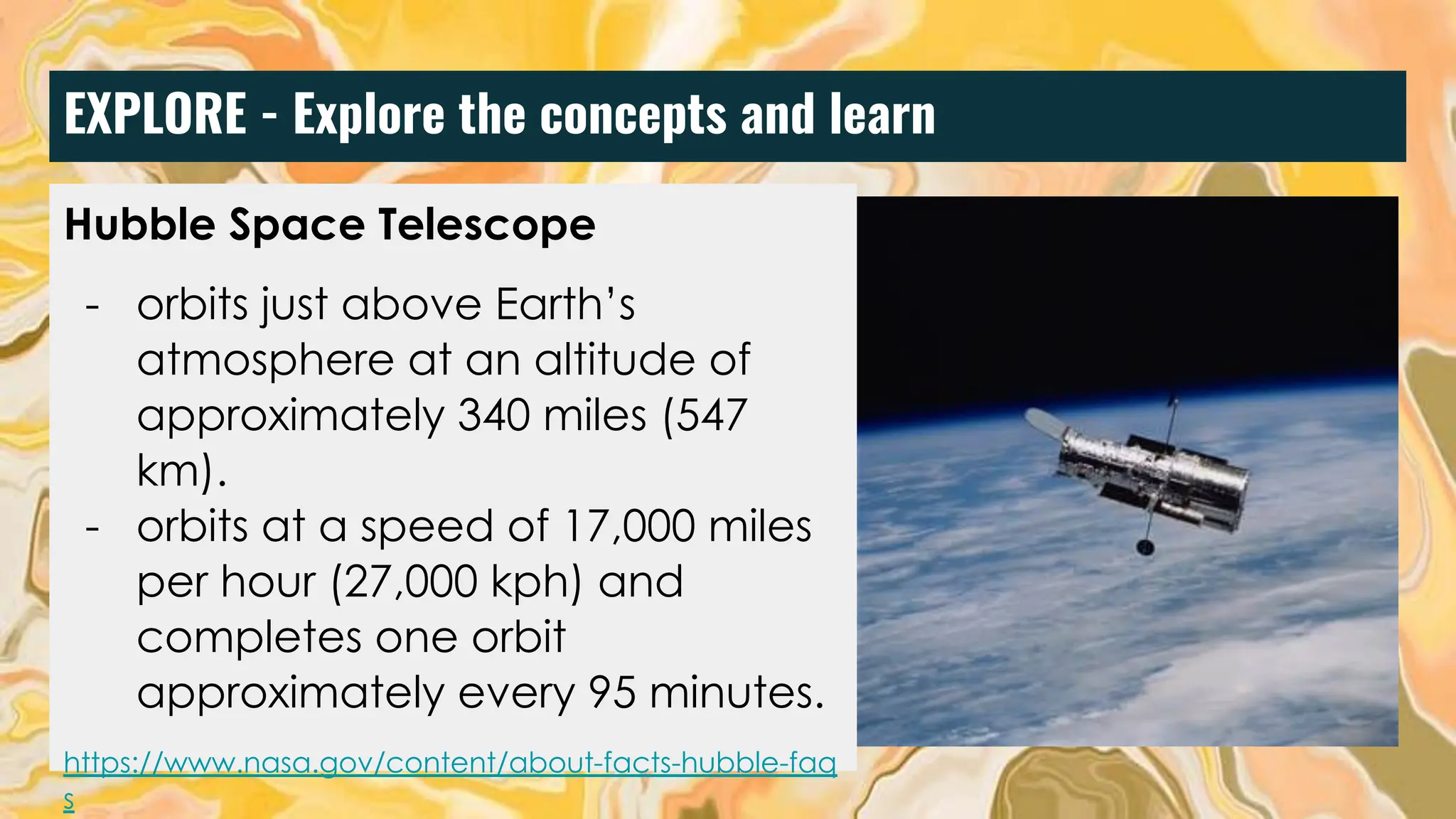
EXPLORE - Explorethe concepts and learn
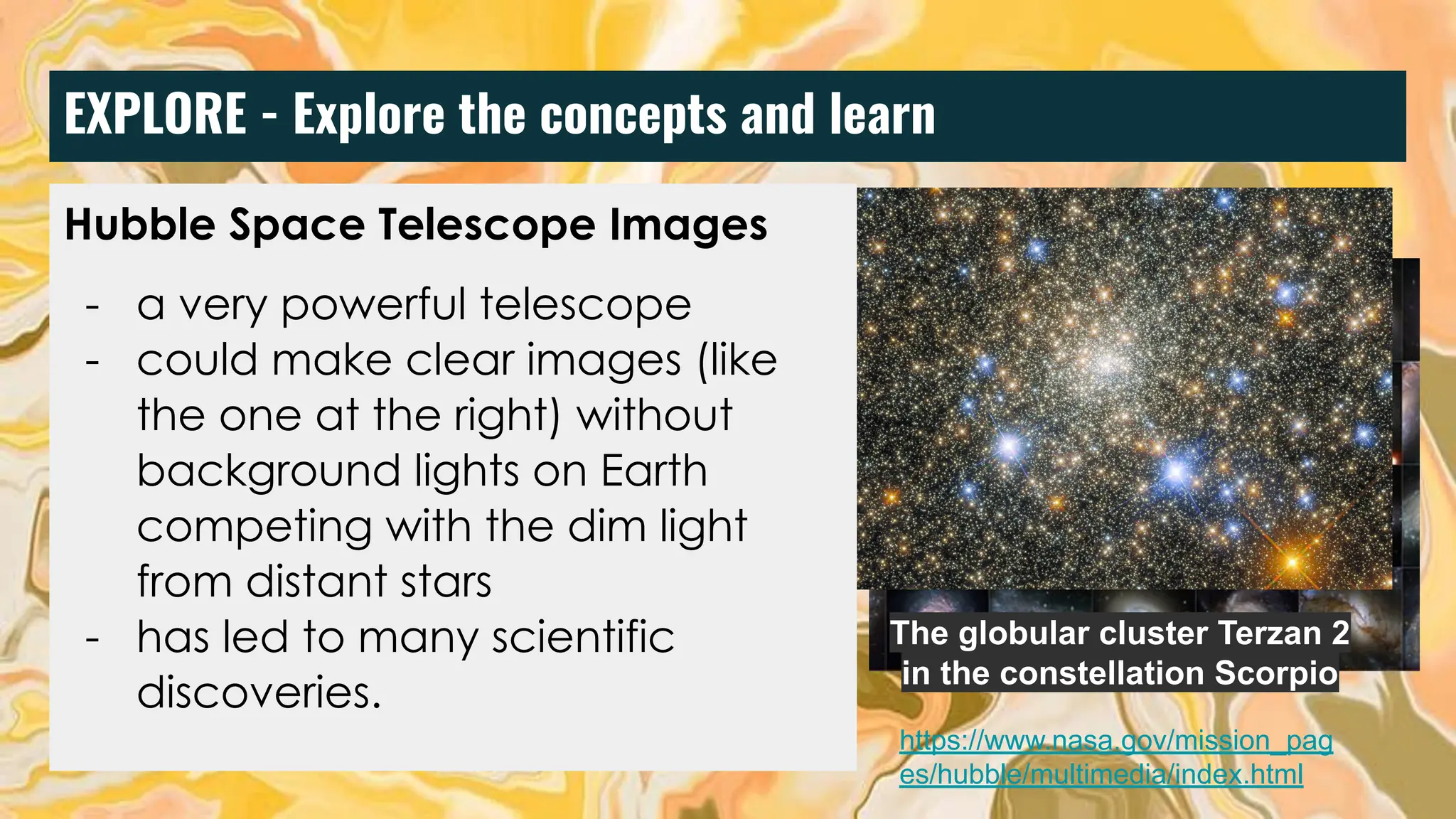
SCIENCE
● Science encompasses the systematic study of the
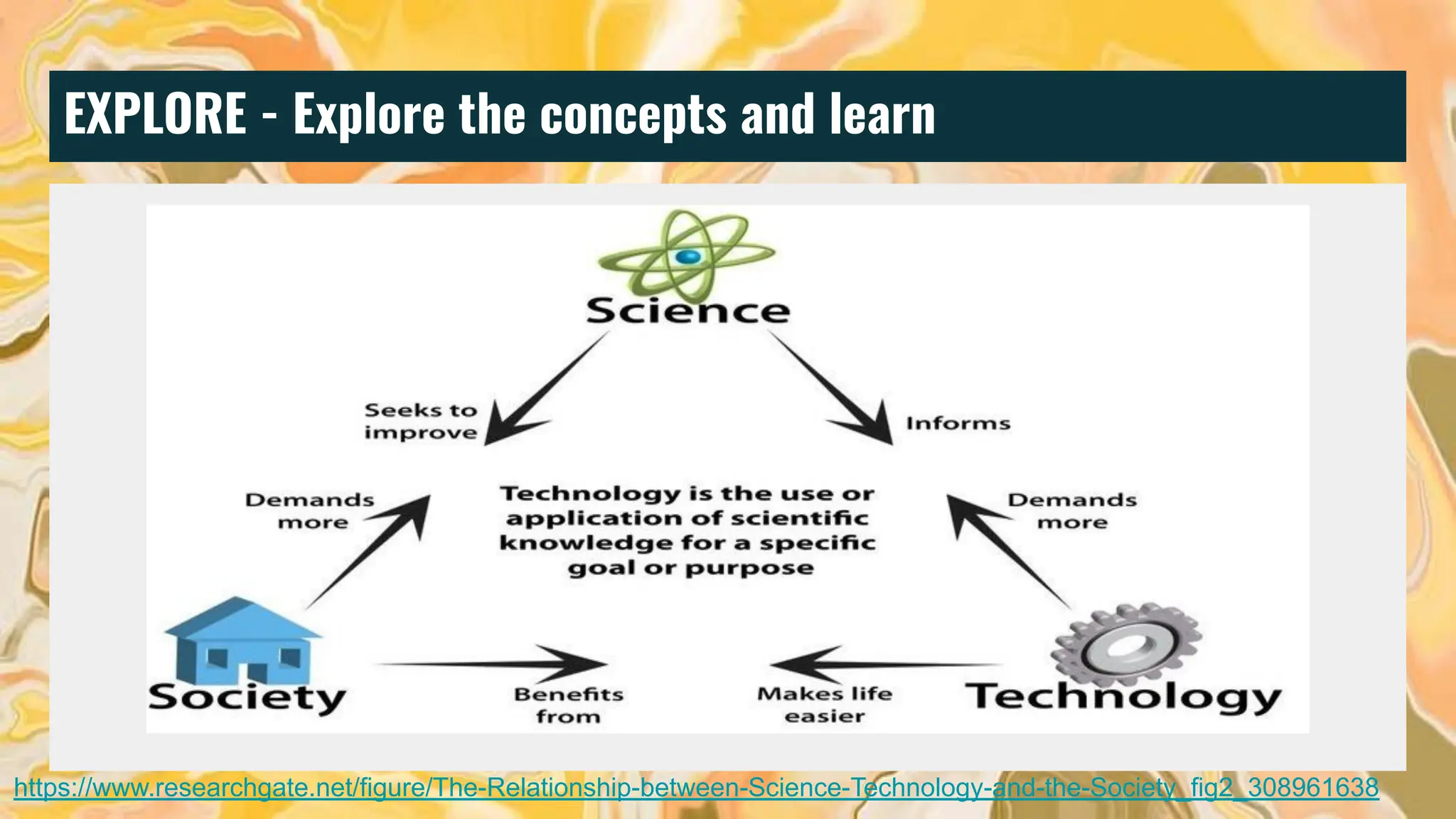
structure and behaviour of the physical and natural
world through observation and experiment.
- https://www.britannica.com/science/science
7.
EXPLORE - Explorethe concepts and learn
SCIENCE
● Watch the 5-minute video on the Nature of Science
and share a THREE-SENTENCE insight about the video:
○ https://youtu.be/TkvjDZseD4k
8.
EXPLORE - Explorethe concepts and learn
NATURE OF SCIENCE
● The natural world can be understood through the
accumulation and evaluation of empirical evidence
(information gathered directly or indirectly through
observation or experimentation).
○ Problem: Declining fish populations and water quality issues in a
nearby river
○ Experimentation: Collect water samples from different points
along the river, measure parameters like pH, dissolved oxygen,
and levels of pollutants, collect fish specimens and analyze their
health, size, and reproductive status.
○ Conclusion: Pollution impacts the local fish population.
9.
EXPLORE - Explorethe concepts and learn
NATURE OF SCIENCE
● Science demands evidence - Scientific knowledge is
derived from a combination of observations and
inferences. Scientists utilize data to draw conclusions and
develop explanations for phenomena.
○ Investigating the Effectiveness of a New Drug, e.g.
COVID-19 drug - can be done through
experimentation on a large group of patients with the
disease-half of them will receive the new drug (the
experimental group), while the other half receives a
placebo (the control group without active treatment).
10.
EXPLORE - Explorethe concepts and learn
NATURE OF SCIENCE
● Science is a blend of logic and imagination. The
acquisition of scientific knowledge requires human
imagination, originality, and inference.
● Einstein's Theory of General Relativity, proposed in 1915, revolutionized our
understanding of gravity and the fabric of spacetime.
● Logic and Imagination - Einstein used mathematical rigor and logical reasoning
to formulate a new theory that could explain observed discrepancies in the orbit
of Mercury and the bending of light around massive objects. The 1919 solar
eclipse provided an opportunity to test one of Einstein's predictions: the bending
of light by the Sun's gravity. His thought experiment: "Elevator Thought
Experiment," where he imagined an astronaut in a falling elevator to illustrate the
equivalence between gravitational and inertial forces.
11.
EXPLORE - Explorethe concepts and learn
NATURE OF SCIENCE
● Scientific Knowledge is durable. Continually tested are
scientific concepts that can withstand the scrutiny of the
scientific community.
● Sir Isaac Newton's Laws of Motion, formulated in the late 17th
century which shows how scientific knowledge can be durable and
continue to be relevant even centuries after its discovery.
● Newton's First Law states that an object at rest will remain at rest,
and an object in motion will continue moving with a constant
velocity unless acted upon by an external force. This concept is still
central to our understanding of everyday motion and inertia, as well
as space travel and vehicle safety design.
12.
EXPLORE - Explorethe concepts and learn
NATURE OF SCIENCE
● Scientific ideas are subject to change. Scientific ideas are
subject to gradual refinement, but "the main body of
scientific knowledge is extremely stable and grows through
slow corrections and gradual expansion of its boundaries."
● The Geocentric vs. Heliocentric Model of the Solar System -For centuries, the
prevailing belief was that Earth was at the center of the universe, and all
celestial bodies, including the Sun and planets, revolved around it.
(Ptolemaic Model). In the early 16th century, Nicolaus Copernicus proposed
the heliocentric model, suggesting that the Sun was at the center of the
solar system and that planets, including Earth, orbited around it in elliptical
paths. This model offered simpler explanations for the observed motions of
planets and celestial events.
13.
EXPLORE - Explorethe concepts and learn
NATURE OF SCIENCE
● Scientists try to identify and avoid bias. In order to assure
the validity of results, scientists' objectivity must be
continually tested.
○ Clinical trials are essential for testing the safety and efficacy of new
drugs before they're approved for public use. Biases, whether conscious
or unconscious, can significantly impact the results of these trials,
leading to inaccurate conclusions and potentially unsafe medical
treatments. If participants in a clinical trial are not chosen randomly or
represent a specific group, the results may not be generalizable to the
wider population. To avoid bias, researchers use randomization to
assign participants to different groups (e.g., experimental and control)
to ensure that each group is representative of the broader population.
14.
EXPLORE - Explorethe concepts and learn
NATURE OF SCIENCE
● Science is a complex social activity. Social and
cultural factors influence scientific knowledge.
○ Traditional practices and cultural beliefs can shape
how scientific knowledge is applied and interpreted,
impacting areas like medicine, agriculture, and
conservation.
○ Public perception and cultural beliefs frequently
influence the social acceptance and implementation
of scientific knowledge.
15.
EXPLORE - Explorethe concepts and learn
THREE TO FLEE
● For us to proceed to the next topic, three students
will share your 1 takeaway each by answering the
following question:
○ What is the nature of science? Give one and
explain.
16.
EXPLORE - Explorethe concepts and learn
HOW SCIENCE IS DONE
● Scientific inquiry is a process of trying to explain
observations made of the natural world around us and
involves…
○ generation of theory (explanatory hypotheses or
predictions)
○ the collection of data through observation and/or
measurement
○ the analysis and interpretation of those data in an
attempt to answer an initial question
17.
EXPLORE - Explorethe concepts and learn
HOW SCIENCE IS DONE
● Scientific method - Scientists engage in a variety of these
practices routinely:
○ asking questions; hypothesizing; designing experiments;
making predictions; using apparatus; observing; measuring;
evaluating accuracy, prediction, and error; recording and
interpreting data; consulting data records; evaluating
evidence; verifying evidence; reacting to contradictory or
anomalous data; coordinating theory and evidence;
performing statistical calculations; and formulating and
revising models and theories.
18.
EXPLORE - Explorethe concepts and learn
What technology is
● Watch the 3-minute video on the nature of
technology, and share a THREE-SENTENCE insight
about the video:
● https://youtu.be/zmU9j0l9ORA
19.
EXPLORE - Explorethe concepts and learn
Science contributes to technology in at least 6 ways:
● new knowledge which serves as a direct source of ideas
for new technological possibilities;
● source of tools and techniques for more efficient
engineering design and a knowledge base for evaluation
of feasibility of designs
● research instrumentation, laboratory techniques and
analytical methods used in research that eventually find
their way into design or industrial practices, often through
intermediate disciplines;
20.
EXPLORE - Explorethe concepts and learn
Science contributes to technology in at least 6 ways:
● practice of research as a source for development and
assimilation of new human skills and capabilities eventually
useful for technology;
● creation of a knowledge base that becomes increasingly
important in the assessment of technology in terms of its
wider social and environmental impacts;
● knowledge base that enables more efficient strategies of
applied research, development, and refinement of new
technologies.
21.
EXPLORE - Explorethe concepts and learn
Technology impacts science …
● through providing a fertile source of novel scientific
questions and thereby also helping to justify the
allocation of resources needed to address these
questions in an efficient and timely manner, extending
the agenda of science (technological advancements,
such as genomic sequencing, have profoundly
impacted evolutionary biology by generating a fertile
source of novel scientific questions).;
Brooks, Harvey. “The Relationship Between Science and Technology.” Research Policy, vol. 23. (1994): 477-486 .
22.
EXPLORE - Explorethe concepts and learn
Technology impacts science …
● as a source of otherwise unavailable instrumentation
and techniques needed to address novel and more
difficult scientific questions more efficiently.
Brooks, Harvey. “The Relationship Between Science and Technology.” Research Policy, vol. 23. (1994): 477-486
.
23.
EXPLORE - Explorethe concepts and learn
Hubble Space Telescope
- orbits just above Earth’s
atmosphere at an altitude of
approximately 340 miles (547
km).
- orbits at a speed of 17,000 miles
per hour (27,000 kph) and
completes one orbit
approximately every 95 minutes.
https://www.nasa.gov/content/about-facts-hubble-faq
s
24.
EXPLORE - Explorethe concepts and learn
Hubble Space Telescope Images
- a very powerful telescope
- could make clear images (like
the one at the right) without
background lights on Earth
competing with the dim light
from distant stars
- has led to many scientific
discoveries.
The globular cluster Terzan 2
in the constellation Scorpio
https://www.nasa.gov/mission_pag
es/hubble/multimedia/index.html
25.
EXPLORE - Explorethe concepts and learn
In the Hubble Space Telescope, science and technology
are related…
- Scientific knowledge is used to create new
technologies such as the space telescope.
- New technologies (such as the space telescope)
often allow scientists to explore nature in new ways.
- Science uses technology to make new discoveries
(stars, galaxies, blackholes, etc).
- Technology uses science to solve problems.
26.
EXPLORE - Explorethe concepts and learn
https://www.researchgate.net/figure/The-Relationship-between-Science-Technology-and-the-Society_fig2_308961638
27.
EXPLAIN - ConceptConstruction
● Discuss the nature of science in five sentences.
● Discuss how science is done in five sentences.
● Based on the nature of science, discuss what science
is not in 2 sentences.
● Define what technology is and its relation to science.
● In no more than 5 sentences, discuss the nature of
science.
● In no more than 2 sentences, discuss how science is
done.
● Define technology and its relationship to science in
no more than three sentences.
28.
ELABORATE - Applyknowledge in new contexts (THINK, PAIR AND SHARE)
● Based on the nature of science, discuss what science
is not in 3 sentences.
● Explain how the relationship between science and
technology is illustrated in the microscope. How did
the invention of the microscope help science
advance? Cite examples.
● Give 2 examples of scientific discoveries made
possible by a particular technology. Name the
technology.
29.
EVALUATE- Assessment ofLearning
● Discuss the nature of science in five sentences.
● Discuss how science is done in five sentences.
● Based on the nature of science, discuss what science
is not in 2 sentences.
● Define what technology is and its relation to science.
● In no more than 5 sentences, discuss the nature of
science.
● In no more than 2 sentences, discuss how science is
done.
● In no more than three sentences, define technology
and its relationship to science.